You are currently logged-out. You can log-in or create an account to save favorites and more. more info
Spirit-Led Living in Liturgy
AI Suggested Keywords:
Talk at Mt. Saviour
The talk explores the concept of spirituality, emphasizing the life lived in the Spirit and rooted in the teachings of St. Paul. It discusses living a Christian life through the lens of liturgy, spirituality grounded in the sacraments, and integration into daily life. The speaker highlights historical movements within monastic communities and broader ecclesiastical settings that shaped contemporary Christian liturgical practices. Additionally, the talk underlines the importance of communal and personal aspects of spiritual life, emphasizing the inclusivity and accessibility of the liturgy.
Referenced Texts and Their Relevance:
- 1 Corinthians 2:6-16: Discusses God's hidden wisdom and spiritual life through the Spirit, illustrating the Christian life as one led by spiritual insight rather than worldly wisdom.
- Romans 8:14: Emphasizes the transformation into children of God through the guidance of the Spirit, reinforcing the identity and freedom gained in the Spirit.
- Galatians 5:16-24: Highlights living by the Spirit to cultivate virtues and resist lower desires, presenting a model for ethical and spiritual conduct.
- Ephesians 1:17; 3:16-19: Encourages spiritual wisdom and deep understanding of God's power, indicating prayer's role in enlightening believers.
- Philippians 3:7-15: The Apostle Paul's perspective on losing everything for the sake of knowing Christ, framing spirituality as an ongoing transformative journey.
- Gaudium et Spes: Vatican II's emphasis on living a Christian life within the modern world, integrating faith with daily secular activities.
Works and Figures Highlighted:
- Romano Guardini's "The Spirit of the Liturgy": Introduced the concept of liturgy being filled with intrinsic meaning despite its outward simplicity, influencing contemporary liturgical movements.
- Liturgical Movement Figures: Notable contributors like Pius X, Marie-Alain Couturier, and Lambert Baudoin are credited for their roles in shaping modern liturgical practices.
- "La Vie Liturgique" by Don Maurice Festusier: A transformative work advocating for a life interwoven with liturgical practices, influencing subsequent Christian thought.
- Objective Piety and Otto Kassel: Presented as essential in understanding communal worship and personal spirituality within a liturgical context, particularly within monasteries.
Through these references, the talk emphasizes an integrated liturgical spirituality, balancing tradition with personal and communal aspects of faith.
AI Suggested Title: Spirit-Led Living in Liturgy
AI Vision - Possible Values from Photos:
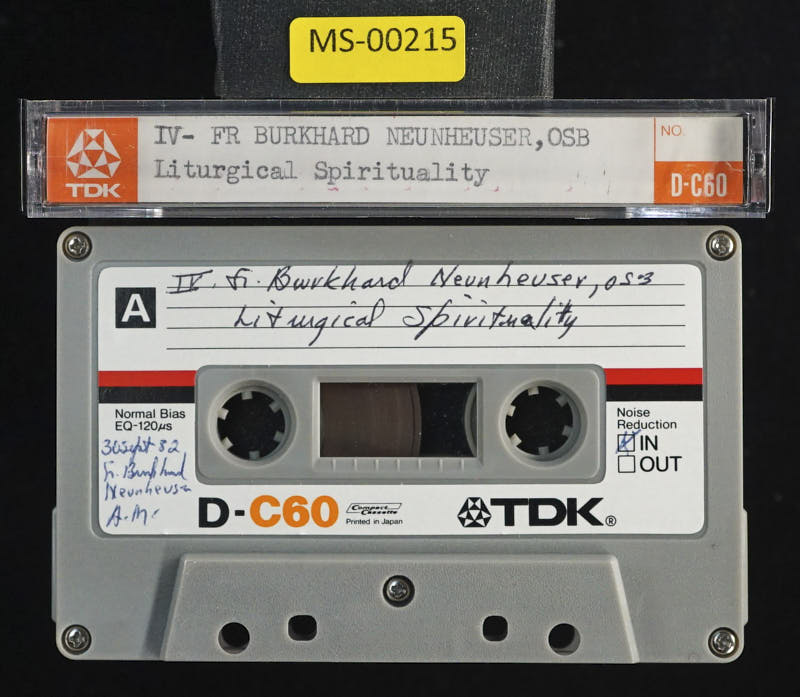
Speaker: FR BURKHARD NEUNHEUSER, OSB
Possible Title: Liturgical Spirituality
Additional text: IV
@AI-Vision_v002
So, for my dear confrères, I try to speak to you again. And the topic of this morning would be liturgical spirituality. And you can speak about it. It would be necessary to speak first, shortly, about spirituality in general. It's a term which means this our life, how do you say in English, in Greek, and pneumati. in the ploy, how do you pronounce it? In the ployma, in the ployma. And our entire life must be alive in the ployma, in the Holy Spirit given to us by our Lord Jesus Christ. And I like it very much to describe this life in the spirit, the life of the man in spirit with some texts of the letters of St. Paul.
[01:01]
For example, 1 Corinthians 2, 16. I do speak words of wisdom to those who are ripe for it. Not the wisdom belonging to this pacing age. I speak God's hidden wisdom, his secret purpose, framed from the very beginning to bring us to our full glory. things beyond our seeing, things beyond our hearing, things beyond our imagining, all prepared by God for those who love him. It is that God has revealed to us through the Spirit. For the Spirit explores everything, even the depths of God's own nature. Only the Spirit of God knows what God is. This is the spirit that we have received from God and not the spirit of the world so that we may know all that God of his own grace has given us.
[02:15]
And because we are interpreting spiritual truths to those who have the spirit, we speak of these gifts of God in words found for us not by our human wisdom but by the spirit. A man who is unspiritual refuses what belongs to the Spirit of God. A man gifted with the Spirit can judge the worth of everything, but is not himself subject to judgment, etc. Wonderful vision of the man who lives in the virtue, in the force, in the light of the Spirit. And then again to the Romans 8, 14. For all who are moved by the Spirit of God are sons of God. The Spirit you have received is not the Spirit of slavery, leading you back into a life of fear, but the Spirit that makes us sons, enabling us to cry, Abba, Father, and so on.
[03:18]
And again, in Galatians 5, 16 to 5, 16, 24. If you are guided by the Spirit, you will not fulfill the desires of your lower nature. And then the next, all that is following, not the works of the flesh, but the harvest of the Spirit is love, joy, peace, patience, kindness, goodness, fidelity, gentleness, and self-control. There is no law dealing with such things as these. And to those who belong to Christ Jesus, it crucifies the law of nature with his passions and desires. If the Spirit is the source of our life, let the Spirit also direct our course. Some texts of the apostles who show us the greatness of the Christian life
[04:27]
that is, a life in the Spirit. A Christian life authentically exercised through Christ in the Spirit, according to the overword of the Apostle to the Ephesians 1.17 and the following. I never cease to give thanks for you when I mention you in my prayers. I pray that the God of our Lord Jesus Christ, the All-Glorious Father, may give us the spiritual powers of wisdom and vision, by which there comes the knowledge of him. I pray that your inward eyes may be illuminate, so that you may know what is the hope to which he calls you, what wealth and glory of the share he offers you among his people in their heritage, and how vast the resource of his power opened to us who trust in him. In Greek, all this is, I would say, more marvelous.
[05:29]
We must know in the spirit what is our hope and how great is the heritage given to us and how great is the power of God exercised in us who believe the same power which he exercised first in Christ Jesus, resuscitating him from the death, and the same power is now walking in us, and in the spirit we must know this reality. And still, the wonderful text to the Ephesians 3, 16 until 19, that the Lord of glory may give us that we, that we may be strengthened, powerfully by the Spirit of God in interior and hominem, in our inner man, so that Christ may live in us by faith and we can understand the dimensions of the work of Christ and understand this love which is the source of this work of redemption, which is greater than ever the human shines, and so on.
[06:53]
Therefore, so more or less, we could describe our life in the spirit. But now we try to live this life helped or founded in liturgy. And we do this. We see our spirituality, our Christian existence as an existence in the spirit. We do it in the atmosphere. in the mentality, in the dimensions of the modern liturgical movement, as it was seen especially by the Benedictine monks. Solheim first, and also Solheim, according to Bouye and his terrible judgment in liturgical piety, has some limits. Nevertheless, in a certain way, we are thanking all what we have now to guarantee and the old Solemn. And Beuron, in its way, tried to continue it.
[07:59]
And then here, Bouillier perhaps is right, one of the Beuronese monks, monk of Mont César in Louvain, then has given new vitality to all this tendency, L'Homme de Beauvoir, the founder of Servetonieux. But the monk of Mont César, therefore of the congregation of Beuron in that time, And what he has seen, especially in his famous Congress of Marlin in 1909, was then explained in a very polemical way, which was nearby a revolution by a monk of Maretsu, again in the congregation of Beuron, Don Maurice Festugier, in his excellent little pamphlet, little booklet, the liturgical life and this book and his vision of an entire life, entire Christian life, entire spiritual life conducted in the dimension of the liturgy has made nearly a revolution especially in that people which was until now never living in its spirituality according to the liturgy, the Jesuits
[09:21]
of the 19th century. Therefore, the reaction of the Jesuits has been terrible. So that in a certain moment, everyone was feeling that the entire war would be destroyed, would be finished and forbidden by Rome. Only the war, in a certain way, has finished these troubles. The first war of 1914. But nevertheless, Lombard-Baudouin has given already a certain synthesis, peaceful synthesis of all these things in his little very fine book, La Pietie de Deblise, The Piety of the Church. And then in our way, we in Maria Lark tried to continue it, 1913, 1914, in the first great liturgical week, the Holy Week. with the academical young people of Germany under the direction of Abad Ildefons Herrwegen.
[10:26]
And then Kassel, Otto Kassel, in his way was the monk of my monastery, who then in a very special way has shown us the dimension of this liturgical life or this spiritual life conducted on the fundamentals of liturgy. And now, after this short introduction, to show you, to remember you shortly only, the dimension of a Christian life, which is a life in the spirit, and then the historical events in the first 20 years of this century, I wish to show shortly the concrete realization of such a spiritual life, founded explicitly on the work of salvation done by Christ our Lord, founded in the work of his entire mystery, his Pascal mystery, realized now and given present to us in the sacraments, in the word of God, in a prayer life,
[11:44]
according to the daily hours. So that finally, after such a foundation on the work of Christ, given as presently in the liturgy, our life totally would be alive in Christ Jesus. It's nothing extraordinary. It's a normal Catholic, a normal Christian ideal. Nevertheless, this life in Christ Jesus This life in the spirit, this spiritual life explicitly founded in liturgy. Eucharistic celebration in the daily hours, in the liturgical week, in the Sunday, in the liturgical year. Therefore, we are beginning with our foundation, the foundation of a faithful life in the sacrament of initiation. And these sacraments of initiation has given us in the beginning of our life, our foundation in death and resurrection of the Lord, so that we are always that with Christ and resuscitated with him to a new life.
[12:59]
And therefore, able, capable to share actively in the Eucharist, in the sacrifice of our Lord. present in the Eucharistic celebration. And you can eat his flesh and blood so that we are really so every day again, every Sunday again, every year again in Christ, dying with him and living with him in the liturgical disposition of the day, the hours, the morning, the evening, and all the other hours. So that we, having celebrated our entire life founded in these liturgical celebrations, in initiation, weekly Eucharistic celebration, in the celebration of the liturgical year, and so on, are able to live really as Christians, in active Christian life, in virtue,
[14:13]
killing our old man with his egoism to love each another in the hope of the eschological fulfillment of all that and using to, in this scope, all the other sacraments, penance, because we are so feeble and always are sinning again in the hope of mercy of God in the last, not the last, in the sacred action which is helping us When we are sick, we can suffer together with Christ. In the ordination, where we are called to serve the people of God, to live really in Christ. And also in Mary's age, where people are called to do these human duties, but in Christ, so that men and women together united are living in Christ, representing the church. Or, in the overvocation, in virginity, where we are, in another way, trying to realize the existence of human life in Christ.
[15:23]
And the Vatican Council shows the last intention of this life founded in Christ in its constitution, the Mundo It is not enough to pray. It is not enough to celebrate liturgy. We must also conduct this life in the Spirit, this life in Christ, in the daily life, in our work life, in our political life, so that the entire world would be consecrated, existing always in Christ. More or less, I would say there is nothing new. It's a normal Christian ideal. And nevertheless, the intention of the modern liturgical movement, with Pius X, with Scholeman Beurum, with Lombard Brun, with Maria Lack, and Otto Kassel, finally has shown this Christian ideal founded explicitly in
[16:37]
liturgical actions where we are touching Christ. In the liturgical movement, we have seen in a new way the wonderful reality in which the word of Christ to redeem us is present to us, that we can share in it, that we can every day again die with Christ and live with him in the hope of eternal consummation of all. And so, in this way, we gather together a church around the altar. Therefore, we don't live only as Christian individuals, but in this liturgical spirituality, in this Christian life founded in liturgy, we must stay together, united every day again or every Sunday again. is church around the altar, being the body of Christ in this world, ready to realize that in every day, in a communitarian way, not only theoretically, we are the church when we are gathered together around the altar to celebrate liturgy, to celebrate Eucharist, but we must also do it really staying together, according to this wonderful word,
[18:07]
which was the chapter at once in the sixth, every day. Can we translate it? We must bear the burden each another. And so we fulfill the law of Christ. That is all. And we know how it is difficult. Every day again, together. Everyone is an individuality. Nevertheless, we must stay together and overcome the difficulties which are given in us. And so really, being the church in daily life, it would be the first point. Common Italian. And again, I could give some citation from St. Paul to the Ephesians to... 11 to 22. There is a moment.
[19:17]
Ah, 2, [...] 11. No. Oh, it's too much to read entirely. He is telling the mystery of Christ. We, at once pagans, know we are in Christ to live his life. And then, after having exposed all these ideals of our new life given to us in Christ, in the church, being the church, the consequences of all this wonderful description of the mystery of Christ is... No, he is conjuring us, you must live according to the vocation in which you are called.
[20:23]
Humbly supporting each another, and ready to retain, to preserve the unity of the Spirit in the bounds of peace. That is all. To stay in one faith, in one Lord, in one baptism, in one God and the Father, in the unity, constructing the church, building the church every day again, the unity of all together in Christ, in the virtue of the Spirit. communitarian, staying together, building this burden, and so realizing the reality of Christian existence. But all that in classical forms. So for not in any way, but using the means given to us by the church, singing in sounds, hymns, in the orations, in the sacraments.
[21:32]
Here are the sources, the fundaments of our Christian existence, of our life in Christ, of our life in the Spirit, of our life as Church, to stay together, using these words, therefore, in an objective piety. We, in my monastery, in Maria Lange, we were very much insisting in it, and therefore, sometimes... We have been blamed. You wish to have a cold piety, objective piety. You don't like this devotion in which you are piously living. But that does not mean we can be very pious, very devoted. So that we are using the objective reality of the church given to us to live it personally.
[22:33]
Therefore, objective piety is the greatest subjective realization of these wonderful objects given to us by the church, by Christ Jesus in the spirit. And so using these objective piety Possibilities, objective means we are overcoming the limits of our subjectivity. We are not living only to our personal, very devoted piety, but we are living in the dimensions of the spirit, in the dimension of the work of Christ, in the dimension of the church. In objective piety, which makes it possible that we are not only poor, limited, individuals but members of Christ and living the totality of the work of redemption he has given us. But we are doing it in forms accessible for everyone.
[23:39]
Therefore, normally, avoiding certain extremism, we are not trying to have revelation. to speak wonderful words, but we are using normal means, normal words, which also the most modest man, the modest girl, could participate with us. Therefore, in forms accessible for everyone, in humility obeying to the forms given to us by the church, against every extremism, On the right, we are not, how do we say, we are not obliged to be slaves of certain forms.
[24:44]
We have a certain liberty. But on the other hand, we don't go to the extremism on the left in which we can do everything we wish, but we follow. humbly the forms of the church, the objective forms given to us, that we, living them personally with all our subjectivity, can grow to the wonderful great dimensions of Christ Jesus. And that all, in the liberty of the New Testament, overcoming all legalism, formalism, rubricism, things which were a little bit the danger of the first beginning of Solheim and Boyron and also Maria Lark. And you perhaps in your monastery, with a certain happiness, could overcome these limits. So certain freedom, certain liberty. And nevertheless, in this liberty, following humbly, obeying the forms of the church to gain so the infinite dimensions of the work of Christ.
[25:44]
And again, doing so, living in the spirit of Christ, according to the way in which this spirit of Christ is given to us in the biblical forms of the church, we are living in the, I would say, in the categories of the Holy Spirit. Categories, categories. First, in the trinitarian orientation our prayer is to the Father through Christ in the Spirit that does not mean that it would not be possible to speak also to our Lord Jesus Christ he is our brother He is our friend. In a certain way, it's more easy to speak to him. And nevertheless, when we are gathered together in the church for celebration of the liturgy, as the fundament of our spiritual life, we are speaking to the Father.
[26:53]
And we have the liberty to speak to him by our Lord Jesus Christ, through him, in the spirit. Therefore, our prayer has these wonderful dimensions of the Holy Trinity. to the Father, through Christ, in the Spirit. Therefore, we could speak about theocentrism, or is directed to the Father, but also a certain Christocentrism, because we are praying always per Christum Dominum, through Christ our Lord. And we could speak also about the pneumocentrism, because we are doing it always so that we are praying to the Father, through Christ, in the Spirit. the power of the Spirit. He is our light. He enables us that we are living together with Christ in him. And then our life is ecclesial, communitarian, according to the doctrine of St.
[28:04]
Paul in Ephesians in chapter 2 and chapter 4. But in the same time, our prayer, our spiritual life, is not only a life of the community, but in this community, we are living personally. Therefore, our spiritual life is communitarian and personal, with the authentic possibilities of such a personal life, as the Apostle is describing it in the letter, to the Philippians, 3, 7 to 15. 3, 17, no, 7 to 15, excuse me. I count everything sheer loss because all is fun.
[29:08]
outweighed by the gain of knowing Christ Jesus my Lord, for whose sake I did in fact lose everything. I count it so much garbage for the sake of gaining Christ and finding myself incorporating him with no righteousness of my own, no legal rectitude, but a righteousness which comes from faith in Christ given by God in response to faith. All I care for... All I care for is to know Christ, to experience the power of his resurrection, and to share his sufferings in growing conformity with his death, if only I may finally arrive at the resurrection from the dead. It is not to be thought that I have already achieved all this. I have not yet reached perfection, but I press on, hoping to take hold of that for which Christ once took hold of me, and so on. Therefore, also this...
[30:09]
My union with the church, my orientation through the Father, through Christ in the Spirit, in the midst of the community, is also a very personal realization. That I could be found in Christ. channeling in his resurrection, in his death, conformed to his death, that also I may be conformed to his eternal life. And this, my living in such liturgical spirituality, is totally sacramental, founded in the sacraments, baptism, confirmation, and I try to realize it every day, more and more... And my life is a Eucharistic life, because I try to take the forces to do so every Sunday, every day again, in celebrating Eucharist, to be conformed to the death of our Lord, to share in his resurrection, to receive his life, to live his life every day again.
[31:26]
He is the source of my daily existence. And it's my... who does not know the scripture, does not know Christ. Therefore, we are men of the Bible. Therefore, again, our life is sacramental, is eucharistic, is biblical. So that we, using these objective means, can live personally, subjectively, in the greatest form, joined to Christ, receiving from him in all his objective means the spirit, that our life would be alive in the spirit. And by the spirit, Christ is living in our hearts. And at the same time, this is my spirituality, this is my Christian life, this is my liturgical life, is eschatological.
[32:29]
Because the reality of the last times is already presently given to me. We are anticipating this last reality in the sacraments, in our Eucharistic celebration, in our reading of the Holy Scripture. And we can touch this reality. We can receive it in us. but nevertheless in the hope that this reality given to us already know may be fulfilled finally in our last day, our last hour in the glory of God. And again, this my liturgical spirituality founded in the sacraments that so I am joined to the reality of the work of redemption of Christ is life which I try to disguise Their life in, how do we say, in German, in Ganzheit.
[33:32]
In English, perhaps, in wholeness, wholeness. Therefore, we are not only living in our heart, but also with our body, in body, in spirit. The entire man stays in God, in Christ, before God. This is a life of both objectivity and subjectivity. Objectivity, because we are using these objective means, sacraments, forms given by the church, that we can find in it the source of our personal, objective life, that we can subjectively fulfill these objective dimensions, infinite dimensions of the work of Christ. And again, our life must be a life of This is communitarian and personal. We stay together, but each one with its entire personality.
[34:34]
And so far, we are really a community. We become more and more real persons. And when we become more and more real persons, individual persons, we can grow also in the same way to a wonderful community staying together. And we are living again in the church. Well, we have the greatest reality in the sacraments, in the Eucharist, in the Holy Communion, in our daily prayer, in the hours. We are touching the reality of Christ. But it is in no way enough to stay in the church and to touch our Lord in the church. We must bring him out in our daily life. Therefore, in the church and in the daily life, in our working life. And again, we are poor sinners. And therefore, our life must be a life of penance, where we are always lamenting that we are not able to do as we must do, and at the same time, joyfully, because the mercy of God takes away our sins.
[35:41]
And therefore, we can join with the pain of penance, also the joy of redemption, in hopeful joy that the Lord is with us. And finally, I would say with a wonderful word of Romano Guardini, which more than 60 years ago was also for me in my young years when I contacted him, also personally, Romano Gallini was so great. He has said it in his first book, The Spirit of the Liturgy, the first volume of our collection in Maria Lark, Ecclesia Orans. Liturgical life is very close, but sinful life. purposeless we have no intention we go to the church only to stay before God to lose us in God to give him glory in the first moment we don't pray for nothing only to stay in the presence of God purposeless but filled with meaning it's wonderful to do so it's for me very difficult to translate it
[36:59]
I was sinful, purposeless. We don't try to gain money. We spend away all our time. It would be better, perhaps, to work, to gain, to stay outside, to be active. No, we lose as forgot. We don't have any intention. And nevertheless, to do so is the most wonderful thing we can do. filled with real, internal meaning, meaningful. And so, again, in this liturgical piety, I would say we can fulfill the ideal given by the Apostle in the letter to the Ephesians 3, 14 until 19.
[38:04]
The Apostle kneels in prayer to the Father that out of the tears of his glory he may grant you strength and power through his spirit in your inner being that through faith Christ may dwell in your hearts in love. And the Lord may given us the Lord of glory by his spirit. And then again, in the wonderful Greek terminology, dynamically be strengthened by the spirit in our inner man. And this, our be strengthened by the Lord of glory, by the Spirit in our inner man, signifies that Christ is dwelling by the faith in our hearts.
[39:11]
And now, so we must be and we can be, have deep roots and firm foundations in The English translation does not give the real meaning of these wonderful words. So we are really founded in the charity of Christ, in the charity in which he loved us first, in which he was dying for us. In this charity we are founded. But not only founded in this charity of Christ, but we are staying in this charity... com omnibus sanctis, together with all the saints, therefore in the church, never alone, as individuals alone, but in the unity of the church. And so, meanwhile, Christ is dwelling in our hearts by the faith, and we are joined with all the saints in charity, together.
[40:19]
We can understand the highness and the deepness and the all the breadth and the length and the height and the depth. Therefore, as one of our exegetes has said it, we can know the cruciform dimensions of the work of Christ in this theological, but very pious, very profound knowledge of the work of redemption. And not only theologically know this work of redemption, the wonderful dimensions of this work in which Christ, the Son of God, must die for us and resuscitate to eternal life, but know then what is more than every theological dimension, theological science, the agape tuteu. No, this love, which is greater than ever the theological science, love, agape, the wonderful word of Father Damasus II, agape, agape of God, who loved us first, manifested in the death of Christ, given to us in the sacraments, that we stay in this love as church, loving each another.
[41:50]
It may be a lot to tell. I remember in 31, Fr. Damasus came to Herstele, Fr. Odo. Then he came back and said, oh, we are stupid in Maria Lark. We are studying always still liturgy, daily office, a little bit mysterious. Meanwhile, in Herstele, they have discovered a new dimension, the dimension of the agape. And one of our conference then has made from this word of agape, brought by Damasus to Maria Lark, content of his entire scientific work, Victor Warnach, with his big book about agape as the fundamental of Christian existence. Therefore, again, this agape, You must know not only theological dimensions, but this love of Christ which surpasses every theological science.
[43:06]
So may you attain the fullness of being, the fullness of God himself. The fullness of God. Therefore, again, living the work of Christ in the celebration of liturgy, according to the rules of the church, is the fountain for our wonderful, personal, subjective existence in the infinite dimensions of Christ. To know his love, to realize it in daily life, in our life as brothers, that so we finally could be introduced to in the infinite dimensions of the divine life itself, to the fullness of God himself. And finally, and so I wish to finish a two words. No, to him who is able to do immeasurably more than all we can ask or conceive by the power which is at work among us, to him be glory in the church,
[44:24]
And in Christ Jesus, from generation to generation, evermore. Amen. raised by some people that if Catholics attend only the Mass on Sunday, since we live in such a secular culture with very many non-Christian values, particularly for young people, the Mass simply does not make any sense, even if it is celebrated well, even if it is liturgically well done by the priest.
[45:30]
But I would answer to it, if you are celebrating liturgy as it must be celebrated, then you are pushed to do it in the world, to continue. Therefore, in the midst, you are celebrating the work of redemption. You are sharing in the death and resurrection of our Lord. You are dead to sin, to egoism, to the old man. You are a human, and you have the power of Christ eating his blood and drinking, eating his body and drinking his blood. And then you go on to stay in love, to be married alongside, to be in the virginity, and to stay alone for good, to do your work in every day. And therefore, Gaudium is best to do your duty in the world itself. This was the meaning of what I said, holiness, not only in the church, not only in the Mass of Sunday, but the Sunday Mass must be celebrated so powerfully that you are every day working as Christ in the middle of the world doing your duty as an advocate, a lawyer, as a doctor, as a teacher, as a soldier, but in Christ.
[46:46]
And then going back to the church, saying, I was not able to do it. I was a sinner. I did not succeed in all what I must do. Have mercy of me. And then again, it helped me to do it, to do my duty. Liturgy, really celebrated, is pushing us for now, as monks, to live in charity. to alter other years on a rapportat, to bear the burden each of another. And we know how difficult it is. But if we don't do it, if we are finishing with the Sunday Mass our liturgical life, there is nothing. But we must do, as is said in the apostolic tradition of Hippolyte in the beginning of the 3rd century, after the Mass, go and do a good work. a good walk of the daily life but you can do it you need also during the day from time to time to pray but not pray the entire day because you must go to the kitchen you must go to the field you must go to the sheep you must go to your writing table to your study and so on a real
[48:15]
Liturgical life is a life which wishes to fulfill the duties given to us in the world. So I see it. I don't know if it's the answer to your question. Therefore, it's not enough to see the Sunday Mass. The Sunday Mass must give me the incitation to do what is necessary in everyday life. And if we, in my monastery, in the 20s, 30s, sometimes have had too much relations to the political world, to some political restoration for a monarchy, in the beginning of Hitler, we believed that he could bring us to this Christian restoration in the spring of 33. We have been converted in the autumn already, in the winter, 33, 34.
[49:15]
It was only because we wished to bring the powerful reality of our liturgical life to the world. And in a certain way, these ideas have found their greatest coronation in the Hochschulwochen, in the academical weeks of Salzburg, in 31, 32. Therefore, in the last years of liberty, before Hitler destroyed everything, we must bring this wonderful world of Christian liturgical life and celebration to the entire world. In 31 or 32, the relations given have been Christ and the doctor, Christ and the teacher, Christ and the politician, Christ and therefore every profession seen in the light of Christ that it could realize so the kingdom of God in this world.
[50:33]
Pax Christi in Renio Christi, it was also the ideal of Pius XI. But everything has been destroyed by Hitler. The totality we wish to have Christ and his church in the midst of their lives has been falsified by the totality of the National Socialism against the church. Also, all is nation, all is people, all is race, all is blood. And we said, all is Christ, all is church, all is the spirit. In a certain way, our ideals to realize the kingdom of God in Christ in the middle of the world has been destroyed by Hitler. But also it was good so, because it was too quick. The realization of our spiritual life in the daily life
[51:39]
It's not possible by political means. Immediately we must do it in every situation and so on. Do you see in a lot of cities, a lot of people want to at least receive the Eucharist every day as they go to work or something. And in many churches, they have these like five or ten minute masses, you know, really like, you know. It's not right. It's not right. Do you see a... Do you see a place for just a communion service, or do you think it should be the whole Mass for nothing? Evidently, if you, in a certain situation, have not the possibility to assist to a Mass, the communion would help you. But it's not right. The Eucharistic sacrament is not only a communion service. Eucharistic service is, first of all, a combination of service of the Word of God, and the sacramental service.
[52:40]
And the sacramental service itself is not only communion, but it's the Eucharistic prayer, therefore a prayer in which you are singing, in which you are giving thanks to God. And this Eucharistic prayer is set on elements of a meal, and you must eat and drink it. Therefore, here you have a totality, a holiness. And only if you are preserving this holiness, this totality, then it is the source of power to do the same then after this good, convenient, liturgical celebration in the daily life, that all your meals may be a continuation of the Eucharistic meal, or your daily work could be a witness for Christ, service of love, a realization of agape, of this supernatural love. And you can do it from time to time. You need also to come back to our Lord, pray. You cannot human, normal human existence.
[53:44]
You cannot go to sixth and known and so on. But at least you must have, according to the reformation, after the council or with the council, A morning office and an evening office. So normally for Christians outside of the monasteries, a morning prayer and the evening prayer and a real morning prayer. The entire family together, father, mother, children. And if families are doing so, really praying together in the morning, but who is doing it still? I don't wish to be unjust. Some short prayer privately is all. But no, pray together, not an entire half hour, but at least two minutes.
[54:44]
And allowed with the tendency to do it, really. If you don't respond in your activity to the prayer of the morning, there's nothing, nothing. Therefore, Sunday, solemn Eucharist, perhaps also every day, a good Eucharistic celebration, prayer in the morning and the evening, and also during the day. Did we not hear yesterday about Jesus' prayer? A little bit during the day, but doing your duty. I think that this was due to an abuse in the church to put a lot of emphasis on quantity, the quantity of brains, the quantity of wisdom, and then the idea of the quality of prayer. And the council changed that, not quantity. We are, we have much, no more so much as before.
[55:50]
What we must do is really singing allowed, therefore, in a family life, at least allowed, in community singing, with a certain dignity. And then also with the tendency, not only prayer, but to do your duty. And this duty is love, therefore patience. And always, again, in these wonderful words of form to the Ephesians, it's better to, in a moment. Live up to your calling. Be humble always and gentle and patient too by forbidding with one another and charitable. Spare no effort to make fast with bonds of peace the unity which the Spirit gives. And so on. Do this. Every day. Patience, concretely. In your situation.
[56:52]
But to do it, you need authentic celebration. So for a certain quantity or two, you cannot say only, I think, in a certain way, we are fighting against this possibility. You take a little pill of grace. Excuse me. The host only. No, two can eat your host. Really, you need prayer, preparation for the entire celebration. So the body of the Lord is really in the host, but it's not enough to take the host. The entire Eucharist is celebration. And for all what is necessary, to stay together, stay, and not only kneeling, and certain life, and certain bodily expression, and so on. So you need also certain time. but not too much. You cannot pray the entire day.
[57:57]
As St. Benedict says it, therefore prayer, lecture, reading, and manual work. Altogether, so the totality of an entire life. But in the power of the work of redemption, and I would say in this vision of Odo Kassel, in our liturgical celebration, we share in the work of Christ himself. And as the council said it, in a certain way the council has given in the ecclesial constitution these wonderful ideas The wonders wrought by God among the people of the Old Testament were but a prelude to the work of Christ.
[59:15]
He achieved his task principally by the paschal mystery of his blessed passion, resurrection from the dead, and then he sent the apostles to preach it. And not only to preach it, but to actualize it. They may proclaim that the Son of God has freed us from power. His purpose was also that they might exercise the work of salvation by means of sacrifice and sacraments. And therefore, every sacred action of the liturgy is a sacred action which could not be greater in other ways but you must correspond to this sacred action of the liturgy in which the entire work of Christ is present in your daily life liturgy not how do you say in English the sacred liturgy does not exhaust the entire activity of the church you need faith before it and after that you must stay in your duty and nevertheless
[60:27]
In 10, the liturgy is the summit toward which the activity of the church is directed. At the same time, it is the fountain from which all her power flowers. Wonderful description. These numbers from 5 to 10, 11 are the most marvelous realization of all the ideas of the liturgical movement, of Solheim, of Maritzu, of Beuron, of Maria Lark, and Father Damasus and so on. The greatness of this liturgical celebration is the fountain from which all our activity comes. As is said here, the liturgy inspires the faithful to become of one heart in love when they have tasted to the fall of the paschal mysteries. It prays that they may grasp by deeds what they hold by creed. The renewal in the Eucharist of the covenant between the Lord and men draws the faithful into the compelling love of Christ and sets them afire.
[61:32]
From the liturgy, therefore, and especially from the Eucharist, as from a fountain, grace is channeled into us. And the sanctification of men in Christ and the glorification of God, to which all other activities of the Church are erected as toward their goal, are most powerfully achieved. Celebrating Authentically, liturgy is the founder of real Christian life. From your experience, you find that in a monastery, you know, in living of the daily life, objective and subjective prayer, that means for doing this and expressing it in the very monastic tradition and land-up, such as . That this adequately meets the situation as it exists today, in the sense that we have people come to the monastery, oftentimes they are not familiar with this.
[62:44]
They are not familiar with this approach to prayer and the life of the spirit. Therefore, it has to be other forms, other expressions. . And is it possible to orientate these people, that people, to this approach to . In a certain way, I would say our way, if it is done really...
[63:25]
@Transcribed_UNK
@Text_v005
@Score_95.82