You are currently logged-out. You can log-in or create an account to save favorites and more. more info
Visionaries of Medieval Monasticism
AI Suggested Keywords:
Monastic History Seminar
The talk explores the influence of Middle Ages monastic women as visionaries with a focus on three figures: Saint Hildegard, Saint Gertrude, and Julian of Norwich. It highlights their contributions to theology and spirituality through visionary experiences and writings. Hildegard's intellectual and spiritually insightful texts, Gertrude’s mystical exercises and affective devotion, and Julian’s optimistic theological reflections and unique perspectives on the divine reveal the complex roles these women played within monastic settings and broader intellectual discourses.
Referenced Works and Authors:
-
Wiesbaden Manuscript: A lost manuscript depicting Saint Hildegard with symbols of intellectual inspiration, as discussed within the talk.
-
"Scivias" (Know the Ways of the Lord) by Hildegard of Bingen: An essential text offering visions and theological insights, underpinning her reputation as a prophetess rather than a mystic.
-
"Liber Vitae Meritorum" (Book of Life's Merits) by Hildegard of Bingen: Explores moral theology through visions, offering symbolic explanations for ethical teachings.
-
"Liber Divinorum Operum" (Book of Divine Works) by Hildegard of Bingen: A treatise combining natural phenomena with divine creation themes, presented prophetically.
-
"Exercises" by Gertrude the Great: A form of methodical prayer guided by her mystical experiences, marking an intersection with later spiritual movements.
-
"The Herald of Divine Love" by Gertrude the Great: A compilation highlighting her mystical insights, with Book Two offering autobiographical reflections on spiritual conversion.
-
"Revelations of Divine Love" by Julian of Norwich: Offers intimate reflections on faith and Jesus as Mother, characterized by optimism despite the contemplative nature.
-
Anchorite and Anchoress spiritual traditions: Discussed within the context of Julian of Norwich's role, reflecting on the lifestyle and its potential for spiritual insight and public interaction.
The detailed examination of these women's lives provides crucial context for understanding the dynamics of monastic women's roles in Medieval religious life, their contributions to mysticism, and their lasting impact on Christian theological traditions.
AI Suggested Title: Visionaries of Medieval Monasticism


AI Vision - Possible Values from Photos:
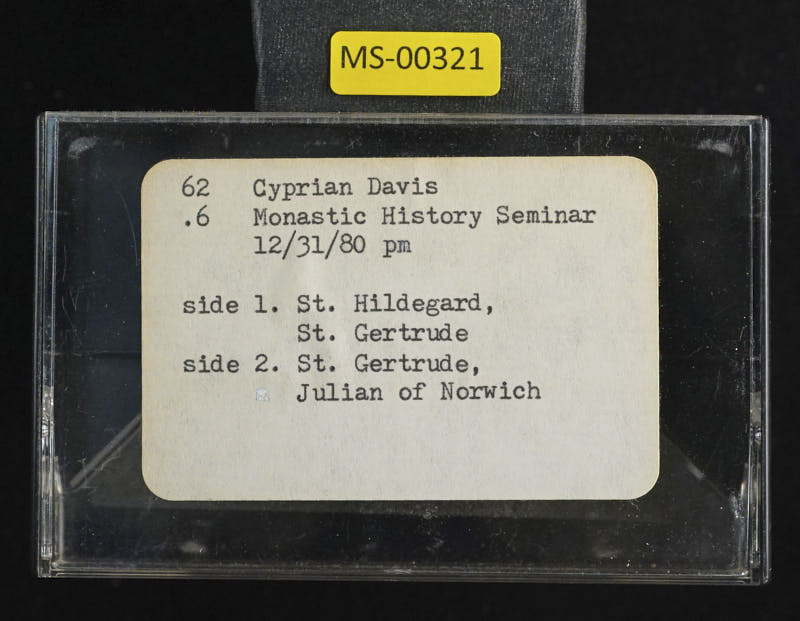
Speaker: Cyprian Davis
Additional text: .6 Monastic History Seminar, side 1. St. Hildegard, St. Gertrude, side 2. St. Gertrude, Julian of Norwich
@AI-Vision_v002
a mini-manuscript that is now lost. There was a miniature that showed a nun, attired in cowl, seated with a footrest, holding in her hand a wax tablet and a stylus. Facing her was a very attentive monk secretary leaning forward to listen to her words. The most interesting aspect of this man is that from her head shot forth streaming flames.
[01:02]
from her two eyes and her ears, almost like a rocket projected. A rocket projected from Cape Canaveral. This was a miniature of St. Hildegard. that was found in the Wiesbaden Manuscript, and that has been, no doubt you've seen it, reproduced many times. Unfortunately, the Wiesbaden Manuscript was lost in, of course, the Second World War, the original. Facing St. Hildegard is her secretary, a monk, who is either Vollemart or Dider or Jean Blu, both of them are these men. served as her secretary during her lifetime.
[02:06]
It is an amazing picture of an amazing woman. Kildegard was born in 1098. She died in 1179. I would like to talk about her and about St. Gertrude, who is a little bit later in our dates born sometime, probably about 1456, and he died sometime after 1301. And I'd like to talk about James Julian of Norwich, who was also a little later, born probably 1342, 1343, and die sometime after 1416. These three women, somewhat apart in time, had a great deal in common.
[03:16]
I think they had most in common is that they were, each in her own way, a visionary. Not a visionary in the sense of having visions and apparitions. Probably none of them have visions and apparitions, perhaps so beautifully. All of their visions were more or less sort of an intellectual perception that was real, that they could visualize. But the intellectual perception that revealed, gave an insight, to be a better way of putting it, gave them a very deep insight into questions dealing either with theology or spirituality. All three of these women can very well be called spiritual teachers, in the sense that they were lighters, or someone wrote down what they had to say.
[04:27]
And in that sense, they should be considered as part of the spiritual monastic heritage, helping form that of which we are part. All of these women have the same thing in common, too, in that they were monastic women. One, a black nun, black monk. Benedictine, of course, is an anachronistic term because Probably the term Benedictine isn't used, according to Jean Leclerc, it isn't used probably before the 16th century as an adjective. Ah, de Julia, the Cistercian, more or less. And Julian of March, we're not sure whether she was a... an actual member of a monastic community, in other words, a professed member of a monastic community, but she lived a monastic life.
[05:32]
She belonged to that group of women known as actresses. Take a look at that. So all three, in one way or another, are part of the monastic tradition. And all three, in each in her own way, sort of exemplifies the position of women. in the monastic order, in the Middle Ages. Rudigard sympathies the Benedictine Abyss of the Middle Ages. A woman of authority, a woman of a certain amount of political and social power, a woman of a great deal of influence outside of her own community. a woman who moved in a certain circle of society. Hildegard is known best because of her writings that have come to us are rather strange, very difficult to understand, and only in recent years, in recent years, have there been a renewal of serious study of Hildegard's writings.
[06:56]
In fact, in 1978, appeared the two volumes of the particular writing of Hildegard, I know of the Shibyas. In the fine edition, it's usually spelled as one word, but it actually is two words. It means Shibyas Gomni. Know the ways of the Lord. You see, but usually shidhyasis is in your idea of three or three words. Shidhyasis is two words. Hildegard, this writing, this particular edition, appeared in Corpus Christi Anorum, the Continuatio Medievalia, volumes 43, and 43A, published, as you know, by Stainbubel, from that, 1970.
[08:03]
Edited by two Benedictine Manns Adelgundus Rurikerta, F-U-H-R, it's been right already, F-U, first U, K-O, and without T-T-E-R-O, and Angela Kalavaris, C-A-I-L-E, V-I-S. This is a very fine edition, including the famous miniature, that we talked about in the beginning, that has been recently published. Now, Aude Gundis Firokota has published several other articles and books recently. Also, in the most recent edition, of the American Bandit Review, thanks to Timothy, I noticed this morning, there is an article on Sardiri Guy and her, particularly her references to women, teaching on women, in her writings, by a man named Short, OTT teaches at Seton Hall University.
[09:20]
And he gives a pretty good bibliography, a present-day bibliography, giving you a good healthy God. You might also notice, if you have access to it, you won't be, you will not be found in his library. Volume 8 of An Electa Sacra of Cardinal Petra, published in Monte Cassino in 1882, contains... other works of Hildegard, other Latin works, but not the she, the us. Also, there's some interesting details. In the known writing of St. Hildegard is the she, the us. And in this writing, we see what kind of a writer she was. She was Instead of calling her a mystic, one really should call her a prophet or a prophetess.
[10:28]
She is, in a certain sense, doing what the Old Testament prophets do, using symbols that she has come to know because of a kind of revelation, a kind of interior revelation that she has. She uses these symbols and then, in using these symbols, she is able then to write a series of prophetic explanations of various symbols. Who was this holy guy? She was born in Heshire, India. in the empire, belonging to a great noble family. Born in Derenesheim, as a member of the nobility of the area, she entered the monastery of nuns at D.D.
[11:35]
Bolden Degg at the age of eight. And I think that for the young hearts, I forget that in the Middle Ages, it was quite common, even in Benedict's time, parents to assure their children's salvation and also help assure their own by putting them into the service of the Lord. And no one in his or her right mind would question such an action. The Lord would question whether you were going to feed your child or vaccinate your child or do anything else for your child's good. What good or good thing can you give him or her than to assure his or her salvation by putting him in the monastic state. Reserving him from this world. So in a certain sense, it was very reasonable to offer your child. Very reasonable to offer your child.
[12:42]
And this is exactly what happened quite a bit. It would obviously create problems. It would obviously create problems and several kinds of difficult problems. One of the things that the Cistercians do is to reject the practice and receive it. children, high into the monastery. The superior Judith, at this particular time, a noble woman, Jutta von Spahnheim, was a recuse, and she was actually the superior of the house, but she was walled in, walled out. In 1136, Judith herself became Abyss.
[13:47]
And in 1147, despite the fact that the particular small community that she had joined depended upon the larger abbey of monks, and against the will of that abbot, she decides on her own to found another monastery. One gets the impression of this woman that she was always very strong-minded, very strong will. 1147, 2000 Monastery of Rupert's Bed near being. Just for a moment, keep in mind, there's a few others. The manual of one or two things in terms of immediate or others. This morning, I recall to you, I reminded you of the fact that Charmaine incorporated the ecclesiastical structures as such, and also particularly the monastic structure, into the socio-economic structure of realism.
[14:50]
There was also the minorial system. Not only was this the case for abbies of men, but it was also for abbies of women. This meant, then, that the abbots, like the abbot, was found in a very strange situation, namely that sheep two possessed a position of authority in this structure, which normally would not have been the case. Normally would not have been the case. Now it would differ the position of a woman who held lands and held a fief did exist. And there would be instances in the sense of a woman, like the Countess Matilda, who would be a a woman of authority and rank in her own right, not depending upon the man. And this would be more or less the position of an avarice. She was, not strictly speaking, a vassal, but she was under, in a certain sense, the vassalage of the king, and would have her own vassals, her knights, and the other vassals depending in feudal subjection to the army.
[16:07]
As well as being in the manorial system, That is to say, that lands on the Abbey of, that depend upon, that the Abbey of Nazareth would have serfs and so forth. So the whole system, she too, she too would be judged. Though she was to have normally an advocatus, namely a nobleman, a count, or some other nobleman, who would substitute for her in carrying out police powers and exercising judgments. Though in certain instances, she perhaps may exercise judgment and engage in quite a bit military activity, more than one might realize. I forgot to mention this morning an institution, and I want to mention it here, just to keep it clear in mind, namely the institution of Eigenkirchen, Eigenkirchen,
[17:08]
namely the proprietary church. That is to say that, by and large, there were two kinds of churches in the medieval period. There was the ordinary diocesan structure with the cathedral, with the parish church, with the attended clergy forming the staff, with the rural parishes, in other words, the normal sort of kind of structure. But this soon became more and more are less and less practical, are less and less common. There was another kind of church that was set up on the land belonging to a feudal lord, which he set up a church for the benefit of his servants or the benefit of any other, of his tenants or to someone else. But anyway, it was his church because he owned the land, he owned what that church was stood on, and he could all continue to hold title to it, and he also owned the priest. When he was a maiden, in the beginning, he would offer one of his shirts, telling him he was going to be a priest, telling him to be a bishop to be ordained, and that was that.
[18:17]
And then he would give the church to a priest, and he would give any other people. When we hand him over, he was supplemented to his ritual action, and invest in him in the office of the church. Normally, this church would not have the right to steal the tithes, or even in the beginning, conduct doctrine. Well, the ecclesiastical accoutrements, in other words, became translated into economic entities in Marxist fashion. Okay. The reason why it's important now and next thing in mind is that there's two heterothorical churches. It's like bishops are proprietary churches. It's like our ladies are proprietary churches. In other words, the system of the Hagin Church becomes the normal Christian. So everyone was in Bible.
[19:18]
So that the anomaly would be that the bishop had proprietary churches and all other things. Bishop or the diocese with his own churches, then had his own private churches, private proprietary churches, and other stuff. And monasteries are the same way. This meant, in terms of the monastery, that the priests, Even later on, when they were able to get the priest out of hand and away, the monks kept around to the normal high churches. The priests were under the authority of the monks. Therefore, the priest would depend on something else. He named the priest. He belonged to a queen. He didn't belong to a deity. He belonged to a priest. And in the same way with them, for others, I also have a proprietary service. She named the priest. The priest belonged to her, and to her authority, her jurisdiction. She isn't so. And that is, in that way, an excuse to me of understanding, whatever may be the canonical legislation, remember that probably the churches don't come understand a lot, they don't come into canonical legislation, they are probably ideal, but it will follow the reality.
[20:31]
She said, you know, one can speak of her. I'll tell them all. But then many of them, I'll say, have learned that we have extensive life holdings with extensive number of challenges. Why the great examples of that? They have lots of our guts and we spend. Of course, it's good. They have lots of our guts. It's better. But lots of our guts isn't a thing. And where, you see, down to the time of the revolution, there were still many, many Christians, there were many, many priests who came to the time of the revolution. But there was no one. There was no one. And from those situations, I understand, I'm not going to die. [...] I'm going to die. One aspect about women in the religious international life, mainly, is that from the beginning, unlike someone, from the beginning, they generally were set up as places of, I don't know how I want to take attention, or these places where, for the sake of members of the royal family, for those who may ask nothing.
[21:52]
So that from this summer, when we have the creation of many abhisattvas, even if there were a small, small century, they usually tended to be aristocratic. And they usually tended to have an obligatory aristocratic nature, namely that one who was not abhisattva directly could not enter. This was not the case with amma or so with men until later in the middle of it. It was not the case in the very middle of it, where they all tended to be of a cloud. But it was not the case, you only have instances of non-locals, as well as entering monasteries of men, as well as exceeding, too, are the Episcopalcy and the higher ranks. Not frequently, but it would happen. It happened to them. But it got, the church becoming almost totally aristocratic, or more in a hierarchy, is more phenomenal at the end.
[22:57]
I mean, even the French Revolution. Just as women gradually lose their rights and their privileges and powers, as we move in the morning time and enjoy much less, a builder guy could never fear after the council of friends. He could not have the phenomena in a builder guy, so not at the time. because women ceased having a good role of their life, as the youth in the modern times. Now, a woman like Kirti Guy then, by her very office, was a woman of influence, maybe, but she tried to develop this kind of woman, as a very author, a very author of the party to the system. The monastery will live in only two rooms, so there are no other rooms. The room will have non-monaster rooms, not one room.
[24:03]
In 1150, she moves her entire community to Ruppertsberg. In 1165, she will put up another monastery, and she rules both monasteries, the Monaster of Ivy Room, of the new kind, the other one now. She ruled both communities. She began all of her life, she claimed, that she had a sort of inner silence. She described in a famous letter, the shadow of a living light was what she saw. She said ever since she was a child. Was it maybe an ocular? It may have been. She was often given, you're often very sick of her. She lived your age, you're often very sick of her. It may have been a malady of the eyes, you don't know. She was extremely sensitive to time-active changes.
[25:06]
She may have been nursing, I would say. But at least she always claimed that she had some kind of inner sight, inner light. It was obscure in some way right now. But by the time that she is, when she's in her 40s, she has been under receiving inner messages, if you will, inner visions. I think they should be considered as sort of intellectual insights in a very visual way, and it's hard to explain what it was. She may have just been neurotic, I suppose. But these insights, she feels compelling to write them down. Between 11.41 and 11.51, she composes them, which she is. And she dictates to, first of all, to the monk of Omer, though she herself knew Latin, she was a well-educated woman.
[26:07]
She was a very well-educated woman, as were the women of her monasteries, in terms of education at times. They were literate and they read extensively. What she is going to, in the Sivya, she's sort of explaining the meaning of creation, the meaning of things. There are 26 visions in three books. She explains the symbolic significance of each of these visions in a series of chapters. And in doing this, she gives a kind of a theology and a kind of spirituality to the various means of things. In the Liber Vitae Meritorum, which is the next writing that comes from her, she wrote this down, our secretary did, when she was over 60.
[27:21]
So it's again a series of visions filled with symbols. Everything is very symbolic. And here she explains the symbols as part of a moral teaching. The first work was more theological. The second work is more question of moral theology or moral teaching. And finally, the Liber Divinorum Operum, in which she saw that as a treatise on natural phenomena as part of God's creation. Written between 1163 and 1173. Rolmar had been a monk of D.C. Goldingberg, and Guy Baer was a monk of Jean Ville, located in 2008 Belgium. He was a famous writer in his own life. Not only did we have these kinds of rather important, weighty treatises full of allegory that she wrote, but she was also responsible for enormous correspondence.
[28:34]
As soon as she comes well-known as a kind of a prophetess, who would be called the seer of the rhyme, She receives many letters from very important people, and she writes several letters. To St. Bernard, among others, to the Pope, to the Lord of Mammu Emperor, who is Frederick Barbarossa, to many, many members of the clergy. You write her, and she writes them, asking her advice. She gives her advice often in highly symbolic language. One of the peoples that she wrote was, for example, to Henry II and his queen, Eleanor Erector X, one of the bishops in Minneapolis. She also wrote her close contemporaries in Elizabeth of Scherna, also a nine-year-old mister. In 11.7, Pope Eugene III, the former novice of Grand Saint-Germain, gave his personal approval to her treatise, Chidi Lass.
[29:36]
But not only did she write letters and write pieces, she traveled. She traveled extensively in the Rhineland, going even as far as Lorraine in 1160. She was in Cologne in 1167. She traveled to Trier, to Hirspir, to Bamberg. And she even preached. She preached in public to the populace. She preached to the clergy, to the lay people, giving them moral exhortations. All of this quite extraordinary in terms of a woman of the Middle Ages. But she was a rather extraordinary woman. She died in September 17, 1179. And you have to understand, obviously, Hildegard in terms of being a medieval artist and therefore enjoying a certain freedom and a certain freedom of movement, freedom of activity that by and large other women and even other men probably would not have enjoyed.
[31:00]
But I think it is important to keep in mind that it wasn't also that completely unusual by a woman of her position to go down to the church and to enjoy the sort of freedom of the day. Are there any questions that you might want to ask about? Some of these people were members of Parliament. Was she a member of the Diet? I'm not sure. As far as in the 12th century, if I can recall correctly in terms of the German Empire, there would be, obviously, reminiscent of nobles. I do not know if she was a member. It may very well have been that she would not have been because, strictly speaking, in the feudal period, this would change as time went on. In the feudal period, women, even an artist,
[32:02]
was not allowed to appear, according to the feudal law, should not appear in court. Only one who wore a sword should plead before the court as a noble person. And that is why, again, the abbots, and also even an ecclesiastical lord, was supposed to, in theory, have a count as his advocate. That would be what the advocatist was. Someone who wore the sword and therefore could take care of police action and also go before the court and plead on the behalf. of the defenseless person in this field in the future. And that may be the reason why, perhaps, you're not even a private member of the representatives of an ability. I mean, I don't know. That sounds good. Would you like to be a member of the union of this? No, because as a member of an ability, Well, I see what you mean.
[33:03]
You'd have to have one of the large feasts. Yeah, that may be true. You may have had to have a thief that gave you the rights. The human second feasts. That's right. You're quite correct. You'd have to have a dukedom or the account with a certain point, I think, to yourself. Maybe it's all along. Yes, the custom of ordaining deaconesses, if my dates are in, I recall correctly, deaconesses are ceased to be ordained toward the end of the 6th century, I believe. But, there are notable exceptions, and one of the notable exceptions is in the 8th century, Sangatagon, the wife of one of the Meridian kings, who killed her, who was pretty much a barbarian, who was the Meridian king.
[34:25]
And Radegan was a woman I always liked very much. I love her name. She wouldn't love you. Radegan finally has enough of her husband because he was really part of a beast. And she decided to leave. She was queen. She's earlier. She's a... She's six. I want to say six. She's six. Yes. She leaves him, gets herself ordained deaconess by the bishop. Anyway, gets herself ordained deaconess and then goes south and starts working with the poor. He had vast estates of Rome in her own right. And eventually, then, on our property, found an order of nuns who follow the rules since its areas of awe.
[35:31]
And that is the Abbey of Saint Croix, who still exists. That's why it's the oldest Abbey of nuns in the United States. The Abbey of Saint Croix, the Poitiers, the Poitiers. And the Magist Fortunatus is her chaplain, and you get a relic of the Holy Cross. She was a deaconess. Now, what happens is, you may be thinking about the Cartesian nuns, The Carthagian nuns had the privilege, and a store, a deacon's store, and singing the gospel of man, and also, even when women still couldn't sing the lessons of man, so they were singing the lessons of certain masses. Precisely because they inherited the privileges of deaconesses that they were no longer ordained deaconesses, because they were found before a monastery, It was a monastery that had been founded from the United States' choir, the monastery, who had all those privileges without being deaconists. And that's how they kept all those things.
[36:34]
There's an article on the Caucasian nuns in, I think it's in the Dictionary, the spirituality table. background on how it happened. Another question. Let's say a word before we take the break about St. Gertrude. St. Gertrude the Great belongs to the 13th century. We know nothing about where she was born. We know nothing about her family. We know because of autobiographical information that she gives us in one of her writings that she was born about the year 1256.
[37:42]
We also know from her autobiographical writings that at the level of age of five she was placed in a monastery of health care. Located in Saxony, located near Aisleben, they wait. The monastery of Helster was a monastery founded, again, it was a feudal monastery in the sense that it was a creation of a local feudal nobility that had decided to create a monastery, build a monastery, endow it, and control it. And control it. Which in what one could do. Remember, in the Middle Ages, if you discuss why the proprietary church could exist, if you found something, then you can continue to have rights over it. And that right, of course, would be according to the stipulations of the foundation.
[38:48]
And that was often the case with monastas. When you speak of Aidenkirchen, you also speak of Aidenkroster. In a certain sense, Hefti was like an eigencluster in the proprietary monastery. That meant, and this is the other way it happened, that meant that the local nobility could constantly interfere and console what went on, even to the selection of the superiors. Hefti, therefore, had a large and easy name, small race. And remember, too, it was... In an age when women, aristocratic women, as the widow of an important person, could enjoy a certain amount of rights and independence, normally as a minor would be under the control of someone else, women were
[39:50]
were an economic problem, too, because you must provide them with dowries and you must marry them. If the family were not able to make a good marriage, then they would remain as a kind of responsibility for other male members of the family. And therefore, the number of others would want, some way or another, want to dispose of young daughters who either couldn't be married or didn't want to have, you couldn't have enough money for a marriage or a settlement. Therefore, the best thing to do is put them in a monastery. And one reason why they tend to be aristocratic is that your first concern is that they would be happy and peaceful in their own kind, with their own social media. You put them out there in a monastery, and that would be helpful. That's their life. And you say, he made a settlement on them, and they would be secure, financially secure.
[40:59]
Oh yeah, she came from the risk-credit family. Everybody don't know much about her. And we don't know why she... It may be an indication that for some reason she was placed there and didn't know anything about her own family either. It's hard to say. But that's the reason for this kind of monastic community. was often the place where you could settle in. Now, Halfter, at this time, despite this kind of handicap, remember, this was the case over in a modern time, in terms of union, being a place where you took care of your unwanted daughter. And that's the reason why, so often, there was no monastic location in a place like this. There was no real spiritual location. But Halfter, at this particular time, underwent a tremendous spiritual renewal. It was just probably no way. the spiritual energy at this particular period. Despite the fact that he was this kind, partly because the woman who was abbess was evidently a very remarkable woman, from a great noble family, named Gertrude of Hakobono.
[42:10]
A long, long time, people thought that Gertrude of Hakobono and St. Gertrude the Great were one and the same. It's only in recent years that we realized There were several different people with the same name, two nectaries, two Gertrude to sell. Gertrude of Hakobon was average from 1251 to 1292. There was much of a lifetime of Gertrude of the world. Held it with a Cistercian monastery, however, controlled by the local mobility, but not recognized by the order of Sito. The Order of Sito, remember, starts out as a farm movement, and they were not really interested. Remember, it was highly organized, the Sistercians, meeting, having a general chapter once a year. Very pragmatic, extremely pragmatic, many of the Sistercians. Remember, you know, you had the creation of labor arts, and you kept the laborers in their place until they revolted in the 13th century by a series of laborers of work.
[43:17]
But they really kind of, they didn't want to have, they didn't want to be sort of bogged down by swimming, not by women. And they were very loathed to take women. Now, everybody wanted to be a Cistercian in the 12th century. It was the thing they do, and so many, many women wanted to become Cistercians. Just like some very different avenues changed, or wanted to become... Habits of white monks, so you find communities of women who wanted to be adopted in the restoration of their mind. And others who wanted to sort of come into the order. And as far as the women are concerned, these men with very little to take them and try their best to keep them out. They had to take some. But more and more, many women who donned the white habit, who adopted many of the restoration customs and so forth, They were not recognized by these, they were not chaplains to be their own, and this was the case of Hatha.
[44:23]
When they considered themselves as patients, the patients themselves almost said, no, you're not. And they had no chaplain from the situation once. And I guess what's often the case in this very situation was the Dominicans who served them as the spiritual directors of Hatha, as they did in many other cases of dedicated women. It was the Dominicans and the Franciscans who were responsible for sort of taking over many abeys and men and guiding them spiritually. That also has many, many consequences in the law. St. Mettilde of Magdeburg, where then Abedin, and Abedin were religious women who were not learned. found, especially in the Low Country and in the Lionel Island, will become increasingly numerous.
[45:26]
I don't know exactly the date of their origin, their time and historic, but really their origin, the word they mean, will become increasingly numerous as we move on from the end of the 12th century and the 13th century. A very, very common. And they represent the non-noble class entering into religious life. Women advocate for spirituality. Advocate for spirituality. Many of them not noble. Some of them were. But many of them not noble because women in the ritual of normalism were desiring to give their lives to God. And from this meeting here comes many of the mystics, many of the ecstatics, out of the later middle ages. And many of the year there was extremely, extremely positive. And so a woman like St. Meg Tilda Magdeburg, who had a great deal of influence in her writings, was a beginning at first, and in the last years of her life, she was, through the influence of the Dominicans, she entered as the added help there.
[46:29]
So therefore she too is a contemporary of St. George's degree, 1201-21. She entered then this monastery at the age of five, received her training under St. Nectile of Hacobon, who was the second Nectile. in Helfter, Neckfield of Hackeborn was sister to St. Gertrude of Hackeborn the Address. St. Neckfield of Hackeborn is also a spiritual writer. So in a certain sense, this period of the last part of the 13th century in Helfter, despite the situation of the Abbey as being kind of a domestic community in a way for a local minority, was also a place of just buzzing over with spiritual growth and spiritual insults. It was a very rich place at this particular time.
[47:29]
The nuns of Helster, although they were under the teaching and direction of Dominican nuns, of Dominican fathers, nevertheless had a very strong attachment to their Cistercian rules. They read St. Bernard. They were very much formed in the Bernardine spirituality. Remember, one of the characteristics of the mysticism of St. Bernard, it didn't necessarily originate with him, but it's one of the characteristics of his spirituality that goes on, is St. Bernard's great effectivity, his great His great devotion to the humanity of Christ is more than, I think, a sentimental devotion, not a sentimental devotion at all, but a mystical opening out to Christ in his humanity. And an awareness of Christ, as one would read simply the sermons on the Summer of Psalms, his ability to...
[48:43]
draw the listeners of his hearer to a love and affection for Jesus and the terms that he uses in drawing him to Christ as he comments on this great mystical writing, the Song of Psalms. So that this sort of richness of St. Bernard, this richness in his awareness of the humanity, in his love for the humanity of Christ, The themes that Bernard uses and introduces as the spirituality now will plow forth into the high system spirituality of the 13th, 13th century, is something that the nuns have helped him pick up, and that is very remarkable in the writings of St. Philip Shul, a real attractivity for Christ. Gertrude was trained by Mecdild of Hackabonga, as I said.
[49:47]
She worked with her as cantor in the monastic choir. This group of sisters who were interested in mysticism seemingly met together, sort of had a... intimate union among themselves and exchanging their insights and so forth. She was definitely a part of this. Gertrude was a woman of intellect. She would work in the scriptorium and I think that working in a medium scriptorium is simply sitting down and taking your pen and copying from another book a manuscript because to prepare the parchment and then to write with great difficulties. and great hardship on the parchment and copying a manuscript. Also, which meant that you had to understand the writing, the abbreviations, the sign, and so forth, and transpose it, was something that demanded knowledge and demanded a certain amount of physical endurance and strength, and also a certain artistic ability, too, because the writer of
[51:10]
of a manuscript, he is still in the 13th century, had to have a good hand. He wrote well. So though we have no, in a way, we know very little about Gertrude, these bits and pieces of information give us some knowledge of her. We know later on, in our later life, she will go ill very often. But we, at least we do, we work in my room and have some intelligence, some training, some a great deal of mystical awareness, and one who has spent all of her life in the cluster. Not all of her writings have survived. There are two major works that we have of hers. The first are the Exercises, which are a series of instructions, seven in all, on how to pray at diverse times.
[52:11]
In other words, the instructions are sort of a collection of prayers, a sort of a manual. There's more than that, it's a very highly personal manual, but a manual saying that, for example, when you want to remember and thank God for your baptism, and you want to thank God for His grace, and so forth, this is how you pray. And when we speak it, in one spiritual development. So it's a kind of a collection of prayers. And not only the prayer, but the reflections before the prayer, kind of a meditative introduction to the prayer. These are the exercises. Our term, of course, which later on will be consecrated, then. as we speak about other exercises tomorrow. But Gertrude, that title was given to a work not by Gertrude himself, but by a later writer, but Gertrude spoke about it in terms of instruction, series of instruction.
[53:21]
The work is interesting, of course, from the viewpoint of the history of spirituality, because it is a... an example of a certain methodical prayer. In other words, the setting out of certain prayers to be said at a certain state of occasions, which will be precisely one of the major characteristics of those who follow the Word of Sinodana, the writings of the Word of Sinodana. So it is taken in the writers that come in the following centuries. So in one sense there are certain elements of of the Vosimha Dhyana in the writing of St. Gertrude. She perhaps is at the beginning of a certain transition. But one really, she does not really belong to, she is a mystic. And the Vosimha Dhyana didn't like mystics. She is really a woman then who is part of a mystical tradition. And this is no place for anyone to belong to the Vosimha Dhyana.
[54:24]
But there are certain elements in it. Just as the affectivity and the love of the humanity of Christ are other elements which we characterize for the world's human government. Still, this is what characterizes also maybe in mysticism. And one of the other aspects, of course, is that the exercises of prayer that she has gathered together affect acts of affectivity. They are not moralistic gems, which is very characteristic of the world's human government. They are moralized, are nauseous. The other great work of hers is known as The Hero, The Herald, The Emerald. And it has been edited, all of her writing in fact has been edited, and now in SOS KTM. The exercises are found in Volume 1, Tome 127 of SOS KTM.
[55:25]
done by two monks, Soleno-Jacques Wittier and Albert Schmitt. And that was published in 1967. And the general title, Gertrude of Helt's writings appear in a series of volumes, and the general title, El Lazer, Spiritual. The Herald appears in several volumes, and that was edited by And then Pierre Douayere, the Abiyavisque, as we found in volume two, that contains the first two books of the Herald, and volume three, which contains book three. And finally, volume four has come out with book four. And there will still be a fifth book that's still appeared. This was in Paris, 1968. in 1978.
[56:29]
The Herald is made up of five books. It is book two that, in a way, is the most important and most interesting because that really is the autobiography, our same directory, that is in the first person. And it is in that work, book two, where she indicates her She calls it her conversion, where at the age of 25 she has a mystical experience, or I would probably prefer to say a spiritual experience, which took the form of a kind of an insight, perhaps it was a vision. I don't like to use the term vision, I don't like visions, the sense of vision of apparitions. I think that we should get an express of oversimplification but a kind of, I think some people probably do have things appear to them. I don't know if that's always necessarily healthy, but I don't think mystics are necessarily, I think one can be a healthy mystic, but not necessarily a healthy person.
[57:44]
What I mean is, what I mean is that one must not think that to be a saint, one must be psychically holy. Well, let's not have to be, you know, we have everything wonderfully all set out. We can in fact be a raving neurotic, and also be an instinct. But otherwise, we'd all have to be perfect human specimens in order to hopefully arrive at some sort of, you know, the framework. I don't think that's very necessary, or even to be a saint, I don't mean, handicapped. and become a saint. I imagine that Gertrude probably was, I don't know, she may not have been. She might not have passed her psychological exam to get into the condom.
[58:52]
I wouldn't stop her for being a great mystic. And I heard the vision that she had of that of a young man, and when we hear it described in a way, one has all kinds of thoughts that come to mind, but it's the young man of the priest or in the dormitory, common dormitory, I have not yet to conflict. And that is her encounter with Christ. And then she begins to talk to him. And from then on, then, is this very close intimacy with Jesus, that who appeared around the first time, had a very long man of good appearance, and so forth. I don't think, I think that one was, it took place on the Monday before the purification, January 27, 1281. And so the whole of Book 2, she dates it very precisely, very important for her. Her book, too, then, is a conversation with God, in which she recounts many graces she received.
[59:56]
It's like a confession from Augustine. Many graces that she received. She indicates the subjects of her meditation, often indicating that I'm certain such a feast day, because it virtually always works out the front work of the eutological universe. Her whole life, of course, like any Cistercian man, she lived between the choir office and the other duties, and so... When she is recounting what God has done for her, she recounts her honesty within that friend book. And as she also turns toward God and has her subject on the meditation, she works along the friend book and the liturgical chair. In other words, she is not, she is very much a liturgical individual. Because that's her life. That's her life. And so, in that sense, when she discusses with God the subjects of her meditation, says, on such and such occasion I was reflecting on this, it is because of the liturgical season, and she would be thrown in the garden between this hour and this commandment, commandment, commandment, and so forth.
[61:06]
And it's in this kind of aspect that her work is not sentimental or devotional in a more violent sense. She is speaking from the richness of the way. She uses the richness of liturgical language. She's speaking from the scripture as it is used in religion. All of the things that are part and parcel of monastic culture about which Shana Tuck speaks, she has. And it's from that that her spirituality goes forth. And it is in this hour, but it has not at all changed the idea that she is a woman of her time, of her age. She is taken with the humanity of Christ, the grandine devotion, and she begins then to speak to Christ and to relate to him in a certain way that people like Bonaventure do too. And one of the ways is a love for a sort of physical...
[62:12]
aspects of his passion. And one of the aspects of his passion is the wound in his side. And drawn to our reflection on the wound in his side is to be drawn into our reflection on the heart of Jesus. So St. Gertrude then was not the only one, not the first one, but one of the first to begin to introduce the mystical love for the sacred heart of Jesus. He did a far cry. We're not going to find it the same sort of sentiment, the same Nagamai out of the 18th century. No, no, no, we're going to find the same thing. But you are, it is much more of a mystical thing, it is a kind of devotional reparation idea. It's much more a sense of, if John could, if John can sort of breathe in and understand and relate, because he is on the breast of the Lord, next to his heart, than any other one who wished to desire to come in the contact with Christ, enter into him, and come in the same way.
[63:21]
It's that sort of, out of that sort of reflection, that she works. Using the imagery, which become more and more common at the end of the Middle Ages. There is obviously and there too little that is apophatic. She is cataphatic, but she is very much that is affective, but not necessarily sentimental. She recalls in some respects how she already anticipates in some respects the kind of revelations and visions that the other great mystic, a woman whom I think is one of the greatest of medieval mystics, She pours forth her understanding of her vision in a long series of prayers, prayers that are all literate of the liturgical texts. Book two is the most important of the works that are held, although there is both book one and both book three and four also recounts, in a way, your true spiritual development and growth, and perhaps
[64:36]
were not written down precisely by her, and are simply the collection of what she had to say. Or it may be that they took it down when she was on her sick bed, she was ill for a long time, and in the moments when she could not be in choir, she would then pray on her own, in union with her sisters in celebrating liturgy. And there's always reflections in which she was unable to personally participate. But she was with them in spirit that also formed part of some of these writings in book 1, 2, and 3. 1, 3, and 4, and 5. But it is especially book 2. It has the lyric quality. That is her style as a German mystic of the 13th century. Anything you want to say about the virtue of all you are there? Did you hear? The contrast, I would say, is great with her whole life.
[65:49]
I'd like to know a little bit more of how did she affect many outside of her landscape? That is a good question. The work by Pierre Dwyer, which is perhaps the best edition now of her, makes a good study, a very nice, long article, in which he studies the influence of St. Gertrude in later times. Mechthild of Magdeburg, her influence was contemporary of the South. Her writings were rather well-known. It also seems that St. Mechthild of Hackeborn, her writings were well-known at the time. Gertrude, evidently, her writings were not. The Abbey of Helfter, if I'm not mistaken, already by the time of the Lutheran revolt, when I speak of revolt, it's in terms of the armed warfare that takes place after the Lutheran movement gets started.
[66:58]
Many, many monasteries, of course, are beginning to be suppressed. Some of them are transformed into Lutheran houses and then supposedly die out. Helfter is finally taken over by the troops and they're suppressed. of our Muslim troops at the time. So the community disappeared. And the writings of the very truth that we did only do not become well known until after the period of the Reformation. They were taxiled by some of the Reformation's gallery and so forth. It's part of that because the left book of Madison wrote in the World Union. I think that one is very much part of it. And she was part of it properly at her time. Bajines always were part of the people. I want to say it's also a gem, but you know, moving on. But I don't, they're not there, I don't want to, when you go to the manuscripts of that one.
[68:04]
No, no, no. You may have got to be received in that. In fact, yes, because I remember now the text and so on. Any other questions? So Gertrude doesn't become really well known until you've moved in modern times. In the 18th and 19th century, she was stressed. She also, as devotion to the Sacred Heart increases, it also has played some part. But one thing that, it's interesting, devotion to the Sacred Heart, remember, is a devotion really that takes, becomes popular because of the 18th century, St. Magamwe Alakar, and it is a devotion that would very much, as we recently heard, but very much
[69:16]
favoured by the royalists, because they are not overtones of magic and kingship. And so, as the, uh, is the moral, particularly wrong, that the lyricist emotions that they have, of their national information, of their actions, of their reasons, of their actions, of their actions, of their thoughts. You also see me in the description of the, if you need a Thank you. Well, it seems like that short-paced span of time is a period, a real high period in the Namaste of history, and it all comes together.
[70:31]
The third person that we want to look at is another individual, unique in our way, and very important for the history of traditionalism. And that is children of knowledge. Again, we know some important things about her and a lot that we don't know about her. We know, for example, that she was an anchor. What is an anchor? An anchor? What is a woman? Usually an anchor holds, we use this word, attached to a chair, usually attached to a chair, by this time. We're walled up. We're in a dwelling which is all about a courtyard, on a window looking at the church, on a window looking at outside. We're going to look more important. The window looking at the church to follow the religion, to see communion.
[71:33]
The window outside, to live in communication with the outside world, and see the offering. And it was suggested by the 13th-century unclean youth, one of the oldest texts that we have in English language, and most important books to historians of spirituality, of all the historians as far as music. Historians, the anchoring rule, it is a great danger for the anchorist to look outside, to get the outside room, because too often she became kind of a gossip host for the town. I thought she had no place to go, and all kinds of people who came to see her. She, uh, uh, rolled up in a liturgical ceremony, she gave herself completely to God, and anchored rules, one of the best texts that we have, describing upon her life in the Middle Ages, describes, for example, the kind of rules that she should leave.
[72:37]
We may deal with private prayers. And so forth, and the priest who likes it, and writing this rule for several women who are living as an emperor, he is trying to give them enough to give them. And to go on to get possible danger, and what he does for us is he gives us a dream, but there are possibilities of this kind of thing. They could tell them that it wasn't enough for our servants. Others of them could, in fact, and property, indeed in the kind of small, small, or handy work, some of them anchors, they need to work, some of them torture. And then he talks to them with new work, the man who writes will say they should not act as bankers, in other words, he tells them they should not really have I ran a moon, but I remember one mother had cows.
[73:41]
He said, if I get this cow, it's ten-quarters of the other day down, it doesn't look good. So if you want to have an animal, let them have a cow. What do we do have to do with them? If you want to have an animal, let them have a cow, because that's still going on. What do we do have to do with them? If you want to have an animal, let them have a cow, because that's still going on. What do we do have to do with them? I know the same series in which the ruler Benedict is edited, is all presented by the in which you are just mechanics. The same series with Justin McCann's edition of your conduct. The anchoress is also very often, could have been a nun, and sometimes he was just a lay woman,
[75:05]
going to get rid of this kind of living part of the family or medical life, and may only be attached to a community of mountains. But the church where, just where Julian was a, was an anchorist, was a church that was a proprietary church, a community of Benedictine mountains. We don't know if Julian herself was a professional of the community, but in some way she was attached to a community of mountains. We don't know that when she began to have her revelations, which she dates very carefully, she indicates the date, May 13th, 1373, when she had this revelation. She says she was 30 and a half years old. We're not sure that she was in anguish at the time, that women began. What we do know is that if she was 30 years old at 1373, that she was born sometime around 1342, 1343.
[76:08]
And we also know that as later, the year 1416, the Archbishop of Canterbury, Thomas Chichely, had made a will and left money to her, and that she was called an anchoress, so that she was still young. There are two writings that come from the Parameter Union of Norwich. One is the shorter version of the revelations, or the showings, it was called, and the other is the longer version. The short text was composed shortly after a spiritual experience that James Julian had in the midst of an illness in the year 1372-1373. in which she describes the various series of visions that she had, and again, it's something that's intellectual, not in the sense of apparitions, but more or less impressions that she presumably had, but a man like the latest spiritual writers like Poutier and others would call an intellectual vision, describing these to the phenomenon.
[77:28]
She is having these series of visions as part of her illness. She had asked God for an illness that would be an illness almost to death, sharing the passion of Christ, and a gift to the three wounds, true contrition, loving compassion, and longing for God. She gets all of her answers. who had a kind of serious illness, a mysterious illness, come on all of this. Was she also neurasthenic, neurotic? We don't know. All we do know is that if she was, when we read her longer texts, written some 15 years after this experience, then all takes place in a short, in a day or so, this illness, when she receives her last rites, And she has these visions of the passion of Christ. If, and she very well, you know, she was in a lot of episodes and she was half crazy.
[78:33]
It was an odd thing to ask anyone. Oh, and my man asked for illness and so forth. The woman who writes 15 years later is a woman of great maturity and of great insight and of, and it's a girl about her. There are probably few spiritual writings, mystical writings, that are as optimistic in tone, as healthy in expression. This is no sick woman, he writes. This is a very, very, very profound, deeply profound woman. A woman of great... woman you would love to know. And of a profound insight. And optimistic. Basically optimistic. That's one of the nice things, I think, in reading you think that she's having visions of the wounds of Christ, and you think, oh my heaven, it's going to be, it's going to be, it's going to make us feel all too bad and sorry for us soon.
[79:42]
Unless, when you read Dengeneer and know that you're convinced that we're all happy as soon as you are, it'll all be alright. All will be well. constantly thinking, oh, even that. In fact, that's what they accuse her of, being a little bit heretical, because she seemingly says, you know, make any difference to God's love, even though you're in hell, I hope you take care of it. But it's extremely optimistic. The whole tonality is one of great optimism, great joy, and a profound insight into the mysteries of the Trinity, the Incarnation, and so forth. There's a whole thing. In these 16 revelations, she, in the long text, reflects on each one of them. It's a long meditation. Long meditation is a kind of an intuition in which she sees profoundly how the truths of the Catholic Church really fit together.
[80:45]
The basic idea, of course, is that God loves us, And that is a long term. We don't need more than that. And this doctrine touches on the mystery of trinity, of the incarnation, the divine indwelling, original sin, redemption, grace. She presents it often in a series of, just like Hildegard, a series of symbolic actions. Here it's more or less like parables, anagogues. And the famous one is this the servant and the Lord, the master and the servant. She plays on different levels. It has different interpretations. But always, and then she pictures the Christian reality of the body and dwelling in various ways, very strong images that she has. But they're definitely images that she's using. But always, it reveals then certain of these truths, like the one of our favorite ones, is the notion of divine development.
[81:50]
There's nothing sentimental again in her approach. It's a very, very kind of basic theological approach. A woman who presumably, we don't know how much aware of her, either she was self-taught or had the advice of many others, but who had some a great deal of influence of theological, rather. He has deep theological insight. Not in a ordination, but certainly one who has no rules, who knows these truths. But in a sense, also, of a solidarity with all people. God is good, and then a oneness with all people. And, of course, There is the other aspect, namely, which she was very famous for, which is very important to understand, and that is her whole picture on the Motherhood of God, the Motherhood of Christ, particularly.
[82:56]
Because it's not original with her, it's already something that was part, it's an Anselm, there's already one who speaks about the Motherhood of Christ, but it is especially James Julian, who really sort of incorporates it into the heart of a series of revelations, in a very, very, very, I think, again, profound way. And she meditates on the Trinity, the fatherhood of the God, and seeing Christ then as a motherhood. And then the Trinity. But it's a very... She presents... Like so many of her shrines, there's a series of meditations, not necessarily logically following one upon the other, but meditations that surround a central vision, a central core. And that's what she does with a series of chapters on the motherhood of Christ.
[83:57]
She treats this in a series of chapters, this mystery of what we're going to do about the motherhood of Christ. He also has allusions to the devotion of the sacred heart, and most particularly to the notion of divine and dwelling. I, myself, find one of the most fascinating chapters at the very beginning of the book, in chapter 5, where Christ is holding a hazelnut in his hand. the sight of Christ with a heathen on his hands, wants to know what it is, and he's saying it's all there is. And in a way, she sees that all creation the size of a heathen, and that it should break apart. How does it maintain its existence? It maintains its existence because he maintains its existence.
[84:59]
And it's that sense of seeing all creation reduced in a way, or all creation, finding its meaning in the hazelnut. I see it, and maybe you're all aware, but I see it all, the same kind of mystical insight is what Gregory the Great is describing in the Vision of Sin Vanity. It sees all things gathered together in the way of one light at the end of the Book of Dialogue. And there is a verse from a poem by William Blake that I think sums this up. To see a world in a grain of sand, and a heaven in a wild flower, full of infinity in the palm of your hand, and eternity in an hour. You read in chapter 5 of the shawings of Ian Julian. I think that those lines may speak to you. There's a lot in James Julian who is like that.
[86:03]
The way I, despite the fact that I think the apathetic problem of mysticism is something that really kind of drives me. When you read people like Julian, and the use of images, the use of the symbolic, but Julian is one of those people I think that is a sure cure for Maria Sevilla. and depression. And I always try to encourage people who are getting tired of their spiritual life facing in the real. It was very exciting. Just in her language it was exciting. Kulage, Eric Kulage, has done a critical text in two volumes. The first volume is a study of the text and the second volume gives you the Old English text. And, of course, she appears in the Christian Writers series, brought by the Thomas Press, a very good introduction, and the text is modernized.
[87:11]
But if you have a chance to have both the modern text and the Old English, you will find it very exciting to, once you understand, to read the Old English text. Read some of the old words, dear worthy. He talks about Jesus as our dear worthy Lord. She did rather expressions like that, but really become very nice. Homely, of course, is a good thing in her life, English. Hungry, that's very much what the Lord is, it means someone who's comfortable. And also courteous, the notion of one who has nobility of character and his nobility is actually speaking in that way. The English becomes very, very strong and exciting once you begin to understand it. Any questions about June? I'll answer.
[88:12]
C-O-L-L-E-D-G-E. Where's that? Where's that? Where's that critical text? It's, uh, I didn't know what it was. It's, uh, It came out in a certain year. It would be in that video reference. Anything else. She's kind of convinced me. She's not owned by a lot of Benedictine writers. Well, I don't think, I don't think we can be absolutely sure that she was a, that she was a member of the banditian community, we really don't know, and more than we know that it may very well be if she was not, and there's nothing in her writing to indicate that she was a banditian, but only the important thing, I should have mentioned this, is that she's part of the 14th century English mystics, the oldest of them being Richard Lowell,
[89:26]
and in the cloud of the author, the unknown author, the cloud of unknowing, and a series of other books, Genesis, Divinity, the book of Charlie Townsend, and so forth, all by this unknown author, and then Walter Hilton, and then she's the last one. All of these English mystics have several things in common, among them being optimism. They're all joyful mystics. A kind of distinction to some others. They're all very optimistic. They all have a, well, they all have beautiful writers in terms of literature. All of them are part of the literary, very important from a literary point of view. And they, but none of them are, strictly speaking, Benedictine, to be sure, you know it. I know it, but I read it, but I didn't know it was a small idea.
[90:38]
They're all through the cloud of annoyance. Richard Rose, a hermit, and he was so generous, absolutely mad, and on his own. We did personal impact on, again, her impact evidently was not very great. People like Marjorie Kemp visited her. Marjorie Kemp was a married woman at the time, who also had meetings, and very important. Visited her for advice, and many other people visited her, too. But we don't, for her contemporary interests, I've seen what I mentioned, everything was great. Where she does make her own back, and that's something I should have mentioned, is that it is the Benedictines who resurrect her. I mean, the English Benedictines, during the time after the Reformation, were on the continent, who are very responsible, especially the Benedictine nuns.
[91:38]
I don't know, people like Augustine Baker, who I spoke to talk about, were very much taken by her writings, and evidently that one of the other manuscripts was in the possession of the Benedictine nuns. They are the ones who make her known particularly in the period of the 17th, 18th century. So there was a nuns who were, there was a Benedictine nun, women, who come under the influence of a man like Augustine Baker and their desire for the mystical life. He is responsible for pushing that. that she becomes emblematic and comes into life. And it was still in our own day that the first sort of editions of Julian's writing was thanks to the Benedictine monks.
[92:45]
That's right. No, I think it's a revival, a revival in our own day. A revival in appreciation of the clouds and the julian is only by our recent interest in mysticism. But it's going back, even people are You know, people are like, I don't know anything else.
[93:18]
@Transcribed_UNK
@Text_v005
@Score_69.87