You are currently logged-out. You can log-in or create an account to save favorites and more. more info
Reviving Sacred Spaces in Modernity
The talk explores the concept of sacredness, emphasizing the distinction between sacred and profane spaces as marked by a divine presence that necessitates unique respect and behavior. It delves into the significance of sacred actions, particularly within religious practices, and critiques the desacralization trend that seeks to strip away these distinctions, arguing that desacralization risks reducing sacredness to mere folklore unless upheld by deep belief in sacramental reality.
Referenced Texts and Works:
- Immanuel Kant's Philosophy:
-
Discussed in relation to the concept of holiness, illustrating inconsistencies in his definitions concerning moral law.
-
Rudolf Carnap's Empirical Philosophy:
-
Highlighted for his perspective that all human knowledge should be grounded in empirical science, indirectly critiquing non-scientific pursuits like philosophy and possibly sacrality.
-
Emile Durkheim's Sociological Theories:
-
Employed to contrast the sacred and the profane, citing Durkheim's view of their fundamental heterogeneity.
-
Roger Caillois's Work on Sacred and Profane:
-
Referenced regarding the nature of sacrality and its expressions, emphasizing a need for contrast between sacred and everyday life.
-
Joseph Andreas Jungmann:
-
Cited for his understanding of the framework that constitutes sacred actions, highlighting the importance of sacramental acts.
-
Romano Guardini's Liturgical Insights:
-
Noted for his contributions to understanding the distinction between sacred actions and secular gestures, with mention of his reflections on liturgical education.
-
Hildegard Bultmann and Desacralization:
-
Cited for arguing against the magical and mythical aspects of religious beliefs and practices, attributing them to outdated views.
-
Pierre Antoine's Articles on Sacred Spaces:
-
Referenced for a contemporary view questioning the concept of a church as a sacred space, tying desacralization to changing interpretations of sacred places.
-
Second Vatican Council Documents:
-
Highlighted for reaffirming the sacred nature of liturgical practices and the distinct role of priests, against trends favoring desacralization.
-
Blaise Pascal's Writings:
- Used to illustrate the idea that humanity transcends itself, connecting sacred actions to deeper existential truths beyond mere human affairs.
Speakers Referred to:
- Berthold Brecht:
-
Mentioned for his views on poetry and his critique of traditional literature as an illusory escape, paralleling views on sacred rituals as potential distractions from real-world issues.
-
Emile Durkheim, Pierre Antoine, and others:
- Their approaches and misconceptions about sacredness, desacralization, and their ideological influences on the current theological discourse are critically examined.
AI Suggested Title: Rediscovering Sacredness in Modern Times
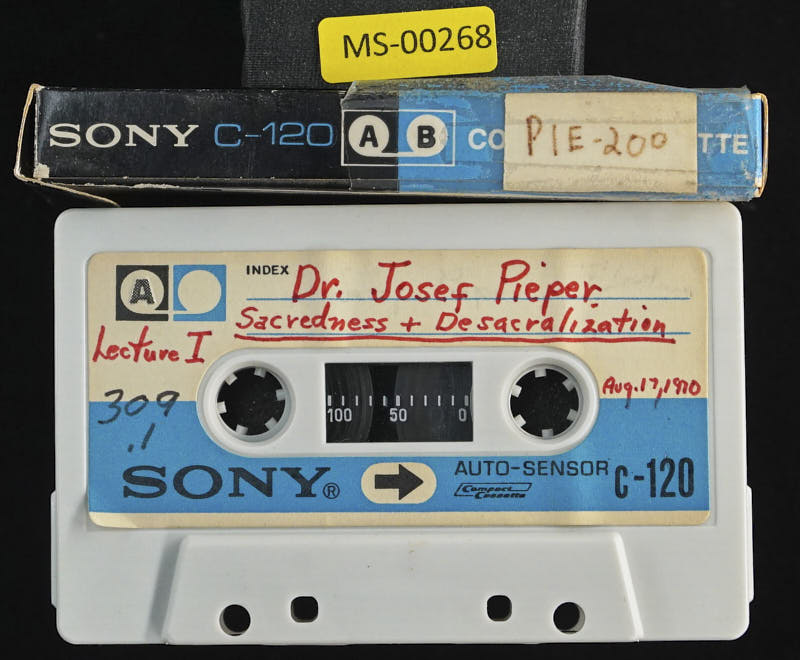

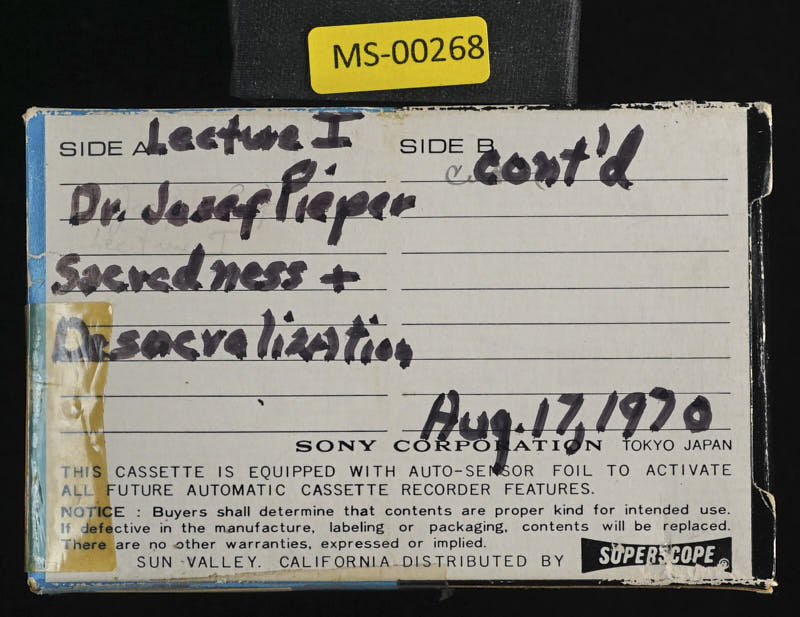
AI Vision - Possible Values from Photos:
Speaker: Josef Pieper
Possible Title: Sacredness + Desacralization, Lecture I
Additional text: 309 / 1, PIE-200
@AI-Vision_v002
Fathers and sisters and ladies and gentlemen, I would like to start with some more technical suggestions. The first is about the discussion. I would suggest that you, perhaps, during the lecture, take some notes and collect some points for the discussion. And I would like to start the discussion tonight with collecting all those points. and then it probably will come out that some point belong together, and so we have some groups of questions and problems. And then we can have a kind of order in our discussion, which of course doesn't mean that all the questions can be answered at all. And the second suggestion is, this morning the lecturer
[01:03]
unfortunately, will be rather long. So I could give you a... I could point to a certain chapter or section where we could have, if you want, just five minutes of... But not really long, I would suggest. Just a few minutes, if you want. So sacrality, sacredness. What does sacral and sacred mean? Now, as always, the best thing to do is to begin very close to everyday experience with a look at the phenomenon itself, so at what you can see. I remember the year 1948 end of May, Frankfurt in Germany.
[02:07]
The city was still in ruins, but in their midst, the St. Paul's Church, wherein the first German parliament had met in 1848, already was reconstructed because of the celebration of the centenary. Now, like many other associations, the just re-founded German Writers' Club to which I belonged, held a festive session in St. Paul's. Now, we strolled somewhat curious, coming out of the warm spring day into that beautiful rotunda, some of us still candidly smoking cigarettes. But then we were told, no smoking here, this is a church. Now, I doubt whether it was really a church. My neighbor said, how is this a church?
[03:08]
I conceded architecture alone does not make a church, certainly not. After a while again, my neighbor, and even if it were a church, why not smoke? Now, one year later, I happened to come across another ban on smoking. I was, as a guest professor, lecturing at the Free University of Berlin. And at that time, 1949, it was still possible to go just by subway into the eastern sector, the Russian sector. I went to Treptow Park, where they have a huge Russian memorial cemetery for the Red Army. And I entered, and I was warned by the guard, no smoking here. in that huge park. And some years ago, again the same in Israel, in our Jewish hotel, when the Americans and the neighboring table lighted their after-dinner cigarettes, the manager came, no smoking, please.
[04:23]
But why not? Now, of course, not of the space and the place this time, but because of the time. It was Friday night, and the Sabbath had begun. So one thing is clear, I should say, in all these cases, the aspect of any expediency or hindrance, like in an auditorium or like in an operating room, all that is simply out of question here. and even less the aspect of danger of fire, let's say, in the airplane during start and landing. Neither is there in Christian any general depreciation, as if smoking would be something that probably should not be done. Nothing of that. The point is obviously to mark a borderline
[05:25]
which separates a special place and a non-ordinary space of time from the average and normal anywhere and anytime. And whoever transgresses the threshold to this different realm, he is expected to behave in a way that is different from what is normally the youth. So whoever enters a mosque, or the realm of a Hindu temple, he has to put off his shoes. And possibly in the latter case, Hindu temple, the borderline is so strict that the non-Hindu will not be allowed to enter at all. In such a case, after I had heard so much from the neo-Hindu that more or less everybody is a Hindu, also the Christian, I asked, how do you know that I'm not a Hindu?
[06:26]
And the guard said, Sahid, your face has the color of a rose. Now, I knew. Now, in the Christian churches, men take off their hats, and the same is usual at the open grave, but also when the national hymn is being sung. The Jew, you know, on the other hand, covers his head, not only in the synagogue, but whenever he is praying. So again, in Israel, when I very candidly entered the enclosed square where Moses Maimonides has his grave in Tiberias, I didn't know. I was surprised, and so I just strolled in to that enclosed square, and the guard ran to tell me that I had no head. on my hand. Then in a rich or religious room, there has to be silence.
[07:30]
Loud shouting, at least, and laughter are prohibited. At the portal of the Marcus Cathedral in Venice, many tourists, all too carelessly dressed, made the experience not to be allowed to enter at all. And the instruments of the public curiosity usually are also looked at with some mistrust, at least. I was in New Mexico, we were visiting the sacred dances in Santo Domingo on St. Dominic's Day, and at the entrance already we got a sheet, please, no, absolutely no photography. absolutely no tape recording and all that. Even the Pueblo Indians, they do not like a visitor with a camera even to approach the entrance of Akira.
[08:40]
In San Indelfonso, you cannot even take pictures of that huge plaza. So is this stranger the outsider, the outsider, the non-initiated, would ask the Christian, what is the meaning of all these perhaps un-understandable and sometimes rather uncomfortable rules? He would get, in spite of all concrete diversity, he would get one unanimous answer, namely that the meaning of all this is to be a manifestation of respect and veneration. No, respect for what? For something, anyway, which demands veneration and deserves it. If he would go on, the outsider, inquiring what this venerable and respectable entity is like, then the answers, of course, would be certainly different.
[09:49]
still they would have in common one thing, that there is in question something that in some sense is sacred or should be held sacred, whether in particular they would speak of the majesty of death or of the dignity of the native country or of the honor of the fallen soldiers or directly of an especially dense presence of the divine or even of God himself. In any case, all these answers would presuppose one conviction, the conviction that there exists within the whole of the empirical space-time world of man that there exists some different emphasized places and special spans of time preeminent among what is always and everywhere, and therefore of special and exceptional dignity.
[10:55]
And such a singling out, such a demarcation of something which is exceptionally respectable is also behind the original meaning of the corresponding vocabulary. That is immediately, and it becomes immediately clear if you only have a glance at the reference books and dictionary. Hagios, for instance, the Greek term for sacred, implies the counter-distinction to koinos, and koinos means average, common, ordinary. And the piece of soil which is owned by the gods and on which the temple or the altar has been built is called temenos, which means cut out, cut out of the normal property. In Latin, the verb sancire, wherefrom sanctus, holy, is derived, likewise means to delimit.
[12:02]
And sanctio originally, for the ancient Romans, meant the delimitation of sacred places. and their protection against violation and profane contiguity. Now, as to the contemporary usage, things are not very different. In French, sacré means belonging. I took it from a... just from a... French philosophical dictionary. Sacré means belonging to an ordre des choses séparées. And the Oxford Dictionary has, among the significations of sacred, also set apart. The German usage is somewhat more complicated and also somewhat inconsistent. Even the philosophical usage, the term highly,
[13:09]
sometimes designates the moral perfection of man, and sometimes what we are speaking of here. So I said also in the philosophical usage there is not much consistency. For instance, Immanuel Kant, even he, he defines the concept heiligkeit, holiness, by saying that it means, I'm quoting now, the complete agreement of the will with the moral law. That sounds rather exact, but some lines later, he calls the moral law itself highly, holy. So that's a different meaning, again. He certainly contradicts his own definition, his own former definition. Now here, then, comes through the other, the non-moral meaning of heilig.
[14:16]
And this different signification means what the corresponding Greek and Latin terms also meant, namely a dignity which excels and surpasses the normal, irrelevant, everyday, commonplace reality of and therefore rightly can demand a special form or special forms of respect. So wherever something is being held sacred in this sense, there is presupposed, as I said, one basic conviction, the conviction that the world is not simply homogeneous, neither space nor time. So a sacred place is different from all other places. And if Easter and Christmas and Sabbath and Sunday really are a sacred span of time, then the meaning necessarily is they are not a day like any other day.
[15:23]
This, of course, is only a negative answer. and the question is still open, wherein this exceptionally and this exceptionality, I should say, and the utterness of the sacred positively consists and how it can be justified. And discussing this question, which is at stake here, We are, as everybody knows, no longer in a room of academic calm. We are in the arena of public debate. And the term desacralization has long since ceased to be just the neutral description of a social historical process, which to be sure is speeding up more and more also. Now it has become...
[16:26]
This name, this term, desacralization, has become the name of a programmatic purpose, which moreover nowadays appeals to theological, I would put that into quotation marks, theological arguments. So we are told, for instance, that Christ has sanctified the whole world and therefore everything is sacred. Others again insist on Christ's having liberated world and man, as they say, to their true worldliness and profanity. And so it has directly been said that, I'm quoting a Protestant theologian, German, that for us Christians there cannot and must not exist anymore anything sacred. Now, if this would be so, if really, for what reason ever, either everything would be equally sacred or everything equally profane, then indeed the distinction between sacred and profane would have become meaningless.
[17:50]
It simply would have lost its objective. By the way, as to the term profane, I, and you may have noticed that, I did not use it myself up to now. In its original signification, there is not the slightest depreciative connotation. Profane does not mean anything but what lies locally, faithfully, before, pro, the sanctuary, the thornom, before its door, outside. But as you know, the later usage in thinking and in speaking has departed rather far from this original meaning. And as things stand now, there is not much help anymore in the evasive suggestion of Roger Caillois. Roger Caillois is one of the very few writers, the French philosopher and historian, culture,
[18:54]
who spoke or wrote explicitly on this subject, Sacré, also on feast. He wrote Théorie de la Fête. Now, I say it is not much help anymore in his suggestion, though it is in its purely formal sense still valid in the suggestion... that the only way, he says, of defining the sacred is to contrast it with the profane. One moment you cannot avoid to declare what you yourself substantially mean by profane as well as by sacred. At this point, I must confess that I would like to postpone this moment for myself a bit. this declaration, in order to consider two analogous distinctions, which likewise have become problematic and which are attacked nowadays as well.
[20:09]
I am speaking first of the distinction between poetry and non-poetry, and on the other hand, of the distinction between philosophy and science. Point one, Poetry and non-poetry. Now, the explicitly non-Aristotelian poetics of Bertolt Brecht, for instance, about which the author himself in its poetical practice fortunately never cared, but I mean in his theoretical writing, this non-Aristotelian poetics aims in the last consequence at nothing but the destruction of poetry. He says the result, what I would call the result of great poetry, let's say a tragedy, namely the catharsis, the purifying shock by the confrontation with the non-workity dimension of human existence.
[21:17]
Now he denounced that as flight into illusion. The spectator, he says, is to keep his cigar burning. That means he has to remain awake, critically awake for the political action of changing the world. So the idea is that there does not exist anything except the pro, let's say, of the class conflict, the class struggle. from which nobody can be dispensed, not even for an hour. But of course the prose, the explicitly non-poetical, can sail under many different flags. Five years plan, for instance, or amusement, just amusement, not poetry either. Sensation, or just psychological description, or sociological.
[22:22]
And so on. And now the correspondence or the corresponding negation of philosophy coming out, I would say, coming out more or less out of the same approach. Philosophy, which means the pondering consideration of the whole of world and existence. with regard to its last significance. Now this confrontation of man's intellect and man's spirit with its true and of course unfathomable object, the totem of reality, all this is declared to be a meaningless business. The only legitimate way to deal... cognitively with reality is exact science, they say, qualified by verifiable results.
[23:26]
At bottom, as the early Rudolf Carnap says, who is, I think, very influential still in this country, he says, all human cognitive endeavor is nothing but physics. And if it is not, then it is meaningless. So proclamations like this, the negation of poetry, the negation of true philosophy, proclamations like this usually do not come down out of the blue sky. On the contrary, there are good reasons for the suspicion that there may be only an answer, an attempt to answer the wrong words. idea of poetry, a wrong self-interpretation of poetry, and philosophy as well. When you, for instance, remember the illusionary idealization of man and society, which in the 19th century was considered to be poetical, then the reaction of all the naturalisms and realisms and verisms
[24:47]
and the reaction of Bertolt Brecht, too, become more and more understandable, even more than understandable. And the insistence on the other side, philosophy and science, that the scientists and this kind of scientific philosopher, philosophers as Rudolf Karnak, that they insist on the empirical root of all human knowledge, That is, of course, absolutely right against the fantastic claims of philosophy to be, for instance, as Hegel said, to be the comprehension of the absolute, or in the words of Fichte, the anticipation of the entire experience. Now, this only as a side remark, the connection to our subject is the following, that it has its analogy in the interpretation of sacred and profane.
[26:00]
Everything must become wrong once you ignore or once you deny that poetry as well as prose likewise are an attempt to word reality. And once you do not see that in philosophy as well as in science, the attempt is made to conceive the one great object, reality. Everything must become wrong then. And in the same way, and for very similar reason, everything must become wrong. once you do not understand the distinction sacred, profane, to be meant likewise as a difference within a commonness which includes both the sacred and the profane.
[27:03]
If it really would be true, as some authors believe, appealing to a questionably interpretation of what they call the mythical or magic or archaic worldview. If it really would be true that the sacred and the profane are related to each other like two fundamentally heterogeneous worlds, that is an expression already of Emile Durkan, 19th century, or that they are related to each other like cosmos or chaos, or like the real and the non-real, or the pseudo-real, and separated from each other, the sacred and the profane, separated from each other by a gulf. If that would be true, and if not on the contrary, there would exist a natural, as a French theologian O'Day formulated it,
[28:11]
a solidarité du sacré et du profan, a solidarity between the two. If not, in other words, the world before the portal of the sanctuary would be good either by virtue of its creativeness, for instance, and therefore even in a certain sense sacred too, also the word before the portal. And if that foolish and heretical simplification would be true, according to which the profane is the word of the devil, now then, indeed, for a Christian at least, the distinction sacred-profane would be plainly unacceptable. And if then, moreover, additionally, The sacred rightly would be primarily characterized by ostentatious splendor, or hieratic stiffness, strangeness of form, and so on.
[29:30]
All these have been said, and somewhat has some historical reasons also, of course. I mean, if all these is true or would be true, then the cry for desacralization must become unavoidable and also conceivable. And nobody should be surprised by an argumentation like that of the French Jesuit Pierre Antoine who wrote in the French Periodical Etude an article with the heading l'église était un lieu sacré. Is the church a sacred place? And he says, no, it is a functional, merely functional place. But he starts from this problematic definition, which I mentioned.
[30:31]
And then after having, I would say, shamelessly exploited the fact of empty cathedrals in some French middle towns, He comes to that conclusion. And nobody should surprise about that, that the church is by no means a lieu sacré, but no more than just a functional room. But an argumentation like this must hit then not only the pseudo-sacred, but the whole range of the concept sacred. in the legitimate sense, too. The truly sacred. Yet what is the truly sacred? Now, one point has to be clear, I think, from the beginning. Not God is sacred and can be called sacred.
[31:34]
Whenever we speak of something sacred, notabene, in counter-distinction, as it is being meant here, in counter-distinction against the profane. Whenever we speak of something sacred, we cannot reasonably intend to name by this word anything but the quality of a piece of this worldly reality, but never an essential quality of God himself. So the term sacred in the following argumentation, are to designate neither the infinite perfection of God nor the moral greatness of a man. They explicitly are meant to express that certain empirically occurring thing, room, time, actions, signs, vestments,
[32:43]
even have the special quality to be in an exceptional way and in an exceptional degree connected with or ordinated to the divine sphere. Also, a man can possibly be called sacred in this special sense. But then we do not mean his moral perfection or blamelessness. which really may exist too. No, we again mean this special connection and relatedness to the divine sphere, one could say his ordainedness. Now, whoever is convinced that something like this really exists, not only the ordainedness, which means a special relatedness to the superhuman sphere, but also here and there an exceptionally intense presence of the divine.
[33:58]
Whoever is convinced that something like this exists, though he will have no difficulty to understand and to respect the borderline between the sacred, in this special sense, Profane, once again, does not mean anything but the region of the ordinary, average reality. Profane is not necessarily identical with the unholy, although, of course, the unholy, the explicitly unholy, also exists, which then represents at the same time an extreme degree of profanity. But nevertheless, it certainly can be said with some justification that all bread is sacred because it is created by God, because it gives life to man, and so on.
[34:59]
This can be rightly said in spite of the fact that there exists a bread which is sacred in a unique and incomparable sense. And herewith, I should say, some precondition have become clear. Preconditions without which no understanding can be expected, neither of the sacred itself nor of the borderline which separates the sacred from the ordinary everyday fear. Now, these preconditions obviously... are not realized not only in the case of the simple negation that there exists a superhuman divine entity at all. They are not realized either, these preconditions, if one would deny that there possibly exists, may exist, an exceptional intensity of the divine presence, a skalbat,
[36:16]
said, Horribile dictu, a dateable presence of God in the world of man. Dateable. Connected with certain special times, places, men, actions, and so on. And he who doesn't realize these principles he would be likewise blind for the phenomenon of which we are speaking here. And presumably this blindness is involved whenever the desacralization, no matter with what argumentation, is made a programmatic aim. But still I have first to discuss the phenomenon of the sacred a bit more in detail. Now, our usage is speaking of sacred places, sacred times, sacred actions, sacred signs, and so on.
[37:24]
And the new Institutio Generalis of the new Ordo Missae even speaks, what certainly displeases some people, of sacred vessels and sacred vestments. In the English translation, by the way, I saw that they It is a heading of a chapter, sacred vessels, sacred vestments. And in the English translation, they left out, in the case of vestments, the term sacred. So there is only vestment. Maybe it is somewhat characteristic. I don't know. Now the question is, were there all the different members of the Syrians? have the same rank and dignity? Or are there primary things and secondary things? This question, I would say, has to be answered by a very clear and definite, yes, there are differences.
[38:36]
And I would say that the actio sacra, the sacred action, evidently has the priority and the higher significance. This is already implied in the old sentence. Something is called sacred because it is ordinated to the Celtic worship. And this sentence, I would say, is clearly confirmed not only by ethnology and history of religion, but also... and that's, I think, important for the modern theological discussion, also by the theological interpretation of the Old and the New Testament, which can be read in Kittel's Theologisches Wörterbuch zum Neuen Testament.
[39:37]
Now, the meaning of the sentence is, if there exists... a special, exceptional divine presence within the historical human world at all, then it is realized in the intensest way in the sacred action. And only by virtue of their relatedness to the sacred action, to the actio sacra, also then places, times, vestments, vessels, persons even, can be called sacred. Now, what is a sacred action? I think it is still somewhat difficult to find a man in our Western world who simply wouldn't know what a sacred action, a liturgical worship, is like. And liturgy is, as the Second Vatican Council says, actio sacra prece lenta.
[40:43]
Sacred action in a distinguished sense. I think this is, of course it is said as a kind of side remark, but I think it is a fundamental thesis. I would place it at the side of, let's say, St. Thomas saying the sacrament belongs to the... Genos of science. It is a sign. So here it is said liturgical liturgy is sacred action. In the English translation they say sacred action surpassing all others. So sacred action is presupposed. The concept is presupposed here. So I think everybody knows that a sacred action, for instance, is not adequately performed by its just being managed, brought about, handled, settled.
[41:46]
But a sacred action has to be celebrated. And the term celebrare, as a special scientific investigation, has brought to light some years ago a German investigation, Joseph Pasha. Celebrare, from the earliest... That is, let's say, the result of that scientific book. Celebrare, from the earliest classical Latin to the language of Christian liturgy, means the same, namely, the social or a social body's festive performance of a non-everyday doing. And as a social event, the sacred action, differently from a merely interior, inward act of prayer, of charity, of faith, and so on, the sacred action is a corporeal, visible doing, realized in conspicuous form, in the audible language of allocution, fusion, and answer.
[43:04]
in bodily action and symbolic gesture, in proclamation and singing, but also in common asylum, whereby the active doing of the celebrant is accompanied by the analogous reading act of the congregation. Reading doesn't mean here reading in a book, but reading what is going on at the altar, let's say. This distinction has been made in the last utterance of Romano Guardini to this point. He was already very sick and old and couldn't go to this convention in Mainz and he wrote a letter to that on the chaotic act. There he made this distinction, the act of the celebrant and the reading act of the congregation, which doesn't read a book necessarily.
[44:05]
Now, the main question, to be sure, is whether, let us say, a solemn high mass here in the monastery or in Maria Lague, somewhere else, whether that is really more than just a kind of miracle play, an ingeniously staged religious drama, or whether it is a mere show. an empty ceremonial theater. Now, curiously enough, St. Thomas Aquinas has formed this same objection against his own view, he says, in the Summa Theologica. I don't like to quote him. When I talk to my students now of Thomas and the Summa Theology, I say, there is a famous textbook for beginners, and I would love to go.
[45:11]
Now, in this famous textbook for beginners, he says, he asked himself, is not this theatrical character of the symbolic action incompatible with what he called the honorableness of the divine worship? And his answer is, poetry and worship, cult, have in fact, in fact, this in common, that both have to express in sensible images what reason cannot completely grant. But, of course, the contemporary objection is aiming at something quite different, is not asking for the meaning of the sacred action, but for its reality, its real content. It calls in Christian, now this is a mild expression probably, calling in Christian, whether in how far in the sacred action something drastically and solidly real happens at all.
[46:22]
So what is denied here is that in the performance of the sacred action, something like the divine presence really should take place. In other words, what is denied here is the sacramental character of the sacred action. And I think here we are touching the decisive point. Of course, only on the basis of belief and of faith, it can be said whether or not a certain empirical event has the quality of being a sacrament, and whether a sacrament does exist at all, and what a sacrament is, all that can be said only on the basis of belief and faith. But nevertheless, I think the non-believer, the non-faithful, he perhaps may be expected... to take notice, at least, of what, according to Christian faith, perhaps I should say here, to Catholic faith, the category sacrament mean.
[47:36]
Now, it means that in this special, unique sense, in unique case, the symbols realized in corporal doing, and audibly spoken language do not only signify something, but in their performance that in their performance what they signify becomes reality, objective reality. So purification. Nullification of sin. Nutrition by the true body of the Lord. and of course not because of the power of the human agents, and even less by virtue of the mere symbol, but through God's own power, who in the sacramental event is in truth the only agent. Now the battle cry magic is of course already heard here.
[48:43]
I should like to speak on this subject a bit later, and perhaps before that we can have a kind of fresh... But I would like to make before another point a bit clearer. Of course, even the mere idea sacrament is something so strange that one cannot try to persuade a man to accept it. But if the sacred action above all the Christian celebration of the Eucharist would not be a sacrament, in this exact sense, which means if in its performance the special and exceptional presence of God would not really happen, then, I would say, then indeed all the talk about sacredness, sacrality, would be at bottom meaningless.
[49:48]
And all forms of sacredness In the first place, the liturgical form would be nothing but a piece of pious folklore without any resisting reality. And although it may perhaps be considered to be something that ought to be preserved for aesthetical reasons, it certainly will disappear as a victim of the ruthless progress of history. And I do believe that behind all desacralization program, especially behind those with theological argument, the last theoretical foundation is nothing but this negation of the sacramentality, which means the conviction that the sacred action, which perhaps is still called so, In truth is a merely human enterprise in which objectively, independently from our consciousness, nothing really happens at all.
[51:05]
And the unavoidable consequence of all that is evident enough. Not only has it become senseless then to consider the church, the building, I mean... to be more than a mere functional place. There is also, and above all, not the slightest reason anymore to regard a priest as a sacred, which means an ordained person. And I wouldn't be easily argued out of my conviction that the ultimate and perhaps the only reason of the much discussed crisis of the modern priest image should be anything but the refusal, the refusal or the inability. I wouldn't like to judge that in an individual case. Of course not. The inability caused by several factors.
[52:05]
The inability to see and to accept the connection between the sacramental consecratory act of the priest and God's becoming present in the mystery of the Eucharistic sacrifice. Again, with one or more, even several, unavoidable results. The results that the distinguishing function of the priest must be defined anew, and that his specific task must be considered to be something different from what has been said up to then or up to now. something different, the mere service of the word or the organization of the congregation or social work or even the revolution. And whoever, on the other hand, is convinced that in the performance of the sacred action, or more concretely spoken, in the celebration of the Eucharistic mystery, the absolutely uncommon thing really happened.
[53:21]
God's corporeal presence among men, which is anticipated, desired for, and prefigured also in all cults of mankind. Who is convinced of that? For him it is simply a matter of cost that at the same time the borderline against the region of everyday life becomes perceivable not only but also valid. This word, rapi, means to be taken away out of the here and now. Exactly this is for man, as the Church herself formulates it. You know, this, what I quoted, is out of the preface of Christmas and also at the same time, the preface of Corpus Christi Day, specifically sacramental preface.
[54:33]
I mean, this rapi, I would say, to finish that sentence, that is exactly the impact of this divine presence to take us away out of this everyday world for a while. And by this Now, the everyday world and life are not in the least depreciated. We are not invited, we are not even allowed to ignore them or to forget them. We are expected to transgress them and to transcend them. By the way, what the Greek church fathers said of the chaotic feast day is in a certain sense also true for the sacred action. It does not really take place here and now. not in this eon, nor on this earth. In any case, we celebrate in the sacred action the real beginning and a pledge of the ultimately blissful life at God's table, the true inquatio vitae etern.
[55:44]
And whether the congregation may understand itself as parochia, parochia, which means a community of strangers, or a community of citizens of the future kingdom, in both cases, the congregation marks itself off from the normal and everyday forms of social life. And whether the liturgical celebration is heard in a provisionary room of a slum's quarter, or in the ballroom of a village restaurant, or in a cathedral, whose precious hall with its colored windows symbolizes the heavenly Jerusalem, or in the concentration camp, where the living wall of bodies formed a kind of interior room, poorly protected for a while only against the control and the grip of the executioner, there is one thing with all these places,
[56:51]
have in common, all of them by their poverty as well as by their splendor, distinguish themselves against the milieu of everyday existence, against its deadly recklessness and against its deceptive comfort. And nothing is more natural for man than in such an enclosed realm to behave differently Not in the same way as, let's say, on the sports ground in a restaurant or on the marketplace. Of course, men still speak a human language, a likewise human language, but nevertheless a different one. Different in the attitude of speaking, in the intonation, in the gesture, and in the vocabulary, too. Now, in opposition to this, the propagandists of desacralization suggest, as you know, to perform the Eucharist like a meal in a normal living room without sacral language, language again taken under every possible aspect, gesture, vocabulary, intonation, attitude, and so on.
[58:16]
The chairman, not the favored, you know, term, may welcome the participants and express his being pleased by their coming, unacquainted people may introduce themselves, and so on and so on. And all this ought to be done solemnly, but by no means sacrally. That was a quotation out of a German Catholic theologian. And as you know, such suggestions are also practiced. Selvan says, good morning, instead of the peace of Christ be with you, or the grace of our Lord be with you, and he dismisses the congregation, oh, like the announcer at the television, with his best wishes for an enjoyable weekend. Now, the meaning behind it is that at any price, the sacred action must be fitted into the practical everyday life, and thus
[59:23]
be, as they say, humanized. Now the truth is, as I would maintain, the truth is that the underlying conception is based on a terrible misinterpretation of the real man, whose nature does not want at all to be restricted to the mere human, and who, according to Blaise Pascal, infinitely transcends man. The truly human sphere... of existence includes still quite different regions, and their atmosphere is just the opposite of that of the living room. But in those regions is what possibly interests me in my neighbour, not his private or civil situation, nor his civil name, but His being a creature like myself, destined to die, created, fallen, redeemed, and now about to receive the bread of life at God's table like me.
[60:34]
And in this sense, I would say, whether I'm in Tokyo and don't know anybody, I feel in the same community. My neighbors are well known to me. And as to that contradistinction, sacral, solemn, I would suggest just to convert it, to convert that proposition. Solemnity means sweating subjectivity, whereas the sacral attitude connects, I would say, the great super-individual form with that kind of non-excited sobriety which used to be the distinguishing mark of a man who deals with reality and not with ideals. And this, once again, this I think is a decisive question.
[61:41]
Do we in the sacred action deal with reality? Or is it more or less a matter of ideal thoughts? It depends upon the answer to this question whether we are able or not to see that the borderline which separates the sacred and the non-sacred region does not only mean otherness of language, of behavior, but at the same time a kind of barrier also, a fence, a hedge, a wall. So whoever enters from outside has not only to pass a gate and a line of demarcation. If he does not belong, he will not be admitted to the sacred action. That suddenly is a statement which may be all too easily misunderstood.
[62:42]
Although its validity is just a matter of cause in all cult community. We just had this spring... I belong to an ecumenical group in Germany, which is working since 46. It is now 24 years. Protestant theologians on the one side, Catholic theologians on the other side. I'm the only name member, so I have a kind of freedom of the pool to be there sometimes rather unofficially. Now, we had our last session on the matter on the subject of intercommunion, and I was surprised even and very much impressed to see that the Protestant theologians, they taught on that matter much more strictly than we do, or we did, or some of us too. The early Christendom, as you know, before the beginning of the celebration of the Eucharistic mystery has banished even the catechumens, although they were preparing them there for baptism, and in so far they were belonging.
[63:54]
And the early Christendom has protected the celebration itself by a discipline of silence. But nevertheless, this is an important point, I would say. the belonging did not consider them that to be a closed group. On the contrary, everybody was able and invited to join them. But that is true. But only on the basis of initiation, which means baptism. And this has not been changed, I think, in principle up to this moment. although the Christian may be asked, whether perhaps the official admission of the instrumentarium of the public curiosity has not been, or at least has prepared, a kind of break here. The decisive point is again the degree of reality conferred to or on the sacred action.
[65:01]
If it is only a meal arranged by man, even if possibly for religious reasons, then there does not exist any plausible reason why not everybody, if he is not just disturbing, should not participate. But if, on the other hand, in its performance, the bodily presence of God really happens, and if the celebrating congregation with the sacred and in the sacred brand, really receive the body of Christ, sacrificed for us, then I think things become fundamentally different. And that for two reasons. One, psychological. When the individual facing that partner and that counterpart puts up for this single time
[66:04]
what Thomas Mann has called the good shame, his good shame, and declares and reveals the secret root of his own life. If the individual does it, then he is in a state of extreme defenselessness and vulnerability, which does not allow a non-belonging observer. And the second reason, It would be a kind of blasphemy to let in explicitly. That's, of course, a question only. Explicitly let in. You cannot prevent people coming in. But to let in explicitly someone who admittedly does not take the sacred action as what it, according to the deepest convictions of the participants, really is. to let in someone who perhaps considers this so-called sacred action to be a more or less interesting case of practical magic.
[67:19]
And there we are again to that problem. Isn't all that simply magic? So at this point, if there is any need for just five minutes walking around, then... At this point, we could have that. And then I would continue with the question, is it magic? And what is magic? Good. Well, the question of magic Isn't it not simply magic? Or, we are talking in fact, works becoming present in the performance of an action celebrated by man.
[68:19]
And then real union with Christ in the eating of the sacred bread, with Christ in whom the divine logo had become man. Of course, this question, magic, cannot be meaningfully discussed unless we agree about the meaning, the exact meaning of the term magic. But one thing is clear already from the beginning. Magic is a blaming word. It's a name which implies a reproach. It designates something that should not exist. So what is magic? There is one useful definition that says magic is the attempt to dispose by certain doings on superhuman power for human purposes.
[69:24]
That's magic. Now taken in this sense, magic clearly is the exact opposite of a religious act. Religion means Adoration, devotion, service. And magic is often an attempt to take hold of and to possession of something, to possess something. With this, something else is clear too. Magic is by no means an exclusive subject matter of analogy. It is an always possible perversion of man's attitude towards God. And it is not at all easy, I should say, to find out from outside whether a specific behavior is religious or magic.
[70:25]
Now, of course, one could become here very concrete. There certainly exists among Catholics also a kind of Petition, petition or prayer, which is at least very close to magic. Just an attempt to get it. What do we really do when we pray to St. Anthony to get back our damned camera or what we lost? Now this, of course, is... And I would say it is not easy either to find out from outside what is going on in the sacraments, the performance of the sacraments, in the reception. In any case, the magical misunderstanding and misuse is, I think, at least not impossible, not at all.
[71:30]
The misuse and the misunderstanding. And it is just the objectivity of what, according to our faith, happened in the sacrament. It is this objectivity which, on the other hand, is the presupposition of all sacredness. It is exactly this objectivity which possibly encourages, at the same time, a wrong objectivation, which isolates the sensible palpability of this definite ritual, of this definite space of time. In Israel, for instance, you can read it in the paper on Thursday always. When exactly, exact to the minute, the Sabbath begins in Tel Aviv and in Jerusalem, and it's different. 732 in Jerusalem, 737 in Tel Aviv, and so on.
[72:35]
So up to this, not yet, not yet, but now. I mean, there is possible an isolation of the space of time, of the ritual, of the building, of the church, of the room, the vestment, a separation not only from the human act, the living human act, which, of course, in spite of the opus operatum, is required in the sacrament, but also, and above all, from the reality of God himself. But after I knew this theology of the sacraments has ever maintained that God in his activity is chained to the liturgy celebrated by man, to sacred place and to sacred time, which certainly does not mean either that we ourselves are not bound to them. But in conclusion, I should say, the adequate performance of the sacrament has clearly nothing to do with magic, if we accept that definition.
[73:46]
But there is another definition, according to which magic and magical is every supernatural power which is working in the human world. So magical are all effects and facts which have their origin outside the normal causality. That is a definition which I found in the most used German philosophical dictionary. Now, what is normal causality? It is immediately clear that everything we are discussing here has to be called magic, man. and magical, because it is beyond the normal causality. And of course, the negative connotation of that term remains valid, saying this time not so much that all this should not be, but that all this, although it may, from a primitive part of view, be considered to be something real, in fact does not exist at all.
[75:02]
And now I have to conjure this big shade that is standing behind all de-sexualization and de-mythologization. I have to quote Harold Boitman here, who says, for instance, that of course, the idea, I'm quoting him, that a pre-existent divine being should appear on earth as a man. Or, quoting again, that a meal should convey spiritual strength, that all this, may it be called magical or mythical or archaic, belongs to the long list of the definitely outmoded ideas. All this is, exactly speaking, non-existent. Not even man in prayer is considered to be able to pierce vertically the closed human fear, and only a moral political discussion of Vietnam or the class justice might possibly be called a prayer without magic.
[76:25]
You see, once this definition is taken into consideration at all, one already is about to deny or at least to ignore that reality which is the foundation not only of the general conception of sacrality, but of the Christian worldview as a whole. In the case of desacralization, whether it is taken as a process or as a principle, there are involved, however, not only theological errors, but also philosophical ones, anthropological heresy, I should say. Whoever, for instance, does not realize that man is a being in whom there is nothing purely spiritual and nothing merely corporeal either, of course.
[77:33]
Whoever does not realize that, And for this very reason, reason is unable to appreciate that what Joseph Andreas Jungmann called the framework of visible and sensible forms which constitute the sacred action. The old sentence, anima forma corporis, always again forgotten. even proscribed within Western Christendom, but also every day anew confirmed by the empirical investigation of human nature. This old wisdom, anima forma corporis, Romano Guardini was absolutely right to call the foundation of all liturgical education. And it is indeed a kind of, I would say, a kind of keyword.
[78:33]
Whoever has the key, he has accept. And whoever hasn't the key, he has no accept to the word of the sacred. Only on the basis of this insight, for instance, the strict and previously given form of the sacred language, gesture, sign, word, and so on, become conceivable at all. This fixed carnage has not only to do with the social character of the sacred action. Pre-instantaneous improvisation is certainly possible only to the individual. But this is not the only reason, the social character. I would say it has much more even to do with this fixed carnage, this pre-givenness of the form.
[79:35]
has much more to do with that fundamental non-abitrariness which does not allow to change a perfect point also. So, that is a two-fold truth in the sentence, anima farma corporis. It maintains the connection of soul and body as well as the priority of the spiritual soul, both. So this truth can naturally be denied also in a two-fold way. The one way is a decided spiritualism, and the second way could be called corporealism or something like that. Now, in the first case, the spiritual act is considered to be exclusively important. That's the only thing which really is important.
[80:37]
And consequently, the mode of expressing it is a merely external and therefore irrelevant matter. In the second case, though for completely different reasons, likewise, an insistence upon the radical irrelevance of the visible or sensible expression exists. So previously given forms are considered to be intolerable. Even common singing, I know of a children community in Germany, they say, singing, that's already manipulation. Instead, go as you please and take it easy. is glorified as something natural. That's natural and genuine.
[81:39]
Now, the disquieting thing is that both forms of negation of that old truth have almost the same result. Neither spiritualism nor what I would call corporalism take advantage of that unique chance which for the individual is contained and offered in the challenge to grow beyond the narrow ego by ladding or lowing into the objectivity of a great pre-coined form. There is, moreover, one other fundamental concept which necessarily must remain foreign to everyone who contests or contests the sentence anima pharmacopolis. He will never understand what a symbol is like, a symbol.
[82:45]
He will never get an idea of why and how it is completely natural and completely human not to aim exclusively at the realization of purposes, but also, always again, to make a sign. and be it only to light a candle, not in order to illuminate the room. The room is maybe light enough already, but in order to give expression, let's say, to the festive significance of the moment or to the remembrance of a beloved one who died, or maybe to give expression to adoration or... Gratitude. Of course, this is deliberately useless then. I don't light the candle in order to illuminate the room.
[83:47]
It is useless. Deliberately. But this reminds us of another element, of the element of superabundance and exuberance, non-calculation, even of weight. The first portion of wine is not used, is not drunk, it is squandered, to shed into the sea or on the floor as a libation in honor of the god. But it is in the same line, explicitly not to build a practical meeting room, but let's say the church of Rajan or the cathedral. And of course the peel, the bath of Notre Dame de Paris, never had served as a kind of time signal. Otherwise it would really have become needless by everybody's having a wrist watch.
[84:51]
Now there is some German bishop who said it. We don't need any more bell towers because everybody has a wrist watch. Now this has been... ever since, and still is, an expression of wordless jubilation. It is abundant. It is waste. But how then, of course, how about the counter-argument that speaks of simplicity and of poverty even? No, I definitely agree with that argument, but on the other hand, I do believe that both are right. Both arguments are right and both are necessary. Grandeur and austerity. And I believe also that the natural tension between them, between both, cannot ever be smoothed into an unproblematic harmony.
[85:57]
It cannot be nullified. Even Joseph Andreas Jungmann who wrote just some years before the country, that is the reason why this essay is almost forgotten now, even he mentioned this polar tension among the six, seven contrasts which are, as he says, unavoidably connected even with the nature of the sacred action. So singing cannot be thrifted and still singing. That's not possible. On the other hand, grandeur is not necessarily identical with material expenditure, although it does not exclude it either. But by no means the waste of which we are speaking here is meant to be a mere display of money and wealth.
[86:59]
It is meant to be a spontaneous manifestation of that richness which consists in the experience of God's real presence among men. And with this I have called again, by its proper name, the only core, the only resisting core, without which all sacredness necessarily must become either a kind of violent strain or a matter of routine. and a perhaps still impressive but empty show. At this point, also the picture of the ultimate human poverty comes into sight. Not man's material, but his existential misery. If it would be already desolate enough to live in a world wherein there would be exclusively usable
[88:01]
serviceable things, but nothing at which man could self-forgetfully rejoice. Only scientific expertism, but no but no philosophical consideration of the whole of world and existence. No commentatio mortis. Only advancing research, but no remembrance. Only entertainment and fun, but no real feast, no great poetry, no great art or great music. If that already would be desolate, desolate enough, then it would be even worse, it would be simply desperate to be void into a desacralized, nothing but worldly world without any opportunity To transcend always again and for a while the here and the now of what is just now urgent and timely and topical today.
[89:13]
And to enter that greater room of existence which also is intended for us. But now not only in the way of philosophizing reflection nor the only by the shock of poetry, art, music alone, but realitaire in the performance of life itself, for instance, and above all, in the sacred action. I would like to add here some remarks in order to answer a criticism published by a theologian in a periodical for priests. My critic, a German theologian, made two objections to what I said. First, he said that I ignore the present discussion, and second, that there is in my statement no biblical argumentation.
[90:22]
Now, my answer is the following. What is the present discussion? In fact, the experience of a profound conflict of opinions gave me the first impulse to think about this subject. On the one side, I'm noticing, I was noticing, for some years, a group of Catholic theologians propagating the idea of desacralization. In spite of the ambiguity of this program, it is clearly directed against the traditional principle of chaotic celebration, against the sacral language of verba certa et solemnia, against the ritual form of symbolic gestures and actions, against the church as a building now, which is meant to be expressly different from residential or industrial or business building, against
[91:24]
last not least, against the priest as a sacred person, ordained explicitly for the celebration of the sacred action of the Eucharist. And on the other side, I perceived how emphatically the Church herself, in spite of all preparedness for changes in some particular respects, how the Church is unfathomable insisting on all that up to her latest statement, for instance, the decrees of the Second Vatican Council and the Institutio Generalis to the new Ordo Misse. And these documents I read, for instance, the liturgy in which the sanctification of man is represented as well as effectuated by sensible symbol. is, in a particular sense, a sacred action, I quoted that already, and the culmination of all ecclesiastical activity and the source of all his strength.
[92:30]
For the celebration of the Eucharist, not only the exact text is prescribed, but also the particulars of standing and kneeling, of gesture, of kissing the altar, and so on. sign of the cross. And the church building is explicitly called Ede Sacra, and its solemn consecration is indisputable, is as indisputable as that of the altar. And the dignity of the sacred place is spoken of. And of course the priests are called in that context neither preachers, nor managers, nor chairmen, nor even presbytals, but such adotes at ministri sacri. Now, this is the conflict of opinion, whose deeply disquieted spectator I am and I was. And this is why I felt obliged to speak.
[93:34]
Of course, I do not consider that conflict of opinion, this conflict to be exactly speaking a discussion or debate between the church when she is speaking as herself, and the view of a theological group, there cannot be a discussion in the proper sense, even if the group should be over-publicized to such a degree as this one is. And what I try to make clear is not meant either to be a contribution to a discussion. My aspect is and was primarily a philosophical and anthropological aspect. It was my purpose to make clear two things. First, that the desacralization program, with its tendency to lay down this borderline between the sacred and the profane, happens to be in that strange neighborhood which revealed unexpectedly also its own
[94:42]
questionability. Namely, the neighborhood of a poetics which denies the distinction between poetry and non-poetry and herewith poetry itself. And also in the neighborhood of a view which tries to reduce philosophy to science and therefore negates and denies and destroys philosophy. All these theories have one thing in common. They proclaim the undifferentiatedness of the clothed world of man, in which case it makes only a verbal difference, I would say, whether the cloth itself is declared to be poetry and science to be philosophy and the profane itself to be sacred or vice versa. That's only a verbal difference. That was one point. And my second point was to show how unhuman, inhuman, such equalization is, I try to make clear above all how much the teaching and the practice of the Church, who from the earliest time persistently is maintaining and just realizing the right of the sacred, is in correspondence with the real man,
[96:10]
In other words, how inviolably the law is valid according to which grace does not destroy but presuppose what is by nature. One does not have to be a Christian in order to know what a sign is. But he who does not know is unable to understand what a sacrament is. And so I had to speak of some other pre-Christian, pre-theological category, Kamenov, for instance, or anima pharma corporis, or symbol, and so on. And perhaps this makes understandable also the lack of a biblical argumentation. In a primarily philosophical reflection, it would have been not only but in the wrong place. But on the other hand, I have not the slightest doubt that the liturgy of the church not only is based on a biblical argumentation, but that the liturgy itself is nothing but an authentic interpretation of the revelation of Christ.
[97:34]
Authentic means here guaranteed by the author himself. And it is, I think, not a good thing to see priestly theologians arguing against this interpretation, although the questionability of their biblical argument open enough is visible at first sight. For instance, there was said, Jesus called us his brother, so that is this horizontal line, but he calls himself also a king. And he finds it right that his disciples address him as their master and their lord. And whenever his true nature becomes perceivable, the apostles fall down before him and angels come to serve him. That's also New Testament. But then they say the curtains rapture in the temple.
[98:35]
That's regularly put on the table as an argument for the delimitation of the sacred. Now, I would say this interpretation is only one of a dozen traditional interpretations which sound quite different and no less convincing. Or the metaphor of God's temple which we should be ourselves. Now, this metaphor was already known in the Old Testament. and to the Old Testament Jews, and had clearly nothing to do with any refusal of the liturgical temple piety, and so on and so on. But nevertheless, in view, I should say, of the disturbing diversity of the exegetical information, the non-theologian, and maybe the theologian too, He cannot do anything better than to rely upon that interpretation of the Holy Scripture, which is given in the self-realization and the self-performance of the Church, and to regard with deepest disposition, I should say, every so-called biblical argumentation which is in contradiction to that interpretation, which is given
[100:06]
in the self-performing of the church. Thank you.
[100:12]
@Transcribed_UNK
@Text_v005
@Score_98.01