You are currently logged-out. You can log-in or create an account to save favorites and more. more info
Mystery and Sacrament United
AI Suggested Keywords:
Talk at Mt. Saviour
The talk explores the theological contributions of Father Otto Kassel to the understanding of the Eucharist and Christian liturgy through philological and historical lenses, emphasizing a synthesis of Christian and pagan mystery traditions, as well as Kassel’s controversial yet influential views on the sacramental reality. The discussion highlights Kassel’s belief that the Eucharist is not merely an act of adoration but a sacred action making the redemption present, aligning with and enhancing the early Christian Fathers’ interpretation. The talk also examines the reception and critiques of Kassel's work, notably from Jesuit scholars and advocates, discussing its impact on modern liturgical theology.
Referenced Works and Authors:
-
Otto Kassel’s "The Memorial of Our Lord in the Old Christian Liturgy": Analyzes analogies between Christian Eucharistic practice and Hellenistic mysteries, which influenced Kassel's theology.
-
Pierre Duployer: Recognized "The Memorial of Our Lord" as Kassel’s most significant work, reflecting its influence in liturgical studies.
-
Clement of Alexandria’s "Protrepticus (Admonition to the Greeks)": Used by Kassel to highlight the continuity from pagan rituals to Christian mysteries.
-
Protestant Historians’ Influence: References scholars like Adolf von Harnack and Richard Reitzenstein in Kassel’s explorations of early Christianity and Hellenistic mystery religions.
-
Critiques by Jesuit Scholars: Discussion of debates with figures like Joseph Wilper and Godefroid Poschmann on Kassel's theological positions.
-
Council Documents: Indirectly references the Second Vatican Council’s liturgical reforms to align Kassel’s ideas with modern Catholic orthodoxy.
-
Jean Daniélou and Joseph Ratzinger: Both recognized Kassel's contributions to liturgical and theological development.
-
Ephesians 2: Cited to emphasize the basis of Kassel’s liturgical theology in the notion of divine love and salvation present within the Eucharist.
AI Suggested Title: Mystery and Sacrament United
AI Vision - Possible Values from Photos:
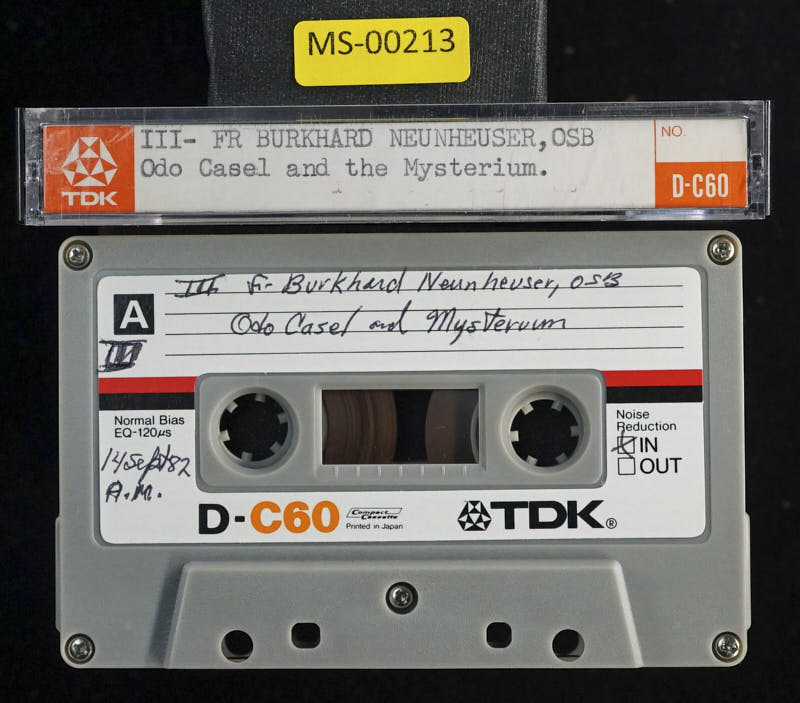
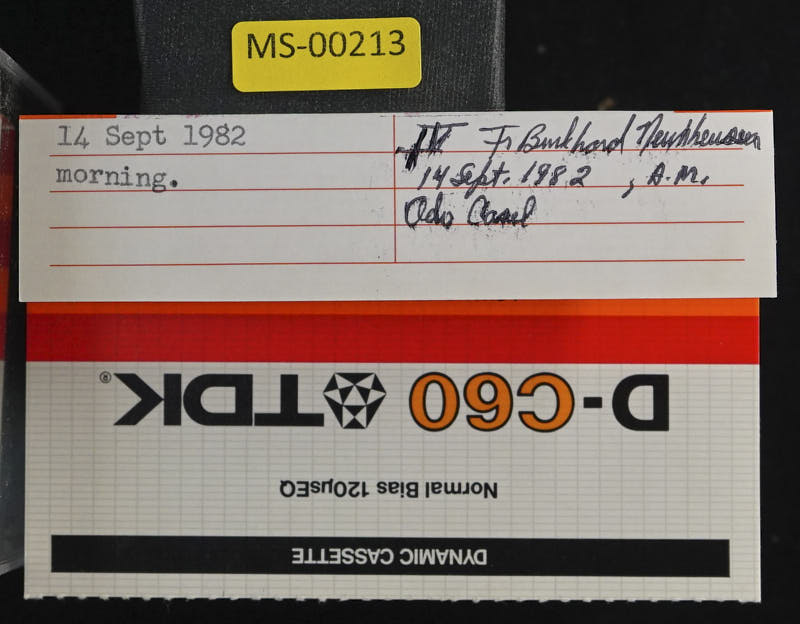
Speaker: Fr. Burkhard Neunheuser, OSB
Possible Title: Odo Casel and the Mysterium
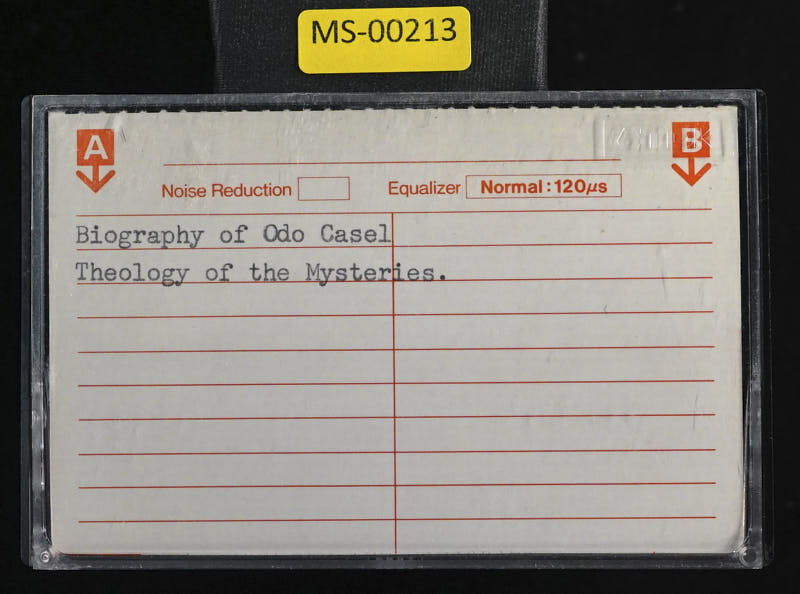
Additional text: Biography of Odo Casel, Theology of the Mysteries, morning.
@AI-Vision_v002
I tried, my dear, until now to speak about the spiritual world from which Father Damasus came to you. And before I could tell you a little bit more about liturgical spirituality and monastic spirituality, and then also in a special way about monastic Eucharist, I would like to tell you today... perhaps in a very dry way, some words concerning the monk who is in the middle of this spiritual world of Maria Laca, of that old times. And that is Odo Kassel and his theology of the mysteries. He is the monk who, guided by Abbot Ilde von Servegen and helped by him and all his confrères, stays in the middle of this theological world.
[01:01]
There is no doubt about it. Sometimes we are discussing the questions, who is the more important man, Abad Herwegen or Father Otto Kassel? Father Otto Kassel is surely the man who has given the greatest energy to our theological vision. But he would not have been this man without... who called him, as a young student from the University of Bonn, to become monk, who has given him all the opportunity to study, to prepare himself, and then later on, when he was developing his ideas, he was sustaining him, defending him, and sometimes also... that he would not be too radical and not too furious against the Jesuits and so on in a very peaceful way.
[02:06]
Therefore, a good synthesis of both. Shortly about his life. Born in 1886, he died in 48. He was monk since 1905. He studied first in Rome, in San Tancelmo. And the dissertation for his doctorate in theology was already a wonderful first beginning of his entire vision, the Eucharistic Doctrine of Saint Justin, Apologies. And then he could continue in Bonn, on the University of Bonn, his philological studies, finished by a dissertation written still 1917 in Latin. the Philosophorum Recorum Silencio Mystico, about the mystical silence of the Greek philosophers, where he also could give the first presentations of his special view of the word mysterion, mystical, mystic, mystic, and so on.
[03:18]
And the first fruits of this presentation have been the two excellent books in the collection Ecclesia Orans. Volume 2, The Memorial of Our Lord in the Old Christian Liturgy, translated also in French, Le Memorial du Seigneur dans la liturgie ancienne chrétienne. Marvelous book. And one of the great French Dominicans, the first directors of the Centre de Pastoral Liturgique de Paris, of Paris, the Père Duployer, an excellent man. Wonderful man. He said to me sometimes, the most excellent book of all the scriptures, all the works of Kassel is this first volume, Le Memorial du Seigneur, the Memorial of our Lord, where he is explaining, also already insisting in certain analogies to the Hellenistic pagan mysteries, especially in the first Eucharistic prayers, where he is seeing already the essence of his doctrine,
[04:29]
praying in these Eucharistic prayers in the Roman canon, in all the other anaphoras, we are proclaiming the mystery of redemption in the center of which stays death and resurrection of our Lord. And then in the more difficult book, but also important, volume nine, liturgy as celebration of the mysteries, where the analogy with the Hellenistic mysteries is more important still. And then later on, all his works in the yearbook for liturgical science edited for the first time in 1921. But since 1922, he was until his death for 26 years chaplain of this small monastery of the Sisters of Herstelle. It was a monastery of perpetual adoration.
[05:33]
And together with this excellent woman, which was the prioress of this house, Margarita Blanchet, he changed the orientation of this house. No more, Benedictine of perpetual adoration, worshiping the sacrament in silence. But... Abbey of Holy Cross, a real Benedictine Abbey, where they were celebrating in Eucharist as the sacred action in which the mystery of redemption is present. It is quite true that his existence, his life there for 26 years in these monasteries, hidden in the silence of these monasteries, where he did not allow nobody to approach him, if not... in special moments. And the sisters were always very much preoccupied to preserve the silence in the priesthoods.
[06:36]
The priesthoods, perhaps, Father Lambros has told this to you. Nobody could speak there. Nobody could make noise there. Always sacred silence. And then a wonderful way to say a mess every day. We learned there for the first time that one Mass every day is the greatest ideal, one Mass in which all are sharing, all are participating, not as we must do it in Maria Lark, celebrate 12 Masses in the same time, but one only, and so on. And he did it also in a wonderful way. We were admiring him there. And you know also then finally how he died there in the Easter night of 1948, He already for many years was celebrating the Easter liturgy on the evening, normally on Saturday morning, only in the evening during the night when it was dark.
[07:38]
And he liked it very much, helped by a noble father for us to be deacon. And therefore also in this year, 48, he came, was... announcing the new light, Lux Lumen Christi, three times, and then he received the blessing to sing the exultate, and he went to the pulpit, and he wished to begin, and at this moment he fell down, a stroke has taken him, and some hours later he died. And the sisters then remained... The sisters then remained... For the first moment, it was totally dark in the church, waiting, but what happened? And one of the sisters, the doctor in medicine, came immediately to help him in the sacristy. They were waiting, and only at the end of the visuals, continued by the upper father, they heard that he died already. It was a wonderful death, because he could die together with our Lord in the Easter night, in the hope of resurrection.
[08:45]
But no, the fundamental idea and results and ideas of these studies and of this work and these 26 years are more or less the following. In the beginning stays already the problem of the original understanding of the Eucharist in the doctrine of the fathers. So in a certain way, we can say the beginning for all the color was not the Hellenistic mysteries, the pagan mysteries, But in 1912, in St. Anthony, in Rome already, in this vision, how the old Christian fathers have seen the Eucharist. And surely they have not seen the Eucharist in the first moment as a sacrament hidden in the tabernacle to be worshipped. But they have seen the Eucharist as a sacred action in which the work of redemption is made present. That is the expression of St. Justin, of the first Old Fathers, and then in consequence too, to adore the Lord present in the tabernacle too.
[09:52]
But to join with this problem of the original understanding of Eucharist is also the problem of the relations between Hellenistic conceptions and the Old Christianity. We call... Because already St. Justin says, we have our mysteries, celebration of death and resurrection of the Lord, in our Eucharist. And the pagans, or the devil, the devil, the Satan, has imitated it in the pagan mysteries. St. Justin already has seen a certain analogy between both. And this strange expression that the devil has done it. But, therefore, Castle was insisting a little bit in this analogy. But two can show us that Eucharist in the first moment is not so much adoration of the real presence of...
[11:06]
body and blood of our Lord in the sacrament but the celebration of his death and resurrection that is the first meaning and the other is only the second point and two can show it he has said look there in the Greek in the Hellenistic in the pagan mysteries you have the same they are celebrating these mysteries two can participate in life and death of their divinities. And what is seen in a shadow in this Hellenistic mysteries that is given in the most wonderful and greatest reality in our Christian sacraments. And also he has seen in this time already the meaning the philological meaning of the word mysterion, the Greek word mysterion.
[12:08]
And also the strange way in which this word was translated by the Latin sacramentum. There is no reason to translate mysterion. What is mysterion? By sacramentum. Quite different. But he is insisting in the history of this relationship. And especially he did it in a very famous recension to a great book of a very long Belgian or French Jesuit, the Gelink, pour l'histoire de mon sacramentum. And in the recension made to this book, he is explaining for the first time the history, how the old translations, how the old Italy... Vetus Latina, the old Vulgata, is translating the Greek word Mysterion by sacramentum.
[13:10]
He used these problems also to explain the meaning of Mysterion to show us the reality of the presence of the redemption work in our liturgical celebrations. Therefore, In all these little bit strange studies, he says, liturgy is a sacred action, not only silent contemplation, a sacred action in which the walk of redemption is how it was realized in and by Christ is celebrated in thanksgiving prayer, in our analysis, in our memorial, but in a memorial which is not only a subjective remembering to that which happened at once, but in which the reality of that old time is made present today.
[14:15]
Anamnesis, memoria, according to the words of our Lord, duties in memory of me. According to the words of the Apostle, so often you celebrate so often you eat this blood and drink this wine you shall announce the death of our Lord proclaim and the meaning of this is then finally in this proclamation in this annunciation the work itself is given to you again it is very difficult to explain it but nevertheless he said so And we were receiving it, certainly also believing it. And also the liturgy itself speaks in the same way when, for example, in this famous oration of Plata, the Roman liturgy says, All the times that you are celebrating this...
[15:28]
memorial sacrifice, the work of the redemption, is realized again. And he was insisting in that in this realization of the redemption work, there is no repetition of the only one sacrifice of the cross. But this only one sacrifice now is given present. so that you stay in the presence of this work, that you can share in it, that you can be crucified with him, that you can rise up with him. And this all in a certain analogy to the Greek Hellenistic Mysteries. In both, there is given a certain analogy, which he calls... in a very difficult German word, kult eidos. Here the English translation in this book, The Mystery of Christian Worship, says so.
[16:37]
Every more clearly then, we see that the right form, a right form mystery, the definite form of worship, which the word and concept mysterium denote, is... wholly necessarily in the worship of the new alliance. It is not merely for the exterior service which is due to God from a visible community, but also precisely for the inmost and essential self-gift to God which is in the last end of all Christian worship. For in this new alliance, God has revealed himself to be love, and love is he seeks, not honor from his creature. A Christ mysticism is the real center of the New Testament ritual, the physical or realistic uniting of the church as the body or the bride with Christ, the glorified God-man, and with him to the Trinity so that God is all in all.
[17:40]
The other two forms, in Greek, eide, species in Latin, the other two forms... Those of prayer and sacrifice meet in the New Testament in the mystery form. Therefore, three ideas, three species, three kinds, three right forms are there. Prayer, sacrifice, and the most excellent, no mysterium. And mysterium, he definites it so. The mystery is a sacred ritual action in which a saving deed is made present through the light. The congregation... By performing the light, take part in the saving act and thereby win salvation. A very neutral definition. Valid for Greek, Hellenistic, and valid more externally for our Christian deeds, Christian celebration. Again, mysterium, or in Latin, sacramentum, is a sacred ritual action given
[18:46]
in which a saving deed, death and resurrection of our Lord, is made present through the light, the Mass, all the oversacriments. The congregation, by performing the light, take part in the saving act and thereby win salvation. And he insists sometimes also in the analogy to the pagan mysteries, following Clement of Alexandria, And he says here so, Clement of Alexandria, the great scholar and Hellenist, said that through the Logos, the whole world had become Greek. He once compared the ancient mysteries with those of Christ. He, Clement, did it so. He saw in paganism only deep shadows, after which light rose, which he greeted with Full of happiness, shire neon fools. Welcome, you light.
[19:47]
A very famous word of the old Greek mysteries. New light in Christ is coming. Before was only shadow. A first very feeble design of the coming as salvation. But those shadows we contours helped him in some way to express the new inexpressible wonders. And then he gives a citation of this book of Clement, the Potepticus admonition to Christian life. O marvelous, holy mysteries, O pure light, by torchlight I shall be brought to see heaven and God. I shall be made holy by the consecration. The Lord is hierophant, is the guiding man who is as a shepherd going before us. to show us the way. The Lord is hierophant. He brings the initiates to the light and puts his seal upon them.
[20:50]
He presents the believers to the Father that they may be kept for eternity. This is the thunder of my mysteries. When you wish, you may be initiated. Then you will join the circle of angels which surrounds the unbegotten, unchanging, the only God. God's progress will be our guide. So, as Clement of Alexandria, also he has seen in the shadows some help to understand the real light. And he did it especially, perhaps I said it already, the Protestant school, which had a certain influence of him, the school of the history of religions, of Harnack, of Reitzenstein, of Busset, and other people, has said, you see here the splendid... proof that Christianity is nothing else, especially Catholic Christianity, is nothing else as a result of syncretism with the Persian world.
[21:55]
The Protestants, this school, said the real Christianity is only the gospel, nothing of sacraments, nothing of sacrifices, only gospel, love, certain humanism. So... This school used this analogy to show that the Catholic Christianity is only a result of syncretism. He said, yes, there is a certain analogy, but helped by this analogy, I can show you the real essence of real Christianity. Celebration of the mystery of Christ, memorial of our Lord, always memorial so that we... stay in the presence of his work, given to us in our sacramental celebration, that we can share it, be crucified with Christ, and then be able to stay in love to life, to live in Christian charity. And this doctrine, explained by him in his book since 1912, 18, 22, 26, for us in these years, when Father Damasus and I have been in the novice in 1922,
[23:10]
23 was a marvelous revelation. To stay in contact with the work of Christ. To be united with him. And to find him in the reality of the Eucharistic sacrament. In the tabernacle too, but more still, really marvelous, in the sacrifice of the Mass, in the Holy Communion, to be united with him, to die with him, to rise up with him. We were happy in all this. Sometimes, I remember it very well, we were a little bit astonished that to understand it, we must speak about these terrible pagan mysteries. But then we put it away, only a first step, a first help. You can stay in these wonderful, spiritual, problematic mysteries of Christ, his death and resurrection. It was a wonderful time. And Father Gabriel... Father James has given me this first edition of Monastic Stodicts, still made by the Trappists at that time, with a recension of Father Damasus given to the edition of this book prepared by me.
[24:26]
You give a certain also, you know, that's due to me that I have done it. That is not important. And then he says, the work of Otto Kassel, through Father Damasus, developed in various stages. Through his philological studies at the University of Bonn, he became familiar with the research of scholars like Reisenstein, Busset, Litzman, and others on the relationship between early Christianity and the mystic religions of Hellenistic antiquity. This was to be his point of departure. In retrospect, one is inclined to regret the fact, since it immediately involved him in controversies that hindered the diffusion of his point of view and obscured his intentions, because he in no way said that pagan mysteries are the beginning of the Christian reality.
[25:28]
They are a poor shadow given by the mercy of God to these pagan peoples, to prepare the wonderful, authentic, absolute new revelation in Christ, where the reality of a cult idols, of a right-form mystery is given. He was accused of accepting the idea that the sacraments of the church were copied from pagan models and of advocating a new kind of piety, yes, that is true, based on the religious attitudes Reflected in these pagan mystery calls, you must imagine, we, the Benedict of Maria Locke, are trying to find a piety which is based on pagan mysteries. This is impossible. But we have known very well there is only a first step to come in the Christian reality only. Therefore, we were very grateful to Father Burkhardt to have edited the book again, of course.
[26:29]
Especially because we could join here some chapter of his letters to explain his ideas. To clarify his true thought on the relationship between the Christian and pagan mysteries. I, Damasus... particularly called the attention of the reader to the selections from conferences he gave to the nuns of Herstele in 1947. They clearly show how questionable is Fr. Louis Bouyer's statement that Domkazel from the first accepted and never discarded a theory about the pagan mysteries which has been worked out by the comparative school and which no serious scholar today would accept as Domkazel, as he says it in... You remember Bouilly speaks in this book with the greatest words of praise for Maria L'Arc against Solène and Thierry.
[27:33]
Luan Berboudou in Belgium and Maria L'Arc in Germany both have given a new life to all these things. But then he says, but why it is an analogy to the pagan mysteries? What Castle would like to find is possible to find it more easily without the pagan mysteries, based only on St. Paul. And in reality, the book which you have given to me, you know, the doctor's dissertation of a Franciscan father, Solbert, about the mystery of Christ, speaks about all these things only in starting with St. Paul. That's quite enough. We don't need the pagan mysteries, especially because pagan mysteries, what is it? We don't know much about it. And so on. St. Paul would be quite enough. And here, Bougie, in certain way, is right. But it's not necessary to insist that you can read it yourself, if you like.
[28:36]
So, this was the wonderful world of this time there. And I might insist again to show us, these young monks from that time, we in our liturgy, we find the immediate way to find our Lord, to be united with him in his passion and in his glorious resurrection. To be made able to live also in our daily life in the same way that to... every sin and egoism and only living for Christ who has given us for us by love that we live always for him but not everyone was thinking so and therefore after his first wonderful years in 26 was beginning this terrible controversy very famous controversy against Kassel until his death in a certain way not yet finished today and
[29:37]
Umberg, Jesuit of Innsbruck University, was insisting it's impossible to construct a Christian piety on pagan mysteries. Okay. Then again he was insisting in 27 there is no possibility to find this doctrine in the old patristic times. And then his confrere, the Jesuit Hansons in the University of the Geriana in Rome, 34, was insisting the liturgy does not speak about it. And then Father Brüm, a Jesuit also in Rome, insisted there is no possibility to prove this theory starting from the philological consideration of mysterion, translated in Latin sacramentum. And there were a professor of the university in Breslau, Poshman, a very famous patristic theologian, who said... There is no possibility to take St. Thomas as patron for the theology of Otokasel.
[30:42]
And there was finally a man you know very well so far as I know, the good man, Professor Fittkow, a man of charity who was working in the States for charity. Did not... He did not see it. He was fighting in wonderful expositions given in many years in the yearbook for liturgical science in 26, in 28, in 32, in 34, in 38, in 41, in all these 15 volumes. And these articles made this yearbook so famous that this yearbook, 15 volumes, is quite a new phenomenon in the story of yearbooks. that this yearbook now is given in the second edition already. In the last years we did it. He could always insist, especially in 26, that the old fathers has given this doctrine.
[31:48]
And this article is also translated in French. of the memorial of our Lord and then again in 28 in a great article not translated where he is defending the reality of his presence against all his adversaries and finally he was protesting against Poshman against other people and it may be allowed to bring you one text from John Chrysostom, in which he is speaking in a marvelous way, Chrysostom, in which he is speaking in a marvelous way about this sacrifice of mass, which is the realization of the unique sacrifice of cross. He says, what is there?
[32:48]
Do we not offer every day, unknown in that Latin Eos, Then he continues, I give him now the Greek citation. Yes, we are offering, but celebrating the anamnesis, the memorial of his death. And this anamnesis is only one and not many. Always the same, the same Thuzia or rather Marlon the Anamnesian or better we must say we are working the anamnesis the memorial of this one sacrifice he is insisting on the reality of this Eucharistic sacrifice at the same time he says yes real sacrifice and nevertheless it's not a sacrifice but only the anamnesis of this one sacrifice
[33:52]
Once made only on the cross, according to the chapter 9 to Hebrews, in one unique oblation he has saved us. And this unique oblation made on the cross is given to us in this, our Anamnesis liturgy. And St. Thomas, you can give the citation of him, of one of the questions in 40, 43, where he says, Christ has redeemed us on the cross, on the cross. And this work on the cross presently approach to every one of us. We are we are redeemed not so much by our Lord now existing in heaven, but by his work on the cross.
[34:58]
Because this work on the cross, presently, is taking us today. And Odo Kassel, against a very excellent professor, Gottlieb Söngen, who was very friend to him, nevertheless he said against him, and we are saved by him, not only because he has given us the effect of his work, but because the effect of his work is given to us by our unison, by being united to his crucifixion, to his A sacrifice on the cross. We must be introduced in it. The mystical reality of this, our unison to him. And so, united to him, in his oblation to the Father, in Christ, by Christ, with Christ, we are saved today. Yes, really.
[35:58]
That we can live in him always. Now, Nevertheless, with time, Kasel remained not alone. He has found every more friends who were defending him, seeing his last intentions. I give you some names. The first who, between the universitarians in Germany, was helping him, insisting in the greatness of his vision, was Gottlieb Söngen of the University of Bonn. And then... one of the great dogmatic professors in Germany, Michael Schmaus, was one of his defenders. And then the great French Jesuit, now today there is no more difference between Jesuits and Benedictines at this point. Jean Danielou, the cardinal. And also Karl and Hugo Rano, both great friends to him. And another cardinal, today the
[37:00]
President of the Holy Office in Rome, the former cardinal of Munich, Joseph Ratzinger. And then Protestants, Ploy, a Dutch reformed theologian who said, the doctrine of Kassel perhaps is of the same greatness and importance as in another kind, Karl Barth, a little bit too much perhaps. Karl Barth on the one side and here Kassel. And why? The World Conferences of the Churches in Montreal in 1963 has said it wonderfully. The doctrine of certain Catholic theologians, like Otto Kassel, can help us to see there is no repetition of the sacrifice, of course, how the Protestants always believe that we are teaching. But there is... actualization of the one sacrifice of the cross given to us today so that there is really presence without a new second sacrifice.
[38:07]
It's difficult to explain it, to understand it. But nevertheless, so is it. It's a miracle in a certain way. And another good Catholic professor, Erwin Isolo, in a work on Luther and the doctrine of Dr. Eck, the great advocacy of Luther, in the 16th century says, There is no anachronism to say the response needed in the 16th century to the critique of Luther, today is given by autocasm. There is no second sacrifice after the sacrifice, of course, which could redeem us, but there is only actualization, realization. And finally, it may be said, there was a certain critique given to castle by Pius XII in Mediato Dei, where he says the sacrifice of the cross is present in the liturgy.
[39:20]
Difficult way. Father Otto Kassel has read it. He did not see the critique. I am not touched here. But later on we have seen there is really also a certain critique on him. Therefore, after this mediator day, we said we are ready to accept this critique and to make the doctrine of Kassel sometimes a little bit obscure and not so certain to a doctrine which is clear and certain. We tried to do it in the years after his death in a certain way. And we realized so that the council finally said in these wonderful numbers in the liturgical constitution, number five until ten, Christ has redeemed us by in a work prepared in the Old Testament in the great deeds of God, And then, in last fulfillment, by his pascal mystery of his blessed passion and glorious resurrection.
[40:27]
And he sent his apostles to announce, to proclaim this mystery. There's already a certain great truth. But not only to announce and proclaim, but to actualize, to the exercerment, by the Eucharistic sacrifice and the sacraments. And then he says, therefore, Christ is present to his church in every liturgical action. first of all in the Eucharist, in the community, in the leader, in the wonderfully highest way in the transubstantiation under the species of bread and wine. But then in every sacramental action, because he is baptizing, in the proclamation of the word of God, because he speaks to his people. And also where we are praying, because where two or three are gathered together, I am in the middle of them. And therefore, every liturgical action is the exercise of the priesthood of Christ's body. And so every liturgical action is sacred action, the efficacy of which cannot be equal to every other action.
[41:36]
Non-explet omnium activitatum is not all the activity of the church, but summits and sources, and so on. Wonderful. probation, not of the anti-adoption of castle, because the council does not do so. But nevertheless, the main intention is taken by the council. And many other Protestants, good friends also of Father Damasus, William Stelin and Karl Barth himself and Peter Bruno, are going in the same way. And to finish now, I would say the main intention of this theology of the mysteries, or of the mystery of Christ, is the presence of the walk of redemption given to us in our liturgical celebration in the Church. The reality of our anamnesis, of our memorial, it is a memorial not only subjective, but a memorial in which the thing to which we are thinking now is given to us presently.
[42:45]
In the eucharistic prayer, where we are saying with the Roman canon, and memories, being, no, how do you say, being, reminding your blessed passion and your wonderful resurrection we offer. Reminding it. doing the analysis we are offering, we are able to offer with you, to you and in you. And then also we must say in this doctrine of Castle, he is insisting in the spiritual presence of the Lord in his word, not only in the sacraments, but in every proclamation of the word, there is already presence of our Lord. In every sacramental action, in the liturgical year, so that in all the great festivities, we are sharing in the entire mystery of Christ under the special aspect of this feast, in Pascha, of the totality, in Pentecost, in the fruit of the coming of the Holy Spirit, in the Assumption of Our Lady, so that we can participate in the work of Christ, as Mary has already shared in the last...
[44:13]
fulfillment in the bodily resurrection, and so on, every feast. And so, in this vision, we can get a synthesis of the entire reality of Christ, who is the mystery of God, realization of the saving will of God from all eternity. He realized this intention of God the Father in his incarnation and in his Pascal mystery, And this Paschal mystery must be announced, must be proclaimed and actualized in all our sacraments, in our daily hours, in our entire liturgy, in our prayer, in our daily life, according to an instruction after the Council where it said the intention of the Reform is to come to this reality in which... The liturgy is summit and source of every Christian life, ita ut mysterium pascale vivendo exprimato, so that the pascal mystery, death and resurrection of the Lord, could be realized in our life, vitally, realized in our life in the celebration and in our activity every day.
[45:33]
And that's all in the hope of the eschatological fulfillment in the eternal kingdom of God. And we may be allowed to join still a little story of Father Damasus. We were therefore very happy in this vision given to us by Father Odor Kassel in the 20th. In 38, 32, he passed nearly one or two months in Herstelle together with Father Odor Kassel. And he came back to Maria Mark and he said this with a certain emphasis. We are sleeping here in Maria Lark. We are speaking only about a mystery. And he, Father Odell in Herstelle, has seen again a wonderful last reality, which is the source also for the mystery of Christ, agape. Love. In that time, we were discussing, you know that, the book of Nugren, Eros, and agape.
[46:37]
And against this book, which has certain qualities, but against this book, which is too Protestant, we were insisting in the Christian vitality, Christian vision, Christian totality of Agape, which is not excluding totally also the eros of Plato. But Agape at least was seen there as the first source. The father has loved us first, not we have loved him. And he loved us when we were sinners. to give us the life in Christ Jesus, as we are hearing it today in the Gospel of the Exaltation of the Triumph of the Cross. And this agape of God is the source of all the mysteries, according to these words in the second to Sheldon chapter to Ephesians, Deus, Dives Incaritate, rich in his charity. because in consequence of his wonderful great love, he has given us the love together with Christ, he has resuscitated us together with him, but as together with him already know in the heaven, reality of the participation in this mystery of Christ.
[48:02]
And so, and now I must finish. we can say, through all this theology, we could come to understand perfectly, more perfectly, the words of the Apostles in the Epistle to the Galicians. I am together with Christ crucified. And so, I do not more live as I, but more Christ is living in me. And when I still are existing now in my earthly existence, I do it in the faith of this Christ who loves me and who has given for me his life that I too can live for him forever and ever in the hope of eternity. sometimes difficult.
[49:05]
@Transcribed_UNK
@Text_v005
@Score_96.08