You are currently logged-out. You can log-in or create an account to see more talks, save favorites, and more. more info
Living Awake: Integrating Consciousness Through Practice
Ordination
The talk explores the significance of the Jukai Ceremony, emphasizing the practice of receiving and embodying precepts rather than merely following them. It expounds on Buddhism not as a religion but as a philosophical practice aimed at understanding and unifying the various states of consciousness—waking, dreaming, and deep sleep—and how meditation facilitates this integration. The practice of meditation and rituals like Sashin are discussed as means to cultivate an expansive awareness and re-orient one's life towards Buddhist activity.
- Jukai Ceremony: Highlighted as a central practice for adopting the precepts, signifying the incorporation of these principles into one's life rather than mere adherence.
- Buddhist Philosophy: Described as a non-theistic framework that facilitates the integration of the waking mind, dreaming mind, and non-dreaming deep sleep towards holistic consciousness.
- Meditation: Positioned as a vital technique for understanding and harmonizing different realms of consciousness, transforming personal experiences into enlightenment experiences.
- Sashin: Described as an intensive meditation retreat that reconstructs and reorganizes memories, fostering the development of a broader, more integrated self-awareness.
- Buddha Activity: Explained as the essence of being, transcending personal identity through the deliberate practice of precepts, which facilitates engagement in divine activity or Buddha's activity.
AI Suggested Title: Living Awake: Integrating Consciousness Through Practice
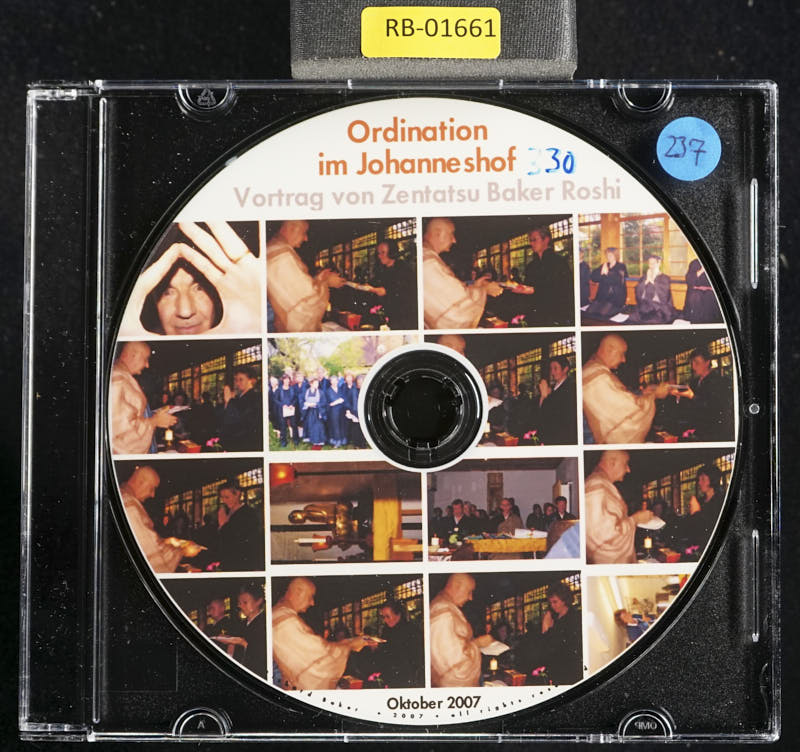
Well, thank all of you, each of you for coming to join our ceremony today. Nun, danke allen von euch, dass ihr gekommen seid und euch für diese Zeremonie heute anschließt. Somehow, on this day, we do what's called a Jukai Ceremony, taking the precepts. And we can do it on a day like this, which is the Jukai ceremony, which is the holidays. I've never given a lecture before. So I don't know how can I speak with the ordinary as well as with those of you who know very little perhaps about Buddhism. And so I don't know how I can speak both to those who are ordinated, as to those who have not been aware of it.
[01:01]
Now, the word Jukai is a Japanese word and it means taking the precepts. And that word Jukai, a Japanese word, means taking the precepts. Yes. Receiving the precepts. Also the precepts. Also die Vorschriften, die Gelöbnisse zu empfangen, sie zu nehmen und sie in seinem Leben zu halten. Die Betonung liegt nicht so sehr darauf, sie zu befolgen, sondern sie in deinen, in euren Aktivitäten zu halten. when you don't. Also so, sie informieren sozusagen unsere Affektivität, unser gelebtes Leben.
[02:09]
Und ob ihr es glaubt oder nicht, ist der Buddhismus nicht wirklich eine Religion. With bells and incense, it looks like a religion. I suppose in a societal sense it functions as a religion. But as a teaching, a philosophy, a practice. But as a teaching, a philosophy, a practice. It's not based on a belief in God or theology. That's what has made it so fairly easy for in Europe and America for particularly Catholic monks and other Catholics to adopt the practice.
[03:18]
Now, for those of you who don't have, you know, the idea of Buddhist practice, Zen practice, meditation practice is new to you. The simplest thing I think I can say, to give you some, I hope, feeling for the difference a Can you hear this guy? Can you hear this guy? Okay, alright. I mean, when I think of it, I say, it doesn't make sense.
[04:26]
What does a posture have to do with our life? We have an identity, we're born, we go through our life. Yeah, and that certainly makes sense if we think of life in terms of destiny or some kind of permanent identity. And that gives sense, insofern, when we live as a place, or as a place, or as an identity. But Buddhism is rooted in a pre-buddhist-indian recognition. The Buddhismus wurzelt in a pre-buddhist-indian recognition. That we're born with three... given realms of being alive. Waking mind, sleeping mind, or let's say waking mind, dreaming mind, and non-dreaming deep sleep.
[05:43]
And the impulse which led to Buddhism. And much before Buddhism. Why are we... What are these different realms? Why doesn't consciousness fully know dreaming mind? And is non-dreaming deep sleep completely inaccessible? Of course there's some overlap they all happen in our lived life. But consciousness only partially extends into, yeah, for all we all know, into our dreaming life.
[06:49]
So there was some kind of scientific sense. Can there... Can there be a way to know these three minds or bring them together more? Yes. Someone discovered that meditation does this to a large extent. It's almost as if someone said to themselves, three thousand years ago or so, I don't know the answer, I'm just gonna sit still until I find out. Yeah, and if we imagine such a possibility,
[08:00]
And when we can sit still, they found that mind and body weave together in a new way. And we can say that this Jukai ceremony is one significant recognition of this. And we can say, that the Chu-Kai-Zeremonie is a significant understanding of this. Now, we all have big experiences in our life. We all have big experiences in our life. We all have big experiences in our life. Yeah. I mean, the biggest experience is we're born. But after that, the experiences we have become more and more our own. But after that happened, are the experiences, which we make, more and more to our own experiences?
[09:06]
Yes, and you may remember, I don't know, the first time you crossed a street or something like that. Or maybe you remember, how you crossed a street or something like that. Yes, or some... meant insight or bodily experience of independence. And if you look back at those, the memory of those moments, and if you look back at those, the memory of those moments, often you'll see You can feel in your memory a kind of shining or light around such memories. The details are often quite clear.
[10:14]
They stay indelibly in our memory. And the details are often very clear and they remain so unauslöschlich in our Gedächtnis. In Buddhism we would say this is some kind of enlightenment experience. And I think we've all had various enlightenment experiences which usually we don't recognize as enlightenment experiences. I know in my own case there were certain realisational experiences and bodily experiences. Also Verwirklichungserfahrung, körperliche Erfahrung. I would say that now in retrospect. Which I didn't... Which I... Maybe I can say that practice is something like... I don't know what... Adding water to your life.
[11:30]
Und ich würde sagen... Vielleicht ist Praxis so etwas wie Wasser zu deinem Leben hinzuzufügen. Also wie ein anderes Medium, in dem man sich lebendig wiederfindet. Und ich glaube, diese Verwirklichungserfahrungen, die alle von uns zu einem bestimmten Ausmaß haben, we don't... We tend to forget about them or brush them off. And practice, you know, something that does something like give us this medium in which we can begin to anchor our experiences. And the practice gives us a medium, in which we can see our experiences.
[12:34]
Which even lift up, almost like our life is also a boat. So that our life lifts up or floats in a new way. So these experiences we have begin to make sense often after we start practicing meditation. Also beginnt diese Erfahrungen, die wir haben, erst für uns einen Sinn zu machen, oft nachdem wir erst angefangen haben zu praktizieren. Also das heißt, die Meditation führt nicht nur zu bestimmten Erfahrungen, sondern sie ergibt auch früheren Erfahrungen einen Sinn. Again, going back to posture. Okay, so... As I say, it's very difficult to sleep standing up.
[13:34]
It's much easier to sleep when you're lying down. It's much easier to sleep when you're lying down. And so the posture of lying down, reclining, is a posture in which the mind of dreaming and non-dreaming deep sleep appears. So there's an interplay between practice and the teaching. Some of us come to practice, men come to practice. so dass einige von uns hauptsächlich oder überwiegend über die Praxis zu uns kommen und andere überwiegend über die Lehre.
[14:48]
Und das Wechselspiel zwischen diesen beiden fängt an, sich zu vermischen bzw. zu verschmelzen, so dass sie miteinander And becoming intimate with each other, they begin to develop. As if your boat, the vessel of your life, begins to take sail in a new way. It begins to take sail not just in consciousness, but also in an awareness that's wider than consciousness.
[15:58]
that's wider than consciousness. Maybe it's some contrast between intelligence or rationality and wisdom. And you're... I don't know, I'm overstretching this poor metaphor. Also ich überdehne hier etwas die Metapher. But the wisdom begins to be the breeze. The wind of wisdom begins to reach the sail of your boat. So dass der Wind der Weisheit die Segel deines Schiffes erreicht. It's not that you're not conscious or rational. It's just that you feel a wider sense of being and that becomes part of our life.
[17:07]
So in some way the posture, the reclining posture Und so ist zum Teil die Haltung des sich hinlegens, in dem das unbewusste und das träumende und das nicht träumende Tiefschlafen anwesend sind, die werden also erhoben oder hineingehoben in diese Meditationshaltung. insbesondere dann, wenn du wirklich still sitzt. It's not just sitting, it's sitting still for some lengths of time, 30 minutes, 40 minutes. Not just sitting, it's sitting still for some lengths of time, 30 minutes, 40 minutes. It's the sitting still, whether you want to or not. And it's the sitting still, whether you want to or not. And it's the sitting still, whether you want to or not. Which takes the practice out of the realm of consciousness and personal decisions.
[18:11]
And I think all of you who do practice have discovered that... Yeah, I've discovered that a kind of new person begins to be present in us through practice. So that a kind of new person in us, in the future, begins through the practice. I mean, whatever our usual person is, the old person is still part of our life too. This particularly... We feel this often, particularly when we do Sashin.
[19:14]
Und das spüren wir ganz besonders dann, wenn wir Sashins machen. Und Sashin, da sitzen wir ja sieben Tage, keine Sorge, mit Pausen. Und ihr folgt einfach dem Zeitplan. And these machines, a few of them over the years, can and often does make us another kind of a wider person. A wider and maybe a wiser person. And it's interesting, because through a machine we not... only are different after Sashin. And it's interesting, also through a Sashin, we're also, it's retroactive.
[20:23]
Because it's, we're different before Sashin too. Sondern vor dem Sashin bereits sind wir auch schon anders. Because the practice of Sashin and meditation and mindfulness. Weil die Praxis des Sashins und der Meditation und der Achtsamkeit reconstruct our memories. Die formt oder baut unsere Erinnerungen. No, that's not quite true. Das stimmt nicht ganz. Reorganize our memories. Vielleicht reorganisiert sie unser Gedächtnis. Und entdeckt Verbindungen in unseren Erfahrungen, die vorher nicht sichtbar waren. Es verändert unsere Erfahrungen nicht, aber es macht sie lebendiger.
[21:36]
And the ability to sit still, most of the time for seven days. zumindest die überwiegende Zeit, sieben Tage lang. It's not really so difficult. Human beings can do it. It's not really so difficult. Human beings can do it. And it helps that there's quite a few other people around you watching. And it helps that there's quite a few other people around you watching. But it also gives you the simple strength to face things that we don't usually face. But it also gives you the simple strength to face things that we don't usually face. In fact, in the first few Sashines, there is a kind of rehashing, rehashing, to mix up again, of our memories, experience and so forth.
[22:47]
Yes. What else you got to do for seven days? All this stuff comes up. Was hat man sonst auch zu tun in diesen sieben Tagen? Da kommt einfach dieses ganze Zeug hoch. And after a while that tends to third or fourth Sashin maybe this tends to clear up. And nach einer Weile, vielleicht nach dem dritten oder vierten Sashin, fängt das an oder ist die Tendenz da, dass es sich klärt? It's a kind of psychological review of your life. And you can't get busy and not look at it because there's no busyness to do. Nobody rings the bell. I mean, you have to sit there and there... Yes. So it puts your life together in a new way.
[23:59]
And in a way, I mean, we can say this Chu-Kai ceremony is a recognition of that. I've decided... You're saying to yourself... You're feeling yourself... Also, du sagst und spürst in dir... I... I recognize and I'm putting my life together in a new way. A way that feels more complete to me now. Auf eine Art und Weise, die... And a way that feels more connected. More connected in fact to my past. And my family. Those of you family members here. And my family. And my family. And other people in the world.
[25:03]
It's a kind of satisfaction. Maybe deeper than happiness. Or is it a, perhaps, a peace, which is deeper than happy to be? So you... Okay, what's the first step? How do I bring this interplay of practice and... the teaching together? Well, I'll start with what it means to be... In the simplest sense of human being. And the Buddhism, as I said, uses these precepts as being more ancient than Buddhism. They are kind of elemental common sense.
[26:04]
They are kind of elemental common sense. And it's the basis for practice, for being a human being. And the basis also for Buddhas activity. So mostly our activity calls forth a you or a me. You know, a Buddha is not some kind of great human being in the past. Und der Buddha ist ja nicht ein großartiges menschliches Wesen aus der Vergangenheit. Natürlich gab es großartige menschliche Wesen in der Vergangenheit. Aber die Betonung liegt darauf, was sie tatsächlich zu großen Wesen gemacht haben, war die Buddha-Aktivität.
[27:09]
Und diese Buddha-Aktivität, Buddhas Aktivität kann Eure Aktivität sein. Und so ist die Zeremonie, diese Gelöbnisse abzulegen, wirklich heil bedeutet, wirklich in Buddhas Aktivität einzutreten. Phasing? Step by step. Phase by phase. Also das Gefühl, dass Buddha's Aktivität Schritt für Schritt sozusagen in dein Leben immer mehr eintritt. Yeah. And our intention, our decision that we hold through the precepts makes this possible. Yes, this is, dare I say so, this is a magic day.
[28:15]
It's also an ordinary day. It's also an ordinary day. And there's also an interplay of this ordinary day and it's also a magic day. Magischen Tag und dem gewöhnlichen Tag. In which nine of us are going to make this decision. [...] Yes, there is a kind of light around this day. Yes, you know, I'm going to give you a Japanese name.
[29:18]
Why a Japanese name? Well, because I don't know how to give you an English or German name. It's like when you translate American Indian, Native American names into English. Red feather shimmering lake. I don't think any of you want me to call you red feather shimmering lake. Some of you might like it. Some of you might like it. I had a friend who called himself for many years bird brother. Yeah. But actually in Japan, at least there's a 2000-year-old tradition of how to give these names. But at least in Japan, there is a 2000-year-old tradition, these names to give.
[30:24]
And I know how to do this, so I'll give you a Japanese name. And in Kanji characters, it's Chinese and Japanese. And it'll be something that has a presence in you. And it'll be something that has a presence in you. And it'll be something that has a presence in you. and will have some meaning in the Sangha. And maybe it will free you from the sense of any name. Or how even each moment is a kind of name. Each moment calling forth Buddhist activity. Thank you very much.
[31:34]
@Transcribed_UNK
@Text_v005
@Score_58.13