You are currently logged-out. You can log-in or create an account to save favorites and more. more info
Divine Mercy and Human Sin
AI Suggested Keywords:
Psalm 50
This talk explores Psalm 50, emphasizing its meditative role in illustrating the themes of sin and divine mercy. The discussion begins with the context of David's sin, as described in the Second Book of Samuel, elucidating how the psalm reflects the communal and personal acknowledgment of sin akin to Adam's. Emphasis is placed on the invocation of God's mercy through the terms Canaan, Chesed, and Raham, highlighting the multifaceted nature of divine compassion. The speaker examines the introspective confession of sin within the psalm, noting the importance of recognizing personal and national transgressions before God. Furthermore, the invocation includes a plea for spiritual cleansing and renewal, reflecting a heart aligned with divine wisdom and truth, paralleling the New Testament themes found in St. Paul's writings, specifically Romans 11. The analysis culminates with a discussion on the psalm's role in the Jewish and Christian liturgical context, underscoring the intertwining of human sinfulness with divine grace.
Referenced Works and Texts:
- Second Book of Samuel, Chapters 11 and 12: Provides the historical context for David's confession and the supposed origin of Psalm 50.
- Psalm 50 (Miserere): Central to the discussion, revealing the dichotomy of divine mercy and human sin.
- Exodus 34: Cited to illustrate the self-manifestation of God's mercy after the Golden Calf incident.
- Other Psalms (Psalms 85, 102, 144): Referenced as iterative examples of divine mercy found throughout the biblical text.
- Romans 11 (St. Paul): Parallel themes in the New Testament regarding sin and divine mercy that resonate with the psalm's teachings.
- Numbers 19 (Law of the Red Heifer): Discussed to illuminate the purification rituals mentioned in the psalm.
- Canticle of Deborah (Judges 5): Examined as an illustration of the spirit of devotion and sacrifice mentioned in the psalm.
- Titus 3: St. Paul's epistle referred to in discussing the spiritual renewal called for in the psalm.
- Wisdom of Solomon 15:1: Quoted to emphasize God's benevolent nature amidst human shortcomings.
Key Themes:
- The invocation of divine mercy and its significance in the understanding of human sin.
- The nature of confessional acknowledgment and the doxological proclamation of God's justice.
- Deep introspection and the heart's alignment with divine wisdom, reflecting similar insights found in New Testament theology.
- The liturgical and communal implications of the psalm in both Jewish and Christian traditions.
AI Suggested Title: Divine Mercy and Human Sin
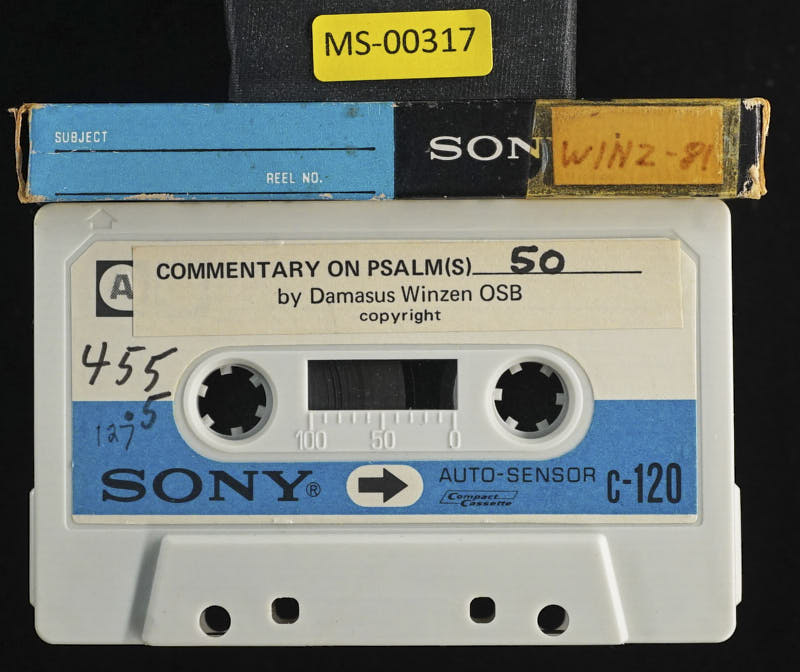
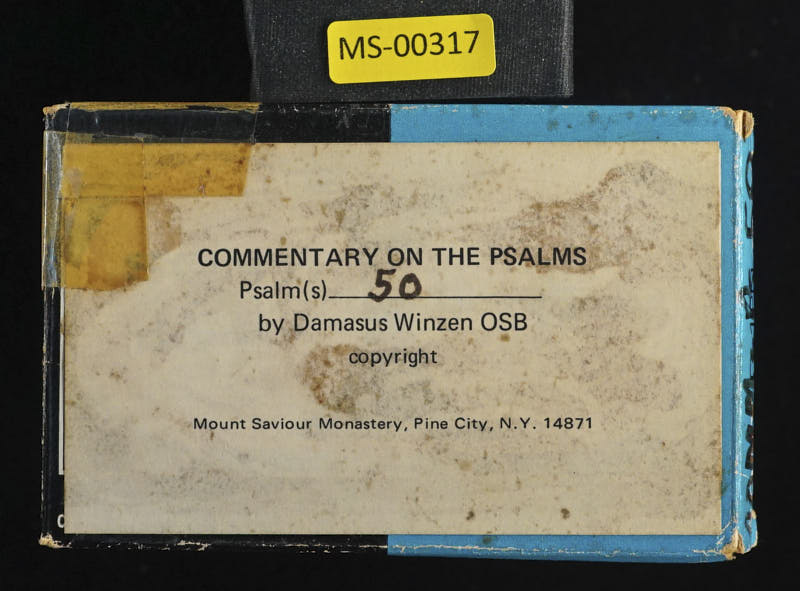
AI Vision - Possible Values from Photos:
Speaker: Damasus Winzen OSB
Location: Mount Saviour Monastery, Pine City, N.Y. 14871
Possible Title: COMMENTARY ON PSALMS 50
Additional Text: copyright
@AI-Vision_v002
So, in, in, in, say, one of the brethren had asked me in connection with the conference on the hearts that we had last Saturday to maybe explain the SARP And I think we have done that once in the past, but maybe we can try it again. Just seeing in it an example of that interiorness which we were speaking about last Saturday. So let's start.
[01:06]
I think an important thing here is first the introduction or the heading which in first one and the first verse sets up as it were the situation out of which This psalm was born as the confession of David at his personal and his great scene with Elizabeth and Uriah. And I think it's good. Of course, these things are probably not historical, but they have a still a great value because they, you say, throw light on this.
[02:16]
We must always think that if, let us say, it may not be right and it's not a part of the exact explanation, exact explanation of the psalm to put it, you know, into this situation as which is depicted to us, explained to us in the second book of Samuel in the 11th and the 12th chapter. Nevertheless, the people who, let us say, put it there and put the psalm into this connection did it out of a very deep insight contemplative insight into the whole workings of holy scripture and it may very well be that the psalm is really in and has an inner connection
[03:32]
not maybe not historical I mean that David now at this moment as his confession of sin his acknowledgement of sin has sung the psalm you know or that the psalm came out of him in historically in remembrance of this situation but maybe personally but still You know, the whole tradition, the whole, the basic, I want to say, thoughts and feelings of the chosen people, of course, are bound up with the whole history. Also, and especially of David. And in David, the general faith and the general spirit of the nation is reflected. and the nation breathes and thinks and plays through him as the leader, so that certainly this is sin and this is conversion plays not only, let's say, a historical role, but a typical role, and this, as it were, present in the whole development and through the history of the chosen people,
[04:56]
and in the history of every single Israelite. So that David's sin is in some way not only a personal sin, limited to him, but it is in some way like Adam's sin. It is a sin in which the whole people and every single Israelite in some ways is involved, in which he sees himself. Therefore, I think that connection has a deep meaning, meditative meaning, not, let us say, in the historical sense in which we conceive history today. So, therefore, it is good, you know, just to refer to the situation. And, you know, it is Nathan who comes then to David and tells David a parable of the poor man and the rich man and the poor man has this one lamb and that lamb becomes and he is a child of the household and it grows up in his lap and his whole soul is bound up with this lamb then comes the rich man and instead who has all everything he wants instead of taking one of his own lamb takes away
[06:25]
the lamb of the poor, in order to slaughter it and prepare a meal for a guest. And then David, in listening to that, gets all excited against this man and says, this man is worthy of death. And after that moment, Nathan says, that you are the man. You are the one who has done patch. But in that moment, that again is one of these typical moments of awakening the sudden awakening of the heart suddenly the deeper region of the heart is touched is pierced and the inner reality comes to life so therefore David expresses that inner reality as he sees that in that moment of awakening Repentance, I have sinned against the Lord.
[07:29]
He says, I have sinned against the Lord. So that is the last in our spiritual theological reality of what he has done. I have sinned for the Lord. And this acknowledgement, this confession, brings about the divine pardon, not, however, a freeing of the divine punishment, as you know. So that is the situation, you see, and therefore the whole psalm has to be seen and can be seen right in that light. It is the voice of a howl that suddenly through, in a mirror, sees its own true reality before God. And that reality is sinful.
[08:30]
So then from that starts then the text. And the first is the invocation. That is in Psalm 3 and 4. The invocation. I would say that one of the... The characteristic notes of the whole psalm miserere is emphasis. It is emphatic in every respect, in every one of its various parts. Emphatic. It is non plus ultra. It is going to the utmost in every direction. And first, this emphatic nature of the psalm comes out right away in the first invocations. Invocation. Be gracious unto me, O God, according to thy mercy, according to the multitude of thy compassions, lock out my transgressions.
[09:42]
So the essence of this invocation consists in the empathic calling upon Jahwe as the Savior God, under three aspects, which, as you know, do not come out in the present Vulgate translation, miserere mei deus ecu normam misericordia tuam, The three are essentially the same in order. That are, of course, synodem. Not however that way in the Hebrew text. That is the first thing that we have to remember. But this invocation is in itself in a remembrance or renewal of the self-manifestation of the mercy of God in its infinite richness and all its various facets, which we find in the 34th chapter of the second book of Moses, the Exodus,
[11:02]
in the manifestation of the mercy of God to Moses after the sin of the golden calf. And there the name is proclaimed, and that name of God is mercy. But in all various shades, and you know that those things come up again and again in all various, also not only in Psalm 50, But in all different Psalms, as for example, I noticed here, noted down Psalm 85, Psalm 102, Psalm 144. Then also in other places, as in not only Exodus 34, 6 and 7, but also Numeri 14, 18. and 2 Kings 23. So it's a thing. It's one of these red threads that goes through the whole of Holy Scripture.
[12:05]
Joel 2.13, Ecclesiasticus 2.13, Jonas 4.2, Wisdom 51. Oh, I have forgotten the Holy Scripture. We have that here. So, therefore, these three words which are mentioned here are the three key words to denote the mercy of God, and that is Karnal, and that is Kesed, and Raab. Those three, you know them. Chanan, Chesed, and Raham. Yeah, Chanan is, or Chenen, you know, is what we could translate it as favor. The Chesed is law, and Raham, or Rahamim. It's usually misericordiae. It's the plural, Rahamim, which means compassion.
[13:09]
And the three signify three relations, three relations, let us say, of mercy, of goodness. One is of the mighty one towards the one who absolutely depends on him, to his servant, the king to his subject, the master to his servant. It's that in connection, I can't explain it, but in the Hebrew, Language, it is that, let's say, a cloud, you know, a rain cloud which goes high, you know, sails over the country and then lets down the rain at a spot, you know, crying for water, a favour canal. How would you write that canal? Oh, it's always the root word, you know, root. It's he or ha, h, you know. H-N-N.
[14:13]
H-N-N. The other one is H-S-D. Here's it. And the other one is R-H-I. Those three, whatever that may help. The important thing is, you know, that you see that. You know, the first is... The invocation, you know, the Lord David, or the one who sings in the psalm, proclaims himself, that is the implication, as the servant who entirely depends on the favor and grace of the king, because he is the sinner who has lost every right, and therefore entirely depends on the king. Therefore, it's also at the same time a glorification. We will find that later, that same.
[15:14]
So the favor of the mighty which the poor or the slave or the subject invokes and in which he is conscious of his own helplessness and extolts the glory of the one whom he invokes. Then the next chesed That is usually, that is translated, you know, as love or as mercy. I think in our usual English translation, it's mercy. Yes, it is, as you know, the covenant love. Yes, it is a love, for example, between two people who are essentially on the same level. Bride, groom, and bride. are united to one another through chesed. The marriage, you know, is a chesed relation. It's a covenant relation.
[16:15]
It's that relation which makes Yahweh the bridegroom of Israel by a covenant which God has made with his people. Chesed. So therefore, that is the second thing that David, that's the song in the book secundum be gracious unto me, have favor on me, according to thy chesed, thy covenant love, thy mercy. See, it's lifting up. Now, the one who asked, the sinner asked, reminds, as it were, that he is an Israelite, and that in Israel, as an Israelite, he is a member of the covenant, that therefore God is his friend. that God promised his loyalty to him. And therefore that is what he calls upon. And then the last and the strongest, according to thy mercy, according to the multitude of thy compassions, that are the wahanim or misericordia.
[17:26]
That is a good translation. Misericordia, that means the core which is turned to the miser the heart which goes out, reaches out to the poor one but in the specific relation of the soul that the whole inner how could I call it, you know, that the whole inner, the viscera, you know, that's what St. Paul always, amo vos in visceribus Jesu Christi, I love you in the viscera Jesu Christi, in the inner parts of Christ, you know, that means that is, of course, taken from the mother, the mother who gives her own inner life, as it were, to the child, and clothes the child with her own flesh, and brings it forth out of her womb, and therefore loves it really and truly as a part of herself.
[18:48]
And that is here Rahabhi. It's the motherly love. It's God is Jareh insofar as Israel is his son, his child, and therefore part of his innermost heart. So you see that, that is, I just give you that as a typical example of right in the beginning of the Psalm of the emphatic nature. the constant, the instant prayer here, going step after step, turning to the power and glory, turning to the love of the friend, and then turning to the motherly love, in which, as you know, Isaiah has described it, that I shall love you as a mother who
[19:51]
loves her child and dangles. Isn't it how? Dandles. Dandles her child on her knees. Isn't it funny? So that is, therefore, that is the invocation. Beautiful. The mother and child which she has for the child of her womb. So you can right away, you can see, you see that the one who, the sinner who cries out in this way, cries out in the fullness of faith. The fact of his sin, you know, does not mean, does not mean to him that he is completely cut off. That is the beautiful thing in Wisdom 15.1, I think, which could be mentioned in this connection and which illustrates the thought that is behind the psalm in which it says, But thou, our God, art gracious and true, patient, and ordering all things in mercy.
[21:09]
For if we sin, we are thine. knowing thy greatness. If we sing, we are thine, knowing thy greatness. That is a very exact, beautiful description of the situation here of the psalm. If we sing, we are thine, knowing thy greatness. Beautiful. One could put that as a motto for the whole psalm, miserably. So, and then of thy convention, Blot out my transgressions. My transgressions, that is, my crimes. Right away, here comes now the other emphasis. And that's the beauty of it, you know, that you must understand that these two things are together and are put right together in the song. The absolute thing in thee.
[22:12]
infinite mercy of God in all its various aspects as favor as friendship as parental love and then together with that immediately the sin of man and the sin of man in its abysmal badness you know is emphasized just the same way Blot out my transgressions. Basha. Basha means the crime. It is that crime which means rebellion against God. And in that way the separation from God. Los Reis. Separation from God. Tearing oneself away from God. Rebellion. So the strongest expression of sin right there in the beginning, confronted with the emphatic proclamation of God's mercy.
[23:25]
But then this same emphasis and emphatic character is continued then on the line of sin in the following verse. Wash me thoroughly from mine. Of course, he is always difficult here of the English language or any translation. Iniquity. Cleanse me from my sin, for I know my transgressions and my sin is ever before me. But you can at least, you know, just reading and listening to the English text or whatever translation there is, you notice the one thing and that is constant retreated expression sin, transgression, iniquity, whatever we can mobilize in the English language, which in these finer things is not as versatile as the Hebrew language is. So, wash me thoroughly from my iniquity, cleanse me from my sin.
[24:30]
Now, it may be difficult to say exactly, you know, determine But again, one thing is true. Wash me is an external action. Cleansing is an internal action. And to that also, here, the words and the expressions for sin correspond. Sin is always a disturbance, a disturbance of order, and therefore a manifesting, a thing then in some way, you know, becomes... Manifest and is known and realized by others. Sin is an aberration from the path, you know, and therefore is a disorder and is as soon as it is realized. Wash me from this sin as an exterior, as a visible manifestation, disorder.
[25:32]
cleanse me from my sin, there, that word which is here used in the Hebrew, denotes the inner stain, which is the disturbance or the inner in our relation to God. Let us say that inner uncleanness of the heart, which sin involves. The sinful man is not more anymore as that, as we could say, in the truth of God. He is interiorly, he is state spoiled. And that is expressed here, cleanse me from my sin. Cleansing is that expression that we have so often in the Pentateuch. And then comes, after that, this here is the invocation, these two.
[26:36]
Then comes in 5, 6, 7, and 8, again, the emphatic confession or acknowledgement. Emphatic acknowledgement of sin. This emphatic acknowledgement of sin has always, in the... psalms in the Old Testament, there's always two things which we should keep in mind. We would say the confessio, the act of confession, the acknowledgement of sin. One is the yes, I am a sinner. And express that in all, in saying all is there. And then at the same time, the confession is also there and connected with glorification of God's justice.
[27:40]
That is all as those two things, you know, always go together and make the fullness of the confession in the old sense. confession in the old sense is not only the acknowledgement of one's own personal state or deed, what one has done, one's own personal guilt, but it always also goes together with a declaration of the justice of God. That is what, of course, not only a thing which is common or which is expressed in our religious relation to God, but there is also a thing which is part of any juridical, forensic process of law. I think if you go, you know, to those happy times, I don't remember them very well anymore, but I still reread
[28:47]
read and translated in the sweat of our, what exactly, Braus, Lysias. You know, Lysias, his, you know, the famous advocate, you know, and his speeches in favor of his clients. And that is always the standard element. Of course, in the juridical court, you know, it's a standard part is the, let us say, the glorification of the justice, equity, and goodness of the judges. But then, of course, earthly lawsuits and Politics would require that the guilt of the accused is either denied or is toned down or is, you know, in some way covered up, you know.
[29:57]
I mean, that belongs to, but not so before God, you know. Of course, before God, the acknowledgement of his justice exists emphatically And the acknowledgement of sin. Both in fact. And that is what you see here. For I know my transgressions. That is acknowledgement. And that is in fact. I know my transgressions. God has always known them. But now I know my transgressions. And this my acknowledgement and my knowing. is not only a passing thing, and that is again what I would call in the line of emphasis, that it is, you know, the realization of one's sin may be something that is there for a moment, and the next moment it is forgotten.
[31:01]
No, the one who prays here, and my sin is ever, It's not only like a cloud, you know, that disappears as soon as a little light falls on it, but my sin is always, is ever before me. That's, of course, the true essence of humility. And then that is what St. Benedict also asks, you know, and asks of the monk that he should be constantly consider, you know, and be aware and constantly repent his transgressions. Therefore, I know my transgression and my sin is ever before me. Against thee, thee only have I sin. Against, again, emphasis on the one hand, you know, I know my transgressions. and my sin is ever before me.
[32:06]
That is as far as I am concerned, you know. The radical acknowledgement of sin. Then the other, against thee, thee only have I sinned, and on that which is evil in thy sight, that thou mayst be justified when thou speakest, and being the right Renkau judges. Now that is what we call doxology, forensic doxology. That is right here. See, you have therefore the emphatic statement of the personal sin, right away connected, you know, with the emphatic of the statement that this, my sin, which I deep into the very roots of my being, remember, is directed against me.
[33:08]
That is the essence of it. It's rebellion against you, O God, and you alone. And therefore, that is now the thought which enters into the heart of the sin of Christ here in all his death I have sinned against you and what is that my king and it is the bridegroom of my soul and that is my father and my mother against thee thee only have I sinned and done that which is evil in thy sight By the way, this verse is a verbal allusion to the 2 Samuel and the 11th chapter. That thou mayest be justified when thou speakest and be the right when thou judgest.
[34:11]
There is a little diversion here in the understanding of Lema'an. Lema'an. which is the term, thatst thou, can have two meanings. Usually it is in that word, thatst thou mayest be justified. But it can also mean, and therefore are you justified when thou speakest, and be in the right when thou judgest. The meaning, however, is, you know, always this, that the one who here realises, you know, I have sinned against you, you alone. And he thinks about who God is, whom he through his sin has offended. And therefore you will be justified when you speak.
[35:14]
That is the glorification of the judge. That means... realizing that i have sinned against you and that shows me the depth of my sin it also opens to me that vista and that horizon of your justice which i completely acknowledge which i completely surrender to and that again of course has to be seen you know in that same in that same connection in which the whole psalm has started. The justice of God in the Old Testament is never and only, let us say, is simply forensic justice of the letter. Never. But that justice, Sedeca, is
[36:17]
Never separated from love. Never separated from love. So that this surrender to God's justice, complete, absolute surrender to God's justice, is also filled with deep hope, even with the realization of salvation. You be in the right when thou judgest. But certainly it is that inner... feeling, that inner realization, that this sin against God, you know, also will be used by God for something better, to his glory. That this sin that has been committed is in some way, therefore, in some mysterious way, is Felix Kulpa. Through God's justice. And we result in God's glory, serve God's glory.
[37:22]
So, but that does not mean in any way to explain away or to diminish or to gloss over the nature and the gravity of sin. Behold, I was brought forth in iniquity. And in sin did my mother conceive me. Therefore, see, the process of confession goes further from, let us say, a single deed. It goes to the inner root of that deed, to the general condition, into the being of the sinner. And the being of the sinner is, in that way, alluded to, I was brought forth in iniquity and in sin did my mother conceive me. That means that the tendency to sin is something which is inborn in me, which I find there when I really and sincerely look at me.
[38:36]
I find that as an inner part of myself. There is that what we call... in the language of our theology formes peccati that inner tendency which is the more I descend as it were into the depth of my heart and use God's justice as the light which helps me to self-knowledge the deeper this I see that this Single deed points and is rooted in something that I am, that in some way is identical with my whole being. Behold thou desirest truth in the inward parts. Make me therefore to know wisdom in my inmost heart.
[39:39]
The mere man descends, as it were, into himself and into the ontological sinfulness in which he sees himself entangled, bound up with. And in this attempt, as it were, to plumb the whole depth of his heart, in this tendency and in this desire to be before God, absolutely truthful then here in this innermost secret of his personality then he discovers he sees what is called here the wisdom in my inmost heart make me therefore to know wisdom in my inmost heart a revelation takes place a light is coming up is the wisdom
[40:40]
It is that light which, to me, is also visible and described by Paul. In our way, it is that I think that Romans, if ever. Romans, if ever. Just at this place where I want to go. For as you also at one time did not believe God, but now have obtained mercy by reason of their unbelief, then.
[41:48]
So they too have not now believed by reason of the mercy shown you that they too may obtain mercy. Then comes that, For God hath shut up all in unbelief, that he may have mercy upon all. I think that verse of Holy Scripture could well be taken as an illustration in the light of the New Testament of this verse which here occupies us at the moment. Make me therefore to know wisdom in my inmost heart. The inmost heart has in some way been revealed. I was born in iniquity. That is, let us say, the depth of the heart. The realization of sin as an ontological part of it. as in some way something inescapable, identified with me, not only as an occasional transgression, but as a status.
[42:59]
Now, for God has shut up all in unbelief, that he may have mercy upon all. And then comes that canticle Oh, the depth of the riches of the wisdom and the knowledge of God. I could well think that St. Paul, even in writing this, had just this verse of the psalm in his mind. Show me wisdom in my inmost heart, where I'm faced, you know, with the sin as status where the wisdom comes. And that is... has shut up all in unbelief that he may have mercy upon all. O the death of the riches of the wisdom and of the knowledge of God! How incomprehensible are his judgments, and how unsearchable his ways!
[44:03]
For who has known the mind of the Lord, or who has been his counselor, or who was first given to him that recognition should be made in? from him and through him and unto him are all things. To him be the glory forever. Amen. That is also the depth of noses that we reach here in this verse. Now, that is the end then, let us say, of the acknowledgement of sin. That was Let's say that was the second part of the sound, the first part, the invocation of God's mercy. The second part was the confession. And that goes down to verse 8. And then comes from verse 9 to verse 11, the prayer for forgiveness.
[45:08]
But we have to... But here's some titty, which such. The only characteristic which is so evident when we look at the psalm is call the emphatic character. That's why the way is evident through the whole way of speaking, the accumulation of terms to express the greatness and manifoldness of God's grace and love for us, then to express
[46:20]
the dip and all the various shades of human sin and then also to celebrate the liberation and the new man which rises out of this crisis of repentance and of restoration. So we divided the psalm in those various little paragraphs. First, the emphatic invocation, misereere mei liu secundum, vange da misericordiam tuam secundum multitudem misrationum tuarum. Right away, the three of those various... shades and nuances of God's love for us. Hence then the emphatic cry for forgiveness.
[47:29]
Dele iniquitate mea, destroyed by apostasy. It's really apostasy. That is the strongest word right away. They are chosen by apostasy. iniquitate mea. Then, ambrius lavame ap iniquitate mea. That means, completely wash me. Ambrius lavame ap iniquitate mea. Iniquitate there is more the, in other Hebrew expressions, more the, it says the, the German one will say, die Kröme. In the, fail the external offense, the offense, the going off the track, the going off the track. While peccato mia peccato meundames, then the internal disorder, the internal uncleanness before God.
[48:38]
Conia iniquitate meam ego conosco. Again, you know, in fact, Because I, solemnly, I acknowledge my sin. I would say acknowledge this sin as mine. It became to meum contra me as sempre. Always one emphasis out to the other. And my sin stands up against me all the time. Then again emphasis. My sin is in last analysis a crime against you. You I have offended. Before you I have gone wrong.
[49:43]
which used to be jealous and their monibus to his advincas communicas. Right away, when he sees that, which is, say, the climax, you know, of his recognition that he has sinned against God, then right away there, too, it dawns on him that, naturally, human sin and the offense against God is... permitted only for the manifestation of God's glory. That the justice of God will stand out more gloriously against the sin of man. I am conceived in sin.
[50:56]
That means sin is not only, for me, is not only the actual deed, but it's a deep, inrooted, inner, deeply rooted, inner inclination. Our whole being is affected by it. Sin, therefore, is not only a case, but it is a situation, a habit, so to speak. So this constant, more and more, deeper one can say, appropriation of sin. Whatever I do good, it's you, doesn't it? But far too bad, it's me, as we say, also in the rule. But this is, of course, important because that is then the condition under which later on the appeal is made.
[52:03]
Comundum crea in me, Deus. Create in me a clean heart. So this is the acknowledgement, the identification of man, the soul of the word of praise, with sin, with his sin. Still in this depth of acknowledgement of sin, There then also dawns, just as before. In some way, an anticipation of that beautiful word of St.
[53:05]
John. Yeah. Leave your heart accuses you, God is greater than your heart and knows everything. In this deep identification and depth of this acknowledgement of sin, still the human heart is deeper. Still never can it get away completely from, as it were, the grips of God. God always has it still in his grip. Out of that, of this deep recognition of one's own sin, not despair follows, not despair, but the recognition of the Sapientia Divina, of that
[54:08]
of that eternal love with which God has decided to turn his face the face of his grace to man in his sin while we were sinners you have sent your son to die for us that is of course the depth of God's wisdom St. Paul, I quoted that last time, I think, to you, the 11th chapter of the Romans, you would have sealed or shut up everything under sin, that you may also have mercy upon all things. So the depth of God's wisdom is what we call God's great mysterium. Mystery of salvation.
[55:10]
And then mystery of salvation manifests itself just in the depth of our self-accusation. If it is the right self-accusation, if you accuse ourselves in the light of God's love for us, and not in the devil's light. You know, we have spoken about that so often. One can approach oneself with the eyes of the skeptic and with the devil's eye. And one can say, now let us see, is there really? Do I really and truly love God? And already in that question, somehow the answer is already contained. The devil whispers into my ear, you are the victim. of a self-illusion. Your faith is only an escape from yourself.
[56:15]
You project your pious wishes into a reality. You call it God and you call it your divine image. But all that are illusion. Your reality, your reality is different. You don't really and truly Love God. It's true if you look at ourselves with the eyes of the one who hates us, the eyes of Satan. Just as I also can get, you know, stuck in somebody else who might look at with the eyes of the accuser, the eyes of Satan. I pick up all the signs which show a devil's image. in this man and in that way I destroy him in my judgment interiorly but this psalm of course started with the acclamation miserably have mercy on me O Lord according to your grace according to your love according to your motherly compassion
[57:35]
So with that emphatic acclimation, all sound stops. That's never, never lost sight of. But you see, though, that's the important thing, that we don't get that mixed up, that the acknowledgement, the solemn acknowledgement of God's love does not gloss over Our human sinfulness. See, that is the whole distinction between the kingdom of God and the kingdom of God's grace and human philanthropy. Soon as I look at things in the eyes of human philanthropy, I say, first of all, there cannot be any God who would, you know, in any way condemn anybody And hell doesn't exist. And at the same time, then, there's also the same idea, you know, that, oh, no human being is so bad, you know, to say ever to deserve hell or anything like that.
[58:47]
You see, there are these false idols, you know, these false, distorted images, humanization, really, of God's love. But in the truth, of the revealed faith those two things go together as it were fullness of God's supernatural love and grace and the recognition of the true death of our sin grace on God's side mercy and redemption and the acknowledgement of our lostness how I have business those two things are the two abysses which call upon one another abysses abysso people the abyss of God's grace and the abyss of human guilt that is beauty also the beginning of this song that both these things are there and that is what we call
[60:00]
Confessio, confession. A confession which is the confession of God's glory and the confession of our sinfulness. The sick man who praises the doctor, the more confidence he has in eschew. So that is ecce nemini quittadus, etat incerta to culta sapientiae manifestasti. That wisdom is the mysterious, the divine mystery in which that divine counsel of redemption, Father, decides, has decided from all eternity to send his son to die for our sins. That is, let's say, the truth in you. Asperges me, then, then, out of that rises, then the cry, that's the next thing, you see, for the prayer for forgiveness.
[61:10]
Asperges me, so poor. Let my dad go, sprinkle me with this, and I shall be made clean. Lava with me, you will wash me. Again, you know, always the heaping of expression and the intensification of expression, you know, The climactic character, always on this asperges, lavabo, lavabist, asperges, you, you, you, and I will be made clean. Now, in a verse like that, of course, the, uh, the reader, the Jewish reader would be, the reader who is familiar with the ceremonial of the old law. Because he thinks immediately of that great, strange, you know, law of the numbers, the fourth book of Moses, we call it the law of the red heifer.
[62:17]
The law of the red heifer. The red heifer, the water cool. And Red Heifer, you know, who is very special or beautiful. I mean, all those things are tremendous if one follows them up. It's a field which is as good as unknown to Christians. Unfortunately, you know, we always call and keep the old law as a part of divine revelations. But we don't do a thing about it, you know. We don't know it, you know. It all falls under that general condemnation. It's ceremonial laws, and all ceremonial laws have been abolished by the sacrifice of Christ, period. That expenses us from even looking at them.
[63:18]
I think it's a tremendous loss to divinal relation, to insight, to... to a loss of really tremendous opportunity to penetrate more deeply into God's thoughts and devices, so to speak. Now, there is then, because that is what it refers to, you know, the Asperges, Mirosopo, is that little, the most, let's say, pardon me, little, a plant, you know, that exists. It's just the opposite to the cedar. By the way, when the red heifer is burnt, you know, then a piece of a cedar and a piece of hyssop is burnt. Cedar is the biggest tree, the hyssop is the smallest one of all world-like.
[64:20]
It's whole thing, you know, structure. So the Asperger's Muge Soap was sprinkling me with this, and that sprinkling refers to the water. That water is that water, what we call the water of, what is it, Entzündigungswasser, water of cleaning, of cleansing, water of cleansing, lustration, I would say, lustration water. illustration water that illustration water as you know is made of the ashes of the red heifer and of water mixture of water and the ashes of the red heifer they make that water which he cleanses man from any uncleanness that he has
[65:23]
drawn upon himself by touching anything dead. Dead human body. By coming, one can say, in contact with death. All these things are full of meat. Very well in a short, you know, even in conference, to go into it. But the Red Heifer, for example, I mean, just to give you a... An idea, you know, is sacrifice extra, extra, outside of the camp, you know, outside of the camp. That reminds you immediately of the emphatic statement of the epistle to the Hebrews that our Lord was crucified outside of the camp. Outside the camp is in the... Later times is the city of Jerusalem.
[66:24]
That's the camp. The place of the camp is taken by the city of Jerusalem. Outside the walls, the heifer is offered outside the walls. And the place for its offering, the offering of the red heifer was Mount Oligot. Mount Oligot, the red heifer was offered. And it was offered strictly alone was a single animal. So many details of that law which immediately leads us to the conclusion that this is one of the symbols of that sin offering of our Lord Jesus Christ who is The fulfillment in the New Testament of the red heifer offering of that idea.
[67:28]
Lustration offering to bring the pure munditia, I mean the cleanness, you know, the reinheit, purity into the world. The conquering of death. Again, here, of course, the Hebrew word is an emphatic word. That means a washing in this word, which is expressed in the Hebrew word, which is done by, how do you call it, by beating the laundry, you know, by beating the laundry. What would you call this word? Squelping and beating, you know. Pounding. Pounding. Pounding, that's it. By pounding, you know. By pounding. Therefore, bulken, we say.
[68:29]
Into a bulken. And then if a little boy, you know, gets something on a certain part of his body, then it's also called bulken. It's a bulken. So, so, so emphatic is that here, La Vafisne. Et then, supernivem de albapo. Auditium meo davis gaudium et laetitiam, you will give me the glad tidings of joy. The glad tidings of joy are, of course, that those tidings in which the priest announces, for example, to the leper, or to the unclean, that now he is clean again, and that is glad tidings of joy and rejoicing, because that admits him again into the temple, and the temple is the place where the joy of the Lord is experienced.
[69:37]
That sentence, you know that from the New Testament, where our Lord cleanses the lepers cures the lepers and then tells them you go now and tell the priest so that the priest may pronounce that judgment which admits them those glad tidings which admits them again to the joy of the people which is the temple and the feasts which are being celebrated in the temple no joy without community Joy is always a community affair in the Old Testament and with people in general when they have their mind. Of course, that the apostasy, the excommunication, is something which affects the entire heart. I mean, anybody who has the idea of what a heart means in the Old Testament...
[70:43]
Also knows that those two things, excommunication and the wasting away of one's body, are one and the same. Turn your face away from my sins and destroy all my iniquities. But then the climax is in 12. It is not any more than the cry for forgiveness. But this is now the cry for restoration. Starting with verse 12. I for restoration. Verse 12. Restoration cor mundum crea in me deus. Again. Just as before, radical acknowledgement of one's radical sin.
[71:47]
So now cry for radical salvation. And what is radical salvation? It's rebirth. Rebirth. The heart, the human heart is rooted in sin. as we have it in this state of fallen nature. And nobody can reach ever. Man certainly, even I, cannot reach the depth of my heart. But God, therefore, with the creative act, and here, again, the emphatic word is used, bara, which is exclusively use in the Old Testament for the act of creation, for God's creative activity. Therefore, create in me, O Lord, a clean heart, cor mundum, as the seat, seat of all my faculties, et spiritum rectum innova in visceribus me,
[73:06]
and renew in me spiritum rectum. Spiritum rectum, spiritum firmum, one could say. A spirit which firmly and clearly clings to his divine goal, the fatherhood of God the Father. Spiritum rectum In my inmost heart. So that leads us, this prayer for renewal, to the idea that is fulfilled in the idea, the New Testament idea, actually, of The baptism. This part here, this whole part here of the psalm is rare, gives us the reason why the psalm is rare is sung by us every morning when the sun rises.
[74:20]
As part of lords, as part of the glorification of the risen Savior. Would be completely wrong to think that the miserere is only a psalm of the sinner accusing himself. No, it is a glorification of the victorious power of the resurrection in Christ, the risen Savior. Therefore, we sing it on Sundays as a part of our faith in the resurrection, expression of the resurrection. The seat of my faculty. Spiritum rectum, the spiritus, that is the power which pervades me and drives me to action, into action. You should take as a commentary to this verse, the epistle of St.
[75:25]
Paul to Titus. The third chapter, the fifth verse. And if I read it to you, you will recognize the affinity with this. What this here really is, no one can say, it's the, it's St. Paul's psalm. Therefore, he says there in this 3.5, to Titus, Non exorperibus justitiae per fecimus nos, not through any works, just works that we have done, set secundum sua misericordia, but according to his rapami, out for the beginning of the psalm, secundum sua misericordia, according to his compassion, salvos nos feci, he has made us safe, given us salvation.
[76:28]
Confer the song. Redem me, Laetitiam. Salutare est tu. Nus pui per la vacum regenerat regeneration. Cal la vacum regeneration. La pavis mene supernivem de albav. Cal la vacum regeneration. Spirit core. The Hebrew word here is you. From the psalm, is there a way. From the psalm, is there a way. From the psalm. the vacuum regenerations and renovations Spiritus San.
[77:33]
Spiritum San rectum inura in visceribus. That somebody to throw a, or how would you say, colchicera in English. And then the class, the way I left it from my face, that's a positive Whoever God withdraws his spirit, then cast him away, if he can't take away. Spiritum sanctum, but here again, notice, The emphatica, the climax. Spiritum rectum innervain, which he was made.
[78:34]
The spiritus rectus is spiritus firmus. The opposite to all lability. A stable spirit. In opposite to the mobility of the of our natural inclination in the state of all human nature. I pointed that out before, you know, it's a characteristic of the messianic spirit is its stability. And the idea which there's always in the mind of any Jew who reads it, it's always the difference between Saul and David. Saul is the example of a man who receives the spirit and loses it through the lability of his entire wake-up service.
[79:40]
David is the one upon whom the spirit rests, spirit to spirit, keeps clear the orientation towards God the Father. Confirmation is the sacrament, the name for the sacrament in the New Testament, which the fullness of the Spirit is given. Therefore, spiritum firmum, your Holy Spirit, that means the Spirit of God in us, is unity with it. makes us capable of being holy as God is holy. All being admitted to being at home in the temple. Spiritum Sanctum Tu, the opposite to apostasy and to separation.
[80:47]
Spiritum Sanctum Tu, the opposite to apostasy and to separation. Spiritum Sanctum Tu, the opposite to apostasy and to separation. et spiritu principale confirmale. So three times re-expression for the spirit. Redemi laetitiam sanitaris tu. Give me, restore unto me the joy of your salvation. That's what the spirit gives, because the spirit means willingness. Therefore, the one who carries the spirit par excellence declares that my yoke is sweet. Redemi l'epitiam salutatu, spiritu principali, confirmate. The Vaticana of Pius XII has there, et spiritu generoso, confirmate.
[81:51]
Spiritu principali. spiritu generoso. Now, that really is the same. I don't know how to say the organic spiritu generoso thing, but it is, uh, it has, you know, to its clothes, you know, to be one of the generous spirit, generosity. And it is true, you know, that breaks out the, um, let us say, the essential thing which is meant here. Spiritus trincipatis. When reading that afternoon and thinking about this, in Hebrew it is spiritus trincipatis. Why? Because, you know, the princeps. The princeps is the, the, the netic, you know, and that is the, that is the one who
[82:53]
And there is, you could put it this way, there is a book here written by a Dominican on the magnanimité, the virtue of magnanimity. It's a very good book. But as far as I can see it, the parallel, the true parallel between Old Testament and the idea of magnanimity, which of course is an idea of the antiquity, And an idea of the renaissance data of humanism. It's a glorification, let us say, of the noble mind. But the noble mind, to us, we have the same. The noble mind and the noble man. And both, there's a good translation, say, spiritus principalis. For the noble spirit. And principality. is the noble man.
[83:55]
So, that is perfectly all right. The book that they have has a very good word. If you, for example, the V-document, we have spoken about that before, the V-document in the Old Testament for that principalitas, that means the nobility of spirit, is in the The Canticle of Deborah. That is in the fifth chapter of the Book of Judges. The Canticle of Deborah. And that would be good to, you know, to remember, remember that. For example, I just give you a little quotation there. Von Judges 5.9. in which, in the Canticle of Deborah, in which it is said, I heart loves the princes of Israel.
[85:04]
And then comes what makes the prince of Israel, not his way, but his heart, his generosity. And that's explained here. who, you know, my heart loves the princess of Israel, who voluntarily, their own will, dedicated themselves, what is it? To, what is it? Yeah, perdition. I mean, you know, it's then that desperate attack, you know, of the valiant wants of Israel, isn't it? The valiant wants of Israel. Valiant wants. That's it. The valiant wants, you know.
[86:06]
The attack or not, the valiant wants. The valiant wants of Israel. The valiant wants of Israel. That's how the principle is, Israel. The valiant wants of Israel. Who is the valiant one who dedicates himself to death? Dedicates himself to death for the cause of the people. That is what makes the nobleman. That's what they have the chasm for. So the nobleman, the valiant one, is the one who faces death for the people. And that is, of course, the, as we have seen that before, that is the essence. And very, very, extremely interesting, you know, that this word here, the Hebrew word for the spirit, one would say, who really said, who consecrates himself, who consecrates, who dedicates himself.
[87:12]
One could say, I would in some way be tempted to translate the word principus, a spiritus principalis, with perhaps a dedicated spirit. Of course, that today is a little lost. But one still says, I am a dedicated man. I am a man consecrated to a cause. Consecrated to a cause. And that is what is here, what is meant here. The spirit of consecration. Spirit of self-dedication. Spiritu principale confirma cor meum Deus. So that is the same word that we have in Latin expressed the word devotio. Cor devotum, spiritus devotus, is exactly this, you know.
[88:12]
Today we say devout, but... I doubt if this word devout in our days, you know, brings about this idea. But the original idea of devotio certainly is that idea of sacrifice for the public salvation. Therefore, the devotio is Christ. The spiritus principalis is shown there. where he gives up his spirit into the hands of his father. That is the devotio. That's the fulfillment of New Testament. Spiritus principali, confirmami. And then right away, doccevo iniquos rears to us. With this spiritus principalis, with this spirit of dedication and devotion, now I become, as a
[89:15]
an evangelist, a missionary. I shall teach iniquos and the iniqui here in the Hebrew text are really criminals, a strong word that is used here. And then even more, and inveterate sinners will be converted to you. All that can be frequently said out of the heart of our Lord Jesus Christ. Father, forgive them because they do not know what they are doing. That is the way in which Christ Right away the good thief turns to him. Tomorrow, today, you shall be with me in paradise.
[90:19]
We must close this one. Restore unto me the joy of thy salvation and let a willing spirit uphold spiritus principalis. We declared that the last time. The spiritus principalis, the spirit of the prince. That means the spirit of the nobleman. The essence of the nobleman is that he is ready at any time to give his own life for the protection of his people. And do that with a willing heart. That are the valiant ones of Israel who with their free flying hair enter into the battle and they offer themselves for the salvation of the whole. That are the princes.
[91:22]
That means those who are the public defenders of the people. Today, the soldier, the one who has the uniform, is in that way in the service of the whole. Hence, therefore, this willing spirit, the spirit of absolute dedication, the spirit of sacrifice, that spirit which in the highest degree has been shown in the Lord Jesus, the Miles Christus, Christ the soldier who carries the cross and devotes himself to the salvation of his people by dying the one for the many. And this spiritus vici paris, that is the highest degree of the spirit, will give to me this spirit of self-dedication, of self-consecration. Then will I teach transgressors thy ways, and sinners shall return unto thee.
[92:30]
When this happens to me, then I have a message. to those who are in the same condition in which I am. The sinners, the criminals, as it is in Hebrew, else the hard-hardened, the tough ones, are hardened in their sinful ways. And sinners shall return unto thee. This spirit in me enables me then To break the hard crust of sin and of hatred of God, wherever I find it. Deliver me from... It's here usually translated, deliver me from blood guiltiness. But this sanguinibus, the Libra may simply also...
[93:36]
mean, that's what it in fact means very often in Holy Scripture. It does mean simply premature death. Deliver me from premature death. You remember that David in this scene with Nathan, when the judgment was announced to him, has an answer to David's confession, I have sinned against the Lord. His guilt has taken away from me, but punishment is not. The punishment still will happen, and the punishment is the premature death of his beloved child, of his successor, the child of David and Bethsa, Bethesha, Beth. And as you know, that death also then happens and it hits David in the depth of his heart.
[94:49]
You know how he fasts, how he implores the God's mercy. Still, the child dies. And then suddenly He's seeing the God's judgment. He feasts as it were. David again enters into the joy of his salvation. And a second child is born to him. And that child is that Solomon. That child is called God's darling. And that is Solomon. That means the king of peace. Or Israel. So that's the In the two children of David, the one that is killed and the other one that is lifted up to the throne, of course, we as Christians, we see in that the fate of Christ himself.
[95:51]
This is the moment where David's sin abounds. And where David's sin abounds, they are also mercy. but a mercy which is not, let us say, against justice, but a mercy which works in and through justice. Therefore, we have in David's case, we have the death of the one child and the exaltation of the other child. The New Testament, and that is the Again, the characteristic, what separates the Old Testament of the New Testament. In the New Testament, death and life are united in one person. That is, of course, never the case in the Old Testament. But what is divided, death and life in the Old Testament, is united in the New Testament in the one person.
[97:00]
of Christ, who dies and rises. He is therefore, let us say, both children of David. In one person. Deliver me from this premature death, O God, thou God of my salvation. So shall my tongue sing loud of thy righteousness. You see, the victory over death initiates the Toda, that means the thanksgiving. So shall my tongue sing aloud of thy righteousness. O Lord, open thou my lips. This song of thanksgiving is, again, God's gift. Open thou my lips. And my mouth shall declare thy praise. It's a new beginning. That new beginning is only based on the grace and mercy of God.
[98:05]
From him comes the initiative. He opens the lips of the sinner. Open thou my lips. The versicle with which we begin every day at Matt's victory. For thou delightest not in sacrifice, else would I give it. Thou hast no pleasure in burnt offering. The sacrifices of God are a broken spirit, a broken and contrite heart, O God, thou wilt not despise. That is the end of the original song. And as you know, there are then many speculations, especially also on the Protestant side, that this is one of these mighty prophetic protests, you know.
[99:05]
They always think about things in terms of protest. Typical German trade. And But isn't that, you know, it completely depends, you know, on what one understands here. One could understand that very well, completely in the framework of the Old Testament, a theology of sacrifice. The Old Testament had no sacrifice which would in any way blot out Real guilt against God. True guilt against God. A sin against God, committed, as the Old Testament says, with a high hand, is mortal.
[100:08]
Even in our terminology, we still speak there of mortal sin. Such a mortal sin, just as it deprives in our Christian life, the Christian from approaching the altar, either offering gifts, today that is less strongly emphasized, but also in receiving from the altar, receiving from the altar the gift of the Holy Communion. So also in the Old Testament, a sin committed with a high hand, that's of course the sin that David committed, has no sacrifice to. Atone for it. Absolutely not. That doesn't exist in the Old Testament, in Judaism. Sin offerings, you know, may be offered for sickness. Sin is, of course, in the Old Testament a much more comprehensive concept than it is in the New Testament.
[101:12]
In the Old Testament, anything that is not in order is a sin. And therefore, sin can be also ritual uncleanness, and things like that. And so, in this way, the sin offerings in the Old Testament are only for external uncleanness, but not really for what we would call today sins, you know, in the full sense of the word. A sinner cannot offer sacrifices in the temple. That's awesome. So, therefore, in that way also this here, thou delightest not in sacrifice, that means not in a sin, never in a sacrifice which is offered by a man who is in sin. Else would I give it thou hast no pleasure in burnt offering.
[102:15]
Burnt offering is not an answer. to this kind of status in which the sinner of this arm finds himself. The sacrifices of God, no, I think it's here sacrificium deo, sacrifice to God are, for the part of the sinner, a broken spirit. A broken and contrite heart, O Lord, thou wilt not despise. That is a real answer. That is itself in the framework of the Old Testament. It's absolutely nothing new. That is the common teaching of the Old Testament. Therefore, it's not such a tremendous, you know, that here At this moment, you know, now I mean, Luther and the whole glory of the Reformation has been miraculously anticipated.
[103:24]
But if it's this thing, you know, which is there, which is alive, you know, in the whole, let us say, concept spirit of the Old Testament, that is not, in that way, a... An externalism that tries with magic means to get into the possession of a merciful God. That is not the case. So, especially not in this height or in which here, of course, in this depth, in which David, in the recognition of his sin, finds himself. And in that specific relation of God which the acknowledgement of his sin opens to him, the real true acknowledgement of his sin is to David the opening of his way to God as God into the inner whole sanctuary of the heart of God.
[104:33]
That's the whole message of this song. And therefore, you see, the The apparatus of the ritual, of the temple ritual, is not designed for that. And every Jew knows that. But here is something deeper. That, of course, that dip to which, which breaks open here in David, that is, in the Jewish ritual, open on the day of atonement. The Day of Atonement. The Yom Kippur. There these sins, the sins of the heart, are brought solemnly and with a contrite heart before the throne of God as the judge. That's the meaning of the Day of Atonement. Hence, this here is the spirit of the Day of Atonement which speaks
[105:38]
sacrifice to God, to God are a broken spirit, a broken and a contrite heart, O God, thou wilt not despise. Just as before, you know, always, of the depth of the recognition of the sinfulness and of the apostasy, gloriously and victoriously dawns the reality of God's forgiveness, of God's wisdom, so ought to hear a contrite howl, God's thou wilt not despise. That is faith in God's mercy as the one who loves Israel, loves the broken heart. Then comes the last verse, 20 and 21, and that is then, as everybody recognizes, is a later addition.
[106:44]
By the way, I could just, by way of adnotation, you know, call your attention here. For example, somebody like Kissane, you know, is, you know, Signor Kissane, has two volumes on the Psalms. And he, of course, also, he refers this thing to, possibly, to the situation of the exile. Oh, if that is right. I don't know. I don't think it's necessary to do that. But in the exile, as you know, Jerusalem and the temple were destroyed. And Monsignor Kissin says, and that is the situation here. Thou delightest not in sacrifice, else would I give it. Thou hast no pleasure in burnt offering. Why does he say that? Because the temple is destroyed. Now, somewhere I doubt it, you know, because for the Jewish people and the sacrificial idea, in some way the sacrificial offering, their whole ritual in the temple, continued in the exile, not at the very place, but in the sacred book.
[108:02]
Therefore, by reading the book of Leviticus, that same ritual of the temple was, as it were, spiritually reenacted. And always, in that way, was considered as staying with Israel. And in that way, as continuing spiritually. But, you know. the then 20 and 21 is as people recognize is a later addition now again you know some people naturally are very kind of great misgivings but that is always you know the way in which modern critic critics you know consider this thing they uh... transfer their own position into the antiquity and they construct then that a rabbi who read this you know that thou delightest not in sacrifice was terribly upset by it but what he read there you know and he thought that if that would get him among the people without a correction it would do much harm
[109:30]
because he was, and that's always, you know, all these wonderful constructions. He had that famous priestly spirit. So it was a man with a priestly spirit who read the psalm miserere, and he couldn't quite swallow it. And therefore he added at the end, you know, a nice little, how would you call it, you know, gravy, you know, a legal gravy. And there is 20 and 21. Do good in thy favor unto Zion. Buildst thou the walls of Jerusalem. See, it's all come back. Then wilt thou delight in the sacrifices of righteousness, in burnt offering and whole offering. And then will they offer bullocks upon thine altar. So that was then, of course, if the thing is in the exile, you know, then on one hand, you know, it's easily to, it was made, you know, this psalm in the time of the exile.
[110:38]
It would be easy to explain really, you know, this is here, the sacrifices now are not being offered in the temple, but we hope for the building of Jerusalem. And once Jerusalem is built, then we also can again at the same spot, you know, offer our sacrifices. Now, that is, you must, I think, in reading these verses, it's always good, I think, to have, you know, this here is, I wouldn't, I mean, deny that this here is an additional. The only thing, you know, that I would be very hesitant to acknowledge is that there is, let us say here, an evident correction from the part of the legal spirit, you know, against the prophetic spirit. Let us say, one would say it's another modern word of the Catholic spirit against the God's spirit.
[111:45]
So, of course, inquisitor, Jewish one who found this not quite in order and therefore addicted to this type of medicine for the more scrupulous mind. So the... But, you know, as I said it, one can understand first 18 and 19 completely out of the very sacrificial legislation of the Old Testament. The sacrifice, an offering of a sacrifice, is not the answer to mortal sin. Let's put it that way. But that is completely common doctrine in the Old Testament. But, of course, what is possible here, and that is always, you know, the eye of every song, that means the ego, the person of the singer of the song, is...
[112:47]
Indeed, and that is the reason why the Psalms become the song of the community of Israel. The book of Psalms is a community book, community prayer. The word I, I, I is repeated a thousand times, but it does never mean only the isolated individual. But in every individual Jew is also represented the whole of the people. That is an essential feature of the Old Testament or the Semitics. The whole, that those two are never separated. They always are included in one another. So that this here is 20 at ready wall is an addition. in the community spirit in which this song is sung and in which the pouring out of the heart of the individual singer is the pouring out and has become the pouring out of the heart of the old people and the heart of the old people truly driven out of their own country
[114:08]
delivered into the hands of the sanguiners, into the hands of the enemies of the holy people, and therefore hear as the end then that word of hope of resurrection. Thou in bona voluntatetua, in thy goodwill, in thy favor, build the walls of Jerusalem, What was before is the voice, as it were, of Jerusalem destroyed, of the one who sits on the ruins of the Holy City. Do good in thy favor unto Sonny. Buildst thou the walls again of Jerusalem, and then the sacrifice, the delight of the temple, will again take place. thou delight in the sacrifices of righteousness. That is, the sacrifices of righteousness, the sacrificia justitia, which are incompatible, even with a, let us say, external sin of uncleanness.
[115:23]
Those sacrifices which require, let us say, the integral and holy Israelite. as a priest. And there are the sacrifices which we call Ola, that means sacrifices of greater surrender to God. Sacrifices which mean, have the spiritual meaning of making a completely new beginning on a higher level. Intensification of surrender to God. And that is the bird offering, or the olah, instead of the whole offerings, kavil and these whole offerings, which really mean, the olah means a new, one can say, a new upward, a rising of the whole heart of the offering Israelite,
[116:31]
And the Khalil means please surrender all one's possession to the glory of God. That is the meaning of the Khalil. Mincha, for example, is a whole offering. But that represents, the Mincha represents the possessions of the Israelite. So that's what he gives, you know. In the Olar, he gives his heart. It's a sursum quarter. A new hire, a new attempt at sanity. Else the whole offerings, the so-called holocauster, the complete surrender of what belongs to one's position. Then will they offer bollocks upon thine order. Bollocks upon thine order. The steer is always the symbol of the Israelite as servant of God, who works the aboda vis avitio, filo vi opus te, in the fullness of his life.
[117:51]
@Transcribed_UNK
@Text_v005
@Score_92.82