You are currently logged-out. You can log-in or create an account to save favorites and more. more info
Transcending Challenges Through Divine Agape
AI Suggested Keywords:
The talk discusses the concept of Divine Agape in the context of contemporary ecclesiastical challenges, emphasizing the need for contemplative withdrawal to address confusion in the church. Through numerous scriptural illustrations—ranging from Cain and Abel to Peter and the crucifixion—the argument posits agape as the core of Christian revelation and the way to transcend superficial solutions and attain a deeper spiritual vision. This exploration of divine love is juxtaposed with human effort, urging an understanding of church history and scripture through the lens of love and spiritual discernment rather than mere critique.
Referenced Works and Concepts:
- The First Epistle of Saint John: Highlighted as emphasizing that God's love initiates the loving relationship between God and humans, reflecting the core idea of Divine Agape.
- The Book of Revelation (Apocalypse): Mentioned as a culmination of Holy Scripture, representing the communication of God's love and the theme of agape.
- Cain and Abel (Genesis): Used to contrast the concepts of divine love and human effort, illustrating differing motivations and relationships with God.
- Jacob at Bethel (Genesis): Symbolizes divine presence and the revelation of God’s enduring mercy, forming a central theme in the explanation of divine agape.
- Peter's Denial and Redemption (The Gospels): Highlights the transformative power of agape, illustrating repentance and reconciliation.
- The Beatitudes (Matthew): Reflects revolutionary divine teachings that align with the agape-centered interpretation of scripture.
- The Trinity: Mentioned to illustrate the unity in divinity understood through the lens of divine agape.
- Pelagianism and Grace (Theological Debates): Cited to explore historical struggles over divine grace and free will, demonstrating how such conflicts can be viewed through a lens of spiritual love.
- Critiques of Church History Post-Vatican II: Evaluated in the light of divine agape, calling for a re-examination of church approaches informed by love, rather than criticism.
AI Suggested Title: Transcending Challenges Through Divine Agape
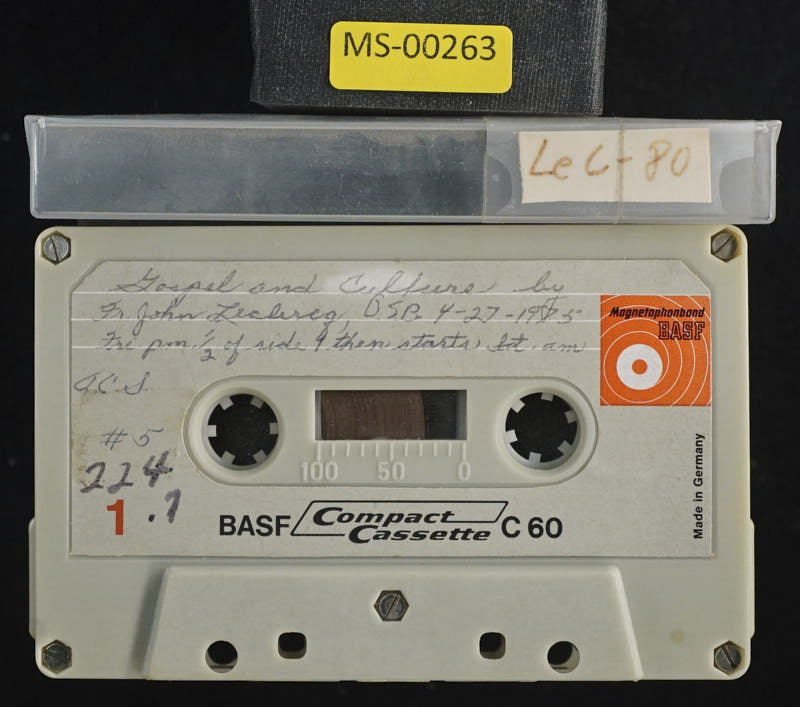
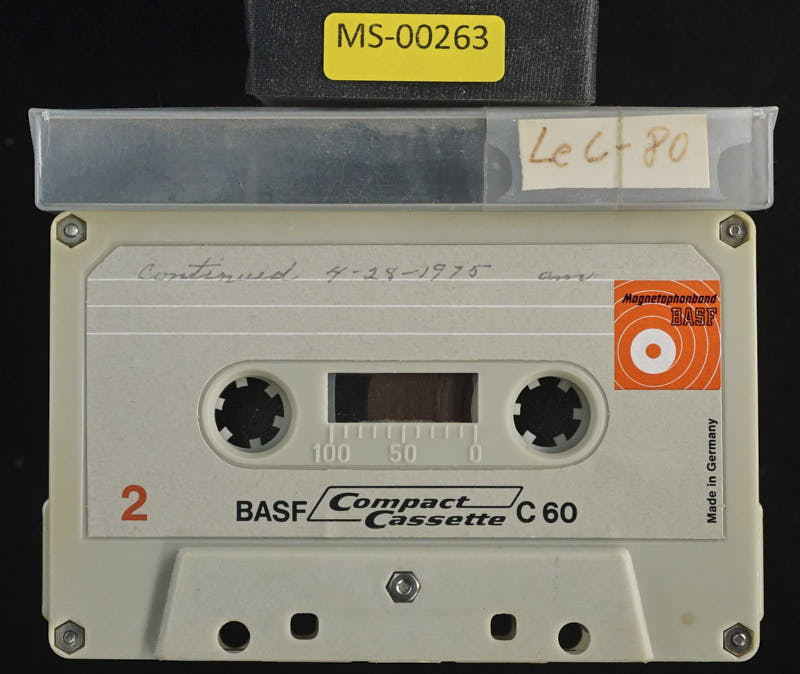
AI Vision - Possible Values from Photos:
Side: A
Speaker: Fr. John Eudes
Possible Title: Eternal Christmas
Additional text: bs.
Side: B
Additional text: Continued
@AI-Vision_v002
Yes, I don't know. Maybe I've been killed for eternity. But what I wanted to talk this morning about is the kind of, I have said these things a hundred times, and my imagination always runs in the same tracks. So I just wanted to propose this whole, to me, very basic idea of the divine agape within the present situation of the church. And I just throw first some key words at you, which are enough to provoke in you the associations and get you, let us say, into contact with our present situation so that we are not giving the impression we are just talking here in a kind of vacuum, not a theological vacuum, not a contemplative vacuum.
[01:11]
It seems to me the present ecclesiastical situation in the church, in the world as a whole, is characterized by lack of depth orientation, orientation in depth. That means there is evidently a great confusion existing everywhere. And this confusion to me results from the fact that many people don't realize what, let us say, changed me or what kind of change they want or what renewal means? Does it mean adaptation to the needs of the times? Then, which are these needs? Of course, the answers are innumerable. Is it the problem of autocracy against democracy in the church or in the political life?
[02:23]
dictatorship, democracy, how much and to what extent are we a democracy, and all these questions, which throw people into confusion. Obedience to the authority of office within the church, also in the political line, or charismatic freedom for the prophets. The other problem, for example, is that between, what is the relation between, if there is any relation between the sacred and the profane. I just throw these things at you so that, you know. Formalism or informality. There's a whole host of practical problems, birth control, abortion, justification of war or pacifism.
[03:25]
draft or volunteer on race question for example in parishes between the old people who are in possession and the new that try to get in capitalism and its effects on the church power machines dictatorships and their effects on the church take brazil The ethics of fighting, massacres in Vietnam, what are we fighting for? Celibacy, religious vows, position of the woman, liberation, matrimony is a trap. Vows are weapons of the institution. and we are the captives of the institution.
[04:27]
Consequently, exodus of priests, even more of sisters. There are those who are disappointed by the way the hierarchy is trying to get back to normal after Vatican II. Those who are vexed by what one may call libertinism, with the liturgical libertinism or sexual, swapping wives, you know, as part of Catholic ethics of our time, juridical, ecumenical, or theological, think of resurrection. So all these things are there. I just throw them at you, so we are in the picture. Now, of course, this presents a kind of an inextricable maze with the result of confusion, generating some desperate attempts here and there to keep the ship from sinking, trying to stop the leaks, you know.
[05:46]
either by authoritative pronouncements here and there or permissive attitudes, you know, or overlooking or ecclesiastical disobedience, all this kind of thing. Now, in the face of this situation, it seems to me that the important thing, and I speak here as a monk, You are in a monastery, you want to hear. You didn't come here, you know, to just get the usual line or something like that. But what is the situation? How can the situation be met? And there, it seems to me, what we have to do is a kind, first of all, strategical withdrawal. A strategical withdrawal, I say. to the heart of the matter.
[06:48]
Seems to me this is the function of contemplation in the church. And we should well consider that contemplative life is not a specialty for some chosen souls, but is a common Christian, I would say human dimension. which, however, is brought to practical effectiveness by a necessary division of tasks. As in, for example, the chemical industry, it takes work in laboratories to lead to new inventions or perspectives. And the work in the laboratories is accomplished by people who are freed from the precious, to which, for example, the salesman on the public front or the production people in the factories are exposed.
[07:56]
They have to watch their customers or the machines. But the laboratory is contemplative. Now it seems to me that in the church, the monastery, at least should correspond to this function, analogically. Now, what do the contemplatives, you know, then, in quotation marks, come up with? They should not by any means come up with theory or theological jargon, but with something that at the same time is essential means is central, or we could say has depth, depth, dimensional depth, and at the same time, to my mind, these two are correlatives, are correlated, and at the same time offers liberty or the possibility of growth or expansion.
[09:12]
The more depth the more liberty. The more central, the greater the possibility of expansion. Depth, concentration, the essential, leads out of the narrowness, which is always inherent in the mere partial solutions of acute practical needs and leads into the wider spaces of external possibilities and of prospects for the future. The more you have your eyes fastened to the needs of the moment, the more you are apt to lose the vision of the future.
[10:14]
gives vision. What is needed today for every single Christian who deliberately stays in the church is vision. Just staying there out of stubbornness or out of laziness is not the justification anymore in our times. It has been when we are still living in a certain compact kind of Christian situation, but it isn't compact anymore. So, therefore, this is necessary for everyone in order to live and in order to be able to creatively meet the situation, not always passively, with this attitude of conforming, either conforming to the general prejudices of the day or what, you know, taking absolutely always, you know, taking things.
[11:19]
So we have to meet them as Christians in the power of the resurrection. That's creation. Now thinking about all these things, it seems to me that the heart of the matter is, and I'm simply drawing the conclusions for myself, you know, for 50 years of experience in the contemplative life, starting just this year. This is my jubilee. It seems to me that the heart of the matter is, of course, nothing new, not meant to be, the revelation by the Father. Father, that's a term of love. Through the Son, that's a term of love. who became our brother, that's another term of love, in the actual light and power of the gift of the spirit, of his agape, the father's agape.
[12:36]
Now, this agape of the father, which is the revelation of the New Testament, and is in itself the only possible, let us say, justification for accepting a special communication of God, you know, to men, which transcends the communication already made, let us say, in creation, in the nature of things, in the cosmos, wherever you go. Here we come, looking at the effect, we speculate about the cause. But that's not the agony. One does not really love without first experiencing love given to one. In order to love, one has to be loved first. And that is exactly the situation into which Christian revelation has put us.
[13:44]
Revelation is a term of agape, of love. Doesn't make sense in the context of speculative philosophy. And doesn't make sense in the context of science. Science is always, you know, observing. Observing. But observing on the outside. But love is a matter of revelation. The one who loves has to declare himself. So the one who loves shares this love out of the freedom of his person. And that is of course the case here. The father reveals his love. Therefore, the role of Holy Scripture kind of has as its climax, the revelation, the book of revelation, apocalypse.
[14:50]
That's a term of love, I say again, agape. Now, what is this, what does this agape of the father involve? I would say, first, it is the beginning of our life. Not we have loved him first, but he has loved us first. So it is written, say, in the first epistle of St. John. Then second, you know, that it is, this love, reconciliation. That means it is forgiveness, it involves expiation, and so on. Now, both these aspects of the agape show that it starts on the initiative of the father.
[15:52]
He is the first who loves us. And secondly, that it descends from above. It descends from above. descended from above. He did not think it robbery, you know, to be equal to God, to stick to his divine position, but he emptied himself. That's the descent. That's the essence of the agape. Therefore, this agape now brings about, because it comes from above, And it is a creation, a rebirth. Therefore, who are the material of the agape? The poor, the children, the fools, the sinners.
[16:57]
They are the, as it were, natural objects of divine agape. And St. Paul has felt that very well, just as Christ did. I thank you, Father. that you have hidden this thing from the wise and have manifested it to the poor and the fools. St. Paul says the same thing. Not many wise around here, not many philosophers. Why? Because we are here concerned and confronted with the foolishness of God. That's a strong term. So this now, these objects of God's agape, of course, can be drawn by the Father only with the cause of love. What are these cause of love? First of all, they are within.
[18:00]
They are not external chains, but they are in the heart. Alive in the hearts of men. The only possible place for the Agatha. And the chords of love are corresponding to the very nature of the divine Agatha. And there are two kinds of chords. Repentance and trust. Repentance and faith. Repentance includes always the willingness to change. And of course, the actual change. You have to do something about it. That means the actual change of direction. What's in people we call Teshuba.
[19:06]
But more than that, a new attitude of the heart. what the Greeks call the metanoia and finally the realization of guilt with the willingness to expiate that is what expressed in the word penitentia the Romans are always on the juridical side now Now I must confess that up to now my basic concern has been to try to open the people to an awareness of the decisive difference between this divine agape and the human arrows, all this kind of
[20:10]
worked with this. But this kind of contrast, you know, was only, I would say, a methodical contrast to the last analysis. Now, but it is this, and I might just remind you of it. I try to do that through in the pictures and terms of Holy Scripture. There we have Adam and Eve, I would say. Or Cain and Abel, maybe more, you know, in a more pronounced way. Cain, the man who is the man of hard work, you know. He works on poverty here. And Abel, you know, sits, you know, on his... on his... on his... rocked, you know, and looks at the sheep, and then everything happens kind of by itself.
[21:20]
They feed by themselves, they multiply by themselves, and neighbor sits and counts them. And Cain works, you know, and therefore he finally gets the idea, oh my god, it might be good, you know, to, you know, make my doing of things more effective by giving something to God, too. Not necessarily the most important products of my labors, but something. It's all in Holy Scripture. Able is different, you know. It's the easy-going type, and he receives, you know, kind of abundance, shall we say, automatically. and therefore he is more easy in spending. That was the kid's difficulty. Then there, for example, is Jacob at Beth El.
[22:24]
Jacob, he is the founder of the House of Israel. This House of Israel is the real home of Jabba, of this earth. So at Bethel, you know, the father of Israel, kind of experiences the nature of God abiding, you see, making his home with his people. Then, you see, there he is. Now... Of course, he got into the difficulties by certain machinations of his mother, you see. It's one of the characteristics of the Holy Scripture, the woman is always in the middle on a shady side. It's already so with Eve, you know, I see. But Adam was shady too, you know.
[23:29]
He says, now look at her, she told me, you see. instead of using his own guts. But that simply means that man has lost his erection and has to taken up too much, you know, from the woman. Now, that's a completely different page. But, I mean, Jacob... Jacob is there, you know. I mean, he really is in a bad position and he is what we call in exile. That means in angustis, you know. in the narrow spaces. And he's there for at this place, and a miserable place at that. Not, not deserve, doesn't deserve any specific description, just a place. And some rocks are about there, and a vast horizon of desert all around. And there he is, poor man, and then what does he do?
[24:31]
He finally That means he surrenders. He's at the end of his wits. He goes to sleep at the end of one's wits. And then he puts his head on the stone, and that stone, of course, that is the famous rock of the divine agape, which abides, you know, which is firm, which is irrevocable, a mercy that lasts from age to age, in other words, the rock of the age. So that's what Jacob does. And then, you know, sleeping on the rock of the ages, this famous rest that the epistle to the Hebrews later on describes, you know, when he describes the Sabbath rest, and that this rest is essentially faith in God's love for me.
[25:32]
That puts us to rest. So it put Jacob to rest, not only to rest, but he had the vision, see? A new perspective opening up, and this perspective not, you know, in the horizontal, but unfortunately in the vertical. In the vertical. He looked up, you see. And there he saw that Something happened, you know. Out of the infinite heights of heaven, a ladder came down to him. That, evidently, he descended. And in a very concrete way, all he's got to describe it, but just ramped into the earth, right next to him. Now, that's divine agape. And that is, of course, the bridge. That is reconciliation. And there is communication, the angel ascending and descending, and the lord of the house watching over poor Jacob, who thought he was completely left in the lurch by all, not only by his family, more by his brother, who was clearly afraid of, and so on.
[26:54]
So he had nobody. That reminds us of Christ. And, of course, there it comes again in the New Testament, the arrows and the agape. Judas, you know, oh, all this money is spending for nothing, just to anoint the thief, you know. Why spending these $200, you know, for such a purpose? Poor, needed, socially minded. Then comes Peter and Christ, you know. It's another wonderful contrast, of course. Peter, the man who... not like Judas, you know, kind of jealous, recalcitrant, you know, always, you know, filled with all kinds of envy and so on. But Peter, the loyal man, you know, golden heart, you know, but, you know, following the Lord, you know, because he thinks he's the Messiah King. And he will give to Israel, establish the kingdom, and then everything will be fine.
[27:57]
problems will be solved, including his own. And so he can understand, you know, he's very much attached to the mountain of the Transfiguration, but he's less, you know, with less, how would I say, comprehension or understanding, meets Golgatha. So when it says, And the Lord says, I have to go to Golgotha, may I be spit upon? And then Peter says, absolutely not. I know me, you see. I will be just absolute plain foolishness, which it was. And so I'm not, you see. And he sticks to him, said, no, I go with him, I stick to him, just to be near in case of any emergency. Then, you know, it goes further to the point in which then finally, after all these hesitations, don't wash my feet, you know, this is not your business.
[29:09]
I should maybe, maybe wash your feet. If you don't wash your feet, you have no part in me. Oh, not only feet, but everything, head, you know. Never, always missing the point. And then finally, when he is flat, all his dreams and his complacency about his loyalty, the Lord says, where I go now, you can't go, Peter. I want to go right now. Why all this nonsense? And then finally, you know, he comes to the realization why the Lord had to go where he, Peter, could not go. Because there's one Savior, and there's one source of the divine apathy, and there's one man of peace, and there's one body and one head.
[30:20]
And Peter didn't realize this then. But then he comes to the point where he capitulates to another little Eve, you know, who asked him, well, I have known you before. I know exactly where you come from. And people, I don't guess, you know, his royal loyalty, you know, his, his, you know, we have a German expression for that part better than Jews, but he gets cold feet, let's say, you know, see. And he warms himself at the fire of his enemies, the soldiers. So then it all comes to the... He finally, after he hears the crowing, that brings certain reminiscences back to him, and he realizes that he goes out and he weeps bitterly.
[31:21]
That is, I would say, with all emphasis, this is Teshuba. This is a change. This is a new creation. Because tears are simply capitulation. Again, you know, the ends, the end of one's wits, you know, tears. End of one's self-control. All these wonderful things. Whoop, you know, with the river of tears, they go down into the ocean of divine agape. So that is what happened to him. And then our Lord turns around to him and he doesn't say, Peter, now. Now you know what you did. It's terrible. But he looked at him with a friend and his glance was the new vision for Peter. Finally. The sun breaks through the clouds in the face of Jesus Christ, and Peter is saved.
[32:29]
He's not anymore on the side of the Satan, you know, who thinks the thoughts of man, not the thoughts of man, of God. But now the thought of God kind of dawns on him. And with that is salvation. Later on the question, do you love me? Then feed my sheep. This do you love me is not the arrows. But this loving of the one who is crucified and is risen can only be the agony. Nothing else. The understanding why he died. And with this understanding that he died for me, Peter. If you realize that, then feed my sheep. So that's the authority of the divine agape, the authority of the arrows.
[33:38]
It's a completely different thing. So it goes through all the police country. Mary and Martha. Martha is working her head off, you know. Oh, I see Mary there. Why don't you tell Mary to help me that we get lunch on the table on time? Mary, don't get excited. Mary, I'm thinking. Then... Welcome, Patrick. And then come Peter and John. See, there's another one. Peter and John. You tell me to follow me. But what about this man here? What about John? He always needs to have the lazier part. You follow me and he should stay the way he is. There are two dimensions, aren't there?
[34:43]
Then, of course, Christ's preaching, the Beatitudes, blessed are the poor in spirit. And that's a revolution, the entire thinking. Christ's passion, everybody went into his own, the apostles and so on. He is the one who stayed in the realm of the agape, which is in that way selflessness, you know, or, as it really is in the light of the agape, the exaltation, the glorification of the Father and of the Son. And His resurrection, see. Mary Magdalene, where have they left my Lord? The tomb, raising Him, the tomb. Then the call into another direction, you see.
[35:48]
She turns around, doesn't recognize him yet, you know, thinks he's a gardener, but then hears Mary. That's the voice of the divine agape. This is directed to the heart. My master, you see. There is my master. Everything impersonally is off. And therefore the next, you know, impulsive impulse is to just embrace his feet. And then now don't keep me, not don't touch me because it's not quite, you know, You know, moral standards. Don't keep me. Don't keep me.
[36:50]
Because I ascend. And then what? To whom? To my father and to your father. Plus absolute fusion of the person and the divinity. Of the father and of the children. My father and your father. And then, of course, this other question, Peter to you loudly. And then his prophecy, now, when you were young, Peter, then you went where you wanted to go. I would say that is arrows, you know, in that way. And instead of that, then, you know, when you are old, that means when you are, come to your fullness, then another one will come and will gird you where you do not want to go.
[38:06]
That's a different realm. That's the kingdom of God. That is the Yaga. Evident. And so he went where he didn't want to go. He was crucified upside down. It's like a seal on the whole idea of conversion. Head down and feet up. Now you see from here you can of course go further. And then, in the light of this, for example, I would consider that as always, you know, as one of the real contemplative dimensions of Christianity, of the church. An examination of church history. Not just fact after fact, you know, and then this happened, and that happened, and that happened, and then, you know, sort of a third, you know,
[39:10]
And then again, some trouble with Luther, you know, and so on. Of course, unity and all that. No, but an examination of church history in the light of the divine academy. It's done today, I mean, people try, but in all that, one has to do it in the spirit of repentance. And repentance means basically love. Criticism as such. has nothing to do with witness. Criticism can essentially be just another way of putting yourself on the throne. And in that way, and in this context in my mind, the word of St. Paul has absolute deep meaning that only a spiritual man can judge spiritual beings. That means agape. The agape judgment is completely different from power judgment, political judgment, social order, police judgment, or anything like that.
[40:23]
Entirely different. I don't say opposed, but entirely different. So why not enter into a real, let us say, quiet, not polemical, because The agape and fighting that just doesn't go together of church history. For example, first of all, in a positive way, the understanding of the struggles that led to the formulation of the creed, you know. Think of the divinity of Christ. All the Aryans saying, no, no, he's not God, you know. Or what is it there? Something in between. Typically German. Seeing the incarnation of Christ, you know, the Son of God made man, not in this constant, you know,
[41:38]
this shows how human God is, you know, I would meet such a statement with some kind of misgivings, especially nowadays. But then, let us take, for example, take the Trinity, three divine persons, Father, Son, and Holy Spirit, to my mind, as equal as as oneness in the unity of divinity, you see. only understandable in the context of divine agape. Take the whole thing, the controversies about the spirit and how the church has struggled, you know. For example, about the central question in the West is always in the practical West. The central question is always grace and free will, typically for the West. Grace and freedom. That's always a hard nut to crack.
[42:43]
Blessing for German minds, you know, again. I would say Anglo-Saxons too, you know. Saints of Rome always said one of the great faults of Pelagius, you know, was that his breakfast was too hairy every morning. That's a fact, you know. I think Jerome says it. Too much porridge in the morning. Wings about, ends up in Pelagianism. And you know what Pelagianism is. The will comes first. And then the divine grace kind of comes. Very close to Molinism, but I shouldn't say that too loud. And so, you see, for example, the tremendous problem of the West, to my mind, in connection with this whole grace of free will business, you know, what is the relation between the spirit and political power?
[43:56]
In application to the Pope, there comes the famous donation of Constantine, There are the Crusades, you know, and one should never forget, you know, that great popes have made Crusades, not only against the Sultans, you know, in the East, but against the, against the, you know, I think they were the Orsini, you know, who had the biggest fortresses too close to Rome. So there is the problem, you know, the political power of the papacy is the problem between hierarchy and political power, a problem with the French Revolution. And then, of course, we come to an examination of our modern times, but now that there is ringing, that means Damasus has to shut up.
[45:00]
There I would say that there are two, of course, considered, and that will be always the meaning of retreat, actual attitudes in our devotional life, you know, let us say in the 19th century church or 20th century church, early 20th century church, and of course in ourselves. What about the agape in ourselves? Do we really understand it? Do we apply it? but you may be getting
[45:38]
@Transcribed_UNK
@Text_v005
@Score_91.28