You are currently logged-out. You can log-in or create an account to save favorites and more. more info
Harmonizing Tradition and Modern Faith
AI Suggested Keywords:
The talk emphasizes the interplay between gospel, culture, and the necessity of integrating modern and traditional understandings to sustain faith in contemporary Christian practice. It argues that knowledge and culture are crucial for deepening one's spiritual life and fulfilling the contemplative role within the Church. The discussion highlights the need to harmonize study and prayer and suggests that reading and engaging with both ancient and contemporary works enrich the spiritual journey.
- Jerusalem Bible: A significant modern biblical commentary tool, suggesting that reading biblical texts alongside such commentaries can deepen understanding.
- St. Bernard and other Medieval Fathers: Referenced as important historical figures in the continuity of Christian thought, illustrating the evolution of theology.
- Second Vatican Council: Highlights the patristic basis that enabled modern theological discussions, underscoring its importance in contemporary religious life.
- Fr. William Johnston's "Silent Music": Discussed as a reference to modern spiritual practices and innovations, indicating the expanding intersection of spirituality and science.
- Le Hazard et la Nécessité: A scientific work cited to illustrate the encounter of faith and modern science and its impact on contemporary belief systems.
AI Suggested Title: Harmonizing Tradition and Modern Faith
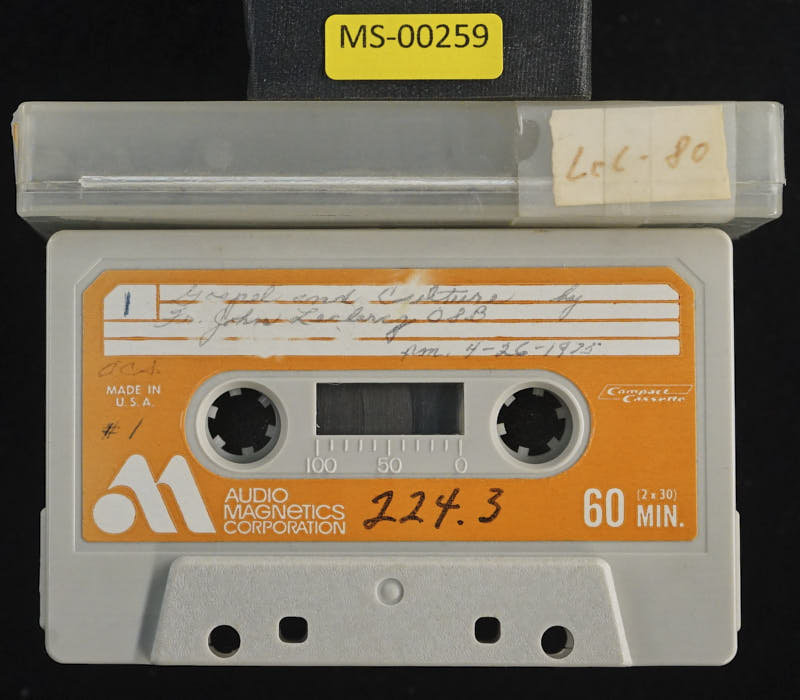

AI Vision - Possible Values from Photos:
Speaker: Fr. John Eudes Bamberger, OCSO
Location: Gethsemani Abbey, KY
Possible Title: Pre-requisite Conditions for ____
Additional text: 224.3
@AI-Vision_v002
The picture was put in five, often invited me in France, but that's to me. And here it goes to me. So I'm glad to see them here in Rhode Island. No need for a production except that every year I get older, so my limit, please. I'm just a historian, so I have nothing else than history, including contemporary history. An old man, French-speaking, French-English, French-English. You remember the first time I came to this country when I wanted to say, Hey, now, I invented peanuts. So, the last time I asked why, I said, I apologize. He said, no, we very much beat our peanut to peanut.
[01:04]
No, I said he said to weep. I said to weep. So you might be enthusiastic. If somebody does not understand something, just ask. And try to understand your question. So about the topic of this sort of seminar, I gave one, I think it was last month, in the New York area convent, and they had the mammographic series of titles, which in fact were written from the course I gave last year in San Francisco on evangelism of gospel and culture in the Christian conservative tradition. This title is... that you know all to keep her crazy inner to allow me to pay what they need what i like on what they like so it's very afflicted and in fact though that they were not called look at that point on long the wrong i was in the phone and i worked by the public with all the three other see if the victim of the problem uh... which
[02:23]
Each of them could be the matter of framing out, so we have to set some limits. But in fact, I think I could fit the things in the general framework I have, and either in the talk themselves or in the question time, and let's be flexible and see how The spirit will guide us. So, the title may be also misleading. Evangelism, in English, you dare to say that because evangelism is the beginning to give up evangelicals, fundamental movements, but instead, in the process of the gospel. Gospel and culture. And both these terms may mean much.
[03:28]
I would insist tonight on the two main meanings of culture. You understand, culture? Culture used to mean, when I was young, a sort of learning, knowledge. A person had a culture or had not. as a particular literary culture, artistic culture, and so forth. That means, there's not a quote, I wouldn't say ornament, but means of knowledge and approach to life with the person's path. Today, in modern language, particularly in the language of sociology and science, they use culture in a broader thing. The culture is all the set of values, the ways of living and dying and doing everything which are part of a certain type of suicide in a certain time and area.
[04:34]
So, culture is much broader. And I think we have to face the problem of the relationship and conciliation of the gospel with both this type of culture. And so tonight I would like to have to speak again, because that's the answer, more or less, in the suggestion gathered by Mr. Claudette, on the, I wouldn't say traditional, but rather limited, the restricted meaning of cultural memory, knowledge and gospel. And then we shall go through, from tomorrow morning, the broader meaning, namely, the relationship between the gospel, and when I put the gospel, I mean all the lessons of Jesus Christ with the various cultures in the world. So the first meaning is a certain, and you know that all these meanings of culture today, there is quite a bibliography as plenty of preferences, as you're used to keep that now.
[05:46]
The problem of the relationship of religious life, particularly contemplative life, which is also proposed here, with culture, that means with intellectual life and spiritual life, knowledge, by all means, is very timely. Formerly, the experience shows that it was possible to have a contemplative life without culture. without knowledge, just despite. And piety, generosity, mortification, renunciation, and so forth. That was excellent. And that worked, truly, for different generations. 1930, up to the 50th of this century. But now, it's impossible to have any contemporary life, except, in very exceptional case, where progress of God supplies everything, which may happen, but we have no right to expect that from the beginning of the day of God, you know, so we don't work without us.
[06:58]
So now today, there is a greater need of culture. We have to cultivate all the human capacities, possibilities, vitality, gifts, God has given us. Well, why do you think ourselves? First, because we all come more or less now to the monetary, as we various problems, the media, TV, printed paper, of all sorts. Sometimes books, particularly if we happen to read serious scientific books, sometimes raise for us questions which we had never thought of before. And we have to catch all these choices, all these new questions. It's not always this. If so many people lose their faith or lose them, not so many, but some are tempted to lose their faith or their vocation is because they were not prepared. They are not sufficient capacity to absorb them.
[07:59]
But that's just a negative aspect. The positive aspect is that today in the church, and I would say particularly in our church, Roman Catholic Church, there is just an enormous progress of knowledge of theology of knowledge, particularly of Jesus Christ. I think no time in history, except perhaps the first generation of the church, and then a period in the fourth century where they were discussing in Greece, in the streets, even the theological problems about Jesus. No time has ever been so interested in Jesus Christ as the first time. No time, Father Congar, that this has led, was that final time. No time has been so evangelical as ours, for concern with the gospel, not only with church institutions and so forth, but with the gospel and, in fact, with a very perfect doctrine.
[09:00]
And so, there is no week during which there's a new book, a new article on the mysteries of faith. And particularly, I could say, I left Europe again, I picked Anywhere I go, I find magnificent work on children. So our contemporaries have to observe that. To be a pity that all the academic people in the theological faculties and so forth work, and we don't talk about it. So I think it's important. Now, our culture is a Christian culture, which means that it must always be and remain centered on children. And not Jesus Christ in a sort of fundamentalist way of today or Jesus, Jesus. No. Jesus as the Redeemer of the Father. And therefore, also of the Spirit.
[10:01]
The Jesus who sent the Spirit. And therefore, all the history of Jesus. Not only the teaching, the doctrine, but the whole method, the life, the activity, the presence of Jesus in our church, in his church. And if we want to have a sort of guideline to consider this contemplation of Jesus, we have to, we may start from contemplating Jesus the contemplative. Jesus the contemplator. Jesus is both the book which we have to read. And the reader of this book, the one who teaches, teaches us how to read him, Jebius the book, you know, it was a very traditional idea in church tradition, in the church fathers and medieval throughout there, that Jebius is the book, the book, which contains everything we need to know to go to God.
[11:18]
In the psalm, we read, at the beginning of the book, it spoke of me. So, at the beginning of the book, it's Jesus. And Jesus is really the book, which we have to read. And remember, all the process, of growth of Christian life was represented that way. We have to read the book. Jesus was the book. It contained all the revelations of the Father, all the gifts of the Spirit. It contained all the life we need, all the riches of spiritual life we have. But we have to read it, and we can't read it without it. So, progressively, this book had been prepared And now, in the Old Testament, has been given. And Jesus died in himself, had in the book two, congregate two of them, what he was reading in.
[12:27]
Jesus is the book and a reader of the book. And then, the Father used to say, when progressively, when he opened his hand on the cross, the book was opened. And then when he gave the spirit to the disciples of the day of the resurrection, the book was interpreted. And what you will have to do is to look at the book and to try to conform to the image we read. We admire in the book. And to check whether we are really reading correctly. And for that we need to be guided, to be taught. That's why the church is there helping her, teaching her how to read. And the Remember many painters like to represent the last judgment, have tried coming, and all the elements are there, and at the place of their faith, there is an open book. Here is, whether it conforms to the model, to the exemplar.
[13:32]
So if we are exactly reflecting the text, the reality... Jesus' words, then we are conformed to him. You see, the last judgment, in between, you have all sorts of books, the book of experience, the book of nature, the book of history, everything which helps us to understand the will of God, the message of God, not only in general, but for our kind, is a means to read God and to read the message of God in Jesus Christ. Now, the first to read in himself was Jesus. And for Jesus, it was not at all a sort of intellectual activity. Jesus was not repeating, reciting something he knew beforehand in his previous existence. Jesus was reading in himself the very experience he had of being God.
[14:36]
Relationship to God, who we call his father, Habba, which is a very primitive and a very intimate and familiar way to name God, Habba. The three of us, they were a baby, a country, and anything, and a civilization is blah, blah, blah, blah. So, Abba's father, and Paul just translated that, you know, Abba, and his daddy. Jesus was in this intimate, personal, loving relationship with the father. And he had to discover what it is for a man, a real man, the man Jezus. This Jezus, that man Jezus, Rabbi Jezus, some people call him Rabbi Jezus, the name that he had in his directive to situate him in milieu. Jezus, a real man, was the first one to know by experience what he to be one with God. And he had to discover that progressively. It is our experience.
[15:41]
Tremendous experience of which we can have no idea except through what he taught us to us. Remember John in the beginning of his gospel says, God, nobody has seen him. But the Son of God had experience of knowing and seeing. And then he explained to us what was his experience. Here, John used to have in the word that he told us that the Greek word is which means . He gave us to exegesis. Jesus believes God has his father. And then he gives us the explanation and it means to explain the Torah word by word, letter by letter. And Jesus was just explaining to us, like to children, you know, working as patiently as you do in three years.
[16:42]
And he continued in his church. And his message was written and commented and still alive. So everything starts from the very experience of Jesus. Everything we know as Christians about God comes from this unique human experience Jesus had of being with God, being in this world. Unity with God, which means that he was God. All the gospel according to John could not have been written, had not frequently, habitually spoken of him, his relationship to and with the twelve. And the script. So that's the experience of this. And John particularly, but also the other synoptic part of this, thought of identity, unity. The Father and me, we are one.
[17:43]
Everything I say belongs to the Father. I receive from the Father. And I give it to the Father. I send it to you. I send the Spirit, the Spirit who proceeds from me and the Father. That's the experience of this. I don't develop that with the long topic, but I just want to call your attention again on the fact that every Christian culture is just the development of this. fundamental, primitive experience of God in man. Every act of prayer we can do now comes from this experience of Jesus. Every act of prayer comes from this experience of Jesus. He's contented with experience. Jesus is contented with par excellence because he contemplates the Father in himself, through the Spirit. And every act of prayer, of faith, of contemplative prayer, we may have gone to the Father through this experience of Jesus in the Spirit. Now, fundamentally, what was this experience of Jesus?
[18:47]
Of being with the Father, well with the Father, in total communion with the Father. It was the experience of being learned. And that was being learned. Not just the knowledge, but just an idea, but this Experience very difficult to describe, but we all know, because we all had an experience of friendship, of love in one form or another. We know what it is to be loved, to have somebody who loved, or mother, or whatever. And so Jesus knew, for true, that the God who loved him, that. And of course, he was returning to the Father, this love. And that's a fundamental experience, being loved. And everything else, it just means to be explicit, to elicit, to elaborate, to try to formulate, to make more conscious this fundamental experience of being loved and in love with God.
[19:51]
And that's why Jesus could only share this experience. And the more he shared, the more he gave, the more he was himself. Jesus didn't exist for himself. He existed for the Father and for... He never speaks of himself except in relation to the Father and to us. He gives everything he gives, everything he has, he shares. He's not a conservative, he's not a keeper, somebody who possesses things and keeps forever. He gives, he shares everything, his teaching, his experience, his power of... We are forgiving the sins, forgiving, curing, killing, expelling the heavy devil. He shares his body and blood at the Last Supper. On the cross, he shares everything. He shares his mother. And at the end, he shares his life. His spirit.
[20:53]
And so what we have to do is just to try to understand always more this experience of the children's It's the first book. Anyway, the love of God has to be read. And Jesus is the first believer who read that book. But Jesus read also that book not only through his own experience, but with the means of human means. The normal ways how to read. Jesus had to learn out to him. That was his experience was not something even went forever at the beginning of the time he was in the humble small world. No, that was the continual process of course, of discovery. And to that, Jesus being a man had to make use of the human normal need of learning. And the trust of them being rabies.
[21:58]
That was Jesus had to read. Whether he read himself in the wall, on the scroll, or he learned it by people who could read. We know he was reading, but he went to the synagogue, he read, he took the call of Isaiah, he told the passage and read it and commented it. But what matters is the fact that Jesus had to learn, to discover his own experience And if we have, and I insist on that, because we have to read. And if we have to read, what to read? Why to read? Because Jesus read. And typically, in a time of great activity, easing, insolidia, and so forth, there might be a temptation not to read. And I think it's very dangerous. You remember, we had an Orchadunel, who had been dictated on our sister,
[23:00]
And one day I was in a monastery where he was there and he said, decadence starts when the monks don't go anymore to the library. So, or if you just read the newspaper, you know, I think we have to. Hey, newspaper, I read it. Values every day. I think it's important. But, you know, I think we have to study and to learn how to read. And we know exactly, you know, that Jesus read and how he lived. We know that Jesus read because he had, of course, the spirit. Jesus was continually penetrated by carrying of the spirit, continually lived. He had a human psychology, and therefore he had to use the normal means to develop his psychology, his knowledge, his technique.
[24:01]
And one of them was read. And that explains that. He had to read the scripture, and he did. And after that, what he did? To explain his own experience, or to comment the scripture. Hence the importance of the Old Testament, the Torah, to speak of himself. He always referred to the prophet. to the son, to the great figure which had stung his psychology when he was young. We may imagine Jesus in his family in the evening where his parents were, as the Jews look to do and still do, remembering all the great marvels God had met for the people, evoking John, Abraham, all the great figures with Jesus. Therefore, in his teaching, quote also, exciting to sound, prising, according to the Torah, and the Torah does not mean only the legislation.
[25:05]
Today the Torah is also, today is all the core of what we call the Old Testament, and we have to be very cautious, because the Jewish today doesn't want to do that. He said, that's the Torah. When you say the Old Testament, you seem to suppose that it was incomplete. For the time being, provisional. And then you have it. No. It is. It is. For them and hearts. And all the Bible, of course, was the Old Testament. What he called the Old Testament. But Jesus was full of that. And then, in the synagogue, every Sabbath, he used to go and listen. Then we know when he was 12 years old, he was in the temple. And what he did was to ask questions about the... the Torah, and he answered, but, and they were surprised how he answered, but he answered, in the psychology, he offered more of 12 days, you see, and then, continuously, he was discovering, and that's how he could, and he was memorizing, that's the way, you know, right away, exactly, of that time, how they were reading, learning the scripture, they were memorizing, reciting, repeating.
[26:14]
And by that way, by being of hearing, they didn't fit with their eyes. By being of hearing and hearing again, they assimilated. It became part of them. And that's the way Jesus did for himself, and then did for his disciples. He was carrying himself in the field. During three years, he was patiently teaching them the part of the... Old Testament, the images, the passages, and so forth, the texts which refer to him, and then teaching them some parables, some sentences, some beautiful phrases he had the art of creating in order to fit them in their memory. And he was memorizing with them, repeating patiently, although the first who had been in yet more or less in pedagogy, in teaching, know what a passion it needs. Jesus was that way, a sort of extremely passion. patient, novice, martyrs.
[27:16]
Really, that people told me, he says, several times that they are very slow in understanding, you know? And he chose them that way. He didn't take the more intelligent, very clever, happy thinker, though. And that's the way Jesus was teaching. And all the gospel, and all the New Testament, he's just made of that. And after that, in the community, they were remembered. Remember of the day, he said, he started that parable. He gave this nickname to Paul, to Pete, to Simon, and so forth. All these memories came out of their memory. And that was the way this was teaching. Reading the Bible, explaining the Bible. And that was one of the functions of the prophet. The prophet is, among other things, the man who protests. to denounce and abuse, the flexibility, the secularization of the religion of the world, is the man who also points out, points to the kingdom to come, but he is also the man who, in order to do that, interpret the Bible, the Torah.
[28:25]
And so Jews were doing that. And that's why Of course, we know that the God, as we have them, are a product of the post-pastical community. It's only a part of interpretation of the community. But we know exactly how any rabbis, including Jesus, were used to teach. So we are sure Jesus read the scripture, and we understand why his teaching is so full of the scripture. And you know that they were reading They were reading the Torah, the rabbis were reading the Torah in Hebrew, it was a sort of secret, secret and secret language, like it used to be for us, everybody understood.
[29:26]
But then there was a reader, a translator, who translated in our language, and then gave the Talgum, which was a commentary, the homing, and he wished to have the Talgum for the traditional targum, or the Bible, the books of the Torah. So that's the way Jesus did for himself and for us. And that's the way we have to do it. If there is the Christian reading of the scripture, it is because it has started in Jesus. When we read, it is given in us, through his spirit, who continued to him. And we have to read the scripture because of him, to find him. like him, in him, with his grace. And as himself applied to insert the Old Testament, they had to apply to insert both the Old Testament and the New Testament in order to understand his life, his mission, his teaching, to penetrate in his intimacy, in his interiority, in his heart.
[30:32]
So, that's why to read. Now, what to read? Of course, the Word of God, and primarily the Bible, the Torah, the New Testament, and everything which explains the New Testament, explains the experience of Jesus, the reason of his return in the New Testament. And we have to read. Not in order to be a teacher scholar or support to know. We have to read. Not in order to be a teacher scholar or support to know or to show that we know. Not even to share what we know if we are not by vocation, if we are not by vocation, call to this sort of teaching. But we have to read to nourish our faith.
[31:35]
And that's why we have to read everything in view of Jesus, in connection with the teaching of Jesus. Everything we read must be a commentary of the teaching of Jesus. And of the reality of Jesus, the person of Jesus. And we particularly, I think all the Christians today, but we particularly in the context of life, I think we have to practice contemplative reading. Not so much to read about things to do or not to do. You know, when I was young, we asked plenty of books about virtues, things. I don't know. Always little virtues, little things. Everything is little about us. You know, and we know it. Usually what we like is not to know what to do or not to do. We know. We like courage to do. But I think we have to concentrate always more, not on morals, but on the mystery. Jesus, the Father.
[32:36]
the Spirit, the Trinity, the Eucharist, the Church, Mary, our relationship with Jesus, with God, in Jesus' Holy Spirit, all this marvelous mystery. I think we have to, and of course, we have to face new problems, and sometimes difficult problems. And that's one of the difficulties today, of reading and also of the necessity. It's not sufficient, the gospel is not just a book that just opened and you are edified. It may be. But, typically, during a certain period of preparation, of planning, we have to study, you know. And always more, we learn, when we read serious books today, that we discover new problems, the application of new methods. When I was young, it was philology, historical criticism.
[33:39]
Now, it's particularly in a very difficult method, which are a combination of psychology, even sometimes Marxists. There were various books presented in France on the reading of Saint-Marc according to Marx. very very very very very very very very [...] proclamation of the message of Christ in the rhythm, pterygma and coming, the application of the structure of comedy common to all the rituals of fertility and of non-sictualization, and particularly in the Greek world, the Greek drama, to the structure of the passionality in Paul and then in Mark and other.
[34:55]
You see, and all these new methods give right to new progress. when the first time we hear that things didn't happen exactly as they are written. That is the part of interpretation, of literary elaboration. We thought it was so easy to imagine that it just happened at the end of the week. It's a book of, it's a historical book, so it just tells fact. No, it's a theological interpretation. So sometimes we, about the resurrection, the original birth of Jesus, And Eucharist, many things, we have no new problem to face. And I think that's why it's not sufficient to read the Gospel itself or the New Testament itself, but we have to read everything which helps us to understand. I think the first commentary of the Bible, of course, must be the Bible itself. But today we are privy, because we have the Jerusalem Bible, the Jerusalem Bible, and so forth, which is the best commentary of the Bible.
[35:57]
You can't... I think the best way to be, and I talk to the theory, I see, I know people who do that. You take any page of the New Testament, and then you check all the references, you go, you read the passages, and you read the parallel passages, which are in the margin, the source, which are in the footnotes and so forth, and we may spend a week in one page, but then we have read 50 other pages, you know? So you abide, you live in the Bible. And so the Bible is not a book that you read from the first, the last bit. It's a book in which you have to live to abide. And normally I think we start with the New Testament, and from that we discover all the things as Jesus did for himself and for the disciples. And so I think we have to read the Bible with the biblical commentary, but also with everything we felt. And that means all the new progress in the understanding of Jesus' message up to our game.
[37:06]
I think we have to be contemporary. It's good to read the Church Father, you know, the ancient Church Father. But we must not forget that we have modern, contemporary Church Father. So we, that's what we call Patrice. Patrice is the father of a Patrice who are those who really engendered their life to the doctrine of the church, starting from the experience of church, developed and built all this beautiful elaborate doctrine. So the father existed in all the great times of the church. apostolic fathers, just after the titles of the apostles and the New Testament fighting, then we have the ancient church fathers, then we have the medieval fathers, then Bernard, Elred, so many others, then Antel, then we have the contemporary fathers.
[38:08]
And if the Second Vatican Council has been possible, it is because there were patristic fathers. Church fathers in our time, they have not yet been declared, they will not be the top martyrs officially, but they were. And so many other, and so many other minor names, not only the big names, that is an almost elaboration and development of Christian doctrine. And what makes the patristic literature, on which I think our conservatives we have to concern. is the unity of this patristic culture. Unity of all the Christian thought. And there are three basic, it's like a triangle, you know, the basis of Christian culture. Bible, patristic, liturgy. And they were united. They were reading the Bible in the liturgy. The liturgical texts were mainly inspired from the Bible.
[39:12]
And the church father was man-made for the little. And so it was very homogeneous, unified. When I was young, we had excellent books of scripture, pure phenology, but without, I would say, without piety, without doctrine. Just apologetic or explaining the world. And we had plenty of books of piety, but without doctrine. Today, we have great men who content to share with us both their knowledge and their spiritual experience. And we had, I had a number of anonymous, as we call it, but Harvey Leclerc, he was an enormous dictionary of liturgy and archaeology. Liturgy was just not clear on the path, the knowledge of the path. Today we have liturgies who are alive, who care newly. So we think it's marvelous time to be alive today. We are a real pacistic literature, and I think we must take advantage of that. And then unity also of, not only of the men talking, Bible, pacistic, liturgy, but unity of all the human resource, all the faculties.
[40:24]
When I was young, we were very intelligent people, but without, I would say, without feeling, without sensibility, without type. And we are tired people without intelligence. We have tried to reconcile, to be intelligent and to be pious. And it's not sufficient. So I think we have to esteem very much everything which helps us today to understand the method. And also there are values, levels and fields of reading, of conservative reading and culture. We have readings of, I would say, formation to learn. And then, you know, to have a continuous, I will not speak again in a program in Penn State University, in Pennsylvania, program of continuous education. So our training now is continuous.
[41:29]
All our life we have to learn because there are always new problems and therefore we have to create new... So, we have to learn about the mystery. Then there are, so that's what I could say, formation, to be trained as they can, as fantastic. Then we have information, to be informed. And I think that's very important today, to be aware of what's going on in the world. God continues to write The book of this, the book in which we live every day. What's happening today in South America, in Cambodia, in Vietnam, everything, you know. We have to be aware of that. Not to be expert, not to be involved, but to be informed, at least in general, and to be concerned.
[42:32]
We have not the right to say, I'm a contemplative, I don't care if there are thousands of people, millions of people who starve, who are starving, who are in war, and so forth. I'm contemplative, I have direct contact with God, like a missile, you know, directly to God without going through the atmosphere. No, we have to. That's why I think it's essential to be informed. Whatever these are mean, newspaper, journal, magazine, TV, whatever, but we have to be informed. And not only of the daily... Typically, in times like this week, where something is happening for the history of the whole world, you know, but we're in Southeast Asia. But the great problems of, the great church problem, the great problems of the universal church, on occasion of the synod and so forth, the great problems of various local churches, particularly in each country, the contents of your bishops and the Church today, and your various, for instance, I was taking out today, the beautiful picture of the apostolic delegate, Mr. Jadot, who is very much insistent, and I think that has already been his proper contribution to the life, just like for this country, in keeping on the necessity for the clergy and even for the bishop, to be learned, to have learning.
[43:58]
And last year he was addressing more in the group of Catholic education and insisted very much on that necessity. So you see, I think if you have formation, which is of course the most important, then we have information, then we have general culture, literature, beauty, by all means, either text or art, painting, music, and so forth. is legitimate, and to set an exit is necessary. And if so many Christian writers are pure readers, it is because they don't quite wear, you know. White, the best people, the best, the most read read in my generation, at least in Europe, where I looked at it. There were Gloria, there were Claudel, there were Piggy, there were Tom Green, there were all ladies, including ladies, you know. Well, all the priests could write a book that nobody read.
[44:59]
They were not interested. They were bad readers. That's why it's so important today to study also comparative literature and so forth, to absorb all the treasures of beauty which are available. Poetry, literature, and so forth. And with all the parts of joy, of humor, of irony, of comics sometimes, that may introduce us in our lives, to compensate the seriousness of that information, which are rather depressing sometimes. So we have to learn and to read all that. Now, that's not true. I have calculated that a month today has about every week the amount of possible reading in in the form of newspapers, magazines, newspapers, and books that a monk in the time of St. Benedict had during all his life.
[46:00]
All they had was a Bible, and there was just one in the monastery, but not one had his private Bible, but they could just listen to the Bible. That's why they liked to have long copies and read it. Then they continued in the refectory when it was too long, or only in the quarry. Then they had a few church fathers and the Christian literature at the time was relatively limited. Now we have plenty of hotels and support. So we have much more material to read and we are more limited to a certain extent. Because we have more to do, we have more to read, we are not just talking about giants. So we are limited and therefore I think we have to find new ways of reading. Personal reading and I would call them... ...book for measure, I would say some books you have to read slowly, perhaps not really, but if you could read continuously one book, that's about a few books a year, slowly, but way too good.
[47:08]
And one of the difficulties, say, is to choose. Fortunately, we have this journals and reviews in journals which help us to choose. But there are some books and you have to put them that way. I have to read that book loudly. But then you have books of information on general culture and so forth, which may go more rapidly. And so he suggested to put them there. And then you have books just to go through. But then that way. Anyway. each one has kind of, you know, through the spreading and to find its time, don't have any insomnia every night, and then, you know, it's a wonderful time to make death, you know, and insomnia, you know, last two hours, you know, we sleep by cycles of two hours, so when you know where you're in insomnia, normally it's two hours, so it's a good time, and at least an hour and a half to do it calmly, and then to prepare, leave again.
[48:16]
But, Then I think we have also to read corporate, sort of corporate or community reading. It's impossible today to read all that could be of help for our spiritual life. So I think we have to help one another. And you know, that's quite totally traditional. The colloquium, you know, conversation was the necessary complement of reading in early Manasseh. Relatively, not all the monks could hear, and some were very slow, some were ignorant, and so forth. So it was admitted that when you read the passage of the scripture, or the church father, or liturgy, it's normal that you are Christian, that you can't answer. So it's normal that after reading, there is what they call the collatio, which means conference, discussing, corporate reading, hearing, and...
[49:18]
That has always been a tactic, you know, in Manasseh, up to, I think, it's in the 19th century, as many things on the tradition. So I think sometimes if we, if in a community, it's one who reads a book or a chapter, you know, and once a week or once a month, we could gather and share. I read that and I found this with us and then would have some compliments of information, some Christians, and so forth. I think this, uh, practice of child reading is very important today and also a good means not only of humility but of charity and also of community life. I know a martyr where I was in Africa every day before complying, they have a moment of the read for a quarter of an hour and then they share the discernment of what ends up. built the community, you know, not only at recreation when we talk about, but to share sometimes on the essentials of our life, you know, on our common concept.
[50:28]
So you see, that our values just have its existence on the reading, the way to read. And of course, one of the main forms of atheism today is, consists in finding time to him. Because often we are always at good levels, not to him. I'm so busy, I have so many things to do. I am observing, I have to help that and that person. And though, then we, we empty ourselves. And then we can still recite your feet, we can say that if we don't feel, if we don't nourish our faith, our faith will, they perish, will not grow. So I think it's essential for us to, to, trying to have the courage to find time to decide that we shall. And today, you know, simply in the left traps in the content of this community, the children in the world, you know, life is so demanding.
[51:29]
We all have appointments with so many people and so forth. So we have to find an appointment with God and to foresee that will be at that moment, you know, and to write it on the agenda, you know. otherwise not to wait or not to be an occasion as normally there is no. So it's always easier not to read or not to pray than to read or to pray. So we have to force a time, a moment, either day or in the night. And if we are driving, it's a moment to meditate, you know, to pray, not to sing, to form. And I think remember I picked up a book two years ago in this country. It was, the title was how to have, how to get more done in less time. And it was a real method and a real aestheticism for businessmen, presidents of corporations, you know, how to get more done in less time.
[52:31]
You listen to records when you drive, everything, you know. And I was amazed, all the discipline, you know, People can impose on themselves just to get more money, you know? So I said, why could not the man of God also have a discipline in their faith to oblige themselves, to find the time for reading and so forth? I think in the contemporary community, the temptation of not having time is less dangerous than its way. But we have to be aware of that. And so learn how to decide, to foresee when we shall read, to choose what we shall read. It's good also to read sometimes with certain centers of interest, to be interested either because it's a personal problem we are, or we are more devoting to the Eucharist, or to Mary, or to the treaty, or what an aspect of Jesus and so forth, or to decide.
[53:39]
that during a period or a year or more, we shall concentrate more on a particular aspect of the mystery of God, you know, because we cannot, otherwise, we cannot read about everything. Otherwise, there is to be disturbed. So, to react, again, to this sensation of dispersion, I think it's good to be centered on certain aspects of the mystery, and then we gather more from our reading. And sometimes there are some important books that are a shock for the face of so many people. I remember a few years ago when, in France, a certain book by a great scientist, but totally had it, appeared on . It has been a bestseller in many languages. Values people were not prepared and there were impressed by these scientists and their faith was in danger. So sometimes we have to concentrate on something timely like that.
[54:41]
And then to finish, I would like also to suggest that we have to be also aware and open and attentive to the non-Christian religion, particularly everything today which comes from the great religious tradition. We are in America and Europe particularly aware of the palestin tradition then good deal, TM and so forth, presidential meditation, and that's okay. But there are also other, and when we are in Africa, particularly the Bantu and ancient traditional religions have something to contribute to our spiritual life. So I think it's good also to be informed about that. And you know, there has been a certain mood and tension during this about fifteen years. But we must also be aware of the danger, particularly today. I remember last year I was in California for a summer program, and weekend I went from Mexico to Canada to various... and I... also when I was in... I... the quantity of Zen center, the yoga... prayer...
[56:01]
meditation hall, and so forth, you know. And then I went back, I took a drink and a drink to come back around the world, so I stopped over in the Philippines, and I could see there, going to a monastery, in small villages, small cities, people, bookstores, saying only Hindu and Hindu Sikhs and Buddhists had I met people who, whose Christian faith had been contaminated. The idea, I think, of Jesus being God, of the personality of God, was a problem for some of them. They had been so much impressed by these biblical theories, you know, and Jesus would maybe be a Buddha, maybe a prophet, maybe, but Jesus is a God, you know. I think we have to be aware. I would never have thought that before. You know, I was always, when people mention the possibility of syncretism, I never felt that, you know. But I noticed that there is a secondary, not for us, of course.
[57:03]
But children and young people, you know, I think we have to be aware of that. And that's why. We have to retain all that, and to see all the possible constitutions. And not only of the great religious tradition, but also of the new American techniques. to provoke some spiritual experience. You know, police, Kuston, I know, the masters in New York, and sort of, there were dreads of those, but besides that, there are some mechanic ways of provoking spiritual experiences, and why not? You know, if it were, that the spirit of the pioneers, the richest of your country, to always find new techniques to produce them. They were even thinking of... instant zen or electronic yoga. That may be an easy way to do it. But, you know, and then you remember, you probably are familiar with the last book of Father William Johnson, the silent music.
[58:06]
Well, he mentioned all these, the electrodes in the brain of people, to measure, and, you know, to know, in order to, to prove value, state, to an experience. So I think, you know, that is, There is no limit to our human ritual of enlarging our spiritual experience. So we have to be aware of that. But, and I remember last year when I was in San Francisco during the summer, there was, I had been at the Krishna festival. And during the whole week, there were positions, the first time I saw the position, I thought it was the position of Mr. Fatima. He was monstrous carried by people. And it was a statue of Krishna, you know. And there were 20,000 people, you know. 2,000 young people claiming, praying, Krishna, Krishna, and 20,000 people going with the position. So I think that point out on the necessity for us to be also center of contemplative prayer. But I think we have to rediscover, and I think our church will, not only our church, we never lost that, but we, in our church, we shall always more rediscover our knowledge.
[59:15]
And... our conservative tradition, and we have the traditions, the Franciscan tradition, the Carmelite, the Vigitante, and the Benedictine, all that, you know, the Dominican tradition, all that may contribute for much, and we have to assume that. And I was mentioning in the car, the sister would tell me, but you know that next summer, or so today again, with the Michigan University, there will be a seminar of Western spirituality, which is a very strange thing today. But it's sponsored by the practice. And you said, in a time where everybody goes to the Eastern spirituality, why couldn't we have one on Western spirituality? And so I think that's OK. I know it's time to stop. I took more than an hour. I think that is some suggestion of starting from the gospel, the experience of Jesus, to the vast horizon horizon of possibilities of human culture, you know, everything which is human has been sanctified by Jesus.
[60:30]
And therefore, everything of the world says, everything belongs to us, and we have to integrate all the riches, the possibilities, the resources of the human nature, which are increasingly rich today. at the service of this concentration of distance. And that is the great riches of our time. Our time in history will be marked and remembered not for going to the moon or for creating always new nuclear weapons, but for this new connection between prayer and life, prayer and science, prayer and technology, prayer and involvement, political or whatever. But the center, the root, must always be prayer. And that is particularly for you as contemplative. I think your mission to remind everybody in the church that prayer is a thing. Jesus was, first of all, a prayer, a contemplative, a contemplator, contemplator of his father.
[61:38]
The church is essentially a contemplative reality. claiming at leading people to pray. Everything else we can do is just means. And if we involve in the means, we need the aid. So I think it's our duty first to practice that for us and to be witness of the value and the realistic value on which we shall come back later of this competitive life, of this continuation of the gospel of Jesus. and human culture. Thank you.
[62:16]
@Transcribed_UNK
@Text_v005
@Score_82.79