You are currently logged-out. You can log-in or create an account to save favorites and more. more info
Mary Magdalene: Model of Divine Receptivity
The talk focuses on interpreting the Resurrection narratives in the Gospel of John, emphasizing the experience and role of Mary Magdalene as a symbolic figure of absolute receptivity to Christ's transformative presence. This receptivity aligns with a thematic exploration of the Trinitarian life and the notion of becoming participants in the divine life through receptivity to the Divine will. The latter part of the discussion explores similar themes in apocalyptic literature, particularly the Book of Revelation, highlighting the symbolic union of the Church as the Bride of Christ and its theological significance within the broader context of salvation history.
Referenced Works and Texts:
- Gospel of John: The discussion primarily focuses on the Resurrection accounts and the role of Mary Magdalene as an embodiment of receptivity and recognition of Christ.
- Book of Revelation: Presented as apocalyptic literature with ties to the Gospel of John, emphasizing the symbolic nature of the Church and its role as the Bride.
- Shepherd of Hermas: Mentioned as an early Christian apocalyptic text that parallels themes in the Book of Revelation.
- Hosea: Referenced in relation to the theme of waiting for the Lord, drawing parallels to the narrative of Mary Magdalene.
Key Thematic Discussions:
- Absolute Receptivity: A central theme where both Mary Magdalene and the disciples are seen as models of total openness to Christ's presence.
- Identification with Christ: Examined through the lens of Eucharistic participation and spiritual union in Christian life, highlighting Peter's commissioning.
- Symbolism and Imagery: Explored within the context of apocalyptic literature, particularly the woman and the dragon in Revelations as representations of the Church.
AI Suggested Title: Mary Magdalene: Model of Divine Receptivity
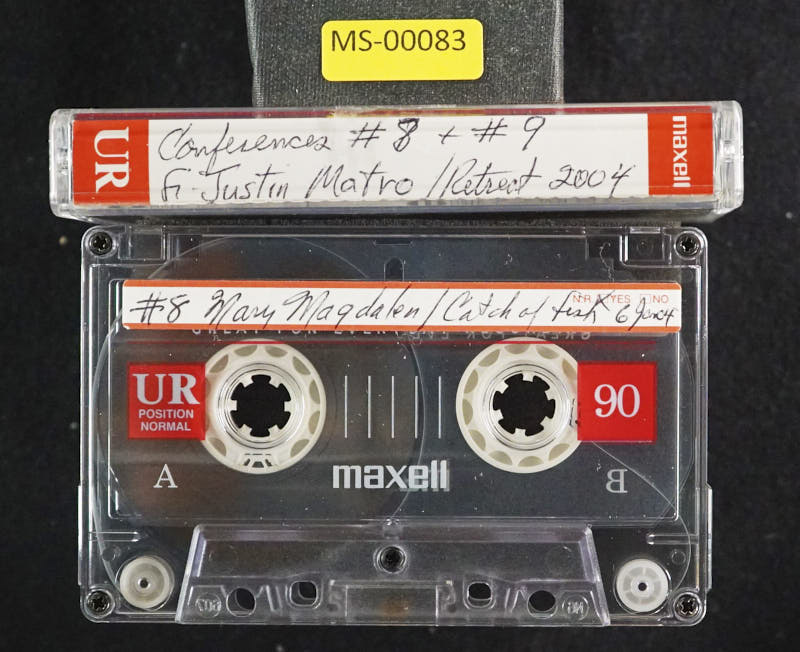
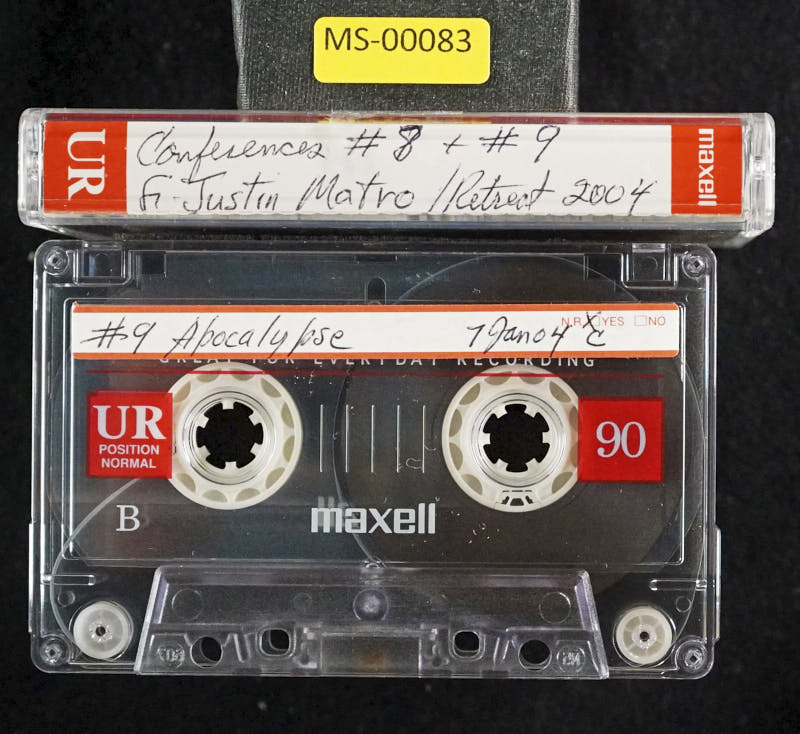

Side: A
Speaker: Fr. Justin Matro
Possible Title: #8 Mary Magdalen/Catch of fish
Additional text: Conference #8
Side: B
Speaker: Fr. Justin Matro
Possible Title: #9 Apocalypse
Additional text: Conference #9
@AI-Vision_v003
Glory be to the Father, and to the Son, and to the Holy Spirit. Okay, well, we've been looking at the Trinitarian life and how we're called to participate in that, specifically through a stance of absolute receptivity that's presented to us today. through our participation in Christ, who is in eternity completely receptive to the Father. Tonight, I'd like to look at how that theme is carried out in some resurrection experiences. And I want to stick with the Gospel of John. And first, to look at Mary Magdalene as she stands outside of the tomb. Now... We've got to recall the scenario here. Mary Magdalene has come to the tomb.
[01:02]
She's been there with other women. John and Peter have been to the tomb. Everyone has left in chapter 20. And yet after everybody else leaves, Mary Magdalene stays outside of the tomb. But Mary stayed outside of the tomb weeping. And as she wept, she bent over into the tomb. Now you've got to ask yourself, why is she staying present to an empty tomb? And she saw two angels in white sitting there, one at the head and one at the feet where the body of Jesus had been laid. And they said to her, woman, why are you weeping? She said to them, they have taken away my Lord and and I don't know where they laid him. When she had said this, she turned around and saw Jesus there, but did not know that it was Jesus.
[02:08]
She's staying present to the mystery of darkness. She's looking into a void, and even a vision of angels don't console her. They don't touch that grief that's in her. I think it's a parallel to the woman that we looked at last night the woman who stays present to Christ even after all the others have left a dark presence because Mary feels absolutely abandoned and yet she will remain present at least the place where she knew he was and she will be completely available to him there And nothing, nothing but him, no one but he will be able to touch the emptiness. She first sees angels and she just starts talking with them.
[03:17]
And then she even sees Jesus and she doesn't recognize him. Jesus said to her, woman, why are you weeping now? whom are you looking for? She thought it was the gardener and said to him, sir, if you carried him away, tell me where you laid him and I will take him. She thinks he's the gardener. In a gospel text that begins with the same words, same opening line as used in Genesis in the beginning, Where did sin first occur? In a garden. Where is it rectified? In a garden. He is the gardener. She thinks he's the gardener, and yet he really is the gardener. He is the true Adam, the real steward of creation. Through him all that is have come to be, and he restores all things in himself.
[04:22]
Jesus said to her, Mary, she turned and said to him in Hebrew, which means teacher. Jesus said to her, but go to my brothers and tell them I am going to my father and your father, to my God and your God. But those who did accept him He gave power to become children of God, to those who believe in his name, who were born not by natural generation, nor by human choice, nor by man's decision, but of God. His father is now her father. His father is now our father. By virtue of his saving death, his life-giving resurrection, We are brought into his life.
[05:28]
He's basically telling her that. He calls her by the same title he uses to refer to his mother, woman, as he does with the woman at the well, madam. But then he calls her by a familiar and yet a new name. in the book of Revelation, which has so many parallels with the Gospel of John, we're told that we will all receive a new name, a white stone in which a new name is written. She receives her old name, and yet something occurs when he speaks her name. Her eyes are open, and she recognizes him, just as Eve, the first Eve's eyes are somehow opened in a wrong way when she sins. She stays present to the mystery of darkness. She will not leave it. She will stay completely available to him. And when she receives him, she sees who he is.
[06:32]
And she's given a new name. An old name, but a new name. A name that is the name of the woman who is not named in this gospel. And the writer of this text surely knows that the name of the mother of Jesus is Mary. I suspect that there's a link. Because he then commissions her to be an apostle to the apostles. I am going to my father and your father, to my God and your God. Mary went and announced to the disciples, I have seen the Lord. She's not to cling to him. She's not to hold on to him in ways that she knew him before. And yet he remains with her because in bringing the message of his resurrection to the others, she herself has become a mother of Christ.
[07:34]
She carries him. She's a Theotokos, the God-bearer. She carries the news of the resurrection and announces that we are all children of his father. She carries his presence by carrying his message, he who is the word. She carries the word of his resurrection. In a very real way, she is carrying him and bringing him to the disciples. She's participating in his life in an absolutely new way because she stays present to the mystery, to the darkness. She's present at the crucifixion. All four gospels testify to that. But she stays present at the tomb even after everyone else has left. This image of Mary Magdalene is so striking and so compelling that throughout the tradition,
[08:46]
it's always maintained that she actually becomes a contemplative, a real hermitess. Up through the Baroque period, you see all sorts of speculation, Pierre Beroul, seeing Mary Magdalene in a mountain, basically in a cave, peering into the darkness, contemplating the God who's been revealed to her in Jesus Christ and his relationship with her. she becomes a sign of really the contemplative vocation, staying present to the mystery only to have Christ revealed in what seemed to be emptiness and darkness because she stays present to that mystery. This experience is taken by many writers to be a prefigurement of the dark night of the soul, now a sign of that because she will not leave she will not satisfy herself with anything else other than his presence.
[09:47]
And even if it means staying present to the place where at least she knew he was, she will not leave. She will remain present to him, at least even there. And that fidelity, that dedication, will be a way in which she comes to share in him We saw that in Hosea. I can dig him up again. We see that Israel will wait for the Lord. They'll wait upon Yahweh. And in waiting upon him, they will finally receive him. They will wait upon him even as he waits upon them. Many days you shall wait for me.
[10:50]
You shall not play the harlot or belong to any man. Don't forget in the tradition, you know, Mary Magdalene said to be the woman out of whom seven demons is cast. It always seems to be a euphemism for a sexual sin. But I think because she's a sign of erring Israel, you know, errant Israel, Many days you shall wait for me and not play the harlot or belong to any man. I in turn will wait for you. For the people of Israel shall remain many days without king or prince, without sacrifice or sacred pillar, without effort or household idols. Then the people of Israel will turn back and seek the Lord their God and David their king. They shall come trembling to the Lord and to his bounty in the last days. The number of Israelites shall be like the sands of the sea which can neither be measured nor counted. Mary waits for him in a period which must seem like an eternity for her.
[11:55]
She whose life had no meaning until she encountered him. She will wait for him. Receive her very self back in return with a new and yet familiar name and be counted among the manifold children, the new race. My father and your father, my God and your God. We are being incorporated into the Trinitarian life. That's the announcement that is her privilege to carry to the apostles. Another beautiful Resurrection account from the Gospel of John, of course, is in chapter 21, a later ending, but nonetheless by the same author. The apostles are going to go fishing, a group of them anyway.
[12:58]
And, as we know, When it was already dawn, Jesus was standing on the shore, but the disciples did not realize that it was Jesus, just as Mary didn't realize it was Jesus. Jesus said to them, children. Again, this title of children. Why is he calling them children? Perhaps because now they're children of God. They answered him, children, have you caught anything to eat? They answered him, no. So he said to them, Cast the net over the right side of the boat and you'll find something. So they cast it and were not able to pull in it, pull in the net because of the number of fish. So the disciple whom Jesus loved said to Peter, it is the Lord. John is always the first to recognize Jesus. When Simon Peter heard it was the Lord, Simon Peter is always impetuous, tucked in his garment for he was lightly clad and jumped into the sea.
[14:02]
The other disciples came in the boat. and they were not far from the shore, only about a hundred yards, dragging the net with a fish. When they climbed out on the shore, they saw a charcoal fire with fish in it and bread. Now, where have we seen loaves and fish before? We've seen loaves and fish in every single gospel. It is the one miracle... in link in communion with the resurrection that makes it to all four gospels because it's such an important sign to the early church. It's a sign of the Eucharist. What seemed to be so little has fed so many. What seems to be a completely insufficient amount satisfies the needs for a vast multitude with an abundance left over. It's a sign of the Eucharist. It's a sign of the one life offered for all. When the apostles come to the shore, what is Jesus going to have prepared for them to eat?
[15:13]
Loaves and fish. In today's gospel, in Mark's gospel, Jesus says to the apostles, when they complain that there's not enough, there's so many people and they're going to be famished. And he says, well, give them something to eat yourselves. How can we possibly do that? Jesus provides the means. But then, when they had finished breakfast, Jesus said to Simon Peter, Simon, Son of John, do you love me more than these? He said to him, Yes, Lord, you know that I love you. He said, Feed my lambs. Give them to eat yourselves. Today's gospel.
[16:18]
Give them something to eat yourselves. Feed my lambs. He said to him a second time, Simon, son of John, do you love me? He said to him, yes, Lord, you know I love you. He said to him, tend my sheep. He said to him a third time, Simon, son of John, do you love me? Peter was distressed that he had been asked a third time, do you love me? So he said, Lord, you know everything. You know that I love you. Jesus said to him, feed my sheep. I know that there's a linkage with the threefold denial of Peter, and yet I think that there's another dimension going on here too.
[17:20]
Amen, I say to you, When you were younger, you used to dress yourself and go where you wanted. But when you grow old, you will stretch out your hands and someone else will dress you and lead you where you do not want to go. He said this signifying what kind of death he would glorify God, by what kind of death he would glorify God. And when he had said this, he said to him, Follow me. Is this a non sequitur? Feed my lambs. And then he goes into a discourse over going where he doesn't want to go. And then John explains that that means that he's going to die. And then Jesus says, follow me.
[18:23]
What sense does this make? Christ is the bread of life, given for the life of the world. Peter could not endure that mystery at the time, at the chronological time of the Passion. He desired to be there. But I suspect there was too much self in Peter. Like the rich young man, he was determined he was going to do by his own will. He was going to stay there, by golly. No matter what it cost, he was going to force himself to stay there. But it's not a matter of my own willfulness that I'm saved. It's a matter of my receptivity to Jesus Christ, my self-forgetfulness, my love for him. Whatever pride Peter had, I suspect the last shreds of it was shattered.
[19:25]
by the realization of his own weakness, his own fear. And here he stands for the Lord whom he rejected, whom he denied. And he feeds him and then commissions him to feed others. The one who feeds commissions him to feed others. And how is he going to feed him? By offering his life, I make up in my own body that which is lacking in the sufferings of Christ. Peter will become substantially united with the Eucharist that he will offer. The body of Christ will live in him. He will be an extension of that body. And even as Christ upon the cross mediates for us and offers himself, so through Peter will the extension of that sacrifice be offered to others, and the church will be nurtured.
[20:34]
And as the prologue for the, I mean the preface for the Feast of Apostles says, and from their place in heaven they shepherd us still, Peter is substantially united to Christ. Christ lives in him. And if he couldn't stand, if his love wasn't yet developed, if he wasn't yet vulnerable enough to share at the Passion as it occurred at Golgotha, he will be prepared later as his love is perfected and he finally offers his life, he will be brought to Golgotha and he will be present to the passion of Christ as Christ who lives in him is crucified and suffers anew.
[21:37]
Not because of Peter's sin, but because of his love does he have the opportunity to share in Christ's passion. This extension of Christ's passion that we're called to share in is not making up for our own sinfulness. It's a gift to share in his act of love. The giving of ourselves, of our being, of our lives, is itself the gift. It's a selfless act of love in which we, who are completely available to Christ, avail ourselves to be extensions of his life-giving action, his saving death. And through the little sacrifices we make and the selfless acts that we do because of our love for him, multitudes are fed in ways that we will never know or understand. That's Peter's gift.
[22:43]
Peter's gift is to be an extension of Christ's passion for the salvation of others. The resurrection that John wants to present to us is a real event. We're not seeing some ghost on the shore. It's a physical man standing there. And yet He's not a resuscitated corpse. It's a new form of existence, a form of existence which we might not readily recognize at first. It's a form of existence that calls us beyond our current form of existence and allows us to share in his metahistorical action of salvation. the resurrection can never be understood apart from the crucifixion just as the crucifixion can't be understood apart from the resurrection.
[23:50]
That by virtue of his resurrection we have got the gift of participating in his life-giving death and by participating in his life-giving death we are signs of his saving resurrection. Mary and John are both presented, I think, in this, Mary and Peter are both presented in this gospel as being extensions of Christ's Eucharistic action. They're able to literally carry him within their own being through their own love to the world. And they don't do it because they have done so by their own will. It's as effortless as a good tree bearing good fruit. It just happens by virtue of the fact that they stay available and disposed towards him out of love, forgetting their own selves, forgetting their own needs, their own wants.
[25:02]
They stay present to the one who loves them first and ask, that not their own will but his will be done, only to find that their own will ultimately is his will. And his joy is complete in our capacity to live as an extension of the Father's will that all might be one in Christ. Glory be to the Father and to the Son and to the Holy Spirit. As it was in the beginning. A lot more than just a crucifixion. More than just a bad day for a good man.
[26:11]
Yeah, Mary was an interesting, Mary Magdalene, interesting person with different shifts. I remember that, you know, she was born in that one. Oh, in the Western tradition, we have her, everybody's Mary Magdalene. Mary of Bethany is Mary Magdalene. One of the, the adulteress we read about last night is Mary Magdalene. Everybody's Mary Magdalene, because she's a type. And that's, she's a, you know, a figure. of repented Israel and of the redeemed church. Yes, she was one of the first delightful women. Benedicta Ward, in her Horrors to the Dead, has a nice section. She opens it up with a section on Mary Magdalene. She has a new Eve figure. Mary is the Eve that's never fallen. Mary Magdalene is the Eve who fell, redeemed. Why didn't they recognize Christ after the resurrection?
[27:26]
What is the explanation? Well, I think there's a lot of things to look at. In one, they were seeing him in a way that they weren't expecting to see him. But I think that there's a new vision that he somehow grants to them. And they have to somehow sort of awaken to that new vision. I don't think, you know, like, for instance, the disciples at Emmaus, I mean, they're walking down the street with him. How can they now recognize him? Yeah, I don't think that it's necessarily true that his semblance and his appearance is exactly the same as they knew him before. They're recognizing by his words or by actions of his, but... I think by something, I think that there's something... There's something that's evoked in them that makes them beyond any shadow of a doubt to recognize that he's present to them.
[28:27]
And in a very real way, and I suspect that lying in here is the sense, whatsoever you do for the least of my brothers that you've done unto me, that you better be cautious about how you treat everybody. Because in essence, he's coming to us through one another quite really. I think that these are real experiences of the resurrected Lord and that somehow a new consciousness emerges that no longer contains him within the physical parameters that they knew him before. They knew him before as a striking brunette with a beard part in the middle, and maybe now he's blonde or he's darker hair. I don't know. There's something different about his semblance, and yet it's still he. And I think there's also the sense that Mary Magdalene, who announces his presence, his resurrection to the apostles, he's somehow coming to them and her as well.
[29:35]
It is a very physical resurrection. I mean, I have... no doubt about that, but I think there's also a sign that we're incorporated into that. So it's a both-and thing. He lives in the church. He lives in the world. And yet his physical being, like for instance, you know, Grunewald's depiction of Christ on the cross and then his depiction of Christ on the resurrection, I mean, somewhere in the meantime is changed from a brunette to a blonde. And a blonde that sort of favors like sun-streaked hair to the point where his hair is brighter than the sun. You know, there's a transition in his appearance. It's not as if his physical countenance doesn't necessarily have to jive with the way in which they knew him before. And yet, get it otherwise. Gospel accounts.
[30:38]
When he's walking into the room they seem to see him quite presumably as he looked when he's with them. I think there's a sense of a disposition of availability to him that transcends the sort of personal act. I mean, I guess by the same token, we know He's present in the Eucharist. I mean, yeah, I mean, we know it because we're told and we know it by our faith, but sometimes we really know it in our hearts. And this is a true story. I have too many stories. But I have Mass every now and then at a nursing home close to St. Vincent. And so at, you know, communion time, I mean, you know, these people at the nursing home, it's, you know, mass is in their little recreation center and you have to sort of like crawl between these wheelchairs and, you know, and body of Christ, body of Christ.
[31:43]
And then every now and then somebody will say, oh, I'm not a Catholic father. I say, oh, you want a blessing? So you give him a blessing. So this sweet old man said, he said, oh, he said, I'm not a Catholic father. That's okay. I said, did you want a blessing? Oh, I'll take a blessing. So... Afterwards, I'm cleaning up, and everybody's gone, and this fellow's still there. And I said, how are you doing? It's good. He goes, I hope it's okay with you that I come to your Mass if I'm not a Catholic. And I said, oh, of course it is. You're more than welcome. So he said, yeah. He said, actually, I'm a reverend, too. I said, oh, are you really? He said, yeah. He said, I'm a Methodist minister. He said, I'm here. He said, I came here with my wife. She died a couple of years ago. And he's in a wheelchair. He's almost completely blind. And I said, really? And he said, yeah. He said, one day I was wheeling down the hall. He said, I was on my way to lunch. But he said, I felt the Lord.
[32:45]
And I know the Lord when I feel him. And he was in this room. And I wheeled on in. And there was a group of Catholic ladies saying that rosary. And I said, well, I can't say that prayer, but I know the Lord and I'm staying. He was dead serious. How did he recognize him? Somehow he just knew. So I come to all their masses now. His relationship with Christ was such that he knew him when he was there. He just knew him. And he knew he wasn't a Catholic, but knew he could be there too. the rabbi was converted the chief rabbi there right after the night there's another book we read it recently by him years ago and he saw Jesus and then at one time later it was even more astounding his wife he saw Jesus again in the synagogue he was officiating and his wife from the congregation saw Jesus too what's the name of that book?
[33:53]
I'd love to read that What's that? Does anybody remember their books? It's something about Sun or Dawn. What's the name of that book? Something like what? That was Sun or Dawn. Before the Dawn? I could get it for you. Oh, that would be good. I would like it. Because it's beautiful. Be careful with my memory. Before the Dawn. Before the Dawn, yeah. But that was the only reason. Yeah. Z-O-L-L-L-L-L-L-L-L-L-L-L-L-L-L-L-L-L-L-L-L-L-L-L-L-L-L-L-L-L-L-L-L-L-L-L-L-L-L-L-L-L-L-L-L-L-L-L-L-L-L-L-L-L-L-L-L-L-L-L-L-L-L-L-L-L-L-L-L-L-L-L-L-L-L-L-L-L-L-L-L-L-L-L-L-L-L-L-L-L-L-L-L-L-L-L-L-L-L-L-L-L-L-L-L-L-L-L-L-L- I mean, like when he's saying Paul's side to Jesus, I mean, I don't think he looked like, you know, a carpenter from Nazareth.
[34:59]
I think he looked very much like a... I was just irreverently thinking to myself, you said he became blonde. I was going to say, I always thought he was about that way of being. I don't know why, though, I'm distracted, because I think that Jesus should be... I like some of the icons, especially when they have a little chapel because of his dark skin and black hair, which I think he would have had. I think historically that is how he would have looked, and yet I don't think he can be contained in it. In one way, it's very beautiful that the Flemish masters make him blond and the Italians make him look like his name could be macchiarolish. And, you know, I mean, like, you know, that, you know, that everybody sees him, you know, and even, you know, you know, our lady coming, you know, in Mexico, she comes as an Indian.
[36:03]
I mean, like, that somehow that, you know, these things are all very incidental. Well, it's universal. I don't know. No, I should put in my power. I didn't answer. You know, I mean, a lot of African art, he's... He's very, you know, even the traditional Ethiopian iconography. Might be Jim Collins. He's got kinky hair. Oh, yeah, Resurrect Church. Yeah, you know, and I think it's just, you know, it's just about... And it's funny, too, because we often try to put that on other people. Oh, I know. For instance, you know, our one guy in Taiwan said that so many... You know, we're always trying to promote an Oriental Madonna and Child, he said, in Taiwan, he says, Nate wanted to eat a traditional Western Madonna and Child. He said, yeah, I look beautiful, though. Apocalyptic literature, there's about a 200-year window for that genre of scripture, about 100 years before the coming of the Christ and about 100 years after the institution of the church.
[37:12]
And apocalyptic literature is generally written in a period of persecution, and it has a certain style. There's almost always some suffering. Well, always. It's associated with some suffering that's being encountered. There's some sort of a divine or heavenly apparition, some sort of a guide from heaven who addresses a seer. and then presents that not only the sustaining presence of God is with them, but that there's actually a plan in heaven for what they're going through now. And then there's always some sort of a solution to show that this is actually part of the divine will, just for your own background. And so the book of Revelation fits into that. So there's a lot of apocalyptic literature that comes from the Jewish community at periods of persecution and then in the early church.
[38:14]
The book of Revelation is apocalyptic literature that actually makes it into the scripture. Another very famous text of apocalyptic literature, Christian apocalyptic literature, that you're probably familiar with but I recommend to you is the Shepherd of Hermas. written by the Christian community, coming from a member of the Christian community in Rome, at just about the same time, the book of Revelation, and many of the same figures you see presented. It's also interesting, for me it's interesting, at the opening of this book, you know, you see the Lord, the seer, presents himself as John. Tradition maintains that the same author is the author of the Gospel and the Joannine Letters, is somehow very related to that community. The style of writing is strikingly different. I mean, the elegance of the Greek, of the Gospel of John and its final redaction, and the Johannine letters is really exquisite.
[39:15]
And the book of Revelation is really written in like a schoolboy Greek. And yet, there's symbols that connect these two books that are associated with no other text of Scripture. There's images that are used and wording that is used, calling Christ the Word of God, insistence on his being the Lamb of God, the bridal imagery. All of these things are so unique as they're applied to these two communities. There's a very clear link, an extraordinarily clear link. So all sorts of explanations are presented as to how could it have been the same author or how could it have been at least coming from a disciple of that original author. But tradition does maintain that it is the same person. And again, because of the strong links between the imagery and the symbolism that we see in those two texts. Origen, and then just, again, for your own edification, and Corsini.
[40:17]
What's his first name? Vacrio Corsini, but he's a patrologist, a contemporary patrologist. He's Italian. and he states, relying on origin, that it's not that you really should read the book of Revelation in light of the Gospel of John, but the reverse is true. You really should read the Gospel of John in light of the book of Revelation. So that's an interesting perspective that I found to be kind of charming, actually, because the book The Gospel of John is so filled with subtle imagery of light and darkness, all subtlety is removed in the book of Revelation. And we see very striking, profound, and rather dramatic scenarios that are alluded to in part in more subtle symbolism in the Gospel of John, use of light and darkness in certain turns of phrases. In any case, probably the most enigmatic character, if not the most, one of the most enigmatic characters in the book of Revelation is the woman that we see in chapter 12, really smack dab in the center of the book.
[41:27]
And she's an intriguing figure. She sort of comes on the scene almost out of nowhere. We see the Lord being presented. with white hair and a white robe, a sash more around his chest than around his waist, a sword is coming out of his mouth, and all this imagery linking him to being a shepherd. Again, you see the same sort of imagery actually used in the Shepherd of Hermas, in the appearances of the woman to the shepherd who prepares him to receive the shepherd, a woman who appears, who identifies herself as the church. And she prepares me to receive the shepherd in the prison diary of Perpetua, an authentic text. Her visions see Christ very much as this apocalyptic lord with the white hair. So not the lord that we're comfortable, you know, that we generally think of. But an image that's obviously very strong and also linking him to it, being a shepherd. But this woman... a very enigmatic figure, appears at the beginning of chapter 12, the end of chapter 11.
[42:35]
A great sign appeared in the sky, a woman clothed with the sun, with the moon under her feet, and on her head a crown of twelve stars. She was with child and wailed aloud in pain as she labored to give birth. Then another sign appeared in the sky. It was a huge red dragon with seven heads and ten horns, and on its heads were seven diadems. Its tail swept a third of the stars from the sky and hurled them to the ground. Then the dragon stood before the woman, about to give birth, to devour her child when she did give birth. She gave birth to a son, a male child destined to rule all the nations with an iron rod. Her child was caught up to God and to his throne. The woman herself fled into the desert, where she had a place prepared for her by God. that she might be taken care of for 1260 days. And then the scene breaks into a war which somehow links heaven and earth, a cosmic upheaval which entails the departure of a split within heaven and how Satan falls upon the earth.
[43:48]
And then I heard a loud voice in heaven say, Now has salvation and power come, the kingdom of our God and the authority of his anointed, his Christ. For the accuser of our brothers is cast out, who accuses them before God day and night. They conquered him by the blood of the Lamb and by the word of their testimony. Love for life did not deter them from death. Therefore, so again, their love for life is a sense of the praise of the martyrs whose death has somehow conquered evil. Again, linking their death with the death of Christ. Therefore rejoice, you heavens, in you that dwell in them. But woe to you, earth and sea, for the devil has come down to you in great fury, for he knows he has but a short time. When the dragon saw that he had been thrown to the earth, it pursued the woman who had given birth to the male child. But she was given the two wings of a great eagle. so that she could fly to her place in the desert where she was taken care of far from the serpent.
[44:54]
She was taken care of for a year, two years and a half. The serpent, however, spewed a torrent of water out of his mouth after the woman to sweep her away in its current. But the earth helped the woman and opened up its mouth and swallowed the flood that the dragon spewed out. The dragon became angry with the woman and went off to wage war against the rest of her offspring. Those who keep God's commandments and bear witness to Jesus. It took its position on the shore of the sea. Okay. What's interesting is, again, this figure is enigmatic. What could it mean? There's all sorts of... linkages. Phoebe Perkins likes to link it with a pagan motif of the birth of Apollo. And yet, that doesn't fit for Scripture. I'm sorry, it just can't fit. Maybe the imagery is similar, but what would it be doing in Christian apocalyptic literature if it was just a pagan account and it makes no sense?
[46:04]
What contemporary exegetes who look at this verse, who look at this text, like to do is say, you know, you've got to realize this book wasn't divided. None of the books of Scripture were divided into chapters until the medieval period. It was one flowing text. Perhaps the sense of dividing where this chapter begins was misplaced. Because listen to the line that precedes the vision of the woman. The temple in heaven was opened, and the ark of his covenant could be seen in the temple. There were flashes of lightning, rumblings, and peals of thunder, an earthquake and a violent hailstorm. A great sign appeared in the sky, a woman clothed with the sun with the moon under her feet. The woman is being made a parallel image to the Ark of the Covenant in the temple of God.
[47:09]
If the woman is the church, and she most certainly is a sign of the church, what the seer is presenting to us is that the glory of Israel, the very dwelling of God within it, which the Ark is a sign of, now occurs within his people, the church. The woman is clearly a sign of the church. Does she somehow resonate with the person of the Virgin Mary? Well, if it is a Johannine literature, she must somehow resonate with the woman who is at the foot of the cross and called mother. But that would be a secondary application. The first application in the Gospels is the first application is that that's certainly a historical woman. The second application, she's a sign of the church. Here, the reverse would be true. Primarily, this is a sign of the church. Secondarily, a sign of the person of the Virgin Mary. It would have to be somehow linked with a woman who's called mother by Christ in his hour if it's coming from the same literary tradition.
[48:11]
But she gives birth to a child. She wails aloud. She's laboring to give birth. And yet, when the child is born, this is not the birth at Bethlehem. We don't see a shepherd in the stables. Soon as this child is born, he's taken to God's right hand. and the woman continues to suffer. The child is born, literally, at the cross, ascends to heaven. The new life of Christ occurs at the resurrection, straight from a result of his cross, and yet... church continues to suffer. The text is presenting to us the passion of the church, the church who does not suffer because of her sin, but suffers in association to giving itself herself completely to Christ. Because the great serpent, the ancient of days, the dragon and its angels fought back
[49:15]
The huge dragon, the ancient serpent, who is called the devil, who deceived the whole world, was thrown down to the earth. The woman is definitely an Eve-like figure, but she does not cater to the demands or the intimidations of the serpent, of this dragon. Where in paradise, the dragon was successful with seduction. In this motif, the intimidation of fear, of terror is used. But the woman is intent upon the child, and the child is destined to rule the nations. She's completely available, disposed to the divine will, the will of God. And the Church, by being disposed to Christ, is destined to suffer. That's basically what the text is telling us. that being in relationship with Christ means that we will share in his cross.
[50:16]
But, for the accuser of our brothers is cast out who accused them before our God day and night. They conquered him by the blood of the Lamb and by the word of their testimony. Love for life did not deter them from death. Therefore rejoice, you heavens, and you that dwell in them. you know, there's a sharing, and there's a communion between the community of heaven, the angelic communion, and the communion of humanity, which was broken by sin, but now by virtue of the blood of the Lamb, we're all part of the same body. We're all members of the same receptive body. There's a communion between heaven and earth. The dragon... goes to pursue the woman. The woman, of course, is saved in many ways. The earth herself coming to her aid. It's as if all of creation over which humanity is given stewardship in the Garden of Eden now recognizes humanity's justification and nature itself works in collaboration to aid, to assist humanity.
[51:29]
The dragon is incensed and does everything he can to get her. Then the dragon became angry with the woman and went off to wage war against the rest of her offspring, those who keep God's commandments and bear witness to Jesus. Who are these people? But to those who did accept him, the prologue of John, he gave power to become children of God to those who believe in his name. And Of course, then in the Gospel of John, in his hour, in the hour of glory, Christ takes the great symbolic figure of the beloved disciple, the sign of the faithful believer, and links him with his own mother in a familial communion and calls her mother. So Mary, of course, is at once given in a very real way as a mother to the Church, but also the maternity of the Church is established. Woman, behold your son.
[52:30]
Then he said to the disciple, behold your mother. And from that hour, and the use of the term hour in John's Gospel is never to be taken lightly, from that hour, the disciple took her into his home. Literally, he received her into his home. After this, aware that everything was now finished, After he does this, Jesus is aware that everything is now finished. So there's something in establishing this communion, this familial relationship of the church, this linkage to the woman, the mother, the bride, the woman who is the bride at Cana, the woman who stands as a sign of the bridal church, who is now made, you know, the marriage is consummated, and the bride is now mother. the evangelist claims Jesus sees that everything is now finished as soon as he makes this action, as soon as he forges this familial communion.
[53:32]
So what is this woman? How do we see her? The text continues. First, the child, who's destined to rule the nations, that she gives birth to she gave birth to a son a male child destined to rule all the nations with an iron rod the king of kings in chapter nineteen then i saw the heavens opened and there was a white horse its rider called faithful and true He judges and wages war in righteousness, because the devil has waged war against humanity, as we've seen. His eyes were like a fiery flame, and on his head were many diadems. All the Christological images that have been presented in the book of Revelation now are being brought together in this chapter to show the victor of the human race. His name... His eyes were like a fiery flame, and on its head were many diadems. He had a name inscribed that no one knows except himself. He wore a cloak that had been dipped in blood, as the martyrs have.
[54:36]
You know, we already saw their clothes have been washed in the blood of the Lamb. And his name was called the Word of God. The armies of heaven followed him, mounted on white horses. Out of his mouth came a sharp sword to strike the nations, just like his beginning. He will rule them with an iron rod, just like the child's iron rod. And he himself will tread out the winepress. So the child, we are seeing images linking the child from chapter 12 to the king of kings in chapter 19. But then the woman, obviously the woman, the mother, is the bridal figure because ultimately the book of Revelation leads us with two feminine descriptions of humanity. Humanity is basically broken up into two groups. There's the bride and there's the whore. But humanity is seen as a feminine entity. Either she is the adulteress, the prostitute, what the prophets accuse Israel of being in the scripture, or she's the repentant, the bride, the one who's completely available, disposed to the word of God.
[55:54]
Then I saw a new heaven and a new earth. This is chapter 21. The former heaven and the former earth had passed away and the sea was no more. I saw the holy city, a new Jerusalem, coming down out of heaven from God, prepared as a bride adorned for her husband. Later on in the chapter, one of the seven angels who held the seven bowls, filled with the seven last plagues, came to me and said, Come, I will show you the bride. The woman isn't just a single entity. Certainly, Mary is a sign of the woman, and of all the members of the Church. She would be the most perfect representative of this woman. And yet, It's more than she.
[56:57]
It's all of us, hopefully all of us who are somehow united to her fiat, to her absolute receptivity, to her complete desire to receive Christ despite any cost, her complete sense of availability to him. And the church is described as bridal. And so that bride is now described as a city. What's a city? But it's a collection of people, a communion of people. all of us brought together in this corporate body. And why bridal? Because just like Eve, it stands of absolute receptivity, resonates with the proceeding of the Son from the Father, stands of a disposition of complete availability to the self-giving of the Father, We will only be one insofar as we are completely available to the canonic self-giving of the Son, which is the sign of the Father's self-giving. And that canonic self-giving is manifested most fully at Golgotha in that metahistorical action that we participated in the Eucharist.
[58:08]
It had a massive high wall with twelve gates where 12 angels were stationed, on which were inscribed the names of the 12 tribes of Israel. And the wall of the city had 12 courses of stone as its foundation, on which were inscribed the 12 names of the apostles. So we see a feminine entity with very masculine features. The gates... The walls are named after the patriarchs of Israel, but the foundation, interesting, the foundation of the patriarchs is the faith of the apostles, which happens historically after the faith of Israel, but rational time doesn't seem to be applied a lot here. What are these symbols then associated with this bridal figure? The 12 stars around the woman that crown the woman, the pregnant woman, clearly is somehow linked to these 12 gates and the 12 courses of foundation.
[59:20]
This 12, the sense of 12, the completion, the fullness of God's people spanning all of creation, all of salvation history from the revelation to Israel through the church. she's clothed in the sun just as this city that comes down from heaven has no need of sun or moon because she's clothed in God's power in God's might it's God's own glory it's not her own glory that shines this terrestrial woman is clothed with celestial glory and she stands on the moon the moon particularly for these people is both the sun and the moon but certainly the moon one level of translation, one's level of meaning would be that the moon stands as the indication of time because they go more by a lunar calendar. The fullness of time, in other words, at the fullness of time, salvation has come to the world and the world has received the salvation.
[60:23]
Those who receive Christ have received the salvation are incorporated into this body. he sees no temple in the city, for the Lord God Almighty and the Lamb is itself the temple. It has no need of sun or moon to shine, as the woman is clothed in the sun, for the glory of God gave it light, and its lamp is the Lamb. And what is the Lamb? The Lamb is the one who takes away the sins of the world, and also the one who allows himself to be handed over. He's the sacrificial victim. It's the kenosis, the kenosis of Christ. which is an extension of the kenosis of the Father, is the very light of the Church. Why? Because the Church is lit by its receptivity to Christ. The self-giving of Christ is the very light that we receive, and we receive it by our stance of receptivity. The nations walk by its light, and to it the kings of the earth will bring their treasures. We already celebrate that Sunday.
[61:24]
Then the book closes. This radical stance of absolute receptivity is the closing description of the Church's relationship to Christ in Scripture. This book, which intends to be, by the Church, intends to be the summation of salvation history, the final statement of it, presents the receptive people of Christ, the bridal body of Christ, as existing completely in resonance with the Spirit of God.
[62:28]
The Spirit and the bride say, come. Meranatha, I receive you. Come, Lord Jesus. It's a stance of open invitation, of absolute receptivity. Let the hearer say, come. We're all to take you. Let those who thirst be receptive for this. The thirst is the receptivity. come forward and he who wants to receive the gift of life-giving water. Scripture wants to present us, at least this book of Revelation presents this stance of radical availability, this disposition of the human heart, this bridal stance, this feminine stance, which does have very striking masculine characters and features with the walls and the gates and the foundation. And yet the primary stance is one of pure, absolute receptivity. best emulated in the discipleship of the Virgin Mary but that's the beginning that's the beginning in that absolute pure stance of receptivity to Christ our yes is derived from her yes and we receive him in receiving him we in fact do receive his cross
[63:49]
And that's a gift. It's not any sort of punishment for sin. He has suffered for the sake of our sin. But we are offered the gift to be an extension of his life-giving action, to link our prayer with his prayer, have our heart completely resonate for him, and to offer our lives as food for others, as the nurture of others. Feed my sheep. The one who feeds commissions us to feed. The one who feeds commissions us to be the food. And so that's the closing of the final word of Scripture, that complete stance of absolute self or absolute receptivity to Christ, to the Lamb. How do we live within this stance of receptivity? By living our lives as we perceive them, responding to the call which has led and directed us here. but totally living in that.
[64:52]
It's certainly through our prayer and, you know, I like John Cash, his, you know, Conference 9 and 10, he goes on and on about, about the imageless prayer, which I like. I think he's a little too harsh about image-oriented prayer. I like the cloud of unknowings stance a little better. It seems to be more integrated. But nonetheless, I love John Cashin. But that ongoing prayer of God, come to my assistance, Lord, make haste to help me. Always pleading to receive God, to receive his assistance. But then that prayer... You know, it's not just what happens when we come together as a community or when we're on our knees in private, but then it becomes a way of life if we are receptive to Christ. You know, we are receptive to one another, all the manifestations of Christ, particularly in how it comes to us in the community, through menial tasks, things we'd rather not do,
[65:56]
through our reception, our capacity to forgive and ask forgiveness of one another, obedience to the superior. Certainly Benedict wants to say that. But also the humility that it takes to be truly receptive to one another, to love one another as I have loved you. John's Gospel, which has such a high Christology, also has some of the most direct characteristics commands to love one another, and certainly we see that borne out in the Jehoah 9 letters, that it's not just a stance of prayer in how we relate to God in our hearts, in our moments of silence, and when we're specifically speaking to God. It's the way we live. It's the way we exist, a stance of absolute radical receptivity to trusting and knowing that the risen Lord is alive and present in the entire world around us.
[67:00]
We certainly receive him in the Eucharist in a mitigated way. We certainly receive him through our prayer. But our hearts will truly be receptive when we receive him in one another. He receives us despite our unworthiness. and he commissions us to receive one another in a selfless way. Whatsoever you've done for the least of my brothers, that you've done unto me. I know I'm bringing in all these scriptural from different texts, but I think that they coalesce. Anyhow, glory be to the Father, and to the Son, and to the Holy Spirit. What about... Yeah, I think Armageddon... I can't pretend to be an expert on anything. I think that it's basically... I think that the most realistic Armageddon occurs in our hearts.
[68:06]
There's a war against our own self-will. And I think that there's all sorts of levels of meaning here, but the one I think I'd better be most attentive to is my own fight against, you know, where I've paid tribute to the kings of this world, you know, and refused to receive the lamb, you know. It's interesting that my entire family are evangelical Christians, and so, you know, you have varying views, varying intensity on that, running with Israel, That was a loaded question. I don't want to say that that level of interpretation can't exist there. Far be it from me to say that I have the full understanding of the Word of God. There could very well be historical manifestations.
[69:11]
However, I do know that these wars exist in my own heart. And that ultimately, I have to make a decision for Christ. And I think that as we're more receptive to Him, He begins to reveal our own sinfulness to us. The more I love Christ, the more He very kindly shows me what allows for Him. And yet, that's not a despairing realization. It somehow fills me with gratitude to know that what a great gift has been given to me in Him. And, you know, I mean, you know, I think most people have had that experience of being in prayer or, you know, and all of a sudden, like, remembering or, like, the poignancy of the way in which I might have acted towards another person or a past memory, you know, that I might have been very proud of years ago to realize that that was actually a How striking that was.
[70:13]
Particularly in sins against others. For me, anyhow, that's what comes out the most striking. It would be great if it could all be out there. Social workers and things like that. But I don't think that's necessarily... That's always the thing that we're all called to do either. It's a sense of a realization of my receptivity to Christ. as he's manifesting himself to me here now in my life opportunities missed and opportunities that were given I don't want to give you a big head but when you started out the retreat you said you were going to talk about the trinity and then you said you were going to go on to prayer I thought to myself I'm going to lose it Thank you. This is going to be esoteric. But then when you have the three-point phrases, Father, Son, Spirit, especially the third point of the Son.
[71:26]
I would say, beloved receptivity. And then you get the examples that you went through Scripture. I was falling asleep at times. I picked one of my favorite ones, one of the women caught in adultery. I don't know if it's got any, you know, what it's saying about me, but anyway. It's one of my favorites because in Gregorian chant, it's one of the few times I can be like Brother Pierre and pull something out of my head. The one that, you know, no one can, The whole receptivity on the part of the woman
[72:34]
when she's faced alone with the Lord, all I can think of is the relationship of father and son, the relationship of woman to son, of woman to... Correct. Yeah. It's the same relationship we have to one another. It really makes... I was having a hard time with this conference until you got to the bride of the Lord. God only knows me. You know, I mean, you said ride is seen as the city, you know, in other words, humanity. And then it all makes sense to me. I'm saying to myself, 43 years and I'm honest, something might be finally, you know, making sense about what domestic life is all about. I just, I really was thrilled with the way you've done it. It makes sense of all of it.
[73:36]
I mean, I don't mean to say I don't think it makes sense of monastic life. I did a lot of great conferences, but I just wanted to say that it's been a treasure for me. And then this last word you had, whatever you do to one another, you've done to me, which is, you want to say what the beginning was all about. You know, it's the Father and the Son, and then how we relate to the Son, relate to one another, is the way we relate to the Father. And I never... And then you had also said, well, this is the life of the Trinity. I've heard that before. This, I guess, more poignant can be this time. I just wanted to say that to you. Thank you. Well, I've enjoyed being here. I mean, like, I passed you once on the highway, and I stopped in for about an hour, but I didn't get to meet any of you.
[74:41]
And this has really been a real delight for me. I mean, I'm serious, so I really enjoy it. I'm probably stopping again, you know? Oh, yeah. Well, Justin said that Donald Rayner is really an excellent violinist. Yes, he is. Another Donald who comes, you know, to visit his mother, says he's really an excellent violinist. And we should I'm going to tell him to bring a fiddle next time. He probably leaves that at home. His mother hit him with a head. I'll tell him to bring it. Somebody was telling me about one of the rooms you use for little concerts. Is it this room? Yeah, and I said, you know, when Donald comes, I asked, I think, at the time, does he ever, because he really, he practices every night. And I know that in the past he's performed a little bit, but he might be a little shy, but I think with this group he probably would be... He's really very talented, from my estimation, which, what does that mean?
[75:44]
But I think, you know... Is he also the librarian? No, he is... Donald is, you know, Donald is really funny. I mean, you know, he's got his doctorate in mathematics. Now, I can't remember... We were talking about whether it's from MIT or from Princeton. One degree is from Princeton and the other is from MIT, but it's big, you know. And I said to Donald, Donald, he takes care of our obelites, mostly. And he wanted to go to China, and he came back from China looking worse than he's ever looked in his life. It was just horrible for him. And he said, he's so happy with working with the obelites. And he said, and you know, he sits in on my classes, and he's taking these notes, and I, you know, he's just He's just the best student. He's like taking nothing for credit, you know? And I said to him, he said, he said, well, I finally found my niche. I'm so glad to do the Oblix because he does a wonderful job with them. I said, don't know. I said, you know, in all your struggles with, you know, what job to do, I said, did you ever think of teaching? And he said, and he looked at me like I had 30 years.
[76:46]
He goes, well, Justin, what would I teach? And I said, well, you know, you do have a doctor in mathematics from Princeton. And he said, oh, really, Justin, it was a cake degree. He said, Donald, that was a cake degree. Donald. I said, what? He said, I just didn't know what else to do, so I just continued work that I started on my master's. Donald is really amazing. He's such a character. Yeah, you'd never know those things without an M-I-T, without an M-R-I and an X-ray machine in his head because he keeps it all kind of hidden. Nothing shows on the surface. He's the most ordinary sort of guy. Yeah. He's just probably about all these things. Well, he's really something. And he's a gracious reader. Yeah. And dear fellow, so I'm going to tell him to tote his fiddle and give you guys a concert. I hope he does. He should.
[77:46]
You might get mad at me for saying that. I don't think so. Let us give you a blessing. You can stay seated. Keep safe your servant. Point out for him, Lord, your ways. Hear my prayer, O Lord. The Lord be with you. Hear our humble plea, Lord, and grant your servant Father Justin a safe journey. With all the hazards of travel in this life, Let him ever be sheltered by the strength of your salvation. We ask this through Christ our Lord. And welcome back. That's the final. Great. Thank you, God. You can take 12 pigeons. Yeah, you've got a lot of pigeons, don't you? Oh, Lord, once you get two, you hear it. Oh, Lord. I don't think all of these are colossal. Oh, yeah. No, I don't think so. We just want to walk off.
[78:48]
@Transcribed_UNK
@Text_v005
@Score_92.76