You are currently logged-out. You can log-in or create an account to save favorites and more. more info
Embracing Life's Cycles and Ends
Keywords:
AI Suggested Keywords:
Speakers: Yvonne Rand and various members of a church
6/15/86 GGF Yvonne Rand Talk, Lecture JT 10/18/21
The talk addresses the theme of impermanence, focusing on the human experiences of sickness, aging, and death, highlighting the need to acknowledge and engage with these aspects to understand life fully. Through personal anecdotes involving recent deaths of loved ones and neighbors, the discussion intertwines practical experiences of death with Buddhist teachings, using the metaphor of gardening to underscore the cycles of life and death.
- Elsa Gidlow's Autobiography (not titled)
-
Shared Gidlow's musings on death and transformation, illustrating the relationship between life and death, aligned with Buddhist views on impermanence.
-
Philippe Ariès, "The Hour of Our Death"
-
Discussed as a historical account of death practices, highlighting societal shifts in perceptions of death and dying.
-
"Tibetan Book of the Dead" (Author: Unknown)
-
Referenced for the descriptions of stages of consciousness before and after death, aligning with the speaker's personal observations during caregiving experiences.
-
Elsa Gindler (Incorrect Reference)
-
Misattributed in the context; clarified as a different individual from Elsa Gidlow.
-
Suzuki Roshi (Referred to in the narrative)
- Mentioned for teachings on life and death, emphasizing presence and mindful living, impacting the speaker's perspective on death and impermanence.
The talk encourages practitioners to confront death directly as a part of life, support individuals in their dying process, and consider the societal separation from the natural cycle of life and death as a loss.
AI Suggested Title: Embracing Life's Cycles and Ends
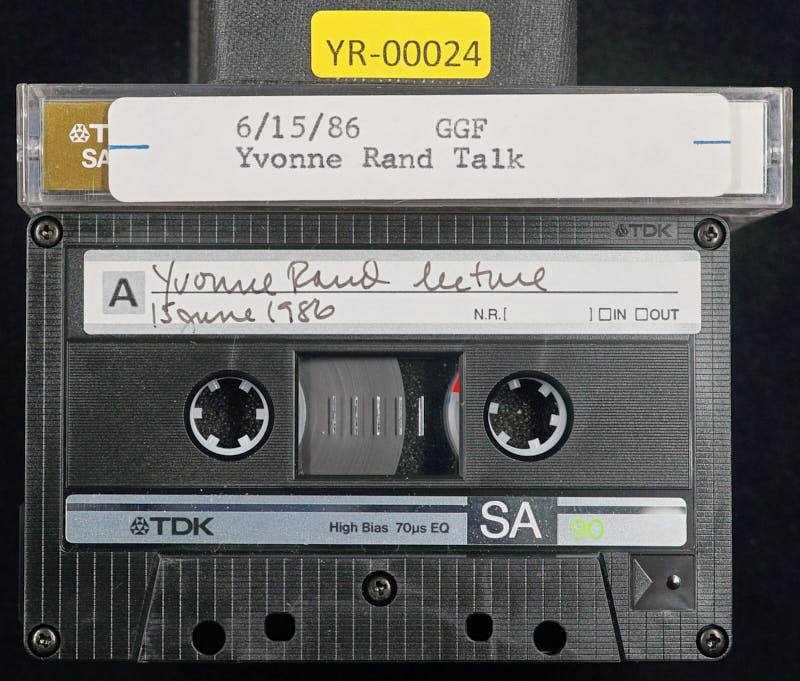
Side: A
Speaker: Yvonne Rand
Location: GGF
Possible Title: Yvonne Rand Lecture
Additional text: Yvonne Rand Talk
@AI-Vision_v003
Tape begins with a chant.
Good morning. I would like to talk with you this morning once again about impermanence. And in particular, our human experience with sickness, old age, and death. And perhaps if I locate myself with you in terms of the events of recent weeks and months, you'll understand why This is the topic which I would like us to consider together.
[01:03]
As I was coming home from India at the end of January, a very dear and old friend and teacher and guide died. And two weeks ago, my stepfather, who has been my father since I was four, died. and last week our good friend and neighbor Elsa Gidlow died. And as happens in the natural order of things, when one reaches the age of 50 or so, or finds oneself with parents and friends who are in their 70s and 80s, we begin to have a kind of experience of dying which we may not have had before that. And in these instances, I have been concerned with the particulars of death and dying with each of these three people in a way that has made, once again for me, a kind of vivid sense and appreciation of the relationship between our dying and our living.
[02:24]
And of course, if we open our eyes to this relationship, it is around us everywhere. It's in the garden. It's in the world, human and otherwise, if we're willing to listen and see. Yesterday, as I went into the market, I looked at the headlines of the newspapers and could, with very little reading, imagine quite vividly the suffering and dying that's happening in South Africa. What I'd like to do is to tell you some stories that relate to these particular events as a way of bringing up to our attention more on the surface for all of us to consider some of the aspects of this business that the Buddha talked about having to do with everything changing. My experience in being with and taking care of people in their dying, when it comes at the end of a long life, is that there may be a particular kind of consideration.
[03:44]
And when I was sitting with Elsa Gidlow, several weeks ago after she'd had a rather major stroke. I was quite struck by her passing because she was so with herself and with each of us who came to see her at that time. And then again last Sunday when she died, in the early morning, I went and took care of her body and sat with her for a while. sat in her garden with some of her friends. I would like to share something with you that she wrote probably sometime within the last year or year and a half because I think it's quite a remarkable expression. This is at the end of Elsa's autobiography. She was 87. a poet, a gardener, one of those people who blazed some trails for many of us.
[04:57]
And here she is again. These are her words at the very end of her autobiography. Looking outward to the autumn world, I perceive ripeness, dissolution, decay into what is called death. But where the stalks and leaves have rotted, they have been transformed into compost, loam, to a seething workshop, a laboratory of elements and organisms that are feeding the peas, lettuces, root vegetables, herbs. What can be said of this death? What can be said of my death in this year's decline as I look to another birthday? Probing deeply, I try to realize make real death, my death, and can find no sense of it. What I do feel is the compost of my increasing years' amalgam of work, writings, love, joys, pain, hopes and disillusionments, defeats and triumphs.
[06:05]
Many of these, as they perform their alternating or interacting dance, come disguised as their opposites. So too I envision life, death, inextricably bound together in an unceasing dance where each assumes the mask of the other, surrenders to the other in perpetual metamorphosis. Yes, I hear you. As a functioning physical being, I have less capability where strength and endurance are required. Emotionally, I become more detached. The passions, if there is occasion for them, are less ardent, infrequently felt, but everything to its season. Is there not compensation in increasing intensity of awareness, in the clear light of spirit shining out through ordinary phenomena, in the greater perspective on the significance and connection of events, personal and on the larger scene?
[07:09]
I ask, If there is a reservoir of creative consciousness on which all emerging life, not solely the human, draws and each returns to that reservoir the fruits of its life experiences, what have I been contributing in exchange for my death? What shall I render back when breath is surrendered? The physical elements composing the visible me face their obvious dissolution to reusable material. What in the cauldron of my soul has been invisibly alchemized for rendering back? I do not know. I am willing to abide by the mystery and to celebrate it. This I shall do as I die into each night's sleep that is rehearsal for the final one, just as each dawn's awakening is rehearsal for what? I think those are remarkable thoughts that she expressed.
[08:18]
Clearly, she was an experienced gardener, and so she understood this process of death and decay and decomposition and renewal quite intensely in terms of what she knew from her garden. Elsa was years ago an avid gardener, working with compost and organic techniques some decades before it was fashionable. The day I went to see Elsa after she'd had her stroke, which was about, I guess about three or four weeks ago, I was struck by how much like a young girl she looked. She had a quality of calmness about her. Her face was absolutely clear, smooth, radiating a kind of light. She looked fully and completely present, in and out of consciousness in the usual way.
[09:34]
And there wasn't so much to do except that we could sit together and breathe together. She stayed that way until a few days before her dying, at which point she began her transition, so that by the time she actually died, the process of decomposition, which occurs with this bag of shit, as a teacher who was here a couple of weeks ago reminded us, this body that we wash and anoint and fuss over, can perhaps fruitfully be considered a bag of shit. Elsa's body was on its way to this kind of decomposition. And in fact, the morning that she died, after I had washed and prepared her body and wrapped it in a sheet, we took flowers, all the flowers we could find in the garden, and covered her from her neck to her toes with the blooms from her garden.
[10:45]
And after sitting with her for a while, I went out into the garden, and in the tangle of one corner of the garden, which had not been cared for in the last year or so, as Elsa was, as she says herself, not having the energy to do it, I came upon a very strange-looking plant. A large, black calla lily. Carnivorous. attracting all kinds of ants and spiders and bugs down into the depths of this strange, quite marvelous bloom. And of course, attracting all of the bugs with that same sweet odor of decay which I had just visited. And I later found out that this was one of Elsa's favorite plants in her garden. I was struck by how long, even to this morning, my memory of that scent has stayed with me.
[11:52]
I think of memory in terms of thoughts or images and rarely smells. I bring this up for several reasons. Within the Buddhist tradition, there is a traditional practice of meditating on a corpse as one of the traditional meditations on impermanence. And for many of us, given the culture that we live in, we have a kind of distance or disassociation from death, which I would suggest to you is a kind of loss for all of us, that in fact, being with a person as they go through their dying and death can be a great treasure, can be an opportunity for reflecting on my own immortality and that of those around me in a way that brings a kind of vividness to my daily life. And I mention Elsa's passing and her expression of her sense of her own dying because I think that
[13:03]
what she is suggesting in these words she's written is exactly the kind of turning toward one's own dying, which is in fact necessary if we are going to live each day fully. Two weeks ago, when my stepfather died, my mother called shortly after he died to say that she had gone to see if he wanted some breakfast. When she had talked to him when she'd first woken up, he wanted to sleep a little longer. So she went in an hour or so later to see if he was ready for breakfast. And he had, in that moment of getting out of bed to go to breakfast, died. She had never in her life seen a corpse. So you can imagine what it must have been like for her. What arose was a kind of shock and fear which left her unable to see an extraordinary quiet and calmness and ease in Papa's face and hands and body.
[14:20]
My parents live in the Sierra Foothills and so it was some three or four hours after my mother's call before I got up there. And I did not go to see my father's body until the next day. Rather strange circumstances, because in this very small town in the Sierra Foothills, no one ever asks to see the body, much less to want to sit there with said body for a while. And in fact, the man who was in charge of the mortuary Cooperative, but uncomfortable. And I think the fact that I was as certain about what I wanted to do as I was, was critical in terms of his being cooperative. He subsequently turned me over to his assistant, a young man, and we drove some 20 minutes or half an hour to another town with a branch mortuary.
[15:31]
where my stepfather's body was kept in a funny little refrigerator box in an old garage attached to the main building. The young man said, please don't hurry. I have some work to do in the office. And take as much time as you wish and let me know when you're finished. And he was very clear that I could stay and sit with my stepfather's body for as long as I wanted to. not minutes, but hours, if that was what I wanted to do. As it turned out, Papa had company in this large refrigerator box, so I was able to do a certain kind of praying and saying goodbye and wishing good speed in liberation, in crossing over. not only for my stepfather, but for some unknown being who was with us.
[16:36]
And I thought at the time, and later when I described the situation to my husband, he said, well, I'm sure I'll hear about this in lecture. I looked around to see what I might sit on so that I could sit in meditation with these two bodies. There was some of that indoor-outdoor golfing green carpet, which I spread out on the cement floor. And then I found a couple of large plastic bags, which are part of the mortician's trade, which stacked on top of each other and made a rather nice meditation cushion. And I sat down on the stacked bags on the golfing green, and crossed my legs, and considered my father's corpse. And I felt very blessed to be able to do that, because it was very clear what his state of mind was in that moment of passing.
[17:47]
In the quality of the gesture he made, I don't want to run away from the fact that I don't have any different Only I very rarely hear the second part, except in its contemplative form. Sure. Well, you know, there's a wonderful description about the archer who hits the bullseye, but not much discussion about the 99 times when he missed the bullseye, which are an integral part of the one time when he hit the bullseye.
[19:00]
But before he gets from the 99 to the 1, you've got to be fortunate. Sure. Sure. All right. Now, what I would like to quibble with you about is your opening sentence, which was, taking everything I say is valid. Big trouble for both of us. I just want to acknowledge this. Nobody is ever complete. And that's a fact. And what I really was accepted by in order to save a long discussion. Sure. Well, one of the reasons I picked up with your opening comment was because I think one of the teachings of the Buddha which I appreciate and think that we can benefit from deeply is an admonition not to accept what anyone says or what any scripture says or what any teaching tradition says
[20:07]
if it means ignoring your own experience, but to listen, to take whatever comes to you and consider it. And if, with consideration and analysis and understanding, whatever someone is putting forth as the truth meets with your own experience, then to accept that as the truth. A kind of admonition not to accept authority outside of your own experience, I don't know where you are. I didn't say anything about giving up your desires. I could, but I didn't. This is, you know, the phrase about pull one thread and the little sweater comes unknit. This conversation is a little like that. I'd like to talk a little bit more with you Because I remember a conversation that I had with my son-in-law before that in which he accused me of not taking care of an old... I've been having a real battle with this man.
[21:38]
It's not at all like the nature of what I do in my everyday life, to do what I do with the scale. And I'm trying everything. Sometimes what I do is I just throw them somewhere else, thinking your neighbor's yard. For me, it's even worse than that, because I have this choice of either throwing them where they're small, It doesn't come from my left hand, because I don't have a sense of control. I mean, that's the state of privacy. It's so unlike what I do in my everyday life. Well, this snail massacre I got into there for a few weeks was very different from anything I've ever, well, not ever done, but done for a long time. And what was interesting for me was when I finally noticed how uncomfortable I was feeling, it wasn't easy, it was not difficult for me to stop doing it.
[22:46]
But, you know, it's hard. When you have a garden, you're in direct competition with a lot of other beings. Oh, it's like when they used to trap the gophers next year and take them somewhere else. I mean, I don't... The raccoons. Remember, we used to trap raccoons here, take them, I don't know where, and I'm sure they just hiked back over the hill and came back the next day. It was a lot of energy to do that. Well, how to work with it? I mean, shall I let them eat my whole garden? I mean, in my garden, it would be different because it's up 20 feet on a deck. So they actually will crawl up 20-30 feet to get to my garden. And there's gardens down below. There are things you can do to deter them without doing them in. But what about if you kill them? We don't kill them directly. No, I'm talking about not killing them.
[23:47]
Yeah. Well, what about eating them? It's interesting. During this teaching that we just had, one of the things that has always been a subject of discussion among a number of us is how to reconcile the precept about not killing with eating meat. And whenever one hangs out with some Tibetan Buddhists, it comes up because they eat a lot of meat. It's the main fat and zampa, barley, the main feature of their diet. But in the strict monasteries anyway, they won't they won't kill the meat they eat. They'll go and buy it from the butcher. And in fact, I understand that when the Tibetans moved in exile to India into a culture where being a vegetarian was actually possible in a way that it was not possible to do in Tibet, the Dalai Lama actually began
[25:01]
not eating meat. And it caused something of an uproar among Tibetans, who made a kind of issue about it. You know, if you're a Tibetan, you eat meat, and it's sort of, you're not being loyal to the cause if you start eating meat, etc. So he had to be a little bit more quiet about it, and at the same time began to introduce some thinking among the Tibetan community about the fact that if you're in an area where, as meat eaters, you're a significant percentage of the population, you are, in fact, whether you like it or not, responsible for causing certain animals to be killed. Anyway, in the Tibetan tradition, apparently, what they say is, if an animal is specifically killed to feed you, then you must not do that. But if the animal is already dead, then you can eat that meat. It's a problem. I think it's a real problem because, you know, as a woman who was one of the first gardeners in Tassajara said, what's the difference between eating cows and eating carrots?
[26:07]
Except that carrots don't scream as loud as cows when you kill them. But we are still, in order to survive, our life depends on the death of other forms of life. And again, from what I understand, the Tibetans make a distinction between the size of the animal, They don't feel so badly about eating a smaller animal as they do about eating a bigger one. I don't know. It's complicated. Yes, ma'am? Well, if you think of humans as part of the cosmos and of nature, and killing is fun, then what about the dinosaurs? Like, say, the cat kills a bird. Well, in this tradition, certainly there is some recognition that the human form is evolved in a particular way, which includes some capacity for consciousness and for enlightenment, and that it is different.
[27:21]
I mean, the extreme end of this tradition not in the Buddhist tradition, but this kind of sensitivity to where we are in the overall scheme of things are the Jains who eventually starve to death and don't move around and don't, you know, don't do much because any activity causes death. I was just thinking of you. goes out and brings the things she builds to the house. So one morning the cat brought a quail. And my friend could hear the maid calling for that quail. And she would not let the cat eat that bird. You know, she just felt so bad about the cat getting I said, this is nature. It's nature.
[28:22]
But she was so compassionate for the bird. Well, what I know has happened for me is that my experience of literally jumping up and down a little possessed with these snails. I can't see you doing it. I did it. I did it for... A test of the path. The front patio was covered with snail tracks. A very interesting walk down the path. That's what I'm talking about. And I really got into it. It didn't last very long because I did get quite uncomfortable with what I was doing, but I did get into it. At the same time, I see our ducks eating the snails from the garden, and that seems like it is, in fact, in the natural order of things. It just isn't the same kind of energy. It's not the same quality of violence or destruction that I've gotten myself worked into. And I remember one evening at dusk when I kind of got carried away, and I said to myself, this is like a little mini version of Vietnam. What's happened to me? Something had gone a little off.
[29:26]
And I suppose the solution is to forget about the garden and just let the snails happen. See what happens. Well, that's probably what happens. See, around our house, it's not really a problem. It's a jungle. It's not like we aren't going to have something beautiful, whether we have tendons or not. It's just when they eat my favorite, It's in video, before it blooms. Yeah. Does not all life require that death to meet itself? Oh, I mean, and in the same way that someday we'll all be gone, and plants will feed off our remains to grow. Yeah. You know, I'm not trying to argue in favor of massive meat consumption or anything, but it's simply a truth. And the plants grow off. And you know, the American Indians have a wonderful practice where they make a kind of offering to the spirit of the animal that they either have killed or are about to kill for their food.
[30:43]
But it includes a kind of gratitude for offering, for giving me your life to feed my life. A kind of recognition about what it is we're doing. Before we eat our meals at home, we have a short chant in which we say, we venerate the three treasures and we give thanks for this meal, the work of many people, and the suffering of every form of life. Some way of reminding ourselves that there is some giving up of life to sustain this life means that I'm much more likely to live with some quality of restraint, and moderation than if I don't do that. And I think that's really what the precepts are about. They are these guidelines for living one's life with a certain kind of awakeness and attention and care, which is not to say that you're just going to stand here and not move, because it's quite obvious what will happen if you do that.
[31:46]
All over. Just one other small thing. My father's request, when he died, was that his remains dumped off the breakwater at Moss Landing to feed the crabs, because he liked crabs. That's fine. Could you talk a little bit about Elsa Gidlow and what she did (inaudible)? No, that's Elsa Gidlow. Elsa Gildow lived in the next valley, right above Muir Woods, at a place called Druid Heights, where Alan Watts lived for a long time. She was a poet, primarily a poet and a gardener. She was gay and was one of the very first gay women to come out and did so in a way that was very courageous. She always used to tease me about our dark robes and the masculine tone of Green Gulch. She said, I like Green Gulch.
[32:50]
I'm glad you're there. I feel like you're my friends. There are these problems, which... She was a very courageous, quite remarkable person, who traveled not such an easy path. One of her poems goes something about, in a world that loves apples, I love oranges. Something like that. There's a poem here at the beginning of her book, her autobiography, which I'll read to you, because it really gives you a little flavor of what she's like. A Real Seeker. Oh, here it is. World, this was written in 1924, so she was really young. "World, I come with my songs.
[33:51]
I come singing. If indeed you have wrongs, I come to undo them. Make ready your terrible beauty. I come with my songs. It shall be my dear duty to praise and adore you. Do you hear my heart from afar beating high like a drum? You must hear it even where you are announcing my coming. I come in awe to your feet, a lover drunk with the fame of your face. Oh, sweet, I bring you my dreams. Make ready your beauty. I'm going to praise you with words that must shake your streets like a drum. Make ready your beauty." One of the things that she hoped would happen, if not at the place where she lived most of this last part of her life, somewhere in this area, would be to make a retreat place for women artists doing some kind of spiritual activity. And she really encouraged women in that way that was not exclusive of men, but included a world of men and women.
[34:55]
So in that regard, she had courage and real vigor, but a very wide allowance. And she was our neighbor. In particular, I want to thank you for appreciating how important it is to acknowledge when death is happening, and to be with it. That's very timely for me. And I would like, if you could, to spend a few moments to talk about those who are dying that seem to hold on, and just need for an incredible amount of time. My fear is that the death process is very slow, It appears that they're having a difficult time with that because I don't understand what that process is. I've been told that it's got something to do with it.
[35:55]
They're not finishing something called Earth. Could you go, could you perhaps sit down on that a bit? Well, two things come up for me in listening to you. I'm convinced that I can't go with another person to a place I haven't been willing to go myself. So, for example, if someone is having a lot of difficulty with pain, if I am afraid of my own experience of pain, I'm likely to have some good bit of discomfort and difficulty being with someone who's going through a lot of pain. I feel very respectful of another person's process, in particular with the dying process. Some years ago, about five years ago, a very good friend and teacher of ours, a man named Harry Roberts, was dying, actively for, if one can say actively dying, for six months, and quite intensely for a little over two months.
[37:10]
And at the time, I was living in the house where I live now, which is just over the fence of the lower fields of Green Gulch. And Harry lived in the house with me and my children. And it just seemed like he took forever to go. And I remember one day feeling really angry with him for hanging on, for I felt exhausted and kind of worn out. Why is this old coot? hanging on and putting us all through this. Why doesn't he just get on with it? And in the middle of it, I realized that I was projecting my pace and my needs onto Harry. And I just stopped for a while. And what came up was remembering that for all the years that I knew him, whatever he did, he did very slowly. So here he was, doing what he was doing very slowly.
[38:13]
And I thought, there he is again, being consistent, doing what he's doing in the way he can do it. And at that point I realized that I was the one who was in a hurry. He wasn't in a hurry, he was just hanging in with himself. It was a very crucial experience for me because I was then able to stand back and let go of having to understand what was going on, let go of trying to control what was going on, and allow the possibility that he had some work to do that was part of his dying process. And that when he was done with it, he would be done with it and he would let go. At the same time, it became clear that there were people who had studied with him, who had come to see him, who were frightened at having him die, didn't want to lose him, who kind of held him back, which was different from his not being ready to go. I had some sense of that when Elsa was dying, that some of the people around her were not quite ready to let her go, and that her dying process looked to me like it might take a little longer because of that.
[39:26]
But it also seemed okay because she and the people she was close to who were around her were so interconnected that that seemed also kind of in the scheme of things and the way it needed to be. I think for most of us, there's a whole realm of the way we do things that may not be so easy for someone else to understand, especially if they don't ask us. If you think about the way we defend ourselves, most of us don't develop defense mechanisms because we don't need them. But we can be very judgmental of each other about the kinds of defense mechanisms we use and the way we function. If I take the attitude that your way of defending yourself is what you've learned to do, that's your best shot at taking care of yourself, I can be supportive, empathetic, with you in a certain way.
[40:31]
That's much more helpful than if I'm over here kibitzing about how you're doing it all wrong. I think the same thing is true with the dying process. If I trust that I may not understand what it is that's going on with the person who's dying, but if I have a basic attitude of respect that this person is doing their best shot at what they're doing, I can at least not get in their way. And the dying process is everything about letting go. It's everything about acknowledging the degree to which, in some ultimate sense, we're not in control. So for some people it does take a long time. I mean, you know, you can look at your whole life as dying. You know, from the moment you're born, you're beginning to die. How long it takes you to get to that point of passing over depends on innumerable circumstances and conditions.
[41:33]
Some years ago, I was quite sick and actually thought I probably didn't live very long. And at some point when I got well again, a friend of mine said, oh, now you're dying at the same rate the rest of us are. And I thought, well, that's pretty good. That's actually pretty accurate. I don't know if that helps, but I do think the process of letting go of whatever it is we cling to, whatever it is we try to possess, is a kind of central corridor with this path of dying. When you use this Buddhist practice of sitting with a corpse, is this the Chod practice of the Tathagata who do this?
[42:41]
This practice that you do, is this something that is normal? It's a very old Yeah, exactly it's a very very old practice No, I think the Tibetans have a much more developed series of practices around this whole meditation But also, you know if you're in a country like India Where I Don't think I ever went more than a I think I figured, I never went more than three days in the time I was in India that I didn't see a corpse. A corpse on the street? Yeah, being carried to a burning ghat. I mean, wherever that was, in whatever village or area we were. So, there's a kind of acknowledgement of death and a corpse.
[43:43]
in a culture where living and dying is happening right out there in front of you all the time, that's quite different from what we experience. And I think for a lot of us we don't realize how recent that is even within Western cultures. It's really only since the turn of the century when hospitals developed where we began to be people who are more used to not seeing a corpse than we are used to seeing a corpse. It's really with the development of hospitals as places where people would go to be sick and die, shut away from the ordinary world. Philippe Ariès, who's a very interesting French social historian, has written quite a wonderful book called The Hour of Our Death, which he chronicles practices around death and dying. And he talks a lot about all of these practices that have to do with an Irish wake or sitting Shiva or whatever. All has to do with sitting with the corpse, usually for a period of three days.
[44:48]
Very, very usual for someone by the time they were 10 or 12 to have had a number of deaths in the family, to have seen a grandmother or a baby sister or brother or a parent die, and to have that happen in the household, and deal with all of the circumstances that follow from that. So our distancing from this piece of the life cycle is fairly recent. It's really this century. And when you go to another part of the world where dying is happening right out there on the street, It's... How do I say? I found staying awake, remembering the Four Noble Truths easy. I found a certain energy for a kind of vivid sense of being on a spiritual path much easier than here.
[45:50]
there were less coverings or pretenses around all of the myriad forms of suffering. And I found that very helpful. And we anesthetize ourselves around that kind of stuff. It's just, it's the way that I sort of post-industrial world is constructed. And I think, you know, one of the things that's happened with the whole development of the hospice movement is a recognition that we lost something in the process of pushing that part of our lives away. Along with having home births, we're also now beginning to have home deaths. And there's a real connection between the two. The process itself is very similar. When someone dies, they actually go through something like transition breathing when a woman is in the last, late stages of childbirth. The actual sequence of breathing rhythms, for example, are often very similar. I've had the experience myself, and I've had lots of people tell me how much being with someone when they were dying reminded them of midwifing, if they had that kind of training.
[47:03]
Tibetans, do they have an understanding of this higher form of death? I mean, do they practice death in a way? I mean, I remember once asking Rev, is meditation death? Well, I think the Tibetans have, the Tibetan Buddhist tradition has articulated stages of consciousness in quite a bit of detail, including the stages of consciousness just before and after death. And, for example, in the Tibetan Book of the Dead, the description of the bardo states, fits my own experience of being with people during the period of a week to 10 days before they die and sitting with the body afterwards.
[48:29]
I think my experience leads me to conclude that the Tibetan Book of the Dead is quite accurate. And I think this is high risk for me to say this, but I'll say it anyway. Suzuki Roshi, when people would ask him about reincarnation, former lives and future lives, was pretty consistently unwilling to talk about it. Basically what I got from it was, well, who knows? But in retrospect, my sense is that he lived his life as if he had some sense that we have former and future lives. One of the things that has struck me in being around Tibetan Buddhists and really struck me this winter when I was kind of immersed in a very large number of Tibetan Buddhists, practicing Buddhists, was a significant difference in the quality of their lives out of their absolute conviction that it's just a fact that we have former and future lives.
[49:45]
So consequently, For them, they are convinced that if they break a precept, they may not experience the consequences of doing some misdeed, some horrible act in this lifetime. They're absolutely clear that they're going to experience the consequences of it eventually. So for someone who comes out of a tradition convinced of the fact of former and prior and future lives, there's a radical difference in their behavior. They take a certain kind of care. There's a certain kind of not cutting corners in the way one behaves. There's a certain acknowledgement that if I cause harm, if I harbor ill will, if I kill, all of that will affect my life eventually. And I felt very moved by the consequence of that.
[50:47]
Anyway, specifically around practices that I do when I'm sitting with a course. A lot of what I do is a series of practices that I've learned mostly from Tibetan Buddhists. Although, certainly in both China and Japan, in the Buddhist traditions in both those cultures, doing something like a meditation in the graveyard is something that monks anyway would do rather commonly. Um, it definitely wakes you up to the nature of impermanence, the way nothing else can. I mean, there you are, sitting in front of this body, watching it decompose. And it doesn't, I mean, you know, I had the experience with Elsa. Two weeks ago, I was sitting with her, struck by how absolutely beautiful her body was. At 87, she just looked extraordinary. By the time she died, she'd already started the decomposition process and was pretty vivid.
[51:56]
And my experience of sitting with her body is staying with me quite intensely in a way that I find pretty helpful. There's some... traditions in the Tibetan Buddhist traditions that have to do with something that borders on magic. And I don't know where that comes from. I think that probably comes from sort of early pre-Buddhist Bon religion stuff. And that, some of those practices I don't really know much about. And I'm not, so far anyway, I haven't been so interested in studying. I've sat with people as they were dying and breathed with them. One woman in particular I can remember died a few years ago. And basically we breathed together as she was going out. And I felt a very strong connection with her that continued after she stopped breathing.
[53:04]
And continued for maybe two and a half days. And then at some point around then, it just, I felt like there was just this But it was very, pretty interesting, the quality of a kind of continuum. You know, we say, well, at this moment, this person died. But in fact, it feels like a kind of continuum that goes along for some while. And saying the point at which the person has died seems kind of arbitrary. It's not like turning off a light switch. It may be in terms of heartbeat, certain vital signs, but in terms of a sense of consciousness, it just didn't like that. And so my first teacher around all this stuff was Suzuki Roshi. I took care of him while he was dying. And I didn't know what I was doing. I just was hanging out with him, because I'd hung out with him for a good five years prior to the time he died.
[54:06]
And it was only afterwards that I realized that he taught me a lot, just in the circumstance of being able to be with him during the last four months in his life was like one continuum. And afterwards I had this sense that this person died in a way that felt completely ordinary. There were no rainbows and brass bands. It was nothing fantastic. There was no magic. It was just every day, each moment seemed completely ordinary, but the experience of being with him in that situation was extraordinary because he was absolutely present on every breath. And I realized afterwards, the next time I was with somebody when they were dying, boy, that was pretty unusual.
[55:11]
And I realized in the years since then how much he taught me as he was dying, which subsequently gave me some sense about what was possible in a way of being with another person. Simply sitting in a chair, hanging out together and breathing. And my experience has been over the years that I've experienced the most intimacy in those times that I've ever experienced with anybody. And I mean beyond the intimacy I know with my children or with a lover. And I've had it with people that I didn't know, doesn't seem to have anything to do with personal history or knowing life stories and that sort of thing. So I think that's one of the reasons why I encourage all of you to, if you have the chance to sit with somebody and to be with them, you will be giving yourselves a gift.
[56:20]
It's not just doing something nice for somebody else. because there's a way of being with another person in that circumstance that's quite extraordinary. I mean, I've been with people who spent their lives trying to find a way to be awake and present and fail. And at the last moment, been able to get it together, to be with themselves and consequently with whoever was around as they went out. It's wonderful when that can happen. And even if somebody goes out scared and fighting, you can still keep them company. About 15 years ago, I met a woman who's a psychiatrist in New York City who, I don't remember how she came upon this. She was doing a lot of work with nurses and doctors in hospitals. One of the things she stumbled on was that It looked like a lot of people who died in hospitals died alone.
[57:25]
So she began to do a study. I think she did it over the course of a year. And she did her study in the four biggest hospitals in New York City. And she came up with some extraordinary statistics. Something over 90% of the people who died in these hospitals died alone. It just turned out at that moment The nurse had to be somewhere else, the doctor was somewhere else, the family was somewhere else. It was just coincidence that something over 90% of the people in hospitals died by themselves. I don't think it's a coincidence at all. I think people are afraid of that moment and have a kind of instinct for when it's coming and can usually figure out some way of being somewhere else. But I think that's just because it's unfamiliar. But I don't think that's bad. Because when you're in the process of dying, you're really not by yourself. You're with someone. Because I feel like, I am reading Kubler-Ross, that you're with God, or you're going there.
[58:27]
I think it's a great moment whether you're with someone or not. Well, I think, you know, in some sense I agree with you. But I also have some sense about Particularly if somebody's a little scared, which happens pretty often. Sometimes just having somebody sitting there breathing with you can make a difference. This one young woman that I was just describing was like that. She would sometimes, as she would exhale, you could feel kind of fear coming up in her. get up high in her chest and get a little bit more rapid. And if I would breathe with her and make a sound on the exhalation, she would immediately let her breath go back to being a little bit slower. So that flicker of fear that would start to come up would subside.
[59:30]
So it was a little bit like watching waves at the seashore. And she never climbed on one of those big waves. She always stayed in a place where her breathing stayed pretty even and pretty deep. So, and she was someone who most of her life had been pretty frightened, pretty anxious, had tried to sort of get it together and never been able to. I mean, who knows? Maybe she would have been just fine by herself. I almost died, and I have this experience of being really healthy. Not at all, not at all, because the present world is not obvious to me. Yeah. Well, I think particularly for people who are ready. Somebody like Elsa, I had this sense that she was ready to go. And she was already transitioned out. I mean, there was a way in which, in the last couple of weeks of her life, she wasn't present in the sense that we usually think of.
[60:35]
And in that sense, I think, you know, it was fine for her, whether somebody was in the room or not. It's okay. The other thing is that after you experience that, you're not afraid of dying anymore. Instead of seeing it as dying, you should see it as that nothing ever dies, that it only changes form. And so, you know, I'm going to come back as a snail maybe. Sometimes I think the dying people are taking care of members and they wait until they go home and then they die. My son died three years ago in a car accident, and I've shared this with a bunch of these non-medical people.
[61:43]
And when I got to the hospital, they had just been out and dead. And I had heard two different things, the dead and dying things, that it's really important if the parent I tried to convince him that I would be all right. And also the coronet. The coronet picked me. I was supposed to go in there for the coronet. Well, anyway, they finally did let me go in anyway. And just like he said, I had the sense that they had already connected him good. This was like maybe 5 or 10 weeks later. He was very warm and still a tremendous amount of life was within him. And I just felt like I was watching the way I could view him while the light was going out. And the weird feeling is, and I haven't told this to a lot of people, but you mentioned it, that our culture doesn't, I have not read it in too many books since, but there's this tremendous joy that comes through, and waves of peace, these waves would come through, and I think, this is crazy, and I can't tell anybody this, because I'm not supposed to be feeling this.
[62:53]
I guess, I mean, it's, you know, you go through thoughts like that later, I didn't want to tell people. Because there's both, there's a tremendous tragedy, and what are you going to do? and death right there. And actually, he looked more asleep. But that sense of joy would come as well a whole couple of weeks after that, every once in a while. And I just could not quite understand that. I still don't, but I was thankful for it, this moment. And then how much that really means the reality. I mean, they let me be with him even after the moment of pain. They were so nice that you could stay with him as long as you wished, just like you said. But even after I was there, my friends came, they saw that he was dead and with me, I got home and I said to myself, are you sure? Was he really dead? Are we positive? I mean, even when you see it. So, it's so important, I think, if you want to, to see it, because it's been helping the weeks to come, when that question comes up, well, yes, I know, I saw him, and I know, you know, and I'm sure it's helped.
[63:55]
He said, after that happened, he went to see a psychiatrist to ask the guy, did he do the right thing by going to see him? And he said, yeah, he did. Isn't that interesting that he had that kind of doubt? He was there at the birth, and if they didn't ever let me see him while I was getting the mortuary, I would have said, that's not real, that's not at those moments. I would have missed that.
[64:21]
@Text_v004
@Score_JJ