You are currently logged-out. You can log-in or create an account to save favorites and more. more info
Unsung Architect of Monastic Unity
AI Suggested Keywords:
Monastic History Seminar
The talk focuses on the impact of Athanasius' biography of Antony and its pivotal role in shaping early Christian monasticism, contrasted with the lesser-known yet significant figure of Pachomius. Pachomius is highlighted as a key influencer in the development of cenobitic monasticism, emphasizing community life based on mutual service and spiritual leadership. The complexities of historical sources and translations of Pachomius' vitae are discussed, illustrating the challenges in understanding his contributions and the evolution of monastic practices that align with early Christian ecclesiology.
Referenced Works:
- "Life of Antony" by Athanasius: A foundational text for early Christian monasticism, serving as a key source for the life and teachings of Antony.
- "La liturgie dans la cenobitisme pacomienne au 4ème siècle" by Armand Veilleux: A doctoral dissertation examining the liturgy in Pachomian cenobitic life, published in Studio Anselmiglione (1957, 1968).
- "The Life of Pachomius" by Apostolos Athanasakis: A translation of the Vita Prima, providing an important account of Pachomius as a father of cenobitic monasticism, published by Scholars Press in 1975.
- Works by Lefort, Maders, and Rene Draguet: These scholars have conducted extensive studies on the Coptic sources and the problematic vitae of Pachomius.
AI Suggested Title: Unsung Architect of Monastic Unity
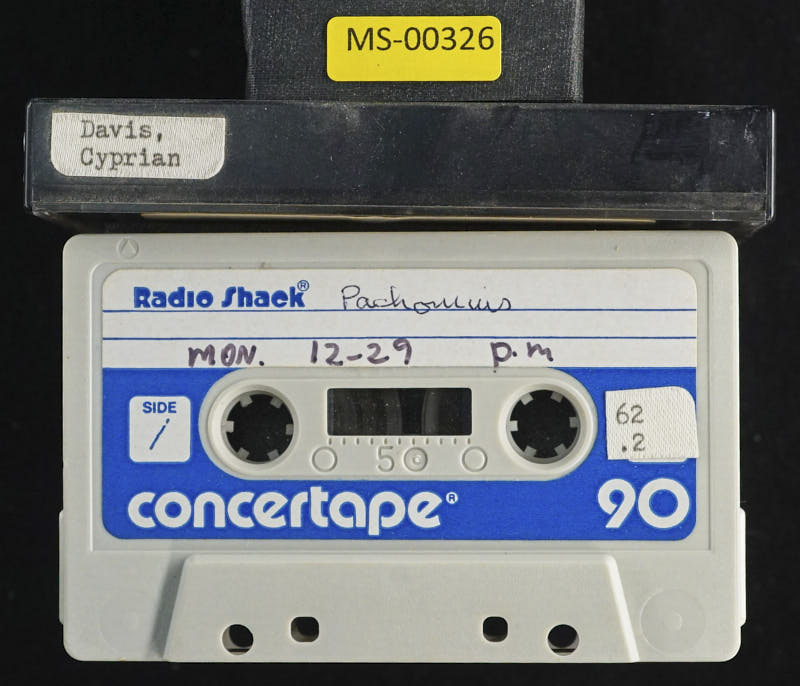
Side: A
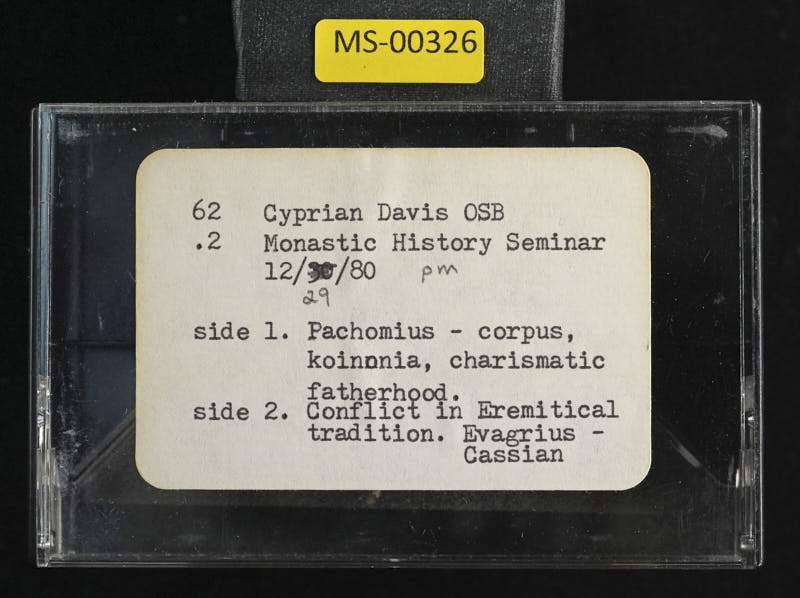
Speaker: Cyprian Davis
Possible Title: Pachomius
Additional text: Mon. 12-29 p.m. 62.2, Pachomius - corpus, koinonia, charismatic fatherhood
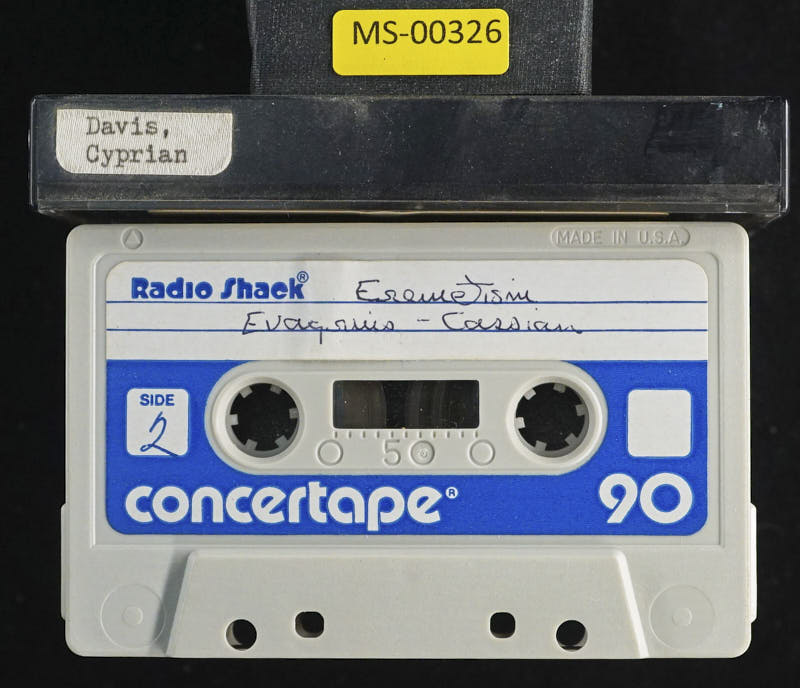
Side: B
Speaker: Cyprian Davis
Possible Title: Eremetism, Evagrius - Cassian
Additional text: Conflict in Eremitical tradition. Evagrius - Cassian
@AI-Vision_v003
We know primarily because of the life that Athanasius wrote. In fact, it is the life of Antony that is the important thing, the monument, really, monumental, the source, really, for early Christian monasticism for its beginning. And in a sense, Antony assumes his physiognomy from that light, from that work of praise of Athanasius. And early Christian monasticism assumes its profile, really, from what Athanasius attributes to Antony, or what Athanasius puts in the mouth of Antony, what Athanasius develops from what he says is the teaching of Antony. There are several letters of Antony which had been edited recently by Jarawas Chiti, edited and translated by Jarawas Chiti, which are attributed to Anthony and may or may not be truly by him.
[01:08]
Probably, if he did write them, he may have very well have dictated them. So we're not sure. So all we have really is Anthony as presented by Athanasius. Because of that, Anthony, we know well, Anthony is someone who is a very good definite figure. The person we want to look at this afternoon, who is in a way as important as Anthony, who is a contemporary of Anthony, is more of a shadowy figure, though we have five lives, or four or five lives of him. There's more than one source that reveals him to us, and yet he is not as well known though he certainly had perhaps even a bit more charming and a bit more exciting as a person than Antony himself. And that is Pecumus.
[02:09]
Pecumus was born. He did not live as long as Antony. He was born actually after Antony. and dies before Anthony. He's born around 286 and dies in 3.6. Dies in 3.6. So his life and his work is ridiculous in the same period as that of the life and work of Anthony. So in a sense, one shouldn't look at The aramidical form of monastic life would say from that develops the syrivitic form that really is perhaps to falsify the whole situation. We're looking at something that almost spontaneously begins and picks up here and there at the same time.
[03:13]
But there are leading figures in the movement who probably really impressed their own personal charism on this movement. But Pocomius is certainly one of them. Pachomius is a shadowy figure because the sources are a problem. They are several vitae, and we have a great deal that's been written in recent years, because Pachomius has become a very popular figure, a great deal of appreciation in the last twenty, fifteen, twenty years, a great deal of appreciation of Pachomius, whereas before He was not a man appreciated a lot. In fact, there were some very strange notions we had in direct to his performance. But today, there's a reawakening of intense interest. And thanks especially to a man who is a Trappist, Armand Veilleux, E-E-I-L-L-E-U-X, who has been for many years in Mr. Sini in Canada.
[04:20]
Armand Veilleux did his on doctoral dissertation at St. Anselmo and Rome on the liturgy in the Piconian and Cenobitic life in the fourth century, La Liturgie dans le Cenobitisme Piconian pour quatrième siècle. And it was published in St. Anselmo in volume 57 in 1968. It really was a major work. and probably is still the great source for our retreating of the Pocomian question and the sources, you know, that question. But there's a long historiography before that. People like Lillefort and Maders at the University of Duvain and Dragett, René Dragett, We've done a great deal of extensive study on the sources, the Coptic sources, in the two, I don't remember, and I cited two dialects of Coptic, from which we have lives for communists.
[05:34]
These were done by Lefort and by Laders in the early part of this century, and then by Fernand Draguet in the period after the Second World War. studying these sources and publishing them. You have the problem of the lives, namely there is the first, there are two Greek lives, one more important than the other, one which seemingly perhaps is the oldest of all the lives, we're not sure, and that probably is a translation of an original Coptic source that is now lost. There is also a series of fragments, Coptic fragments of a life, which may not be, again, the first life, You have then a series of translations, and they're not always able to know what is the original text. The original text is probably lost for a series of translations in Arabic, and it's in English, if I'm not mistaken, in several other languages, especially in Arabic, and then also in Ethiopian.
[06:40]
which are rather important witnesses for early Coptic, of early lives of St. Pecomius. But it is a tangled skein of primary sources for this first life, for this life of St. Pecomius. So that is one of the historical problems. Whereas we have, you have the details of St. Anthony by Athanasius, which is a kind of a shrine, and you have that there, then you have a tangled mess, if you will, of contemporary life, most of them probably being various oral traditions. Various oral traditions that were written down by the disciples of Pachomius and contained in various collections, and that the problem is to try to unravel them, and you see various levels of the tradition, somewhat similar to the scriptural problems that we have. A translation into English of the first major Greek life was made recently by a man named Athanasakis, Apostolos Athanasakis, The Life of Pachomius, which is a translation of the Vita Prima, the first Greek life, a major Greek chorus.
[08:11]
and was published by Scholar's Press in 1975. The reason why there has been a resurgence of interest in Placomius is because he is the father of the Cenobitic monastic life, if you will. It is our first indication of the development of Cenobitic life, and because the various lives picture to us the ideal of synabitism, an ideal based upon a two-fold reality that comes through again and again in the communist life. Namely that the synabitism, the monastic life, is a koinonia. It is a community, but a community in all the scriptural richness of that term, the commune. through the ecclesial communion, and that this koinonia is based upon mutual service.
[09:15]
This koinonia is based upon mutual service. And the second aspect is the notion of charismatic father. The koinonia is the charismatic father, the father who possesses the spirit, and who is one who possesses the spirit as a responsibility to serve his brethren and is in serving with brethren, that the koinonia is made possible. That is the kind of person that Tacomius emerges. So you can understand that Tacomian monastases have embodied a notion of ecclesiology, a notion of community, and a notion of service, which has become, which speaks to us today in our own contemporary Christian experience, our experience of church in Vatican II. And so that In a way, we are rediscovered in this ancient form of monasticism something that speaks to us, whereas we have always had a kind of a misunderstanding of what a common monasticism really was.
[10:18]
And that's why it's very valuable to look at this. When you read the light, even though it's a tangled series of anecdotes and events, it comes very much alive. There's something very, very relevant of the early church in the common resources. Pogomius, born around 286, seemingly from a village in Upper Egypt, was born a pagan. He was not a Christian parentage like Antony. Probably was not as well-to-do as Antony. Antony was from the wealthy peasantry. But he was from an Egyptian village. Very much the rural Egypt grouped in villages around the Nile and so-called wall villages. Tacomius is interesting to us because, in a way, he was a draft-dodger. He was conscripted into the imperial army. You must understand that this is the later Roman Empire.
[11:22]
It is an empire that is trying with all its mighty name. structure. It was a really top-heavy structure together. The necessity of defending its borders against the barbarians who were always anxious to cross the frontiers and at the same time wanted to become all of them and get the necessity of having to defend the frontier. The necessity of depending upon the troops from our Spartan colleges depends on forcing people into service. as we shall see again tomorrow. He isn't the only time when monastasies are behind his sources were military personnel. So the communist is one of those conscripts. The Egyptians were conscripted in the service. Remember, Egypt is not a willing, it's never been a willing part of the Roman Empire. It was always a country that, despite its poverty at that time, despite the fact of being beaten nation, always remembered
[12:28]
that it was, after all, a cradle of civilization. Older, much older, but alone, even grieved these years. But conscriptive of the service forced them to, in a gang that was going to be sent and shipped to one of the frontiers, probably in Europe, he found himself in a Christian village. And the villagers showed great kindness and compassion, charity to the soldiers who were the conscripts, who were the prisoners, giving them food, giving them drink. And he was so impressed to ask them, well, who are these people? They explained to them, these are villagers, they are Christians, and they're Christians do this kind of service. And he was so impressed by this that he decided then and there that he would be a Christian and he would, in a way, spend his life in this type of Christianity, giving service.
[13:30]
So when, in fact, the war ended, the emergency ended, and they were released from military service, and he finds his way to a Christian village, he comes to catechumen, and at the same time embraces an ascetic life, begins to live with an ascetic, which is a normal part now of Christianity, they've done for some time, ascetic living on the margin of the community. He joins up with them in a man named Palamon, and he is trained not only in Christianity, but also in the political life. So it's very, very important. He's a catechumen who opts for Christianity, which means the center of the monasticism. It's very interesting because it's surprisingly what would be the case for many men, much of the common monasticism. In other words, what I'm trying to say is that in a sense, the common monasticism His basic spirituality would be that monastic life is the church, is the church's life. And that one catechumen to one and the catechumen to the other will be the case later on for many of those who enter into the becoming community.
[14:37]
He then becomes a Christian and after a while he moves To live alone, his brother joins him, becomes a Christian, and he's beginning to live the evangelical life, which he traditionally did, already in the northern part of Egypt, living as a hermit with his brother, another hermit, when he has a revelation according to the various lives. The circumstances are slightly different in each life, but he has this remembrance that God has called him to a very special kind of occasion. What must he do? What should he do? And the angel appears to him, and the angel tells him that it is the will of God that you place yourself in the service of men in order to reconcile them with God.
[15:45]
And Pachomius gets a little irritated. These wives are very anxious to be. You see Pachomius Lord is a giant person who can lose a temper very easily. Spends all nights in prayer. And he's praying so intensely. And then they give you the prayer, which is really interesting. Liberating. The church is a historical form of view. You do a prayer and you're standing on a rock where I was going to show you a plan like that on a rock. When you're a sweating body, you see your belts under a heavenly picnic. And, uh... But he got, he sort of calmed down after the night was over. At any rate, he says, I'm looking for the will of God, and you tell me to go out and serve men. And the voice repeats three times. The will of God is that one places oneself in the service of men to invite men to go to him. And as the communist remembers his promise as a, when he was in the hospital, that he would devote himself to the service of others. And he and his brother then enlarge onto a new kind of concept.
[16:49]
They enlarge the incommodations, and they want others to come and join them, not just as other hermits, but in a way to join them as a community. His brother dies, but candidates or young men do join opercomers. And the type of domestic lives, they evolve. You're not proper hermit, training them proper hermit. But it is Pachomius, the father, who sees himself called upon to form these men by serving them. In other words, he waits on the man and put back. The earlier Pachomian monasticism is a very simple type of monasticism. The monks hire themselves out to local farmers and work, especially during the work season. And Pachomius stayed home, and he did the cooking, and he did the taking care of the household. and sort of just looking after the youngsters. And they, in turn, were a rather rough and crude bunch, you know, typical of the farm.
[17:53]
In fact, they were very crude. But the Comus sort of has this great desire, he must serve, and he's got to wait. They want to change, take his example. He's waiting on them, hand and foot, leaving the client, taking out the dinner to them in these days. between a labor and... And the Coptic life describes in rather crude terms the kind of sport that these first monks make of him. The Greek life is more gentile. The idea that Pachomius is a great hero, but the Coptic life sort of gives you... Now, which one is true? Of course, you certainly get the idea that Pachomius had. The first experiments of Pachomius were a decided... We are... The rough-and-ready men decided they were going to have a little fun with Pocomius since he wanted to serve them. They were going to let him serve him. They piled all the pots and pans, got in, and made him, they let a donkey out.
[18:57]
They rode the donkey and made him carry everything like he was a donkey. And they had a very fine time just eating him and this kind of horseplay. and for comius goes on well they'll learn because I am their father and I serve them but finally they are he's had it now and begins to realize that I come in to some axis and I come in to declare and decide it was time to have a kind of showdown and shows them but from now on they will come to declare and they will do this to develop and they decide well we'll see how far he gets with this and decide to support everything And with that, then, Pocomius drives them out of the habitation. And it was a pretty rough and great character. They had moved and they'd go to see the bishop and tell the bishop that Pocomius was driven by the monster and the bishop and takes Pocomius' part. This man, as strong and big as you are, could be driven out by this man and the power of God is with it.
[19:59]
But Pocomius had to do it. Pocomius dies again. with a new group, in the same vein that he has served them, works with them, and they are working elsewhere. But there is a, it takes this time. There is a transformation. And that is the early Pecunian monastic experience. Monks work for others. They share, in fact, the Pecunists and his monks build the church for the villages. And Pachomians, who were the electors, leave and get a priest to come in and celebrate the liturgy. In fact, the early Pachomian monks assisted the liturgy with the liturgy. It's only later as they become a larger group, become over a hundred, that then a Pachomian monastic village, which becomes the typical style then of the seminary village, a village is set.
[21:04]
In other words, what the Pocomian monks are, are villagers, like any other villagers. They're living in a village, however, where all the inhabitants are not, because their sister gives in, it figures in the lines too, and he makes them to a virgin, and he gives them the same form of life, and they too form a village of virgins not far away. The first place is a Pabau, and then a Tabenezi. Upper Egypt was still the greatest way. In Upper Egypt, it was sort of a large community, large-time groups. The Communists seized the community, the village, as a church. It is a church, in every sense, a church, in other words, that reflects whatever the church must reflect, that in the local situation, she reflects then Christ.
[22:17]
The communion is the communion in Christ. And it is a concrete realization, the mystery of the church, right here and there, in this village, monastic village situation, as as wherever the church is to be found. This local church expresses a mystery. And how does it realize its koinonia? It is through the presence of the Spirit in the scriptures, in baptism, and in Bucharist, and in the common prayer, and the common asceticism. Now, there are some interesting things, of course, about this community, which is like any other ecclesial community. with the exception, of course, that there is no marrying or giving and marriage. And on the other hand, also, there is strictly speaking about a priesthood. But Cornelius was not a priest. And strictly speaking, there is a tendency of anti-hieretic attitude.
[23:26]
Now, that can possibly be misunderstood, at least in the Cornelius generation. He did not want priests. For him, there was a feeling that priests tended to become involved in, they wanted to answer, get ahead. And this did not take a point in mind. In the end, however, he does accept, he does accept men who were already priests into the community, but no one in the community does become a priest. It was necessary, you bring a priest in to celebrate the new priest. The rest, however, is taken up by your mind. One of the interesting things is that you had to be able to read to enter the common community, or you had to learn it, because the scripture is important, a very scriptural-based community. In other words, the Bukhomian monk would have no problem, we would not have understood it if you were to say my master is not scriptural. It's very, very scriptural-based, scriptural consciousness, and a
[24:32]
It is very much based upon the early Christian notion that you must give a catechism. Because many of the other people who enter our catechumens are not, are unbaptized. They are baptized into the community in which they are baptized into this Christian community, which was a monastic community. It happened to be a monastic community. It was very much a mix. Obviously that meant, you still, you know, in every way a large man paid many better payments to the family. So one opted for Christianity, one opted also for this monastic church. They have no problem there, because already, for them, the mythos, in other words, the history they had created for themselves, or their understanding of their monastic existence was the Jerusalem community. Again, you could not say to any of these men, they're not scripture-based, they would never understand what you meant. We have a source in Scripture.
[25:33]
Whereas our source, it is the Jerusalem community. It is that community, that, you know, one-minded, one-heart share, having all faith in common, that is according to Nia. And this is what they identify with. Now, in another tradition, with the Hamids, there is another Scripture source that they identify with the prophets, Elijah. Or Jeremiah. But the prophets are the ones from Neanderthal. So you see, they would not have understood anyone talking about, well, this is not scriptural. They had created, in a sense, their scriptural antecedents. In another sense, too, the Bacolian monks, remember now, have a kind of a different ethos from what is in the north in other Egypt. They have a different details.
[26:34]
They too see themselves in terms of the community of Israel. So that at Easter time, for example, all of the various monasteries, because there are other monastic villages that start up after Tabahu and Tabernese and so forth, they would all come together and meet almost like on Sinai at Easter time for a renewal of the covenant. Remember, there's no profession in our sense of nature. There's no one enters the community, not itself, is the profession. Or when it's baptized in the community. It's the same thing. But there's no profession as such. There is an entering of the community. Perhaps maybe an oral engagement is hard to know. At least they hear it. But they receive a help. There is a refinement, however, in the sense that, very quickly, they are broken down into groups, either into houses of maybe 10 or 20. We're not sure.
[27:35]
I'll tell you in a moment why we're not sure. We're probably in the houses of 10 or 20, and maybe into tribes of two or three of these 10 to 20 groups coming together, with each house having a head and an assistant, with the abbot being done over the whole village, and for communists, and then as successively in general over one village, and over the others, kind of as a superior general, in a way. But it is in the group of ten or twenty, in the one house, that the catechesis takes place. To explain in scripture in terms of their mind, and some of the prayer. And there is the church where they assemble for prayer, also uncertainty. Usually we're seeing the prayer, the psalmody, was done as they would do some leading with their, they came on rope and so forth, they worked with the hand of the prayer.
[28:48]
Then they were broken down the houses, usually according to crack. Probably in terms of those who are responsible for preparing the food in the kitchen, those who are responsible for having the gut, those who are responsible for taking care of the sick, those who are responsible for making a certain number of produce evidence by weathers, killers, killers, but for those who treat the cloth after being woven. and various other kinds of press, none of those responsible for taking out for the sailors who were responsible for taking the produce up in the south. In other words, they broke up according to the task. and assembled then, according to accounts, for their daily life.
[29:53]
The problem, one of the difficulties we have in just understanding Pachomius master, like in the time of Pachomius, where it began Jerome's plan as well, Wellington as well as, there definitely was a rule. Now the rule of Pachomius was not a rule like it was a series of precepts. of one-liner, so a short paragraph, giving them to the scriptural text a kind of, a series of precepts, a series of what one should do, and so forth. There's not a development there. There are evidently several editions of this. They're not exactly sure what all of them go back to Pocomnos, or what one is accepted. And only fragments of the Celtic versions of his own. What we have is a Latin translation from the Greek that was made by Jerome for a Victorian monastery at the time in Alexandria, in the time of the fourth century, this century, that he makes, and that he freely, as he admits, freely changed here again.
[31:15]
So what we have, I mean, Jerome is very free and sometimes brought this fantastic translation of a series of rules. So we're not exactly sure of all of that. We can't really put that back into what would be the original component to making in a time of the fourth century where you just don't have the early sort of this can get you. One has the impression that the well-established many, many faceted series of houses and large numbers. It was probably more characteristic than the post-Beccombe era, rather than Beccombe himself. Beccombe in Manassas went into a decadence. That was how we ran about the fifth century, sixth century, and so forth. It is nevertheless a very interesting form.
[32:20]
The picture that we have from the 19th century, in the 20th century, was for monastic writers, monastic historians, to sort of view Pocomian monasticism as part of the evolution of the era medical form of monasticism. And then to picture it as almost a type of termite existence, you know, huge colonies of termites going about their labor with single-minded purpose and military precision and so forth. It is thanks to people like Armand Villier and others in more recent times that we have begun to rediscover the rich spirituality that would be extremely scriptural, and that it is not at all mindless, huge mindless population like ants working together, but a notion of a community that is scripture-based and is held together by a father who perceives his role as father, a spiritual father,
[33:42]
One who has the spirit, he can guide and lead and teach. Because the kind of teaches is very important. And he serves. Now, the source is really ill. The source really ill as Pocomius. Very much is the spirit don't bother. Very much is a man who is personally concerned with his mouth. And very much concerned with the notion of serving him. There is a story, I think, that kind of typifies this. And it's kind of beautiful, because certainly I don't think there are now very few modern abbots who react in this way. To give another example, the early Christian monasticism was extremely much ramish. It was a great appreciation for the nation. And there was much more of a flexibility than perhaps more modern types of black sea. The story goes this way. This is her... It is to be found in various lives.
[34:43]
I took this one from the life that was edited by Tranquil from a Coptic source. Some two miles or so to the south of Tabinesi, there was a little monastery. The father of this monastery belonged to the Pacomian complex. The father of this monastery came frequently to our father Pacomius, whose friend he was, and he would repeat to his own monks with words of God that he had heard become his say. Catechesis is very important, very important, to the early church, so that he might teach them the law of God. One day, a brother of his own community had demanded an important post in the community from him. This particular abbot says to him, Our father Picomius has recommended to me not to do, not to give this to you, this position to you, because you are not yet worthy to occupy this post.
[35:50]
The man became extremely angry, and he began, and he dragged his abbot out of the monastery toward Picomius, saying, come, let us go to him, and let him prove this, this thing. The father, the monastery had to follow him. He was embarrassed, he was chagrined, and he was asking himself all the while, what in the world was he going to say to Pecomius when he got there? Now, when they arrived at Pecomius, and the monastery would tell me maybe, they found the monks busily constructing a wall, and Pecomius was on a ladder up there working too. The brother in question went up to Pecomius, angry, beside himself with anger, and he said, come down and prove to me my fault. For commonness, you liar. And with his great patience, says the text, the man of God replied, not to worry.
[36:55]
And the other continued even louder and said, who has forced you to lie about me? You have your fault right to say. You are contrary to say that you see clearly. In other words, you have discerned that. And that the light is in your mouth. So the Abba Pachomius, this man of God, knowing the tricks of the devil, replied to him, forgive me, I have sinned. Have you never sinned? You also? As soon as he said these words, the anger of the Abba went away. Our father Pachomius then took the father of the monastery apart in Yazdun. What happened? I know the father of the monastery said to him, he says, forgive me, my Lord Father. He asked me for something which really he did not deserve, which would be on his merits. And knowing that he would not obey me, I decided to invoke your name, saying that perhaps he would remain calm before I knew that this was a very serious affair and that there were no secrets from you you see over there.
[38:02]
But now he says, look, he's added sin to his own sin. The man of God replied, he said, listen, give him the position which you asked, in order that by doing so he might snatch his soul from the hands of the enemy. In fact, if one does well to an evil man, he will come back to a sentiment of business. The love of God consists in taking pain one for the other. A sentiment, which is expressed here in the details of the communists, that we have already heard mention again and again the apophagmata. And remember, there was not a similarity. There are two different strands of monastic spirituality in the north and south, two different strands. But the same idea that we must take the love of God consists, loving a neighbor consists, the brotherhood consists, in taking trouble, one for the other. When they had heard this, when they both listened then to the teachings of our father Pacomius, and again he stressed Pacomius as a father is a teacher, they leave him fully company.
[39:19]
Some time later, after we arrived at the monastery, the father of the monastery named them this brother to the post that we had been under. As the man of God, the other Pacomius had asked him to do, Some days later, this brother, who had now come back to its senses, returned to our father Leconius, and he kissed his hands and he speaked. He said to him, truly you are a man of God. You are really far above what anyone else has recounted about you in all these times. The Lord knows it, that if you had not taken the trouble, the patience with me, that day in which I insulted you, I am a stupid sinner. If you had pronounced some harsh word in my own account, I would have left the master left, and I would have gone back into the world. Blessed are you, old man of God, thanks to your patience and your kindness, the Lord has given me life.
[40:20]
I find it very interesting, because I mean, it sums up very well what is meant by the notion of the communist as a charismatic father. this kind of syrup, what it meant by the syrupus, what it meant by the koinonia. And I certainly would find that it would probably be hard put to find an abit or an abyss or a prior who would use that kind of spiritual medicine. to try to deal with a wayward mother or a wayward sister. They only give them the job they want. By the way, it's very interesting, the whole reason and so forth.
[41:22]
There's several other things. strange things in terms of Poconius and Boninacitim. I have noted that there are two different strands between the North and the South, Poconius and Boninacitim. There definitely are. Poconius, for example, when we're going to come back today and then take our break, Poconius was very anti-originist. And as we're going to see at the greater moment, The oregonist problem is one of the main problems in terms of the offensive aviost sabrasa. Very anti-oregon. So there was a definite theological difference. There was a kind of an ongoing discussion between the two groups in terms of the notion of the anchorite life. whether solitude was better or community.
[42:27]
And I think it's very clear that for the Pachomian monasticism, we're not dealing with a sort of a collection of hermits, as was to be some types of community that would become, especially in Syria, I don't know about that. They're just a collection of hermits, and even they saw it in solitude near each other, even in one large community. but very much of community as communion. Which does not mean by any means that this, that the common domestic life was a long, long holiday and just to just kind of chit-chat and getting along together. It was very, very serious, very, very sacrily, very contemporary, very hard, and so forth, and silence. But it was a notion of a brotherhood and a sisterhood dealing with each other, while the other form of nastic life is very much the Abba, the teacher, and the disciple.
[43:34]
That's the disciple relationship, and a solitude in a certain sense, which was not absolute. Well, that you didn't see anybody. But it was a much more of a vertical axis, if you were. Much more vertical. Now, these are two different And in a way, both of them will tend to disappear. But I think it's very important to keep that in mind. Now, it's part of one of the things that is stressful in my team, but there is an ocean of events. There is an ocean of beauty, of beauty, of beauty. I think there probably are other contrasts that can be made between the pecorum and our citizen and the air medical tradition that we get from the upper segment.
[44:42]
The upper segment gives us almost nothing other to the pecorum tradition. Almost all the texts that speak to us in the common tradition, the Lausiac History of Palladius, and as mentioned in the works, I don't want to overload you, I don't want to overload you with texts, others may have heard, Lausiac History of Palladius, which is an account of what, a light among the hermits, the account written by certain Palladius in the post-century, of the imperial court in Constantinople. The man never visited a monastery. He talks about it, describes it. It's all mythical. The same word catching. You never get the scenes. You know, you're, I believe, you never visit it. But he has all these stories about but the rule of the angel and so forth.
[45:44]
But it's all second hand or a kind of extraditional intuition. So that it's only the text himself. Well, the character is still a Gnostic for years of a certain super-seeker. You get that. I don't think become a Gnostic. I mean, quite the contrary. But what I keep doing is that Nasticism, like anything else, will even be there. And as there were the aspects of it, we didn't actually send Judy Brahmers or the patronage we wanted to. We didn't want to. We didn't want to. There would be some things that probably would be wrong. But it is interesting. And I'll witness it. And this is exactly what one of the difficulties that was going on during the tunnel in which Altaquimus lived.
[46:53]
Altaquimus died in 346. It's really an absolute threat. It's a great explosion, completely, in North Egypt, in the north, in the Arimatal there is in Skeet and elsewhere. Mainly, it is a question of culture, cultural differences, ethnically, as well as theologically. We must be aware that the notion that stress and strain and tensions and In fact, remember that your Egyptian monk, who in a certain time will adopt from society, will adopt from a certain sense,
[48:06]
on your post-central angels. There is at least one occasion in the Theodosian Code, where the municipalities, all Roman cities, where monks were forbidden access to, because the monks had called some people, and finally, of course, for the Lord, But there was fights. And in games of all kinds of life. You linked on all of this, they're always on Doctrine Twenties. Sorry, that's not sorry. No, remember that, uh, in the early day, um, Brother John said something about, uh, everything about, uh, cereal of our identity. Remember that, in your Christological, uh, controversy to play with the Lava Council of Episodes.
[49:10]
In the 400th, he could talk to once by the council, the Lava Council of Episodes. The reason why the Oscars is able to get through, he won't beat him because he's got his cohort, his band, and what he's got in the months in the sale of monks who were very rough in the 80s. They were like the bodyguards. These were very strong men. These were very simple men. Very uncultivated in one sense for the Egyptian Korean men who loved God and with strong setups in their soft life and kind of very simplistic in some respects. But the physical violence was there. It was documented. It was documented. So we shouldn't all be surprised that the fire-up that takes place with physical violence back to it.
[50:18]
It involves two men I mentioned earlier, invagrious and oppression. Invagrious is born In Pontusk, in the area which is now Turkey, the province of Yatlik where St. Basil was from, and in fact, he was connected with the primary St. Basil. He was born, he brought up, he was then the lector by St. Basil. He was born around the year 245, when he died in Paine National. Evagrius was kind of a... I know it's a hard story because it was always going to show you that once again, I haven't shown you a whole lot. Evagrius was an enthusiastic who was working on a tremendous career.
[51:19]
Tremendous career. He was a man who knew the right people who moved out in September and at London and went to a family member And he has a tremendous great, an intelligent man, and, uh... And eventually, uh... Didn't I love this story? And he, uh... Not only does he fall in love with a beautiful woman, but she's a beautiful married woman, and her husband is a high intellectual official. He couldn't have done that. It's rather, it is not well known exactly how far the love affair proceeded. All I mean is that it seems that he very briefly learned that he was in a very dangerous situation.
[52:28]
According to the logic of history, he learned the thing, but he may have learned the other way, but I thought it was green. But if he did not get out of Constantinople, get out of Brickley, I'd rather be rid of the land. He leaves everything. And he leaves obviously a tremendous career. And he ends up in horny. He ends up, and he's another woman, who is another woman. And that is millennial elder. Do not notice that millennial elder, although she certainly isn't even a bandwagoner. But that's even more so than Melania the Elder and Rufinus, who were the other people.
[53:39]
Rufinus and Aquilea, they both during childhood were kind of a bone monastery. Rufinus was a master of men, and Melania the Elder was a mother to the other monster of women in the Holy. A millennial was very wealthy, they were great, very wealthy, extremely wealthy. It was three days when the Greek patrician families had a men's class, in men's class, and she would find, she was a white guy, and she had to build her, and she, of course, she couldn't learn a way of anything, but she would be fine, so she would gather in there, and of course, it was a wealthy, cultured, cultivated woman, He ends up then in the Holy Land, found in his nice day, and, uh, wearing good trillions and so forth. He finds his mother, he's turning from a lesser, he's not as well placed socially, but he is also, uh, a teacher, a father, a writer, and, uh, he is over a monastery again.
[54:51]
Now, Wenya is a great student of ours. She was part of that. At the end of that group, within the church at the time, those who found an origin, it was the process of spiritual property. We built the body. Gee, that was a romantic. In the way, intellectual and of course, quite a large artistics. We also never watched. So we're a great citizen. We never watched. At all, except for the trend is, a large artistics are raised to be ready with some portion. And there's times like an interesting person, what you see. but the uh... uh... millennia accept uh... uh... uh... the way we use most in that uh... we really have to be broken up, you have to keep, literally, to be careful uh... you know, that's not something that we're broken, you should tell us that we're not going to be broken up and to join the, they haven't said, you know, you can just talk to them
[55:55]
She really pushed him back on his feet. In fact, she was supposed to have a relapse, a spiritual relapse, which resulted in a physical relapse. And the second time around, she gets him up to Egypt and gets him stirred up. And very vaguely, it will arise now, as there were others, Greek-speaking, in the community of Hermit, with a great deal of knowledge, you know, trained, a theologian, knowing the wider world, knowing the heaven part of the administration of the church, not that noble. And he arrived in the evening. So he mustn't think that the Egyptian derogated was people of all kinds of people, I thought, in the Egyptian part of this time. Many of them from as rich and as varied a background as what the baby was. And obviously, they were going to be kind to him. It was obvious, you have the Egyptian ring of the word, It's simple, strong, and devoted men, knowing only when you've got them.
[57:01]
And you have these intellectuals coming in, various parts of the world, Greek speaking, and intellectuals, and people who could read that, right, and wanted that. And this group of all who tended to be intellectual tended to these students so far. There's a Genshin, he's a pilot, and I think on how own they... that we would have those among us who would read Skilebex and others who would say, I read Skilebex and others who would [...] read Skilebex. I was going to stick with my own vault of organicism. At the same time the tensions and the same sort of feeling that Skilebex, you know, already put on. You can't be sure. You can't be sure. Well, the same with Origen. Origen was a man and he's dead. We all must stand under the shadow.
[58:04]
We all must stand. Origen, no matter what you can blame him for, no matter what person you may, he is still a man who would let the work for us all. We didn't know Christian, you know, without him. We didn't know Christian spirituality. So we still in the brain of all I think he's still been standing in the gap. He was a man, he forced on to it. He forced on to it, he made mistakes, you know, in the two years of life. But a man like the Vagrius, Paul Darjean, follows, no doubt, also seemingly, you know, the impression of his teaching. What sort of does it? Instead of the breathing out, you don't miss the power of it, and so forth. And a man like Jerome, who's a super-orthodox, Client of time, quick man, quick man, he naturally, in preparation for his army, he said, we've done the banter, at least the first time, or so, but anyone who followed the army is suspecting a devil.
[59:07]
When Jonah is a prey, we must attack all of the army. The whole problem, of course, blows up in Egypt, because you have high electors in the videos, So it's subtle to give me an understanding of theology of all of his organs, men of simplicity, and little and ugly holiness, and so forth. The conflict was already there. When it breaks out, it involves the kind of practice breaks out, and it's described by Cassian in Miracle, on from 10, this time of the year, it breaks out, where you had a patriarch who was more of a politician than he was a man of law. to teach you something to do and try and appeal to everybody and get what to do for it. When you defend the origins of my school, my life will be. You finally start to find the Egyptian man striving against him and deciding whether it's sort of criminal sales and going after it actually and plans against the people and the result of it.
[60:21]
He'd write, even in that sense, he goes, they're all great. So by that time, the beggars would be up. But all of this time, the beggars who taught, who looked in, in the day of the scheme, was part of a small community apartment, under the, almost, the, [...] the carriers, [...] There's several strange apotheos. They are always like, they always put the apotheos down. It's a strange one. A situation. So the apotheos, Now, when Trashen arrives in the city, Trashen was born around
[61:50]
three hundred and sixty and died sometime after 432. Gashem, who grew up living on both vitamin B very well, arrived in the holy land and there was a massive life there, lived with not too many humanists, and there he was poor father, I'm just, I have to go shopping between you, I'm sure. And the only thing you do, a person, you go see real monasticism in a source. Of course, it's only because of the repetition of the historical problem, but it was the Paribas. He grows to be, and there, to the guest, the American population probably never gets into the common situation, or never. He grows to the Egyptian, there are the Eastern Hermes, and there, of course, he is gone. Before he left, He was forced to make a promise in the cave of the nativity of the Balkan, but he had to make a return.
[62:57]
Well, when he gets to Egypt, he wants to get down to Paris, he wants to return to the farm, but he doesn't want to go back. And the mouse tells him, you can't get down to a promise to do a loss of good. others to go, when I asked people in Egypt, I went, why are you going to go back to the Dutchman? Because he had no reason to go, well, yes, school, yes, school. So he did go back and get the monks and daughter man to the east, you know, they do with very hard. He returned to Egypt. But when he returns to Egypt, he returns to Egypt before that means in turmoil. And through that, you know, when he woke and breaks up, he was like a little bit of a lady who's hoping to break up and it's supposed to be. And finally, that the John Chrysostom of Township, no, what would you call it, we went big trip up, end up with Christoph, who a short time later will be exiled himself from the death, and many other originators who need welcome to be himself with a hundred percent originators, welcome.
[64:09]
They have to move out a grand fashion, and Paul Rejelmanis, who were only, And he's the Roman Catholic century, and he eventually ends up in Gaul. As an old man in Gaul, where he was found, we played with the monastery, so we rise to what is now good. It's a stereotypical. So we give to the monks in Gaul, who really don't know that. What authentic monastic keeps in the world. It was described, first of all, the activities of the act of life. And I remember what ancient, ancient spirituality, the fact of life is not working on hospitals, and that's just in politics, not working on the cars. The act of life is the operating appliances at a point of university, which is the way of the beginning, the perfect work.
[65:15]
in the south person, wherever you can proceed it is the way in which you begin then you're on a discipline, or asceticism, is the ascetic or lucky which prepares you then for the area, the contemplative lives, when you read the right prayer. So there's not a question of the mind which looks like the better of what you're going to do. One needs nothing to the other. And um... The institute, which we write, is describing what the monastic details are in terms of the vices that you must believe and the virtues that you must find in the framework of the monastic body. And the conferences, the ulcerates of conferences, the conferences, the spiritual doctor, there is no way [...] there is a question in that
[66:46]
We've always typical granted, but there may be a little bit. There is the influence of passion. Some would, some wonder today, and I think probably would take it well to bring the question up again. Whether, to what extent granted, was influenced by passion. That of course brings in another problem because passion always has an influence. that he would never know. There was a teacher about me. He always saw it. And yet, he was there to get out of his teaching. One night, he said, hey, cash and sit in the corner. But by the time he writes, the dangerous was now a man's invisible who's a man [...] who's a man. With many writings, the great influence that we had, sufferers, and lost the writing.
[67:53]
We're kind of a non-person. In fact, 33 is condemned. And so Cashion is not about to mention that he meant taking a negative idea. And the only way of anger is surprised is that his writings, particularly his writings here with spirituality, are taken up by the monks. And you need a Greek copy and usually another name. There was, for example, a great historian of spirituality, a great Christian spirituality, a long time here and there. I was there, who in 1940 discovered the paganist truthisters on, summonses on crying, which is for a long time another name of St. Niles. who is it, [...]
[69:10]
was really buying it this time period for such a long time than somebody else's man. The man really is sort of the reconstituting of the labor and quote this has taken place in Iron Bay. And we know much more about this man today than I thought it was theater central. He was starting to be very young. He really condemned the non-person. But cancer, in a real sense, is the bearing, there is the The burden of this teaching is always all this thought. One of the things is atapho, where there is atapheya, extremely important in the development of the spiritual world. Passion uses the term. It uses the concept, but never uses the term. For again, it becomes purity of heart. For the purity of heart in passion is really And the person says that the end of the master's flight is to achieve your heart.
[70:18]
I think it's very important, at least you see later, to try to come back and look at the beginning and present teaching in looking at, as an example of St. Vanity, the rule of Vanity from New Year's Master, tomorrow. But I want to mention those to me, because in talking about desert monastasism, the Arametic tradition, they must be played there. Even though Trash is writing, when he writes, really pointing out the only monastasism is Arametic. It's certainly Arametic. And Egypt was, the Egyptian Arametic tradition, where is that? Well, I think that's the truth. The communist gives us for it.
[71:21]
Well, you wouldn't address your own feelings about your thoughts. Now, what are we doing? I don't know. Let's say, I suppose I like these things. I like cash. And I like the regular importance of it. So I tend to be one of those who would stress much more the vertical relationship. Well, others I think would tend to be more than a rock. I can get too much communication. I didn't mean to talk so much, you don't want to bring it up.
[72:26]
I don't want to bother you. Go ahead. He seems to have really... I don't know. I like Dorothy, I said, Dorothy. And I wanted to be in Redden, who was a search and study.
[73:29]
And I find Dorothy, I was a very delightful person. Dorothy, I said, writing from a kind of series of discourses, a small monastery in the region of Galveston, which would be made as a script in public, literally. It is a monastery of the lower type, which is a community with an aspect where monks can live, so like Hermes, much more of that. It comes out of the Syrian tradition, and I didn't say anything at all of them, see. But Dorotheus worked by the 6th century Syrian tradition. And with Dorotheus, you see an individual, you see a human person pulsating in the neighborhood.
[74:30]
He described I would love to go and be able to passively really fantastic because Dorothea in his talks, he had been infomerian in his house. He was infomerian and he was charged by the man in charge because in the Syrian monastasism as in any of the Syrian monastasism, in a community, the Abba or the cocturator was a temple ruler and another individual was the spirit of Bautista. to me to the Prince of Bonnet. Then I did combine the tea, but they walked into the town of East and then I assumed that two are a separate individual. It was told by the man who was in charge of the house, who already compromised, to give him the orders of a baby and a baby to take care of the solitary, the grand old solitary who lived in the house and who no one ever saw, and that was Boston Eucharist. you know that is a person who doesn't john and they've been traveling in the carol thing we come out of the population of frank uh... but nice to be with chris and john were both uh... barcelius perceived in uh... in the house in Vietnam and i think later i and john did it on the unison these two men lived as recruits no one ever saw except the one man took care of them and they
[75:53]
would antispirish directly to many. They would answer queries of Keynes and Lynn from far and wide, and would write a reply. It was extremely important for the history of development. Correct. Now, Dorotheos was trying to take care of Barclays. For a long time, some of the monks said, man, that doesn't exist. Here you go, Barclays. I never saw him. So finally one day Bartonee was cut out to be no fit in order to be able to do it. But then everyone wanted to take care of him. And then Josephus describes all this around the Indian people that have promised him. I saw them were so mad, so mad, that they did such things to him as where he found the land. They were all sorts of wrecked around where he was sleeping so that The, the, uh, flyings, and that's a cop, by him.
[76:57]
And one, when he went so far, almost a year in the atmosphere. I don't mention it. Give you some idea of monastic life. Turn to, uh, the captain of the I.T.O.I. I don't, I don't, I don't, I don't think I have a type of life. I don't, I don't really do it. Well, Duarte Vales talks about all this, very frankly, very, very human, but he's talking about spiritual perfection and so forth. And it's true, I think a very rich source of spiritual teaching, Duarte Vales. And he's very down the earth. A man who was, perhaps, when we wanted to die, because he was a very Canadian for a long time. And perhaps it had some medical training beforehand. It may very well be that there was much more of a harmony among certain groups than among others.
[78:05]
I think you'll probably find the whole again. People like Barstin nucleus are interesting because it gives you a very concrete example of the development of spiritual direction. Spiritual direction as such is something that doesn't start with domestic, but the early part of it, the desert part of it, the apostatism and people like Barstin Mufus and others are very much a part of getting a formative influence to this phenomenon in the spiritual direction. And there's also a little how to talk about the rectum, the kind of paramedical life we lived inside a community, or lived on a quick business community, walled out in 31. I kind of saw it very loud, but also very interestingly loud. I don't think I can stress enough the fact that the helmet is not cut off in society, and that the wall of the helmet was very much a grassroot floor.
[79:17]
Precisely because, in a way, the helmet was too long except free. And the fact that one could approach the helmet, it was not easy to see, it was not easy to see a helmet. Because if you have a long, long side, because you have a wall of abilities, like Pecone is in the United States, you couldn't get one side there easily to see it once you wanted to. And you couldn't get inside and see him. But the heaven. What's going to stop you from seeing the heaven? If you want to get to his place. And that was always. It may not be easy to get there, but you get there. And everyone went out to the desert. He did various things. For example, it was me. And they are my old dear friend. Moses of life. Moses, so many people come out to sin. And Moses was around. They're telling me, while the officials are coming out here to see him, and so Moses decides, well, you have enough of that, climbs up into a tree.
[80:27]
The officials approach, and they say, where is the amity of Moses? They say, well, what do you want to see him for? He's a fool, an heretic. You don't want to see that man. And so the party, the unions, and they find the priests of the, who are in charge of this area. and the priests say, oh, we can't come out here, they told them, come out here, see, the great over-modus, and then we, meet one of the monks, and tell them, we said, man, so we were working with the old heritage, and we said, oh, we'll speak about the great over-modus, no way. And he said, what do you look like, do I do the big black man? I [...] said, what do you look like where there are some string of visitors coming out to see them, eyes and ties to the inner mountain to meet the people, to respond and speak to them, to heal, and so forth.
[81:31]
So that I may just talk about the great doctor and physician whom God had raised up in the media. So that, in one sense, the The Hermit was very much involved with people, more than Wooden. In terms of eating in the Egyptian desert, they dispensed charity. And in fact, they helped distribute food and have a family. So that on the one hand, you have the Arametic tradition with the Hezekiah, with the notion of solitude. And yet, an accessibility that was rather extraordinary. And then very much closer to the grassroots. The grassroots. Much closer in some way than . That was almost a . But that paradox would continue through history. The limits would be .
[82:37]
Thank you.
[83:06]
@Transcribed_UNK
@Text_v005
@Score_61.38