You are currently logged-out. You can log-in or create an account to save favorites and more. more info
Unity Beyond Dualistic Perception
AI Suggested Keywords:
Zen: The Root of Being (Part 1)
The talk focuses on the convergence of Eastern and Western thought, exploring the concept of the true self as distinct from the objective world, drawing on Zen philosophy to highlight the unity of self and non-self. The narrative references Buddhist stories, such as Shakyamuni Buddha's enlightenment, to illustrate the non-objectification of self, emphasizing Zen's unique experience of emptiness (Buddhaness) and the necessity for experiential practice over conceptual understanding. Discussions include the difference in religious and philosophical perspectives on dualism, monism, and the expression of compassion (karuna) as integral to the bodhisattva path.
- Shakyamuni Buddha
-
Discussed in relation to the realization that the self is beyond objectification, demonstrating enlightenment as the recognition of the non-duality between self and the objective world.
-
Enya Datta Story
-
An allegorical tale highlighting the misconception of seeking one's self in external mirrors, used to illustrate the Zen principle that the true self cannot be objectified.
-
Bodhidharma
-
Mentioned as someone who, alongside Shakyamuni, could not conceptualize the incomparability of true enlightenment, emphasizing the experience of non-dual reality.
-
Zen Training
-
Described as essential for experiencing the unity of the subjective and objective worlds, with practices like kinhin (walking meditation) being vital for embodying this experiential knowledge.
-
Christianity and Buddhism
-
The talk contrasts the Christian concept of God as Creator with Buddhist notions of principle, emphasizing Buddhism as a non-theistic religion that embraces principles like emptiness.
-
Bodhisattva Path
-
Defined as a spiritual journey toward enlightenment that requires realization of unity and practicing compassion (karuna) and friendliness (maitri) without discrimination.
-
Principle of Emptiness
- Equated across Buddhism and Brahmanism as a foundational aspect of existence, contrasted with Western religious inclinations to personify the principle as God.
The content deeply engages with Zen philosophy's core tenet—that the non-dual experience transcends intellectual understanding, stressing that scholarly interpretations should translate this unifying experience into accessible knowledge while acknowledging their limitations.
AI Suggested Title: Unity Beyond Dualistic Perception


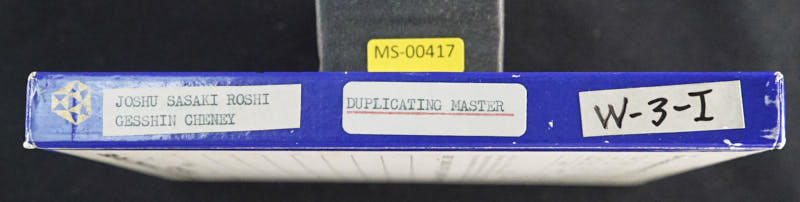
AI Vision - Possible Values from Photos:
Speaker: Joshu Sasaki Roshi & Gesshin Cheney
Location: Mount Saviour Monastery, Pine City, N. Y. 14871
Possible Title: Zen the Root of Religion - Part 1
Additional text: Word out of Silence SEDFO/SIUM\n2-track mono Dolby B\n7-1/2 ips, TDK-SD\n37 min\n36 min 40 sec
@AI-Vision_v002
I'm sorry. Thank you. Keep me here.
[01:59]
... [...] It has been 10 years and 2 months since I came to this country.
[03:46]
I have lived over 10 years in the United States but I cannot speak English. I feel like I'm shaking hands with you wearing gloves. But through facing each one of you, I feel I am communicating with you. I feel I can communicate with you through silence, namely without grabs. I feel very strongly the war or the gap between the ways of thinking between East and West.
[04:52]
There's a great difference between us. I respect Dr. Ranwat for trying to bridge this great gap between East and West. If young people are losing interest and interest in religion, that is our problem, our problem of us, all the generations. I came here to explore and see if there is a space and time for two traditions to meet, to shake hands each other, and if we could do that, I thought that young people would not discard our traditions.
[05:55]
Each religious tradition put up their advertising board representing what they contain. Whatever the labels may be read, They are doing that for their own sake. I think that religion, any religion, is trying to give the people the ultimate, highest ultimate experience, whatever their teachings may be deferred. You may not have any complaining if you could have gotten the ultimate highest experience.
[07:05]
No matter how many records you receive from your friends, if you couldn't have the experience of enjoyment of that record, then the record would be worthless. I believe that the highest experience, most joyful, blissful experience would be the experience of God for those who believe in God. For those who believe in Christianity is the experience with God, and for Buddhists, the experience of Buddhaness. I'd like to talk about that place, that space, where one can experience God, or Vishnu, or Brahma, or Buddhiness. It may be on this sitting room, on this sitting cushion, or it may be on the toilet seat.
[08:14]
After I came to this country, I have heard often that God is always with you. I believe any religion would take the position that Vishnu or Brahma or Buddha is with you. Therefore, I'd like to continue my discussion on that place where we can meet I believe everyone has mind. Again, I think what mind is is quite different from each other, East and West. We always say I or self.
[09:19]
Therefore, I believe everyone has We say, my body, my eyes, my ears, therefore you must have also the physical body beside that self. Probably I can say that self consists of physical body and mind. But our mind always objectify our physical body. You say, my body. That means you have you, my, and body.
[10:24]
Where does this mind and this body would meet? A self is not two. It will be a complicated operation if you have two selves. This is a story told by Shakyamuni Buddha about the Enyadatta. Doctor, what a laugh that smiled because probably he knew this story. I don't know where that smile came from. This Enyadatta was an extremely handsome man and every day he looked at the mirror and smiled at himself.
[11:27]
One day, when he looked into the mirror, he couldn't find himself. No face on the mirror. He came crying to Shakamuni Buddha and asked him to find himself, find his face. Then Shakamuni Buddha told Enyadatta to bring a mirror. He extended the mirror to him. Then he could see his face on the mirror. He was trying to see his face on the backside of the mirror. You shouldn't try to find yourself, objectifying yourself like are trying to see your face in the back of the mirror.
[12:33]
True self is not something you can really objectify. Thus, the true self cannot be found in the world of objects. True self is, of course, within you. Even when I say this, when spring comes, you go out to see flowers in the field. Or you may go to the store desiring to buy some cake. In any case, thus, what you don't have like flowers or like cake, the world of objects would provide all those things you do not have.
[13:37]
Then the world of objects become true self. The world of objects is the world which has everything you do not have. Thus, man seeks in the world of objects. Thus, those who seek in the objective world are those who are incomplete. Man would be lonesome if he cannot seek for something which he does not have.
[14:42]
Thus, imperfection of human being is the nature of human being. What I do not have is possessed by Dr. Watt. When I look at his face, I smile. No matter how long I would live, I cannot become Dr. Lan Watt. It will be lonesome for me not to become Dr. Lanwat, when I want to be Dr. Lanwat, thus I have to try to be Dr. Lanwat. I'm male. I'm not female. I do not have womanhood. It is quite natural for men to seek for women, for women to seek for men.
[15:50]
In so seeking, one should realize that one is imperfect, incomplete. Thus, man is incomplete and seeks for the objective world. And when one thoroughly realizes objective world, one would become complete. people seek for satori or enlightenment and ask questions about it. But I do not have anything like satori or enlightenment. But it is said that Shakyamuni Buddha attained enlightenment. And upon reading,
[16:54]
books on Buddhism, you may ask that kind of question. The enlightenment of Shakyamuni Buddha is that he realized that what he thought he was is not what he really was, but he realized the objective world. If you realize that objective world, then where would you be? When one realizes the objective world, the objective world becomes non-objective world and self becomes non-self. One becomes neither objective world.
[17:56]
self nor the objective world. Mountain is not mountain. Water is not water. When you have realization, the objective world becomes non-objective world and self becomes non-self. That experience is indeed an incomparable experience. Even the Shakyamuni Buddha or Bodhi Dharma could not have that experience. Because it is an incomparable experience, everything is within it. Therefore, one cannot make
[18:57]
any statement. I may say that grasping the universe in your hand is satori. I don't think ordinary people can stay any longer than one hour in that world of unity of subjective and objective worlds. Even two persons like each other so much, they cannot keep shaking hands more than five hours. Even if a place you are staying is a nice place, you feel like going back home. It is a natural tendency of human being. He would be a god or a Buddha if he could stay in that world of unity forever.
[20:02]
Since you are a human being, you don't have to stay in the world of Buddha or God. You can always come back. The Buddha said that man, human being, is always in that unity. in reality, in that unity of subjective and objective world. But always trying to get away from that unity and dividing subjective world and objective world. We do so quickly of this returning trip because it is so quick We are so quick to come back. Even though one has that experience of unity, one wouldn't know it. Ever since you were born, you are taught and educated to separate subjective world and objective world.
[21:15]
Thus, you always come back to that dualism even though so many times you experience the unity. Because of this natural tendency of returning always to the dualistic world, we have to have special training to stay, to realize, and to stay in that experience of unity. and that is called Zen training. That unity itself and the function of that unity is called Zen. It is beyond our conception, and even the Shakyamuni Buddha or Bodhidharma could not conceptualize it.
[22:19]
Therefore, Buddhism calls that unity emptiness or buddhaness. Thus, when you read Zen books, you may find passages that are satori or enlightenment. Oh, I'm sorry. Zen is emptiness. Zen is buddhaness. Zen is selfness, or the principle of universe. I mentioned the principle, but this principle is not something Shakyamuni Buddha created. The idea of principle was old idea, at the time of Shakyamuni Buddha already, by the time of Shakyamuni Buddha, and it must have been conceptualized at the time by Brahmans.
[23:32]
Of course, Buddhism does not believe in the creator. Brahmism does not have the creator either. Brahmism considers the... world of principle or dharma. And that is the great contribution. And the symbol of this principle is Brahma. In later generations, the Brahma became to be considered as the creator. But I think it is... the degeneration of the doctrine of principle. Since Buddhism also believed this principle, one may ask that I'm also a Brahman.
[24:39]
Amid the historical development of this doctrine of principle, But in Buddhism, this principle is emptiness, voidness. In Christianity, you have God as the Creator, but in India, generally speaking, and in Buddhism, there is no Creator God, and we have... we conceive the universe as principle. When I was young, I was always told that Buddhism is not religion because there is no creator God. The Western religious tradition
[25:44]
When there is no creator in Buddhism, Buddhism could be said that it is not religion. When Buddhism was introduced to China, the Chinese decided to call the Buddhism religion, that in Chinese character means the basic teaching. When about 100 years ago, other religions were introduced to Japan, they didn't know what to call. They didn't know how to translate the word religion into Japanese. But the scholars at that time decided to use the word shukyo, that means basic religion, which meant only Buddhism at that time as the general term for religion.
[26:57]
Thus, apparently they were very confused. They thought that Buddhism is not religion, shukyo. Because the word shugyo only meant at that time Buddhism and meant basic teaching. But since the word began to be used as religion, as a translation for the word religion, which contains creator, God, etc., Buddhism became non-religionist. non-sukyo in Japan. But the connotation and the meaning of religion should be expanded, and actually it has been expanded, and we don't hesitate to call Buddhism religion since the word religion, the meaning of religion has been expanded.
[28:11]
And Buddhism being religion, even though we do not have the God, we should have commonplace. Even though we do not have God as the foundation, but Zen Buddhism is also a religion, and therefore you do not have to worry about what i said on christianity as i mentioned earlier we cannot stay even one hour within the realm of god or buddha we have to return to the world of human being as soon as you come back of course you would be objectifying When you are meeting with God or Buddha, you are functioning entirely differently from your ordinary intellectual activities.
[29:32]
What a Zen monk would say is that you have to manifest yourself And the word of God having returned from the word of God. When you can manifest the realm of God in ourselves, in yourselves, then there will be no strife. We have to establish the realm of human being from the from the point of the realm of God. He'd like to actually continue or develop his theme through questions. Earlier he mentioned that it's always very difficult to give a one-way talk because he don't know where you are.
[30:41]
So he would like to... develop his theme through responses of your questions. Swami Venkatesananda has a question. Even before this session started, the Roshi had jug full of cold water and about a dozen glasses. Obviously, he didn't need a dozen glasses to drink from. When we are thirsty or hungry, it's extremely doubtful whether we would be ready or eager or even
[31:42]
able to absorb the teaching concerning Nirvana or Satori or Samadhi or whatever it is how does the Zen practitioner who finds God or Buddha or whatever you wish to call it when he returns from that state to this world of living beings, how does he behave? He returns to this world or the world of living beings with most clear understanding of what he is and what his duty is, and he acts, behaves accordingly.
[32:51]
But, actually, he does not have any place to return, and there is no time when he can return. Therefore, I translate directly. Therefore, the returning means the manifestation of time and space. Therefore, it could mean the manifestation of self is the meaning of returning for the monks. Alan Watts has a question. Rashi-san, I've been asked to present this question to you.
[33:55]
If in the disappearance of subject-object, why isn't it that the Zen life doesn't dissolve into anything goes? And what is the basis in prajna, in wisdom, for karuna? Why be compassionate? Why feel that you have some sort of bosatsu duty towards others? Because there are no others. But still, would you explain that a bit? The question is very clear. Now... When I came to the airport, I met Dr. Lam at the airport. And when I came to greet him, he made a sound.
[35:02]
And I answered by that. When that scene That meeting represents the dissolving of the subject and object, unity of subject and object, and his action is the expression through silence, the expression of that unity through silence. He responded with... to his sound. And the sound of that, of Dr. Lanwat, is also the expression of silence. And there is no other way of responding to that silence of Dr. Lanwat, except doing silence.
[36:15]
covering his mouth. As I said, the returning to the realm of living being is to establish a new order. Since one has realized this unity, when he returns, he has to manifests himself without excluding any other human beings. When one says that he likes this or that, then that is not the manifestation, true manifestation of There are many people who are suffering, who have pains from one reason or another.
[37:28]
Having their compassion and having them as part of him is called karuna, or compassion. The compassion or karna in Buddhism means that you would suffer and you would pain, without exception, together with those people who are suffering and mourning. When a child, an infant, is suffering, Mother would suffer together with her child, and child would feel better without even having medicine. And now he's talking about two basic terms, which can be translated as one, compassion or sympathy, the other one, friendliness, or maitri, friendliness.
[38:43]
And Maitri means that he would cry, he would suffer, he would enjoy, he would be happy with all the people in the world. The action of compassion and friendliness will not come to be if one would like only those who like and he hates. those who dislikes. The compassion and friendliness in Buddhist sense will not be realized without realizing this unity or dissolving of this subject and object. The Bodhisattva path Bodhisattva means the enlightenment being or the person who is walking this path toward enlightenment.
[39:50]
The Bodhisattva path means that one has that realization of unity and therefore one would exclude all sentient beings including criminals and sinful ones. So the bodhisattva, enlightenment being, does not even have Zen. There is no evil. Just this one ultimate wish that he shall walk the path with billions of suffering beings. For a person who has not realized this unity, he discriminates and he segregates, and to him there is no enlightenment path.
[40:55]
The bodhisattva path will not come to or will not satisfy those people who still discriminates and who... still has the discriminative thought because to him always every action requires judgment from relative point of view. Thus for bodhisattva, there is no evil nor good. But if you see this bodhisattva or enlightenment being from our point of view, human being point of view, his action is still only good, even though he accept both evil and good.
[42:01]
Are you satisfied with his answer? Professor Panikkar has a comment. In spirit of obedience, I am here to express my feelings. I don't know a word of Japanese, and yet I think, I appreciate, understand, I have an empathy with Roshi when he speaks in Japanese much more than when I try to make out what he says in English. I think I catch his being, his presence, his message in Japanese without understanding Japanese.
[43:07]
And I say that quite sincerely. As sincerely as I say that I am bewildered, not convinced, and full of doubts when I understand his translation in English and undoubtedly not only because every translation is a certain deformation but because when what as I see what he has to say is put in clear cut English sentences at least for me is far from being convincing. Alan Botts already has said that his question might not satisfy some of his theological friends.
[44:13]
This going to a place where we don't know where it is and coming back and then again taking up the human condition in the world of the living, I understand the words. I fail to understand the meaning, if it is this. But perhaps I have another reading into his message. So my question here will also be perhaps a non-question. Namely, if he assumes that this Zen journey, Zen experience, is a journey into an experience of another world which allows for this kind of dichotomy and even coming back
[45:26]
to the world of the living, as I understood he was saying. That, for me, is the central question, which then would entail immediately his understanding of compassion and mercy. And to explain my uneasiness, then would seem to me that this compassion and mercy either is an almost irritating paternalism or a kind of playing a game which the man enlightened feel doesn't need to play at all and only plays it for the sake of the other, which, in my opinion, would defeat the purpose. I think I got some ideas about the contents of questions.
[46:33]
Zen Buddhism does not accept nor reject the monistic view or juristic view. I don't care how the scholars would like to label Zen Buddhism. Roshi shakes hands with Ellen Watts. In that action, we are experiencing the realm of unity as well as the realm of duality or the world of dichotomy. One may say that when we emphasize this experience, it may sound like monistic.
[47:48]
One characteristic of Zen is that From that experience, one would reconstruct or recreate oneself or manifest himself. In that action of greeting, good afternoon, there is unity of the two. You may call it... Pure experience, the position of pure experience. No time can destroy that unity at any time. The satori or enlightenment of Shakyamuni Buddha is that everyone has that experience. Buddhism calls it practice. Therefore, the truth manifests only in action, not in your head.
[49:04]
Therefore, we can say that the ordinary mind, daily life, everyday mind, is namely the practice and the path or ultimate reality. that that experience is so absolute and so complete that no Buddha or Jesus Christ or God could enter because everything is in there. Because it's so absolute that because it's so absolute that nobody No supreme beings could stop it. Thus the pure experience of Buddhism unifies and completes all existence.
[50:09]
He wouldn't appreciate such a sick hand when the other person is thinking of Sakamuni Buddha or Jesus Christ. When he shakes hands, when the two shake hands, all the beings, Buddha and Christ, are within it. It is only a fool who seeks Sakamuni Buddha outside of that shaking hand. One does not have to seek the Buddha or God when one is one with sick hand. In that pure experience, we are indeed meeting Buddha or God.
[51:13]
You may try to enter religion from scholarly point of view. through a scholarly approach. But our position, Zen position, is that it has to be the experience. All religion is experience. Thus, because we depart from that unity, we immediately return to this subjective and the objective. Through this, because of this experience, one would manifest himself as well as the other. We are experiencing every day at every single moment, but we, therefore, you shouldn't take
[52:24]
my talk as theoretical speculation. How to interpret it and how to understand that experience or that attitude is the job by scholars. and giving the interpretation, modification, conceptualization, which are already not experienced itself, but still communicable in some form. And that job should be done by scholars. The question asked by Dr. Panica is the manifestation of his compassion on behalf of the audience, the entire people here. And I answered the question without understanding.
[53:27]
I'm grateful for the question. I mentioned earlier that one would seek the objective because that is what one does not have. the objective world does not have only the things you like to have or the things which accept you, but also things which would reject you and destroy you. You shouldn't take it that the realm of the Buddha or God is not that which accepts all of you. The objective world has death and hatred, etc.
[54:40]
Therefore, you cannot just seek the objective world with... Thus the objective world is necessary, but at the same time provides with destructive forces. And this is precisely the position in which man has controlled Contradictory elements in objective world is that contradiction of the objective world is called suffering in Buddhism. I mention about this because Professor Panika's question implies this aspect.
[55:49]
I think it is his warning to all of us here that you shouldn't just hear or listen to the Rossi's talk with easy feeling. True practice does not come to being without if... if one does not completely realize and understand the objective world. Taking this objective world as both ways, both good points and destructive points, and separating them is called discursive thought in Buddhism. Zen Buddhism does not permit one to accept self or the objective world unconditionally does not permit that.
[57:01]
Because one tries to accept all these elements, one suffers. To become a truly free person, one has to remove that consciousness which tries to accept all things unconditionally. The more you try to remove that consciousness, the more difficult it is to remove. The true position will come not in trying to remove that consciousness, but in that very action Only through practice one can dissolve into all others. Even when there is even a single dust of affirmation of self, it is not called satari.
[58:16]
Thus... Thus, Zen Buddhism says that satori or enlightenment is also death. And man has to revive from that death. The death of Christ on the cross means his realization of absolute knowledge, wisdom. That is the only way I can understand Christianity. Thus, he obtained the resurrection as man. I believe personally that the reason the Christianity has continued
[59:21]
up to today and flourishing, is because of his resurrection from his death and attainment of the absolute knowledge. Now, I'd like to ask you if you have resurrected yourself, if you haven't resurrected yourself today, yourselves today, you are not a true Christian. You should send away all the robes you are wearing. I believe that you have to live the life of Christ every day, at every moment. And that is the That should be the way, in my opinion.
[60:24]
We have asked Roshi-san to lead us in kinhin between now and supper, and there's just about time enough for that, so that we experience rather than talk about these things. And Roshi-san, if you'd like to do that now. I think people would be willing to forgo the rational answer to their questions by just simply getting it. During kinhin, we don't have to use any Buddhist recitation, but...
[61:31]
. [...] This is something. ... ... ...
[63:56]
Thank you. Thank you.
[65:28]
This is all about. Thanks.
[66:49]
Thank you. This is a song. ... ...
[69:14]
... [...] Thank you. So long.
[70:31]
... [...]
[71:45]
. [...] ... [...]
[73:10]
@Transcribed_UNK
@Text_v005
@Score_87.47