You are currently logged-out. You can log-in or create an account to save favorites and more. more info
Transforming Faith in John's Gospel
AI Suggested Keywords:
This talk examines the themes of Eucharist, enlightenment, and eternal life as depicted in the Gospel of John, particularly in chapters 6, 7, and 11. In John 7, Jesus's actions during the Feast of Tabernacles symbolize the transformation of libations into a metaphor for the Spirit, illuminating how John connects water and spirit to the Eucharistic imagery established in chapter 6. The discussion then addresses how the narrative of the blind man in chapter 9 illustrates progressive spiritual enlightenment versus the obstinacy of religious leaders. The raising of Lazarus in chapter 11 is explored as a demonstration of Jesus's authority over life and death, emphasizing the transition from disbelief to recognition of Jesus as the life source.
- Gospel of John, Chapter 6 & 7: Discusses the Eucharistic symbolism linked to Jesus's journey to Jerusalem during the Feast of Tabernacles.
- Gospel of John, Chapter 8: Highlights the Johannine theme of enlightenment and Jesus's identification as the "light of the world."
- Gospel of John, Chapter 9: Utilizes the healing of a blind man to underscore the theme of gaining spiritual insight versus rejecting truth.
- Gospel of John, Chapter 11: Analyzes the raising of Lazarus as a pivotal moment illustrating the concept of life through belief in Jesus.
- Raymond Brown, "Jesus, God, and Man": Explored for its insights on the human and divine natures of Jesus.
- Daniel, Chapter 7: Cited regarding the messianic title "Son of Man," open to multiple interpretations in its connection to Jesus.
- Community of the Beloved Disciple: Discussed for its mystical perspective and contrast with the more structured apostolic churches.
AI Suggested Title: Transforming Faith in John's Gospel
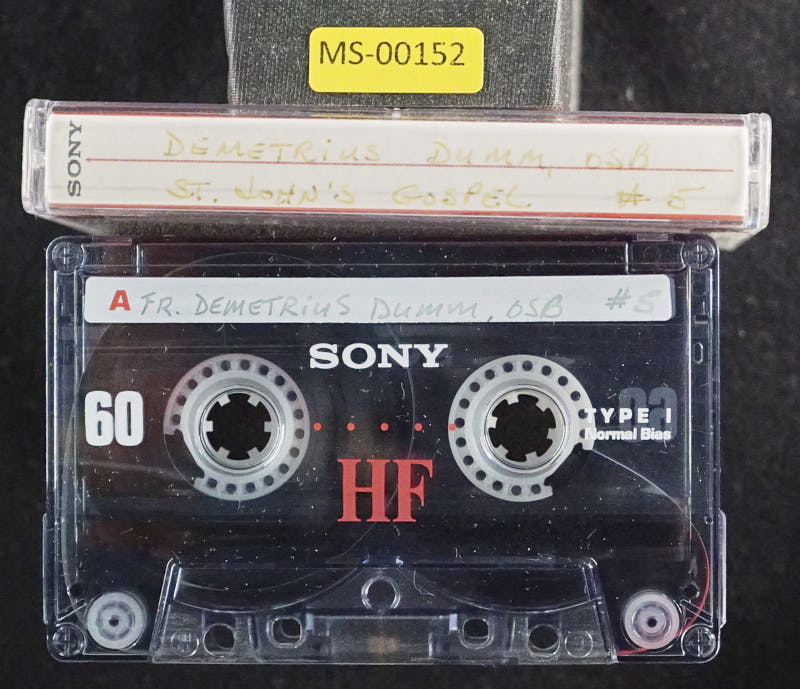


AI Vision - Possible Values from Photos:
Speaker: Fr. Demetrius Dumm, OSB
Location: Abbey of Genesee
Possible Title: St. Johns Gospel
Additional text: W.L. Country Man
@AI-Vision_v002
The primary teaching of John about the Eucharist is found, of course, in chapter 6. But chapter 7 can be associated to this same theme because in that chapter, Jesus goes up to Jerusalem after telling his disciples that he did not plan to do so, and then goes up secretly, the point being that He did not want to go up in the way that they wanted him. They wanted him to go up and declare the arrival of the Messiah and start the revolution. He had no such intention, so he went up for his own purposes, and they went there for the Feast of Tabernacles. And toward the end of the Feast of Tabernacles, which ran several days, They had these libations.
[01:02]
They would pour out huge pitchers or barrels of water. It was a religious ceremony. In the ancient Near East, which is a semi-arid region, water is much more precious than it is in our part of the world. And on the occasion of this pouring out of the water, it says, on the last day of the festival, verse 37, the great day, the climax, while Jesus was standing there, he cried out, let anyone who is thirsty come to me, and let the one who believes in me drink. Out of the believer's heart shall flow rivers of living water. And so as the bread came, in chapter 6, was food for the believer, so here the water of libation is drink for the believers, which of course in the Eucharistic context becomes the wine or the blood.
[02:16]
Now he said this about the spirit which believers in him were to receive, for as yet there was no spirit, because Jesus was not yet glorified. So this is an anticipation of the coming of the Spirit after the resurrection, which would be that flow of water, that gushing water of new life, which I think can be understood also in a Eucharistic context. Moving on then to chapter 8. As you probably know, the first 11 verses of chapter 8 are generally considered not to be Johannine. The vocabulary is completely different from the rest of the Gospel of John, and scholars disagree about where it might have come from. It's the story of the woman taken in adultery, which seems to have no connection with anything that went before or after.
[03:18]
And so in chapter 8, verse 12, we have the initiation of the theme of enlightenment. Enlightenment goes beyond the traditional, classic stages of initiation. And John's Gospel wants to invite us to move beyond that. Of course, conversion, baptism, and Eucharist, they all continue. and one grows into them, and they become more truly part of oneself. But at a certain stage, when one's identification with the Eucharist and with baptism becomes strong enough, when there is a certain maturity, and one's commitment is serious enough, one enters the realm of enlightenment. Classic mystical language, of course.
[04:21]
And so, chapter 8, verse 12, once again, Jesus addressed the people, I am the light of the world. No follower of mine shall walk in darkness. He shall have the light of life. For the first time, another great I am statement, for the first time identifies himself as the light of the world. Absolutely. That this is the only meaning that one can find in the world according to God's purposes. The light of the world means the meaning of all creation. And so this enlightenment in an individual Christian belongs, I think, to the realm of intuition. a profound intuition that leaps beyond rational evidence.
[05:26]
The clouds part. The sun comes out. Everything takes on a luminous quality. Not comprehensible, but luminous. You know, this word mystery, we talk about the mystery of God and the mystery in the Bible. Unfortunately, in English, mystery usually is limited to what is unknown. And so you have mystery stories. And the question is, who did it? Was it the butler? Or was it, you know, the gardener? Who did it? That's a mystery because it is unknown. At the end of the story, the mystery is resolved. Religious mysteries are altogether different. It is also incomprehensible, unknown, in the sense that it is not controlled rationally. But unlike the mystery story, the mystery here is full of meaning.
[06:34]
It is incomprehensible, but has no meaning than anything that we can comprehend. And so, to leave rational knowledge And to enter into the mystery of God is to be enlightened, is to see more than one could ever have seen by rational means alone. This enlightenment reminds us of the transfiguration in the Synoptic Gospels, where Jesus himself was illuminated. We see in the face of Jesus, in his garments, this luminous aura which represents his personal discovery about how God will save the world to him. This is not the common interpretation of the transfiguration, but to me it's absolutely obvious.
[07:43]
that the illumination came from within Jesus. Nobody does it say it came from heaven. And it does not reassure the disciples. You do not see them saying afterwards, oh, it's going to be all right. We saw him illuminated. No, no, that is not what happened. If that was the purpose, it failed. I think it's far more likely that Jesus grew in the understanding of what his mission would require of him. This question of the knowledge of Christ is very, very interesting. And Raymond Brown, in his very first book, Jesus, God, and Man, he hedges on that. And of course, ever since the Arian heresy, we have had such high Christology that we hardly leave any room for the humanity of Jesus. And with the high Christology comes a kind of, you know, know-it-all. Jesus knows everything. In fact, Thomas Aquinas said he had the beatific vision.
[08:44]
Well, nobody today, well, I wouldn't say no, hardly anybody today would claim that Jesus had the beatific vision, not even Ratzinger. And so I think it's fairly safe to say that he did not have the beatific vision. But I think more than that, I think he grew in the understanding of his mission. In other words, to put it simply, Jesus was not making little crosses in his father's workshop. What are you doing, my son? Oh, nothing. Just practicing. And in the Garden of Gethsemane, threw himself full length from the Grandfather, can this cup not pass from me? You know this. And Pere Benoit in Jerusalem said, above all, avoid this mistake of thinking that Jesus was pretending. That he was winking at the angels. We know it's going to be all right, but for their sake, I have to act as if.
[09:46]
No, no, they're not pretending. The incarnation was successful. Became one of us in everything but sin. And so I think this transfiguration is a critical moment in the ministry of Jesus where suddenly the dam breaks and the flood comes over him. Oh, my goodness. So that is how God is going to save the world. Not by my miracles. That's the way humans would want to save the world. By power. No. God is going to save the world by my loving. By loving, which does not seem to have much power. By loving and therefore my suffering and my dying. That is how the power of God is brought in to our human world. But we think power, violence is the way to get things done.
[10:51]
We tend to think that. And so this is illumination. And of course, Moses and Elijah are there. What are they doing there? Well, they were the two great mountain men of the Old Testament who met God on a mountaintop. Mount Sinai. For Moses, he came down from the mountain and his face glowed so brightly that the Israelites could not look upon him. Talk about a transfiguration. And Elijah on Mount Horeb, which of course is another name from Mount Sinai, and then on Mount Carmel, where he met God in that famous sacrifice. And he was so elated by this presence of God that he ran toward Yisrael. And he outran the chariot of Ahab. What a dream that must have been.
[11:52]
Elijah running with his beard on his shoulder. There's some wonderful images in the Bible. So they are there to tell us how critically important this moment is. All the Old Testament is represented at the Transfiguration. And one of those is that illumination, a recognition that this is what God has in mind, that is you are loving, humble, unassuming, hardly noticed loving that the power of God is brought into our world to effect tremendous things far more than all the power and violence could ever do. In the rest of chapter 8 you have a strong almost a bitter dialogue between Jesus and the Jews.
[12:53]
I think this tells us more about the Johannine community in the 90s than it does about Jesus in the late 20s. Because they were the ones who had these bitter contests with the Jews who were rejecting them and persecuting them, their compatriots. Chapter 8, verse 30, they were, you know, calling... them demons. You are a Samaritan and have a demon. That's not diplomatic language. And he says, your father is the devil. That's wrong language. As he spoke thus, many believed in him. And Jesus then said to the Jews who believed in him, if you continue in my word, if you abide in my word, meno, if you deepen your understanding of my word, if you move along the path in every deeper recognition of what my call is, you are truly my disciples and you will know the truth and the truth will set you free.
[14:09]
You will be enlightened. You will know the meaning of everything and you will be liberated by that knowledge, that understanding. They answered him, We are descendants of Abraham and have never been in bondage to anyone. How is it that you say you will be made free? Unfortunately, they do not accept his invitation. Instead, they see the light as a challenge to them. They are in the darkness. They do not want to leave the darkness. The light is very threatening to those who live in the darkness of self-interest. It seems like bad news to them and their impulse is to kill the messenger. He answered them, If the Son of Man makes you free, you will be free indeed. I know that you are descendants of Abraham, yet you seek to kill me because my words find no place in you.
[15:17]
There's no room for the light in them. John then illustrates the theme of enlightenment by telling the story of how Jesus cured a blind man. The story is quite simple, uncomplicated. I'm sure you know it. A man born blind is cured by Jesus. The miracle takes just a couple of verses as typical of John's Gospel. He wants to talk about the meaning of the miracle When asked what happened, he says, The man called Jesus made clay and anointed my eyes and said to me, Go to Siloam and wash. So I went and washed and received my sight. Simple story. Simply told. But notice how he refers to Jesus.
[16:19]
The man called Jesus. He has not yet seen Jesus. Remember, he had mud in his eyes when he left Jesus. So he knows him only by reputation. They say his name is Jesus. This is like that early childhood faith we have. We believe with the faith of our parents. We believe on the witness of others. The first stage of becoming initiated into the Enlightenment. A necessary stage, but very, very early. At first he knows Jesus only by reputation. And then the Pharisees entered the picture because Jesus had worked this cure on the Sabbath. You know, you have the distinct impression from the Gospels that Jesus checked his watch every Friday and said, you know, I'd like to cure you, but just wait a while until it's the Sabbath.
[17:21]
It seems he always goes out of his way to cure people on the Sabbath. Why? Because he must challenge them. He must challenge these people who have misunderstood and misinterpreted the Sabbath. It was never meant to be a burden. It was meant to be a time of freedom. You were allowed to circumcise somebody on the Sabbath, but you can't cure somebody on the Sabbath. You said you're hypocrites. Pharisees enter the picture. He has challenged them directly. He forces the choice. They are torn between their profound bias against him and their common sense. They ask the blind man, who is it that cured you? Well, now he's had time to reflect a bit. He said, he is a prophet. The next stage.
[18:25]
He is a prophet. He is one who stands for God, speaks for God. He is a man of God. He now makes his own judgment in his own name. You see, in this story, the blind man is getting more and more sight as he goes along. Not just physical sight, but spiritual sight. And the Pharisees are getting blinder. They are progressively becoming blinder, and he is becoming more sighted. Finally, they call his parents, and they do not want to get involved. Then they ask the blind man, the former blind man, tell us again. There must be something we missed. And he says, why should I tell you again? Do you want to become one of his disciples? Of course, that's the last thing they want to do. And they abused him. They chided him. And then they say finally, we know that God has spoken to Moses.
[19:30]
But as for this man, we do not know where he comes from. We know that God spoke to Moses. We do not want to move away from Moses. Now they've been living with Moses for over a thousand years. And they have interpreted Moses and interpreted him and commented on him and they have edited him, massaged him, I would call it, massaged the law into their categories. That's a great danger that we edit documents until they agree with us. So they are comfortable with Moses. They are familiar with Moses. They want nothing about this man who comes and challenges their distorted understanding of Moses. We know that God spoke to Moses, but as to this man, we do not know where he comes from.
[20:37]
And then the blind man, former blind man, exposes their hypocrisy. This is indeed a marvel. that he has cured a man born blind, and you say you do not know where he comes from? We know that God does not listen to sinners. If this man were not from God, he could do nothing. This is so obvious. But when you don't want to see something, you don't see it. You become blind. If something is too challenging to be accepted, you just don't see it. You block it out. They cast him out. Who are you to teach us? Where did you get your degree?
[21:39]
They have preferred their controllable understanding, their familiar understanding, to the uncontrollable implications of listening to Jesus. They are unwilling to change. They are unwilling to grow. And this is tragic because it means they begin to die. They choose an edited Torah over a living Jesus. If we get stuck in the past, we do pretty much the same thing. Then the blind man comes to Jesus, finally. He meets Jesus. And the dialogue is most interesting. Do you believe in the Son of Man? Jesus said to him.
[22:44]
And he answered, Who is he, sir, that I may believe in him? This on the surface seems fairly simple, but I think John has some very important message here. Do you believe in the Son of Man? Son of Man was one of classic titles for Jesus. He called himself the Son of Man, which was ambiguous. It could mean nothing more than a human being, but it had a little hint of the messianic passage from Daniel. You shall see the Son of Man coming on the clouds of heaven, chapter 7 of Daniel. So it had open-ended possibilities, but it was basically a title given to Jesus. The blind man, now recovered, had what's nothing to do with titles.
[23:46]
Who is he? I don't know if I believe in the Son of Man or not. I think this is just protest against a religion that is focused on titles and definitions and rituals. I think the blind man could well have said, I believe in you as a person. I don't believe in your titles. If you say you're the man in the moon, I believe in that. If you say it, it's a protest against reducing Jesus or God to theological titles. We'll see more evidence of this later. And he began to worship him. Worship him in person, not because of his title. It is only at this moment
[24:50]
that the blind man is finally cured because now he sees clearly and is enlightened since he enters into a relationship of total trust in Jesus, a relationship that does not reject ritual or doctrine or titles, but which totally transcends them and fulfills their purpose. The consequence of enlightenment is a deep insight into the meaning of life revealed by Jesus. In chapter 10, Jesus says that he is the good shepherd. Those who are enlightened will hear his voice. They will recognize instinctively the truth of his message. And what is that message? They must follow his example of love. I am the good shepherd. The good shepherd lays down his life for the sheep. He lays down his life every day for the sheep as he allows them and their needs to control his schedule, to control what he does or what he does not do.
[26:05]
A model of unselfish service, a model of living in the light, those who are in the light can recognize the voice of the shepherd, I know my own, and my own know me, as the Father knows me and I know the Father, and I lay down my life for the sheep. The enlightened ones will have entered into that intimate personal relationship with Jesus that makes them participants in the flow of life and love between Jesus and his Father. final step in this program that John goes beyond Eucharist, enlightenment, and finally, fullness of life, eternal life. We find this in chapter 11, and the whole theme is captured in the story of the raising of Lazarus.
[27:16]
Now, a certain man was ill, and Lazarus of Bethany, the village of Neri, and her sister Martha. We must pay attention to this first sentence. There are some very important clues in it. As I mentioned earlier, he said, now a certain man was ill. It's not the way you start telling the story of Lazarus. He introduced Lazarus first and then described his condition. As I mentioned, he wants us to understand that he's talking about every man, and Lazarus is only the representative of all of us, even with the sickness of mortality, as I mentioned. He says he was from Bethany, the village of Mary, and her sister Martha. If you were Martha, you would notice the difference.
[28:24]
the village of Mary and her sister, Martha. Now there's a little political thing going on here because in the story it's going to become clear that Mary is the favored one. Martha's okay, but Mary is better. And of course that's part of the whole tradition about Martha and Mary. What comes to Jesus in Galilee is The one whom you love is ill. Your dear friend is ill. Mortal human beings can have hope because Jesus loves them. He is ill, but we know already that he's going to be all right because he is the one whom Jesus loves. That for those who are loved by Jesus have an answer to to illness and death. However, Jesus waits around for several days before he leaves Galilee, and then finally he goes, even though his disciples warn him that it is dangerous to go to Judea, that they are trying to kill him there.
[29:45]
And then he gives this... have this ambiguous or emigmatic question, are there not 12 hours in the day? And if you walk in the daylight, you do not stumble. But if you walk in the dark, you stumble. It doesn't seem to have any relationship to what is going on in this story. And I think what one time does it a bit, Jesus is saying, if you live in the light, in the light of my teaching, that is the 12 hours of daylight, if you live in the light of my teaching, you will not stumble. But you will be tempted to extend the daylight, to extend your light beyond the 12 hours that God has given you. And if you do that, you begin to enter into the darkness. You do not accept the timetable that God has given. determined for you.
[30:46]
It is a selfish thing to extend life beyond what God wants you to have. There is always time in life for what God wants us to do. And there is never time in life for what we want to do. You ever notice that? I can't believe that I'm going to die. I haven't gotten to Alaska yet. And then in 95, no matter how old we get, we're still surprised that we're mortal. It's concerning to know that God is not surprised that we should die. In fact, God would be very surprised if one got away. And so in our world, everybody is so impatient and the pace is so traumatic, especially when you get older.
[31:50]
One of the ways of dealing with old age is to move faster if you can. Extend the day, stay up later. Never time to do what we want to do. But there's always time in that to do what God expects us to do. to live unselfishly. Jesus is greeted by Martha. Martha is an impatient person. She rushes out to meet Jesus at a distance from the village. The children run back and say, he's coming, he's coming. And Martha jumps up quickly and goes out of the village to meet him before he even gets to the village. Bethany. She is impatient. She's impatient because of her brother who is now dead. She's impatient about what Jesus may be able to do.
[32:56]
She's impatient because she's struggling with death. And she represents one way of dealing with the scandal of death. Maybe the classic way is to try to find out why. Why did he die? Why did she die? So young, so promising. It's like shaking a rag doll to get the stoppings out of it to find meaning in death, human death. So she's very impatient. She runs out. If you had been here, you could have done something. Maybe it's still not too late. but she's not too sure. And then Jesus responds to her with a profound statement that used to be in the gospel of every terminal mass. This story. Out of the story that took Martha's part, not Mary's.
[34:00]
I think that was a mistake. Anyway, Martha, the high point was, I am the resurrection and the life. He who believes in me, though he die, yet shall he live. He who believes in me shall never die. I think there's two statements here. I am the resurrection. He who believes in me, though he die, yet shall he live. I'll go even farther than that. I am the life. More than resurrection. He who believes in me will never die. It may be called death, but it won't seem like death because my life in him will be so powerful. This is a profound theological statement. And then Jesus says to Mary, do you believe this?
[35:04]
Do you believe that I am the resurrection and the life? She reveals the inadequacy of her faith when she responds, not with a simple yes or modest, I hope so, which would have been the more appropriate answer. Sometimes yes is the best answer. Don't add to it, just get in trouble. Yes, or even I hope so. No, she said... Yes, Lord, I believe that you are the Messiah, the Son of God, the one coming into the world. Three titles. We just learned that he's not interested in titles. She said too much. The deeper one's experience of Jesus, the fewer words one needs to describe it. Indeed, it becomes ineffable. Beyond words. Raymond Brown says, Martha gave a memorized catechism answer.
[36:14]
Not a personal answer out of her heart. A memorized catechism answer. Why did God make you? God made me to love him and serve him in this life and to be happy with him forever in the next. Very good. Next one. You know, you know what a catechism answer is. Memorized, la-la-la-la. And Dwan, you know, he's no dummy. And this was a memorized catechism answer. And if you read the community of the beloved disciples, you know that the community of John, very charismatic, very, you know, mystical, is compared, is contrasted in John's Gospel with the other Christian churches at the time. they call the apostolic churches or the great church, which were very strong in structure, very strong in theology, very strong in titles, but not strong enough in mysticism. Raymond Brown says, the Geronion Christians, represented by the beloved disciple, clearly regarded themselves as closer to Jesus and more perceptive
[37:31]
and the Christians of the apostolic churches. I think Martha represents the apostolic churches who know all the right theological definitions and the right answers but have not yet gone into that deeply personal relationship by and large. Of course, keep in mind that the community of the beloved disciple had to go to the big church and ask for help when the beloved disciple died and they had no structure to hold them together. So they had the charismatic and the mystical, but they needed the structure too. And they came back with their gospel and with the letters of John and the two together. They made a trade, Brown says. I think it's very plausible. Later on we will see that Martha's faith truly was inadequate. Because when it comes time to open the tomb, Martha will say, oh, you can't do that.
[38:40]
He's been in the tomb three days. He's thinking. Well, if you believe Jesus is a resurrection and a life, you can, you have no problem with older. So her faith was not as strong as it should have been. Well, then comes Mary. Mary was now brought into the picture, and it happens in a very significant way. Mary has stayed at home and waited until she was called to Her attitude is not impatient, but quiet and contemplative. It's body language. It says in verse 28, when Martha had said this, you know, yes, Lord, I believe, and so forth, she went back and called her sister Mary and told her privately,
[39:57]
The Master is here and is calling for you. That Greek adverb, latra, is just untranslatable in English. And every translation has a different adverb. Here it says privately. Others say quietly. Others say in a whisper. There is something about Mary that makes everybody quiet down. her contemplative attitude causes people to whisper in her presence. You know, there's an atmosphere around her. Said to her, quietly, the Master is here and is calling for you. For after she is invited, she goes to meet Jesus. She represents a mystical experience of God. And when she goes to Jesus and he sees her weeping, he is deeply moved, but does not make a profound theological statement as he did for Martha, but he goes into action.
[41:18]
Where have you laid him? He wants to confront death. This verb which says, when he was deeply disturbed, Imbri-ma-o-mai, it is a very, very strong verb. Imbri-ma-o-mai in its first literal meaning is to snort with rage as a horse. And that's the literal meaning. I don't know how much experience you've had with horses, but when a horse gets angry, you better give it some room. Plates its ears back, opens its beard, its teeth, rears up. Believe me, it's a frightening sight. An angry horse. Now this is the literal, but the transferred meaning obviously tells over some of the power
[42:24]
of that image he was angry angry at what death had done to his friends angry about what death does to anyone and then it said most surprisingly in verse 35 and he wept Jesus in John's gospel shows very little human emotional weakness and God was divine. So it's surprising to find he wept, deeply moved, moved to tears. What causes him to be so moved? The trust and the vulnerability of Mary. When he sees Mary and the Jews with her weeping, as a sign of their vulnerability.
[43:27]
Lord, we don't know what's going on. We don't know why people die. We can't explain it. Can you help us to accept it? We trust in you to help us. We're not going to deal with death with some macho attitude. Oh, I'm not a murderer. No, no. We need to be vulnerable. If we're not vulnerable in the presence of death, it means we haven't loved. People who love become vulnerable. And that's a victory. Being macho is not a victory. When Jesus sees a human being who is trusting and vulnerable, or vulnerable and trusting, he must respond. Where have you laid him? Martha protests.
[44:31]
He just ignores that. He goes to the tomb and he cried out with a loud voice, Lazarus, come out. The dead man came out, his hands and feet bound with strips of cloth. and his face wrapped in a cloth. He came out with all his burial garments on. And Jesus said to them, unbind him and let him go. It's strange that he comes out. Why not just come out free? Oh, he has to come out bound. And this is a strong hint that Lazarus is doing what Jesus will later do. Because remember in John's story of the Passion, the beloved disciple bent down to look into the tomb and saw the linen wrappings lying there.
[45:39]
And they went in the tomb, and Peter saw the linen wrappings lying there, and the cloth that had been on Jesus' head, not lined with the linen wrappings, but rolled up in a place by itself. So the world shroud of Lazarus, which is broken by the power of Jesus, is a reminder that we will see the burial shroud of Jesus, too, taken off and carefully placed at the side. As he was liberated, it becomes a foretaste of the resurrection of Jesus. I mentioned, of course, that poor old Lazarus, you know, he's delivered from bond, he's not even allowed to say thank you. No words to say at all. When Jesus said to him, I think we wanted to bring him out bound because Jesus wanted to say, unbind him and let him go. And when you hear Jesus say to Lazarus, say to the bystanders, let him go, you hear an echo of the words of God through Moses to the Pharaoh.
[46:52]
Go and tell the Pharaoh, let my people go. God is for liberation. God wants people to be free. Told Moses that. He says it here for Lazarus. And of course the resurrection is God's ultimate liberation. of his beloved son who had taken on all our bondage and through love allowed the power of God to break that bondage and liberate him and hopefully to liberate us also.
[47:40]
@Transcribed_UNK
@Text_v005
@Score_95.9