You are currently logged-out. You can log-in or create an account to save favorites and more. more info
Transformed in Christ's Eternal Light
The talk centers on Gregory of Nyssa's theology, particularly his understanding of transformation in Christology and human salvation. Gregory teaches that Christ's incarnation and resurrection enable a transformative process from mortality to immortality, implicating humanity in this divine change through participation in Christ’s life, sacraments, and virtues. The discussion includes Gregory's views on the image of God in humans, emphasizing growth and divinization, and addresses his unique perspectives on baptism, Eucharist, and the eventual reconciliation of evil, alongside a critique of his views through a modern lens.
Referenced Works:
- "Catechetical Oration" (Gregory of Nyssa):
-
Used to explain Gregory's model of transformation and salvation, detailing how Christ’s resurrection initiates a process of redemption and eternal life accessible through faith and sacraments.
-
"The Christology of the Later Fathers" (Edited Collection):
-
Contains the catechetical oration and examines Gregory's unique Christology that emphasizes transformation beyond conventional categories of divinity and humanity.
-
"On the Soul and the Resurrection" (Gregory of Nyssa):
-
Explores the relationship between body and soul, arguing for the soul's role in resurrection and its intellectual nature.
-
"Life of Moses" (Gregory of Nyssa):
-
Uses the biblical story of Moses as an allegory for the spiritual journey and continual striving for divine perfection (ephektasis).
-
"Homilies on the Song of Songs" (Gregory of Nyssa):
-
Discusses the mystical union with the divine, inspiring later mystical thought about the soul’s journey in love and knowledge of God.
-
"Ephektasis" Concept (Explored by Cardinal Daniélou):
- Focuses on Gregory’s idea of perpetual growth and striving towards God, influenced by Paul's writings in Philippians 3:12-14, indicating that perfection is an endless pursuit.
AI Suggested Title: "Transformed in Christ's Eternal Light"
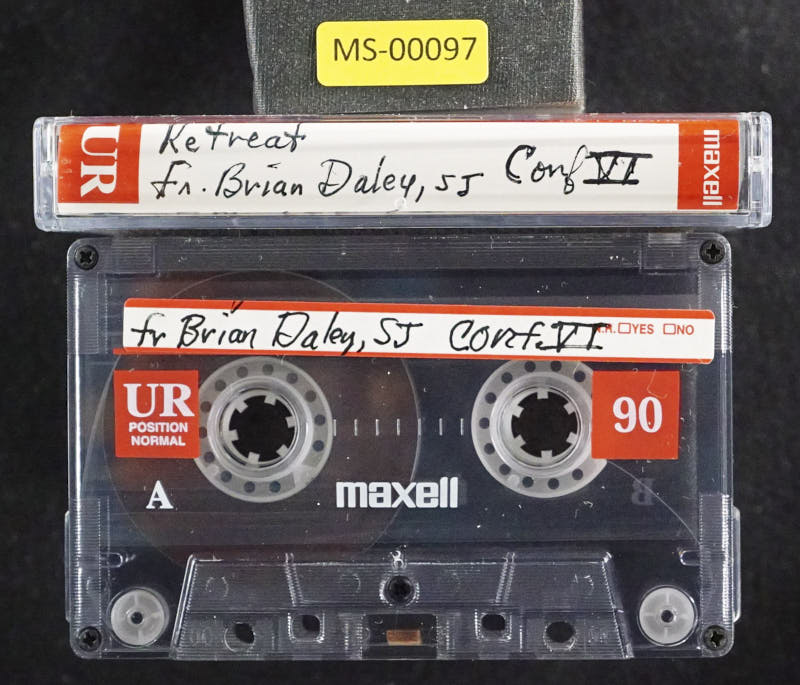
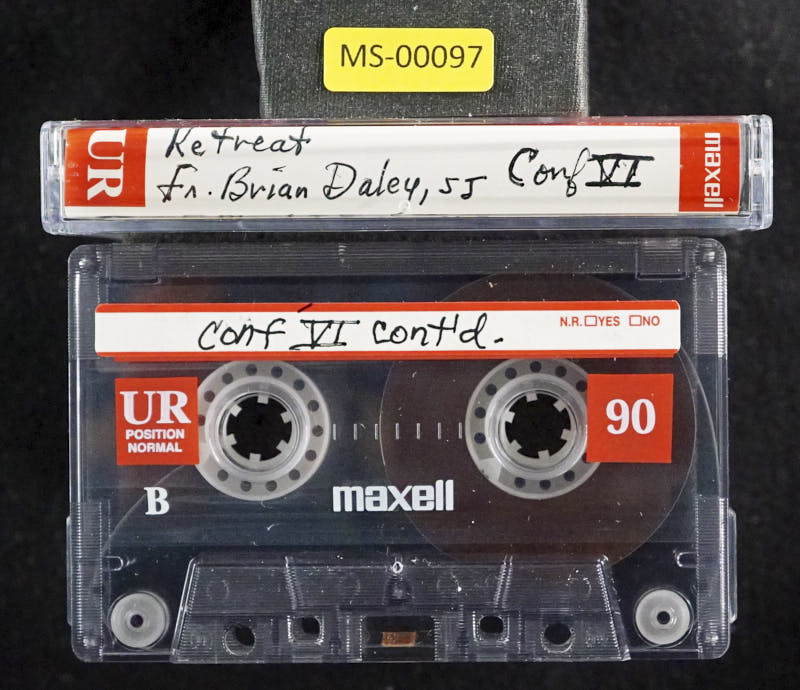
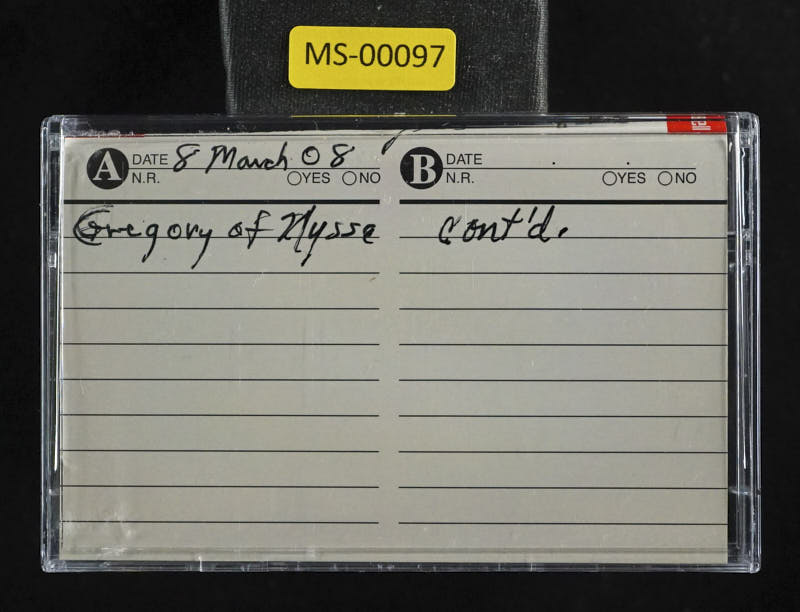
AI Vision - Possible Values from Photos:
Speaker: Fr. Brian Daley, SJ
Possible Title: Retreat, Conf VII
Additional text: Gregory of Nyssa, Conf VI contd
@AI-Vision_v002
Well, thank you for being here once again and also on a day when we have other things to distract us. I brought a handout along that I made a few years ago for a seminar I was doing on the Cappadocian Fathers. I don't know if this would be of interest to you, but I put together kind of a time sheet, a timeline of Basil's life and Gregory of Nazianzus and Gregory of Nyssa. And if you want, you could just... look these over if you're interested in following up on reading any of these people further. This is obviously somewhat conjectural. We don't know for sure, especially for the case of Gregory of Missa, but it would give you a sense of how things probably fell out. And then I put in a map, not a great map, but it gives you a sense of what the different provinces in Asia Minor were like at the time of these writers. And as you see, Cappadocia is kind of just right in the middle over number three there. Present-day Turkey goes a fair amount further east than that, and Iraq would be kind of just to the right of the map.
[01:08]
There's trouble right now on the border of Turkey and Iraq and the Kurdish region, and that would have been Armenia in the old days. So Cappadocia is kind of right smack in the middle of present-day Turkey. As I say, a fairly remote region, but a very beautiful one. You can see Caesarea is right there in the middle of Cappadocia. It's the capital of the Roman province of Cappadocia. So that is just to give you some idea of where these people were living and where they had to travel. A number of very mountainous and kind of a high plateau in there, but a lot of mountains and caves and things. So there wasn't a lot going on up there. for people of their education. But they were constantly traveling and staying in touch with the capital, which would be Constantinople up on the left, and then with Antioch down on the lower right, which are the two main centers of culture. And then the Western coast by the Mediterranean had some major cities like Ephesus and so on that were also great centers of learning.
[02:18]
So it'll give you some idea at least of where they're moving around and these timelines can give you a sense of how they overlap with each other and how they moved around in that world. We've been talking about Gregory of Nyssa and about his rather unique way of understanding God, the Christian understanding of God, and also something about his... his sense of human growth, of human transformation. And I think a lot of his notion of salvation and also his attraction for the modern reader comes from the emphasis he places on transformation and change and growth as really the heart of perfection for the human being. So I wanted to say a little more tonight, first of all, about his notion of Christ as kind of embodying that growth in a normative way, in a central way, and then about human salvation, how we also are empowered by God to grow in Christ and with Christ towards a share in the life of God, because I think that's kind of the central idea that Great Readiness is communicating, and one of the things that makes him very attractive and fascinating for modern readers.
[03:37]
to grow towards a share in the life of God. Sometimes I can't repeat these long sentences that I roll out. So it comes with reading all these rhetoricians. Christology, his picture of Christ, has often been criticized by modern scholars as kind of being hard to place. We have certain different schools of Christology, some of them that like to divide Christ into his humanity and his divinity and keep those very separate from each other. Others that want to emphasize the kind of subject at the center of things, the divine son, the eternal son who is the kind of subject of both his humanity and his divinity. And this gives you kind of a different picture. devotion and for spirituality of how you relate to Christ. Gregory of Nyssa is hard to categorize. He doesn't fall into some of the usual categories. And I think the reason is that the core of his picture of Christ, of his Christology, is really the idea of transformation, of movement.
[04:51]
He sees Christ very definitely as the Son of God, the second person of the Trinity, who has taken onto himself a complete human nature like ours, a complete human apparatus, a human mind, human will, human senses, human body, all the human difficulties that we have, and yet does this without turning away from God, without ever ceasing to be the Son, without ever ceasing to be obedient to the Father's will. And that's obviously central in a lot of classical Christology and modern Christology. But Gregory sees the humanity of Jesus, this human nature of Jesus, as really undergoing a transformation from mortality to immortality, from limitation to a kind of freedom from limitation, that for him is the first stage of a wider transformation that reaches out from him to us, that kind of spreads out like an electric shock through the rest of humanity.
[05:54]
He talks about this in a number of places, but one of the places where he does, which is a very interesting work, is what's called his Catechetical Oration, or Catechetical Discourse, which appears also in this collection, The Christology of the Later Fathers, that you have in the library. There it's called An Address on Religious Instruction, but that's another way of translating it, Catechetical Oration. It seems to be a mature work of Gregory's, and it seems to be an attempt to outline for the Christian reader how the whole content of the rule of faith, the whole content of the creed, really holds together. It may have been meant as a kind of a handbook for people who are teaching catechetics in the church or for preachers. But it seems to be an attempt to kind of spell it all out in a single handbook or a single volume. And in doing this, he he parallels the same kind of handbook that you find in some of the Neoplatonic pagan writers. There's one called On the Gods and the World that was written in the time of the Emperor Julian, so about 360, about maybe 25 years before this catechetical oration, which does in some ways the same thing.
[07:09]
It talks about what the gods are like, what their life is like, and how they get involved with the world, what providence is like. how humans are modeled after the gods and how they get to purify their souls. But of course this notion of the gods in the world doesn't include an idea of incarnation or an idea of a god of love who sends his son to share his life with us and to die for us. And Gregory may well be modeling this catechetical discourse on that kind of handbook to show that the Christian approach to ultimate questions is really very distinctive and that we handle these basic questions and basic problems in really different ways. But what he's dealing with mainly here, he deals with all kinds of things in the catechetical oration, but he's really talking about redemption in Christ. How a human being in the present situation, in the present world, can come through faith in Jesus, through membership in the church, to hope for everlasting life and for resurrection, hope for this transformation that we believe happened.
[08:14]
already to Jesus. And so he begins by talking about God, about creation, about why God creates, and also about the fall, how we got into the present situation that we're in. Gregory's idea is that God creates simply out of love, that God has created the world not because God needs anything outside of himself, but because it's natural for God, in a sense, to want to share what he has, to share the infinite riches that he has. Again, not a new idea, but an idea that he puts very strongly and powerfully. And humans, in his view of things, are created in order to share this goodness of God. They're created in God's image. I'll talk about that in a minute because it's a very important piece of Gregory's view of the human person. That we have a kind of kinship with God, a likeness to God, that is there from the very beginning.
[09:15]
We're kind of hardwired to long for God and to reach out for God and to imitate Christ. The problem comes, of course, with human sin. And for Gregory, the story is implied in the scriptures from the beginning that the serpent in the garden whom he identifies as Satan with the evil spirit envies the human creatures. He already has turned against God, has decided to be his own God, to be in charge of the world. And so he's jealous, he's envious of this human pair who are less noble than he is. They're weighed down with materiality and so on, and yet they are innocent and they are resembling God by the innate gods in it. And so he wants to lure them into his own rebellion. And so the familiar story of the fall of eating the tree in Genesis 3 is told by Gregory as really a playing out of the envy of the evil spirit.
[10:15]
But for him, the key I think here is that God didn't leave us there. And this of course is a familiar theme, that God has to heal us, has to reach out for us, to draw us back into himself. He puts it this way in his catechetical oration. Why then, people ask, did the divine stoop to such humiliation as to be born in a human body, in a human context, and to live our human life with all its weaknesses, and to die a human death. Our faith falters when we think that God, the infinite, incomprehensible, ineffable reality, transcending all glory and majesty, should be defiled by associating with human nature, and his sublime power is no less debased by their contact with what is abject. Not that he has a low view of human nature, It seems that when you identify the transcendent moment, any limitation, you're kind of bringing it down a peg. And he says, we're not at a loss to find a fitting answer, even to this objection.
[11:21]
Do you ask why God was born among us? If you exclude from life the benefits which come from God, you'll have no way of recognizing the divine. It is from the blessings we experience that we recognize our benefactor, since by observing what happens to us, we deduce the nature of him who is responsible for it. If then the love of humanity is a proper mark of the divine nature, here is the explanation you're looking for. Here is the reason for God's presence among us. Our nature was sick and needed a doctor. Humanity had fallen and needed someone to raise it up. He who had lost life needed someone to restore it and so on. So we were in need and God who is always a lover of humanity is drawn by simply our need to become one of us, to share our life. The question is, how does God do this? And for Gregory, it's pretty clear in the story of Christ. He does it by sharing what we are, by beginning where we are in our condition of weakness, of alienation, of mortality.
[12:28]
He assumes, like most of the ancient fathers, that humanity was not made vulnerable or mortal, that we were made with the hope of eternal life. that weakness and death are part of the working out of sin, of turning away from God who gives us life. And so the Word becomes flesh in the condition that we're in. He takes on our mortality, our weakness, and beginning where we are, He lives through a human life in such a way that He turns it around. He shares our weakness and death without ever compromising His own obedience, His own human virtue. And ultimately by being put to death, he triumphs over death by rising from the dead. And that pattern, which of course is the familiar one to us, suggests a kind of direction or a change that begins in Christ and that then radiates out to us. Christ kind of puts the pieces together in his own person and in doing that begins this transformation
[13:37]
of humanity into being what we were originally meant to be so that we see in Christ what we feel that we're called to share ourselves. Again, just a passage from this catechetical oration. We hold that God was involved in both the fundamental changes of our nature by which the soul is united to the body and then separated from it. He was united with both elements in our makeup, the sensible and the intelligible ones, our eyes and ears and also our mind. And by means of this ineffable and inexpressible union, he brought it about that once these elements of soul and body were united, the union would remain permanent. For when in his case, too, soul and body had been separated by that successive movement of change our nature undergoes, death, he joined the parts together again with a kind of glue. I mean by divine power. And so he united what was separated in an unbreakable union.
[14:40]
This is what the resurrection means, the restoration of elements into an indissoluble union after their separation so they can grow together. In this way, our primal grace was restored and we retrieved once more eternal life. By our dissolution, the wickedness mingled with our nature was poured off like a liquid. which when the vessel holding it is broken to pieces is dispersed and lost, since there is nothing more to contain it. And just as the principle of death had its origin in a single person and passed to the whole of human nature, similarly, the principle of the resurrection originated in one man and extends to all humanity. This is Paul, of course. He who united again the soul he had assumed with his own body did so by means of his own power, which was fused with each element at their first formation. And in doing this, he can join the intelligible and sensible nature on a larger scale, the principle of the resurrection extending to its logical limits.
[15:40]
For when in the case of the man in whom he was incarnate, the soul returned once more to the body after dissolution, a similar union of the separated elements potentially passed to the whole of human nature as if a new beginning had been made. This is the mystery of God's plan with regard to death and of the resurrection from the dead. So in other words, God doesn't... Do an end run around death. God doesn't say the sentence no longer holds, but he takes death on himself, and living through it and triumphing over it and raising himself completely soul and body from the dead, he communicates to us a kind of a new start, and that energy flows out from him to the rest of us. It's a picture of solidarity. You asked, Gabriel, about solidarity before, and certainly... although he doesn't use the word, the idea, I think, is very much better that it's because of our solidarity with Jesus in a single human nature that what happens to him on Easter Sunday is the beginning of what's promised to all of us.
[16:45]
And it's kind of, for Gregory, an almost inevitable physical process that radiates out from Christ towards us. Well, I think it's really hard for us to, in our modern more individualistic way of thinking to get into that because I think we do think of ourselves as kind of self-enclosed units to some extent. But for certainly the people of the Bible, for ancient Israel and for the New Testament writers like Paul and also for the church fathers, they find it, I think, much easier to see certain people, at least, as having a kind of privileged role.
[17:55]
So they think about humanity in terms of Adam and Eve. These are kind of typical figures, figures that embody the story of human sin. Or you think of Abraham, who responds obediently to God's call, and in his obedience, the whole destiny of Israel is kind of real life. Or Isaac, Abraham offering Isaac as a sacrifice, anticipates the death of Christ. And so I think Paul, for instance, will easily see Christ as sort of a new Adam, a new beginning. God starting again with a new kind of human nature. But even if we don't automatically sense that, I think our idea of union with Christ in the church can help them to work with it. We speak of the church as the body of Christ and the church as being the place where through the sacraments, through faith, we're kind of identified with Christ in a way that pulls our life into the current, that brings us into this same trajectory, the same sweep of
[18:57]
of obedience, of offering ourselves to the Father. But I think it is something that we need to let take us over. But for Gregory, as I mentioned, I mean, change is of the essence of being a creature. And for him, salvation is a perpetual process of change towards the good. It's something that God has to initiate. It's a process of healing, of transformation. But he believes that God almost without question does this. Having created us out of love, God needs to bring us back into his own circuit to communicate life to us. And this perpetual change towards the good is really what Gregory sees as the result of the Incarnation. It starts in Christ. and then radiates outward through the church.
[19:58]
And it begins, I think, interestingly enough, in the practice of virtue. Gregory lays a lot of emphasis on human virtue as being the way that we reflect the nature of God. God, he says in several places, is virtue. God is love. But God is also a kind of purity of all the different things we can think of as virtue. And as we begin to live a life of virtue by following Christ, by keeping the Sermon on the Mount, the process of transformation begins that then carries us through death, in a sense. And the resurrection from the dead is the fulfillment of the transformation that starts now in our moral transformation, our spiritual transformation, our ascetical transformation. So he sees a real continuity between our inner life being transformed and ultimately our physical life being brought into this whole deal and being full and energized by the life of God.
[21:03]
Even Satan, he believes, is going to be healed in the end. I mentioned this before. And this is something that scandalized a lot of people in his time. But for Gregory, if this were not true, then it would suggest that evil in some ways and in some places is resistant to the love of God. And he sees evil as simply negativity, as something that has no power of its own, but simply as what wills, what human and angelic beings do to deconstruct and tear down the goodness that God has created. And so in the end, it's a negative power that can't compete with the reality that is God and God's creation. So that in the end, Satan himself, he believes, after a very painful process of purification, will be himself healed. For us, in the same catechetical oration, he also emphasizes, interestingly, I think, that the way that we make contact with Christ is through the church.
[22:06]
And I haven't seen any other patristic writers doing that in quite the same way. He's very interested in connecting the sacraments, at least the main sacraments of the Christian life, with the events of Christ's death and resurrection. And so the final section of this treatise on catechesis is about baptism and the Eucharist and faith. And he talks very interestingly there about baptism as kind of plugging us in to the death and resurrection of Christ, these redeeming events. Because, as Paul tells us, it is a kind of sacramental, typological imitation with the death and resurrection of Christ. Gregory and Gregory Nazianzen and Basil are very interested in baptism and see it in the terms of Paul in Romans 6. See baptism as an acting out, if you want, in our own life of Jesus being laid in the tomb. going down into the depths of the underworld and then rising up again.
[23:10]
People point out that earlier on, the theology of baptism in the early church was focused more on the baptism of Jesus. If you read, say, Ephraim, the Syrian writer, in the early fourth century, his hymns on baptism presented as kind of modeled on the baptism of Jesus by John, where the Holy Spirit comes down, you hear a voice from heaven saying, you are my beloved son. And the Christian is given the same kind of mission. The Holy Spirit comes upon us in baptism. We're sent out. We're made sons and daughters of God. So a strong element of adoption and of mission. The Cappadocians emphasize more what Paul talks about in Romans 6, which is that it involves us in Jesus' death and resurrection, not denying the other, but emphasizing more death and resurrection. And so for Gregory, This is kind of a central element in this remaking of the human person. Seeing then, he says, that the pioneer of our life died and was buried under the earth in common with our nature.
[24:21]
The imitation we make of his death is represented in the allied element, water rather than earth. Now, after the man from above had assumed a state of death and had been buried under the earth, On the third day, he returned to life once more. In the same way, everyone who by his bodily nature is united to him, we share something just by being human, by having a body, and looks to the same successful issue, I mean the goal of life, has water instead of earth poured on him, and by being immersed three separate times, reproduces the grace of the resurrection which occurred on the third day. In our previous discussion, we've already given some indication that divine providence had a purpose in bringing death upon human nature. It was to refashion us once more in means of a resurrection into a sound creature. If our humanity was kind of spoiled and stained and ugly, God had to break it apart and remake it. Just as you have a pot and you're a potter and the pot gets, there are flaws that come in in shaping the pot.
[25:22]
break it up again before this clay is fully hard and start over using the same material and reshape it again. So by the resurrection, God kind of reshapes this human composite that he's made. In the case of the pioneer of our salvation, this design of death was fully accomplished and its essential aim completely realized. For by means of death, Elements previously united were separated and then once more brought together, and thereby nature was purified. Our nature was purified by the dissolution of elements, naturally united. In this case, however, those who follow the pioneer, Jesus, their nature does not admit of an exact annotation at every point. It receives now only as much as it's able to, and the rest is laid up for the future. And so for us now, we kind of anticipate our own death and resurrection by the sacramental or symbolic death and resurrection of baptism, which is really the point that Paul is making at somewhat last length.
[26:24]
Then he goes on here to talk about the Eucharist in a very interesting way, too, to see that the Eucharist is kind of the way that what's begun in baptism is kind of continued now. And the way it's continued, of course, is that we make Jesus our food and drink. We've been identified with him in this kind of dramatic procedure of baptism and now we take his own flesh and blood into ours by means of the food of the Eucharist. And Gregory makes the point that just as Jesus, when he was incarnate, ate bread and wine and made these things into his own body through consumption, so now the Word of God in the liturgy is invoked on bread and wine, and they become his body again in a different way, and we can consume them so that he becomes a part of our body. So there's kind of an analogy there anyway, which is nicely worked out. But he goes on to say that having received the sacraments, we have to live them out.
[27:26]
We have to keep growing in virtue, or otherwise the sacraments are kind of a waste of time. He says this actually pretty boldly right at the end of the catechetical discourse. But he says if somebody has been baptized or if the washing has only affected the body and the soul has failed to wash off the stains of passion, And the life, act, or initiation is identical with that which went before, despite the boldness of my assertion. I will say without shrinking that in such a case, the water was only water. And the gifts of the Holy Spirit is nowhere evident in the action. So unless you live this life that you're introduced into by the sacraments, they didn't have any effect. And you've got to do it some other way. Because you have to be what you become.
[28:29]
If you become this, then you have to live it. And if you don't live it, then it didn't really work. And so you have to find some other way to be transformed. He does believe that somehow or other, everybody will be transformed. But probably for most people, it will take place after death in what we think of as purgatory, in some sort of a process of training and purification and probably suffering that may take a while. So it's better to do it now through the sacrament and to let it become our reality than to have to struggle with a long period of purification after death. But sooner or later, that pot's going to have to get broken and refashioned. I mean, what effect does it... So you mean, what happens if a baby dies? In fact, interestingly enough, Gregory has a treatise, has a work on it, actually, on infants dying prematurely. Because people ask, he says, what happens if you baptize an infant?
[29:34]
and then they die before they're able to kind of realize the meaning of baptism. And he basically says that they come right away into the presence of God and that God has somehow foreseen what they might have done if they had lived and has cut off their lives so they don't fall away or they don't become... I mean, we don't know what the answer is because we can assume that God has his reasons. to prevent people from standing. Right. Right. Right. A lot of them. turn away completely. And that's, I think, where you have to leave the actual individuals to the mercy of God, but try to get people to realize if you've been baptized and you're being brought up in a Christian community, it's important to live there and not just to sort of... I think he doesn't want people simply to say, well, I was baptized, so I'm okay, and you were baptized, you weren't.
[30:53]
You weren't baptized. But I mean, I think he wants to say, unless you really let it change your life, then it hasn't really done the job that it's supposed to do. Because the job is supposed to be a kind of a remodeling of the human person after the example of Christ. So the expectations are high. Relatively recent. They had an exaggerated notion of that, too. I don't remember what we were reading about. Well, we were saying the other day about these men not getting baptized until they were in their 30s usually in this period. Because I think the assumption, this was a fairly widespread assumption, that baptism is so serious.
[31:59]
or the whole initiation process, that if a person really did it, then it was expected that they would live a serious Christian life. And that meant a certain amount of ascetical practice and working at getting rid of their passion, their selfishness, and their self-seeking. And if you weren't prepared to do that, then it would probably just dwell the weight of baptism. Yeah. Because, I mean, if you take, you know, Romans 6 seriously, you know, that if we're baptized, we are kind of identified with Christ in his death and resurrection. And this means that if you've been through this, then you receive the Holy Spirit, you're living a new life. And you're expected to...
[33:03]
to sort of walk in the Spirit, as Paul said. That's why, I mean, the problem for the early church was enormous. What do you do with baptized people who commit serious sin? And in the beginning, many churches seem to have said, that's too bad, and we'll leave it up to God, but nothing we can do about that. But fairly soon, by the third to fourth century, I think pastoral practice, pastoral prudence realized you have to make some accommodation or open some kind of a pathway for people who are baptized and who have been alienated in some way. And so the whole sacrament of penitence develops in different ways. But it's done in a public way and it really isn't personal or individual confession until the 7th or 8th century. And it's become, of course, much easier for us. Well, if you're an emperor and you had all this blood on your hands, you're killing people all the time.
[34:03]
I guess they just didn't want to take any chances. It shows, I think, on one hand, a great reverence for baptism, for the seriousness of the Christian life, but it also is kind of pastorally unrealistic. Let me just say a little bit about... how Gregory then understands the human person. I think this flows out of how we understand Christ. And one point which is very central in many of his writings is that God created us in his own image. We read that at the end of the first chapter of Genesis. And that this is really important for us. It's the image of God which is at the heart of every human being which makes it possible for us to know God and to to come into a healthy relationship with God. This is another section of the catechal oration.
[35:05]
If then the human person came into being for three reasons, to participate in the divine goodness, he had to be fashioned for these reasons. If the human being came into existence for these reasons, to participate in the divine goodness, he had to be fashioned in such a way as to make him fit to share in this goodness. For just as the eye shares in light through having by nature an inherent brightness in it. This is the old theory of how we see that there's a certain light in the eye that mixes with the light outside. And by this innate power attracts what is akin to itself. So something akin to the divine had to be mingled with human nature. So there has to be something like God in us from the very beginning. In this way, its desire for divine goodness would correspond to something native to it. Even in the natures of irrational creatures whose lot is to live in water or air, they're fashioned to correspond with their mode of life.
[36:05]
In each case, the particular way their bodies are formed makes the air or the water appropriate and congenial to that. Fish are made to live in the water and they can get oxygen from the water. In the same way, the human person was created to enjoy God's goodness had to have some element in his nature akin to what he was to share later on. Hence, he was endowed with life, reason, wisdom, and all the good things of God. I mean, he assumes that the very power to live, the power to think, the power to make rational decisions, to make prudent choices for wisdom, all these things are qualities of God, first of all, so that by each of them, the human person's desires might be directed to what was natural to him. And since immortality is one of the good attributes of the divine nature, it was essential that the constitution of our nature should not be deprived of this. It had to have an immortal element so that it might, by this inherent faculty, recognize the transcendent God and have a desire for God's immortality. So he wants to say that from the very beginning, Adam and Eve and all who descend are made with this innate desire
[37:13]
to be like God, an innate capacity to be like God. We're a second cousin of God in this sense. We're made in His image so that we both notice when it's missing and reach out for what would make us more like God. And so he wants to say that what we call virtues are really natural to us. They're not something we kind of stick on our nature, but they are really the fulfillment of what we naturally want to do and do do. And the vices that we all share are not natural. In fact, they're aberrations from nature. They're distances from nature. And so the project of a human life is to get rid of the vices and increase the virtues so that we become, in our present life, more like God. We imitate Christ. And we become, in a sense, more divine all the time by living in the goodness of God. He also, he has a beautiful treatise on the soul and the resurrection, which is a nice translation of this in the St.
[38:19]
Vladimir's Press series, which is easily available. And he talks there about the resurrection of the body. But he begins by arguing for the presence in our persons, in our body, of an immortal soul. And he asks the question, how do we know that we have a soul in the first place? Why do we say this? And what is the soul like? And this is a dialogue between Macrina, his older sister, and Gregory. And after a certain amount of discussion at the beginning, she gives a definition of the soul which I think is interesting. She says, the soul is an essence or substance which has a beginning. It's created. It's not eternal. It is the living and intellectual essence which by itself gives to the organic and sensory body the power of life, and the reception of sense impressions, as long as the nature which can receive these maintains its existence." So the soul for him is a sort of a spiritual reality, a spiritual substance, completely in itself, which is made for a certain material structure, a collection of atoms, and enables that material structure to function and take in sensations and information and to interpret the information in such a way that it
[39:38]
it grows more reflective of itself. It becomes the instrument of the soul itself. It becomes the way in which the soul can intelligently interact with the world. Through our bodies. He believes in this, that soul and body are really made for each other. If the soul is separated from the body, complete and the body incomplete. As Thomas Aquinas would say later on, we don't have a human person unless we have this kind of composite of soul and body, of reason and will and a material, sensible structure. The problem is we don't directly see or sense the soul. How do we know it there? And he argued that we do this because the same way we come to reason to the presence of God in the world. We don't sense God either. But we can look at the nature around us and the order and the beauty of nature. And from that, assume that there is some intelligent force who created it and who steers it and whose beauty is represented here.
[40:48]
And so also in the body, we don't see the soul, but we can see that the body is behaving in a way that suggests some intelligent force is steering it and controlling it. And so we kind of reason indirectly to the being of the soul as we do to the feeling of God in the world. He's got this analogy then between the cosmos, the world as a whole, and the microcosm, the individual person, which is inhabited by a soul. The soul is in the image of God. So what God is in the large world, our soul is in our body. He wants to say it. So the soul in a sense is made to play the role of God in me as an individual that God plays in the world as a whole. And that enables him, that way of thinking enables him to argue a lot about what leads to the perfection of the human person. Ultimately, it's to imitate God, to follow God, as you say. Virtue is natural to us.
[41:49]
But because we're embodied, our souls are involved in sensory processes and begin to let the sensory needs of the body dictate to us rather than controlling them. And that's what he calls passions. Not that emotions are a bad thing, but that we're out of control of them, and that we don't reasonably steer them and balance them. So that, for him, what the soul has to do is to order itself, to order the body, order its relationship with the body. Passions are sort of like warps on the body. He says we have to cut them off, and it can be painful. But they're not part of the original form. They're kind of exgressive. They're added on. So the call for us is to grow from our present kind of unnatural condition to what we were made for in the beginning, what Adam and Eve were made to be, which is somehow to represent God and to imitate God. And we can see this in the person of Christ. We see this in his behavior, in his words, and ultimately in his resurrection from the dead.
[42:53]
So what we do is to try to, through imitating Christ and through being united with him in the sacraments, become more like Him and more virtuous and ultimately to be raised from the dead, which is the sort of final stage of our perfection. So it's a vision of the human person which is kind of based on imitation of Christ and based on the fact of the image of God in us. As a friend of my life would say, we're hardwired to desire God. That's sort of the way that we're made. And it's a natural instinct that we have to reach out to God. Right. trying to explain what they have to do.
[44:23]
The weight of the world, it helps things to die. Right, right. So it doesn't look like . Well, it's a whole idea of development. Right. It was going from there as a whole new design. Yeah.
[45:32]
It's coming to place. Yeah. What do you think about it? What do you think about it? What do you think about it? It's possible that the part of life is a new creation. I'm sure of that. Well, I think that evolutionary kind of thinking would be very congenial to someone like Gregory Messon, even though he didn't operate exactly with the same scientific basis that we would have.
[46:33]
But, I mean, the idea that humanity is in a process of growth towards God and that God made it so that it would grow towards God I think is very central to his thinking. Whether we want to think of paradise as a particular place at a particular time or not, I think that's an open question. I mean, it seems to me it's a way of talking in a narrative style of theology. It's a way of talking about God's original intention and what God really created the human race to be so that we don't make God responsible for evil in the world or for sin. But it's making the point that humans from the beginning, through their own mistaken choices, and their own desire to be like God, to take control of things, to know good and evil when they want to, and so on, that they are responsible for a major change in the quality of our lives. And that the miseries that we have, which come largely from our own frustration and our own lack of being able to fulfill our desires, are the result of not
[47:48]
obeying God from the beginning, not taking God's commandments as really the center of our happiness. Yeah. Free will and the desire to use it to make our own laws, to be in charge. And what Paul is saying, I think, is to contrast humanity as it's got off the tracks from the very beginning with what happens in Christ. And Christ is sort of the new Adam, We see in his life and his death and his obedience to the Father and his teaching the way that humanity is really intended to be so that by being baptized into his death, we can kind of start again. So the paradise story isn't so much about a particular place and a particular time as a way of talking about human rebellion, I think, and human turning from God who had blessed us from the start and wants good for us. And Teilhard really, I think, brings that out.
[48:51]
I mean, he wants to take the theory of evolution and see it not as something that's hostile to Christian faith, but as something that really you can see as leading to the fulfillment of Christ, the fulfillment of the church. And there are individual failures and so on all along the road, but in the end, God is steering it towards unity and towards new life in Christ. And I think Gregory is on that same His notion of salvation is often said to be divinization. That's really true. As many of the other fathers, I think the Eastern fathers especially, he speaks of human salvation as being able to participate in the life of God. To be like God, which we are from the beginning, and to let that part of us grow and transform us so that we really become more divine in our qualities, in our virtues, and ultimately in the divinization of our bodies, in the freedom of the body from death.
[50:00]
As I mentioned the other day, too, Gregory has this idea that we never entirely reach the goal. And that's perfectionist. Perfection is always... reaching out deeper for a deeper share in God. This is something that Father Danielou, later Cardinal Danielou, brought out in a number of his essays on Gregory. And he took a word that doesn't appear very often, but made it into kind of a technical term for Gregory, which a lot of people use. And that is the Greek word, apectasis. And apectasis in Greek is hard to translate, but it means kind of reaching out beyond. And it's based on Philippians 3, 12 to 14, where Paul says, You know, I seek to be made perfect by being united with the risen Christ. Not that I've reached it, but I always reach out beyond where I am, hoping to be united with him who is united with me. And that same Greek word, epektosis, is what Gregory uses a number of times, which he sees as kind of the pattern of life, always reaching out beyond where we are to grasp more fully the reality of God who is always ahead of us.
[51:07]
In his life of Moses, which is a beautiful, thing, using the life of Moses in the book of Exodus as kind of a parallel or a parable of the growth and perfection. He has a great passage about Moses on the top of Mount Sinai in Exodus 34, asking to see God face to face. And God says to Moses, you can never see my face and live, but I'll put you in a little cleft in a rock and you can see my back parts as I pass by. And Gregory says, what does this mean? He says, well, if we see God face to face, we'd be going in the opposite direction. God would be coming this way and I'd be coming this way. That's the only way you see his face. So we don't want to do that. We want to follow God. And we follow God, we see his back parts, but we don't see his face. And perfection is following God. But God is always ahead of us. So we're kind of reaching out, but we never entirely get there. And that's because God is infinite. We're finite. But perfection is seeing God receding into the distance and chasing after it. And in doing that, growing in some ways more like God. And I begin to do that even now in my very limited knowledge, in my desires, and in my growth in virtue, and my participation in the sacraments and the life of Christ.
[52:22]
We probably ought to stop. I can say a little bit about... his biblical exegesis and also on this little homily on the Beatitudes, which I hope he had a chance to read. But that'll be some things. Anyway, you wanted to stop around 8, so... Well, yeah, we can do that. Well, in a number of places, but it's in this catechetical oration. It's page... I noted it down here. There's 304 in here. Yeah. It'll take him longer than it takes the rest of us, though. Even the adversary himself cannot question that what occurred was just and solitary. That is, when he comes to recognize his benefit. So he goes on about how
[53:26]
Even the enemy of humanity will be healed in the end. He has this great picture there, which I think is probably partly humorous, of Christ the perfect man. And he says the devil who had acquired sort of property rights over the rest of humanity by the fall and was the prince of this world was willing to let go of his rights over the rest of humanity in order to grasp Christ and dominate him in death. And he says it's like a big fish. that sees a bait on a hook and is willing to lect over everything else and grab on the hook. And so the devil grabbed out of Christ to bring him into death, only to realize that this was the Son of God. And therefore, he himself was transformed. He himself was kind of pulled out of the water on the hook. And Christ is sort of the bait on the cross, pulling the devil up out of the water. And an interesting metaphor. Well, he's been in some Netherlands with that. That particular thing of grabbing Christ and destroying it is better than the business model.
[54:36]
Right. Well, death for them is a diabolical force which kind of tries to dominate us all. But it's a... Oh, yeah. Well, it, yeah. Never standing still. We have this expression that fall within the body. I don't have to go the other way around. The body is a different soul. It would be more than an increase in the body of the body. And the soul kind of contains and shapes them. Right. In this nice little treatise on the soul and the resurrection, he has this idea, I find it fascinating, that at death, body and soul, we say, are separated.
[55:47]
And the soul ceases to kind of hold the whole structure together. And so the... physical structure disintegrates and all the atoms kind of break apart and go in different directions and the body is simply scattered after a long time. But he says the soul, because it's not spatial, because it's a spiritual substance, remains present to all the different atoms so that none of them escape in a sense. The soul is kind of everywhere because God is everywhere. And so at the signal from God at the end of history, the soul can sort of pull everything back together again. But in different form. It's a better form. So we look better. I'll have my hair back. But the same bits will be there, he thinks. Which is an interesting idea. Right.
[56:56]
And containment, yeah. Well, yeah, I mean, a number of the fathers will speak about the soul containing the body, holding it to the dead, getting in a shape. And Origen talks about the two, the He thinks the soul is what gives our material elements form so that we're recognizable. I look like myself, even though I've changed a lot from when I was, say, 15 years old. If somebody knew me then, I'd be recognizable in some way, probably. And all of us, we have a distinctive shape that continues through all this change. And Arjuna says that, you know, our bodies change every seven years, and there's always new stuff coming in, old stuff going out. So it isn't that the atoms, he doesn't think, are all there at the same time, but that the soul gives a shape to them that enables it to continue in the space of flux.
[58:02]
But Gregory thinks that we have some of the bits still together, but we have different notions of the human body. But it's interesting to see them trying to struggle with these very difficult questions, you know, and to take the Bible as the norm that we're saved through Christ, but to think, how do I understand this as a person who's also read some science and read some philosophy? In his biblical writings, his exegesis, he especially is interested in in the same idea of growth towards God, but he will emphasize also the need to be united to God in love. The commentary on the homilies on the Song of Songs are the most famous thing for that. He wrote them almost the last thing in his career, it seems, and wrote them for a very well-connected lady who was living a kind of ascetical life in the Capitol.
[59:05]
And there... It's a kind of inspiration for later mystical writings because he wants to talk about entering the divine darkness, that a person who is committed to God in love enters a state of kind of unknowing in which they cease to be entirely aware of where they're headed, but they know that they're being united to the beloved. And that idea of kind of entering the bright darkness of love is, of course, a theme that you find in John of the Cross. a lot of later writers, using the Song of Songs as well. Gregory is one of the first ones to talk about, and then Barnard and John McCrom. And there's a nice new translation of that that's about to come out, as I say, so when it comes out, we'll all benefit from that, I think. So? Let's do it. No.
[60:06]
This little sermon on Six Beatitudes, I find it fascinating too because he asked this question, how do I, you know, we can't see God. So what does it mean to say, blessed are the pure in heart, for they shall see God. And what he ends up saying, I think, is that we We see God reflected in our own selves if we are pure of heart. And pure of heart means focused on God through Christ, getting rid of our passions, being virtuous. But if we know ourselves and are aware of ourselves, then we see the image of God in our own beauty, as you see. And so you see God in the mirror of the heart. But you have to keep working at at purifying your desires.
[61:09]
I think that's an interesting kind of building on this idea of the image of likeness of God. That we have a desire is to contemplate the true good. When you hear that the glory of God is inexpressible, do not despair of ever beholding what you desire. It's within your reach. You have within yourselves the standard that wish to apprehend the divine. To see the image of God in ourselves is a vision of God, a glimpse of the reality of God. Oh, great. Of the handout.
[62:15]
I do. I've got one that you gave me. I think that's what he's really saying too, that this perfection which we try to pursue in this life gets a big bump forward in death and resurrection where we believe that our bodies are somehow going to be transformed in a way that we don't fully understand to be what God intended from the beginning. But even then, it goes on for Gregory. I mean, when we come to heaven, he doesn't see heaven as a static state, but as this, I always think it's like diving into a pool without a bottom.
[63:19]
You just keep going deeper and deeper. Eternal champagne bun. Eterno smorgasbord. [...] We got the lights back. A big jacket? No. Maureen called saying that we lost her power at 2 o'clock.
[64:20]
They told her she was around 26 customers. When I called her 4. They told me we were remote to do 13,000. They probably come back at midnight. So then I go at 6 o'clock, and the recorders let me were remote dying, because we went out there for another. And there was no time to go. They recovered. But they didn't say at the time before. Yeah, at the time, I think that's right there, but. I've forgotten that that, you know, boat over there were on plug. from here sent to electricity through to the outlets, light from the wall. Yeah, there was no one at the site. Yeah, so it went up and went up and went up. Yeah. There was a certain power around. Yeah. Oh, that's my line for this.
[65:24]
. . . Thank you.
[65:59]
@Transcribed_UNK
@Text_v005
@Score_92.38