You are currently logged-out. You can log-in or create an account to save favorites and more. more info
Transfiguration: Pathway to Divine Light
AI Suggested Keywords:
The talk explores the theme of transformation within the context of monastic life and the mystical significance of the Transfiguration of the Lord. It delves into the idea of doxology in prayer and life, emphasizing how the Transfiguration serves as a spiritual metaphor and goal for the monastic journey and Christian life, framed by engagements with liturgy and community. The session also discusses the importance of a personal and collective encounter with the divine through the practices and principles taught by prominent figures like Father Danisys and the spiritual community of Mount Savior.
Referenced Works:
- "Journey of a Soul" by Pope John XXIII: A journal illustrating the spiritual journey and revelations of the Pope, influencing ecumenical communities and individuals like the speaker.
- "The Art of the Icon: A Theology of Beauty" by Paul Evdokimov: Examines the theological and aesthetic dimensions of icons, highlighting their role as mirrors of divine splendor.
- Various writings by Hans Urs von Balthasar: Focus on concepts of divine glory and beauty, resonating with Father Danisys's understanding of spiritual transformation through God's light.
- Articles by Father Danisys in "Orate Fratres": These writings, now part of "Worship," explore themes of formation in Christ, particularly through sacraments like baptism, as central to Christian life.
Key Figures/Teachings:
- Father Danisys: Known for his teachings on the Transfiguration and its role in monastic and Christian life, emphasizing divine encounter as transformative.
- Mariola's Abbot Ildefons Herwegen: Promoted the understanding of liturgy as a transformative encounter, foundational to Danisys' thoughts.
- Sister Elizabeth of the Trinity: Although not deeply elaborated upon, her mystical communion with the Trinity aligns with the themes of divine glory and spiritual transformation discussed.
Overall, this talk connects deep theological ideas with practical spirituality, showing the transformative journey from living a life of self-centeredness to one filled with divine light and community service.
AI Suggested Title: Transfiguration: Pathway to Divine Light

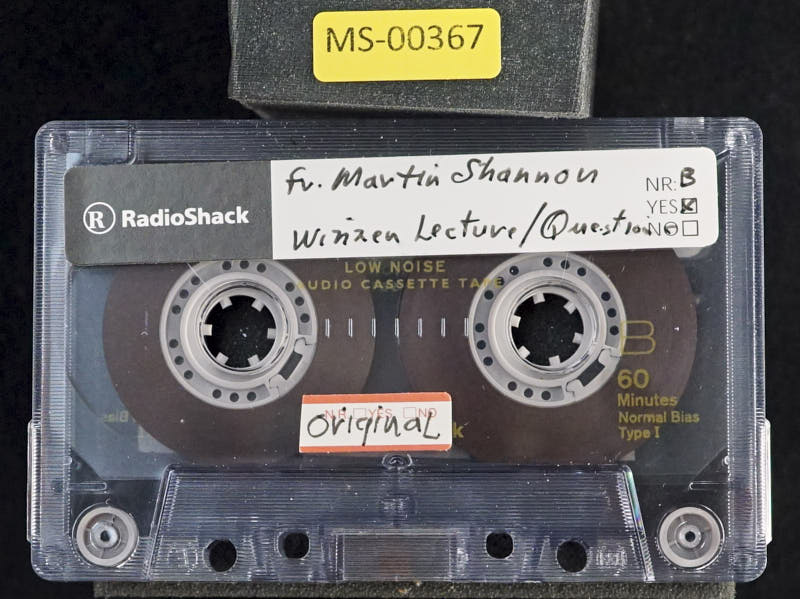
AI Vision - Possible Values from Photos:
Speaker: Fr. Martin Shannon
Possible Title: Winzen lecture
Additional text: Original 60 min. per side
Speaker: Fr. Martin Shannon
Possible Title: Winzen Lecture/Questions
Additional text: Original
@AI-Vision_v002
and did a very valuable contribution, especially in the United States. And so he took, they suggested he take from Damasus, which he did. And it was really a blessing for us because we learned so much about someone who worked at New York, and also in this country, and the very role he had, which is the poochies and patients, and the deal was a difficult subject at that time. Anyway. So we're very grateful that Futterbacken could come, so we're planning him to put his thesis into a book, but it's always 300 pages down there. And it's an enormous amount of us in big detail in the jail hotel. Nevertheless, it's great that he puts it into a book. And while I'm selling books, we have a book on it. And the contribution of an African person, the contribution of Benedictine, churches in the world. And there's a speech that actually we had in 2001, and we have copies over in the shop for $19.95.
[01:09]
But anyway, it really shows some of the richness of the Benedictine kind of approach. We're supposed to end the church, and we're not the old church by any means, but those of you who know us, a really good method, I think, when some of the richness of has been and is in the West City. So, my usual introduction, I steal from Father Dimitri's film, who said he went to a Quaker meeting, and was just about to start, and you're first in charge, and said, we're ready, are you ready? . Well, thank you very much, Fr. Martin. That had nothing to do with my finally selecting them, Mrs. Winston and Mount Xavier as the place where I would do my dissertation, the fact that there was another Fr.
[02:12]
Martin here. But we hit it off very early on. I'll tell you a little bit about that in a minute. I first want to say how deeply grateful I am to be able to come here and give that, which is really how I see this talk, a kind of perspective from what I've gained in the last four years of studying Father Damasus and the work of Mount Savior. I must say as well, which every speaker needs to say, and I'd like to be able to do it and convince you that I mean it, because I really do, and that is that it's also rather daunting and an honor in that sense to follow after people like Jerome Paul and Jerry Swoyan and Nathan Mitchell. I don't consider myself in their camp at all. I'm a midlife student, and have always been somewhat of a student, and hope always will be, without the sort of background that any of those three men had. Jerome Hall, of course, you were here for his talk, and if you know him, he's the son of Elmira, and in many ways the son of my savior, because his parents were uplinks here.
[03:24]
Gerard Sloyan, who's been around since Abraham, knows everybody since Abraham as well. And then Nathan Mitchell. I don't know if there's anything I've read by Nathan Mitchell that I haven't walked away with a new thought or perhaps a new motivation. So I feel quite honored to be fourth in lines in that distinguished list of speakers. All of them, in some way or another, had and have a connection with Mount Savior and with Father Danasis Winston. Mine comes in directly. I want to create one, however, and say that it came a little bit before 2001 when I first stepped foot on this property. I am a son of Rochester, New York. Elmira was that place down in the southern tier that was close to Watson Homestead and Painted Post, where I did many retreats. There was an acolyte in the Episcopal Church and youth and other ways.
[04:28]
So I was in the area. I don't know how it occurred. Don't ask me how it got there. But on one of those retreats, I came upon a book entitled Journey of a Soul, which was the journal of Pope John the 23rd. It had just been published, so I don't think I was more than 13 or 14 years old. I may be saying more about myself than I really want to if I tell you that I picked that book up off the shelf at 14 and actually read through it. And if an Episcopal young boy, if it's possible to adopt a pope, that's what I did from reading that journal. And since that time, he's been a hero of mine. I say that because I'm convinced And I've told this to other members of my community, and I'll say a little bit more about that as we go along, that we would not exist as an ecumenical community. We're an ecumenical community of about 300 people, about 75 celibate sisters, about 25 celibate brothers, and the rest of the families, all of whom have made vows, professions, of stability and conversion and obedience.
[05:43]
We would not exist if it were not for John Pope Jack the 23rd. And those who were like-minded, and I consider Father Damasus Winston as one of those who was like-minded, whose love of God and of the Church and dedication to the prayer of the Church overflowed into ecumenical work and understanding of the largesse of God's heart. and the largesse of the church itself, larger than the borders that we understand. So, that's all to say that it was a pleasant surprise to find myself, I won't say how many years later, but a number of years later, back here, under the suggestion of Father Joel Rippinger of Marmion Abbey, who's a Benedictine historian, who first put me on to Damasus Winston. If you know anything about doctoral work, you know that there comes a point when you finally have to say, I'm going to finish.
[06:47]
And that means you're a man or a woman in search of a dissertation topic. And that's what I was. And thanks to Father Joel, I discovered Father Danesis. My first visit here, and this is all by way of a little background, because I think it's only fair that if I'm going to tell you a few things that I think you may know already... that you know where they're coming from. My first visit here occurred, I arrived on September 10th, 2001, and arrived late enough in the evening that it was dark, had not seen much of the monastery, tired after the drive, and they put me up in the sabbatical room where I made myself comfortable, had a wonderful night's sleep, and the next morning, slept in, not only past the 445 bell, but the 7 o'clock bell as well. Got myself a cup of coffee and was sitting in the room reading when Father Martin was kind enough that morning of September 11th to come and get me and invite him to join the monks to, with, as you all know, anxiety and prayer, watch what was taking place.
[08:02]
That was my introduction, not only to Mount Savior, but to the hospitality and the prayerfulness. of these men of God. I did not stay that day. I turned around and went back home. We had some Europeans with us at the time who were in need of some time for prayer. So I went home and I returned at one of those wonderful times of year to be in Elmira in February. That was its own introduction. But I returned then and one of my first interviews to discover more about Father Damasus was with Father James Kelly. And I did not hear until just a week or two ago that he was now with God. I was very grateful for his... To the entire interview, the one thing I remember is that a smile never left his face while he talked about Father Damasus. So, speaking of return, this is what brings me to the topic that's in front of us. I've entitled this talk, The Transfiguration of the Lord, Dapsology in Prayer and Life.
[09:09]
Only because you always have to come up with a title, and I thought this one about covered everything that I wanted to say. The Transfiguration of the Lord, Dapsology in Prayer and Life. gives me an opportunity to explore with you a little bit a few of the elements that I touched upon in the dissertation but were not really the essential subject matter of the dissertation. One of the wonderful things about exploring archives is that you come upon all sorts of useless information, useless to you in terms of the avenue that you're proceeding down, and so I wasted many, many hours, I think, reading other material that was outside the venue for the direction I was moving in. They were not wasted for myself personally. And so what I proposed to do is to talk a bit about the transfiguration in connection with Father Danasis and how he saw this and how perhaps we should continue to see this playing out in our life of prayer and indeed in our lives themselves.
[10:20]
Most of this material is drawn from the dissertation and from the research that I did during that time. But it's not entirely simply a remade of the dissertation. By the way, my last time here was to present copies of the dissertation to Father Martin. This was in April of 2004. So I haven't been back since. I was on my way from here down to Washington to take my oral examination. And I have to tell you, there were two groups of people I was nervous about presenting this dissertation to. One, of course, was the committee. But they held my future in their hands, so to speak. But there was this unspoken anxiety that I had about presenting this, bringing Coles to Newcastle, so to speak, and hoping... that I had not made too many errors. Actually bringing the life of this man to those who knew him personally was rather frightening, to be honest with you.
[11:26]
I'm nothing but grateful that it's been received so well. So back to our title, back to what we're doing here, The Transfiguration of the Lord, Dixology and Prayer and Life. Mount Savior, as you know, and this is, again, I'm aware that some of these things, many of these things you know already, but I'm hoping that perhaps we can weave them together some and be renewed in our view of this. Mount Savior, as you know, was dedicated on August 6, 1951, named Mount Savior for the Mount of Transfiguration. It was dedicated on the Feast of the Transfiguration. Father Danis is later explained... The Feast of the Transfiguration was the monastery's, quote, yearly returning to the origins, an opportunity, he said, to listen again to the original invitation. It was especially meaningful to him because his old original invitation to monastic life was heard through that hopeful message of the transfiguration, and we'll get to more of that in a little bit.
[12:36]
Father Damasus, who was in many respects a controversial figure as well. Not everyone liked what he was doing or agreed with what he was doing. But in this element of appreciation for and seeking to embody within a monastery the meaning of the transfiguration, few could argue with that because this has been at the core of the life of the church since its beginnings. Father Danesis liked to say that monks are the living memory of the church. So when he's talking about returning to the original invitation, it wasn't just to the origins of Mount Savior, but to the origins of monastic life and all that it entails for the rest of us as well, who may not live in a monastery, but are still seeking to live out the values of monastic life. And we all know that this has become especially in this most recent generation, an important aspect of the enlarging of monastic life.
[13:44]
There's been the Adelaide programs and others who've been contained within the borders, so to speak, of monastic life. So, Father Danesis used to talk about monks being the living memory of the church, that they provided a way of by which the church was reminded to return to the essentials about what it's about. And in returning to those essentials, reminding ourselves of the basics, that is the very place he saw progress taking place. It wasn't a kind of reclamation of archaic practices for the sake of saying we're doing something old. It was for the sake of rediscovering what we're really about. My family and I, because of the generosity of my parents, my father is from Ireland, and they took me and my wife and our four children and my sister and her family to Ireland for a week in that same year, 2001. And touching upon our roots gave us a whole new appreciation.
[14:50]
We've all done that to some extent in one way or another. And Father Dana says those roots, some of those roots, were embedded within the mystery. of the transfiguration. I want to tell you that this is true of our community, the community of Jesus as well. This is not meant to be a PR presentation on the community of Jesus, but it's only fair that you know some of what my own connections are and that you know that I see what we're doing on Cape Cod as one small aspect of it, as an echo Father Davis's own voice, and those who fed him as well, those who spoke the voice to him. We're doing some of the same sorts of things. See if this doesn't ring true to you. This quotation here is from our rule of life, and our rule was written by a committee upon which I shared at the same time as the dissertation was going on.
[15:54]
So I follow myself sometimes not sure which other writing at times. And I think you may find certain parallels. But listen to these words. This is from the prologue of the rule of life of the community of Jesus. Since it's found me, the community of Jesus has cherished the inherited conviction that human lives can be changed, converted and reformed by the burnishing hand of the Holy Spirit. and made to reflect more clearly the life of their Maker and Lord. We believe that in the end it is lives, not words, that are the true keepers of the monastic vision. Etched with the mark of God's handiwork, people, not rules, are the only guarantors of a community's faithfulness and preservation. Therefore, the simple purpose of this rule is to assist in the making of such transformed people. That may have been, I'd like to think that had I read that to Father Damasus, he might sit there quietly, but he might have a small smile on his face and a little nod to his head that, yes, this is what the community life, the monastic life, is about.
[17:08]
People, the possibility that our lives can be changed. Let's talk about that a little bit further. What is the meaning of this idea of transfiguration? You all know the story, but bear with me for a minute as I read Matthew's account to you. After six days, Jesus took with him Peter, James, and John, his brother, and led them up a high mountain apart. And he was transfigured before them, and his face shone like the sun, and his garments became white as light. And behold, there appeared to them Moses and Elijah talking with him. And Peter said to Jesus, Lord, it is well that we are here, if you wish. I will make three booths here, one for you and one for Moses and one for Elijah. He was still speaking when, lo, a bright cloud overshadowed them, and a voice from the cloud said, This is my beloved Son, with whom I am well pleased. Listen to him.
[18:08]
When the disciples heard this, they fell on their faces and were filled with awe. But Jesus came and touched them, saying, Rise and have no fear. And when they lifted up their eyes, they saw no one but Jesus only. And as they were coming down the mountain, Jesus commanded them, tell no one the vision until the Son of Man is raised from the dead. The Son of Man is raised from the dead. So we tell the vision. This is why this is an appropriate topic, especially during this easier time. Until the Son of Man is raised, what was going on in the transfiguration would not be understood. And it's still a mystery. But this season that we're in, the Easter season leading us to Pentecost and the coming of the Holy Spirit, tells us that the transfiguration is about the resurrection.
[19:11]
This is what it's aiming for, both Christ's resurrection and our resurrection. not just a historical event of Christ's own resurrection, but something about new life for ourselves as well. It has to do with you and me, not just with something that took place on a place 2,000 years ago. We all know this. We've heard it in the hymns and in the prayers. The Orthodox, for example, for whom this feast is one of the 12 major feasts. There's hymns for great vespers, One of their hymns on the Feast of the Transfiguration says, Before your crucifixion, O Lord, taking the disciples up into a high mountain, you were transfigured before them, shining upon them with the bright beams of your power. From love of mankind and in your sovereign might, your desire it was to show them the splendor of the resurrection.
[20:12]
Grant that we too, may be counted worthy of this splendor, O God, for you are merciful and you love mankind. Grant that we too may be counted worthy of this splendor. What Peter, James, and John witnessed was the splendor of the resurrection before it took place. The Orthodox hymn is asking that we be found worthy, that in some way we share in that same vision. But not just as outsiders who look upon it, but as those who actually participate in it in some mystical way. This idea was at the heart of Fr. Dennis' own thinking, in part because it had a great deal to do with his own conversion, his own vocation, and his own formation at Maria Law. Do you remember the story that he wrote in his memoirs, the earliest part of his memoirs, about that night in which he heard Prior Albert Hennenstein speak.
[21:16]
He was a university student in Gerdenden. And he writes this about that night. My true life began, he says, on that November evening in the year 1920, on which Albert Hennenstein, then Prior, the Abbey of Maria Law, came to speak to the Catholic student body on the idea of transfiguration in the Liturgy of Advent. The time of Advent made me a cozy feeling, though I had no clear idea of what it really was. And on top of it, the quote, idea of Transfiguration was something completely new. It sounded quite positive and promised a certain standard. Even on the way home, I could overhear a few other students who walking behind me spoke of the fact that they had never seen so clearly How in receiving Holy Communion, they received the risen Lord in his glory. All of a sudden, new worlds had opened up before my eyes.
[22:20]
I was completely taken by the idea of glorification. How many of you have either heard him directly or read or heard his tapes or read words of his that speak about glory? With his thick German accent, the importance of glory, God's glory. We'll talk more about that in a moment as well. Father Damascus goes on. Glorification was what could fill the life of the monk. With overwhelming power, the glory of the praise of God flowed into my soul. All through the night, I held a vigil praying, Holy God, we praise thy name. And it became fully clear to me that the only way to give my life a meaningful shape was to become a monk. So hearing... Albert Hammerstein speak about the transfiguration in the liturgy of Advent. Who would put that together? How would that seem a natural fit? It would not. But by this time in the life of Maria Locke, the notion that Christ was present in his glory in the liturgy was permeating the life of the monastery and beginning to seep out into the life of the larger church.
[23:29]
And Father Damasus was caught in that net, so to speak, and came under its influence. He remembers, in his own remembrance, when, this was November of 1920, at Epiphany 1921, when he first went to Maria Locke on a dreary winter's night. He goes to bed and awaits the following morning, and he says that came out of the damp, cold winter fog into the festively decorated Abbey Church. And in that church, have any of you been to Maria Locke? few of you have been. You go in there, in the apse, what do you see in the apse? It's Christ in glory, reigning over. It's a rather dark Romanesque church, and on the one hand you can picture Father Danis is convinced he's to be a monk, perhaps having second thoughts the night before in the cold, dank reception that he received, but this day he goes in to the Abbey church, fully decorated for epiphany.
[24:32]
And I saw Christ the Almighty Look down from the apse upon this church, where after the solemn procession, the holy play of the advent of our Lord and mighty ruler was performed. What's he talking about? The Eucharist. The holy play is what he calls it. After the procession, all feelings of being a stranger disappeared. This was my hope, he said. What could be more sublime than to sing like the angels in heaven if him of eternity, together with the monks of the choir? I knew it now. This was what had pulled me like a magnet without my being conscious of it. It was the glory of the Lord revealed in the mystery of his church. This was Father Davises' idea which he translated in his work in the United States. It filled his thinking. He gave many conferences on the Transfiguration. His idea was that the purpose of Mount Savior, more than anything else, was to realize, to make real the life of the Transfiguration in its members.
[25:42]
The hope, he said, he called it, the hope of every Christian and the goal of all creation. He said that the Transfiguration was the fundamental pattern of the monastic life. A dear friend of his and his fellow addict, Immanuel Heifelder of Germany, an abbot in Germany, wrote in the memorial issue of monastic studies after Father Danisus' death that the goal of the creation of the world and the incarnation of the Son of God is indeed the transfigured creation which shines forth in the final book of Holy Scripture. The life of the monk must therefore be stamped with this expectation of transfiguration. I love that image. It must be stamped with this. This is what the identity of the monk is. So, what is it we're talking about? What is a nice idea, but what is it that we're meaning by this idea of transfiguration? Paul of Dakilov, a Russian theologian, whose works are recently being translated into English, wrote a book entitled The Art of the Icon, A Theology of Beauty.
[26:56]
And he says this, God takes pleasure in every work of art, which is a mirror of his glory. And he is pleased with every saint who is the icon of his splendor. Every saint who is the icon of his splendor. Icon. It's the same word that the Apostle Paul uses in his letter to the Colossians, In his sin describing Christ, when he says of Christ, he is the image, the icon of the invisible God. Christ is the icon of God. We are the icons of Christ. This is what Paul says to the Romans. For those whom he foreknew, he also predestined to be conformed to the image, in the Greek, the icon of his Son. in order that he might be the firstborn among many brethren. And those whom he predestined, he also called.
[27:59]
And those whom he called, he also justified. And those whom he justified, here it comes again, he also glorified. The notion that we bear, we are stamped with the image of Christ and that our lives are being spent having that image renewed in our lives so that we become icons of the divine as well, this is inherent to the message of the gospel, and it was inherent to Father Damasus' vision for monastic life. In the second letter of Peter, from the reading that's often used at the Feast of the Transfiguration, he speaks of our becoming partakers of the divine nature, almost as if we share in this spirit in this sort of thing, this substance, as if it existed that way. But it takes on a kind of materiality, something real, and we partake of it, though it is mystical. It is a mystery.
[29:01]
And we heard it this morning. If you were in church this morning, you heard it in the first letter of John. You love it. We are God's children now. It does not yet appear what we shall be, but we know that when he appears, we shall be like him, for we shall see him as he is. This notion of seeing God, of seeing Christ, and therefore becoming like him, makes this connection between vision, what we see with our minds and our hearts and our eyes, makes this connection between that and what we become. Spend your time Where you spend your time looking, you begin to take on the likeness of what you're taking in. No example is greater of this than of Moses on Mount Sinai. When Moses came down from Mount Sinai, says the writer of Exodus, with the two tables of the testimony in his hand, Moses did not know that the skin of his face shone.
[30:06]
Why? Because he'd been talking with God. He'd been present with God and the result of that interaction was his face shown. No wonder Paul writes to the Corinthians and we all with unveiled face beholding the glory of the Lord are being changed into his likeness from one degree of glory to another. Changed into his likeness because we too are beholding God. What we're talking about here is an encounter With the living God. Moses went up on the mountain. The cloud covered the mountain. The glory of the Lord, which was like fire, consumed the mountain like fire and cloud. Moses went into the midst of the cloud and spent 40 days. Spent that time and comes down. The result of that is he's taken on a new likeness. His face, his very flesh, begins to show forth something that is heavenlyly.
[31:09]
Peter, James, and John are on the mountain. They're on the mountain of transfiguration. They see the transfigured Christ. And if you've seen icons of the transfiguration, you see Christ there with Moses and Elijah. And in what manner do we see Peter, James, and John? Virtually always cowering in fear. But as if piercing them, these rays of splendor, of light, are coming toward them as they lay there on the ground in fear. Have you ever seen that? And you see these rays and all these orthodox icons, these rays of light are part of the picture. I'm always struck by the fact that they always seem to come to Peter and James and John and they reach a point when they get to them. And I think there's something about transfiguration that can also be a little painful. Encounter with God brings change.
[32:13]
In his weekly address after Easter, Pope Benedict XVI said, whoever encounters the risen Christ is transformed. This is what Father Damasus thought of the Christian life, that the meaning of life was only to be found in an encounter. Sometimes you'd call it, I found in tapes I'd listen to, a confrontation with the living God. And in that confrontation, in that encounter, he said this was the place where the true self is restored. Not a different self is made, but the true self is restored. It's not a diminishment of human nature, it's a renewal. It's what human nature is meant to be and was always meant to be. This sort of confrontation with God leads to a change of heart, or it certainly can. into a conversion of life, a new vision for what's important. The human person, he said, transcends all passing purposes and enters into the fullness of its last and eternal destiny.
[33:21]
Finally, we find out what life is all about in the presence of God. Here he says, a new life begins out of dust and ashes of a sinful human creature. A new spirit rises through the power of God's life giving mercy. This is what he liked to call the dimension of glory. It was in that encounter, this was the dimension of glory, where the Christian is given a sense of the glory of God, what he sometimes called a taste of glory. It was the glory of God that was manifested in Christ on the Mount of Transfiguration. And now the church, represented by the cowering and fearful Peter, James, and John, the position the church often finds itself in, on its knees for one reason or another, nevertheless, the church is meant to reflect the glory it has witnessed. We become, as Father Dennis has said, mirrors of God's splendor.
[34:21]
In our community, we've built a church in the last ten years. It's still going on. The artwork in the church is still being put in. And it's called the Church of the Transfiguration. Though it's the community of Jesus, the church within that community is the Church of the Transfiguration because it plays a formative role for us as well. And on the two clear story walls will be, when they're completed, a series of frescoes depicting the life of Christ. But between those frescoes are other images of saints, none who we know, just people, robed in white, processing to the eternal city, to the acts of Mosaic of Christ in glory. What's interesting about these saints is though they're wearing white garments, you would not know that they're white. Because they're reddish gold. As if to say, and the way they're reddish gold is you can see it as if they was white in the acts shining on them.
[35:23]
So the notion is that what they're doing is taking on the fiery glow, of heaven gradually and as you get closer they're becoming even more fiery until finally in the very corners the artist is chosen to depict the entry of heaven as a fiery glow in which they sort of disappear not lost but become fully themselves so artistically that's the way it's done there this idea of glory being light and brightness was a favorite idea of Father Damasus. Hans Urs von Balthasar calls glory, the Greek doxa, from which we get doxology, the divinely beautiful. I'm recalling Sister Marie-Julian, our interview early on, you may not remember, but she was kind enough to talk to me about her experience with Father Damasus, and she told me that towards the end of his life he was thrilled to come upon some of the writings of von Balthasar and find this notion of glory so prominent in his writings.
[36:35]
This is the radiant splendor of the Lord. We see it in the pillar of cloud and of light. It's what the church fathers called the Taboric light, the ray of the eighth day. He likened it to fire, to glory, to splendor. white. Our lives, therefore, our lives are meant to become glorified, or doxa being the word. So another way of saying it might be that our lives are meant to become doxological, that we are meant to be living doxologies, living reflections of the glory of God. reflecting God's glory and rightly praising God. This is what living daxologically means. Fancy word for saying, we live to the glory of God in our prayers and in our lives. The question is, how does this happen? This is all very wonderful, and theoretically, it sounds great. But how does it really take place? Well, one place, first place, for Father Damasus said that it took place, is in the literature.
[37:43]
The Church Fathers were fascinated by the notion of the Transfiguration as a long exegetical tradition trying to explain what was going on. They saw in the Transfiguration an explanation for God and for humanity and for their relationship. But one question they wrestled with was, if this was a manifestation of the glory of God, of the resurrection of Peter, James, and John, how, even powering in fear, how could they sustain God? such an experience without dying on the spot? Even with their backs turned, if they were. But apparently they saw because we hear their explanation. How could they take that in? And the Father said that they could take it in because they were given grace at that time to be able, as mortal clay-footed creatures, to partake of that glory. They were given grace. How do we then? How is it that it comes to us? I suggest to you that for us, liturgy is one of the vehicles, it's one of the filters by which we touch the glory of God.
[38:52]
Father Danesis saw that the renewal of Christian life, he believed the renewal of Christian life, was to be achieved through the liturgy. The liturgy, he said, was the means by which the community and its members are to be exposed regularly, regularly, to the power of the resurrection. which, he said, was, quote, the principal transforming power of the monk. The liturgy, he said, was the sacramental prolongation of the work of God's love for us. The sacramental prolongation, the resurrection, the transfiguration continuing, it communicates to us the life of Christ. This came out of Father Genesis' own formation. Maria Locke was caught up in this notion because of the teaching of its monks and not least of all its own avid, Dildifon's hair bathing.
[39:53]
Father Dildifon said that prayer is the language of union between Christ and his church. That prayer brings the union, the language of union between Christ and his church, especially the Psalms, he said. It's what Don Selliers called the language of doxah. And we share that language with the eternal. And since the church, he said, is also the prayer of Christ, then our prayer must also reflect the splendor of the eternal world. It must contain an element of beauty. It is precisely the prayer character of the liturgy that explains the unfolding of its intrinsic beauty, he said. In prayer, the soul ascends from earth to God and learns to know him. and to love him in his infinite beauty. This, he said, this beauty within prayer is the creative principle that is at work within liturgy. The inner force is the very essence of Christianity.
[40:56]
He said the purpose, the purpose of Christianity is to assimilate us to God through Christ, to form humanity in the likeness of Christ. The purpose of the liturgy, therefore, is the transfiguration of human souls. Hervégen calls the mystery of the Transfiguration the primary and fundamental idea which underlies all liturgy. This is what Father Damas has brought with him to the United States. He believed the same thing, that in the liturgy we encounter, we find that place of encounter. though we go again and again and again and may come away with absolutely no sense of difference or emotional feeling at all. Because it becomes a filter. Hopefully not an opaque one, but a genuine filter by which the glory of God can come to us and by which we encounter the resurrected Christ.
[41:57]
And by virtue of being a filter, we don't get the full blast. We don't get the full ripeness. of the race. We get some of it. For example, the early fathers used to call baptism the illumination. That was one of the ideas, one of the ways of understanding what took place in baptism. The reception of light, of new birth, of glory, God's glory. Essentially, it's a passive sort of character, the passive sort of reception of God's glory. Father Damasus wrote a series of articles for what was then Orate Fratres, which is now worship, and he entitled it Formation in Christ. And the first one was Formation in Christ-Baptism. He said that baptism, by virtue of what it is as a sacrament, has a relational character about it. That in baptism, the baptized is in relationship with God, encounters Christ,
[43:01]
and comes to share in the life of Christ. In our community, when we baptize at the Easter Vigil, and I've thought of Father Danesis a few times when this has taken place, we also anoint our newly baptized with Holy Chrism, which has just been consecrated on Maundy Thursday. And it's a fragrant oil, perfumed oil. And so here we have this wet, naked baby handed into the arms of the presider or the prioress and their family, And suddenly they're slathered with this oil. Slathered with it. So that the whole assembly can smell this fragrance. But as they're given this oil, these are the words that are said. I anoint you with this holy chrism. I anoint your head that you may have the mind of Christ. I anoint your eyes that you may see by faith. I anoint your ears that you may hear the words of God. I anoint your mouth. that you may speak the truth in love.
[44:02]
I anoint your hands that they may be given to the service of Christ. I anoint your feet that you may run in the way of God's commandments. I anoint your chest that Christ may make his home in your heart. Aren't these all figures for a life being changed on the spot? Not being made perfect, but being christened, anointed, made perfect. like Christ at that moment so that what we're seeing is this whole person may become new and that every part of them may become a vehicle for the glory of God. The Eucharist is the same thing and the primary thing. The Eucharistic life is a life that's transformed into the image of Christ that becomes broken bread and shed blood for the sake of others. The sacraments, said Father Dana says, are the living mold of a Christian personality.
[45:08]
They are the places participating in the sacraments again and again, molds our lives into the personality of Christ. Recently, I was at a dinner with a number of clergy, one of whom was a Roman Catholic priest who told us the story of a young man who decided not to be confirmed when he was a sophomore in high school because he no longer believed really what he had been raised to believe and did not want to make the mockery of it and so decided not to be confirmed and he was experimenting with other religions, especially Buddhism. Two years later he came back to this priest and said that he wanted to be confirmed as a senior in high school. And when Father asked him what it was that had made the difference, he said, I started going back to Mass, and I found it comforting. Well, when he said comforting, what he was saying was that he found his roots again, and it was simply going to Eucharist.
[46:10]
He did not say, well, I heard this speaker at Mount Savior, and he convinced me. He did not say that I was reading these books. What he said is, I started going back to Mass. My upbringing in the Episcopal Church carries a similar sort of story. I grew up in the Episcopal Church Eucharist every Sunday and left the Episcopal Church. Left the Episcopal Church as a rebellious teenager because I didn't think I heard the gospel there. And then when I went back and participated in the Eucharist, guess what? It was there absolutely every Sunday. I found I could not get it out of my blood. that even after 11 years, as I like to tell my Presbyterian friends, in the mission field as a Presbyterian minister, I returned to the Episcopal Church because of the Eucharist, primarily, because of the liturgy and because of the way it had molded me. More could be said about this as well, what Father Damasus did here, my Savior, in the architecture of this monastery.
[47:15]
This, too, is a reflection of the same idea that things... people, places, and things become the repositories for the divine. So even in the building of this monastery, of its octagonal chapel, we have a sign of the transfiguration and its mystery permeating the life of this community. To crown this blessed hill, he said, we presume to build three tabernacles to try to lead a life drawn to the imitation of the mystery of of the Transfiguration. So the Liturgy, both in its sacramental form and in, as we understand that traditionally, and in the people and the places we encounter in the Church, this is one way in which the Transfiguration takes place. The second, however, simply has to do with living. And I say simply, though living is not, there's very little that's simple about living.
[48:17]
Peter, James, and John were witnesses of the transfiguration. And so their lives, their lives, what they saw, their lives in turn became witnesses to others. Monastic life, according to Father Damasus and his introduction to the rule of St. Benedict, the purpose of monastic life is that we may be molded into the divine image of the Lord. This is what the rule of Benedict is for. This is what conversion is all about. The monk exchanges, I like that idea, the monk exchanges the will to self-glorification for, quote, the will of the angels with the stability and the natural easiness with which they participate in the glory of the Lord and radiate this glory. Didn't he love that word? Radiate this glory, this notion that we participate and then It begins to shed forth from us as well, shine forth.
[49:21]
So, life is meant to be conversion, an exchange of an avenue, of a way of life that aims towards self-glorification to a way of life that bears the glory of God. It is what he called a process of becoming. And it takes time. It takes time. It takes time. And it takes the community of those we live with in whatever form as well. I was struck yesterday, and I hope I'm not telling tales out of Father Martin. You can tell me later. Father Martin gave us a tour, a couple of us. I came with a friend from my community, Reverend Bill DeBock, who's sitting back in the corner. Not sure whether he should identify himself too closely with me yet or not. We'll see how the response is. Anyway, Father Martin took us on a tour, and I saw some things I'd not seen before. We got the full tour, and one of those things, towards the end, we got to the back corner of the monastery, and the doorway that leads directly out to head towards the barn.
[50:27]
And inside that doorway, directly inside, through another door, is a room which... If the lights are out, it would be the darkest room in the place, I'm sure, which is filled with dirty boots and shoes and overalls and coats. It's the antechamber for the monastery after you've been working out in the mud. You know what that's like. Well, there it is. We all have those sorts of rooms. So there's the door that leads to all the mud, but here's the door. You come in and here's this first chamber. But that wasn't the final room. We went from that room into another room. And he said, it's sort of a process. The dirtiest stuff goes in this room, and they opened the second room. Now, this second room was lit not only by lights, but there were actually windows in it. And in this room, there were slightly dirty boots and shoes and jackets, as if there was sort of a step-by-step process that one went through. And in that room, things were a bit cleaner.
[51:28]
And then from there, you went to the showers and then changing. And with each step, we went deeper into the monastery. And I thought, here is an image for what our common life is about. We get dirtied up all the time. This is what life does to us. We get dirtied up all the time. And it does not always necessarily get cleaned off all with one fell swoop. The wounds which we bear in our own hearts and lives take time to be healed. And we're all on our way to reflecting the glory of God. But I see in those rooms a message of hope, that this process of conversion, of laying aside layers, and with each step deeper into the community, with each step further in, more of that is put aside, until finally that monk who'd been out in the mud puts upon himself his habit and comes to church, and you might not know that he'd never been there in the first place.
[52:30]
This is the monastic life of conversion. This is what living to the glory of God is about. It's not about being there. It's about getting there. It's about moving there. It's personal, and it's very communal. Father Danasis liked to talk about the tension there was between the personal and the corporate nature of monasticism. He said that they were brought together in a kind of synthesis. And there, there, where the Holy Spirit works within the corporate body and the hearts of its individuals, that is the place where we glorify God, where we live in communion with Him and with one another. And, not surprisingly again, it's the liturgy which becomes the most prominent example of that. That life of conversion is never more fully realized, he said, than when members of Christ's body added to praise the triune God of glory. What he's saying is that any community of believers and any individual believer, what their life is about is living what they pray, living the liturgy.
[53:38]
If we do not see the vital connection, he said, between what we do in chapel with what we do outside the chapel, our whole monastic existence is a failure. The monastery, he said, is a family whose whole objective is to live through the day what is done at the altar. This is what builds community. And I wonder, and we don't have time to go into it, but it's something, another area that attracted me to Father Dennis's. I wonder what implications it has for genuine ecumenism as well. What are the real priorities that we're after here? And what does it mean for human beings to reflect the glory of God in whatever branch of the divided church we are part of. And I think Father Danesis had a concern in his own heart for how this was to be realized. So, the liturgy, our prayer, and our living.
[54:42]
These are the places where the transfiguration takes root, takes shape, does its work. This is the way that is realized within us now. Within our prayer life and within our common life. But this can only be done. Only be done. It is only possible by the work of the Holy Spirit. It is only by the power of God's Spirit that we have any hope for this to take place in our lives and in our community. We've been reading And it's no mistake, we've all been reading it, due every year during the Easter season from the Acts of the Apostles. The first thing we jump to after the resurrection is the formation of the resurrected body of Christ in his people. In our community, we have a choir which will be putting together together Elgar's The Kingdom, The Oratorio of the Kingdom, which covers the first four chapters of the Acts of the Apostles.
[55:49]
And Elgar, I discovered, does something rather interesting. Like most oratorios, they sort of can take the order of things and turn it around, you know, depending on how they want to. But he stays fairly faithful to the order of things in the first four chapters of Acts. Except he does one thing. You know the story of the lame man? We heard the end of it this morning. the story of the lame man who's healed at the beautiful gate after Pentecost, and the newly empowered apostles, he's healed in the name of Jesus, and they get testimony to that. Well, Elgar creates a kind of fictitional encounter of the lame man on the morning of Pentecost. as if Peter, James, and John and the disciples are walking by the beautiful gate, and there's the lame man. There's no conversation. They simply see that he's there. But nothing happens. We don't read about that in the Acts of the Apostles, but Elgar points this out because the man was there every day.
[56:55]
So there he is. Then Elgar goes on and presents in musical form the story of Pentecost. Then he returns to the beautiful gate, and the man is healed. As if to say, here is the reality of the need, but it could not be met yet. But I want you to know it's there. Then he presented Pentecost, and the empowerment of the Holy Spirit, and then the healing of the layman. The promise of Transfiguration's fulfillment rests on the power of the Holy Spirit in the life of the monk, of the community, of any Christian. A new divine power, strictly supernatural power, is given to us, said Father Danesis. This is the Holy Spirit. One who surrenders himself completely to Christ is by that very fact taken into a completely new realm, into the life of the Holy Trinity. This is what Father Danesis called the descending love of God, the agape.
[58:02]
It's a love that changes us, that works within us, It's a love that we are not called to imitate as if it was some sort of external structure, but a descending love in which we are called to participate. It's not calling us to act certain ways. It's calling us to be transformed and to answer. Any love, he said, that we give as a reflection of is an answer to the descending love of God. What can man do about it, he said. but be like a piece of clay in the hand of the potter. It's not about our effort. It's about the Holy Spirit's power working within us. We avail ourselves of that every time we participate in the liturgy, every time we pray, every time we genuinely live a Christian life, a life in Christ, an anointed life with our brothers and sisters. This is why Father Dennis says,
[59:03]
said that the monastic life, the community life, that the Christian life is liturgical at its heart, that it's both personal and corporate, and that it is spirit-filled, it is spiritual. It is the fruit of the descending love of the Father through Christ in the power of the Holy Spirit. We have a chapter in our rule, and I'll close with this. which I'd like to read to you. It's a chapter entitled The Vow of Conversion, and it's a description of our vow of conversion. Jesus charges those who follow him to live in such a way that they reflect the divine lineage. You, therefore, must be perfect as your heavenly Father is perfect. Lives stamped with God's own nature in creation, though broken and distorted by sin, are meant to be restored in the image of their Creator. This is why the transfiguration of the Lord holds such a prominent place in the community of Jesus' life and prayer.
[60:11]
For it not only reveals the unique glory of the Son of God, but it also proclaims that the divine life can be born by human flesh, and that the resplendent light of God can shine in and through the darkest regions of every human heart. God holds out the promise that by the power of the Holy Spirit, the lives of his people can be healed and changed, conformed more and more to the image of his Son, Jesus Christ. The vow of conversion, therefore, is both a confession of hope in that promise and a commitment to cooperate with God in the lifelong process toward its fulfillment. I would like to think that in some way those words echo faithfully the message about Transfiguration to which Father Danis has dedicated his entire life.
[61:16]
Thank you very much. I'd be happy to answer any questions about Rory and so forth. Thank you very much. I'd really be happy to follow up on anything or something new if you want it, but see if there is anything. Yes? I'm just interested about your community. Is that a residential community? It is a residential community. Maybe could you describe a little bit about how that came to be? Sure. I'll try to be as brief as I can. We've been around since the 1960s. I would say that the community is the result of a kind of convergence of Episcopal liturgy and values and the Charismatic Renewal during that period. Two women who were both Episcopalians, both involved in the Charismatic Renewal, their families, they met.
[62:25]
in the late 1950s, began basically just a prayer group. But out of that grew a ministry. They began to be invited to come to churches and speak and so forth. And their message was, what they were really emphasizing, they called it the way of the cross, that our discipleship means that if we're going those days for God, we have to learn how to live less for ourselves. And that's a cross. This is why the notion of the Transfiguration plays so large in our community, because that idea of being changed is at the heart of it. So they never intended really to begin a community, but over time two things took place. One was that others felt a call to move to, they owned a couple of houses near one another in Rock Harbor, Massachusetts. which is near Orleans, in Orleans, Massa. If you don't take Cod at all, it's right inside the elbow of Cod.
[63:28]
They owned some property there, and some people began to feel that they were called to come and support their minister. And at first, most of those people were single young women. They began the sisterhood, actually. They were the first to make any sort of professional vows, which started very early on. The other thing that took place is that because of the set of circumstances, the two families, when one house was being worked on, they moved together into another house. Together, two families. And I don't know, what was it, Bill? Six or eight months or something. And that became the laboratory for living community life with two married couples and children sharing the same kitchen, the same tools, the same living room, choosing television program. I mean, so it was living out the practical day-to-day in which they discovered this is where it really happens.
[64:36]
This is what we learn, how to love one another and how to be honest with one another and vulnerable with one another. So that became sort of the model. So now what we have in the community, after many years, since that time, one of our founders has died, the others retired, we've adopted the rule, we've elected a superior council. It's very benedictive. So since that time, now the sisters have their own building, the brothers have their own, and there's about 30 35 homes that are privately owned, often owned by two families. And every home is multifamily, multigenerational. So that's really where we live. And then we have a church and a retreat house and a guest house, and we're in the process of building a chapter house now and a refectory.
[65:37]
Have any yet there? There's about 300 of us altogether, maybe a little less than that. We have about 300 obliques as well. When I say we're very Benedictine, that was not the intention at first. I think this is the genius of the rule of Benedict. It was Benedictines who came after we'd been in existence for 20 or 25 years who said, you know, you're remarkably Benedictine. It sort of developed that way. In part, to the liturgy, we teach the liturgy of the hours. Lauds, Midday, Despers, and Conflict. We actually chant the psalmody in hymns in Latin. Prayers and the readings are done in English. And then the leadership side, superior, counsel and so forth. It sort of naturally began to move that way. And then in our rule, we intentionally based it on earth. drew a great deal from the Rule of Benedict.
[66:41]
The other unique thing, or unique is not the right word, but Sister Mary Collins, some of you may know her. She was my dissertation director. She taught at Catholic University and was priorist at Mount St. Scholastica in Atchison, Kansas. She encouraged me when I was at Catholic University to attend an American Benedictine Academy meeting some number of years ago, and since then we've become deeply involved there. But I'll never forget the first time I went and sat with other Benedictines and we shared the stories of our communities. And the most encouraging thing, or two things I found tremendously encouraging, one was that we spoke the same language. Here was a group of people I didn't have to translate, you know, what we were about. I mean, even though we had married couples, the notion of being monastic and the things that were important to us, I didn't have to try to find some of the language for it. Second thing is, they had cousins.
[67:42]
The skeletons in their closets were cousins of the skeletons in our closet. And there was no story I could tell them about our early days that scandalized any of them. They all understood exactly the price that paid in the founding of a monastery, of a community. And I went away thinking, this is the first group of people I can remember not being embarrassed with, trying to tell them some of the mistakes that we made in our early days, or even some of the non-mistakes, things that worked that you'd say, you know, why did you ever do such a thing? So we think we share some of the same skeletons as well, the same family. Can you say a little bit about the experimental nature, the community, particularly, well, what is the breakup? And how do you handle lucrative, particularly how do your Catholic efforts? Yeah, I can't answer that last question publicly, so... I can't give you percentages.
[68:53]
As I said, the founders were Episcopalians, so at first, Quite a number of Episcopalians came. But probably the predominant denominational affiliation is Presbyterian. Would you say that's true, Bill? So a lot of Presbyterians, Episcopalians, United Church of Christ, Methodists, Baptists, Lutheran, Pentecostal, and a few Catholics. So mostly mainline Protestant. And then, quote... former Catholics, who are no longer former Catholics. They came to the community of Jesus as, quote, something else, and rediscovered their Roman Catholicism in a highly liturgical setting. And they are, and we are with them, negotiating, so to speak, their pathway in this setting. Because we have a daily Eucharist, and it's one Eucharist.
[69:53]
We don't do a Presbyterian in the Methodist. We don't have a Roman Catholic priest. I mean, the whole complication of just even the place, we have a single altar in the community where Eucharist is celebrated. The kind of liturgical convergence that's taking place in this generation, if you look at the worship books of the Episcopalians, the Methodists, the Lutherans, the Presbyterians, we're all drawing from the same sources. It's people like Father Damasus. and others who researched these sources and used them, that we owe our ability to do this, too, because there's nothing we're doing there that would not be followed to any of those prayer books, or in your sacramentary, for that matter. It's highly, in Anglican terms, we call the liturgy High Church. You would feel quite at home there. But in terms of officially what we do, we have no official word.
[71:01]
The local bishops and leaders are quite aware of what we're up to and are actually quite supportive. So we had a Greek Orthodox bishop visited us a number of times, and during one of his days he called us an experiment. a divine experiment. And he said, you must succeed. So we're working at it. We've survived the founding years and survived transition into new leadership. And we're building and growing. It's part of why I was so interested in Father Damasus, by the way. As soon as I started reading his stuff, I realized that he was a message. that was simpatico, that I could learn a great deal from. And it was a way of also finding hope, saying, yeah, we're part of a larger stream. And I'd like to think he'd feel quite comfortable there.
[72:07]
Yes, sir? Do you see the development and the evolution of the liturgical movement? Yeah. There was such an enthusiasm and excitement, you know. that the years have gone by somehow seems to fizzle. Yeah, yeah. I don't know. Because I haven't been that involved in the larger picture, it's hard for me to... I can't speak with any authority. I can say this much. I hit my time at Catholic University in the mid-90s and late-90s, a perfect time, I think. There was a very, very strong faculty in liturgical studies there. And the same was true at Notre Dame, and the same was true at St. John's, in terms of training people who were then going to be doing this work. Since that time, there have not been that many to replace the Mary Collinses, and the David Powers, and the Terry Austin, some of these names, and the Catholic University. There haven't been that many. So one concern I have is where's the teaching going to happen?
[73:15]
I think it's true to say there's been a kind of retrenchment that has gone on, which is worrisome. And men who I think have been great heroes of the movement, like Monsignor Fred McManus, have gotten caught up in that. God rest him. He was a hero of that, but some of that retrenchment ended up costing him and others. in terms of the closing years of their lives. I don't think it's gone away, though, because I don't think this message goes away. It's been going on. There isn't anything that I've said here that couldn't be said better, probably, in a series of eight or ten homilies. I mean, it is the Gospel, so I can certainly hope that it will continue. The other thing to say is that we've arrived at certain places, I mean, the reality that within mainline Protestant churches, you hear the Eucharistic prayer of Hippolytus being said by Presbyterians.
[74:24]
You know, this is a... I wouldn't belittle the progress that's been made by any means because I find that amazing that we're saying the same prayers. And if we go on saying the same prayers, how long does it take? before certain other fences begin to break down. So it's a paradox. I wonder, Gary, if you keep talking about the transformation that's so important and the conversion, that maybe what seems to be happening is that image you use from the mud to the church may have to go in the reverse direction. in which, in fact, those people who have been shamed have to reflect that quote-unquote glory in life. And it's not always there.
[75:26]
You know, there isn't... You know, when you talk about Christians in life, you talk about glory, it's somehow... doesn't, I don't know, it becomes very exclusive instead of being transformative. Yeah, the danger, of course, exclusive is certainly one way. The other danger is to see it as sort of idealistic, as if, you know, this is, I mean, we're, I don't know about you, but I don't, my days I've spent basking in the glory of, you know, fighting with my son or struggling over finances with my wife or, you know, the normal day-to-day things. But the reason for lifting this imagery before us is that we lose sight of what we're about if we don't remind ourselves that in the midst of the mud there's something more going on. I think the image could go both ways.
[76:27]
You get cleaned off in parts so that you can go back out into the mud and do some more work. In our church, what's interesting is It's oriented west to east. And in the Acts is, as I said, the reigning Christ in glory. And in Mosaic. And it was done by a Ravenna mosaicist, Leo Grimloff, in his memorial article for Father Danisus, said that Ravenna was his love. And I can see why. I love the artwork there. So there's Christ in glory. And you'd think... You know, if it was the Church of the Transfiguration, what you'd do is you'd have that in the apse. But no, we have the image of the Transfiguration in abstract form on the west wall over the great doors. The lintel carving of Peter, James, and John in fear. The oculus window is a fiery red, and there's more glasswork that's going in there. But the point is, where we need to know about the Transfiguration is as we're leaving the Church.
[77:31]
When we're coming in, we're drawn to Christ in glory. But when we're leaving, just like Peter, James, and John did, we're coming down off the mountains. But let's be reminded what we're about, that we've partaken of, we're having shed upon us the splendor, the light of God while we're here. But we don't stay there. We don't live our whole day in that church. So that was our reason for doing that. Yes, there is a risk to that. But that risk, I think, is diminished to the degree we're willing to continue to lay down our lives for one another. It has social implications, I think, yes. Does your community give any consideration to the Abrahamic tradition and the Jewish community? Yeah. Is there anything that happens here in the earth? Yeah. Two things I'd say. The first is, just by virtue of our location, Cape Cod is, how can I say this and still be PC?
[78:43]
It is predominantly white, Christian, middle, upper middle class, retirees, resort. There's not a lot of blending that is going on on the Cape. However, what we've purposely done in the church and in the art, for example, is do what we can to be faithful to the first covenant and the way in which we depict it artistically, for example. We have a good friend, a Jewish music composer. Music is a very strong part of our outreach, and we've sung in his synagogue, and he's assisted us in doing some of this so that People of these broad agree we're on the right track. For example, the baptismal font, which is an octagonal, and you can appreciate this was being designed about the same time as we were looking at some things here as well, so this octagonal font with four bowls that you can actually reach, and those four bowls have within them the Hebrew lettering for the four rivers of paradise.
[79:54]
There's a small illustration, but what I'm trying to say by that is that We're wanting to be faithful to the foundation for our identity as Christians so that those who do come in, Jewish, Muslim, Christian, whatever, will recognize signs that are shared. But other than that, there's not a lot of contact. A lot of the Hebrew... music that we've done. We've worked with the synagogue at Hyannis, but that's the only one that's on the Cape, to my knowledge. It may not always be like that, but for right now, the Cape seems to be maintaining that sort of demographic identity. Do you have an outreach to gays? Not specifically. The community's outreach is not...
[80:58]
aimed toward any particular direction. The arts are a very strong part of our outreach, but the aim is hospitality for whoever wants to come and participate. So we have retreats and conferences and so forth, but much of the work has taken shape through the music and the arts in terms of outreach. Choir, orchestra, band, but other art forms as well. And in that regard, the attraction for people, it's been very satisfying for us to be part of that, to find a language like that to bridge. The summertime is the busiest time, really. We get people from all over the country. If you're ever on the Cape, I know you're not on your way anywhere. But if you ever are, I hope that you'll all feel free to look us up.
[82:05]
Yes. How did you find the community? I went there first the last night in my honeymoon. Imagine going to a monastery. Friends gave us a night in the guest house. I'm Martha's Vineyard. When we came off the island, we stayed there for a night. We heard of the place, and I was not all that at the twos at the time. Then I went back when I was in seminary, actually, as early as that, in 1974. And I really credit the community for my return to the Episcopal Church as well, to my liturgical groups. because they were very strong there. So my wife and I began to go on a retreat. We'd take our children every summer for a couple of weeks. And then finally in 1987, as I say, after about 11 years of mission work in the Presbyterian, amongst the Presbyterians, I felt called to return to the Episcopal Church and we moved to the community.
[83:08]
I did my Anglican studies and we stayed, raised four children there. And we're still there? Okay. Can you speak a little bit about the role of the transfiguration? You talked about liturgical prayer. What about the private prayer life of the prayer discipline of your community or maybe as you've experienced? Yeah, yeah. That's a good question. Aside from the icon of the transfiguration, I don't know that it has played a large role for me personally. I found that praying with the icon of the transfiguration privately, that's been very meaningful. It's that image of those pointed rays, as a matter of fact, that's come out of just pondering what's going on in this image. We have one of our sisters who is trained as an iconographer under a Russian iconographer who lives in Boston.
[84:21]
It's been a fascinating experience for her, but the first thing she did, like traditionally so many, the first icon she worked at was material configuration. That's the whole reason behind that, which you can see, taking this material. But that's the only place I've personally or in private prayer have done that. I think it figures large in public prayer, whether it's spoken of or not. It's not necessarily an overt message that's made or only takes place on the feast of the Transfiguration. This is what Father Damasus is getting at, is that its message permeates our lives, our liturgical lives. And it gives some sense to why we're experiencing some of what we're experiencing as well. As we all know very well, conversion comes with a price. There's pain involved. So... I think we need to be reminded from time to time what this is about, that it's not meaningless.
[85:24]
It's not pie in the sky. It's genuine change that is taking place, genuine conversion. So, I don't want to start over again. How are we doing? Fine? I don't want to stop if there's anyone else. Yes? Yes, sir. I'm not sure I have this right to hear to have talked about transfiguration and transformation as though they were eight synonyms. Yeah. Is there also a way to describe them that they are different, and does that matter? Let me start with that. Yes, it probably matters in some circles. I don't know if it matters in the context of what we're saying right here. those two words have been parsed out differently. And you read the fathers and what they said about the transfiguration, and even the event has been parsed out.
[86:26]
For example, there are those who would argue that nothing really happened. In the transfiguration, nothing really happened to Christ, to Jesus. What happened was that the eyes of Peter, James, and John were open to see what was true about the Christ. And a whole theology is developed out of that, the notion of elimination and what it means to see that way. That, I think, would emphasize the idea of transfiguration, that what took place there is actually a seeing of the divine in Christ, and the emphasis then is on the pre-crucifixion, what was being shown about Christ. There's another whole side or another whole part of the idea to say, no, no, they actually had to have their eyes somewhat covered by a cloud in order to take in what genuinely took place in Christ in this great shining glory.
[87:32]
But that perhaps the way to understand the connection between transfiguration and transformation is that because it was Christ in his flesh, who was transfigured, it tells us that we will be transformed. It actually took place in him, but it tells us that we will be transformed by that. Does that make any sense? So that's just a nuance thing, I think, but I don't mean to... If I went to Holy Cross... Orthodox Seminary Brookline and sat down with some of the theologians there, and you asked that question, they would say, oh yes, it matters very, very much, I'm sure. So, but that's sort of some of the nuance that I give it. About ten years ago, I looked at painting the cemetery, the museum, and he picked up the class, right? Yeah, yeah. Well, I think Father Daniels, and others from Maria Locke, I think they were quite right and very much embedded in the tradition when they talked about the transfiguration really being connected with or rooted in the resurrection.
[88:54]
That this is what we were getting a foretaste of. This is prior to the crucifixion, prior to Christ going into Jerusalem. that what it's really about is the resurrection. And so what you're seeing in the transfigured Christ, shining more brightly than the sun, is the resurrection, the Easter glory, which would be, in the eyes of the Gospel writer, a whiteness that was whiter than any soap could make it, not even the... strongest leech. So there's something about this image that's saying it's beyond what we could actually even imagine, that brightness. Thinking of the question, Mark, about the transfiguration of private prayer, I was just wondering if you think that the spirituality, like the Trinity of prayer, is related to that? I'm sorry, Sister.
[89:57]
Marie, but I'm not familiar with her. That's a big lacuna, I can tell, on my part. Pardon me? No, but you've given me a sedista, the sorts of questions I love, because now I need to go as if it works. But maybe somebody else knows more. To click that, if you are interested in Julia, would think, Sister Elizabeth Petrini, the Carmelite, her mystical name was Praise of Glory. She studied very much St. Paul and the indwelling of the temple. Praise before it really became something that was widely practiced. And her Dominican spiritual director, of course, encouraged her. But you may like to pursue her. Interesting, yeah. I can't think of the word. She just kind of completely took in the idea of God's glory and that it was, she would become transformed into a praise of that.
[91:04]
What it reminds me of is a couple of instances of St. Seraphim of Sarov, the Russian, you know, his disciples seeing him, you know, aflame with glory. The same with, I think it was Macarius, was one of the Desert Fathers who who the saying shows that he was asked about prayer or something, and he said, you know, if you pray, you can become inspired, put his hand up, and tongues of fire come up. So that notion of it actually taking on a sort of corporeal form, an image, that something actually happens to the body as well. I think of this... We didn't know it at the time. I think of it in the life of one of our founders who did die. We might have known this was happening, but you always think back on this. But the last year of her life, she virtually shone. I mean, there was just something.
[92:06]
And we all know people like that. We know people whose smiles are not just by habit. There seems to be something, even in their countenance, that gives forth a sense of peace and joy. And I think there is a way in which we're not just talking about a kind of inward spiritual thing. We're talking about something that takes physical, begins to show forth physically as well. These other mystical experiences, maybe other levels of that same sort of thing. I'd like to read up a little more and find out about her life. It has to. It has to take on something physical. This is the way that we communicate with one another, with our bodies. So God's glory is for the shine. So it happens through these hands working and sometimes through our eyes, too. We all know people like that, too. Yes? Say something about the children in the community. Remembering that the people that they keep in the communities often have children in them.
[93:10]
Yeah, we have a whole flock of children. We have a lot of children. Yeah. The vow of celibacy is only for the brothers and sisters. There's about 75 kids, I guess. And everything, we baptize four babies at the last Easter vigil, and it's been about four or five every year. And then we have young people in high school and college. We're talking at the end of the night with some people about this, but just very briefly, we have... With the monks the other night, Bill suggests that about 65% of our young people actually stay in the community. That's often the question, you know, how many stay. I think of ourselves sort of like that medieval or that Irish monastery, you know, that within the village, it's like a small village and you've got the monastery, but the families as well. So our children are brought up
[94:12]
Essentially, it's like an extended family or a small neighborhood. My father talks about his days growing up in the Irish ghetto neighborhood of downtown Rochester, New York, and complained about how he could never do anything wrong in the neighborhood because aunt so-and-so would see it. And he said at the same time, though, you can walk into any house on the block and grab a cookie because that house was family. And so the community is sort of, I don't mean to idealize it because it's not ideal, but that's sort of the model. It's a small village or extended family which the children are raised. It really does take a village. Well, thank you very much. As I say, this has been an honor for me and I hope that in some small way I've been able to get back just a little bit of how much I've been given here in the last four years.
[95:16]
So thank you very much. Thank you. And then we have . We got about 20 minutes, but maybe 10 minutes will be enough, so we can start at 10 minutes to 6. and we all play together, more inspired than we will be Thursday, Friday, Saturdays. So thank you all for coming. It's just a real encouragement to us that people are deeply interested in their faith, and they help us to deepen our own commitment. What happened to the rest of this month? Food. I've got to pray first. An abundance of food.
[96:21]
@Transcribed_UNK
@Text_v005
@Score_94.51