You are not logged in. You can log in or create an account to save favorites and join collections. more info
Transcending Form: Zen Beyond Thought

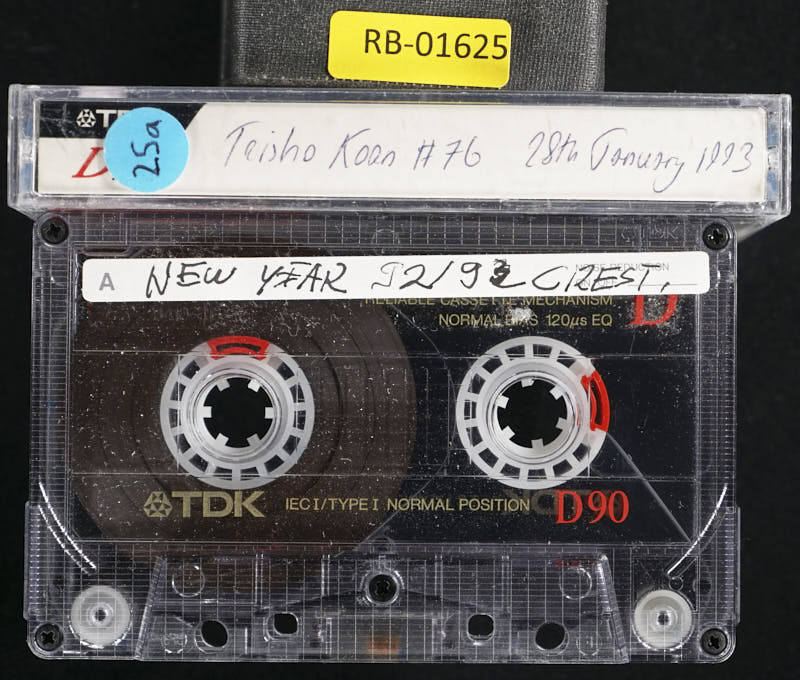
Talk_Koan_76
This talk emphasizes the importance of physical presence and awareness over intellectual understanding in Zen practice. It discusses the three phrases of Zen teachings and their relation to the mind and practice, indicating that true liberation arises when one transcends intellectual constructs and embraces the interconnectedness of practice and existence. Through this discourse, the idea of formlessness is highlighted as key to discovering the essence beyond existential categories.
- Diamond Sutra: Referenced in the context of koan practice to illustrate the concept of form versus emptiness, an important theme within the teachings that stresses the transcendence of dualistic thinking.
- Blue Cliff Records: Discussed as part of a broader teaching approach, highlighting the integral Zen tradition of exploring koans to uncover deeper insights into the nature of reality.
- Shri Rupa 20 Koan: Mentioned in the discussion to convey complex Zen concepts of "being" and "non-being" and to show how they relate to practical Zen exercises and philosophical inquiry.
AI Suggested Title: Transcending Form: Zen Beyond Thought
Then you know that, you know chant, starting the chant is more important than hitting the bell? So why don't you not hit the bell and just start the chant then? I mean, and even when I bowed you didn't have the bell ready for the third bell. I said to Mark the other day in the kitchen, the condition of your shoulders, not having tight shoulders is more important than any number, thousands and I mean, practice begins with the physical stuff of this world. And you get that down first. And the rest is actually quite important compared to that.
[01:04]
I mean, better to go through the world with relaxed shoulders than to have ever heard of Buddhism. Do you understand what I'm talking about? And being present to hit the bell, that's more important than understanding anything From the point of view of Buddhism, you have ideas about yourself, understanding, and so forth. This third phrase says, when you attain the third phrase, you can't even save yourself. That's what this means. In practice, we don't live in our heads.
[02:06]
We live in the stuff of the world. That's your first job, is your own stuff and the stuff around you. And out of that, then, true mind arises, not some thinking mind or ego-based mind, a mind of boundaries and comparisons. The first, you know, part of the reason for monastic life is you just get so that you're no barrier, boundary between you and the stuff of the world. Now this poem is pretty good to discuss and on New Year's Eve. And, you know, we started out, if I remember wrong, this is 76.
[03:14]
We started out with 76. We went back to 20 because 76 led us to 20. So now since we've had so much good discussion, 20, you are all participating in koan practice of studying koan much more fully than you used to much more sense of what happening at koan so you must understand this koan pretty well because of what we discussed on 20 what you know, Marcus pointed out in the Diamond Sutra, and we were kind of asked to go to Europe, I guess it was, the second time, to read the Diamond Sutra of Khonses and the Diamond Sutra of Thich Nhat Hanh.
[04:23]
And probably what we ought to do is maybe... After 76, film study of 76, maybe we should specifically look at the time of the trip together. Or at least one or two, perhaps one or two years. Anyway, a little bit. But as Mark put it out, I think it's in there, that first you put in no Buddha, and then there's no no Buddha, just as this koan states. Or there's beings to save, and then there's no beings to save, and then there's no beings to save. Of course, we have these three phrases. In the first phrase, you save Buddha's ancestors.
[05:29]
In the second phrase, what? Humans and divinities. In the third phrase, you can't even save yourself, because in the third phrase, there's no beings to save. And then no beings to save is saving beings. Okay, so what kind of world is this? What kind of mind is this? Something being presented to us here. Now, Suzuki-oshi used to teach in such a... No, that's not correct. Precise, yes, but delicious, yes, delicious way.
[06:33]
In some... He would just talk about me. And these three phrases were something he talked a great deal about, early 60s. And I remember them quite well. I don't know. particularly when he talked about the blue cliff records. And he gave, I think you know, he lectured over a few years on the entire, all the hundred cases. So he didn't put these, I mean, sometimes he would, but generally he would just talk about, you know, That attitude or phrase, mind which covers everything. As this book says, containing you.
[07:37]
When you talk about a mind that covers everything, you'd speak about some statement that covers everything. Then at some other time, maybe a month later or something, you might talk about cutting off the strings. Cutting out near the stream. And he often talked about it. He particularly liked the phrase, as he put it, wave follows wave. Wave leads wave. And his comments on sutras that were on Sunday lectures to the public, more or less the public, he would just talk around about, sometimes not mentioning, just one of these phrases. So they became quite familiar to us. Something that covers it, contains it, contains heaven.
[08:44]
So this kind of praise, you know, you don't, again, of course, look to the logic of it so much as maybe perhaps the image of it. And the image of it and accompanying the image of it is a feeling of state of mind. And... It's something you can become quite familiar with and familiar with it so that the phrase actually covers everything you say. And you can feel the phrase covering everything, containing everything, containing everything in the way you speak or stand or feel. territory maybe that you feel thinking through things through the way you are inseparable from the stuff of the world and the stuff of your own body and on the second phrase you likewise you
[10:07]
Then just when you feel something clear and bright, you cut off it. You feel like you gave everything away. You didn't have anything. You freely released everything. And when you practice your breath, bringing your attention to your breath, this is a kind of cutting off. It's not forcing anything, but you can feel. When you bring your attention to your breath, just that's all there is. And it's not done with some effort of cutting to remove things.
[11:12]
just like a loud noise might stop everything in you. Feel. Only the loudness. When there's no force there, why don't you hear some misty cry of an animal outside. just cuts through it. But you can come to the point where your breath just cuts through everything. Not in some kind of removal process. It just becomes the full focus. And then you can even let that go. or even that which cuts the loud noise, the mystic cry of some animal, or the brightness of your breath, even that go.
[12:24]
So these are quite, you know, A real practice, a real experience is not as the koans say, this is not for a sutra teacher or professional teacher or something like that. No, this is for you who find each of these phrases covering it. Each of these phrases containing it. Now you remember that in Shri Rupa 20, we were discussing how there's a kind of underlying structure to the koan and the way of thinking. This is A, not A, not A, either A or not A. This is the opposite.
[13:35]
And then it's include both. There's not limited by either. It's a basic way of thinking. And this way of thinking also is another surface of a way of practice. And this is a way of thinking, a way of practice, or just other surfaces of how we actually exist. or don't fit into the category of existence. What's it say that travelers already beyond the Blue Mountain? And he said he practiced before ancient, before the time of ancient.
[14:40]
And when the emperor couldn't find his jewel, the knowledge couldn't find it. The other guys couldn't find it. And only formlessness could find it. So this is talking not just about the way of practice or the way of thinking, but how we exist in ways that the category of existence isn't even met. You can't even save yourself in such a way. There's nothing to save. But, you know, this is a kind of philosophy, and as a philosophy it helps you develop your attitude.
[15:58]
The attitudes, if they're refined, they help you in your practice. But again, these are not separate categories. They're as they are because practice One phrase covers the other, too, because practice is inseparable from the way things exist. And your thinking is inseparable from the way things exist. And the way things exist is inseparable from thinking in practice. And the way things exist can't be pinned down. So this kind of attitude, as you begin to refine it, and then philosophy, a kind of philosophy becomes an attitude that's integrated with the way you act and covers what you do.
[17:08]
But then you have to have more of a kind of entry, some kind of handle. So they talk about beginning, middle, and the final good and stuff. But we're not really talking about the beginning, middle, and final good. Maybe the beginning is the final good here. And you see, I'm doing exactly what I said the other day. I've been sitting down over there. Each phrase. So the beginning can become the final good, and the final good can become the beginning. And in fact, You can't even save yourself. You can become the teacher of humans and divinity. The teacher of humans and mankind.
[18:10]
What a funny idea to be the teacher of Buddhas and ancestors. Or to be the teacher of humans and divinities. Again, it's not talking nonsense. I'm trying to give you an accurate, precise sense of how we practice problems that exist beyond ordinary ideas or any ideas that exist So New Year's is quite good, you know, time to talk about this because our usual way of thinking is so connected with time. Now we're going to, well, it's our new year, the calendar changes, the solstices pass, and so in January,
[19:26]
I mentioned today to them is the god Janus who has two heads. One looking forward and one looking backward. Into the new year and one looking into the old year. And we have in Christianity such a strong idea of the arrow of time. Christ, Christ it meant. We talked about this some in your book. Christ it meant, which changes history. We count time from the Christ event. But come on, you speak of practicing before the prehistoric Buddhas.
[20:29]
There's no question when you talk about practicing before the prehistoric Buddhas. No Buddha event. No time measured from Buddha. And here again, we have, like in the first one, the children, the children, are you going, the children, which here the traveler is already beyond the blue mountain. Where exactly are you? The meeting a handle, we start with these, these, um, phrases and start, and many columns, answers. Yeah, sometimes if, uh, you were working on a column, and you'd become more sophisticated about the column, you would give me an answer in terms of containing everything. You'd give me an answer that cuts off strings, and you'd give me an answer that reflects weight, falling weight, and weight, weight, weight.
[21:32]
So as you practice with these handles, eventually you can Take the handles off. Take what the handles were on off. At some point while they're functioning, it's useful to have these in. And wave followed wave is quite good. Wave leads wave. Is the wave leading or is the wave following? This is also the white bird against the white snow. And it's an expression. And white bird against the white snow doesn't mean just some philosophical idea of sameness of everything or the experience of equanimity and sameness, but rather, or also, that in a situation where everything's white, you become white. In a situation where everything's black, you become black.
[22:39]
And that which is a woman, she becomes a woman. She meets a man, now he becomes, she becomes a man. She meets a female, a thief, here she becomes a thief. Whatever. boy, baby, girl, business man. And this is a kind of social recipe, you know, how you behave with your friends, how you go to New Year's party with yourself. On the one hand, you are wave followed wave. You completely go along, move. And at the same time, if you look closely, And as a person who covers everything, including the entire New Year's party, including January and December, before the priest or buddhist
[24:04]
So these three phrases become very useful ways of practice as you kind of see that they are what we could call perhaps netha attitude, big attitude, which can cover each one of these phrases, can cover anything you do or think. And at the same time, each one is different and each one covers the other. rather subtle. And these are attributed, this comment says, to young men. But it says it takes three generations before we've developed. And this is a kind of, on the one hand, the arrow smashes all the barriers. And the water clock kicks minutely at night. It takes several generations to understand even a simple thing like these three phrases that you're attributed to.
[25:12]
I guess that this going on, he didn't work it out as a teaching system, but in his own answers and way of being, he developed the sense of A, not A, not A, into a way of practice that reflected only East and beyond. And how to teach. So sometimes his answers are cutting upstream. Sometimes his wave follows waves. Wave, wave, wave. His expression is covering. Sometimes one word, if one word answers, it's functioning in all truth. Not listening. It's remarkable to be able to say something. One word covers three ways of practice.
[26:24]
And it's all at the same time, and yet it's each one separately. As you can practice wave follows wave, that attitude will inform your actions in a different way than cutting off married streams will inform your actions. Not from one distance they're different. From another distance they are the same. But here we're talking about moving your distance, moving your pace, feeling a certain pace. And in that pace, sometimes you're in the undivided world. Sometimes you're in divided world. Sometimes you're in a world that's neither divided nor undivided, or is both the same. And these three phrases help you begin to give you the attitudes, the practice attitude, meta attitudes, in which there are many other smaller attitudes about what you want to do,
[27:42]
how to understand something. But these attitudes are big. Each one of them covers everything. And together, they cover even self. So these meta-attitudes, as you begin to practice them, they begin to affect you on a cellular level. They begin to affect the way your body and brain and mind, breathing, and so forth, function. It's a dream. We have a kind of attitude that you bring into your recipe, your daily recipe. You will cook yourself differently as a result. So then, again, what world are we talking about here?
[28:43]
Because we definitely have the experience, you know, each of us has the experience of, yes, now it's December 31st, 1992, tomorrow we will rewrite a check, a letter, you will write December 1st or 2nd or something, 1993. And this isn't just a calendar event, it's you did eight things yesterday, you did And you'll eat something tonight, and you'll eat something tomorrow, and it's a different thing. Eventually you will go somewhere else. You will remember having been here. And so there's a kind of obvious succession. It's very real in this world. And Dogen preceded us. Wonbo preceded us. Tsukiyoshi preceded us. Some succeed us.
[29:45]
So this is quite right. You will eventually die, and you know, like, well, you were born in some time. So this sense of succession, of course, in the Western sense, this sense of progress, of development toward an end point from the beginning point, You know, the idea of progress, I don't know, but certainly we have the idea of obvious experience of succession. And the beginning, you know, of men and the birth and dying. Two friends. We'll be dead. Oh, I'm pretty sure we'll be dead in three months. And I won't get to speak to them again. Not in any of your familiar sense.
[30:48]
Okay, but still, these are categories. And when you have this idea, as accurate as it is, it forms your mind. And naturally, because everything we grasp or think about tends to, as thought has an object of thought and objects of thought fall into succession, we tend to believe this is true. But formlessness finds the jewel. Formlessness of mind or attitude, a way of meta-attitude within your thinking and acting, which doesn't have these categories, which doesn't think in terms of succession of objects of thought.
[32:04]
If this subtlety you can find, which this koan pointing out emphasizes, you find you are living. You're living isn't the right word. Something, an existence which doesn't fall into the category of existence, Or you can't, I don't know, whatever I say is not God. But there is a, let's say, exist. Dharma exists. Buddha exists. True nature exists. It's not in the category of 1992 or 1993.
[33:21]
Such categories not only are limiting, but actually don't exist. Beyond even undivided will. Divided. This form is in itself a Jew, but we can't be the same. And yet I think you may find that so. So let's celebrate the new year, and let's celebrate a year in which there are no distinctions of view. So we should have a toast tonight in the satsang.
[34:38]
Toast to this continuous love existence. It reaches everywhere. Traveler. [...] Well, it's the way Jesus goes.
[35:31]
@Transcribed_UNK
@Text_v005
@Score_74.99