You are currently logged-out. You can log-in or create an account to save favorites and more. more info
Soul's Journey to Divine Simplicity
Talks at Mt. Saviour
The talk delves into themes of simplicity, immortality, and freedom concerning the nature of God and the soul, emphasizing the writings of Saint Bernard and Gregory of Nyssa. It discusses the distortion of the soul's original divine image due to acquired duplicity and the importance of restoring the natural state of the soul through self-examination and divine grace. The speaker references Saint Bernard's ideas on the affinity between the soul and divine love, citing examples from monastic traditions and ascetic practices.
Referenced Works and Authors:
-
Saint Bernard of Clairvaux: Central figure in the talk, his writings lend insight into the properties of the soul and its likeness to God, particularly through concepts like the divine image and the challenges of maintaining spiritual purity despite human duplicity.
-
Gregory of Nyssa: Cited for his theory regarding the soul's transformation by moving from dissimilarity to likeness to God, with an emphasis on spiritual regeneration over loss.
-
The Psalms (Various Authors): Discussed for their role in illustrating spiritual principles, as they frequently appear in both Old and New Testament citations due to their artistic and theological richness.
-
Saint Athanasius's "Life of Anthony": Provides an example of spiritual renewal and the recovery of man's natural state through the depiction of Saint Anthony's ascetic life.
-
Plotinus's "Enneads": Referenced particularly Ennead IV, Chapter VII for its symbolism of gold, paralleling the purity and initial state of the soul with aesthetic and moral beauty.
-
Saint Augustine: Introduced for his definition of sin as misdirected love, which complements the discussion on the hierarchies of spiritual and mortal affinities.
-
Peter Abelard: Briefly criticized for his misogynistic view as part of a discourse on gender perspectives within medieval religious teachings.
-
Yves Saint-Hilaire de Rivaux: Mentioned as an exception amongst medieval thinkers for his possibly more equitable view on women.
-
Saint Paul and Jeremiah: Quoted for their insights on the nature of spiritual loss and redemption, using allegories of gold and transformation.
The analysis centers around the intersection of theological concepts with philosophical inquiries into human nature, spiritual purity, and divine love, drawing extensively on early Christian thought and medieval scholarship.
AI Suggested Title: Soul's Journey to Divine Simplicity


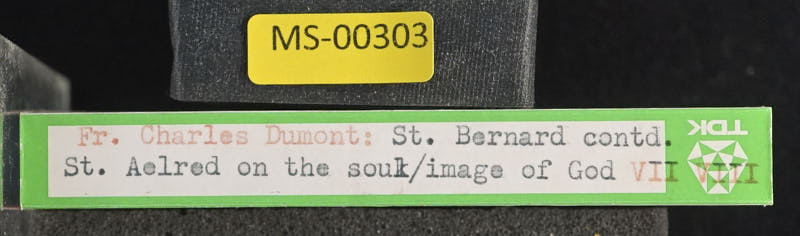
AI Vision - Possible Values from Photos:
Side: A
Speaker: Fr. Charles Dumont
Possible Title: St. Bernard contd., St. Aelred on the soul/image of God
Additional Text: VII
Side: B
Speaker: Fr. Charles Dumont
Possible Title: St. Bernard contd., St. Aelred on the soul/image of God
Additional Text: VIII
@AI-Vision_v002
And we just stop after St. Bernard has proposed some difficulties about the similitude or likeness of God in men. Suggests three texts of scriptures, three texts of Psalms. It's very interesting also to know that most of the, certainly, great quantity of quotation comes from the sounds, for the good reason that sounds were known by heart. In the Old Testament it's always the sounds, the great majority of the quotation are the sounds, and in the New Old Testament it's in Paul's and Bernard's quotes all the time. Interesting to know that the psalms are very much used because I knew them by heart, duty, the choir.
[01:05]
So, simply as I say, perhaps, therefore, these three attributes, simplicity, immortality, and liberty, either are not in God or are not in the soul, or, then page 43, lines from the top, granting the existence both in God and in the soul of simplicity, immortality, and liberty, yet the soul may also be without such characteristics, and therefore they are not inseparable from her. God forbid that we should so speak. Not only do these attributes exist both in the world and in the soul, but they exist also inseparably in either. And so there is nothing in what they have said which they have reason to repent of, for it is all granted an absolute and unquestionable truth.
[02:14]
With regard to what all the scriptures say about the souls having been made unlike to God, I observe that it does not assert the putting of the old similitude, but only the putting on of a new dissimilitude. Now, this is the new theory, which comes from Gregory of Nyssa. The soul has not lost the likeness, like in the system of the freedom and the... Yes, the... facility to follow the law, or in the previous sermon, 81, where St. Bernard says, the soul has lost her righteousness. Here, the soul has not lost anything, but instead, the soul has added something, putting on a new dissimilitude.
[03:19]
And that's the way the image has been distorted, damaged, because by an addition of something which was superfluous. The soul, as is evident, has not stripped herself of her original form, nativa forma, but simply covered it over with an advantageous. The latter has been added to not substituted for the former. This is very interesting doctrine, very important too. You can compare with many texts of, or many doctrines of Zen masters and all the traditional asceticism, which is not to acquire virtues, but just to treat of everything which has been added by yourself, by the false self, the empirical self, the self which wants to show off, to convince itself to be important, interesting, and all that, all the vanity which is in us.
[04:40]
Therefore there is nothing to be added, not to acquire anything, which is good to try to get stripped of all these things, and get rid of all the advantages, and recover this naturalness of our being, as it was created by God. I suppose Brother Anthony would like to know that St. Athanasius, in his Life of St. Anthony gives a very striking example of this language of nature. He says that St. Anthony spent a long time in a cistern or in a cave somewhere, and after 10 years or 12 years in this cistern, he came out and he was completely natural. It means that he has recovered the nature of man
[05:48]
as man was created in paradise. That's always the language of the Father. To recover the natural beauty of man as he was coming out of the hands of God. So Anthony was completely natural, which is a doctrine which has been sought by all monasticism, all asceticism. The naturalness is continually coming in Zen literature, to be yourself, to be natural. You see the doctrine now here is that man has not lost anything of his form, but he has had something which has deformed him. And although that which is superinduced has been able to obscure the natural form, it has not been able to destroy it completely.
[06:52]
And St. Paul says, their foolish heart was darkened. In Jeremiah, always the gold become obscured and the finest color change. The prophet laments that the gold has lost its brightness, yet a knowledge is that it still preserve the nature of gold. He agrees to see the finest color dimmed, but does not complain that it has been utterly destroyed, for the soul still retains an attribute of simplicity quite impaired in its essential. Although it is no longer visible, being overlaid with the vice of duplicity which exhibits itself in human deceit, simulation, and hypocrisy. See, the example of gold, image of gold, has been used, taken from the antiquity, especially Plotinus in Enniads, in the fourth Enniad, chapter seven.
[08:02]
And also, by Gregory of Nyssa, the symbol of gold. Nature of gold, which has been deemed obscured And then St. Bernard continued, our incongruous, my brethren, is such a combination of simplicity and duplicity. Our becoming to raise so bad a super structure upon a foundation so excellent. It was with duplicity of this kind of the serpent and so on. And the two dwellers in paradise have recourse when having been seduced by the tempter, they endeavored to conceal their now shameful nakedness amidst the shadow of the trees and with garment of fig leaves and words of excuse. How universally thencefore and all done through the centuries as the poison of hypocrisy inherited from them infected their posterity.
[09:06]
Can you show me one amongst the children of Edam, who I do not say is willing, but can even endure to be known for what he is. It's a very beautiful statement. Is there a man who can endure to be known for what he is? Nevertheless, along with this hereditary duplicity, a natural simplicity persists in every soul, so that the union of opposite properties makes the confusion worse, confounded. And so for the soul's immortality likewise endures, but dimmed and darkened by the invading dense cloud of temporal death, and so on. Then paragraph the fourth, consider the case of Eve. of course, in the Middle Ages, it's always the case of Eve, which is considered, not the case of Adam.
[10:12]
So the pejorative approach, which is quite universal. Not so bad as in Beats said sometime that the nature of women was inferior as nature, but certainly morally. Morally, perhaps because it was... or centuries of monasticism. But you have a very interesting text about the opinion among authors of the 12th century had about women, imprecisely in this doctrine on men and the image of God. All kind of... approach and remarks. One of the worst anti-feminist, very paradoxical as it appears, is Abelard.
[11:21]
Abelard is certainly the worst. When he speaks of women, he's absolutely appalling in his treatise. There's a famous exam, I don't know if I mentioned it already, that he does approve, as a good grammarian, approve the superiority of men on women by saying that in a Latin sentence, if you are four nouns in the feminine and only one noun in the masculine, the adjective will be in the masculine. LAUGHTER but that's the proof of the thing one exception I'm glad to see one of the best the exception which is perhaps unique he sent a letter of Evo and we shall see the text probably tomorrow anyway consider the case of Eve of an immortal soul through an inordinate affection for mortal objects it's always there as a sin
[12:33]
inordinate affection for mortal objects. That's the definition of sin. St. Augustine gave perhaps the most beautiful definition of sin, saying that it is to take finite beings for an infinite. So, this inordinate affection for mortal objects caused the glory of immortality to be overlaid and obscured by the duskiness of a supervening liability to death. And so on. O woman, neither that goodness, nor that fairness, nor that delightfulness, or if it does pertain to thee according to thy material part, it pertains not to thee alone, but is equally the property of all the beasts of the earth. That which is thine, which properly belong to thee, comes from another source and has another nature.
[13:39]
For it is from eternity and is itself eternal. Therefore, would you impress upon thy soul another form, especially an alien form, nigh, what is more a deformity? It's important to see the The important word is forma, the form, which belongs to the aesthetic world, aesthetic philosophy. Forma, the exemplar in the mind of God, which is considered as a form. The language is for aesthetic, although it's used for the nature of a being. For the pleasure which the soul feels in acquiring temporal goods is accompanied by the fear of losing them. And this fear is a kind of color because it stains and is so disguised the liberty of a will and makes it look unlike itself.
[14:44]
Poverty is that, to take greed to keep things which we are not supposed to have for ourselves alone or forever and so on. How much more worthy of her origin would it have been to desire nothing which could become a cause of uneasiness to her, that so she may defend her inborn freedom against this servile fear and preserve it in all its natural strength and beauty. But alas, it has not been so. The finest color has lost its brilliancy. And so... though poor Eve flees the way and conceal thyself. So he is the voice of God and thus hide thyself. Why is this? Unless because thou are not afraid of him who elsewhere thou didst love. And because the form of the slave has superseded that of the freeborn child.
[15:51]
It's a beautiful lyrical almost passage of St. Bernard. Now, But that voluntary necessity also, and that contradicting law imposed on the bodily member, military against the same liberty, and by means of his own will, reduced servitude, while alluring him, man, the creature naturally free. Filling his face with shame, so that even in spite of himself, he has served with his flesh the law of sin. Therefore, because he neglected to defend the nobility of his nature by probity of life, it has come to pass by the judgment of his creator, not indeed that he is deprived of his native liberty, but he is clothed over with his confusion
[16:53]
as with a double cloak. Verse of Psalm 108. Very appropriate is this image of a double cloak. For man wears now a double mantle, so to speak, because whilst his freedom still remains on account of his will, his slavish manner of life is a proof of his servitude. And such is the case as you may notice, not alone with the soul's liberty, but also with her simplicity and with her immortality. In fact, if you examine the matter closely, it will appear to you that there is nothing at all in her soul which is not similarly covered with this double cloak of likeness and unlikeness to God. Therefore, this again, he goes on, it's not something, duplicity is not a natural quality, but as something super added to a native simplicity, fasted and sewed onto it as it were with the needle of sin.
[18:10]
And where, in the same manner, death is combined with immortality and necessity with freedom and so on. For simplicity of essence is not excluded by duplicity of heart, the simplicity of essence of the soul, but the moral duplicity of heart. Nor immortality of nature by either the voluntary days of sin or the involuntary days of the body. Nor liberty of will by the constraint of a willing servitude. Accordingly, Accidental evil, supervening on the good of nature, is not substituted for, but rather co-exist with that good. It does not destroy, but dishonors it. It confounds without expelling it. Hence it is that the soul is made unlike to God, and made unlike to ourselves also.
[19:15]
already pointed out, this doctrine that the soul, when she's made unlike to God, is also made unlike to herself. It lost her simplicity, and in this simplicity, doesn't know really anymore what she is or who she is. It's a doctrine which is, the doctrine, you have all the teaching in the Sistema, especially in St. Bernard, on curiositas, curiosity. Now, this curiosity is a very almost theological thing. Curiosity is after the soul has lost contact with the exemplar, She doesn't know where to turn to find out who she is. And then began the long search asking the finite beings to tell her who she is.
[20:28]
Curiosity is that. Trying to find some... She's always disappointed because no one... No finite being can give her what she has to find in God. God only can give her the example of her being. Now, you can transpose that without so much difficulty in modern thought. The loss of identity. Men having lost his identity. Men completely lost. in the world today because he has no model even nature he's destroyed he's changed so where man where is man where can he find his truth what is man what should he be see in all ways of thinking of living so
[21:37]
This touch is a very important, very deep problem, this losing the likeness with yourself when you lose your identity or the image of God in yourself. Then page 46, you have a very long description of the misery of the soul. What shall I say? Of the fact that man, a free creature, instead of ruling as a lord, the inferior appetite which was made subject to him, prefers to obey it and follow it like a slave. Does he not herein also make himself the equal and the associate of the irrational animals which have not been endowed with liberty but fashioned for servitude
[22:40]
without a path of resisting their appetites and passions. Is it not with reason that God is ashamed to be represented or reputed like a creature so degraded? Therefore he says, Thou taughtest, O wicked one, that I shall be like to thee. And he adds, But I will reprove thee and said thee before thy face. It is not possible for a soul that sees herself to regard herself as like to God. At least this is not possible for a wicked and sinful soul such as mine. And it is to souls of this kind that the above reproof is addressed. And these, again, St. Bernard, very attentive to the little details of the text.
[23:42]
For God does not say, Thou taughtest, O soul, or Thou taughtest, O man, but Thou taughtest, O wicked one. There shall be light to thee. It's a finesse. Wicked one. But if the wicked one be set before his own face... and be shown the dead and corrupted continents of his interior men, so that he cannot shut his eyes or refuse attention to the impurities of his conscience, but as to gaze upon the soul of his sins, even in spite of himself, and to contemplate the fullness of his evil habit, then, I believe, he will no longer be able to think God like himself. But humbled by the great dissimilarity which he beholds, he will cry out with the psalmist, Lord, who is like to thee? I have spoken this with reference to the voluntary and superior added dissimilitude of the soul to her creator.
[24:48]
That's one aspect. He made it as bad as possible. Now, the other, the reaction. For the natural and original likeness still remains. and by its presence only renders the unlikeness more displeasing. It's very beautiful. Because we know, even if you face your misery and your sin, you know that you are like God, and you are unpleased. That is this conflict of any conscience. And our great good is the former, or greater than evil, the latter. And they are greatly good and greatly evil, even when separately considered. But when viewed together, their conjunction has the effect of rendering more apparent both the goodness of the one and the badness of the other.
[25:51]
That's one of the reasons why the saints accuse themselves so much of sinfulness. Because I feel much more than anybody these... conflict. Although, as Bernard said, only two people, two kinds of people who are perfectly at ease and happy, it's the saint on one hand and on the other hand the perfect scoundrel. Menno is completely deprived because they have no problem. The saint has no problem and the wicked one has no problem because he's absolutely happy without any remorse. But it's only the people who are in the middle, who don't know what they want, who have this problem, this problematic. They always make this conflict.
[26:52]
Now, when therefore the soul perceives within a single self qualities so widely different from each other, placed as she finds herself between hope and despair. Between hope and despair. Sometimes going from one to the other. And Pascal has said that beautifully, man is so strange. Sometimes he is exalted and he's so much... in sort of euphoria and exalted above himself and the next day he is completely down and depressed so much so in Saint Pascal that you would believe that man has two souls so it's between hope and despair has she not reason to cry out Lord who is like thee she is drawn to her despair by the consciousness of some achievable
[28:01]
but encouraged to hope by the possession of so great a good. Hence it is, my brethren, that the more she is disgusted with herself on account of the evil which she discovers within her, by so much the more ardently does she endeavor to conform herself to the good, to the likeness of God, which she also beholds within her, and the more eagerly does she desire to become again such as she was originally made. Like to this creator God created. Simple and upright and fearing God and avoiding evil. Now, that is the conflict. Now, what can she do to Amen, to restore, to return.
[29:02]
Why should she not be able to abandon the evil which she has been able to embrace? And why should she not be able to embrace the good which she has been able to abandon? That should be in a possibility. Why not? And this, I just like very much in the translation, this, nevertheless. As a man, I would like to be capable naturally. Nevertheless, it has to be admitted that it is on the grace of God she must depend for the power both to avoid evil and to do good, not on nature or on human industry. For as we read, it is by wisdom alone and not by natural force or by your own effort that marriage can be resisted. However, this is very beautiful too. Nevertheless, however.
[30:04]
However, there is not one thing to her, a reason for presuming that this grace or wisdom shall be given her because her turning is to her, the world. Splendid. Because that's her nature. And therefore she presume. And this presume, presumption, is one of the most beautiful things in the whole treatise and the canticle. This daring presumption. And there are the most beautiful texts in there. And this presumption is a presumption of love. I'll just have a quote. It's the presumption to be loved. And he says it's an incredibly scaritas. incredible charity. In faith, she experienced her love for God, living all for him.
[31:07]
And her love itself is a proof. I fear nothing because I love. I would not do so where I not loved. There's many, many quotations. There's just quote two In Candicles 69, paragraph 7, there is such a natural similarity between the soul and God, says St. Bernard, that she cannot doubt that she is loved when she loves. Something like that in human love, but it's not always sure. It's not always certain. But for God, it is certain. Because if she loves, these loves come from God. And another passage, 71, she cannot doubt.
[32:09]
It is evident, that's the opposite. It is evident that someone who never loves has never been loved. It's very beautiful too. It's the opposite thing. So this presumption is that she's sure that by this love, which is natural to her, any kind of love as we see, even the weakest glimpse of love, that she's loved. And that is, this love is already turning are turning his towards the word. That noble affinity which connects with the divine word and that likeness which endures as a witness to the relationship between them are not without influence to conciliate his favor.
[33:12]
See? So the likeness endures in spite of everything which has happened or still happens. and his affinity of nature connects her with the divine world. And this affinity of our nature conciliates his favor. And that is another beautiful idea of Saint Bernard. He graciously admits to the society of his spirit one who so closely resembles him in nature. indeed it is the law of nature that life should seek its life so the spirit when he sees a soul turning to him or loving him turns himself to him because this similitude of nature does that
[34:24]
Because it's a law of nature that the like should seek its like. Now, if you like to read in one of the also beautiful lines, if you like to take page 25, page 25 of your booklet there. That's the top of the page. It's a sentence. which is same idea, based on the same idea, which is perhaps even more beautifully expressed. That union, union in spirit, more or less mystical or anything you like, spiritual, and a high level of union with the word, the descent of God into the soul, that union then is made in the spirit because God is a spirit and is moved with love for the beauty of that soul which he may have seen walking according to the spirit.
[35:30]
Spirit of God moved with love for the beauty of that soul. It's remarkable. I remember I met in France one day in the century of St. Bernard. not famous, but a great philosopher in France, who is the disciple of Blondel in Aix-en-Provence, Aimé Forest. Aimé Forest, he published quite a certain number of books. One of his books is Le Consentement à l'être, Consent to Being, and He read St. Bernard in his class in philosophy in the National University in Aix-en-Provence, and he told me that was for him the most beautiful sentence, if not of all Christian literature, at least of St.
[36:38]
Bernard. This love, this move of love, moved with love for the beauty of the soul, because God is a spirit, and when the soul lives in the spirit, God is attracted by it. So he graciously admits the society of his spirit, one who so closely resembles in nature. And here are, he even calls after her, God calls after her, it's a canticle, return, return, or salamitus, return that we may be all day. He will look with complacency upon her now when she is made like to him, whereas when she was not, when she was unlike, he took no notice of her at all. And not only will he look upon her, but he will also allow her to look upon him.
[37:42]
We know, says the evangelist, that when he shall appear, we shall be like him, because we shall see him as he is. In my opinion, therefore, it is not a difficulty other than an impossibility. That is implied in the prophet's question, who is like to God? Now, this quotation of St. John is also a theological basis or a biblical basis for all this doctrine, and it comes again and again. See, it has to be taken in both directions, both meaning. To see the image, to see God, is to become like him, And to become like is to see him. It's a knowledge by conformity. You conform to another, to God, and you know who he is.
[38:44]
It's conformity. And in sermon 83, such conformity unites, or maritat, with the soul to the world. Already resembling him by nature, it begins to sow also by will. See, this conformity of will is to be completely like God. It loves as it is loved, what more desirable than the conformity which makes it adhere lovingly to the world. You see, I am united when I am conformed, when I am like God. Or perhaps you would prefer to hear it called a cry of admiration. Who is like to God? For admirable and astounding that likeness assuredly is which brings with it the vision of God.
[39:48]
Which is itself the vision of God. The likeness of man. is the vision of God. And that's the theory of Gregory of Nyssa. If you recognize this likeness in your soul, you have the vision of God. You know God in you, in your likeness, because you are like him. This vision of God is not, of course, an intellectual vision, but I am speaking of the likeness and the vision which are one and the same with charity. That's the doctrine of St. Verba. It's not a vision, it's not an intellectual knowledge. This vision and this likeness is charity. For that likeness is charity, and charity too is that vision. What does not stand amazed and beholding the charity of God, despised and yet recalling the soul that has spurned it?
[40:54]
Well, therefore, did not a wicked one, who I referred to a while ago, deserve the reproach addressed to him for claiming a likeness to God, although he could not love either himself or God. For so we read, he that loved iniquity ate his own soul. But let him remove from his soul the iniquity which forms in a partial unlikeness to the word. It's always a partial unlikeness to the word. And then there shall be unity of spirit. There shall be mutual vision. There shall be mutual love. For as the apostle says, when that which is perfect shall come, that which is in part shall be done away. The word and the soul. shall love each other with a pure and perfect love.
[41:57]
They shall know each other fully. They shall behold each other clearly. They shall be united to each other firmly. And they shall live together inseparably. They shall be like each other absolutely. And the soul shall know even as she is known. Then she shall love even as she is loved. and over his bride shall rejoice the bridegroom, knowing and known, loving and beloved, Jesus Christ, our Lord, who is over all things. God bless us forever. Amen.
[42:36]
@Transcribed_UNK
@Text_v005
@Score_94.86