You are currently logged-out. You can log-in or create an account to save favorites and more. more info
Roots and Legacy of Local Pioneers
AI Suggested Keywords:
History of Local Families
This talk recounts the history and genealogy of local families who settled in a specific area in the 19th century. It offers a detailed narrative of various family lineages, relationships, notable events, and property ownership among families such as the Pauls, Uhl, Nagels, and the Darmstadt. Specific anecdotes about family members' lives and occupations, the construction and destruction of old properties, and connections to the wider historical context, such as the Civil War, are also mentioned.
Referenced Families and Individuals:
- Paul Family: Discussion includes Melchior Paul and his descendants. Historical elements such as migration from Prussia and family contributions to local farming and railroading.
- Uhl Family: Noted for their Catholic background and contributions to the local community through professions like blacksmithing and farming.
- Nagel Family: Related through marriage to the Pauls and involved in historical property ownership, including a notable land donation for church construction.
- Darmstadt Family: Emigrated from Germany with significant contributions to local agriculture, noted for ties to religious institutions and the maintenance of family properties.
Key Historical References:
- Civil War: Contributions to supplying the military with resources like wood.
- Dutch Hill Cemetery: Mentions of burial traditions, significant family graves, and the history related to the area’s settlers.
- Local Architecture: Construction details and historical relevance of properties built by these families, including barns and houses.
Historical Landmarks and Properties:
- Dutch Hill Cemetery: Burial site for many discussed families, highlighting the integration and impact of immigrants in the area's development.
- Family Homesteads: Properties owned by families like the Gardeners, Smiths, and Dalys are recurrent themes tied to historical land acquisition practices.
AI Suggested Title: Roots and Legacy of Local Pioneers
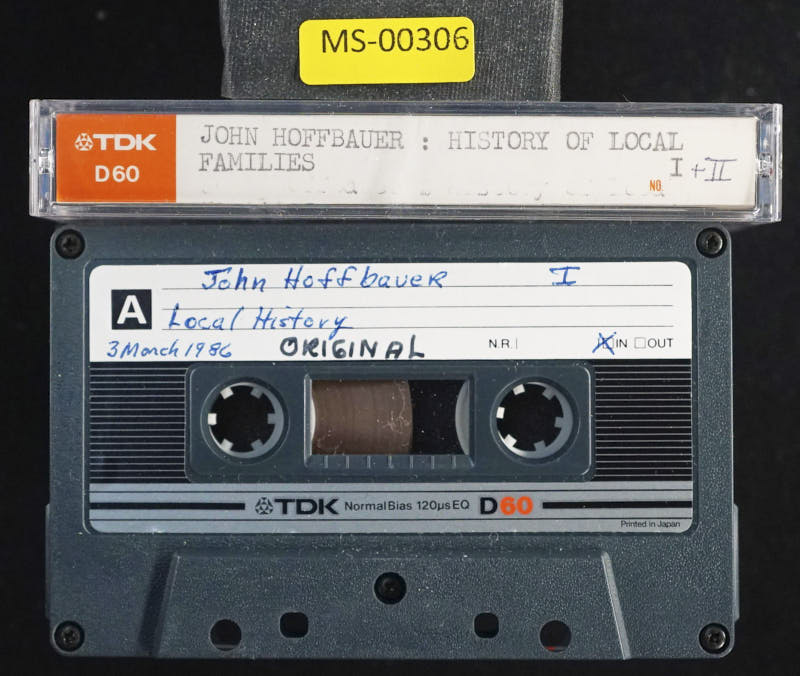
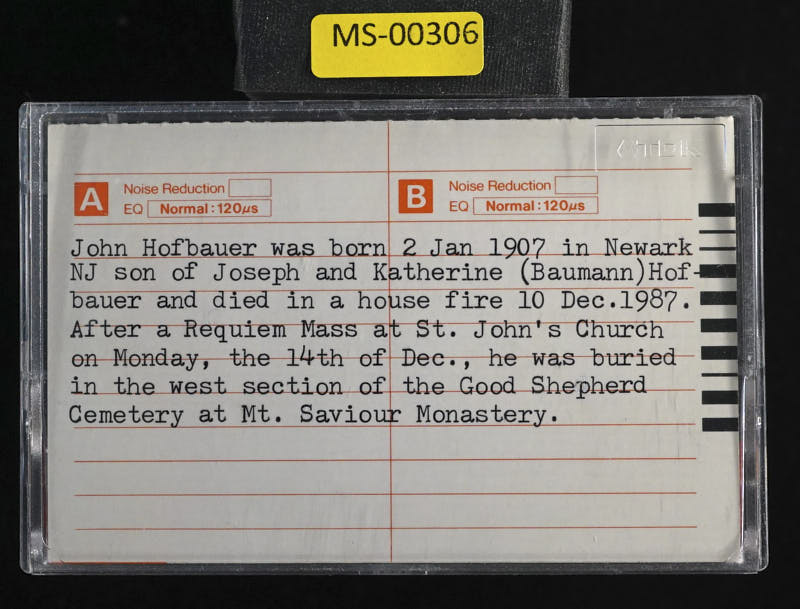
AI Vision - Possible Values from Photos:
Speaker: John Hoffbauer
Location: Mt. Saviour Monastery
Possible Title: History of Local Families
Additional text: John Hoffbauer was born 2 Jan 1907 in Newark NJ son of Joseph and Katherine Baumann Hoffbauer and died in a house fire 10 Dec. 1987. After a Requiem Mass at St. Johns Church on Monday, the 14th of Dec., he was buried in the west section of the Good Shepherd Cemetery at Mt. Saviour Monastery.
@AI-Vision_v002
The Pauls came in about 1848, I suppose. Well, that's about when the old settlers all came in here. The Nagels and all those, you know. And the Smiths. Oh, the Smiths. The Biewallers. The Reesbecks. And the Madigans down here. And down here where the Kellers were, it was the Hartmans. And then the Gardeners, that was a big, big relative ship, the Gardeners. Over there, Henry Mosher just bought a place, you know, over there. That joins you over in there. On the knowledge. That really was a homestead of the Gardeners. Now, what was it about the Paul boys? I just wanted to show you these pictures here and see.
[01:01]
This one I was particularly interested in because it's kind of a strange picture to be having. Now, that's supposed to be Melchior Paul. This here is supposed to be Melchior Paul? Yeah. Now, I didn't know which generation. You see, there were... There were two Melcher Pauls. Well, this Melcher Paul here, he didn't have a beard. He was one of the children. This must be the father. Yeah. Yeah. And what this package is right here, I don't know what he was carrying. Now, there was Melcher and Williams and John. I think his name was John. John got killed on the railroad. The two boys stayed on the farm. Oh, I see. Then one girl married Jake Wagner.
[02:04]
He's a convert. That was Goody. She taught school down here. Right. And she was my teacher once or twice. Then another one married Zimmers. And they had one girl, and her name was Elizabeth. Yes. And she's alive yet. And she lives in back of Bower Road. And she married Fedor Smith. And she worked for Allen Chevrolet for years. Then another one married Amal Reesbeck down in South Corning here in Gibson. Down in there. Oh, it's the other side of Gibson. What did they call that? It was a glen. They called it a glen in there. And they have a boy that they adopted. And he was caretaker of the whole cemetery there.
[03:08]
And he's alive yet. He could give you a lot of information too. Then let me see. Another sister... Now, you see, that stuff gets away from you. Then they had another sister. I don't know who she married. But there was a large family of them. There was probably six, eight children all together. Yeah. Well, this fella here, I don't know, you like to say, I don't know what that package is either. He looks like he's got a... a slit on his stomach or something. I was Paul Bearer from North Ship Hall. What year was that about? What year did he die about? Oh, that was back in the 70s. And William died first. And the man that lives up on the farm up there now, his name is, he's a barber, you know, croaker.
[04:11]
Oh, yeah. Yeah, that's the old Paul place. Well, this must be their father. That must be the father, yeah. Well, I don't know if you know any of these. That's supposed to be Mrs. Fisher. Mrs. Fisher? Don't you know who Mrs. Fisher was? Not sure. Mrs. Fisher was a sister to Katie Nagel. And Katie Nagel, they were the ones that owned this farm here that we bought off of. She was a sister. Both those girls were brought up in a convent. Their father died with pneumonia. He worked on the ice wagon and he died young. And they're related into the coons. You've heard of the coons? Yes. I think some of the coons are in here. That could be possible. This is Gertie, I know that.
[05:11]
Gertie Wagner. Yeah, that's Gertie Wagner. That's right, is when she was a girl. You saw her, haven't you? Yeah, she's been up here. That's her older sister, I presume. That's Gertie there. Yeah, that's right. I'm just trying to think. who all the power girls married into, it's kind of got away from me, but it'll come to me again. And then if it comes to me, I'll let you know. I'll let my sister know. Did you ever see this picture before? I took, that's from an old tin type, you know. You took it from who? A tin type, you know, one of those old tin type pictures. Oh, yeah? It's real small, so I took a picture of it and enlarged it. That's supposed to be Damien Paul. He's supposed to be the father of the first Melkshore Paul. And he was born in Prussia in 1808.
[06:15]
1808. Well, doesn't that man resemble the man that had that package there? I don't know. I think so, more or less, doesn't he? Except here he has a beard and here he hasn't a beard. This might be the father of this man. That could be. That could be. Because his clothing here, it looks pretty old, old style. Yeah, it does. It does. It's right. It does, yeah. Now, Elizabeth Smith, you don't know her, do you? Not right offhand. She's a Catholic. Supposed to be a Catholic, yeah. Gertie Wagner was her aunt. And Gertie Wagner's sister was her mother. And when you go up Bower Road, that's up Colmont Avenue.
[07:16]
She could see you could take a lot of these pictures along and she could straighten you out because she saw them already. She lives up on Bower? Now, you go up Cowan Avenue a little ways and then you see to the right there it says Bower Road. You turn in there and you go up Bower Road and you come up here by the Kawaians. That's Kawaians. And right across colman avenue it's acorn avenue colman that's acorn so when you when you get up to kawaiians you turn right and it's about in the end in there it's the end house in there oh i see uh-huh you never knew madeline odessa did you and not by name i might have heard of her all right madeline odessa lived over on bower road And Theodore Smith and she lived right over here. There are lots of joints. And she could give you a lot of information on that.
[08:22]
She knows the history pretty well, you know. Now who is this supposed to be here? That's supposed to be who? Ull? Henry Ull? Henry Ull, yeah. Yeah, well, I'll tell you who Henry Ull was. Henry Ull lived down here. where Bob Butler is. Oh, yeah. That's the old old place. And Henry died in 1926 with Breit's disease. And he was the first one that I ever was pallbearer for. And he's buried at the Dutch Hill Cemetery. Then he had a brother, Freddie. Have you got a picture of Freddie? Yeah, I think Freddie. Yeah, yeah. Those were Catholics. They were Catholics. Oh, well, we'll run on to it. Now, Charlie Ull was the oldest one of the family.
[09:24]
And there was 12 boys in that family. And they lived in Scranton. And the father died in 1865. And he's buried up here at the Dutch Hill Cemetery. Oh. And Charlie had to go to work in the coal mines to make a living for the rest of them. And they misused them coal miners, something terrible. And when a mule was killed, the big shots had come out in their white shirts and cry. They had to buy him. But when a man got killed and he had a wife and a family, that was nothing. Because we could get him free. So he got so disgusted, he says to his mother, he says, let's go up on the Deichenberg and buy us a farm. That meant let's come up here on Dutch Hill and buy a farm.
[10:29]
So they bought the farm where Jack Watts is. You know where he is. That's the old, old homestead. And They started in farming there. And the father, they brought the body up and buried it up on the Dutch Hill Cemetery. That stone is about wore out. It's almost impossible to find it anymore. It was a sandstone. So Charlie, they went farming. Then Fred, came Fred along. And then came some more of the boys along. They were so bored that the old lady would... Oh, hello, Father. How are you? Well, I see you got rid of the colibrator after I fixed it. Yes. That's old a year ago. Summer of 84. Is that, yeah? Yeah. A man named Whitney. Oh, yeah? Down on Maple Avenue. Oh, yeah, I've heard of him. I've heard of him. Yeah, Whitney down there.
[11:29]
Whitney, yeah. Oh, yeah? A really large vegetable garden. Is that so? Wow. That's good. You couldn't use it no more. It was no good to you no more. John, what is this? You're losing your hearing? No, no, I'm getting recorded over here. That's all right. I'll see you later then. Okay, Father. Now, so the boys begin to spread out, see. One of them, his name was John. He put up a blacksmith shop down here where Buckner was. And he shoot horses and done blacksmith work. The other one, his name was Pete. He went to Corning. He was a paper hanger and a painter. And William, he went to Corning, and he was a paper hanger and a painter. And he was the father of Mrs. Guernsey. You remember Mrs. Guernsey?
[12:31]
All right. Uncle Henry, he went to Alabama, and he was a paper hanger and a painter down there. And one brother drowned it in the Susquehanna Creek. Going swimming down there. That Susquehanna Creek goes into the Susquehanna River and she flows east. Then another brother went out west. And he wrote home for some money. And they sent him the money and they never heard a word of him after that. They don't know what happened. So when I was in Seattle in 1936, and I walked around the city, I run into a bunch of delivery trucks with the name of Ool on them. And I began to think, if he didn't get married, it all springs from him.
[13:34]
But there was no use of asking the drivers. They wouldn't know. I didn't bother then to go to the office where they came from. So it's a mystery. So Fred Ull, he stayed on the home farm. And he married a Steinhauser in Elmira. And he run thrash machines and steam engines. And Charlie Ull run thrash machines and steam engines too. And Charlie stayed down here on this farm. Well, Charlie Ull lived up... up above the Polish people over here where it goes towards Thickler now. There was a farm up there and there was a swamp there. And Henry owned it later. And when John decided to go to Scranton to retire from up here, Charlie bought him out and bought the farm down here. And that's where Henry and Freddie was born. Then they had... Two or three girls were born, and each one died with appendicitis.
[14:39]
Aunt Mary was a bee waller, and she killed them with kindness. She always wanted a girl, and they would eat, eat, eat all the while. In those days, they didn't know anything much about dieting or anything, and they didn't know too much about appendicitis. So there's three little girls buried over there in the Dutch Hill Cemetery, but the boys, they survived. They survived. Henry and Freddie survived, yeah. Then let me see. I don't think I remember of any more. Where all the rest of the boys went, I never heard. So when they got settled down on the farm, the Civil War was in action, and the prison barracks was down along the Water Street. And they were right in there where the Jewish churches are. And Charlie Ull, being the oldest one, he'd get up at 3 o'clock in the morning with a stone boat and a pair of auctions and haul wood down there.
[15:45]
Sell it to the government. So they had heat down there. So they could survive. And they died like rats. They wasn't used to our climate. And food was poor. And everything was poor, and he said they died like rats down there. So then they built the church on Dutch Hill, the Catholic Church. You probably heard about that, too. Half of that barn down there is lumber out of that Catholic Church, you know. The ooze tore the Catholic Church down, and Freddy took the bell out on the belfry and brought it down to the blacksmith shop. And Conrad Nagel donated $2,000 to St. John's Church to have that belt put in. Well, they didn't get around to it right away. And Carl Dutenheimer over here got married and they had a hornet. And they got this belt out and pounded it and they cracked it.
[16:49]
It stayed back there in the back of the blacksmith shop. All the while I went to school, I can remember until... Oh, hello, Father Mark. Thank you for coming over. That's all right. I'm glad to see you. I'm glad to say my prayers. That's all right. So, then the Guernseys got the price, and I know the guy who stole the bell, and he sold it for bell metal. So, that went down the ding-dang. So, John, when he went to Scranton, he had a family down there. He had one boy who was named John, too. And he got to be a big shot in the Lackawanna, Delaware Lackawanna Railroad. And he had a pile of people working under him. And then on weekends, he'd come up on the trains and spend his time with Aunt Mary, Uncle Charlie, and Freddie, and Henry.
[17:51]
And then... Charlie, I think I was Paul Bearer for Mrs. Ull, and I was Paul Bearer for Charlie, and Freddie Ull's grave, and Bill Lerkey, and I dug that. That was the last grave dug on Dutch Hill Semperger. And there's only two more plots left, and one is for Mary Hartman and Bill. And William, he's buried in the wood lawn. I suppose Mary will be buried down there too. So there's no more burial. That ducho cemetery is concentrated ground. There's Catholics and Protestants buried up there. And I think old Adam Motsman gave that land for a burial ground up there. And today the Monsons own all the ground around it. So it must be at one time, Adam owned this big field over here. And he sold it to the Munsons. And that cemetery plot is a jog in there, see.
[18:55]
And Florence Lovejoy always thought that that would come back on their farm. I don't think so. I don't think so. It could. If he sold the land to the Munsons, it would. But... if the Munson's always owned it, or the gardeners. Really, really the gardeners are the proper owners of it. You see, there was a big, big relationship with the gardeners. There was these gardeners over here. There was three girls. There was May and Lottie and Phil Smith's wife. I forgot what her given name was. Then Mrs. Kakridge over here on Dutch Hill, she was a gardener. Then that place where Owen is, that... That was a hotel. And that was run by Dan Gardner. And John Mosman married his daughter. And he inherited the farm. And then Owen bought the farm off of him when he got old and retired, see?
[19:59]
That was the hotel? Uh-huh, that was the hotel, yep. And I tell you who got shot there. He sold wine and liquor and beer and whiskey and tobacco without a license. There was not much law around here those days. What happened up there, he wouldn't get away with the day. So there was a bum around here by the name of Alex Little. And he stopped in there too, you know, and get intoxicated. And when he got midnight, John would put him out, kick him out. At 2 o'clock in the morning, he'd come back. He wanted to get in. He was going to kick the door in. Well, John had a little bulldog pistol, and he shot right through the door and took him right through the heart and dropped over. Well, what were we going to do with him? Nobody wanted him. So that cemetery down over here on the Fishery Hill, there's a cemetery back in there.
[21:06]
Oh, yes. You know that, do you? No, I didn't know that. Oh, yeah. You go back in there. It belongs to Sherman. Sherman bought... Mrs. Gungey sold that field to Sherman. And there's one tombstone left, and that is the storms. And all the rest, some more different people buried in there. Well, when I went to school in 1914, 15, 16, they used to bring flowers up there, and there was a picket fence around there. So... They stuck him over in that cemetery, and they gave him a little tombstone about that square and about that high and put his name onto it, Ellic Little. And I remember all that. So Charlie Ull told me all the history about Ellic Little. So there was no problems out of it. There was nothing come out of it. So when my brother tore that bar out where they sold a beer, and took that wall out, they found that gun. It's all rusted up.
[22:07]
He stuck it in there and hid it. It all rusted up. So then the storms is... John, is this light too much for you? Is this light too bright for you? No, that don't bother me. I don't care. When I talk, I blink. I only think. So this Charlie Ull place down here, That was started by the storms. There were the originaries of it. They built it. And they had it out. They built a little barn. Then there was J. Storms and J.C. Storms. And where Bob Voorhees built the house. Down here. He run into a well there and a lot of dishes. And it didn't make no difference who he asked.
[23:10]
Nobody knew anything about ever a house being there. So they asked me about it. Well, I says, old Ferdinand Keller is dead. He might have known. Charlie Ull is dead. He might have known. And other old-timers, but they didn't know. So I went over to Raymond Wheeler's one time and got the visit with him. And we got to talking about that. Old Raymond says, I've got an old book here, he says. It goes right back, he says, to the very first day when they came in here. He says, we'll find out who lived there. So he got the book out. And sure enough, on that book, my cottage was already put down on there. Oh, really? And where Fisher's cottage was and where Rhodey's cottage was. That was all on that book, and they were the first settlers. And the first settlers on my cottage down there was the Eastmans.
[24:14]
The Eastmans. They built that. So he says to me, he says, that was Jay Storms. And he built that house there and burnt down. So it was forgotten. It was forgotten, yeah. So then the land goes down like this. And then it goes down again. It's in the creek. Well, in that one bank there is Chief Police Weaver's grandfather buried. And two pests. No marker. And the two pests, they had smallpox. And everybody was afraid of them. And John Dickinson down here, he was a Civil War veteran. And he was a drunk and never done much work.
[25:15]
But he had two sons, Fred and Ed and Mrs. Hartman, Emma. They lived down the corner there where the Bozes were for a long time. And that at one time was the... Let's see, what'd they call those boys that lived there? They was great fox hunters. They lived in here a long time. That'll come to me sometimes. All right, I know them just like that. So he says he'd marry them. He ain't afraid of them. So he dug a hole and he buried all three of them. They never got smallpox. Never got smallpox. So you see these graves are static scattered around. Then down over here in the corner of the woods is a Peterson girl. Hughes has fixed it up. All right. She was born the same year my father was born. She was born in January and my father was born in March. And I'll tell you how she died. They was poor. And quite a family.
[26:17]
She was married twice. Her first man died. The second man was Rhodes. You've heard of Jerry Rhodes. The first man was Speedison. And... They went downtown, bought second-handed bedding, and was plastered with scarlet fever. Old Doc Wakely and Big Flats, all he had was a horse and buggy. He took care of all these people up here with scarlet fever, and he lost very few. But he didn't have the drugs then like we got now. He didn't have nothing to work with like we got today, you know. Today we got penicillin, this and that and that, you know. So... I remember when there was a little picket fence around that grave and a nice green reed made out of metal and flowers brought up there on Decoration Day. Well, that, after a while, clicked. So, one day, my father and I seen an ad in the paper about a cow down in Shillong.
[27:23]
And this man's name was Orison Taylor. You see how things will leak out. So we went down. He wasn't home, so his wife took us in the house, and we had quite a visit. And one thing led to another, and she says, you know, I'm a Peterson, she says. So we got talking about the Peterson. She says, I was born up there on that farm. Well, I said, who was the little girl that's buried in the corner there? Oh, she said, that was my sister. See how that goes? Yeah. Amazing. Then there was another grave over here on where Henry Moser is now. And that was right straight across up on that hill. And that's all woods now. That's right. You own a piece of woods in there, you know. Yeah. And I remember when that hole was farmed. And there was a big fence around there.
[28:26]
And flowers brought up there on Decoration Day. And in 1919, my father and I moved them out. His name was Wally. He was a guy from New York City and married this May Gardener. And he didn't know bull about farming. And he couldn't make it go. So they moved out, and we moved them downtown. And he went back in his own line of work. He was a water room player. So I remember looking up there and seeing that cemetery, and I forgot about it. So Phil Smith, he had a brother by the name of Burke, and he had the upper farm, and that was sold to a man by the name of Newton Learns. And he raised potatoes up there, and he raised a thousand bushels, and that helped dig him that fall. And the winner, he says to me, come over and help me sort them.
[29:31]
So I'd walk from here, clear over across these hills with a gasoline lantern, and sort potatoes till 1, 2 o'clock in the morning, and then walk home. And I jumped across this dump fence, and I jumped into all those tombstones. I was kind of startled. Now I began to read the names off of them. And I says... Up on St. Gertrude is where that Charlie Darmstadt died out. He was the last one. And I took care of him, saw him out of the world. And I asked him, oh, he says, I remember all them people. He said, when I was seven, eight years old, he says, they died, he said. And they was buried up there, and they were related to the Conquers. Well, the Conquers was the greatest barn builders there was. They could get that beautiful, nice-shaped gamble on the barn, like over here. All the rest tried it. They could never do it.
[30:33]
Never. There was a fellow by the name of Tesh, or Tush, who lived in back of Gus Nalitz down in the valley there. You can still see the old foundation back there where he lived. And Mrs. Nalitz would bake him bread. And he built the barn down here where Father Placid has the fruit cellar. And that burned down in 1940. when we lived here, but he built a good barn, but he didn't get that nice slope to the roof. Couldn't do it. I don't know why. So there's more graves scattered around here, you know, that's got no markers. Yeah, and finally... Yeah, this one boy, here's Nausher Paul on here, you know. Yeah, there he is right there. And have you got a picture of his brother, William?
[31:34]
Let's see. Bill, we called him, Bill. That was John, yeah. You see what it says here now? Now, look at him. Melchior Powell, the father of Gertrude Paul Wagner. Yeah. Now you've got to straighten it out. This must be the father right here then. See? Yeah. Here's Will. He looks just like young Melcher. Yeah. That one you recognize? Now that looks like Bill here. Yeah. That's what somebody wrote on the back there. That's William Powell. That's right. Mm-hmm. You're the Paul brothers when they were little. Mm-hmm. You probably didn't know them then, though, huh? No, I knew them in their later life, yeah. Do you know who this fellow would be?
[32:38]
Is that Henry? Hard to tell. Now, what's it say up here? I have a question here, if it's Louis Reistracker. Who? Louis Reistracker. R-A-R. R-A-I-S-T-R-O-K. No, he could have been a relative of theirs or somebody. I don't know anything about him. Oh, here. Maybe that's the same person. It looks like the same person, doesn't it? It does. Somebody wrote up here, it's real fine. Lewis married a schmucker. A schmuck... Lewis Reistrock married a schmucker. Who did he marry? It's the same name as on here. No, it isn't. It's like S.C., like Schmucker's Jam, you know.
[33:40]
Do you ever hear that name? Schmokers? Maybe it was Schmokers. Yeah, I've heard of the Schmokers. They was related in some way. Yeah, the Schmokers. Yeah. That couldn't be possible. Well, I tell you, you go up Bower Road sometime, go up to Kiwanis, that goes this way, and Bower Road goes this way, and you go around in there, and you ask for Elizabeth Smith, and you take that stuff along, and I think she can straighten you out on all her relatives. Yeah. Yeah. Now, who was this supposed to be right here? That says Mary Paul. Who? Mary Paul. Mary Paul. Yeah. Born May 1886. 1886. That's when she was born. Yeah. This must be her husband, I suppose. That's her. That looks to me like her man and wife, yeah. But who was she related to? Now Mary would have been, I don't know, would that be Gertrude's sister?
[34:45]
Could be possible. Gertrude's sister, you mean? Yeah. Gertrude Wagner? Yeah. Do you think that you say she was born in 1886? This lady was born in 1886. Well, that could be possible. That could be possible. And her husband's name is Ernest something, Nietzsche. It looks like Ernest Nietzsche. Yeah. Or Nietzsche. I don't know how they'd say it around here. In my hometown, they say Nietzsche for that church. Mitchell, Mitchell, Mitchell. Like Nietzsche, N-I-E-T-S-C-H-E. Yes, I don't know. You don't recognize him, though? No, I don't. It says Mary, Mary Powell. Yeah. Well, see, I wrote that in ink from up here. It's a pencil. But you can hardly read the pencil up there. Yeah, I know. And the picture is from 1912, huh?
[35:47]
Yeah, I think your sister told me that. Mm-hmm, mm-hmm. All right. Maybe some of these that she knew something about and I didn't. That one is Julia Kuhn. Julia Kuhn, yeah. Yeah, yeah. And Katie Gottfried. And... Annie Fisher were coons. They were coons, yeah. This one here, these are supposed to be Paul's. Yeah, this is Melcher right here. I can tell him he looks something like good he does in the way. And this looks like Bill here. But who would this be here? Let me see. Is that the other brother that got killed on the railroad? Could be. That's probably it. No, the other one says it's Ed Schnucker. He's a smoker.
[36:49]
A smoker. I've heard of the smokers, too. These two look like brothers. They are. This is Melchior, and this is William, and this is a smoker. I see. I see. Yeah, because he looks different, doesn't he? And that's Julia. I've kind of forgot about these smokers. All that stuff gets away from you. This one is supposed to be Mary Paul II. Oh, yeah. That was taken in Corning, New York. How did you get these pictures? I think maybe Gertie gave them to Brother Lawrence or something. That could be possible. I think so. That could be possible, yeah. That might have been... All right, and then what you want to do now is get them straightened out and put it down on record, see?
[37:51]
When Gertie gave you these pictures here, this one here is of 1884. This is John Paul. Yeah, now they say on there he was killed on the railroad. He could have been the one that got killed on the railroad. That's right. Yeah. Yeah. He's down south somewhere. Yeah. Yeah, that's Brother Lawrence's writing. Yeah. On the back here. He was 23 years old. Yeah. Now... Mike Madigan down here, he had a brother killed on the railroad, too. Oh, he is? Mm-hmm. Yep. Here's another schmoker, a cousin of Mrs. Wagner, it says. Yeah, let's see that. That's a joke. Of course, that's a pretty old picture there. That's an old picture, yes. Yep. Now, they spell this S-C-H-M-U-C-K-E-R.
[39:02]
This is Anna. Anna Schmucker. Anna Schmucker. I think I've heard of Anna Schmucker, too. Now, I can't place them anymore, though. They were here in Elmira, too. Because this photograph was taken here on Water Street, Elmira, New York. I remember him. He was an old photographer. He's gone. That's years ago. And this one is supposed to be John Kuhn and Francis. John Kuhn? Where would they have lived? The Kuhns? They were originated up there where I live now. That's the old Kuhn property. That's where they started out. Old Chris Kuhn, Bill Kuhn, and all of them. Then there was another coon. Up there was no relative at all. And he lived where you go up Jack Watts, go around.
[40:03]
There's an old barn here, an old house. And his name was Peter Cohn. But he was no relative to the coons where I lived. Oh, really? No, no relative. Well, that was a small house there, isn't it? That was a small house. And then back here on the Peterson Place, there was a small house there, too. I think... You people tore that down. It was pretty well rotted down. That was the old Peterson house, yeah. Some of those Petersons are alive yet, you know. They're scattered around in Big Fudge and in Elmira, you know. Yeah. This one I can't read. It said, George, either Roger or... I can't read it. It's in pencil. Rossi or... You can't read it with a big magnifying glass either, huh? It's just not written very clearly. But it's George, probably, G-E-O, which usually stands for George.
[41:08]
But you can't make this out over here no more. You see, if some of these old people wouldn't be alive yet, like Naushabelle or Will B. Waller or some of those, they'd know a lot of these people now. You never run into or got in contact with any of the respecs, did you? Respecs. Respecs. Yeah, they were related into the B-Wallers. I have to write that down. Yeah, and they've died out. And Emil was a son off of him.
[42:18]
And Harry was a son. And I forget they had another son. And Emil is a convert. He married Gertie Paul's or Gertie Wagner's sister. See? So he wasn't a convert. Then they had a boy. His name was Paul. I think he was an adopted boy. Well, this must be that Ernie then here. Because this says Ernie on the back here. Well, you said respect. How do you... Emil, Emil Reisbeck, yeah. I forget how it was spelled. It was R-E-E or I-I-E, I-E or E-I, and Reisbeck, or Reisbeck. Yeah. Yeah. It's been so long, I couldn't spell it no more. I forgot all about it, but it can be found out. It's on the record somewhere. So, I don't know. I bet that's who this is. Hmm? Reisbeck, here. Louie, Lewis.
[43:20]
Lewis, he married a smoker. A smoker, yeah. He's married a smoker. You ought to write that down plainer on there. And maybe Elizabeth Smith could give you more idea about the smokers, too. And her maiden name was Jimmers. Her father's name was Jimmers. And that would be... Yeah, I could check with her. That's right. You do that sometime. You check with her. She's nice. She's a Catholic. She goes to church. Oh, yeah. Yeah, I got this at the library. They have the census records there on microfilm. Uh-huh. So I have Peter Paul and Melchior Paul... You know, back in 1880. And they lived down in Scranton also. The biggest share of the people come from Scranton up here.
[44:25]
They all come from Scranton. And you see, his father was Damien. And he was 72 years old in 1880. I see. And that's this picture here, you see. Oh, yeah. So I don't know whether Damien ever got up here or not. That I don't know either. This old man, whether he made it up in 1800. In 1800, he'd have been 92. Yeah, maybe the younger generation came up then, you know. He might not have made it here in time. That was a pretty large family, the Paul family. Yeah? Yeah, pretty large family. Yes, sir. A lot of girls, more girls than boys. Pretty big family, I'll tell you. I have a couple other things over here. Did you ever hear the dailies coming in here? The dailies? The dailies?
[45:25]
They were the first settlers in here? Oh, no. Tell me all about it. About the first settlers? You never heard of the dailies, huh? No. The dailies owned practically all the land around here at one time. What year do you suppose they would have come? 17-something, late in the 17s. Oh, yeah. Yeah, and I have to tell you about it. And they had 12 boys, 12 or 13 boys. Sounds like that. And one of the offsprings was Louis Daly. I don't know if you ever heard of him or not. Elmerdale, they're still alive. And the father lived on the farm over here where Shirley's are. Oh. And his name was Sebastian, Sebastian Daly. And John Daly, he was a son from this old Daly. He lived where Mrs. Butler lives now, that little greenhouse. That's all Daly property. All the horning property was Daly, the Hartman.
[46:28]
And where Bob Butler is, that was all Daly land. And he came over here. was over to that big family, and he had no education. He was so uneducated that when he picked up the newspaper, he picked it up upside down. And there was a sail ship in the Atlantic Ocean was in distress. He picks the paper up upside down, and he says, a big storm on the ocean, ship upside down. Didn't know the difference. And yet he could handle money. You know what he paid for this land around here? A couple of cents an acre. Two, three cents an acre. And he sold it. This one bought plots and this one bought plots. And the old fisher place over here where Gillis has got now, I think that was in the daily too. And then on this side here where it goes over and...
[47:30]
Hits over there where Gillis is, that was all daily property. All the way daily. Would he have bought that from John Arnott? Huh? Would he have bought that from John Arnott, you suppose? I don't get what you say. You know John Arnott of the... Arnott? Yeah. Yeah. He owned... Ah, listen. The Willips and the Arnott's. first had this land around here, and they sold off. And Gwyneth and Arnett, they were gamblers. And they got into a gambling game. And Arnett, he lost a lot. And Gwyneth took it in trade land. Took it in land, yeah. Then there was a forged 14,000 acre tract over here. They bought in here. where that big mountain is over here, you know, a peak over here, across the valley here, you know.
[48:33]
Well, they owned a lot of land in here too. And down along in the river, the wolf, the wolf got in here. Then the wolf was in up here with a sawmill up here on the Handy Creek Road. And that place up there where Bruce Lovejoy was, you know, I think one time he gave you a bunch of pigeons, didn't he? Somebody did, yeah. Yeah, that was him. And his wife died here the 5th of June. I've been helping them out over there for 12 years now. And he came in here in 1842 or 45. And he built that big house over there in that big barn. And took all that lumber down, the bottom of the creek there, and had that sawdown wool sawmill. And all those wheels, they were as high as this room here, and some smaller. They were all made out of solid wood. They didn't know what iron was then. All they had was just iron pins through for the shafts, for the bearings.
[49:37]
So I had cider pressed there. After a while, it was empty. And somebody put a cider press in there and pressed sweet cider. So when the road went through in 1970, they took everything out of there. It's all gone. Although those wheels have been great antiques, you know. They just tore everything out, you know. And then in the 1936 flood, the creek went down through there and took a lot of houses out. But you must remember, there was a little garage set back in there with a hip roof where it comes down like that, see. That's what they call a hip roof, like the Darmstadt House. That's a hip roof. And that belonged to George Harris. His house got washed out there. There was a beautiful house, a great big house. And he left the rod set there. And they tore that out, and that's gone too now because they shifted the road over this way more, you know. Yep.
[50:41]
So... Do you know anything, John, more about the Darmstadt? Who? Sebastian Darmstadt. Up on the... Where would that be? That would be up where St. Gertrude's is now. Where? At St. Gertrude's. You know, where the Darmstadt's. Oh, the Darmstadt place up there? Yeah. Yeah, I can tell you how that worked. There was two boys. There was Sebastian and, uh, what the same hill was the other? Adam. They came over from the city of Darmstadt. And old Sebastian, he settled up here. At Adams, he went to Stingetown, up there in that creek. And his wife was a Protestant. And he was so poor that he plowed barefootage up there.
[51:42]
And he built that beautiful house. And that beautiful barn and those sheds. And Adam, he done good over in Satan. So in the wintertime, they did walk over these hills, go back and forth and play cards and drink hard cider. The boys were. So Sebastian had four boys. Frank was the oldest. He married... the Snyder girl that you that place that you tore down up there that was the old Snyder farm he married that girl Charlie was next he never got married John he was next he never got married but Jake he got married and went to Penny Ann and he was the chief fireman or engineer in the Glen Tiley powerhouse up there
[52:48]
He took care of the dynamos, and they run a streetcar line. So Frank, when he got married, he went out in the world, and he went to work for Reynolds down on Maple Avenue, where Lomont Reese lived. He bought that afterwards. He was a farmer. And we had the 1889 flood. And they told him not to go across the creek after the cows. It was bank to bank. And he was a kind of, all the Darmstadt boys was drinkers. I guess, you know, we took the boat and we went across. We didn't get across, tipped over. He was gone. That left her a widow. She just died. Lucy just died here. About a year, Lucy Darmstadt. That was her uncle up here, Charlie. And John. So Sebastian never went to church, but he always said, I'm going to die a Catholic.
[53:56]
So he got old and got sick. And he called for Father Stemler. You've heard of Father Stemler, one of the greatest priests we had in Elmire. Father Stemler come up and say, did she raise hell? He didn't want on him to get the sacraments, and he didn't want anything there. And boy, old Father Stemler could get awful excited. And I'd talk about arguing up there and quarreling. But the old man went out. He died a Catholic, and he got the sacraments. Father Stemler wouldn't give up. So then the two boys stayed up there, and John did go up to the powerhouse for a year to work. Then he came back. And finally the mother got old and she died in the front room. That front room is up there yet. And there was a pot-bellied stove there. And she sat in front of that with a rocking chair and Charlie was taking care of her.
[54:59]
And John, he was working up in Penny Ann in the Glen Tylee powerhouse. And she died. And they buried her. So Adam, he had a couple of boys over there too. And girls. He had quite a few girls. Yeah. One boy's name was Nick. And then there was Mike. Then there was one girl married Rudolph Shue, the cigar maker. Another girl married John Gorgeous in Corning. And I forget who the other girl married. Oh, yeah. She married the guy that was a big shot over there in Harris McHenry Lumberyard. And his name was Clarence Cole. Nice people. Nice people. And they were Catholics. They were Catholics, and these were Catholics over here, and this Adam, he had a Catholic woman. Things went bad. They're all Protestants though today. They all fell away from the church.
[55:59]
So that's the history of the Darmstadt farm. How long did John die later than Charlie? I'll tell you how they died. Frank died in the creek. Seven days afterwards, they found him down the mouth of Sealy Creek in the Chemung River. Then the next death was Jake. He was the youngest one. Every two years was a boy. Every two years a boy. That's a funny thing. When Frank was born, two years more, Charlie comes. Two years more, John comes. Two years more, Jake comes. Then, after Jake died in 1934, John died. Cancer of the stomach. He died at home. I took care of him.
[57:00]
And then, Charlie was the last one. He was the last one. So, he got old, too. And he got around 80, I don't know, 86 or something. And he developed hardening of the arteries. And he stayed at home. And I took care of him. My mother washed her blankets and the quilts and the sheets. And he died in January. I don't know what day in January anymore. In 19... In 19... How did I say... It got away from me in 1945 or 46. I'll have to look it up. 46. So he was the last one. So, you know, we have that picture of the house, of the Darmstadt house. It got so beat up.
[58:01]
You know, it was just gambles. Oh, yeah. There wasn't anything done to it no more. Charlie just lived there. Taxes were cheap. And if it hadn't been for all that, he wouldn't have seen himself out of the world. But taxes were cheap. Food was cheap. I brought him up all his stuff through the war. And I took the groceries up and buy them downtown. And I knew him ever since I was seven, eight years old. And he always liked me. And, you know, he had his mind made up that I was going to see him out of the world. So, and the house was getting an awful shape. I put that roof on that house once, but it wore out. And I often wondered who was going to last the longest, he or the house. Well, he died. It was all right. And Then I notified the relatives, Rita and, let's see, Rita and Earl.
[59:08]
They were two, a niece and a nephew. And Lucy over here. Lucy Darmstadt, she was a nephew. A niece, and Freda was a niece, and Earl was a nephew. That's all there was on this side. And they come and look the place over. They sat there empty. Another year or two, and George Hemingway, the lawyer, come up and bought it. And Jimmy Hemingway fixed it up. He put that garage addition back on. It was all tumbled down. And he put a new roof on and fixed up the inside and everything. And then he had it. I guess you people were seeing here already when he still had it. Yes. You remember? Then he wasn't too friendly to the Catholics, you know. I never liked him in a while. Then the old man wasn't either. Then he sold it to Mrs. Singer. Do you remember her?
[60:10]
Yes. And she sold it to you people. Well, that's the history of the Darmstadt. When did the barn come down up there? Oh, that... I remember all them buildings. I don't know, when I was a kid, a small boy, they just rotted down and kept falling down, you know, kept caving in and rotting down. I remember that beautiful shed up there and that beautiful barn farther back and that road that goes over the hill here and, yeah, comes over the hill here and comes down around like this and goes past his house there. I made that road, you know. Oh, really? Oh, yeah. And he wanted that, so... so I could bring stuff up there and look after him. That road has been in there, oh gosh, I put that road in there probably early in the 30s, 1828, 1928, 1930, somewhere in there. And that gave him, so I could get in and out too, you know.
[61:16]
It's a private road, you know, it's not legal, you know. But after our road gets traveled so many years and there isn't a gate put up, it gets to be a legal road, you know. But if you put a gate up every year, it's different, you know. Well, I don't know if I've done you any good or not, but I tried to, I guess. I appreciate that, John. Now, you don't forget now. You go. Gee, that's very good. John, can I offer you a piece of pie? I brought a piece of pie down for you. Well, I might have a piece of pie. Just sit right there. Okay, I'll sit right here. Want some tea or coffee? Want some tea or coffee? Oh, that's all right, brother. I've got some right here. Unless you're going to have one. Unless you don't eat now, but I'll just try a piece of pie.
[62:18]
This is a monastery baked pie. Yeah. Here's some applesauce, too. Maybe you'd like that. Oh, yeah. I love applesauce. Now, these apples you have out there, those are your own home raised, aren't they? Right. Yeah, they are.
[62:34]
@Transcribed_UNK
@Text_v005
@Score_91.3