You are currently logged-out. You can log-in or create an account to save favorites and more. more info
Rethinking Eucharist: Liberation and Empowerment
AI Suggested Keywords:
Given to Benedictine Juniorates
This talk explores the themes of victimhood and sacrifice in the context of the Eucharist and Christian theology, focusing on the narratives of Exodus, exile and return, and priesthood. It challenges the dominance of the priestly interpretation, which emphasizes sin and guilt, proposing instead a reinterpretation of Jesus' crucifixion and resurrection that empowers marginalized individuals by framing them not solely as crucifiers but also as victims subject to systemic oppression. Through an exploration of original sin, the discourse critiques traditional views and emphasizes the need for liberation and healing in understanding one's dignity and participation in divine life, particularly through the Eucharist and the role of the Holy Spirit.
Referenced Works:
- Holy Spirit, the Gift of the Spirit by Callistus Ware: Discusses the transformative power of the Holy Spirit in the Eucharist, emphasizing unity and diversity within the Christian community.
- Gerard Manley Hopkins' Poetry: Reference to experiencing the Holy Spirit's presence, emphasizing diversity and the dynamic nature of divine interaction.
AI Suggested Title: Eucharist: Embracing Empowerment and Liberation

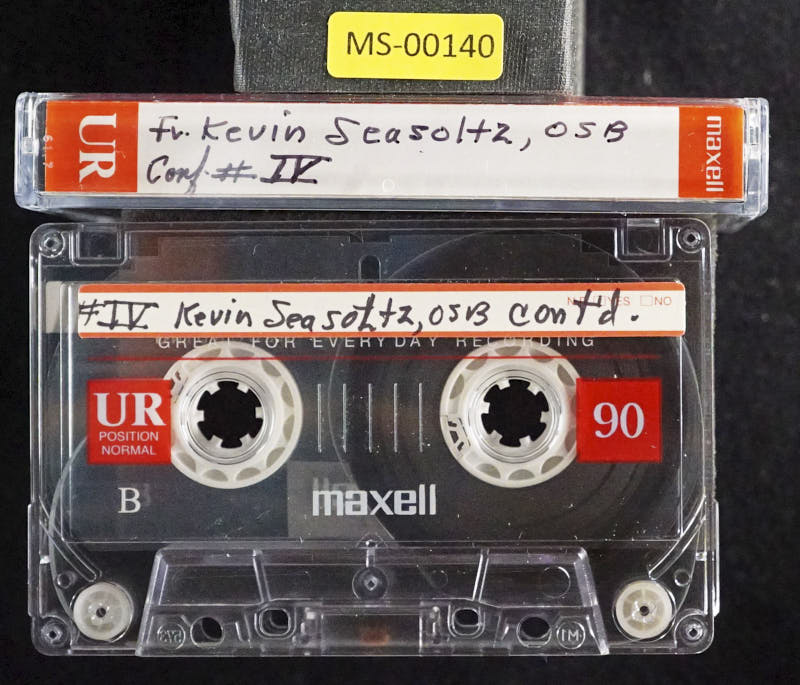

tape1:
Side: A
Speaker: Fr. Kevin Seasoltz, OSB
Possible Title: Conf #IV
Additional text: 7 pm CLASS 0:00 - 0:45, Original SAVE
tape2:
Side: B
Speaker: Fr. Kevin Seasoltz, OSB
Possible Title: Cont\u2019d.
Additional text: 7 pm CLASS 0:45 - 1:00, Original SAVE
@AI-Vision_v003
as a prelude to what I want to share tomorrow morning about Eucharist as sacrifice, and not only about Christ as victim, especially in the Eucharist, but also somewhat about human victimization. We know certainly that many people claim to be victims of sexual abuse by clergy or religious, but I think many people suffer from other kinds of victimization. So I want to shed some light on that whole phenomenon and perhaps help us rethink the understanding that we might pay a price as victim in the Eucharist. You know, in the old days, we used to sing, oh, so the car is possibly a benediction every Sunday, oh, for saving victory. What does that mean? What does that communicate? Well, as you know, there are many stories in the Bible that including stories of blindness and seeing, sickness and health, doubt and faith, vocation and conjunction.
[01:09]
But there are really three what I would call macro stories, each one of which images the religious life of persons and communities. And those three are the Exodus story, the story of exile and return, and the priestly story. Now the first two, the exodus and the exile, are in fact rooted in the historical experience of God's people. But the latter, the priestly story, is rooted above all in the history of the institution, such as temples, sacrifice, and priesthood. But these stories shaped not only the understanding and the imagination of God's people, but also they have shaped the religious lives of countless Christians throughout the age.
[02:18]
And the presence or the absence of these stories in Christian theology and practice over the ages has had, I think, significant implications for our understanding of the role of Jesus Christ in the Eucharist and the role then that the Eucharist plays in Christian sacramental theology and practice. So the question is, with which story do we identify above all? With which story do we identify above all? The story of the exodus, God's deliverance of the Israelite of slavery in Egypt, really tells us that we all live in Egypt, a land of slavery. And it invites us then to ask, to what are we in bondage as persons and also as communities?
[03:20]
And the many answers to that question But perhaps, of all, we're all somewhat in bondage to contemporary cultural forces that tell us what we should be like, what goals we ought to be pursuing. Above all, success, individualism, consumerism, competitiveness. Likewise, I think many of us are in bondage to our own past experiences of guilt That's a shame. Most human beings, I think, are familiar with these forms of slavery, but I think their body is more likely to be psychological and spiritual rather than physical. It's often caused by very subtle forces. Human beings, for example, are often undervalued, unappreciated.
[04:24]
They're often paralyzed by fear, by anxiety. They're often in the grips of some form of addiction. They're often enslaved also by an image of God as a cruel and distant judge, as a father who needs to be pacified. Now certainly, the way out of their bondage must begin with an acknowledgement of their situation and their need for help. As a revelation then of our human condition, and as a story proposing a solution to our predicament, the Exodus narrative images our life then as a journey from bondage to freedom, from slavery to intimacy, not only with God, but also with each other.
[05:26]
And although we are in fact slaves in many ways, the story above all proclaims a way out of our slavery. It proclaims that we are possible both as persons and as communities. It affirms that God can indeed liberate us, that God desires our liberation. and certainly longs for our freedom from bondage in a cultural morass of false values to bring us from that to a light of intimacy with God, with creation, with ourselves, and with each other. Like the account of the Exodus, the story of exile and return is also rooted in historical experience The period of deportation and exile in Babylon certainly became important in the religious development of Judaism and became a significant theological theme in the Bible.
[06:41]
As an image then of our relationship with God, what does the experience of exile say to us? What does it mean? to be in exile. Well, as we all know, we live in a time that countless people do in fact live in exile. Some here have lived in exile. The rest of us must simply imagine what it's like to live in separation from all that is familiar, all that's precious, to live then as marginal people, often without any power, often oppressed, secondary citizens, often victimized in a very subtle way. Well, like the metaphor of slavery in the Exodus account, the metaphor of exile has significant psychological as well as cultural, economic, and political implications.
[07:54]
The experience of exile implies estrangement and alienation. It involves a lost sense of connectedness with meaning, with centeredness. So exile has indeed a profound existential meaning for all of us. It means living far from Zion, far from the place where God is to be found. And so, if exile is our predicament, what's the solution then to our situation? Well, obviously, a journey of return. And like the story of the Exodus, the account of the exile and return does not seek to burden us with shame or with guilt. It rather offers us hope
[08:57]
by encouraging us through a promise of God's loving kindness and mercy. Then, there is the priestly story, which, as I mentioned, is rooted not primarily in history, but rather in the establishment of institutions. And within that story, it isn't who makes us right in the eyes of God by offering sacrifice on our behalf. But this story certainly leads to a quite different metaphor describing our life with God. It's not primarily a story of slavery, exile, and journey. It's rather a story of sin, guilt, sacrifice, and forgiveness.
[10:00]
And in the priestly story, we are imaged not primarily as people in slavery or people yearning to return home. We are imaged rather as sinners who have broken God's laws and who therefore stand guilty before God who is imaged primarily as lawgiver and judge. In that story, there's very little reference to creation as the original blessing, something, by the way, which is much more original than sin. And so viewed through the lens of the story of the priesthood, our own lives then become narratives of sin, guilt. Forgiveness. Then more sin. Guilt. And forgiveness.
[11:04]
Then more sin. Guilt. Forgiveness. And so with which story do you and I identify? All three stories, the Exodus, the Exile, and the Priestley stories, were in fact significant for Jesus. Biblical texts can be found to support all three of them. However, much of subsequent Christian theology has in fact emphasized the story of the priesthood and neglected the stories of exodus and exile. The story of the priesthood has certainly dominated iconographic interpretations of the death and resurrection of Jesus. It's also dominated much of Christian spirituality and many of our Christian liturgical texts.
[12:08]
This is reflected, I think, in the prominence that the confession of sin is played in Christian worship, both Protestant and Catholic. But if the priestly story becomes the only story or the dominant story about Jesus and the Christian life. It can so easily deform and block a positive relationship with God as it has done in our own time for many women, those who live in the underside of contemporary society. It can, in other words, prevent our true selves from ever really surfacing. This all means then that we need a contemporary reinterpretation of the cross and Jesus as victim.
[13:16]
You know, throughout history, the cross of Jesus Christ has often been a stumbling block for people seeking to live a life of religious faith. They kept on difficulty in accepting that at the heart of Christianity lies the cruel death of an innocent victim. In the past few decades, many women and other marginalized people, especially the poor, have rejected the facile assertion that their suffering is either meritorious or in fact deserved. They have asked, why suffering? should be the lot of those who in so many ways are already downtrodden by society and sometimes even by the church. And though Pope John Paul II was very quick to acknowledge the sins of the institutionalized church and the parents, these folks then have questioned the way the cross has been used to denigrate women and minorities
[14:25]
and they've begun to explore the ways in which injustices have been perpetrated, especially through colonialism, in the name of the cross. Not satisfied with the traditional answers that Christian institutions have given in the past and continue, I think, to give in the present, many of these critics have rejected Christianity altogether or concluded that somehow Christianity must be purged of the cross. The Christian theology of redemption has traditionally emphasized the betrayal of Jesus by the authority, has emphasized his innocent suffering and death and the subsequent forgiveness of our sin. The powers that disenfranchised today often find that theology alien and denigrating.
[15:33]
They reject the implicit assertion that by their own suffering, they themselves are like Jesus and are somehow involved in the redemption of the world, that the more they suffer, the more they merit forgiveness for their own sins and the sins of the world. to the cross, with or without the resurrection, has often been interpreted in a facile way of saving humanity from sin, categorized above all as pride. It's been said that redemption involved a transaction whereby Jesus died for us, taking our place in order to pay the price that we owe to God because of our sins. Furthermore, in Christian iconography, the prominence of the suffering Christ on the cross has often encouraged onlookers to believe that the more they suffer, the more they are like Christ.
[16:45]
That view, unfortunately, has certainly been prominent in evangelical and fundamentalist preaching in the past, especially at Revival, the Greek Awakening in this country, it's also found in missions in many of our Catholic parishes, bar a brimstone sermon that certain religious communities were well known for, not Benedictine. Another version, though, of the redemptive events is fortunately now being told. And if Christianity is to be true to its biblical foundations, it simply cannot be purged of the cross. Nevertheless, theologians and preachers and teachers must help people, especially women and minorities, the poor and the downtrodden, find meaning in the suffering that is caused by human choices, both their own choices,
[17:57]
and those made by others. In other words, they need to find a way to liberate people from falsely imposed guilt and to discover how their personal suffering can be either effectively resisted or somehow incorporated positively in their experience of God as the source of human authenticity and hope. you might be tempted to think that these depressed people are found only outside the monks. And if we think that way, I think we're readily confronted with the great mystery of the number of monks who have committed suicide. In my lifetime as a monk,
[18:59]
I could tick off ten. Ten. One of the most tragic ones occurred this past year before we're out of Belmont in England. A man much loved, an extraordinary soul friend to so many people, wonderful confessor, retreat giver, suffered from deep depression, most of his life, in and out of institutions, especially after he resigned his habit. Just a week before he took his own life, he was hospitalized. And in that experience, he said to the present habit, I'm utterly worthless. I've lost my faith. God has abandoned me. God has abandoned me. The only exit for him was suicide.
[20:01]
What's behind all of our moms who suffer from chronic alcoholism? What's behind the experience of so many of our moms who suffer from chronic depression? You know, in isolation, a priestly story can lead to a static or cycling understanding of Christian securiology, whereby we sin, commit our guilt, and our forgiveness, only to repeat the same process of sin, guilt, and forgiveness. It certainly neglects the basic Christian fact that we are loved and accepted now and must embrace that gift of love so as to continue journeying through life.
[21:04]
The priestly story, yet isolation, can so easily blind us to the fact that our Christian lives involve us in a process leading to very gradual and mysterious transformation. I wonder why the sense of helplessness and guilt and shame in many people's lives I think is their understanding of original sin. Adam and Eve were told that they could only receive the gift of life. They were not to snatch it or grab it. Their sin was ultimately the act of robbing taking by force something that can only be possessed when it's gratefully and reverently conceived as gift.
[22:06]
I have insisted, life is always gift. I've come that you might get life and have it to the full. Simply put then, it's another way of looking at original sin. Simply put, their sin was a failure to in receptivity and gratitude, which are the basic notions behind the idea of Eucharist. By turning away from the posture of receptivity to one of seizure, they took by force, as if by right, what was to be theirs only as given. Certainly, that understanding of original sin differs radically a popular understanding of the original sin as pride. And in our own time, those who wield power in our society often perpetuate the original sin by robbing life, by seizing power from the disenfranchised, the marginal, the downtrodden, who end up then certainly with a strongly diminished sense of self, a meager awareness,
[23:22]
of their own dignity and worth, often a feeling of utter helplessness. You know, contemporary feminist theologians asserted that the basic understanding of sin and pride arose from a male-dominated tradition, and that for women at least, pride is not the primary sin, but rather self deprecation is. A sense of worthlessness is not only characteristic of many men, it's also characteristic of many men who live in the underside of history, the poor, the unemployed, the redundant, the manipulated, the racially, religiously, and sexually marginalized in our world. the people who don't seem to fit.
[24:26]
And for all those with a deprecated sense of self-worth, for those who already have a denigrated sense of self, what is needed then is initially not forgiveness. What is really needed is healing. As wounded victims then, contemplating Jesus, as the innocent victim on the cross, they can be helped to discover themselves not primarily as crucifiers of a sinless victim, rather as victims themselves who have been wounded and slain by the mysterious mystery of iniquity that is operative in our world. In that context, then, Jesus, as the crucified victim, becomes an ally.
[25:27]
God the Father, instead of being a parent abuser, God the Father then becomes a grieving parent. The risen Lord becomes the one who offers healing and empowerment with the gift of the Holy Spirit. In this approach then, sin consists not primarily in disobedience to a divine demand or as pride. It consists rather in the inability to appropriate one's true self, whether through one's own fault or through the fault of others. Sin is manifested in the innate conflict then between who we are now at who we are called to be. I think the human problem for so many people today, they simply don't believe in themselves.
[26:37]
Salvation consists in the conviction that one is possible, that one is indeed lovable. This process whereby we come to understand ourselves as traveling on a road to self-destruction, leads eventually to the understanding that we are not simply crucifiers, but somehow we're often those who are crucified. And the more we see the complex ways in which we ourselves or others sabotage our own personal development and responsibility, the more we are able to see that we ourselves are often victims and objects of crucifixion. Sadly, there are many people in the world today who think of themselves simply as non-person.
[27:38]
The Lord's salvation calls them to discover that intrinsic worth their intrinsic dignity as sons and daughters of God, as the bearers of God's own life to the sacraments of Christian initiation. And with that self-understanding, they might discover then something altogether different as they contemplate the cross and the resurrection of the Lord Jesus. Reflecting on their own lives, they can see the extent of evil's power. Reflecting on the cross of Jesus, they can discover themselves not as the crucifiers who brought about Jesus' death, but rather as victims like him who have somehow been slain. Just as Jesus was slain,
[28:47]
not because of his own death wish, or because his angry father had to be placated on account of the sins of the world, so likewise many people are slain by the power of others who somehow think they can define and determine who in fact is a worthy person entitled to live with human dignity. By identifying then with the crucified Jesus, we are called to name our own distinctive forms of victimization. Called to face the wounds that have in fact obstructed our personal responsible development. Presumption that one is not worthy to be in communion with thought is overturned then. but the conviction that one is in fact embraced by God's law, in spite of the mystery of iniquity in oneself, in the world, in others.
[29:59]
I think that is, to some extent, what Christian resurrection is all about. Not something that simply happens in the future. Something that is meant to happen now. As Christians, we espouse an initiated eschatology. It's not all here and now, it's not all in the future, but the beginnings should be here and now. Perfect fulfillment we will find in the future. It's to be hoped then that one will eventually see one's own complicity in the oppression of one's true self as a body person. But above all, I think it's important to relate to the crucified Jesus as one's friend and to be convinced that resurrection is possible, that it involves God's raising my belief in myself, my true self, in face of the powerful contrary messages that come from all my oppressors.
[31:09]
Now, although, as personal sinners, we certainly all need to discover ourselves in the crucified Jesus as crucified. There are certainly many people who need, first of all, to discover themselves among the crucified. You know, traditional interpretations of the cross, I think, have emphasized our role as crucifiers Preachers in the cathedral in the twin city this past Lent told the people from the pulpit, every time you sin, you put another nail in the body of Jesus Christ. Get in the box. What do you think? Get in the box and admit your guilt. our strong voices today, coming from the powerless people, especially in the third world, people who are powerless, who live in the underside of cultural, political, economic, and relational power, who assert they themselves are, in fact, being crucified.
[32:39]
Resurrection certainly conveys forgiveness. The experience of resurrection as an empowerment needs to become a significant transformative force, I think, for many people in today's world. In the Eucharist, it brings us into communion with the crucified and visited Lord Jesus. We find in the Constitution of the Sacrificity there is low of divine presence in the literature. It not only speaks of the presence of Jesus, but of the presence of Christ. It is the risen Christ whom we celebrate, the one who has triumphed over sin and death and evil. As you know, the number of biblical scholars regularly distinguish between the historical Jesus and the risen Lord Jesus Christ.
[33:43]
It's precisely the risen Lord Jesus Christ who is present to us in the Eucharist. The Lord invites us there and empowers us to participate in the death and resurrection of the crucified but risen Lord. We have to note the Lord Jesus is not now dying in his humanity. He has died once and for all. However, through the power of the Holy Spirit, we are meant to die to our own self-preoccupation, our own self-centeredness. The Lord Jesus is not now rising from the dead. He has, in fact, truly risen. However, through the power of the Spirit, We are meant to rise from the dead.
[34:46]
The deadliness of our own sinfulness, our own inclination to evil. As the acclamation after the text of institution in the Eucharistic prayer affirms, Christ has died. Christ is risen. Christ will come again. The Lamb of God comes to us in Eucharistic communion. is the lamb once slayed, but now truly grew. The Lord Jesus is the one who was once a victim, but is victimized no longer. Certainly, our world and all of us in it are transformed by being brought into a closer relationship with God in Jesus Christ through the power of the Holy Spirit.
[35:49]
Because it is in union with God that all the pain and sorrows of life, including human victimization and oppression, are remedied and healed. The gift of God's life is often been reviewed by human beings who opt to separate themselves from God by refusing God's gifts, and who in turn refused to strip those gifts with others. But in our effort for self-realization, I think it's important to remember that we human beings do not decrease as human persons in order that God might increase. What I'm saying here is that God's identity does not exist at the expense of human being. The more the human person is endowed with God's gifts, the more that person should simply respond with gratitude for the generosity of the divine gift giver.
[37:07]
So in the gift of the Eucharist, we are meant to find ourselves in the story of Jesus' death and resurrection. Somehow then to see that his story continues in our own lives. We are meant to move from simply identifying with Jesus to an embrace of the interior dispositions of this experience to the power of the very Spirit of God. And to some participation We are not simply victims of evil, but rather we become co-victors over evil in ourselves and in our world. Just as Jesus' wounds were healed through resurrection, so also our wounds may be healed through the spirit. First of all, I think we have to come to grips with the role of
[38:13]
in our own lives. Choosing to be a disciple of Jesus involves accepting suffering. Above all, it means choosing to love. Choosing to forgive others. Choosing to let go every day. Jesus himself chose love and self-giving rather than revenge. This great revelation, as I've mentioned before, is that our God lives always for healing. Never hoping back. Never hoping back. Jesus suffered only as an indirect consequence of choosing to be his true self. Choosing to fulfill this mission of bringing God's love God's light to the world.
[39:17]
Suffering and ransom then were not his real objects of choice. He accepted suffering. He didn't choose it. And likewise, our sharing in the life, death, and resurrection of Jesus may undoubtedly often result in suffering. But what we choose above all is to be in communion with the risen Lord Jesus, with the power of the Holy Spirit. Pain, sorrow, grief, they're certainly intertwined with our share in God's love for a broken and twisted world. But we, like Jesus, are called to choose forgiveness rather than we've been. To choose love rather than faith. To accept suffering and death, but only as port of entries. Port of entries. the new life, never just ends in themselves. That understanding of God, then, I think makes God somewhat other than a child abuser.
[40:28]
God did not choose the death of his son as a solution to the problem of evil in the world. Rather, God chose to make us as people free. And in creating us free with the freedom that we are given, God permitted evil. Consequently, our human freedom must always remain intact. Evil is redressed through love rather than through the destruction of human freedom. What God desired from His Son was not retribution. What God desired from his son was the love which the Father loved him. So likewise, what God desired from us is a life of love and communion. Communion with God and with each other.
[41:38]
Our Christian initiation then really launches us on a journey where the exodus and the exile story are so key for us. And it's a journey that lasts all night long. The Eucharistic bread and the saving cup, their nourishment for our way as we make our own exodus and pass over from bondage to freedom. And as we return from exile to our true home, not only with the Father in Christ and the Holy Spirit, but also with each other. We don't have it together, or we don't go at all. I think we in the West, as you have heard me say before, have certainly neglected the role of the Holy Spirit, and also the role of the Spirit in the U.S. Fortunately, with the Vatican II reforms, we have finally retrieved the apotheosis in the Eucharistic prayer, a prayer in which we call upon the Spirit to transform, not only the bread and the wine, but to transform us into the body and blood of Christ.
[43:02]
I touched on this briefly this morning, but I want to elaborate this with it. Writing of the gift of the Spirit, Callistus Ware has highlighted three points that I think are especially striking. First of all, when we celebrate the Eucharist, the Spirit is given to everyone. In other words, the Spirit is given to all who open their minds and their hearts to the present, the transforming power of God. I think this is vitally important today that our church seeks effective ways to appropriate the many gifts of lay people in ministry and service, especially, as I mentioned this morning, the gifts of women. In other words, all of us are members of the body of Christ.
[44:04]
All of us are spirit-bearing. Secondly, But this is where it says the gift of the Spirit is a gift of unity. The gift of the Spirit mysteriously makes the many to be one. In other words, that gift reverses the human condition developed at the Tower of Babel. The Spirit transforms us isolated individuals, into persons who are in fact capable of meaningfully relating to one another. Spirit brings unity and mutual comprehension to go back to one of his methodology. The understanding. We can understand one another. Mutual comprehension.
[45:07]
Mutual understanding. Empowering people then somehow to struggle for consensus. That's what we work for in our community. And then somehow to be able to speak with one voice. To be obedient in that sense. And thirdly, and perhaps most importantly, the gift of the Spirit is the gift of diversity. That means that the Holy Spirit not only makes it one, the Spirit makes us all different. And that's all right. At Pentecost, the various human languages were not abolished. The different human languages ceased to be causes of division. Each one continued to speak in his or her own tongue.
[46:11]
To find the power of the spirit, each could understand and accept the other. So just as there are different members in the human body, so there are different gifts among the members of the body of God. To be then a spirit manifest itself in an inexhaustible sort of variety. And yet, I think at a time when heterogeneity is often considered unorthodox in our church, I think it's important to emphasize the greatness of God's Spirit are not revealed in the sameness of people, but rather in their marvelous diversity. Well, then, to reflect
[47:14]
not only on the presence and power of the Lord Jesus in the Eucharist, but also on the presence and power of God's Holy Spirit in our human heart, in our monastic kingdom. I do well to rejoice in Gerard Manning Hopkins' wonderful words. The Holy Spirit, the Holy Ghost, over the bent world brooms. with warm breasts at all, rightly. Copy. Can you write down those three points? They kind of reversed there for a second, and it was kind of a mistake. Calista's where? Calista's where's three points? At the end? Yeah, the point's there.
[48:17]
Yeah. I'll do that. I'll bring it back to you tomorrow. Is that all right? Yes, ma'am. All right. Okay. Makes sense to you. What is the superiority? 100% agree. The difference is in the human, you're a little bit harder to take. Yes, true, it's true. And so we talked about this earlier, the whole problem that why do we tend to marginalize the prophetic people in our community? Why do we marginalize? And what is so tragic, I think, is often then they find their identity outside of the kingdom.
[49:28]
Something that troubles me. I remember Jerome Tyson, the evidence that John before he came, he used to ask the question, how many marginalized people can he take around? We have a very large community, great diversity, different skills, and so forth. For a third Wednesday, we're going along with the prophetic people. Many people were threatened by that because we become so comfortable in our own messiness. I'm just kind of mulling over, and I don't know how to articulate it. being comfortable with ourselves. I keep going back to that where we say... Do you remember... Does it help you a little bit? Like you were saying, we can accept that that's the present we've got on the table, but in our own lives... Remember that diagram?
[50:39]
Yeah. We get in the rut. We get in the rut. And the rut is the shallow grave. And it's so easy. I mean, I can just look at my own experience a bit in my life, where I've gotten into that rut. And I acknowledge I can't get out of that rut unless I look to my Lord. Or somebody else who mediates that challenge into your life. And, you know, that's one of the beauties I like about community life, that I'm discerning wanting to live in community is... Community has that aspect of bringing me out of that. They're helping me. And yet today there's this terrific challenge that many people watch spirituality, but they certainly don't want organized religion or community. We're taught to do it alone. I'll do it my way. And so what you have, you've got people split from one 12-step program to another 12, and I'll get that taken care of, and then I'll get this taken care of.
[51:42]
Well, you know, sometimes I experience it when the community gets into the rut. You know, where there's a stagnation that occurs. You know, when you're trying to work out your own, that's also weird to hear that. Yeah, that's what visitations are supposed to take care of. It doesn't always work. No, it doesn't always work. I was thinking, if you're talking about that, diminished pneumatology of how we can't be so word-centered. And it seems like often we lack the preference to live from that spirit, that road where it will. You know, like the structure, like the comfort, the certainty. We need structure. Yeah. But the question I always have to ask myself, does it allow the spirit to live? The structure simply keeps us in. Right. Or do they stretch us?
[52:44]
And it's true, you know, if all they do is keep me in, I kind of get smothered. But if all they do is stretch me, I get spaced out. But St. John, what could you say that means so much toward being word, structures, and vision? Well, I may have mentioned this the other day, but I just find Vassal scribing is extremely helpful in this regard, or in the chapter that's just generally. And somehow we lost that. We lost that in the West. At least an explicit statement. Because we're so logical. Because we're so logical. Probably so. And have difficulty living with mystery. Anything else?
[53:33]
@Transcribed_UNK
@Text_v005
@Score_91.63