You are currently logged-out. You can log-in or create an account to save favorites and more. more info
Pursuit of Spiritual Discipline
AI Suggested Keywords:
Ascesis
This talk explores the historical development of monasticism and its distinction from ascetic practices, emphasizing that monasticism is characterized by the concept of "fuga saeculi," or flight from the world, whereas ascesis involves systematic spiritual and bodily discipline. The discussion highlights different ascetic practices, such as fasting, vigils, and continence, and their purpose in achieving spiritual growth, transcendence, and purity. The relation between ascesis and monasticism, including potential pitfalls of elitism and pride, is examined, concluding with the importance of discretion and balance in Christian asceticism.
- Ascesis: Considered as a systematic discipline involving spiritual and bodily training, distinguished from monasticism's world-renouncing character.
- Monasticism: Defined by the "fuga saeculi" tradition, emphasizing withdrawal from worldly life.
- Historical Christianity: References to early Christian ascetical life, particularly around St. Scholastica, highlighting service and prayer without complete world withdrawal.
- Philosophical Concepts: Discusses the terms such as discretion ("discretio") as essential to a balanced ascetical life, aligning with philosophical prudence and "Sophrosyne."
- Comparative Religious Practices: Mentions of ascetical practices in non-Christian traditions, such as yoga in Hinduism and meditation as a means of transcendence.
- Contemporary Issues: Engages with modern experiences of transcendence, especially through drug use, contrasting mechanical, artificial states with authentic ascetic efforts.
AI Suggested Title: "Ascetic Wisdom: Balance Beyond Retreat"

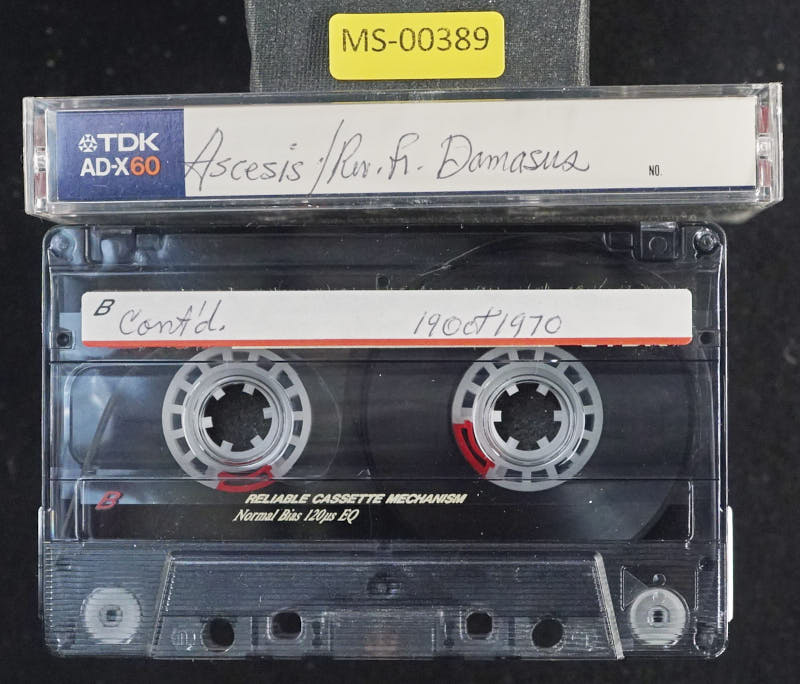
Side: A
Speaker: Rev. Fr. Damasus
Possible Title: Ascesis
Additional text:
Side: B
Speaker: Rev. Fr. Damasus
Possible Title: Contd.
Additional text: Conference given
@AI-Vision_v003
some things, you know, still on paper, on the tape, you know, concerning things that were always very close to my mind and heart. And one is, and we might do that today, just some ideas about the historical development, you know, of the monastery. Let's say in the context, you know, of the ascetical, you know, life of the church. And, you see, usually one speaks about monasticism. I think we have spoken about that before. One starts with the desert, you know, but to my mind that isn't, you know, really white. I think in the deserts, that monasticism that started in the desert, we are not living it these days.
[01:08]
And I don't know any Benedictine monastery that lives it. What we live is what in the early Christianity one would have called the ascetical life, you know. Is that the right word, ascetical? Ascesis, you know. Ascetical life. you see, of the Ascids, you know, who would live at home or who would live in little groups and around the cathedral of St. Scholastica, you see, was one of these ascetic virgins, you know, living close to the church and then doing it as services and being there for prayer and being there before the other Christians came. things like that, but otherwise not that kind of fuga seculli, flight from the world, that monasticism really represents.
[02:17]
I mean, monasticism, you know, to distinguish it from asceticism, that's the reason why Egypt plays such a role, you know, history is this idea of the flight from the world, you know. And of course what we are doing is in that way not flight of the world in the sense, you know, of the old monks in Egypt. So we go back to the ascets, you know. But I would say that the ascetical life, you know, at the same time had a great influence on the monastic idea. The monastic idea is really rooted in the idea of the ascetical life. Now, if we try to speak and see what is and what would you say is ascetical life, asces,
[03:29]
What does the word mean? I mean, this is the root of our present life, what we are trying to do. There's this ascesis, the ascetical life. What would you say? What is the... All the self has been to enable us to open ourselves up together. All right. Ascesis is discipline. That's a good way of putting it, you know. Because asces has always the connotation or the meaning of, how would we call it, this kind of discipline. Training is right, training. You see, it's training. In other words, it's a kind of a systematic thing, you know, see. And it is something which is different from the Let us say what we call the everyday life.
[04:33]
Renunciation is there, but maybe we come to that element of renunciation later, you see. Let us just stay a little bit with this idea of training. And training always has the idea of being systematic, isn't it, in some way? It's the system. Now, if you look at the meaning, you see, or the purpose of this training, this kind of, let's say, spiritual training, but of course you realize that ascesis is not merely spiritual training. The body is always involved, you see. always involved. We are really in that way, we are, I mean, our spiritual life to a great extent is influenced by the body, you see, so that ascesis.
[05:42]
But on the other hand, it's very important to realize that ascesis is by no means, at least not in Christianity, only a bodily thing, you see. I say that only because if you come to, if you go outside of Christianity, you see, then of course there the accent takes Zen, you know, or take the, what is the Indian word? In Hinduism, what is the word? Yoga, that's it, yoga, you see. The yoga is, of course, strongly, is a system of bodily exercises, you know. Not exactly standing on your head, you know, but I mean it comes close to that at times. Now, these are, you see, these are bodily things. For example, in that way, what would be one element that you find in all asceticism?
[06:48]
Fasting. Right, you see, it's fasting. It's one of the elementary things. But outside of fasting, just do you know any other? Vigils, right? You see, the we, how would you call it, the we of sleep, I am reducing of sleep, you know, vigils. Then what else? On the bodily thing, yes. Now, one thing, it's very basic, you know, in this whole business, everywhere is what? Now, you say, for example, bodily pleasure, you see, and so on, all this kind of thing.
[07:53]
What is one of the most radical, let us say, bodily pleasures? marriage, sex, you see. So therefore, this is an element, you know, continence is a basic element, you know, of all ascetical things, not limited to the monastic idea. But then there are others still. Now, I would just, you know, inflicting our wounds you know, self-inflicting, flagellation, you see, is, for example. I mention that because it's so widespread, you know, so, I mean, so, also in the pre-Christian thing, but then in the Christian thing too, flagellation. Another important element, which comes much closer to the spiritual side,
[08:57]
If, for example... Yeah, that comes to the spirit. But what I have in mind is something that still is in the bodily sphere too. But what is the... Where do the spirit and the matter meet most in human life? Your language, speaking, you know. Silence, you know, is an ascetical thing. If you take all these things together, then you realize, you know, that ascetic is always something, as you just indicated, a renouncement, renouncing, because at least, you know, in the things that we, it's not doing something, you see, for now comes For the purpose of what, you know?
[10:01]
What are the purposes? Yeah, what would you say? Yeah, spiritual growth, all right, yes. All right, let's put that down, spiritual growth. But what else? If you say spiritual growth, that's, I would say, is in that way, as you mean it, is typically Christian. But then if you go, huh? Transcendence, getting beyond oneself. Now, there are various ways of getting beyond oneself. And what is a very universal, not for us, but I mean in the sense of comparative religion, religious condition of that. Meditation, yeah, that we would Remember, he would put that under concentration, see?
[11:01]
Concentration, meditation. And that is, of course, one you could right away say, on the spiritual, mental side, you know, concentration is one of the essential things, you know, of meditation. But by meditation, one must be, again, be kind of, you know, contemplation might be better first. And, but that is on the purely mental side, that's why, you know. But still in moving still along a little in the bodily sphere and then in the, where body and mind meet, you know, in that sphere. What would you say is the purpose of it? One thing is that spiritual growth, all right, you know. But then, what else? Cult. Let's say cult. Definitely cult.
[12:03]
Cult is one of the things. For example, if, now what can one take? Take the dervishes or so on. There is dancing and there is the whole excitement. inflicting or wounds, you know, let the blood flow, you know, all this kind of thing for what purpose, you know, to get into ecstasy is right, just the word we need, ecstasy, you see, ecstasy. And that's, of course, that's one thing, you see, which what is ecstasy? Getting out of yourself. Right. So in some way you have to lose to a certain degree. You have to lose your self.
[13:05]
But in what way? Hmm? Yeah, yeah, yeah. Yes. But that is still, I mean, we are now also moving in the... realm, you know, of, again, of the religious, the general religious condition of man. Yeah, mysticism, right, yes, why not? But I would call it dervishes, you know, in Mohammedanism, in Islam, it's mysticism. But what is, in this specific ecstasy, what is necessary? the losing of the conscious self, you know, of self. Let us say, not only, you see there are various degrees, one degree is self-consciousness, what we call self-consciousness.
[14:08]
Now this self-consciousness in the emphatic way, you know, that is of course the greatest barrier to any kind of... in some way of ascuses or any kind of opening oneself. What makes it most difficult to open oneself, say, to God, to the supernatural, is self-consciousness. Or to man. Or to man, not just God. With man and man. With man, the same. In communication with man, self-consciousness is the greatest. the greatest barrier, you see, to even, let us say, come to the other or to listen to the other, you know. But then, of course, there is consciousness in general, which is more the general feeling of being alive or something, you see.
[15:11]
And there, of course, we go beyond consciousness to the let us say, losing consciousness, the unconscious in that way. But unconscious, losing one's consciousness, and very often ascetical, also in the pagan realm, ascetical training and exercises, for example, among the American Indians, you know, goes deliberately to the point of making the one who is in this process of asces, make him lose consciousness. For example, inflict wounds or clubbing to the point of losing consciousness. For what purpose? In order that in this way, emptiness is brought about in a subject. And the more empty is, the better and the more power does the supernatural have, you see?
[16:18]
And the more is the, the greater is the, I'm going to say, expectation or probability to be filled with the divine somehow, you see? Of course, in this thing we are already in the realm also of magic, you see, of the magical. Now, let us still see a little about purposes of ascesis, losing the unconscious, losing the consciousness to the point, you know, of being completely empty, you see, for the... Now, would you have any other ideas about the purpose of ascesis and where it occurs and what What context occurs? And what are the concepts, you know, that help? Would it be fair to say that it only has relation to either the divine or the mysterious, rather than it's not just a program of humanistic discipline, just for the sake of being.
[17:25]
Ah, now? It's got a relation to the divine or the other world. Yes, yes. Now, but in, you know, in the broader sense, of course, Askesis, for example, an athlete, you know, and what an athlete does is, at least, for example, in Greek is certainly called askesis, you know. If an athlete, you know, let us say, trains, you know, runs, or fasting, or systematic, let us say, training of muscles, you know, is askesis. So it could be done For example, in the whole field of sports, you know, that's ascesis. Of course, it is true. This is, and therefore, one can say that ascesis is done very often for, let us say, purely humanistic purposes, see? But still, if I may just add one thing, for what is the purpose of also this kind of ascesis?
[18:36]
Right, yeah. Ideal, is it really an ideal, you know, in sports, for example? Yeah, it may be an ideal. I would like a different word, you know, in this context. Do you have it? plays best when he's not concentrating trying to do it the spirit plays through him and also the athlete often times he is the best athlete when he isn't trying but the spirit moves through him and if he brings up the spiritual thought makes it alive so that he no longer wills it in his own consciousness but allows the spirit to well up of its own so that he breaks his own will
[19:37]
Yeah. There is a new spontaneity which comes up, and a higher spontaneity. But you see, all this falls under the general category. I'd like so much to get the word from you. Also this, you know, where, for example, you can do things better, as you said, the musician, if he loses all self, this kind of self-consciousness, you know. He's completely surrendered, you know, and given to the thing he's doing, you know. And then he does it, as you said, he does it better. For heaven's sake, there you have the word I want. Is he doing it? No, I mean, I don't care. I mean, he certainly is doing it. He is doing it. He is still the Argent, you see. But I would say yes, to a certain degree, he is not the, let us say, the self-conscious agent, you know, maybe in some way then he is more an instrument, you know.
[20:45]
Yeah, yeah, right, right, I know. But let us see also this, if you, for example, if you can say of yourself, it is not I, but Christ is the one who does it through me, what does that mean in the line of Are you better off? Are you worse off, you know? Why do you want to do it in this way? So let Christ take over. Or let the inspiration take over. For what purpose? What is the goal of it? I would say perfection. And if you take that as a general category that Askes is has to do with perfection, you see? You take that, then you have a whole field, you know, for example, the one who tries, who is a, tries to jump, you know, and then who gets over the highest, you know, thing and so on.
[21:49]
Now, that's the perfection, you see? There is therefore involved in this phases, various phases of perfection. Askesis is a development. and the developing of inner or of spiritual potentialities. But still that is not all. It's not every, we have still other purposes for which ascetical life is done. Would you have still another idea? We came close to it already before when we spoke about, you know, it's not humanistic, but it's religious or something like that. divinity is involved, and we spoke about cult. As soon as we speak about cult and ask us, what cults, what category appears on the scene? Why is somebody, a priest, let us say, continent, especially before he performs a sacred action?
[22:55]
Purity there, you see? the whole field of purity, ritual purity, you see? You see, that's another important thing for askesis. Now we have already various fields, we have, you know? Don't be, I mean, for askesis, we have the thing of perfection, we have the thing of purity. We have the thing of, what did we say before, renouncement, you know, renouncement, emptying oneself, you know, you brought it up, you know, this empty, to be empty of oneself in order to let the divine take over, you know, in this whole field of ecstasy. Do you think that is about it or not?
[24:03]
I don't know. Yes? Could you answer the question? Yes. To what extent would you relate asceticism to the practice of Gnosticism? Isn't there a similarity between the spirituality and the ascetic and the sense of greater insight and even the sense of elitism? is associating with the ascetic. In other words, the ascetic reaches or believes that he reaches perfection. And therefore, because he feels more perfect than others, he is caught in his own prime. Yes. No, yes. I mean, with the whole perfection, the elite concept is in it, you know. It's very good to bring that out. And with that, of course, immediately the other thing comes in it, too, that one is proud of one's achievement, you see. In that way, what appears there, the danger of the arrows, what we call arrows, you know. That's why I wanted to bring this concept of perfection in, you know, that we get also this thing.
[25:09]
There is the drive, you know, in asceticism. But there is also the element, what you pointed out, of play, you know. For example, dance, and then this kind of self-affliction. and dance, of course, all these things also go into the field of getting drunk, so to speak, you know, see? And that's, of course, this being alienated from yourself and being taken over by an overpowering element, you know, that's drunkenness. Therefore, for example, on a similar line, we have another exercise, ascetic exercise, widespread, which is? Drugs. Yeah, that's a good question, you see, because that comes in here too. To what extent are drugs really ascetic?
[26:16]
That's an interesting point, you know. I don't know. I would leave it as a question, yeah? Now, we are not concerned with hedonism because asceticism is hedonism, too. Oh, hedonism. Oh, I see. Hedonism. Yeah, yes. Now, I would say that drugs, of course, today are used, you know, for the purpose of a certain heightening, we would say in general, heightening of one's sensitivity. You see? I mean, that's one of the... Then, of course, maybe drugs are also used, you know, in order to remove certain barriers, you know, psychological barriers. There we always come back to that old self-consciousness, you know.
[27:19]
If you drink, if in antiquity one says, in vino veritas, you know, in the wine there is truth. Now that comes pretty close to drugs, you know, and in some way maybe wine is a drug, you know, any alcohol, you know. What if we try to define this kind of element, you know? I think we all have the feeling that this is not why, as you said, you said it's hedonism. It is not. It may be, yes, it may be. But I mean, what would be the difference, you know, and I think we should work that out, between this, using drugs, and also if it's drinking beer, you know, whatever it is, you know, doesn't matter, or wine, but what is the difference there between asces and this thing? I would say. Personally, I would say this taking of drugs and so on is not asceticism, I would say.
[28:30]
But for what purpose? What's different? You're using state by using something external for yourself. Yes. I think one could say either artificially or mechanically, isn't it? I mean, this is mechanical. It doesn't take you any kind, let us say, of deliberate, you know, how would you say, effort, you know, and any kind of especially systematic effort. Even what you want to do by using drugs is to get what other people get through training just in a second, you see. Drugs are very often... today and the popularity of drugs is because people, first of all, don't want to wait, you see. On the other hand, they don't want to make the effort, you know, and especially they don't want to get into any kind of a method, a methodical doing of things.
[29:36]
I think that's what's so dangerous with the young people today, you know. For example, the individual may feel that he has encountered God while under some sort of drug, yet afterwards he is as much of a spiritual barbarian as he was before. Yes, sure, yeah. It's very true. Even it may do constant, I mean, lasting damage, you see. Why? Because it is mechanic and because it works through Nerves, you know, nerves is something. I mean, bodily, this is not only spiritual in any way, you know. Then, of course, we have the whole field of imagination there, you know. Very often the drugs help you to, let us say, to lose the sense of your limitations, you see.
[30:42]
And you do things that you otherwise would not do. But what is this kind of transcendence? One thing is that it is only, as you said, it's a passing thing. Now, it might be possible, as we had this famous, who was it here, this Baba Ramdas, you see, to him or he, but we don't know how his life history will end, you know, he's not yet at the end. He just started out. But he used it, you know, as he said himself, you know, to get out of the skepticism, you know, of the, let's say, the intellectual Harvard skepticism, you see, this negative. How could we call it? It's more than sobriety. It's, no, let's call it skepticism.
[31:45]
If somebody has a better word, that would be all right, but I don't know. Intellectual skepticism, you see, I mean this, oh, whatever it is, logical positivism, you see, however you may call it, let us say a general critical attitude, you see. I mean today one considers it as one important element of scientific procedure is doubt and is questioning things and is in that way, what was the word you had just there? Positivism, you see, logical positivism, that means, now we don't want to go into that, that's not necessary, you see, but take, for example, Descartes, you know, said, you see, this... to reach the truth, you know, I mean, the only thing that is really brings to you is universal doubt, you see, universal doubt.
[32:48]
That means don't take anything for granted, you see. And then, of course, if you come to this don't take anything for granted, what is then, you know, say, the psychological effect on you who does this thing? He doesn't believe anything. He doesn't take anything for granted, you know. He will therefore always say, oh, we have a phrase, you know, that we always remember in this thing. And you must remember that too because it's prevalent, for example, also in biblical criticism, you see, or exegesis, you know. It's in every field today. You know, when you ask about and declare or explain a phenomenon, for example, the phenomenon of love, you know, see, and the phenomenon of love brings with it great, you see, feelings, great elation, you see, or it brings with it a very clear value experience, you know.
[33:58]
value experience, maybe aesthetical experience, you know. And then you say, for example, oh, I love you, you know, I mean forever, you know, and so on. You see, there come always these categories in there. And then what is the attitude of the skeptic and of the scientist today, the general thing to say it is Nothing but, you see. We always call that the nothing but attitude, you know. That means bring everything as far as explanation goes first on the lowest level, on the lowest denominator. To my mind, in some way, Freud, you know, tries to do that, although I'm not clear, you know, I mean, Freud changed in his thing. by saying love, you know.
[35:00]
And what makes man tick is nothing but libido, you know, whatever that means. That means maybe an urge, an urge. Of course, now, we don't go into that, but you understand what I mean. Ram, what was his name? Baba Ram Dass, you know, said he took the LSD, is it LSD, in order to get out of this terrific, I mean, skeptical, negative, negativism, one would call it, you know, of Harvard, the Harvard intellectual, let's say, general trend, you know, let's put it that way. to get therefore and to get out of this uh... this process of disintegration that sets in by over intellectualizing everything and get into the spontaneity into the world of let's say of the dream you know into the world and also say of the ideal you know experience that
[36:24]
There is something in man which is beyond matter and which is what we call the spiritual. You see? It's really an attempt, a shortcut, you know, but in many ways also prove to yourself and to others that there is something beyond matter. And let's call it the spirit, you know, so the spiritual experience. So that is, of course, but our question was, you know, what about asceticism? And we said, in the case of this Baba Ram Dass, if he takes the LSD, he takes it as a kick, you know, that kind of would push him over the frontier, you know, from the self-conscious, you know, or materialistic snob, snobbism, into something that he would consider would have what they call today a real meaning, into the sphere of meaning.
[37:37]
Now, in that way, one could say in this case, you know, I would say that the drug is used as a means to get you out of this novism, but then to begin asceticism. For example, in the case of Baba Ramdas or all these Hindus, what is an important element then of the spiritual, let us say, to keep this You see, in the case of Baba Ramdas, the purpose of it was not to live all the time simply in a dream world, you know. You know what I mean. It's not the, let us say, the drunkenness was not an end in itself, as it may be for many people, you see, who used the drugs in order to replace their
[38:43]
the sadness and the pain of their everyday milieu, let's just say, the slumps or whatever it is, by something that would just take them out of it, you know, which would in that way be escapism. But escapism is not asceticism, you see. I think we should keep that in mind. but here it might be used as an instrument still I would say what is for example let us just spin this out a little in asceticism and certainly when you come into the Christian realm what do you see immediately as one of the very important basic elements of all let us say Christian asceticism Yeah, I would say balance.
[39:46]
But maybe by discipline you mean balance, keeping the balance. Yes, yes. I agree, you see. It's therefore escaping the effort. You see, in that way, the deceptive thing, you see, the effort thing. But what is beneath that, you see, still? You see, I mean, or underlying this. Why is, for example, in Christian asceticism, certainly, the effort, you know, is a continuous one. But what is the, what is underlying this thing? Can we get at that? You know, what I'm thinking about, you know, is this, that, of course, a Christian asceticism, as, you know, when we... Now, I would say the key word in this whole realm is discretio, you know?
[41:00]
Discretion, you know, discretio. What is discretion? What is discretion? How is one discreet or what is the opposite to being? Rash, yes. Rashness is, of course, a lack of balance, you know. Extremism. Rash, you see. But with this element of, as far as I understand, the rash of impetuosity, And asceticism has nothing to do with impetuosity, you see. But still, you know, I was looking for another, for another, yeah, this creates you, you see. This creates you is the, the realization of what can we say, of one's limitations, you see. Remain in the,
[42:04]
realm of one's limitations. Not overdoing it, you see, I would say. The opposite to discretion is what we call overdoing it. And the overdoing can be done, of course, in the realm of the spiritual world as well as in the world of the bodily, in both. You can overdo it. For example, drinking, to the point of unconsciousness is overdoing it, you see. Underlying here is a, for the Western world, an absolute basic for our entire civilization, absolute basic concept. The Greeks called it Sophosyne. Sophosyne. Now, how would we How would we translate sophosone?
[43:07]
We very often we call it prudence, you know, but prudence is not quite sophosone because, so you see, prudence is something that I do for to get a certain purpose, you see, I mean, and not to harm to myself. Sophosone is much more a concept of In German we say we have a beautiful word for sophrosine. It's besinnlichkeit. I look up these English-German dictionaries and the decisive things are not on the English side. Besinnlichkeit is, you know, besinnung is of course the same as Überlegen, you know, to überlegen. That means, here, do this, you know. That's what we sometimes do, you know.
[44:07]
One leg over the other, crossing our legs, you know. Do that in the spiritual sense, you know. And think it over, you know. Thinking it over. So for Sunne is a process of interiorization. see, and an interiorization which assures superiority, you see, but superiority over the means, you see, to be used, you see. And therefore, for example, sophosynes always connected the idea of, how do we call that in German, you say, sparsabkeit. What is it in English? For example, if you have the Quakers do that in their whole culture, let us say, is based on never too much, you see. But rather a little too little, you see.
[45:12]
For example, if Saint Benedict says never eat to the point of satiety, you see. How do we call that? I think if, of course, Benjamin Franklin was one of the masters of what we call frugality, you see. And that is one of the elements. Schluss. Too late.
[45:34]
@Transcribed_UNK
@Text_v005
@Score_90.04