You are currently logged-out. You can log-in or create an account to save favorites and more. more info
Practical Foundations of Pachomian Monasticism
Talks at Mt. Saviour
The talk focuses on the legislative texts attributed to Pachomius, exploring the structure and content of his "Rule," particularly the various sections of precepts. The discussion highlights the lack of direct scriptural quotes within Pachomius' rules, contrasting his monastic framework with that of St. Benedict, emphasizing material and practical organization over spirituality in monastic life. The text divides Pachomius' precepts into groups and demonstrates connections between them, suggesting they originated from different periods. It also detailed the process of candidate integration into monastic life, expectations of learning and behavior, and the roles within the monastic community.
Referenced Works:
- "The Rule of St. Pachomius"
-
A foundational monastic text discussed for its structure and practicality over spiritual instruction, highlighting its legislative format without direct biblical quotations.
-
"The Rule of St. Benedict"
-
Mentioned as a comparison point, highlighting its focus on spirituality and detailed organization of monastic life, compared to the pragmatic approach of Pachomius.
-
First Epistle of Peter
-
Referenced as the source of the only direct biblical quotation found in Pachomius' precepts.
-
"Regulation from Arciages"
-
Coptic text providing a parallel description of monastic practices, used to emphasize similarities and variances in monastic routines.
-
St. Augustine's Writings
-
Briefly referenced in relation to translating terms used within the monastic context, highlighting Latin usage at the time.
-
Writings of Cassian
- Cited for contributions to the evolving structure of monastic practices and theological incorporation within monastic activities.
These references provide a rich context for understanding monastic life evolution and how these foundational texts influenced various religious practices.
AI Suggested Title: Practical Foundations of Pachomian Monasticism
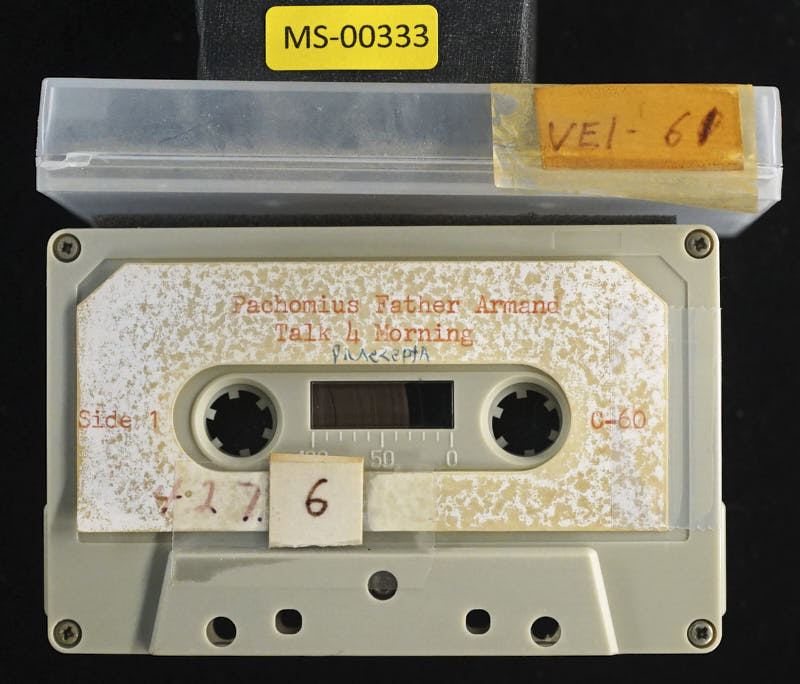
Side: 1
Speaker: Fr. Armand Veilleux
Possible Title: Pachomius Father Armand Talk 1, Morning
Additional text: VEI - 601, Naceppa
@AI-Vision_v003
This morning, we move to another type of text, the rule, which I think is not so dry as it seems to be at the beginning, but certainly different. Just to remind you of what I said the first day, because when I got to that part of the rule, it was at the end of the hour, so I had to go very far. The text that we have legislative text that we have from Phacomius. There is this series of text translated by Jerome, which are called The Rule of Phacomius, divided in four parts. The Precepta, the Precepta et Instituta, the Precepta Acleges, and the Precepta Aclegesia. So that means precept, precept and institution, precept and law, precept and judgment.
[01:07]
Of course, this precepta is the longest one, the longest one, and the most important. Precepta et instituta, there is 18 numbers. And the 18th one is important because it's a very different style from the others. And it gives direction to directives to the superior of the heart. And it's very similar in many ways to the list of good works in the Royal Saint Benedict. And then we find in that most of the already time in the precepta. It's quite shorter. And the precepta at Judicia is interesting because it's a kind of penitential.
[02:12]
So we will study especially the precepta, which is the longest part. And according to me, the one that includes the oldest precept. Although some people, like Ms. Venmoor, think that trichotach with Ishiya is supposed to be the core beginning, and then that the rest would be a kind of collaboration from that. It is said in the life of Pachomius many times that he gave to his brothers rules that he took from the Gospel for them. It's mentioned many, many, many times. The thing which is very surprising is that if we read the rule, say, for example, the precepta, they are 140 something, 144. There is practically no quotation from the scripture whatsoever, only two allusions. And one is in the paragraph 51.
[03:23]
say that when people come to the gate of the monastery, they should be received with special honor if they are clerics or monks. Their feet should be washed according to gospel truth. So there is an allusion to John 13, 14, 15. Then in the next paragraph, there is a quotation, at least a few words. It's said in Latin, . If seculars are the weak or more fragile creature. And the Latin text is . I don't know how to translate that. And this is a quotation from the first epistle of St.
[04:25]
Peter, as the only direct quotation. And the funniest thing is that in that text in St. Peter, that word is, the context is the care and the love and attention that the man shall have for his wife. And here it is used about the attention that the monk shall have for his wife. the guest woman. But those are the only quotations. So let's take the rule itself at the beginning. Preceptor number one. There is a title, but usually all those titles in the Latin translation of Jerome are from Jerome. So When there is something special in the title, we should not draw conclusions too rapidly from that.
[05:27]
When we have the beginning of a Coptic text, here we don't have the beginning, but when we have the beginning of the Coptic text, we can always verify that Jerome is adding the title. So probably here he's adding two. Rules of the man of God, our father by communion, who by command of God was the first founder of the synophysical way of life. Here begin the rules. And just to give you an example that that rule is composed of different groups of precepts that existed separately before, we can find a good number of conclusions at the end of different groups. Take, for example, at the beginning of number eight, The first sentence of number eight really belongs to number seven. It's the end of the group. Here are the rules of life handed down to us by the elders. That's the end of the first group of seven numbers.
[06:32]
It goes with seven rather than with eight. You have something similar in number 22. At the end of number 22, you have Whoever violates one of these stipulations shall undergo the aforesaid punishment. That's the end of the group of precepts. You have the same thing, number 48. If one of these stipulations is neglected or omitted, the one responsible shall be corrected with the usual judgment. And then the same thing, number 103. at the end, and if one of the things mentioned above is omitted by content, the offender shall be corrected by a similar punishment.
[07:33]
Well, there is a punishment at the end of each group. But at least this helped us to see that there were different groups, and probably they come from different periods. You have something similar I didn't mention, that number seven, there it is not so, number I mean, Number 14, it's not so clear, because there to take a long demonstration to show that probably Jerome misunderstood his text. And he adds a few words in his usual way, because Jerome very often in his translation, and we can check that when we have the Coptic text, he adds words to make the text clearer. If any of this forgets anything and hesitates in reciting, he shall undergo punishment for his carelessness and forgetfulness. Well, in the Latin, if you suppress the words in reciting, that makes a conclusion just exactly like the others.
[08:38]
If anybody forgets or hesitates in any of these things, he shall undergo punishment. Because here, Jerome related that text to the path. the preceding paragraph. Now, to give a general idea of the content, the group 1 to 14 form a group in itself, and they deal with the general synaxis, general meeting of the brother in the morning. And those texts don't deal with the spirituality, they don't deal with the content, they deal with just the material organization. how the brothers shall behave in their meeting. Of course, there is a spirituality implied in that. But it's not a rule in the sense of the world. And Benedict, especially the prologue, does not give a kind of summary of the spirituality. It's just like the chapter of the rule about the number of sounds that we use.
[09:44]
This sound at that office, and that sound at that other office, and so on. And then the paragraph 15 to 22 is still about the meeting, but especially the meeting on Sunday, the only meeting when there was the Eucharist. And then the paragraphs 23 to 28, it's about work and reading at the Synaxis. And then 30 to 39 is about the refectory and food. And then there is an interesting way to link the text to one another. When they speak about the work, they speak about the work in the refectory. And speaking about the food, they will speak of the food to give to the sick people. And so speaking of the food to give to the sick people, then we begin to speak about the sick people.
[10:46]
And there are a whole series of paragraphs about the sick people. And then sometimes when someone is very sick, Israelite will come. So we speak about the visit of Israelite. And then that brings us to speak about all kind of visit that may come to the monastery. But speaking about the people who come to visit us, it leads us to speak about our visiting them outside. So a series about going out of the monastery. Well, we'll see that later on. But it's not logical. It's not according to our own logic. But there is a kind of connection. Each group is linked to the other by a kind of hook. Let's read the first one. Uninstructed, coming into the assembly of the saints.
[11:51]
In Latin it is, qui rudis collectam sanctorum in graditu. Rudist, Jerome translated by, not Jerome, the translator here, uninstructed. That's a good translation, illiterate, uninstructed. It can be translated in a different way. Rudis in Latin in that time, St. Jerome, could mean also pagan, the non-Christian, the pagan. For example, St. Augustine has a treaty about how to catechize the pagan. So we mean the one who is a catechumen. But it was my interpretation, and it was questioned by Father de Vogue. There is a good, it's not clear whether it is mentioned here, the one who is not yet baptized or simply the one who is yet uninstructed.
[12:58]
So let's keep uninstructed. Coming into the Assembly of the Saints, we collect them in gradito, fanctorum in gradito. We have some parallel text in which it is clear that collect them here translate synaxes. So the one who... who entered the Synaxis. Synaxis is the meeting of the brothers in the morning. So from comparison with other texts, it's quite clear that the word Sancto on here is added by Jerome. So does that mean that the one who enters that assembly of the saints, which is the community, means simply the one who is introduced in the meeting of the brother, that was back in the morning. Just mention that he has to keep the place which is given to him by the porter. Because the one who comes to the monastery, he remains at the gate of the monastery as long as he does not know enough to be able to celebrate the office with the brother.
[14:01]
So when he is ready, the porter brings him to the assembly of the brother in the morning, and he gives me a place. And when he will be worked for, he will be given to one house, and the superior of the house will give him his place, that it will be his permanent place. They call it in Latin, locus sedendi and tendi, the place where he will sit and stand during the office. So it's only that which is said here. But he instructed, coming into the assembly and given his rank by the potter at the gate of the monastery, once provided with a place to sit in the Convocation of the Mothers, shall not be permitted to change place or rank of sitting until the , that is, his own housemaster, has moved him to the place properly his." That kind of good organization, what place he takes. But before he is given that place, he has a preparation.
[15:07]
that will be given to him, information by the porter. So we could go immediately to another paragraph that will give more explanation about that, paragraph 49, which is a beautiful one. And I don't think there is any objection seeing that paragraph now because where it is situated, it is without any link with the paragraph before and paragraph after. So it's just placed there. If someone comes to the gate of the monastery, wishing to renounce the world and be added to the number of the brothers, When someone comes, he comes to the gate of the monastery.
[16:10]
They are to move a renunciation and a commitment. And he renounced to the world. He renounced to the type of life that's been his life up to now. And he wants what? He wants to be added to the number of the brothers. He wants to be a member of a community. That's it. the aim, he wants to enter into a community. That gave us something about the mentality in which people came to the Pacomian monasteries. He shall not be at liberty to enter. . Just like chapter 58 of Saint Benedict, when someone comes, he shall not be admitted easily. First, now, what will we do with him? First, the father of the monastery shall be informed of him, and he shall remain outside a few days at the door.
[17:19]
Same thing as in Saint Benedict. Remains for a few days. And be taught the Lord's prayer, and as many sons as he can learn. He will have to learn more later on. But even before being received at the Father's life, he has to learn at least that, the Lord's Prayer, as many Psalms as he can learn. So that means that, in many cases, he does not know anything yet. He's not a Christian yet, in many cases. He doesn't even know the Lord's Prayer. Because if he were a Christian, he would certainly know the Lord's Prayer. It was taught during the initiation to baptism, the first thing that was taught. He shall have a care to make himself known. That's typical. He will make his proof. He will show that he is... make a proof of his decision by staying there.
[18:25]
Has he done something wrong and troubled by fear? suddenly run out? Is he under some sort of influence? In Latin, it is . I think it doesn't mean under some influence, but is he a slave under a master? Because if he is a slave under a master, according to the law, the master can come and take him out. So it has to be known whether he is a slave. So means under a master. and not under some sort of influence. Can he renounce his family and his own will? Facultatum. I will not translate his own will. I will translate his possession. Facultatum and his possession. So can he renounce his family and his possession? It's important. To renounce the will is, first of all, that. To renounce his family and to renounce his possession.
[19:26]
If they see that he is suitable in all these respects, so that's the essential, first of all. This has to be checked. If they see that he is suitable in all these respects, he shall then be taught the rest of the monastic discipline, the condition. The rest of the monastic discipline, that is, what he must do, whom he must serve, become the monastic to each other, whom he must serve, both in the assembly of all the brothers and in the house, to which he is assigned. So in the assembly, in general assembly, when the brothers meet, somebody has to do a certain number of services, so he will have to do some of that service, and also in the house in which he will be assigned, as well as in the order of eating. So the three meetings, meeting of all the brothers in the morning, the meeting in the house in the evening, and the meeting for... eating. Instructed to perfection in every good works, he may be admitted to the brotherhood.
[20:34]
The Latin text is beautiful. When he arrives, he arrives. He wants to be added to the number of the brothers. And so we have to verify, to check whether his dispositions are good, and if everything is OK, then he's instructed everything, and fratribus copuleto, united to the brothers. It's a very strong expression, fratribus copuleto. He wants to be added to the number of the brothers, and he is united with the brothers, when everything is considered OK. They shall strip him bare of his sacred clothing and garb him with the habit of monks. He is made a monk. Then his formation begins. He shall be handed over to the gatekeeper so that, and now we come to what we read in paragraph one, he shall be handed over to the gatekeeper so that at the time of prayer he may bring him before all the brothers.
[21:44]
He shall sit where he is told. by the master of the house. The clothing he has brought with him shall be given to those in charge and brought to storage, where it shall be at the disposition of the chief of the monastery. Here there is a difference with Benedict. Benedict says that we keep his clothes so that if he wants to get away sometime, well, he will take back his clothes and leave the clothes of the monastery here. But Pacumius does not foresee that possibility. He says that his clothes are given to the father of the monastery, who will dispose of them. There is another paragraph that is parallel to those, 1.39. It's more or less a repetition.
[22:46]
with the differences that shows that it comes from a different period. Whoever has come into the monastery, who is uninterrupted, shall first be taught what he must observe. And when so forth he has agreed to it all, they shall give him 20 psalms of two of the apostles' epistles of some other part of the scripture. More detail here about what he has to learn at the very beginning. And here he is illiterate. He shall, at the first, third, and ninth hour house, go to, oh, ninth hour. The house is ninth hour. At the first, the third, and the ninth hour. I have not seen that. Go to the teacher, so delegated, and stand before him, and shall learn with the grittance of eagerness and gratitude."
[23:50]
So as I mentioned the other day, that was very special in Upper Egypt, in the far-remoted, backward, Catholic village. Very few people could read, so that everybody will learn how to read in the Pakman village. That was very surprising. And I say Pakman village because the word which is used in Catholic, to, as the name of the monastery, means the village. The monastery is called a village. And as a matter of fact, a Pakomian monastery was organized for all the material purports exactly in the same way as any Captic village. And when we speak about the houses in the Pakomian monasteries, one houses for the carpenter, one houses for the infirmarians, and one houses for the farmers. It's not an original idea of the commune. It is exactly the way all the Coptic villages were organized, a kind of corporation in each part of the village.
[24:55]
So he just accepted the organization that was in his time, just as he did for a little bit. And even the wall around the village. He said somewhere in the rule that Malasserie should be surrounded by a wall and with only one door. So everyone and everything that enters the monastery has to go through that door and everything that goes out also. But this is not a mistake of the monastic enclosure. It is the way every village was built. It was the only way to defend oneself against the invasion. So after that, they made a whole spiritual mistake about that wall around the monastery. But that was simply a question of defending oneself in a very efficient way. Afterwards, the fundamentals of syllable, verb, and noun shall be written out for him. And even if unwilling, he shall be compelled to read.
[25:57]
And next paragraph, no one whosoever shall be in the monastery who does not learn to read and does not retain something from Scripture. The minimum is the new testament of the Father. as a winner. You have to learn by heart the New Testament at the start. Just the beginning. There is another text in the life, in the old Sadiq life, the 10th fragment, which comes from what I consider to be the life of Theodore. And it's about what to do with people who come to the monastery. And there I find an indication that probably would have to be targeted by not yet Christian, pagan. He says, brothers, all the young, the boys, the children, but children is not five or six years old for them, might be 17, 18.
[27:10]
All the young, the boys, And those older that the Lord brought to us so that they will be regenerated, the regeneration of the baptism. Let us teach them that God has created them. And then let's teach them about heaven and earth. about the sun and the moon and everything that has been created by God. And let us teach them how to praise unceasingly the one who has created all those things through their mouth and through their heart, saying, be praised, Lord, and so on. And after that, we will give them psalms to them by heart. In the same way, they would have to learn other books of the Holy Scripture.
[28:11]
And then they will be taught other things that are agreeable to God, how to do His will. And then, the rules of the monastery. They have to learn many things before learning the detailed rules of the monastery. They have to learn about God, that God has created them. They have to learn how to praise God. They have to learn the Scripture. the New Testament, and the sound. And that they have to do the will of God. And then they are taught the rule of the monastery. Those rules that I have taken from the scripture for you. For they taught exactly the rules that we have here. So why to teach them those rules? So that they may love the Lord with all their heart, with all their soul, with all their thoughts. of their strength, and love their neighbor as themselves, so that they may know exactly what is written by the Holy Spirit, and that they may keep their body and their soul pure, and they may become temples of the Lord, and may the Spirit dwell in them.
[29:29]
And then the fragment is finished. It's a beautiful text, what we have to teach to those who are coming to the monastery. And the gradation is beautiful. And the rule of the monastery has a place related to something more important. So let's come back to number two. So the following numbers are just how to behave in the meeting of the brother. Let's not forget that that meeting was a meeting in which people work. They will sit down and they work, weaving baskets and so on, while somebody was reciting the scripture. And from time to time, they will raise and then was turned on the ground to adore the Lord and recite our Father, and then sit down again and continue to work.
[30:35]
So work and prayer are bound together. So number two is not very important, how to sit down in a decent way. He shall sit with all decorum and refinement, tucking under his buttocks, the funny translation, the lower edge of the hide that hangs over his shoulder, down his side, carefully drawing his garment, the sleeveless linen tunic called libitum so that he covers his knees. End of side one. Please turn cassette over for side two. To come to the assembly. When he has entered the assembly, when he hears the sound of the trumpet, summon him to the assembly, he is to leave his cell immediately, meditating on something from Scripture to the very door of the assembly hall.
[31:44]
So the meditation of the Scripture, when one leaves his cell to come to the assembly. When he has entered the assembly place, on the way to where he is to sit or stand, he shall not tread upon reeds that have been wet down. unreaded for rope-making. Not even the slightest lust should come to the monastery through one's carelessness. That's very practical. But at the same time, there is the same motivation as in St. Benedict, that we have to respect the things of the monastery. Benedict would say are the vessels of the altar. No lust should come to the monastery through one's carelessness. Always the same concept of carelessness. If the signal has sounded at night, you must not stand at the fire, usually lighted to warm bodies, and keep up the cold, nor should you sit idle in the assembly.
[32:46]
But with a quick hand you shall prepare strength for the warmth of mass, avoiding in any case the weakness of the little body to which the indulgence of stopping work is granted. Well, I won't try to analyze each work here. The translation is a bit difficult to understand, too. But the idea that you should not be lazy and keep next to the power, but to take your place in the assembly and do the work which is assigned to you. And then during that work, there is the prayer. And at some point, somebody will make a signal, and then we have to raise for the prayer. So when the one standing ahead on the step is the one who is leading the prayer, has a cat for the prayer to end, that means that what they call a prayer is a recitation of one part of the scripture.
[33:55]
And at the end of each section, which was recited, There was a trap of the end. Does that mean the end of the prayer? Does that mean that the time to the office is over and we go? That means that one recitation, one reading or repetition is finished, and then there is a trap of end. Everybody raise and make a bow and recite to our Father. And then we sit down again. There will be another prayer, another end of the prayer. So here the translation is not good. When the one standing ahead on the step has clapped for the prayer to end. Meditating something from the scripture. So the one who clapped his hand is meditating something from the scripture. Let no one delay in rising. You see the text in Latin for...
[34:58]
So, the one who is standing on the steps and meditating something from the scripture, when that one has a slap, he sends, let no one delay in rising, but all shall rise together. The whole meaning there is a bit confused. To understand that, let's go to number 13. Next page, speaking about the role of the different persons. The house hebdomadaries. Those should not be chosen who stand on the steps and the congregation of all give out something from a written text. But all in the order of sitting and standing shall spin out what by command they have committed to memory. So, for a week there is a group of hebdomadaries who their role during that week is to make the reading of the scripture. And so each one, by turn, will rise, go to the steps, recite the text on the Scripture, and when it is finished, there will be a signal to tell all the brothers it is time to make the prayer.
[36:19]
There is, in the regulations of our sieges, you don't have the translation in English. It's a Coptic text published and translated into French by Lepore. And in that regulation, there is a description of the synapse in the morning. Those regulations are parallel to the rule in many, many ways. And there is a long section on what to do at the bakery. what to do at the park, what to do at the gate and so on. And there is a paragraph on what to do at the synaxis. And there is a description of the prayer. When the signal has been given for the prayer, let's stand up immediately without delay.
[37:23]
And the same thing when The signal is given to us to kneel down. Let's not delay in prostrating to adore the Lord after having signed ourselves on the sign of the cross. And then prostrated on our face, let's weep interiorly our sins, as it is written. When we stand up again, let's make again the sign of the cross, and let us recite the prayer of the gospel, that means our Father. And everyone saying interiorly,
[38:24]
with a sigh. Purify us, O Lord, from our hidden sins. And so on. And then when the signal is given again, let us sit down. Let us make again the sign of the cross. And let us... I pray our heart and our ears to the words of the scripture again. The brothers are weaving baskets and something like that and they are outside down and one is reciting by memory or meditating scripture and when he has finished a section there is a a clasp of hand, a signal.
[39:24]
All the brothers rise and make the sign of the cross and recite the Our Father. They are prostrate and a moment of adoration. And then there is another signal. They rise again. Again, the sign of the cross, and the Our Father. And then another signal. And then they sit down, and walk again. And this is repeated many times. This is the office, in conclusion of that. And when they speak about the office of the six prayers in the evening, that means that they do that six times.
[40:26]
Yeah, six texts that are recited. And after each text, there is a moment of adoration and meditation. It's an extremely simple form of office, where the body is involved very much, involved by work during the reading. The whole body is involved by fraternation and sipping, stepping, sign of the cross, and the Our Father. There is no way of knowing, reading from the scripture. So I could never find any place that will mention that it will be sound more than anything else. Except that every time it is mentioned, what they have to to learn, they have to learn the sound and the New Testament and other books. So the sounds are always there. But I think each one was free to recite what came to his heart.
[41:33]
And from The quotations we have, for example, in Arsiasis, it doesn't seem that they quote the Psalms more often than any other book. And the same thing. The spontaneous quotation in their catechesis comes from every book of the scripture, from the Old Testament, from Genesis, from the prophet Ezekiel. And from the Psalms also, a good number of quotations from the Psalms, but no more from the other books. I don't think there is a direct influence there. The influence comes more from Cassian. Cassian who gave us the structure of the artist as he invented it himself under the influence of what he had seen in
[42:48]
in our Egypt. And it's very complicated, the story of the office. And it's still little yet known about it. But the whole tradition of the 12 Psalms is a very complicated one. And it seemed that the early monks, they tried to pray all the time. And each one will make for himself a canon, a certain number of colors, he will say. during the day. So many prayers during the day and so many prayers during the night. That means that so many times you will start to say a prayer. It could be a psalm, it could be another prayer. At the beginning it was another prayer. But then it was more and more a psalm. And some people will say, I make 50 prayers during the day and 40 during the night. But then the number that became more and more standard was 12. 12 prayers during the night, and 12 prayers during the day.
[43:51]
And those prayers will become a psalm with a prayer. A psalm with a prayer. And in the rule of the angel, for example, where it is mentioned, it is the earliest form. It is 12 prayers in the morning and 12 prayers in the evening. And then there will be three groups of prayer. 12 in the morning, 12 in the evening, and 12 during the night. And so our nocturnes come from that, with the direct influence of that tradition of the 12 prayers. But I don't think there is a direct influence from the... Except that this type of reciting text in a very simple way, was quite general in Egypt.
[44:53]
There is a basic feature which is common everywhere and becomes more and more organized. So, number seven, no need to comment on that. Number Eight and nine and ten. It's about how to come to the synaxis. And though to come late. For example, number nine. When the trumpet blast has sounded for the daytime assembly. What is that? [...] When the trumpet blast has sounded to Bethlehem to Bethlehem to Bethlehem to Bethlehem [...] to Bethlehem. I don't think it was the silver trumpet of the Vatican.
[45:53]
When the trumpets that are sounded for the daytime assembly, the one who comes after the first oration shall be punished by scolding of the Señor and shall remain standing in the living room. It becomes one prayer late. But during the night, we are more indulgent. It will be punished only if it comes after the third prayer. Number 10. At night, however, to grant a bit more to the weakness of the body, the one who arrives after the third oration would be punished in the same order, both at the assembly and at the meal. There is something similar in Benedict, that we have the invitatory sound that has to be said slowly so that to give time to people who come late to arrive. There is a... and then we can parish in Dolbo, a town next to my monastery, and the pastor, Father Hugh, and he's always late at everything.
[47:01]
Every meeting, every office is always, always, always late. So people call him the late Father Hugh. So 11 and 12, it's about work. And 14 is the conclusion of that first part. 15 to 22, it's still about the religious exercises. So nothing very important. Except number 18. Then we see something special about Sunday. And it's one of the very... few occasions in the rule where we see an allusion to Sunday and to the Eucharist. The one who without the command of the senior, all those paragraphs are about that we should not leave the assembly without having the permission of the superior.
[48:03]
And the one who without the command of the senior leaves an assembly in which the offering is to be made shall be trespassed immediately. So the assembly in which the offering is to be made is the Eucharist. And for the office, it was a bit different on Sunday. And there was some psalmody on Sunday, on the ceiling. There was nothing the other day. But we have very few details about it. We just know that there was psalmody and chant on Sunday. That's all that we know. So all the rest, we can guess, but cannot see. In the number 19, In the morning, in the individual houses, once the prayers have been finished, they shall not return right away to their own cell. But remember that that meeting in the morning was not in the individual house, it was in the General Assembly.
[49:06]
But after the General Assembly, when they go to the individual houses, once the prayers have been finished, they shall not return right away to their own cell, but they shall share among themselves. what they have heard, the master giving out. Then they shall go into their cubicle. So you have to go into the general assembly. You have listened to the father who has given the catechesis in the scripture. Then in your house, you ponder over it. You meditate together. You share among yourself what you have heard, the master giving out. And then you go to yourself for your meditation or for your work. You see something similar in paragraph 138. Everything they have heard talked of in the congregation of the brothers, they shall necessarily be obliged to talk over among themselves.
[50:13]
That's very strong. They shall necessarily be obliged to talk over among themselves, particularly the instruction of the house masters given on the path. For the same thing, here it is about the instruction given by the house master on Wednesday and Friday, and the others are about the instruction given by the master of the monastery on Saturday and twice on Sunday. The place of the catechesis was very important. It is said, number 20. Conferences, catechesis, shall be given three times a week by the housemaster. During the conferences, the brothers, the number of conferences vary a little from one source to the other. Sometimes it is two, sometimes it is three. Here it is said three times by the housemaster.
[51:13]
But usually it is mentioned twice by the housemaster and three times by the housemaster. by the monastery father. During the conferences, the brothers, whether sitting or standing, shall not change their place according to the rank of the house and of the individual man. Let's go to number 24. After the morning prayer, the weekly server, whose work it is, shall ask the chief of the monastery about the various things he believes necessary, and when they ought to go out into the field to work. And according to the latter's directives, he shall go about to each house to find out what each of them considers necessary. So after the morning prayer, there is the organization of the work of the day, like we had after crime and after the chapter in the old time.
[52:14]
The center would distribute the work. And when they go out to the village to work, usually they have to go out and they work for salary. And then if they come looking for a codex to read, let them have one. And at the end of the week, they shall put it back in its place for those who come into service after them. So the codex is quite probably a codex of the scripture. I don't think they had other books on the Bible. But they had many caddiches, and they had to take good care of them. There are many paragraphs of the rule that speak about the care to take of the book and bring them back on the shelves. Yeah?
[53:16]
Transcriber is speaking of the hebdomadary, the one who is serving during that week, and he has to read or to meditate during many of the services he is fulfilling. Maybe that's the reason why he lived that cadet during his week. And after the end of his week as hebdomadari, he brings it back for the other group of hebdomadari. And the houses, each house fulfilled the role of hebdomadari during one week at the General Synaxes. I don't think so. There are other places where each one may have a cadet to learn the Bible. But probably a context will not comprise the whole Bible, I think.
[54:21]
So maybe I don't know more about that. 12 contexts. Because those colleges we've been on And so if they had the whole Bible, it would have been a huge thing. So I don't think it was possible for them to have the whole Bible in one way. Very good. The Bible had been translated into Celtic at a very, very early stage in the early Christian generation, and it was very much spread in Egypt.
[55:27]
Even the New Testament and for the text of the New Testament, the side of the Kaddishites are very important in many cases. Let's go to paragraph 34. So from 30 to 39, it's about the meals. It's good to know something about their meals, too. When you have come out from the meal, you may not speak while making your way back to your own place. There was a tremendous amount of silence in the faculty and mastery. Even if there were numerous, I think the place must have been very silent, because there were always meditating scripture. And of course, there was a continued murmuring. But very little place for chatting.
[56:29]
There was ample place for sharing on the scripture, sharing on what they had received from their father. And we see from the light a good moment number of occasions to share on spiritual matters, but there is a place for chatting. They were silent in prayer. The servers may eat nothing else but what has been prepared for the brothers in common, nor may they prepare different food for themselves. And Dr. Muir was very strong on that. He always insisted that the superiors and everyone who was in office shall not profit from his office to get anything special to himself. So he's just applying here to the servant what he's applying to himself. The one who strikes the signal and gathers the brothers for their meal shall meditate while striking. The one who hands out sweets to the brothers at the dining room door shall meditate on something from Scripture as he does so.
[57:36]
That was a custom which is... surprising and I have not spent much time trying to analyze it in the day but after meals and someone was given sweet to them and that they they were they could carry to their own self but just what they could eat and bring back the rest so And then after speaking of Swede, so we speak about sick people. You say I've eaten too much, Swede. So number 40 and the following numbers are about the sick people. But nothing very special there except the care we have to take of that. From number 50 to 53. are about the people coming to the monastery for a visit. This may be interesting.
[58:38]
No one dwelling in the monastery has the power to invite anyone to eat, but shall send him to the guesthouse gate to be received by those in charge. Just like in Benedict, the guest keep at the guesthouse. When people come to the gate of the monastery, they shall be received with special honor. if they are clerics or monks. Discrimination already there. Their feet should be washed according to the gospel precept, and they should be brought to the guest house and offered anything suitable for monks. If at the time of prayer and assembly they wish to join the congregation of the brothers and are of the same faith, the guest poster or guest master shall inform the father of the monastery and they shall be brought to pray. So the guests are always invited to prayer, and always come to prayer. But they don't mingle with the community in the rest of their life. They don't come to meal or so on.
[59:42]
And there is a narrative, I don't know if it is in the Greek life, certainly in the Catholic, when there is a priest who comes to the monastery and speaks with Pacomius, his name is Dennis, and he complained that Pacomius does not allow a visitor to to live with the community. The community says that the reason is that, you know, in the monastery, we are all kind of monks, and they are not out of the edifying. So if people come in the community, they may be unedified. So it is to protect the guests against the community, and not to protect the community against the guests. And if seekers or the weak or more fragile creatures that this woman came to the gate, each shall be received in a different place according to their sakes and the wishes of the Master.
[60:44]
Above all, women are to be cared for with greater concern and honor in all fear of God. So there is discrimination which belong to the whole cultural context. At the same time, a very nice concern, a greater concern and honor in all fear of God. They are to be given a place set apart, completely out of proximity to males, that there may be no occasion for gossip. So, gossip around the monastery was already, I think, existed in that time. If they arrive in the evening, it would be wicked to drive them up. But as we have said, they shall take a separate, closed-off place, without due discipline and caution, so that the flock of the brothers may freely tend to its duties, and no occasion for detraction be given to anyone." The mentality is not very different from our time. But I think there is a good balance of the different preoccupations that it is not so common in this time.
[61:57]
I think the general attitude was much more ruthless than the one that we come use. And paragraph, I don't have time to read much more because the hour is out now. Paragraph 54 is full of beneficent discreetio about the family that come to the monastery. And then, well, I thought we could have time to read more than that. Well, we'll stop here, and tomorrow, we'll take the book of our sièges. And Saturday we'll see whether we'll take Arceus again or come back to the room.
[63:01]
There are some things interesting that we could see again here. But maybe there is more spiritual truth to gather from Arceus. Thank you. End of side two.
[63:14]
@Transcribed_UNK
@Text_v005
@Score_75.97