You are currently logged-out. You can log-in or create an account to save favorites and more. more info
Pilgrimage to Monastic Peace
Colloquium
The discussion explores the complexities of monastic life as illustrated in Book 5 of the "Vitae Patrum" and the "Sayings of the Fathers," focusing on themes such as the monk's search for peace and identity, the tension between external actions and internal attitudes, and the goal of achieving union with Christ. Several stories and sayings are highlighted to illustrate that monastic life is a pilgrimage towards peace and salvation, where the monk must endure suffering, cultivate humility, and strive for a balance between solitude and community life.
Referenced Works:
- "Vitae Patrum," Book 5 translated by Pelagius the Deacon: Provides the foundational text for monastic teachings known to Benedict when writing his Rule, explored in English in Owen Chadwick's "Western Asceticism."
- "Western Asceticism" by Owen Chadwick: Contains translations of the "Sayings of the Fathers" as well as the "Rule of Benedict," serving as a key resource in understanding monastic spirituality.
- "Rule of Benedict" by Benedict of Nursia: Cited as a guide for monastic living, emphasizing obedience, stability, and the pursuit of humility and charity.
- "The Lausiac History" by Palladius: Discussed for its emphasis on discretion and moderation in monastic practices, warning against vainglory.
- John Cassian's works: Highlighted for their insights on discretion and the dangers of pride within the monastic context.
The talk examines how these texts provide both a historical and practical framework for monastic life, stressing a balance between inner virtues and external practices, all rooted in the pursuit of divine union with Christ.
AI Suggested Title: Pilgrimage to Monastic Peace
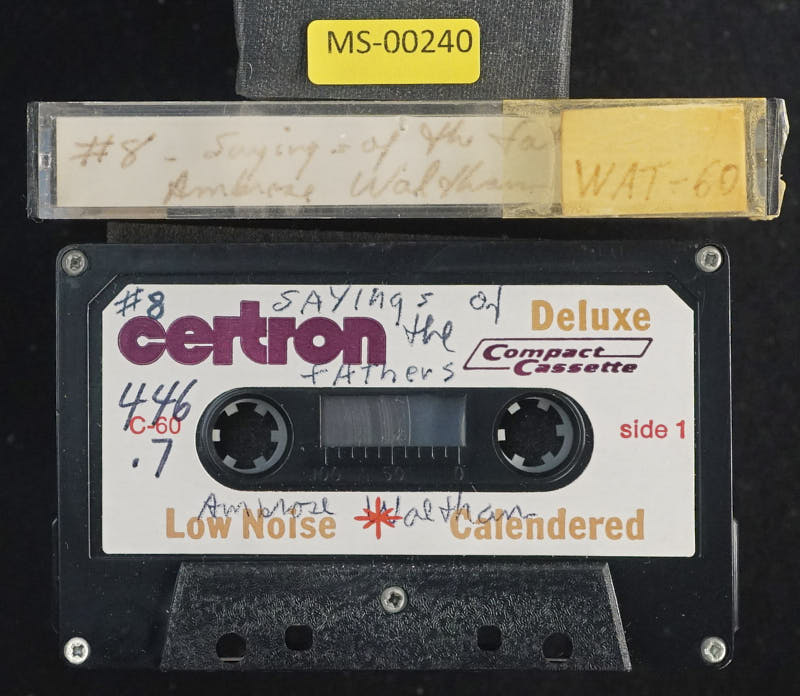
AI Vision - Possible Values from Photos:
Speaker: Ambrose Wathen
Possible Title: Sayings of the Fathers
Additional text: #8, 446, .7, side 1
@AI-Vision_v002
This afternoon, we're continuing our reflections on the sayings of the fathers. And for what I'm going to do this afternoon, I'm using book five of the Vitae Patrum, which was translated from the Greek by Pelagius, the deacon, and which is the text of the sayings of the fathers that Benedict would have known when he wrote his rule. And this is found in English translation by... Owen Chadwick, in a book called Western Asceticism, which belongs to the Library of Christian Classics, and it's published by Westminster Press in Philadelphia. It's volume 12 of Western Asceticism. That volume also contains some translations of John Cashin and also The Rule of Benedict by Owen Chadwick. Remember what we said last week about... the difficulty in trying to theologize on the apothegmata, or the sayings of the fathers.
[01:06]
And we must always remember the unique literary form of these sayings. Nevertheless, I'm going to try to give some sort of a picture of what we see in the sayings of the fathers with regard to certain questions. The first question is the meaning of monastic life. In chapter three of book five of the Sayings of the Fathers, Narita Patram, we read, an old man told this story. A brother wanted him to become a monk and his mother forbade him. But he did not rest from his purpose and said, I want my soul to be saved. Notice here that we seem to see that the primary motivation for becoming a monk is the desire to save people. one's soul. I'm sure that this is a theme that we've heard over and over again. But another story which I think is very good and throws us into the meaning of monastic life is in chapter 9.
[02:11]
Abbot Joseph asked Abbot Poyman, tell me how to become a monk. The old man said, if you want to find rest in this life and the next, say at every turn, who am I? and judge no man. Notice here that to be a monk means to ask the question to oneself over and over again, who am I? This is the basic question of all life. It's the necessary question of any conversion. Man must know who he is in relationship to God and to other men. And monastic life is nothing more than a discovery of the answer to this question. And so the monk asks the question of identity, in order to find rest in this life and the next. If you want to find rest in this life and the next, say at every turn, who am I? And so the goal and result of this existential question is really peace or rest in this life and eternal peace or salvation in the future.
[03:18]
So we could say that peace is the goal of monastic life, but we'll see that it can hardly be attained in this life. and we must wait for the future. Notice also that closely associated with this personal question of self-identity is the injunction not to judge others because, tied up with the goal of peace, there can be no peace in one's soul when he sits in judgment against his fellow men. And this point is rather important. Monastic life is not a judgment or in any way a condemnation of other ways of life. Rather, it is the existential question of self-identity that the monk asks himself. He's not sitting in judgment on other forms of life by his monastic life, but he's trying to find out for himself who he is. The answer to this question should result in peace. And so although peace is the goal of monastic life, the monk must be aware that he can hardly ever hope to obtain this
[04:25]
in the present life. There's a story from chapter 7, which I like very much. A hermit who was troubled went to Abbot Theodore of Fermi and told him so. Notice he's a hermit who's going to this abbot. And the old man said to him, go make your mind humble, put yourself in subjection, and go to live with others. Notice he says, go be a Cenobite, and that means to be in subjection to another, to a superior. So he went to a mountain and there lived with a community. Later he returned to the old man and said, not even when I lived with other men did I find rest. And the old man said to him, if you are not at rest when a hermit or when in community, why did you want to be a monk? Was it not that you might suffer? Tell me, how many years have you been a monk And he said, Eight. And the old man said, Believe me, I have been a monk for 70 years, and I have not been able to get a single day's peace.
[05:29]
And do you want to have peace after eight years? Here we see that peace, the goal of monastic life, is hardly attainable, and neither in the Aramidic nor the Cenobitic life. Rather, the monk can... plan to experience long years of suffering. And so it would seem that patience is essential for the monk. He will have to suffer and endure much in his search for peace. So in chapter 7, we read again, Abbott Poiman said, the monk, the mark of the true monk only appears under temptation. This story about the man who was not at peace either as a Cenobite or as a hermit, I think is very important for us. Sometimes we suspect that we should find peace in our monastic life. And hopefully we will find peace. But that beautiful phrase of the old man, why did you come if you did not expect to suffer?
[06:31]
We can expect to suffer in the monastic life. And the hope is that we will have some peace, but we know that our peace will be in the future. And so monastic life is a thrust, a movement towards peace, towards salvation. It is really a pilgrimage. And so we see in chapter 10, Abbot Peter, the disciple of Abbot Lot, told this story. I was once in the cell of Abbot Agatho when a brother came to live with him and said, I want to live with the monks. Tell me how to live with them. The old man said, From the first day you join them, remember you are a pilgrim all the days of your life. And do not be too confident. Notice this theme of life as a pilgrimage, which ties in with the Vatican Council II theme of the Christian life as a pilgrimage, the pilgrim church. And so monastic life is a pilgrimage.
[07:33]
We're on our way towards something. Benedict uses a theme of the tabernacle of the Lord. We are in the tent of God, in pilgrimage with him through the desert, towards the eternal city. The monk doesn't become too confident in this pilgrimage. That is, he doesn't become complacent and self-satisfied because he knows he's a sinner. And indeed one becomes a monk because he's conscious of his sins. This self-awareness as sinner is part of the response to the question, who am I, that the monk asks. The monk then answering this question says, I am a sinner. There's a beautiful story of a Syrian monk in chapter 7. When he was asked who he was, he replied, I am a sinful man, and I have come out here to the desert to lament my sins, and I worship Jesus Christ, the Son of the living God. Notice that the monk doesn't wallow in his sinfulness, although he's quite aware that he is a sinner.
[08:37]
Rather, positively, he worships Jesus Christ. the son of the living God. And so the goal of monastic life can best be articulated as a search for Jesus Christ, a desire for union with Christ crucified. And this is beautifully expressed in the following story, which is really one of my favorites, in chapter 7. An old man was asked how a watchful monk should not be scandalized when he sees others returning to the world. And he replied... A monk ought to look at hounds when they are hunting a hare. One of them glimpses the hare and gives chase. The others merely see a hound run, run some way with him, then they get tired and go back on their tracks. Only the leading hound keeps up the chase until he catches the hare. He is not deterred by the others who give up. He thinks nothing of cliffs or thickets or brambles.
[09:39]
He is often pricked and scratched by thorns, yet he keeps up until he catches the hair. And so the man who searches for the Lord Jesus aims unceasingly at the cross and leaps through every obstacle in his way until he comes to the crucified. This is a very beautiful and impressive image or picture of monastic life, and it's a very relevant problem that this man is asking. What do we think about monks who have left the desert, and have returned to the world. How is it that we can help from being scandalized? And the answer is that the monk is one who searches for the Lord Jesus, and having acquired a glimpse of him, gives chase. And without this glimpse of Christ, the monk will not continue his chase, but will easily turn back. And so the monk who is chasing Christ does not falter in the chase, because others turn back. Others have seen him running after Christ and then have run with him.
[10:44]
But maybe they haven't glimpsed Jesus Christ. Notice that the monk doesn't judge the ones who turn back. He is so intent on catching Christ whom he has glimpsed that he doesn't really notice if he is alone or not. And no obstacle will keep him from coming to Christ. And so in his search he will have to endure much and even suffer. He is... thinks nothing of cliffs or thickets or brambles. He is often pricked and scratched by thorns. Then he keeps up until he catches the hair. And so in his search he will have to suffer, but the goal is worth it. The goal of monastic life is union with Christ, Christ crucified. And so the man who searches for the Lord Jesus aims unceasingly at the cross and leaps through every obstacle in his way. until he comes to the crucified. Monastic life is the way the monk carries his cross after Christ and participates in his passion.
[11:47]
Remember that beautiful conclusion to the prologue of the rule of Benedict, that we might, through patient perseverance in the monastery, participate in the passion of Christ. And crucified with Christ on the cross, the monk will rise with him and thus acquire his peace. Let us take a look at monastic life, monastic lifestyle, and monastic virtues, as we see in the sayings of the fathers. In chapter one, we see, an old man said, this is the life of a monk, work, obedience, meditation, not to judge others, not to speak evil, not to murmur. For it is written, you who love God, hate evil. This is the life of the monk. Not to go in with the unrighteous, not to seek evil, not to be inquisitive, not to be curious, not to hear gossip, not to use the hands for taking but forgiving, not to be proud in heart or wicked in thought, not to fill the belly, in everything to judge wisely.
[12:57]
That is where you find a monk. Notice in this story we find the answer to the question, what is a monk? What is the essence of monastic life? And this question is answered in two ways. The monk does certain things or refrains from certain actions, and he has a particular attitude towards others. What does the monk do? The monk works and he meditates. He gives rather than receives. Thus we could say monastic life is a life of service to others rather than a welfare state. And on this point, think about the... mendicant spirituality. Mendicant spirituality is really not the ancient monastic tradition. Ancient monastic tradition is a life of work and service for others. We see that mendicant spirituality, though it is certainly legitimate spirituality, is not the same as monastic spirituality.
[13:59]
The monk doesn't speak evil. He doesn't murmur. He doesn't hear gossip. These are all negative ways of saying that a monk keeps silence or guard over his tongue. The monk does not fill his belly. Here we get into the whole theme of monastic fasting. The monk never eats to satiety. Besides doing certain things, the monk is to cultivate certain attitudes and virtues. He is to be obedient. He is not to be proud in heart or wicked in thought. He is to be humble. He doesn't judge others. And then everything that he does judge, he judges wisely. And since he is not to judge, he will see no evil in another. And to keep himself from judging others, he will not be inquisitive, not be curious, not listen to gossip. A very frequent theme in the sayings of the fathers is a monk sitting in his cell. And this is sort of a stereotype phrase just meaning to live monastic life.
[15:05]
And so the activities of a monk are specified in a saying which answers the question, how is a brother to sit in his cell? A brother asked Abbot Poiman in chapter 10 and said, how ought a brother to sit in his cell? Really the question is, how or what am I to do to be a monk? And the old man said, To sit in the cell is externally to work with the hands, eat once a day, keep silence and meditate, and internally to make progress by carrying reproach wheresoever you may be and keeping the hours of prayer and keeping a watch on the secret thoughts of the heart. If it is time to stop working with the hands, fall to prayer and finish it with tranquility. The end of it all is to keep company with men of good life and avoid the company of the wicked. Notice here that Abbot Poiman says that there are two aspects of being a monk.
[16:08]
One is external, the other is internal. Externally, monastic life consists in work, eating once a day, and thus avoiding gluttony. It consists in external silence and in meditation. It also consists in praying at proper hours, although here we see that Abbot Poiman puts this more under the internal aspect than external aspect. One is a monk internally if he makes progress by carrying reproach wherever he is, by keeping the hours of prayer, and by keeping a watch on secret thoughts. It would seem then, according to this distinction, that a monk could be a monk merely externally. Also that in any situation with a proper attitude, one can be a monk internally. But Poinman doesn't seem to like this dichotomy between external and internal. Both aspects are important.
[17:09]
The internal forms the external. The external ensures the internal. We'll see this problem, and I'm sure that we're aware of this problem in our own lives, of the relationship between external conformance and internal disposition. And Abbott Poinman tells us that monastic life is both external and internal. And so we can't say that monastic life is merely an internal desire for something. It must be externalized. Nor can we say that monastic life is merely some sort of external, structured, disciplined life. It also must... bring forth some sort of internal response. These two aspects are essential. There's another story that tells one much about the lifestyle of the monk, even though it does so rather negatively or at least critically. In chapter 10 we read, An old man was asked by a brother, How do I find God?
[18:11]
With prayers, fasts, labor, watchings, or the works of mercy? The old man replied, in all that you have said, and in discretion. I tell you that many have afflicted their body, but have gained no profit because they did it without discretion. Even if our mouths stink with fasting, and we have learned all the scriptures, and memorized the whole Psalter, we still lack what God wants, humility and charity. Notice in this saying that the goal of monastic life is to find God. How do I find God? Recalled in the rule of Benedict, the whole theme of to seek God. What is the lifestyle for seeking God? And then the monk replies, fasting, work, vigils, that is prayer, and of the learning of sacred scriptures and memorizing of the Psalter. Thus we see the traditional balance of prayer and work.
[19:12]
Opus Dei, Lectio Divina, and work in Benedictine tradition. But all of this is to no avail without discretion, for it is discretion that enables the monk to go to the heart of the monastic life, humility and charity. Again, monastic life is both external and internal. The externals are useless without internal attitudes. The ancient fathers were very fond of giving a thumbnail description of monastic life, little pithy statements, which would be sort of definitions in a way of monastic life. Here's one which is rather saying what a monk is not, chapter 10. Abbot Poiman said, the grumbler is no monk. The man who gives evil for evil is no monk. The irritable man is no monk. I think such sayings, though brief, give us an insight into the meaning of monastic life for a particular elder.
[20:16]
They may be reactions and responses to a concrete situation, so that avid poyman saying quoted above could be well directed against those monks who were perfect in observance and felt self-satisfied on that account, but who were grumblers, murmurers, and irritable. With these attitudes, even the most observant monk is really no monk. A very similar statement is found by Abbot Zacchaeus. The true monk must be detached and content with necessities. In chapter 1, we read, Abbot Macarius said to Abbot Zacchaeus, Tell me what makes a monk? And he said, Is it not wrong that you should be asking me? And Abbot Macarius said to him, I am sure I ought to ask it of you, my son Zacchaeus. I have one who urges me on to ask you. Zechariah said to him, as far as I can tell, father, I think that whoever controls and forces himself to be content with necessities and nothing more, that man is a monk.
[21:23]
Notice in this story, it is the elder who asks the younger monk for a solution. And this may be an example of what we call the Socratic method. that the elder, in asking the younger monk, is trying to bring forth from the younger monk his own ideas and articulation of the meaning of his monastic life. So it's really a learning method, a learning process for the junior. For Zacharias, monastic life is a simple life. No superfluities, no luxuries, merely what is necessary. The whole theme of frugality. Monastic life can be summed up than in one way or another. Certainly one essential characteristic of it is renunciation of one's own will. This is the root of the monastic virtue of obedience. It is this virtue which leads one to the perfection of Christ. I've been able to finish this side of the lecture much earlier than in the course with the novices, so now just turn the tape over and begin side two.
[22:34]
In chapter 1, we find Abba Cashin related this story of one Abba John, who ruled over a community because he was great in his way of life. When he was dying cheerfully and with his mind set upon the Lord, his brothers stood around him and asked him for a sentence which would sum up the way to salvation, or this monastic life, the way to salvation, and which he could bestow on them as a legacy. by which they might mount to the perfection which is in Christ. Here you get this whole tendency of you're asking an elder to give you some sort of ledithy or tradition, something to hand on. And this is the basic meaning of a monastic rule. You ask a father that will give us the principles of the way of salvation. With a sigh, he said, I never obeyed my own will, and I never taught anyone to do anything which I did not first do myself. So that's what he says is the way to salvation, to give up one's own will.
[23:38]
And so Abba John gives a testament to his disciples, a final word of advice. And in doing so, he sums up the meaning of monastic life. The way to salvation, the path to perfection in Christ, is not to obey one's own will. The father also seemed to delight in condensing the life of perfection into three short rules. So this might have been a mnemonic device. There are three things. You'll remember three things. And so here's some examples. Chapter 1. Someone asked Abbot Anthony, What rules shall I keep to please God? And the old man replied, Keep my instructions, and they are these. Wherever you go... Recollect God in your mind's eye. Whatever you do, do it after the example of Holy Scripture. And wherever you stay, be in no hurry to move. If you keep these three rules, you will be safe.
[24:41]
Three little rules. So wherever you go, be recollected. Whatever you do, follow Scripture. And wherever you stay, have a little stability. Don't be one to move around all the time. Monastic life is a life, then, that seeks God. One does this by following the instructions of an experienced elder. So they ask Epidathi, what rules shall we keep to please God? And he gives them instruction. Here we have, again, the beginning of monastic tradition, both in the sense of content, something which is there, which you hand on, tradition which is handed on. And Anthony says, the three things necessary are recollection, following scripture, and a certain stability. It's worth noting that Scripture is the norm or rule for the monk's doing. Whatever you do, do it after the example of Holy Scripture. There's another threefold rule of Anthony. In chapter 1, Abba Pambo asked Abba Anthony, What shall I do?
[25:46]
And the old man replied, Trust not in your own righteousness. Be not penitent for a deed that is past and gone, and keep your tongue and belly under control. Notice again that monastic life is both internal and external behavior. The monk is not to be self-confident, so he doesn't trust in his own righteousness, and he is future-oriented, not wallowing in his past failures. And so this whole idea of pilgrimage, you're going, and there's no sense of where you were in the past. So don't be over-sorry for the past. Don't wallow in the past. His goal is progress into Christ, and so he should keep his eyes ahead, not backward. But certain external practices are necessary for monastic life. Anthony points out silence and abstinence in the sense of fasting or destruction of gluttony. Notice that gluttony seems to have been a rather constant temptation for these ancient monks.
[26:50]
in the desert. Well, there's nothing else to do, so you're always getting hungry. You're always tempted because you're eating so little to eat a lot, but I don't know whether they had much of a chance to eat a lot. Well, they're certainly not very luxuriously. In this text, one sees again that Anthony is sort of a monastic legislator. He's laying down rules for monastic life so that others can follow him. Here's another threefold rule. Gregory said, God demands three things from a man who is baptized, to oil the true faith with all his soul and strength, to restrain his tongue, and to be chaste in body. Now notice these are not specifically monastic virtue, but the monk is a Christian and has baptismal obligations. Monastic life is a means or a help for the Christian monk to live as a Christian. So Gregory points out faith, silence, and chastity as essential for monastic life.
[27:53]
A very good synthesis of monastic life, its virtues and its practices, is found in the following saying in chapter 1. Abbot John the Short said, I would make up a man out of all the virtues. Rise at dawn every morning. Take the beginning of each virtue and keep God's commandment in great patience, fear, long-suffering, in the love of God, with a firm purpose of soul and body, in deep humility, in patience, in trouble of heart, and earnestness of practice, in long prayer, with sorrow of heart, with purity of tongue, and guard the eyes, in suffering injury without anger, peaceful, and not rendering evil for evil, not looking for the faults of others, nor puffing up the self, meekly subject to every creature, renouncing material property and the things of the flesh, in crucifixion, struggle, lowliness of spirit, in goodwill and spiritual abstinence, in fasting, in penitence, in weeping, in the fight against evil, wise and discreet in judgment, chaste in mind, receiving good with tranquility, in working with your own hands, in watching in the night, in hunger and thirst, in cold and nakedness, in labors,
[29:15]
burying yourself in a tomb as though you were already dead, and every day feeling that death is upon you. So this is sort of this picture of monastic life. And notice, again, it's an interpenetration of attitudes and of practices, that the external behavior patterns are the incarnation of interior attitudes, desires, virtues, and motivation. So in summarizing what all of these texts present, we could possibly categorize monastic life as, first of all, avoiding certain actions and attitudes, and secondly, as certain interior attitudes and virtues, and thirdly, as external practices. Now, the last two go together, and it is hard to distinguish between the internal and the external. But let's review what the monk is to avoid. It sounds like a litany here and very similar to chapter 4 of the Rule of Benedict. The monk is to avoid the following. These are all negative things.
[30:16]
He's not to do these things. He's not to judge others, and this came up a number of times, as we saw. He's not to speak evil, not to murmur, not to go with the unrighteous, not to see evil, not to be inquisitive, not to be curious, not to hear gossip, not to use the hands for taking, but for giving, not to be proud in heart or wicked in thought, not to fill the belly, not to grumble, not to give evil for evil, not to be irritable, not to obey one's own will, not to teach anything which one would not first do, not to be in a hurry to move, not to trust in one's own righteousness, not to be penitent for a deed that is past and gone, not to look for faults of others, and not to puff up self. Now, what interior attitudes or virtues is a monk supposed to have? Those are things he's supposed to avoid. What's he supposed to do? Obedience. Judge wisely in everything. Make progress by carrying reproach.
[31:19]
Keep watch on the secret thoughts of the heart. Pray tranquilly. Supposed to have discretion, humility, charity. Be content with necessity. Be recollected. Hold the true faith. Be patient. Have fear, long-suffering. have a firm purpose of soul and body, and earnestness of practice, have sorrow of heart, purity of tongue, to suffer injury without anger, be peaceful, meekly subject to every creature, be lowly of spirit, have good will, be chaste in mind, receive good with tranquility, and bury oneself in a tomb as though you were already dead, and every day feeling that death is upon him. the crucifixion of life. What about the external practices? One, the monk works with his hands, he eats once a day, that is, he fasts, controls his belly, he keeps silence, so he controls his tongue, he meditates, keeps vigils, he practices works of mercy, he learns scripture, he memorizes the Psalter, he has chastity of body, he rises at dawn every morning,
[32:34]
He engages in long prayer, and he renounces property. So there are external actions which are part of monastic life, as well as internal disposition. Do you have any common observations on these reflections? Brother Joel? I was noticing that in that second part about things to do, you just read, I just thinking that David Anthony went to the tomb. That was because he was going to the domain, the evil one himself, or death range. And in the second part here, it says to bury oneself from the tomb like one was already dead. There's sort of a different approach in a way. Yeah. But you have this theme throughout of the tombs and being dead. And this comes up in a little Benedict. Always to have death daily before one's eyes. And the idea of being dead, so completely dead to oneself that one doesn't sin and that one doesn't follow one's own self-will.
[33:42]
This thing that we read about discretion, moderation, especially moderation, kind of fascinates me. It doesn't seem like there's anything moderate at all about going out to the desert. And then you hear about... I think one of the things you read today was moderation and beating the body. I believe something like that. And it seems like moderation is already violated by just beating the body. And I find that, you know, the way they look at that is rather interesting. I wonder if it's a means of art. Could you use this in saying how dedicated they were that they would consider... leading themselves with a stick or something, the love of Christ. It seems to me that moderation is a relative thing, and what is moderate for one person may be very moderate for another. And I think that these men being sort of giants would do things which for us would be very immoderate.
[34:49]
And yet at the same time, they were always very cautious to insist that one doesn't go beyond what one can really do and maintain a certain equilibrium. And I think that this is a general principle in our aesthetic life. Nothing too much. Go as far as you can, but know when will it stop. But it is a relative thing. No, that Lausiac history, that came out over and over, you know. Discretion, moderation, and moderation. And if you notice in Lausiac history, the reason many of these holy people fell is because of vain glory or because of lack of discretion. There's a story, I think, in John Cashin where a man who, an example of what is a lack of discretion or discernment of spirit, he thought that he was so holy that he could jump into a pit and... stay alive and come out again.
[35:51]
Well, he jumped in and broke his neck. You know, this is all, John Cashin said, well, this is a lack of discretion. Same way in the Lousy Act history, recall these people became so holy that they didn't need the Eucharist anymore. Well, this right away, this is indiscreet. You know, they had some sort of spiritual communion with Christ that they didn't need the sacrament anymore. This is a sin against discretion of discerning the spirit. One thing that struck me on that was that, uh, It's very indiscreet not to have contact with the brothers. It comes out that there's really no such thing as an absolute hermit to maintain discretion, moderation, to keep from pride, and to keep in contact with the brothers. you know, with holy men, that you have to come in and spend time with the brothers.
[36:54]
There are very few real hermits in the absolute sense, either in the sayings of the fathers, of course, right, in the sayings of fathers, they wouldn't be because they're talking to other people, but even the lousy act history, there's very few people who are absolute hermits. Now, occasionally there's a history of somebody who went for 35 years in the desert and spoke to no one. for 35 years or so. But the idea, the medieval idea of a recluse, somebody who's walled up and has no outside contact, it's sort of rather foreign from the ancient fathers. It's more or less, and especially in the Lousyatic history, you get a picture of semi-Aramidic life more than anything, or at least a mitigated Aramidic life. It's a real question whether you could really be an absolute hermit, or whether it's as humanly possible. You can't jump off the earth somehow. And you are dependent one way or another upon somebody. Well?
[37:57]
@Transcribed_UNK
@Text_v005
@Score_97.16