You are currently logged-out. You can log-in or create an account to save favorites and more. more info
Monastic Wisdom Through Sacred Reading
AI Suggested Keywords:
Reading the Bible
The talk provides an overview of the role and challenges of engaging with the Bible in monastic life, with a focus on the practice of Lectio Divina, a form of prayerful reading that is central to the Benedictine spiritual tradition. By revisiting early monastic traditions, it explores the variations in biblical engagement, from memorization and recitation to the reflective practice of meditatio. The discussion highlights the historically evolving practices of prayer and reading within monastic communities and examines the tension between contemporary intellectual demands and spiritual practices. The talk aims to evoke reflection on how these traditional practices can be integrated with modern monastic life.
Referenced works and authors:
-
John Cassian's Conferences: Discussed for its role in detailing methods of unceasing prayer, including the use of Psalm verses as meditative focus points, highlighting Cassian's influence on Benedictine prayer techniques.
-
The Life of Anthony: Recommended as essential reading for understanding early monasticism, depicting Anthony's memorization and engagement with scripture as a divine gift.
-
St. Benedict's Rule: Explored for its directives on monastic formation, the emphasis on Lectio Divina, and Benedict's innovative use of biblical verses to structure daily prayer.
-
Thomas Merton's Early Monastic Journals: Cited to illustrate the challenge of engaging deeply with text, underscoring the difficulties of maintaining biblical consciousness in a modern context.
-
Evagrius Ponticus: His writings are noted for cataloging biblical verses to combat spiritual and moral temptations, an example of targeted use of scripture for personal growth.
-
Smaragdus' Commentary: Referenced to describe historical monastic practices and the continuous engagement with scripture, emphasizing the integration of biblical text in daily monastic activities.
-
Mark the Monk: Mentioned for introducing the practice of monologistic prayer, influencing the development of the Jesus Prayer in Eastern Christian tradition.
This summary engages with the central themes and challenges faced in monastic Bible study, highlighting key texts and figures relevant to understanding its evolution and significance.
AI Suggested Title: Monastic Wisdom Through Sacred Reading
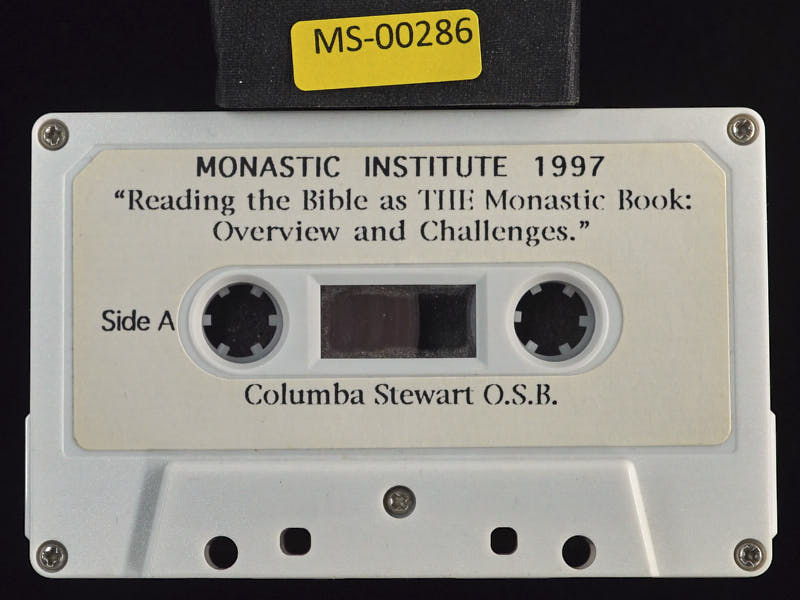
AI Vision - Possible Values from Photos:
Speaker: Columba Stewart O.S.B.
Location: Monastic Institute
Possible Title: Reading the Bible as THE Monastic Book: Overview and Challenges
Additional text:
@AI-Vision_v002
My task this morning is to do the overview and introduction to a vast subject, a subject which, in fact, could occupy us far more than the few days we have together in this institute, and that is simply the role, significance, meaning, experience of the Bible in the monastic life. What I'm going to do with you today, both this morning and this afternoon, is talk some about the practice of Monastic Lectio, An Encounter with the Bible. And then more this afternoon, talk about the theology of that encounter with the Bible. So what I hope to do is to do a romp through the early centuries of the monastic movement and then plop us down today in the kinds of challenges that we face as we try to do the same thing that our monastic ancestors did, which is face this book and the God... of whom it speaks and try to make sense of it.
[01:03]
In your chairs, you have an outline which gives you some idea of what I'm going to do today. And I deliberately gave you the outline in two forms, one to intimidate you and the other one to show you what I'm really going to be talking about today. And I'll put the second one up on the overhead. If you use both sides of the gray sheet, you can follow today what I'm going to be saying to you. On probably what is the top side of your two handouts there, the one that says introduction and then has a kind of outline, that will give you some of the concepts and major terms that I will decode for you today. This is not a test. And if you have no idea what these words mean yet, that's okay. That's why I'm here. If you turn it over, though, and you see the side which says basic principles, and that's what I put up here on the screen, I've called it principles, but another title for it would be axes, in terms of axes he will grind today.
[02:18]
Because these are the things I think we need to kind of get a grip on, and these are the ideas and prejudices and biases which will drive what I'm saying to you today. So... The first side will let you follow the actual content of what I say. I will alert you periodically in the course of the presentation as to which one of these I'm getting at as I talk. And I hope that by giving you both the kind of academic content and then what's driving it experientially, that can help give us a basis for our conversation together. The other part of this, of course, is that I'm a Myers-Briggs P, which means that I can never decide how to do something. So if I can come up with two or three different ways of doing something and then give you all of them, then I feel most comfortable. So that's what I've done, giving you two outlines. The other handout you have in blue is simply a little information about some of the people and texts that I will be talking about today.
[03:18]
Now, to me, these have become second nature because I spend all my time with these people. But I know that for many of you, they may be new. And so I want to give you both the introduction in my talk. but also a little cheat sheet here to tell you who some of these people are. And not least you have the spelling of some of these odd Greek and Latin names. What I plan then to do this morning in a session which I hope will be done by about 11, part of the Monastic Institute, as Abbot Timothy indicated, is to give you a chance to practice what we preach so we try not to fill up the schedule entirely. And we hope to give you some intervals throughout this week When you can take a walk, when you can sit down with your Bible, when you can sit in the church, or do whatever it is you need to do this week to process what we are doing together. This morning I want to talk about reading the Bible as the monastic book, overview and challenges. And what I'm going to do is basically give you an introduction to the way that the early monastic tradition, St.
[04:26]
Benedict, and monastic men and women ever since have read the Bible. And I'm going to do all of that, including a break and a chance for discussion by 11 o'clock. So let's plunge in. The challenge of Lectio today. We Benedictines in our return to the sources have rediscovered the biblical basis and the distinctive aspects of our monastic Lectio. We have claimed once more in these last two or three decades our own spiritual tradition, and its way of encountering the Bible. There is a plethora, an abundance of books today about Lectio. And interestingly, many of them are by non-monastic Christians, which says that there is something about this tradition of monastic encounter with the Word that speaks to people today. Fundamentally, the practice of Lectio is simply a reminder that we can never bypass attention and attentiveness to the Word of God.
[05:36]
When we Benedictines are asked about our method of prayer, we tend to talk about Lectio. But Lectio, of course, is an anti-technique. So this is one of my axes up here. Lectio Divina is not a technique. Listening in Lectio Divina, like listening at the work of God, like listening to the rule being read to us, like listening to a superior or a community member or a friend or a parent, heightens awareness of God and generates prayer. It is a space. It is an opportunity. It is not a technique. Now, the consequence of that is there is no right and wrong way to do Lectio. So I am not going to stand up here today and tell you how you ought to spend your time with the Bible. Because, as I indicate up here, one of my points is you can't teach it that way.
[06:41]
At the same time, I think we all experience that Lectio Divina is not easy, point two. And I think one of the things that happens to people in monastic formation is they get told all these things about Lectio, get plopped in their room with a Bible, and they panic because it's boring, it's confusing, they don't know where to go with it. Some people seem to take to it like that, but other people really struggle. I think there are a lot of reasons for this which we can explore together. I'll suggest just a couple to start us off today. One of them is the decline in the art of reading. Both skimming and speed reading are antithetical to Lectio Divino. And many of us have to spend much of our time doing both of those things to get through all the stuff that crosses our desk in a day. Thomas Merton wrote in one of his early monastic journals, you know, I really shouldn't read more than three paragraphs of something without stopping.
[07:45]
If I read fast and I go right on, I get confused. and my mind simply ceases to grasp anything. After half an hour, I'm exhausted and worried, as if I'd been roughed up in a dark alley by a gang of robbers. Books pile up around me, and I can't finish any of them. Now, anybody who's ever been in my office or in my room in the monastery knows that books pile up around me, and I can't finish any of them. And I think many of us can identify with Merton's observation. But I want to suggest a second challenge, and one that is perhaps even more subversive than the one I just mentioned. And that is the loss of biblical consciousness, which was natural to Benedict, to his predecessors, to his medieval successors. The principal source of stories for those people, of imagery, of intellectual stimulation, was the Bible.
[08:48]
This is no longer The other books that they read were all expositions of biblical themes or aids to interpreting the Bible. It was their movie. It was their radio. It was their TV. It was their detective story. It was all of those things for them. I think the challenge for us now is keeping a mental grip on the biblical words and stories that are read to us for which we read in the course of days flooded with other kinds of verbiage and imagery. These are among the challenges which we consider in this institute. Now, the other side of this is that Lectio Divina is very hard to describe or to teach because it varies so much from person to person. It's shaped by temperament. It's shaped by needs. It's shaped by different ways of thinking.
[09:50]
It's shaped by life experience. For some people, the intellectual stimulation of reading the Bible or biblically-based books is a welcome break from the demands of life which do not give them that stimulation. While for other people, the time in Lectio is a break from the highly demanding intellectual work with which they spend the rest of their days. Some people read slowly but steadily. They might get through a paragraph in the course of a half-hour's Lectio, while others sweep the page, crawling for little morsels of nourishment. Somebody I know does three chapters in that same amount of time. They're both right, because knowing those two people, that's who they are. So the interplay of Lectio in life and of Lectio in prayer is variable. Some people take formal exercises of reflection or assiduous notes as they do their Lectio.
[10:52]
And some people like Lectio because they don't have to write down something. They don't have to draw a conclusion. They don't have to type anything. They don't have to sign anything. Now, although the manner of doing Lectio varies, the commitment to it and the centrality of it is a universal marker of Benedictine life. I think we could also say that one spiritual path can be traced by revealing the ways that Lectio has changed over the years. As it was shaped, as it is being shaped by experience, growth and self-knowledge, increasing awareness of dependence upon the word. The times when we didn't do it at all or didn't do much because of pressures of work or of life or spiritual apathy. The other times when we had a crisis or a period of spiritual renewal, when it came alive again because we realized we had to do it.
[11:53]
These are all the things we can trace through our Lectio. So our task today is to explore the ups and downs of the monastic encounter with Scripture. As I said earlier, I will not provide answers to these challenges because, remember, Lectio is not a technique. But I can tell you about the way that the monastic tradition, especially the early monastic tradition, which is what I know best, except of course the monastic tradition since 1982, I can tell you what the early monastic tradition practiced and understood about the encounter with the Bible. Now I'm not telling you this just because it's what I know, but since the Council, when we as monastic Christians had been asked to renew our sense of ourselves, it is to that early tradition that we have gone, and it is there that we have found the most inspiration and challenge. So that's what I want to share with you today. But I want to begin with a few words about the Bible and prayer, just to put this in context.
[12:58]
And that's my point up here about the biblical word comes to us out of silence and returns to silence in prayer. Simply put, The Bible was the source and the context of all early monastic prayer, as indeed it remains so today. Ancient monastic women and men were awash in biblical words and images. They were soaked in them. They were full of them. They were second nature to them. They read the Bible. They had it read to them. They memorized huge chunks of it. They sang it. They repeated it with heart and with mouth while working or traveling. The first major commentator on the rule of Benedict in the 9th century who had the name Smaragdus, it's on your handout. It's an ugly name in our language. We hear the name Smaragdus and we feel sorry for him. But the word means, it's a Greek name originally, the word means emerald.
[14:03]
So it's a beautiful name. It just doesn't sound very good in English. Now Smaragdus, quoted another monastic rule as saying this, While on the outside our hands are occupied with work, on the inside our heart becomes sweet through meditation of the Psalms, with the tongue, and remembrance of the Scriptures. From such sweetness on the inside, cultivated by that reciting the words of Scripture, came prayer. praising God for mercies received and for mercies still needed, both for oneself and for others. Now, similarly, early Christians took the biblical command to pray always very seriously. And they talked a lot to each other about what this could possibly mean, something we don't do very often. The practical application of that command, which is something you find Jesus saying,
[15:07]
In Luke chapter 18, you find Paul saying it, 1 Thessalonians 5. Look at Ephesians 6 also. The practical application of that command was understood in a lot of different ways. But the imperative itself was understood as a defining trait of the monastic life. Whether alone or in community, whether chanting the office or pondering texts in what we would call Lectio Divina, and they called meditatio, more on the words later. Their basic work was always to give voice to the Bible and to respond to that voiced Bible with the prayer of their hearts. All of their prayer arose within a continual encounter with the biblical word. What's interesting about the early monastic tradition is the way they used the word prayer. And if you look in the Latin text, like Cashin, and I keep coming back to Cashin, not because I wrote the book.
[16:13]
I wrote the book because Cashin gives us the most extensive and profound theological synthesis in early monasticity. So that's why I talk a lot about him today, and that's why I did the study of it, because there is no one comparable in terms of a systematic overview of monastic theological questions. All of these early writers used the word prayer, in Latin, oratio, in a very specific sense. And it is one that I think challenges us in our understanding of how we encounter the Bible. They located prayer, oratio, especially in the reflective silence, in the pause, which followed each psalm of the canonical office, the Liturgy of the Hours, or in the silence which followed one's own recitation of a memorized biblical text.
[17:17]
So they had a very precise understanding of what prayer was. It was inspired by the Word, and it was response to God after encounter with the Word. What is interesting, therefore, is that These early monastic people would not have thought of singing or reciting the psalms as being in and of itself prayer. It was an indispensable companion to prayer, but just chanting a psalm wasn't praying. It was disposing you for prayer. It was the pause after the singing, chanting, or reciting the psalm, which was the space for prayer. The biblical word was preparation for prayer and could provide language for it, but prayer in that narrower sense happened when the flow of sung or recited text paused and the heart spoke its own appropriation of those texts.
[18:24]
Offered by each person in the liturgical assembly in silence, gathered together by a leader, that prayer arose from responded to the biblical words which had been vocalized. Now, they all say that that pause after the psalm or that interval after your own recitation of a biblical text. And remember here, by the way, and I'll say this again later, ancient people always read aloud. So if you were doing your Lectio in your own room, you were still saying the text aloud. So that's why this business of the silent pause is was equally applicable to the individual in her cell in an ancient monastery as it was to people in the liturgical assembly. That pause was always to be brief, and St. Benedict follows the tradition here, and people like Cashin tell you why, and we all know why.
[19:25]
If the pause is long, what happens? It's a summer evening, it's evening prayer, the day had been about 94 degrees, The relative humidity is about 96. And after 60 seconds, you fall asleep. But nonetheless, the pause was the essential space for prayer. Now, Cashin and the others note that in Egypt, the home of great monks, right, where synabetic life got off the ground with Pachomius and his community and the community run by his sister, they gathered for liturgical prayer only twice a day. They did it once just before dawn and once in the evening, and the whole rest of the day as they did their work, they did this business of reciting texts. So they continued throughout the day, but they had begun in their pre-dawn liturgical assembly. Other places, the early writers note, they prayed several times a day, so they didn't have to bridge a long gap on their own, but they had sort of stepping stones throughout the day.
[20:31]
The differences in these patterns did not matter, and they do not matter. I think we all know the kind of monastic fundamentalism that judges monastic integrity by the number of hours spent in choir. This is not the mindset of the early tradition. Whether alone or in community, in their understanding, all monastic prayer came down to the same thing. It was rooted in that ongoing encounter with the Word. The Bible established the ground of possibility for unceasing prayer, and it also provided its method. Individuals, as they read, memorized, and recited biblical texts and paused for prayer, were simply doing the same thing that an assembly or community did when they gathered in church. Anchorites and Cenobites prayed exactly the same way. Those who were alone in a hermitage prayed the same canonical hours, practiced the same kind of meditative prayer as the Cenobites.
[21:38]
The difference was just one of formality in a course of context. Now, we all know that later on what happened, and this is a liturgical spirituality which many people in this room were brought up on, later the Psalms of the office themselves came to be seen as the prayer. And one went into the chapel, and sang the canonical hours, offering that as praise to God, and that was prayer. And indeed it is. And the important thing about that is that the ecclesial dimension of that common action became emphasized. And if you can criticize early monks for one thing, it's that. They didn't always have that strong ecclesial consciousness. The result, though, is that it sharpened the distinction between what communities do in their chapel, in what individual monastic women and men do when they're in their room. And that is a distinction that we need to back off from and realize that what we do together in our sharing of the word and in our prayer following the word in chapel and what we do in our room are on a continuum.
[22:51]
They are not sharply distinct actions. And that's my other point up here. I want to talk a little bit about how the early monastic folks actually handled the Bible. So I'm going to talk about their methods of biblical prayer. Now, I know some of you may know this. I hope it won't be needless or pointless review. But I have a certain amount of confidence that there are a lot of you who don't know much about this tradition. And so I want to share it with you. And I'm going to do it under three headings, which are on your intimidating outline, not on the nice outline. I have posted there are four approaches that I want to talk about with you this morning one is memorizing and reciting biblical texts and I gave you the Greek word and the Latin word I'll say something about them in just a minute then I want to talk about antarotic and monologistic prayer and again these are the words that I don't expect anybody to know but I'll tell you what they mean
[23:56]
in the course of this presentation this morning, and I think you will find them fascinating. Then I want to talk about Cassian's prayer formula, which is terribly important for the history of Western monastic prayer. And then I'm going to talk about St. Benedict, okay? So let's start with the first, memorizing and reciting, Melete Meditatio. Ancient people had incredible memories. We have terrible memories. And I don't mean memories about remembering the things we're going to do today. I mean memories which can preserve stories and texts and narratives. Some of us, even those of us relatively young, like me, can remember in grade school and high school being asked to memorize texts. You memorize a soliloquy from a Shakespeare play. I can remember having to memorize a French poem for a contest in junior high. These kinds of things were just part of education. I don't know if they still are. But we considered those to be impressive feats that I could memorize, a whole page of Shakespeare.
[25:02]
Ancient people, however, could memorize the New Testament, all the Psalms, major portions of the Old Testament. And that is how they kept the Bible before them all the time. Now, part of that was because they all didn't have their own copy of the Bible because books were expensive because they were hand copied. The other part is that they knew that propping a book up on a stand in front of you while you went about your daily task or work, whatever it was, ain't the same thing as having it right here and being able to call on a text when you have the opportunity. In both solitary monastic life and communal monastic life in Egypt, they called that practice of memorizing and reciting the biblical text melate and that word is on your intimidating side of the handout now in Latin monasticism that word melate was translated meditatio and that is the origin of our word meditation but it signifies something quite different than we usually think of with that word meditation the Greek word melate meant study or exercise and it was often applied in classical usage
[26:24]
to rhetorical declamation. So the kind of thing I was just talking about a few minutes ago, memorizing a speech or memorizing a famous poem and then being able to declaim it. Studying that text would have been called mellete. In philosophical circles, what they meant by mellete was memorizing basic principles like this so that you could call on them in times of need. sort of programming yourself with right thinking so that when a particular problem arose, you had the dictum or principle you could pull out and apply to the situation. The monastic use of the word melate and of its Latin word meditatio for memorizing and chanting biblical texts probably doesn't come from philosophy. Instead, it comes from the Greek translation of the Old Testament, known as the Septuagint, that LXX that you come across when you're reading, the Septuagint, because the word, the verbal form of melate is used in that translation of the Old Testament to describe the pondering of God's word or law.
[27:37]
Think of Psalm 119, all those places where it talks about in every verse pondering law, turning over the law, being mindful of the word. It often uses that Greek word. that the monks then picked up to use to talk about memorizing the Bible now remember this was not just a feat of exercising the memory this was a vocal exercise so the stuff they memorized they would say out loud to themselves they would sometimes do it together as they would in the common liturgical assembly but they would also do it to themselves so they'd walk around talking to themselves Now, for us, this is a sign of something wrong, or the sign at least of an eccentricity. I had somebody once overhear me talking to myself, and he was actually rather impressed because I seemed to be rather nice to myself in the conversation I was having that day. He caught me on a good day, but he remarked upon it because he found it odd that I was carrying on this conversation with myself.
[28:41]
I did not tell him, I am simply practicing my melité, because of course I wasn't. I was talking to myself. I wasn't reciting the Bible. But this was second nature to them. If you've read Augustine's Confessions, which probably most of you have read parts of at some point in life, you may remember that St. Ambrose, Augustine's mentor in Milan, was famous because he could read silently. And people would come and watch him read. He'd be sitting in his office reading silently, and they would watch him read because his lips didn't move. So even if you didn't do it out loud so that other people could hear it, you would say the words with your lips, which meant you were reading at the pace of vocalization. And individually, then, these memorized texts that they had would be recited in the same way. Now, the point of this was simply to create an atmosphere conducive to prayer. One German scholar said this, the unceasing recitation of holy words should bring the soul into a climate, into a disposition from which its own prayer
[29:48]
can arise spontaneously. And a lot of these early monastic texts talk about the effect of the voice, that using the voice brought a kind of peace, partly because of breathing, partly because of the use of the vocal cords, brought a peace and a centeredness which complemented the content of the words that were being recited. Abbalat, one of the early Egyptian hermits, described his regimen in the hermitage in this way. As I'm able, I do my little synaxis, which means the Liturgy of the Hours. I do a little fasting. I do a little prayer, which would be that prayer in the pauses. And I do my meditation, my melate. And I keep quiet. And I try to purify my thoughts. That was the monastic life. Another saying said the foundations of the monastic life are meditation, meditate, psalmody, manual labor.
[30:53]
When you read some of these early texts like the life of Anthony, if you haven't read the life of Anthony, you must read the life of Anthony. If you remember nothing else from what I tell you today, you gotta read the life of Anthony because it's fantastic. The first time, you may not like it. I hated it the first time. I now treasure it. So read it once for me and then read it the second time for yourself. But when you read that text and you read other things from the early Egyptian monastic tradition, you find this constant emphasis on memorizing the Bible. It is said of Anthony himself that his memory took the place of books. Now, apparently he was a lot more interested in books than the life of Anthony suggests, but nonetheless, he memorized huge, portions of the Bible. This was regarded as a divine gift that people could be immersed in the word so much. A character called Ammonius, one of the so-called tall brothers of the Egyptian desert, was known for memorizing both the Old and the New Testament and six million lines of the writings of Origen, Didymus, and other early Christian biblical commentators.
[32:08]
This is an exaggeration. I don't think even Origen wrote six million lines, although it seems like it, as I'll say something this afternoon, about Origen. You find that people like Evagrius, his name is on your blue sheet, one of the great early monastic theologians, great influence on Kashin in the Egyptian desert, said that the neat thing about psalmody and about this practice of meditation is that it was a kind of bridge between the ascetical aspect of life and and the contemplative aspect. Because there's a real discipline to memorizing those texts and to sitting yourself down to recite them. We all know about that part of Lectio or prayer. But he said that by doing that and by reciting those words, you're providing your own medium for contemplation. So the discipline itself is the door to contemplation. And that's an important thing to hold on to. because we all know those two sides of Lectio.
[33:12]
There's the discipline of making yourself sit down and do it, but at the same time, that's the opportunity for contemplation, which makes it different from most of the ascetical disciplines of the monastic life. Now, if you want to find the most vivid illustration of what these people meant by this business I'm describing as melate or meditatio, you have to read the Pocomian literature. Now, some of you may have seen these three volumes with an orange cover called Pachomia and Koinonia, one, two, three. They're great. The greatest thing about them is they have wide margins on the page, so it's not as long as it looks. It's always intimidating to assign people 100 pages of the life of Pachomias, and then they realize that there's only this much text on the page, so it's not so much. But if you read those texts, you find the best illustration in early monastic literature of this practice I'm trying to describe. They depict meditatio, or melitate, as a pervasive and unifying element of the monastic life.
[34:16]
The monks were expected to be reciting these texts in Pachomius's monastery as they went to and from church, as they worked, while they performed community tasks like ringing the bell for meals or handing out dessert. There was a monk in this monastery, and his job was to stand at the door of the refectory with a big bowl of candy. and give everybody a kind of praline as they walked out the door of the refectory. What a great job, huh? But he was supposed to be reciting texts as he did this instead of saying, you know, you don't really need one of these, do you? It was said of their liturgical assembly that a soloist would recite psalms or other texts from memory while the other members of the community sat, in the chapel and did manual tasks like weaving baskets or making rope. This is what they did in church. And then they would just go down the line taking turns standing up and reciting a text.
[35:20]
We need books. Newcomers to the monastery were required to memorize at least the Psalms in the New Testament. Newcomers. Psalms in the New Testament. Another text from that tradition says this. Let us devote ourselves to reading and learning the scriptures, reciting them continually. Along with this came an elaborate choreography for the way they did these texts. And this is my next point up here about the whole body-soul experience. The soloist, as I said, would stand up and recite the text, usually from the Psalms, but not necessarily. Might do a bit of Isaiah the way we do canticles in our office. After the soloist finished, the members of the community would rise from their seated position and make the sign of the cross. Then they would kneel and then prostrate in silent prayer. They would stand after the superior gave a signal, knock probably of some kind, and again make the sign of the cross.
[36:27]
Together, they would extend their arms in the aurons position and recite the Lord's Prayer. make another sign of the cross, and then sit down and do the whole thing over again. And they would do this either six or 12 times together, depending on which office it was. Now, Cashin admired this decorous stateliness of this beautifully choreographed movement that he observed in Egypt. And he reproached his brother monks in Gaul who had a way of throwing themselves down on the ground even before the psalm was finished. and yawning their way through the whole prostration. Now, in addition to this thing that I've described that they did in church together, these early monastic women and men of the Pachomian tradition would spend time alone in meditation and prayer. It is said of Abba Theodore that he would sit in his cell making ropes and memorizing...
[37:31]
texts, or reciting memorized texts. And by the way, making rope for them was not just some dumb thing they did to keep busy. These were people who lived and worked on a river. And rope was an essential article for people who lived and worked along a river. And there are constant exhortations in the Piconian rules, which are really more a collection of notes from the superior's bulletin board than they are a kind of monastic rule in our sense, which say things like, don't forget to tie up the boat, okay? So the rope that Theodore was making in his cell was a product the community needed and also something they could sell because people always needed rope for agricultural purposes, for river traffic and so on. Anyway, he's sitting in his cell making rope, reciting memorized text, and the story records he would get up and pray every time his heart urged him to do so. So it's not fixed like it was in the communal Assembly, but it was the same idea.
[38:33]
There was a pause, and he would stand up and pray. Theodore's practice mirrors that of a visitor who was sent to help Anthony the Great when he was struggling against excedia, that monastic listlessness we all get, that kind of antsy boredom, that disease or unease. Anthony was wondering what he should do, and of course he was living alone as this great hermit. So the angel models for him how he should pass his day. He should sit down and weave palm branches into whatever it was he was making, baskets, whatever. He would rise periodically to pray, and then he would sit back down and do some more work. And the angel says to him, do this, and he will be saved. Work, prayer, but rather differently configured than the way we usually think of them. So that's the meditation part. I want to talk now about these two others.
[39:33]
Where is it? The intimidating outline. Antaretic and monologistic prayer. Now these may be less familiar to you than the practice that I've just described. I'm going to do them in reverse order to what I have on the handout. I'm going to talk about monologistic prayer first. Am I? No, actually I'm not. I'm going to do it in the order I have it on the outline. Many of the sayings of the desert elders, the apothegmata, correct spelling, found on a blue sheet, depict a form of prayer which consisted of a verse from the Bible or a brief phrase which would be used as a plea for divine help or as a weapon directed against temptation. So instead of just reciting texts like pushing the button and starting with Genesis, and you've memorized all of Genesis, so you just do it in order, they also had another kind of prayer. where they would take certain biblical phrases and they would pray just those. Now one form of this was this antaretic prayer.
[40:35]
And all that word means, it's a Greek word, all that means is something used against a word or suggestion. So you have a problematic thought or a bad thought or something you regard as a temptation. your issue, if we want to use our kind of language. They would say it was demonic temptation. We would say it's that same old stuff or that issue I struggle with coming at me. You would direct against that a particular biblical verse which was keyed to that issue. These prayers were prescribed for particular situations or for limited periods of time. One saying notes that that using biblical words in that way has power against the demons even when the power is not appreciated by us. In other words, there's a kind of divine energy or sacramental presence in a biblical phrase that we may not understand, but is real.
[41:40]
Evagrius, this great early monastic theologian, gathered hundreds of these verses together in a huge work, not translated yet into English, although a little part of it has been, where he listed under eight headings, the headings of the eight big issues or principal faults that these people chronicled, about 60 verses you could use for each of those eight temptations. And for each one, he would describe the particular scenario. So if you read, for example, under gluttony, he doesn't just give you 60 biblical verses you can use against gluttony. He'll say things like, When it's about 11.30 in the morning, and you know you're not going to have lunch for another 45 minutes, and you know it's Friday, so there's going to be tuna fish, and you hate tuna fish, and you're thinking, gee, I'd love a hamburger, this is the text you use. It's that specific. So it's a remarkable compendium, which probably tells us more about Evagrius than we really want to know, but it's quite interesting.
[42:43]
Now, about half of those 600 or so biblical verses that he provides are taken from the Psalms. So what we've got is a highly targeted form of meditatio, key to particular situations. It was not a leisurely pondering of biblical texts. It was an arsenal to be used when you were in no situation or position to be doing that leisurely open-ended meditatio. So it's a kind of therapeutic process. The other form of this kind of prayer is monologistic prayer. And the reason I give you these words is that you find these words in secondary literature. So when you read about this stuff, scholars use these words because that's how they claim to be scholars is they use these big words. So this is so you know what they mean. Now, if you look at the word monologistic, you can figure out the definition. It means a single word or just a few words. So it's a short word. prayer phrase or formula, which wasn't targeted against a specific issue like the antaretic prayer, but was used the way that people today often talk about a mantra, or the way the Eastern Christian tradition talks about the Jesus prayer, or the way many people have used the rosary in the Latin church, a short prayer which is recited over and over and over, which creates a kind of calm atmosphere.
[44:12]
in which one becomes centered and in which one can pray. The term monologistic is traceable to this character called Mark the Monk, and if you look on your blue sheet, you'll discover we know nothing about him except that he wrote stuff. This method arose in the desert tradition of Egyptian monasticism. It came to the West through John Cashin, and I'll say more about him in just a moment. Side B continues immediately as you turn over the tape. It has made a tremendous difference in my own life, and this is directly traceable to this Egyptian tradition. This ultimately took the specific form in the East of using the name of Jesus somehow in the prayer because of their theology of the power of the name. So they would take pieces of biblical phrases... and then add the name of Jesus, which is what the Jesus prayer is, a kind of combination of things.
[45:13]
So let me talk about Cashin's formula for prayer, which will pull all of this together. If you read John Cashin's conferences in Conference 10 on prayer, after a long run-up and a sort of tedious catechesis on all the kinds of prayer, he finally provides his method of unceasing prayer. And he says, what you do... is you take one verse from the Psalms and you recite that verse over and over and over until it becomes second nature, internalized. And that verse is this. God, come to my assistance. Lord, make haste to help me. Now, of course, you've all heard of this phrase. And I'll say more about that part of it in just a moment. Now, Cashin foresaw this method of prayer as both an ascetical exercise, because it's a focusing technique, And because it's a focusing technique, it's a discipline, and therefore it's tough. And he comments that although this seems like such an easy way to pray, that in fact it's the hardest way to pray, because it doesn't give you the constant distraction that sitting down and ransacking your Bible for interesting passages would provide.
[46:26]
But he says that it also is a Christological remembrance, because when early Christians read the Psalms, they always read the Psalms as being about Christ. So when you are praying, God, come to my assistance. Lord, make haste to help me. In their mindset, you were directing that prayer to Christ. And so in a sense, this was analogous to the Jesus prayer because it was Christological for them. And that's a whole different way of looking at the Psalms from what most of us probably do. But that's something we've got... to think more about. And I'll say something about that this afternoon. Now, the challenge of focusing on that one verse epitomized the broader monastic struggle for dedication and perseverance. And it gave the pastorally involved monastics of southern Gaul, where Caching lived, a portable form of meditatio, something that you could take with you wherever you went, that you could use in any circumstance, and that even the likes of us
[47:33]
with the kind of work that many of us do, can actually use. Rather different from that scenario of just reciting long texts to Scripture. This is a portable technique of meditatio. And the other thing about it is that it is accessible to everyone. It's not esoteric. You don't have to have a PhD to use it. You don't have to be a theologian. Anybody can pray that way. And that is precisely the way he presents it, as being a universal and accessible form of prayer. Now, the key to understanding what Cashin is getting at with talking about that kind of prayer, and help us to understand this whole first part of what I want to do today, is to realize that although your prayer is anchored in that one verse from the Bible, you're still chanting the Psalms and the Liturgy of the Hours, you're still hearing biblical texts read at you in the liturgy, you're still doing that reflective meditatio of other biblical texts.
[48:38]
But that single verse kind of is an undercurrent that is always there beneath whatever other biblical words you are using. It's a kind of anchor when you need an anchor. It's a reminder when you need a reminder. It's something that comes up from inside when there's a space, space in the schedule, a psychic space, an opportunity. Cashin says that as you get to know that one verse so well that it's written on your heart, and he compares it to the Shema, the people of Israel, which is to be put on the doorpost, to be worn on the forehead. He says this is the monk's version of that. This verse, which is yours intimately, in which you understand perfectly. And he says if you can get hold of that one verse, you can navigate the rest of the Bible with relative ease. This makes St. Benedict's use of that phrase as the opening versicle of the day hours at the office very interesting.
[49:40]
Benedict is the first person we know of to use the verse in that way. It was not done, as far as we know, in the Roman office of his day, although it was later. Benedict knew Cassian. His monks knew Cassian because it was read at them, and Benedict recommends to all of us that we continue to read Cassian. So when his monks heard that verse used at the opening of the office, they would think of this tradition of prayer. And it would make that point of bridging what they did as individuals with what they did as a community. And that, I think, is provocative. Now, what I'm going to do to finish up this morning is talk about St. Benedict and Benedictine tradition on Lectio Divina. And I'm sort of thinking that we need a little break now. Would that suit you? I think we should do that instead of my plunging ahead. I'm sort of big into recycling here, and I've been asked by Maureen to say that when you're done with your aluminum pop cans, you can put them on the table over here, and we will dispose of them appropriately.
[50:48]
What I want to do for the rest of our time this morning is just offer you a little bit about the rule of Benedict and about what happened in Benedictine tradition. And this is designed to sort of get us up to more or less now. And then we can take some time, when I'm done with that, just to sort of talk among ourselves. You can respond to things I've said, ask questions, whatever. And I think we'll do that just in the big group so everybody can hear, if that suits you. I'm not very good at the small group thing myself. Maybe that's a guy thing, as we say. But we'll try it in the big group and see what happens. Now, one of the surprising things when you read the rule of Saint Benedict is that he expected the members of his monastery to spend up to three hours a day in Lectio. Now this is an amount of time which surprises most of the sorts of Benedictines who are in this room, who, whether or not we are involved in external apostolates, typically work too hard and too long to devote that much time to a spiritual exercise that is demanding.
[52:00]
because Lectio demands concentration and energy, and that's why it's different from reading a detective story. Something else I'd like to do. Now, ancient reading, as I've suggested already, was hard work because it was done slowly and it was always vocalized. It also meant that if you were going to read any sort of extended passage, it took a while. So that is one thing that helps us understand that three hours for them was a little different than three hours for us. But nonetheless, it has a prominent place in the horarium. Now, the consolation in this is that St. Benedict anticipated that his brothers would find Lectio difficult. So in his monastery, he delegated seniors to patrol the house during the Lectio time to make sure that the brothers were actually doing their Lectio rather than watching TV or gospel. And he says that if worse comes to worse, you know, I'm not making this up, it's in chapter 48, right?
[53:05]
He says that if worse comes to worse, the hopeless cases can be given some work to do so they don't distract the others. Now, during the Middle Ages, what was typical in Benedictine communities was that Lectio was done in common. And I don't mean that one person stood up and read a book to everybody else, but everybody had their book. But they gathered in the same place, the cloister, which usually had some sort of protection from the elements and some light because it was, you know, kind of open on one side. And they would gather there together to use the Lectio time in common. And the reason this was done, according to one commentary, was so that seeing one another, they could be encouraged. Because if you see other people doing it, it's like, you know, the Liturgy of the Hours. I mean, I go down there to pray in the morning because everybody else is there. And if it were up to me, would it be 7 a.m. every day, you know? But there's something about the common group, and they knew that about Lectio. Now, St.
[54:07]
Benedict was clearly worried about the misuse of time. And we all know that that chapter on work in Lectio, chapter 48, begins with the maxim, idleness is the enemy of the soul. He intended that the hours that are not spent at the work of God, at meals or asleep, he devoted to two things, work and Lectio. Now, even though you can gain the impression that his major preoccupation was filling the day constructively, some of the ways that he talks about Lectio suggest more than just filling up the horarium. He says, the monks are to leave themselves free for, the verb is vacare in Latin, they are to give themselves over to In other words, open themselves up to their reading. It's not just something that's done, it's again an opportunity. And his terminology here recalls the terminology of the earliest Latin monastic rules, which do not speak of Lectio Divina because that term hadn't been invented yet.
[55:19]
Instead, when they give the horarium for the day, the daily program, They say that the first three hours of the day are to be left free for God. Now, presumably that means reading. It means meditation. It means all of these things that we call Lectio. But they didn't call it Lectio. They simply said, leave it free for God, which in some ways is a much better term than Lectio Divina. And I have to use the term Lectio Divina when I give this talk today because that's sort of what we're about as Benedictines. But I really like that other language better. because it suggests that the real point of this is awareness of God's presence, which for us means encounter in the Bible, because that is our medium of encounter. But it's a much broader concept than simply talking about reading. A 13th century English customary for a monastery urges the members of the community to love holy leisure, during which time they undertake the business of their souls.
[56:23]
Again, that's a description of what Lectio Divina is supposed to be. Now, by the time of St. Benedict, the monastic rule writers had become more specific than earlier about what that time for God should involve. St. Benedict himself understands Lectio Divina to include both reading, and of course, Lectio means literally reading, but also this meditatio stuff, this reflective recitation, pondering. It's sometimes translated in RB1980, study, but that's a tricky translation for us because it's study more in that ancient sense of going over a text carefully than it is study for us, which often means cramming, getting information in. That's not what they mean by meditatio. When he uses the word meditatio, he is not talking about the later sort of imaginative form of meditation, that I suspect many people in this room were brought up on, even in Benedictine communities at another era.
[57:28]
Instead, he's talking about meditation in that early monastic sense of reciting the memorized text. So this isn't Jesuit spirituality he's teaching, and Jesuit spirituality is great, Jesuits, right? He's instead talking about this early monastic practice, slow, prayerful recitation of biblical text. whether you're reading it out of a book or whether you're doing it from memory. The Lectio time in Benedict's monastery gave the members of the community time to memorize the texts they needed for the office. Because remember, in his day, they didn't have office books in each place. So if you had a psalm that had to be recited or sung or chanted, or if you were doing a reading, very often that had to be done from memory. and you sometimes see those huge, great antiphonals from medieval monasteries that are about this big, because they put one out in the middle of the choir, and either everybody gathered around it, or it was just there to remind you in case you forgot, because the presumption was you'd have it committed to heart.
[58:36]
A 13th century Benedictine urged his fellow monks to remember every evening's common reading that they would have after supper, so that throughout the night, whether they wished to sleep or to pray, they would have something to ponder, lest the devil find them at loose ends. A great little description of what this is about. St. Benedict notes, of course, that during Lent, every monk is to be issued a book. And most likely, say, the scholars of the rule, which I'm not, this meant a section of the Bible. So you would not have the Bible, of course, in a single book because it was a manuscript, so they would just sort of take a chunk of it. a particular book, and hand it to somebody. And that was the Lent book. And this, he says, is to be read straight through. Don't just sort of dabble. Don't just read the stuff you like. Read it straight through. And that's something I want to talk about this afternoon. Lent was a time of particular intensity for Benedict in Lectio, and he gave the members of the community an extra hour for Lectio in Lent.
[59:43]
An abbot of Monte Cassino in the late 8th century says that at Lent, every monk was given a candle so that they might devote themselves to sacred reading, not only by light of day, but even at night. Isn't that interesting? In an era when people didn't have desk lamps or even desks, but he would give them each a candle so that they could continue their reading even outside the normal hours. Now, obviously, the Bible was the staple of Benedictine Lectio, but it was not the only book. that St. Benedict's community ever read, and it certainly is not the only book that we read, whether in common or individually. In his monastery at vigils daily, there would have been readings from early Christian commentaries on the Bible. So you would have readings from the great early Christian theologians, but of course they were commenting on biblical texts. The reading at meals, we know nothing about specifically from Benedict's monastery.
[60:46]
but we know that the tradition has certainly included non-biblical works in table reading, and probably was true in his monastery as well. In Egypt today, in the monasteries, they read the sayings. Those sayings of the desert elders that we love so much is what they read at table to this day in Egypt. Fascinating. Each night before Compline, he said, the members of the community have common spiritual reading, where they did have somebody reading a text to the group, And he said this would include Cassian's conferences or other monastic and theological literature. At the end of the rule, he directs his readers to the works of the Holy Catholic Fathers, to Cassian's institutes and conferences, to monastic lives, and to Basil's monastic rules. And his own acquaintance with Latin monastic and theological literature, evident in that index in the back of RB1980, where it has all of the stuff that's quoted or alluded to in the rule, shows that he knew all the standard works.
[61:50]
I mean, he was no intellectual in the sense of having read everything, but he had read all the stuff that you would expect somebody who had spent a lifetime in a monastery hearing that stuff and doing Lectio Divina to have read. And he read it well enough that he could weave it into his rule in a way that isn't always apparent at first glance. It's very interesting when you look at later lists of texts that were read in monastic communities, and several of these lists are preserved from the Middle Ages. So they would tell you what the members of the community heard, whether it was at table or whether it was in the common reading in the evening. They often read Gregory the Great's Dialogues. We know book two because that's about Benedict, and that is a text that is always worth rereading because it's a fascinating text. and it's one that we tend to sort of smile about because of the funny stories. But there is a lot of theological depth in that text.
[62:54]
They would also read Gregory the Great's Moral Instructions on Job, the Moralia in Job, which is not something that people tend to read much anymore, and partly because there's not a decent English translation. But medieval monastic men and women loved this text, and it is a fascinating text. They would read Isidore of Seville's Sentences, on the vices and virtues, a little compendium of asceticism. They, of course, read Cashion. They read John Chrysostom's sermons. They read old Smaragdus. These were the biggies that were read. One monastery of the Carolingian reforms, so that ninth century movement that made the rule of Benedict kind of the norm for European monasticism, one monastery proposed the following for the reading and meditation of the monks. Psalms, canticles, and hymns. Fair enough. Very liturgical. The rule. Scripture generally. In other words, stuff that wasn't needed for the office, but the rest of the Bible.
[63:57]
Commentaries on Scripture. The conferences and lives of the fathers, as in chapter 73 of the rule. Grammatical arts, because monks had to know Latin grammar to understand the liturgy. And also it said... spiritual flowers, a phrase which is not one that we tend to use, but that meant an anthology of favorite texts. So they called it, you've heard the term florilagium, perhaps? So a collection of flowers, spiritual flowers, would be an anthology. Now what's interesting about that list is that the most important thing is preparation for the liturgy. Make sure that you know the text that will be used in the liturgy. And part of this was that memorization piece. Part of it was it was Latin. And we're already in a time when people have their own vernacular language, which is different from liturgical Latin. But there's also, of course, the recognition that there is spiritual benefit to focusing on those liturgical texts.
[65:03]
Now, as time passed, two trends become evident in Benedictine Lectio. The first is that the understanding of Lectio itself changes. And the second is that the intellectual climate of monastic communities changed also. So I want to say just a couple words about those two things, and then I'll stop. That broad view of Lectio that I was waxing eloquent about a moment ago, leaving things free for God, encounter, present, all this kind of thing, gradually narrowed. And it narrowed to become more like that phrase spiritual reading. which I think, again, would be familiar to many in this room as a kind of designation used for a particular activity or spiritual discipline. And then that spiritual reading took its place among a whole set of other devotional practices. So no longer is Lectio Divina the kind of overarching category for all of the stuff that monastic women and men do outside of Lourdes of the Hours.
[66:08]
Instead, spiritual reading becomes one thing you do along with rosary, meditation, stations, whatever it is that the particular community does. And this trend happens right throughout the Middle Ages. It's not just a 19th century Benedictine revival issue of what is our spirituality. It happens much earlier. Because Benedictines have always been influenced by things happening in the larger church. So for example, in the 14th century, The devotio moderna, the modern devotion, that great spiritual movement with a very imaginative spirituality emphasizing vivid imagery, imaginative experience of the life of Jesus and so on, that influenced Benedictine, which meant that it changed the way that people understood Lectio Divina. There were also distinctive developments within the monastic world. For example, among English Benedictines, there was the work of Dom Augustine Baker, who developed a whole technique of meditative prayer based on the cloud of unknowing.
[67:17]
And it's a wonderful tradition and a fascinating technique, but it's really its own thing. So it's a new development which shapes that branch of the Benedictine world, and it's new compared to the earlier tradition. By the 19th and early 20th centuries, when we come closer to our own age and to the formative experience of some people in this room, various kinds of Jesuit-style meditation or non-monastic spiritual manuals, things like this, are what are used to form even Benedictines. Now, things have sort of changed more recently with a return to a more traditional Benedictine understanding of the centrality of Lectio. But this is still pretty new. And I know there are a lot of people in my own community who've said, and I've heard them say this in chapter, that they never heard about Lectio until about 20 years ago. They weren't taught it. They may have known the phrase, Jean Leclerc kind of reinvented Lectio Divina in the 1950s, but people weren't really taught how to do it or what it was.
[68:22]
And in our own community, I think that changed particularly under Abbot Jerome, and Abbot Timothy is certainly pushing that too, but it is not something that everybody was raised on. And it is still something that it is very hard to talk about, describe, or teach for all the reasons I began with this morning. And we're really here this week to talk about some of those challenges and how we do it and how we talk about it. The second major development I want to note is the increasing prominence of intellectual work in monasteries. Now, part of the impetus for this, moving from Benedict's more purely agrarian kind of monasticism, was pragmatic. Monastic men and women had to learn how to read and write. You couldn't be a Benedictine, even from day one, unless you could read. And so you had to teach people not only how to read and write, but how to read and write in Latin. And increasingly, that became a major educational task.
[69:27]
as you couldn't presume that people knew it before they came. You could never presume literacy in the ancient or medieval world, and even the literate required guidance in reading the Bible and in reading theology, as is indeed the case today. Latin was the key to literacy, and the study of grammar was always emphasized. And you find a lot of these medieval customaries saying, remind people just to talk in Latin. Because they're speaking French or they're speaking German or they're speaking Italian. They've got to talk Latin. Because unless they speak Latin, they won't really understand the language in which all of the theology is written and the entire liturgy is conducted. We also know that because St. Benedict himself legislates for child ablation, children were raised and educated in many of those monasteries. And this was not the case in all monasteries because a lot of medieval... monastic legislators didn't like this idea of having kids around.
[70:30]
And so they said, don't get into that, because then you start learning schools, and the next thing you know, you're St. John's. So because you had these children there, you had to educate them, which again sort of creates a different kind of intellectual climate than there might have been before. The other thing, of course, that happens is that monastics become well-known for copying manuscripts. because there's a demand for it, it's suitable monastic work, and monasteries needed books, and other people needed books, and it was an industry. The other part of this, of course, is that some members of monasteries, of both men and women, were naturally drawn to writing their own stuff. So having read all these things, they thought, well, I could write something. So they write a hymn, or they write a devotional treatise, or they write theology, or they write science, or they write commentary. One of the fascinating things, for example, about the Venerable Bede, the great English monk, is he wrote not only biblical commentaries, but works of science, which some people still find quite helpful and interesting as he reckons with issues of how do you tell time?
[71:42]
A practical issue of honesty, because you've got to ring the bell. But then he starts thinking about, well, the problem of time. then you get this incredible scientific treatise. Inevitably, some members of communities found themselves drawn more and more deeply into the stuff they read and were inspired to contribute to the tradition which they had received. And that kind of work seemed fitting. The other thing that happened is that, for better or worse, monastic communities, again of both men and women in the Middle Ages, became class-marked societies. in the sense that they attracted people who tended to come from literate and affluent backgrounds. And this is probably true of the women than of the men. And so you had people who were naturally inclined toward intellectual labor, especially in an age which regarded the gulf between intellectual work and manual work to be almost unbridgeable, something which is different, I think, in our kind of culture, where people like to do a mix of things.
[72:47]
at least in most monasteries. But in those days, uh-uh. If you came from a certain kind of background, you didn't touch a shovel. So that meant, again, that the intellectual climate in the community changed. The other part of it is that monastic culture itself began to place greater intellectual demands on people. When you read about monasteries like Cluny in the Middle Ages, the one that developed the liturgy and built this gorgeous church, the liturgy became so complicated. and the way of life of the community became so complicated, you had to have a pretty sharp idea of how things worked to make it in a community like that. And so they have to start writing commentaries on the liturgy so that people understand what it is they are doing eight, nine, and ten hours a day, because that is how much time those medieval Benedictines often spent in church. And a lot of it was stuff that was in addition to the office that Benedict prescribes.
[73:48]
So you have people explaining why we do that and how we do it, and it's a nightmare when you find the complexity of that. So you've got the Bible, commentaries, liturgical commentaries, as well as theological and scientific works. Now, monastic writing tended to stay close to the Bible and the liturgy, concerning itself primarily with growth in the spiritual life. And so Benedictines tended to be uneasy with the rise of scholasticism in the 12th century, a different kind of intellectualism which was directed toward theological speculation and philosophical questions instead of biblical and spiritual understanding. But nonetheless, it began to shift the center of gravity of even monastic lectio from its biblical focus to at academic and philosophical disputation. Now, I just want to illustrate briefly for you the difference between the traditional monastic and the scholastic approach to using the Bible and other sources.
[74:54]
And I think this will be helpful, again, for helping us understand the difference between Lectio Divina and study. Both monastic and scholastic writers depend heavily on Augustine. If you read any of these medieval theologians, whether they're monastic or scholastic, everybody read Augustine and used him. He was the major authority. Now, the monastic writers rarely used footnotes. So even though they would be using an idea from Augustine or even quoting Augustine extensively, they'd never say, as the Blessed Augustine wrote, da-da-da. This drives modern editors crazy. Because when you edit an ancient text today, you want to be able to identify all the sources like they've done in R.B. 1980. And monastic writers didn't quote their sources. Instead, if they read something interesting, they copied it down in their notebook, and then they copied it into whatever they were writing later. And, you know, Augustine's one of us, so why bother with footnoting it, citing it?
[75:55]
No copyright. The scholastics, on the other hand, always cited their sources because they were arguing. And if you're arguing... the stature of your source counts. Because if you're trying to flatten somebody else's point, you want to say, well, after all, Augustine said. And who's going to quibble with Augustine? So they would always highlight the fact that it was Augustine or it was Gregory or it was Isidore or somebody. And so if you read the Summa, for example, if you read Thomas the Summa, which many of you have read, who's parts of, who's read the whole thing? You read part of it anyway. You see that he always names his authorities because he wants people to know that it's not just Thomas saying this, but it's Augustine himself. Now, as I said a moment ago, the influence of that new movement affected monastic writers too. But nonetheless, that difference that I was just trying to describe has things to teach us. Because it reminds us that what we are about in our Lectio Divina is not proving a point. It's not convincing an opponent.
[76:56]
It's not advancing the frontiers of scientific or theological knowledge. It's about growth in the spiritual life. And therefore, the conclusion... is not as important as the process. If I can sort of summarize that stuff for us, I think the bottom line is that our communities today, whether you think of yourselves this way or not, are in fact more intellectual than what Benedict envisaged. And I don't mean intellectual in a kind of specialized academic sense. Most Benedictines, male or female, receive a pretty decent theological grounding. and have access to resources that Benedict could not have imagined. Many of us, because of the work that we do, have had to receive preparation and credentials which are intellectually demanding. And these days, almost any job you've got has those kinds of demands. Even stuff which we might think of as non-intellectual, in fact, requires the degree of technical expertise and skill which is enormously demanding.
[77:59]
But how has all of this education helped our understanding of the Bible? And does the increasing prominence of non-theological, non-spiritual intellectual demands in our work, in the administration of our monasteries, in the formation of our newcomers, help or hinder our Lectio? And I don't mean in theory, because in theory there is no problem. All forms of knowledge are ways to God. This is one of the important principles of the Christian tradition. But I mean in practice. Do we find ourselves overstuffed with information, intellectually exhausted, out of touch with ourselves when we sit down with the Bible and Lectio? These are among the challenges that we are meant to explore this week. And I realize that as I say those words, I am coming perilously close to starting to tell you what I think about these things. which is what I do not want to do. So I'll stop and let's take some time to sort of talk to each other about this.
[79:05]
@Transcribed_UNK
@Text_v005
@Score_96.43