You are currently logged-out. You can log-in or create an account to save favorites and more. more info
Monastic Simplicity: Bridging Cultures
AI Suggested Keywords:
The talk examines the principles of monastic life, particularly the concept of poverty, through experiences in India and America. It emphasizes the contrast between Western and Indian perceptions of poverty, highlighting the challenges that arise when Western monastic standards are applied in Indian contexts, where such standards often appear luxurious. The talk also discusses how monastic life can align with the broader social and economic conditions, beginning with internal renunciation and extending to practical engagement with surrounding communities. The speaker advocates for a return to basic simplicity and connectivity with nature in monastic practices, suggesting that such practices offer a transformative witness to the world.
-
Benedictine Rule: Central to the establishment of a simple, contemplative life—aimed at reflecting the poverty and renunciation of Christ.
-
Three Gunas: A Hindu philosophy referring to qualities of purity and serenity, influencing dietary practices that align with spiritual life.
-
Mahatma Gandhi's Teachings: Integrating service to the poor as an expression of finding God, illustrating the alignment of spiritual and social commitments.
-
Abraham's Call: Used as an allegory to describe the monastic call to renounce worldly attachments and embrace a life of spiritual dedication.
-
Meister Eckhart: Cited for his teachings on spiritual poverty and renouncing material and emotional attachments to allow divine presence.
This structured approach to monastic poverty not only emphasizes internal spiritual freedom but also a profound engagement and responsibility towards societal and cultural complexities.
AI Suggested Title: Monastic Simplicity: Bridging Cultures
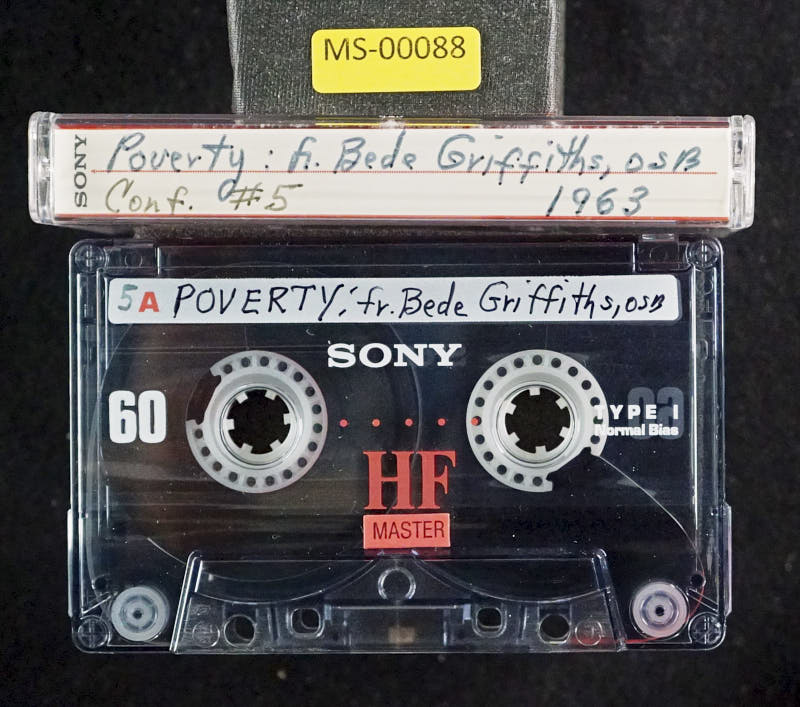
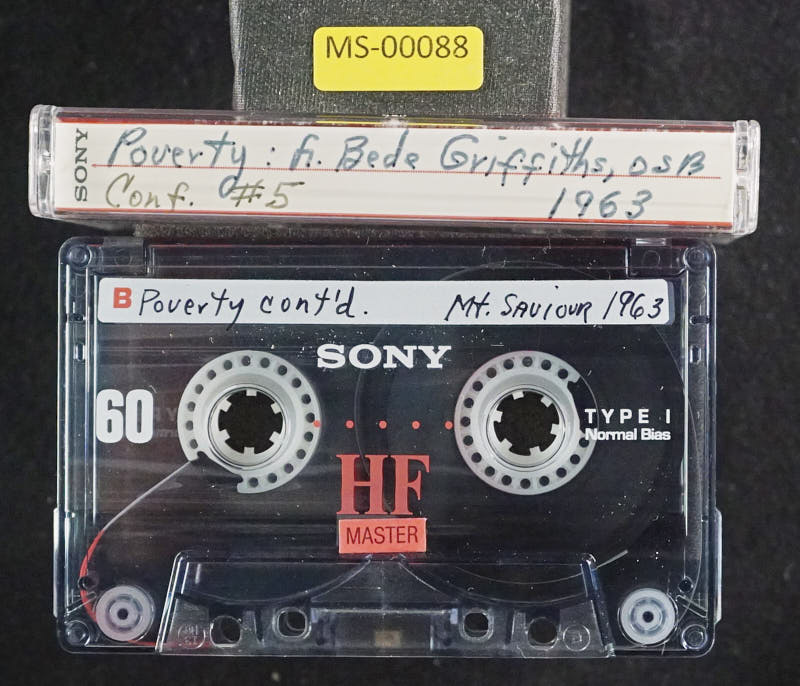
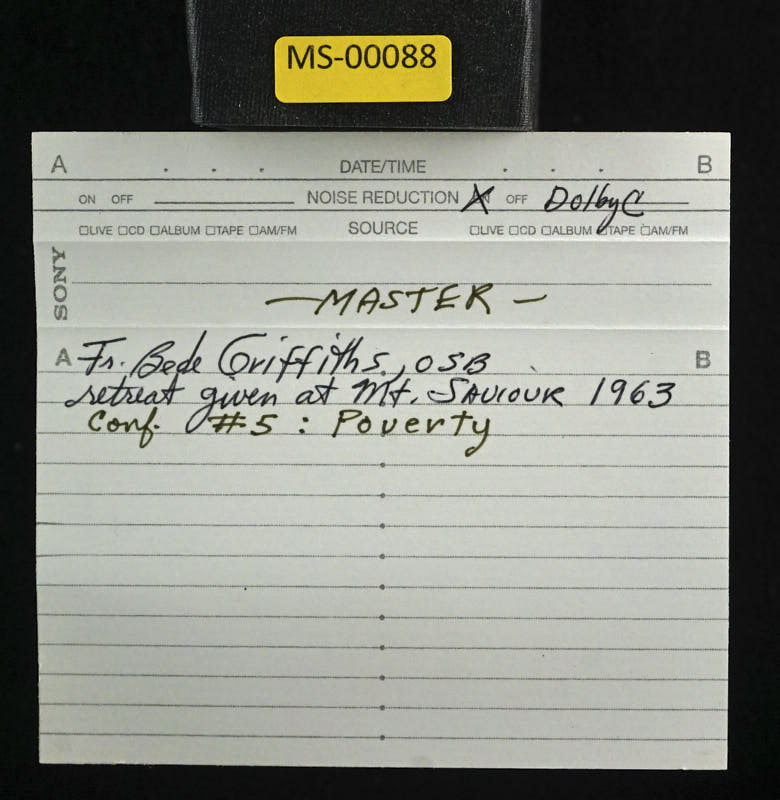
AI Vision - Possible Values from Photos:
Side: A
Speaker: Fr. Bede Griffiths, OSB
Location: Mt. Saviour
Possible Title: Poverty
Additional text: Conf. #5
Side: B
Speaker: Fr. Bede Griffiths, OSB
Location: Mt. Saviour
Possible Title: Poverty contd
Additional text:
@AI-Vision_v002
They said we would try to rethink some of the principles of our monastic life, thinking of the more fundamental principles of the Christian life, of course, govern our own life. But I'd like to rather consider more specifically problems with our monastic life, beginning with that of poverty. And to show you something of the context of the problem, perhaps I'm going to tell you a story of my first experience in India. When I first went out in 1955, I began a monastery, we were able to stay there eventually, in a village outside Bangalore, South India. with an Indian monk who was somewhat westernized in his habits.
[01:02]
And we wanted simply to start a Benedictine monastery with the normal Benedictine rule and with the ordinary Benedictine office. And that in general, we wanted to have the kind of centricity and poverty with which I was accustomed to, for instance, very long street printage. We thought we'd have a sort of basic simplicity of poverty. And I, in my innocence, imagined that there was a sort of general level which one could adopt. And so we bought a small bungler and we put up some cells. And in my cell, I had it, it was very much like a cell I had upstairs. as we all have, simply a bed, a wooden, plain wooden bed, and a plain wooden chair, a table, and something for some clothes. And I didn't think there was anything else.
[02:05]
And I thought this was basic quality of simplicity. And then I began to get to know some of the young men in this village. There were many young students at the university of Bangalore. and they began coming out they spoke English of course and many of them became very friendly and we got to know them and they took us to their house and then I began to discover that there were not more than half a dozen houses in all their village where such things of tables and chairs and beds were known at all what to us was the thought of basic poverty was to learn a rather luxurious innovation from the West. And the ordinary Indian household who simply, and this isn't only the very poor, these families, for instance, my very particular friend who's got very close touch with him ever since.
[03:07]
He actually saw me off when I came across this time. He's a Brahmin family, and they're rather well-to-do. His brother has a very good job, made it an engineering factory. They are a, as I say, a welter to a prominent family. And now, they have outside a sort of parlor. And there was a table and some chairs, and there was even a radio, and that they would receive me. But inside the house, where the women preside, the old mother, then I'm never allowed to go. There I know, because he tells me, and I know from the others, they keep sitting to the old Indian custom. You simply sit on the floor, or on very, very low sort of stool, say sometimes that, but almost on the floor. Then you eat with your hands, and when you sleep, you simply go to nap down. That is the norm in India. Or rather, that has been.
[04:09]
Now, Western customs are coming in, especially among Christians, and perhaps things in parallel. The majority probably now have beds, and many have tables and chairs. But still, these are innovations. And as I say, they represent really a certain standard of luxury. Well, that was really quite a shock to me, and it did make me realize how... difficult this problem of poverty is. Because, you know, poverty still counts for very much in India. I think it's one of the great problems of the Church that, you see, we've come over in the wake of the colonial past, and all the Portuguese who have very great influence, and almost invariably we've introduced the customs of the West. so that in all our seminaries and in all our religious houses, our priests and religious live by Western standards.
[05:10]
Well, you know, to India, the standards, this is very luxurious, and I know it has a very unfortunate effect on Hindus. They often comment on it. They don't disapprove exactly. I mean, they appreciate our schools and colleges, but to see priests living as we do, and having the large meals which we do. And in the midst, of course, of very, very great poverty, people living absolutely on the poverty line, just on the survival level, it does create rather strong feeling. And what is really serious is this, that there is practically no witness to the poverty of the gospel in India. There are exceptions, and I'm glad to say it's principally among monks. I think that we monks have had a conscience about it.
[06:12]
The other orders, of course, you can understand, they are there on some practical mission, as most of them have schools, colleges of some sort. and then you fall into, you're giving a Western education, and the whole standard tends to rise, and so it's very natural. But you can see the problem that the church appears as a great organization, and it does not appear as a place of holiness, nor does it appear as a place of prayer. They really don't know that we pray at all, for the most part. They only see our priests in schools and out in the streets and so on. And even if they did penetrate in, I don't know that they're deeply oppressed. I don't know. [...] The church is making all of these very, very religious people. And you see that behind all this modernization in India, there is this immense religious state and this immense veneration for holiness.
[07:19]
Almost every Hindu, and certainly everywhere you go among Hindus, you find people with this desire for holiness and with this veneration for holiness and respect for the holy man. then in their eyes a holy man must be a poor man. And a poor man is a man who goes about with a very sepulchronic, this is the mark of it, and we particularly, we wear this thread-woven cotton, it's very cheap, and of course Rahatma Gandhi gave it a great, though it was a sign of being one of the villagers, you see, you're using their weaving. So this habit, this simplicity of life, he will normally go barefoot, as we do in the monastery, and I just stand outside also, and he will just have his rice meal, and he will never normally eat meat.
[08:22]
I mean, that to a Hindu is very scandalous. They cannot understand how a man who is ready to go and eat meat, But something in it, I think in India, in that time that we saw, meat isn't conducive to a future religious life. They have a theory of certain foods of what they call sattvic. There are three gunners. And sattva is the gunner of purity, of serenity of mind, and of a... a purative heart, you could say. And they think that certain foods are separate. They agree with this way of life. And so that is an absolute rule. The ordinary sannyasi will not eat meat or fish or eggs. And except when he is ill, he may be not. He will create milk and he will have rice and vegetables.
[09:24]
Well, you see, these are externals, but they come for an immense amount in India. They are also the Hindu signs of our early life. And if you accept these conditions, they treat you with the greatest respect. That has been a great discovery for us. When we came to Kerala, we quite changed our plans, and we tried to adapt ourselves in every way to the Hindu custom, sitting on the eating with our hands, speaking on mats, rolling this car, wiggling their foot, and leading the kind of ascetic life to which they've been accustomed for thousands of years. And immediately you fall into their perspective. They understand what you're doing, and they have an almost unlimited respect for it. Most Hindus today will not live this life, and they won't deserve very much to do so, but they have this great respect for it. So you see, I feel that as for months in India, and as I say, it's been rather promising that almost all months have started in India, that has been rather recent, have been making experiments on these knives, some in even greater statistics that we have, so that we are, like,
[10:47]
falling in with their customs, we are making a witness to the poverty of Christ. But I think, surely, for us as monks, that is something very fundamental. We can't eliminate that from our life. Right from the very beginning, the real monk was to make this renunciation of the world and to live with poverty. Well, now, that obviously produces great problems. particularly when you go through the situation in America today. But actually the problems are not so different as you might think, because, I don't know whether I mention this, the Hindu Tanyasic theory is very rarely content simply to live the holy life dedicated to God alone. It's very interesting to find that the majority, as far as I can discover, or certainly a very great number, Lord has said that some kind of total work, some regard of the poor, belongs to the sannyasi life.
[11:54]
I visited a master of a tribunal, quite a typical one, where there was a sannyasi there. He'd been a general of quite high rank in the audience. He had some call and he'd given everything up. that he was living this life, but I found that he had, as usual, they have a woman, in a Hindu ashram, you know, you may easily have married people, and children, and they all mix up, but you're living a relatively religious life. And this was very, he was living a long life of meditation, and this woman who had a debt of tea, And they had a little orphanage and a little dispensary and several other works which they were billing for the benefit of the poor. So I think we can say that into the Hindu idea that this principle of concern for the poor has already entered in.
[12:57]
And there's a beautiful story of Mahapagandhi which I think is very significant and really perhaps shows you how India has taken this line. You know, he said once, my one purpose in life is to realize God. That is what every true Hindu really seeks, to realize God. That is to experience, really, the fullness of life, the very life that he perceives it in his own life. He said, my one purpose in life is to realize God. If I thought I could realize God, By going and living in a cave in the Himalayas, I would do so immediately. And I'm sure he was speaking in the truth. And there are, you know, many of them are sitting in a cave in the Himalayas and living on just wild fruits and things. But, he said, I am convinced that I can only find God if I find him in my neighbor. As my neighbor is the poor man in India, therefore I devote my life to the service of the poor.
[14:03]
but in order to realize God, you see. Well, I think that is very significant, and I think it marks a tendency of our whole age that we don't find it possible now, really, to separate the service of God and complete dedication to God from this concern for our neighbor, and particularly this concern for the poor. And so, actually, in our monastery, we've simply been led to it. We've For some time we've had a small dispensary, which actually, it's been rather a trial. One of the Indian fathers did not be very good at dispensing medicines. They've not studied it except by getting it up in books. They seem to have quite a genius for dispensing the right medicines. And you can't take it. I mean, the last thing, the growing number began to come from miles and miles away. Whenever you start anything in there, that is trouble. If you start to get out a little rice or milk.
[15:04]
You'll have half a dozen people to begin with, and the next day there are a dozen, the next day there are twenty, and if the news gets round, you've got any properties on you. It's quite pathetic, you know, this state of complete poverty. They're just living from day to day. They're not starving usually. They're just enough to carry on. But the moment you have something, very often you get American wheat or milk to go, then everybody comes to get it. So we started the dispensary, and soon we found one father and one brother for taking up the whole day, morning and afternoon, and we thought this was a bit too much, and we'd have to cut it down. But still, we feel that is something which we have to do, and we will probably make arrangements for a proper dispensary later on. But also we found that by undertaking the dairy farm, which we've done for our own support, we were doing something of real value for the whole neighborhood in which we are. This dairy farm, very much on, well, it's not only milk parlor lines of your farm, but it's pulling up directly, and we make it really a good standard farm.
[16:18]
we're working with the government and we are really being able to do some really positive part in this movement for the development of the villages in India which is really fundamental so that you see living our contemplative life seeking this idea of poverty renunciation and devotion to God with at the same time being drawn quite spontaneously and naturally and rightly I think into this concern for the world around us and into this general movement for raising the standard of life. Well, now, I think that is important because I don't honestly feel that a monk can or should try to separate himself from the world in that sense. I think there is a false idea of separation from the world. Sometimes we think that we... We live out in the country, and we don't see a lot of people, and we are, to some extent, independent of the outside world, and we create an illusion that we're really independent.
[17:28]
Of course, we're actually depending on the world at every moment for our lighting and our Daily Post and a million other things which were simply tied to the world. And I think it's very important that we should recognize that. And furthermore, doesn't it mean that the monastery, as the church, is always in intimate relation to the world? We can't really cut that part. And so, when we think of renunciation of world and poverty, I think we must relate it to the world in which we are living. Now, as I say, our world in India, that the particular circumstances of poverty, and we must relate our domestic life to the poverty there. For us to live in the style in which we are living here would be positively wrong in India, because it wouldn't be related to the life of the people around about us. On the other hand, you have in America, you have to relate the poverty of your life to the general standards of America.
[18:35]
And that obviously presents a different problem. But in each case, surely, we've got to be really sensitive to what the demands of poverty are. I mean, poverty isn't just... sort of abstraction, some particular rules which you can apply. It really is, ultimately, of course, and more to that, it's an interior disposition. But as far as it expresses itself externally, it is a living relationship to the people and the circumstances in which we live. And that's why it must always be diversified, and why it's a matter of positive, creative understanding. I think that is what we have to achieve. And I must say, from what I see here, I do feel that you have created here a really positive form of poverty, of monastic observance. It's got it all easy, but in this world of great abundance, I think the Edmites were living in simplicity and in a real poverty
[19:46]
is a very, very important witness, and I think it would be a great pity if monks should fail in that witness. In America, as in India, we are witnesses to the poverty of Christ, particularly to that simplicity of life, which goes with poverty and goes with poverty of spirit and purity of God. So, there is our progress. We can't pretend that we're cut off from this civilization. And equally, don't forget in India, that whole Indian economy will come for stock in a day if it comes to numerical stock. And India is simply dependent on this American age. And this building up of the village economy or the standard of life, as I was saying, is part of this development taking place, which must take place if India is to survive. And therefore, we are involved. in this whole movement of modern civilization is foolish to pretend that we're not or to deny it its proper value.
[20:51]
Therefore, when we say we're renouncing the world, we want to, as I say, to think clearly what we really mean, because I'm sure there is a very deep and fundamental meaning in it, but it does not mean that we cut ourselves off from the fundamental relationship with the world, which really belong to us as men and also as Christians. We are in a necessary relation to it. And that, of course, brings the further problem that in the world today, and in the church today especially, we are all very much aware of the need for the Christian to be, as they say, engaged, be involved in the circumstances of his time, not to be the building ivory car, not to be setting themselves apart in a ghetto, but to be entering into the life of the people, and actually transforming their life. And I'm very conscious of that in India, and I think we have a wonderful opportunity there to cooperate with this economic movement, with this tremendous social movement, you know, this breaking down of cost, which is going on all the time.
[22:01]
absolutely transforming society. It's very slow, and it's very difficult, and sometimes I think the Christians can get to the extent of the best example. But all the same, that social revolution is taking place, and the church should be at the center of that revolution. We have principles there, and which the Hebrews recognize to some extent, which are of incalculable value to them, so that when engaged in the economic and the social a movement which is going on, and even in the political movement. This democratic order is an order which enables us to live our life with the greatest degree of freedom. We can't be unresponsive to that. And so also, therefore, for you in America, you have to live a benedictive life, an elastic life, on the traditional foundations, and yet in relation to this vastly complex civilization, this very high standard of life, this very interesting and profound social evolution which is taking place, and also political evolution, so that I feel as monks we must be aware of our relationship to all this evolving world.
[23:17]
We are in the center of this new world, which is really very, very exciting. I'm sure you'll feel it, that you've learned so much here because it's all been going a long time. When you see it getting underway in a country like India, when you see the invisible property, I mean, don't forget this background of life you see, just the next door to us, wherever you are, within a hundred yards or so, practically, you will find people living on a subsistence level, they're just surviving from day to day, and their polity is simply basic, not in the sense which I imagined when we made that monastery, but in the sense in which it has been throughout history, a little hut with map walls, with an earth floor, and with a palm leaf roof. That is the basic pattern throughout India. You know, 80% of the people are living in villages, and, well, I don't know 80%, but 60%, I think, of the houses and cottages in the villages are on that pattern still.
[24:23]
Simply a little mud path to an earth floor and a palm leaf roof. And that is the utter simplicity, you see, the utter poverty. of life, and that is the basis of the whole life, and that is what we have to keep in our lives that we relate it to. Well now, as I say, in America you've got to keep your relationship to this whole complex civilization, and yet we have in the midst of this wherever we are, to make our witness to the poverty of Christ and to this great principle of renunciation of the world. And I do think that that should be really, very fundamental in our lives. I think we all take as our platter in this, the call of Abraham. That is really the basic call, get thee out of thy country, thy father's house, and the van that I will show thee.
[25:24]
In a sense, of course, That is a basic Christian call. There is a sense in which every Christian is called to reduce the world. Of all, we made that pronunciation at baptism. And this word, the world, of course, it is somewhat confusing. Most of all uses it. And the New Testament, generally, they have this rather particular sense, just with the flesh. They don't mean the body as God created it. So with the world, they don't mean... human culture and civilization in itself, they always mean the world and the flesh as they are concretely under the dominion of sin. That is the sense in the New Testament, isn't it? So this renunciation of the world, this renunciation of this human order, insofar as it is under the dominion of sin, which of course is very real and very deep. Wherever we look, we see this dominion of sin going through human civilization.
[26:26]
And I mean, to an appalling extent, materialism leading to eight years of which runs right through modern society and which extends wherever it goes, wherever you get a big mobile city in Long Bay or Singapore or Hong Kong or Tokyo, the same effects immediately become apparent. People dragged away from their traditional religion, losing belief in God, losing belief in moral values. and giving way to this complete materialism. So the reign of sin is only too clear in the modern world. And yet, of course, we constantly renounce that world as a whole. And that is a kind of simplification which I think we're sometimes in danger. And the real difficulty is, isn't it, that Life is never like that. It's never black and white. You always were in it. Whenever you're starting to condemn something and this is positive evil, you immediately find some good in it. And whenever you're trying to say, now this is positively good, you immediately find some evil in it.
[27:29]
I mean, take sort of classic opposition of the church and communism. You would like to find that communism was wholly evil and that communists were bad men. then we could think of them as the enemy and we could try all the Psalms too. But immediately we tried to do that, then we discovered it's Canada, India, most of the world, yet calling the fact that the Christians are so awful on the side of the bridge and are being positively... are refusing to accept the elements of social justice and the communists are coming in, and are simply the only people who have any real concerns of social justice. In general, it's a terrible fact. We had an example. I don't want to take a tour of my short-term stories, but perhaps it helps to give a human background to my retreat. We have a terrible example of that in our monastery. I won't mention names, but a very good Catholic landowner gave us the property of our monastery.
[28:36]
And he's a very good friend to us, and in many ways he's a very nice man. And we're very good friends. But he had about a thousand acres there, and he gave us a hundred, which was very generous of him. But he had three hundred acres under tea. which is worked by coolies, that is, for laborers. And he's been cultivating this now for years, or maybe less, could many years. And these people have been working for him. Well, now, you know, the daily wage of a laborer in the tea estate is, it's a statutory wage, is about, I always forget, 2 rupees a day. That's about... 40 cents a day. Now that is a basic wage, and that is not a bad wage. He can live on that, particularly the women work, and the children work, and the whole family could do fairly well on that.
[29:38]
But you know, this lad owner never paid his goodies that minimum wage. He invariably gave them what is called store cash. At the end of the week, He told them, I can't pay you, I'm afraid, but he'll give them just enough to buy provisions for the next week. And this went on from week to week and month to month and year to year. And by the time we came, he was earning those people several thousand rupees. He left people on an absolutely suggestive level, as I say, with a minimum wage and a very sincere Catholic going to Mass every Sunday and contributing to the funds of the church and giving a land for a monastery, and yet feeling himself perfectly justified. He never felt there was anything wrong with it. And I tried walking with it once, and then no relief. What was anything wrong with it? She said, I haven't got the money. which is probably true, but it expended all on lots of other things he was more interested in. But he simply didn't acknowledge the interesting fact. The only people who came to the rescue of those bullies were the communists.
[30:42]
The communist MLA, the member of the elected assembly, came down there, he studied their case, he took it to the court, and he brought a case against this man. But he, of course, was very rather very influential fellow, and he was defending his case very strongly, and he told me, I'd not let these fellows take the paper off me, and he was telling to act the case against them. But luckily, we were able to settle it. One of our children's fathers is an extremely good man. One of the best priests I've learned in his understanding of the coolest Particular Communists have a lot of experience, and these Communists, you know, are perfectly simple, good men. The only reason they're Communists is because the Communists are inclined to help. There's no ideology in it at all. And he had the confidence that these men, and we managed to get the son of this landowner to come speak to the Communist leader as they get in our forestry, and they came to an agreement, and the money is now being paid.
[31:48]
Well, that was simply good fortune. We could have done it without this particular fellow. But that is an illustration of what is happening all over the country. That you've got these rich landowners with no sense of justice, and the only people who will do anything on the list. So as I say, as soon as we try to face a situation, I kind of think, this is evil, this was before, this is the work of the devil. We immediately find... Something like that. See, and on the other hand, when we think of the church, when we think of the work of Christ, this is where we can give our whole support, and we find the church in the representative, not many daemon, but often priests and bishops. on the other side. So the complexity always, it strikes me more and more that this complexity of life and the necessity of making concrete judgments, not in abstractions, you see, communism, Catholicism, but the real situation of people here and the factors involved in their lives.
[32:52]
So there, I think, is where we have to face this modern civilization. You can't say it's good and you can't say it's bad. It's got this complex of very, very profound evil in it, whether it's communist or whether it's capitalist, there are tremendous forces of sin and of evil in it, and we should be deeply aware of that. At the same time, Iran, you see it's so extraordinary in America, this mixture of terrible evils with less wonderful good. marvelous forces of good that we've released. So, we have to place ourselves and our domestic life in this concrete setting of good and evil as we see it. And now, as I say, I'm fully convinced that in the midst of this world we have this witness made of renunciation. Like Abraham, the Christian is called to renounce this world, this powers of evil in this world, which are continually shaping the whole destiny of the world, of the nation, these forces have to be renounced.
[34:03]
And the monkey is called to make this renunciation in a very positive sense. There is for each of us, isn't there really a conversion, a time when we do really turn against the world? And I would say at a certain phase, we have to make a total conversion to God. And that means that the whole of this mixture of good and evil, with all it involves, we do at a certain stage, I think, renounce. We say, I give myself totally to God. And that perhaps is our monastic vocation, isn't it? That we are trying to give ourselves totally to God and then to renew our life totally on that basis. So that in a sense, the monastery, monastic life, is a new beginning. It's a kind of recreation of the world. But I think that perhaps can define our position in the world today, that these forces that they are, forces of good and evil, the church has to be at work in this ferment.
[35:08]
with the forces of God, but really trying to bring the Christian leaven into the wholeness of modern life. But within the church, there is the place of the monks of the monastery, and they are called to a more profound renunciation, and to a more profound beginning again. Don't you think that there is in our life something basic? We go back to the then. We go back to build up our life from its basis in the dead. I mean, you can have had this experience with your farm, and we know what the labor and the trial and difficulty is involved in really trying to go back to basic things to start your life from scratch. That is a wonderful, fantastic experience to start off with everything provided, and all the amenities of life. We don't have the real monastic experience, and that's why I'm eternally grateful for this experience in India.
[36:12]
It's a bit harassing that sometimes, I'm sure you've had to say, you're sort of not prepared for all the... all the demands made on you. I remember some of them. There was no road when we first came, and we had to ford a stream and try to tilt it to the monastery, and there was no means of carrying anything except in the Indian way on our heads, and so we transported our whole library on our heads from about two miles away across the stream and up the hill. So there are many demands which one has to meet. And then again, you know, it's very interesting because the caste Hindu will never do work of that kind. And when they saw us getting these things in our head, they said, oh, father, you mustn't do this. They were very shocked. And some of our Catholics were, too. But we feel it's very necessary in this program, a nurse, to show that there's no work that we're not prepared to do.
[37:18]
And we work alongside the coolies. You see them in Indian ordinary establishment. You employ some coolies, and then you have a caste issue or a Christian And he is in charge of them, but he doesn't really work. He just stands by with a nice clean shirt and dirty, an umbrella of rain, and he tells them what to do, and he sees that they're doing it, and he collects the money and pays them and so on. It's a very responsible job. and they often do it very well, but he doesn't really work. I mean, he wouldn't be seen dirtying this shirt or anything like that. And so it's a real revelation to them, to see us, and we all do, from Dr. Thartum, doing all the dirtiest work ourselves, and cleaning out the cow shed and all that, this, this. So I think that again, it's a really important aspect of it. So as I was saying, as Americans, we are called to this, like the basic work. We start from scratch again, we build up from, and I think a monastery has a necessary connection.
[38:23]
I don't know whether you agree with the land, I suppose I can't say absolute universally, but in its tradition, surely, with the Benedict himself and all the early spread of monasticism, it builds up from the land, from this basis, which to me is important in this relation to nature. You know, there is a basic human relation to nature, as we're seeing in the Garden of Eden, the original plan of God. And I feel that in a big civilization like America, which is tending to lose that, it's rather necessary that some people should be preserving it. See, it isn't good when you simply begin to live in big cities and you lose this relationship to nature upon which, well, we all prepare for you. They have to come to us for their local bread and everything else that pretend that is there. So we do start from this basis, this wrap of fundamental simplicity and poverty and labor. You see, I think this is all a wonderful vocation in this present world.
[39:28]
that they should see people of all different kinds and classes and callings coming and sharing this work. And that is where, again, I think, in your monastery, as in mine, in England, and also in India, this principle that we all share the work alike. We all come to be monks, and whether we're priests or not, we take our part in the daily work and share and share alike. I think all this is to fundamental to our monastic calling and our witness. Now, that I think is the basic matter to poverty. Now, I'd like to apply it a little to the detail of our own personal life. Obviously in this, the important thing is to have this deep inner spirit spirit of renunciation.
[40:35]
And I think when we come to the monastery, when we renounce the world, we have to make a very, very deep back for detachment. I mean, it's quite true, we know we're going to have the necessities of life normally, we're going to have even some of the amenities of life. But we do need to make that radical conversion, that real act of committing our lives to God. I think that's very important that God may provide, because that is the principle of a monastic life. We commit ourselves to God, and we expect that God will provide. And, well, I expect you've experienced it, and most monasteries do in their early stages. You do depend very much on divine providence from day to day. I had a very interesting experience, the monastery in England in that way, where we were... I was at the start, and we were building up, and we never... I think the Grand Providence did it on purpose.
[41:36]
We never seemed to have... We were always absolutely at the last limit each month. We just survived from month to month. And I remember one occasion when we were going to... We had a large overdrive, and we couldn't go beyond this village. And things had practically reached the minute, and some good nun wrote to us from Africa, and said they urgently needed five pounds to buy a cow. And I discussed it with the bursar, and we said, well, now, we must trust in divine providence. We'll give these five pounds to bear and see if God won't provide us. But sure enough, the money gave. And again and again went down, and I'm sure this is true, but if you trust in divine providence, you may be led through all sorts of straits and difficulties, but you do hide that God provides for you in the end. And that's a very important lesson for the monastery. And I think, as I say, for the individual monk, to have that sense of dependence on divine providence, and to be prepared for emergencies when one may be deprived of things.
[42:48]
Michael Glenn and Father Francis Bruce, in the war, his monastery was taken over by the Germans, and they were simply dispersed. they managed to get together in some place, but I mean, these things do happen in the world today, and we should have that sense of dependence on providence which will carry us through in extreme difficulties. But so then, with a basic sense of detachment, we have to bring it into our daily lives, and then in the life of the monastery, we have to find each in the bedroom and the monastery as a whole, that kind of poverty, which is suited to our state, to our place in the world and to our place in the monastery. And in the matter of food, in the matter of dress, in the matter of furniture, in the matter I think is very important, of public buildings and of a church and so on, it is obviously very great scope for diversity, but surely at the basic level of poverty.
[43:53]
Actually, your church is to be a model of that, really. I mean, it's got a basic simplicity, poverty. I must tell you one rather amusing story. My grandfather, little kid, Evans, the Dominican. He's very, you know, church architect and a rather modern style. And you know, the Archbishop of Los Angeles is building a new cathedral. Yeah, it's a subparter, but... Father Lucifer was introduced again or not. I had a conversation with him. The Ausbishop asked him what he thought of his prayer for the fall, if you see, which he thought. He said, do you want me to say what I promised you to take with all your support? He said, well, I think I have sent care for you. The bishop said, well, you know, I don't know anything about architecture at all.
[44:58]
You've just been given me recently. You've been telling me what you think. And the Father Luther said, well, I think the principle on which you ought to build is that of holy poverty. The Archbishop said, I've got $15 million for this critique. Then Father Luther explained that holy poverty is that... A bright use of a cherry was using cloths, getters, garden, cake, and a piece of concrete, looked like a bit of marble, or anything like that. It was still a piece of work. And at the end, he said, the art bishop of Therese, he seemed to be quite converted, and he even suggested an extremely good article, the one who built the church for the priority of St. Louis at St. Louis. Japanese architect, so you may see something quite wonderful.
[45:59]
Now, you see the point that there should be inner church. It's an expression of all this augurty, this simplicity, with the spirit, of course, of worship and of honoring God. And I think we're learning that. I mean, I think we now have a a sense of its wrongness or cheap display, and that the architecture of the church should show forth the real meaning of our Christian life and of our monastic life. And so also with the monastic buildings, not the hamperate, ornate buildings, and particularly, I think, very high buildings. I like this idea of keeping things low. It gives that book a good impression of humility. So, there we are then, with our dress, with our food, with our clothing, with our furniture, with our buildings, and particularly with our church, and our church furniture, and everything, and this principle of poverty, and of simplicity, and of a dedication to God, you see, after all that is one of those things, should be regulating everything.
[47:15]
And then, if we have that fundamental spirit of poverty that we are, It indicates to God that we've really emptied ourselves. You see, that is the real basis of poverty. It's to be empty in one's own heart, in one's soul, so that God can fit it. You know how Pastor Eckhart speaks so wonderfully of this emptiness, this poverty of the soul, which, as long as you've got any possessions of your own, God can't come in. Only when he sees you naked and empty and poor... and God come and take his place in your heart. Well, so it is, if we have the basic simplistic poverty of spirit and of heart, then it will express itself in our lives. We shall find the right way of doing things in the monastery and in our personal lives. And just to conclude, I think each one, each individual man has to exercise his goal spirit of poverty. You know, it's quite easy to collect things, and even without intention, simply by routine, things do collect, and one gets exceptions and certain things, and so on.
[48:27]
And gradually, one can find one is making a kind of separate place for oneself in the monastery. And that, again, I think you have always to be aware of it, to be, we used in our monastery to have a poverty list. We made out of the year, the length of the cross, that gave it to the year. But what do you want to do this? It helps to. But it certainly was a peck when you wouldn't have to go around the furniture for your cell and to put down in writing where she got the nose of scrawlery. How many people do you know? Yeah. And it was quite an opportunity to get rid of the unnecessary. So that kind of works for this. I think we all have to exercise in our lives what's a really called the vice of private ownership. It always, as I was saying, we've got to be vicely deep in our nature and it's a very strong impulse in our nature and we have continued to be upon our guard against it.
[49:30]
But if we have this basic spirit of poverty, if we're really seeking God in this emptiness of soul, in this real radical detachment of the world, so that in a very real sense, though we're related to the world, though we're prepared to pay our part in the world, yet... Ultimately, we don't depend on anyone or anything except God. I think we must say that, I mean, I've said all this about our relationship to the world and our need of recognizing it and playing our part, but in the ultimate ground of our soul, we have to have this complete dependence on everybody and everything. We have to be simply... naked before God alone. As St. Benedict says, the teaching of the Church tells us to be prepared at every moment for our death, where we are simply present with God. That surely must be basic in our life. And if we have that, then, as I say, it will radiate into our daily capital life of the monastery, and it will radiate from the monastery into the world.
[50:39]
And I do think we have a predicted response real reputation to transform society, as Benedict himself did, from this basis, the hypocrisy, simplicity, of dedication to God, that this should radiate out into America, into this modern civilization, and bring about that balance, that harmony, which in prison it doesn't possess, and which it needs really very, very seriously. And there is our positive contribution as monks to the Daleks.
[51:12]
@Transcribed_UNK
@Text_v005
@Score_90.09