You are currently logged-out. You can log-in or create an account to save favorites and more. more info
Monastic Pioneers of Western Spirituality
AI Suggested Keywords:
Monastic History Seminar
The talk explores the significant monastic influences of St. Martin of Tours and St. Benedict, highlighting their contributions to religious life and Western spirituality. It posits St. Martin as a prototype of monastic and episcopal activism, with a detailed analysis of his portrayal by Sulpicius Severus as a cultural and spiritual pioneer comparable to St. Anthony. Conversely, St. Benedict is depicted through Gregory the Great's "Dialogues" as a model for later medieval monastic ideals, emphasizing his role in combating spiritual and existential challenges. Both figures are positioned as central to understanding monastic development in Western Christianity and their lasting impact on ecclesiastical traditions.
- References:
- "Vita Sancti Martini" by Sulpicius Severus: This is presented as a critical early text detailing the life of St. Martin, accentuating his role as a monastic leader and his impact on Western spirituality.
- "Dialogues" by Gregory the Great: Specifically, the second book, which outlines the life of St. Benedict, is highlighted. It is portrayed as a foundational text setting monastic ideals for centuries to follow.
- "Vita Sancti Antonii" by Athanasius of Alexandria: Referenced as a comparative model for monastic biographies, it sets the precedent for the portrayal of monastic virtues and spirituality, paralleling the accounts of St. Martin and St. Benedict.
AI Suggested Title: Monastic Pioneers of Western Spirituality
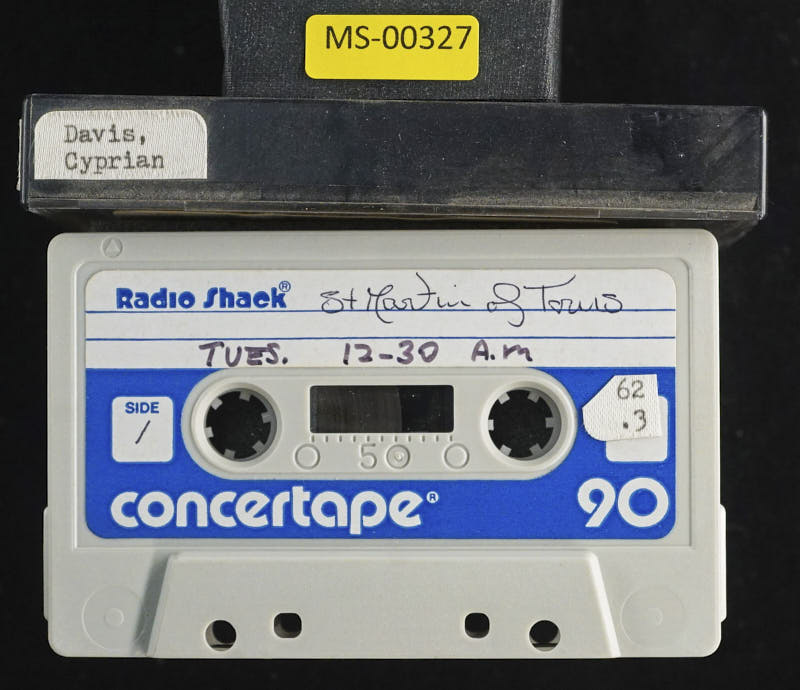
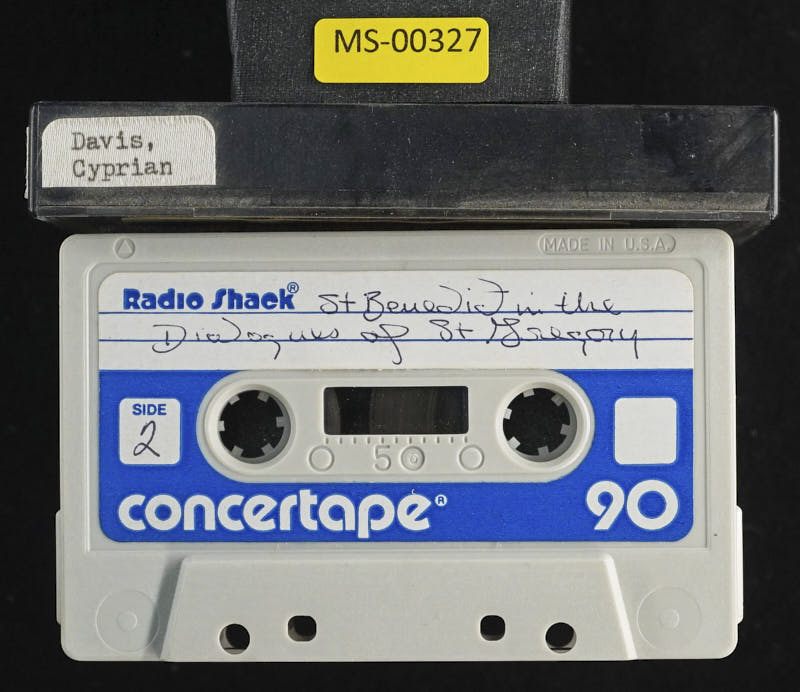
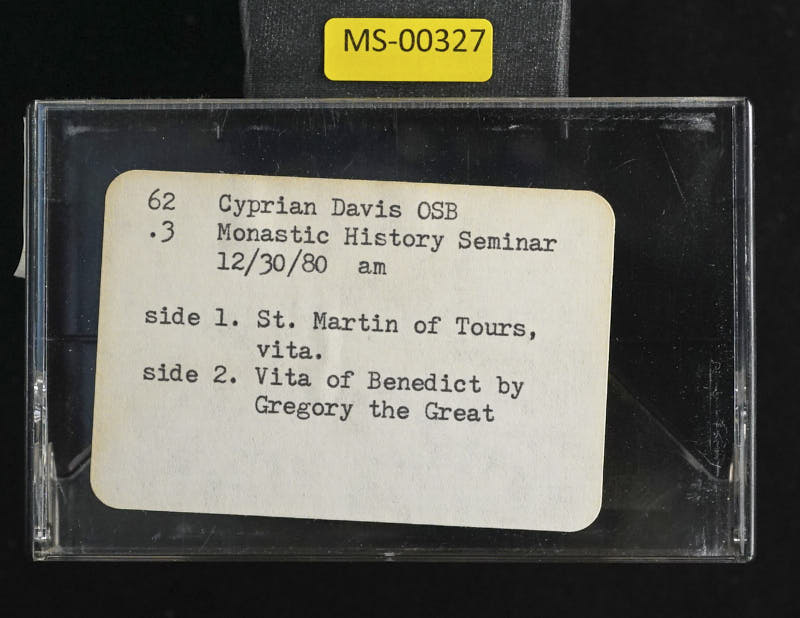
AI Vision - Possible Values from Photos:
Speaker: Cyprian Davis OSB
Possible Title: Monastic History Seminar
Additional text: TUES. 12-30 A.M
Possible Title: St. Martin of Tours, vita
Additional text: St. Martin of Tours
Possible Title: Vita of Benedict by Gregory the Great
Additional text: St. Benedict in the Dialogues of St. Gregory
@AI-Vision_v002
to the day of two monastic saints. It certainly would be understandable that to take a look at the history of monastic spirituality, have any kind of perspective on monastic spirituality, one would have to deal with the life of Saint Benedict as given to us by Gregory the Great in the second book of the Dialogues, but it might not be so clear as to why I would make the first choice, namely that of the Dieter of St. Martin of Tours, because in a sense probably we don't think of Martin of Tours, of course we don't think of Martin of Tours at all, we don't think of Martin of Tours as being particularly monastic. And yet, probably, of the two works, the vitae magna tua, from the historical point of view, from the cultural point of view, and perhaps even the ascetic then, from that point of view, is more important.
[01:20]
And probably had, and maybe, well, it would be a difficulty to gauge the impact. But if the vitae magna tua had as much impact on the religious, cultural, and spiritual history of our Western civilization of St. Benedict. My nature is roughly contemporary with caching, with Ilegria supportive. My nature is a pioneer like Anthony. He is a symbolic figure, just as Anthony was and just as Pacomius was. And my nature is also a kind of a kind of answer, a response.
[02:27]
First and eternal, the life, the written life, as a response to Anthony and to Egypt and his monasticity. It is the answer that Gaul, too, has his great Anthony. It has his monastic lever, his spiritual lever. And even more than this, he is also a great bishop. And in Sweden, Martin Luther, not only sort of a Gaelic answer, but also a trendsetter, a prototype. It is what a holy bishop should be. In the same way, the life of St. Benedict is somewhat perhaps not as very, we do not get the the definitive sort of apologetic tone because the wife of Martin definitely has an extra grind and people to get people to attack more than just the wife of the thing he's also about to get those who are against it and the grind is still in a lifetime of the same but when he was in life of Benedict
[03:56]
It is not so much fresh and definite apology or defense of a saint, but it is also a sense that Italy, too, has her answer to other places which can bolster their holy men and women. Italy, too, can both. And we have these saints. And among them, most particularly, is this man, blessed both by life and in deed, and that is Benedict. Réveille à Saint-Marc-de-Naturre, been written by Sopetius Rivera. It has been, you'll find a French translation in the Sources Crétien, published in 1967. It's a very, very thorough study by Jacques Fontaine, in which Jacques Fontaine gave a very good introduction.
[05:08]
Introduction particularly in regard to the life of Sheprofegius Severus himself, who is a very, very important individual, and then to look at the whole question of the documentation of the detail of Saint Martin, its significance, and then its later history, and then the text, Latin and French, and then a very, very extensive commentary, with volume and a half, probably a two-lier commentary on the life of Rita itself. Very well done. Pointing out that this life, written by Sopcici Stavari, It is in itself a kind of literary masterpiece of the period. A work that you might find interesting is a very recent work published in 1980 by an Englishman named Christopher Donaldson, simply entitled Martin of Tours, London with Richard Keaton Hall.
[06:28]
It's very well done. It's popular, but depending heavily on Jacques Fontaine and others, Donaldson has reconstructed, in a way, the gall and the Europe of Martin Luther's lifetime. And he looks at Martin precisely in terms of his vocation. And I think he does a very good job as parish priests, as bishop, and finally as Mark. Because, you know, we're in Martin, it was all brilliant. That's one of the intriguing things. Martin comes to us as a prototype of a type of monasticism and a prototype of a certain kind of apostolic activity. And he's both now intertwined. What was he going to do? And to some extent, one must be part of the other.
[07:32]
And that's why Martin is a very interesting figure. So, Peter Severus himself was living what was not exactly called a monastic life. He was an ascetic. He had been married probably after the death of his wife. Cresus Severus retired, who was very wealthy, and he belonged to the Gallo-Roman aristocracy of Gaul, the 4th century. After the death of his wife, he followed the example of several others, among them, of course, Strenson Colline or Fignola. And he retired on the whitewood stage, not living exactly in poverty, but still living a life of simplicity, had a certain rigor with only a servant of And, uh, very, with, uh, with more praying prayer and so forth, he, uh, gave himself up to prayer and notification.
[08:40]
But also, he had a very sharp time. With a man, he had been trained in a period of the barbarian invasions and so forth, I'd have a decline in learning. The man still knew how to write Latin, knew how to observe the in the uh... the project, the Latin project, he would have read the prose rhythm, who was a man of a certain amount of culture and background and refined it, uh... educated. And he, through his mother-in-law, Dasulia, who was a very devout woman too, also one of the very wealthy women who had ended up on a library of athleticism. We become interested in The Bishop of Tours was something odd and different from the other Dalek bishops. And in fact, he meets him and talks with him and he then takes up the cudgels on his behalf because Martin Bishop of Tours was not at all a retiring individual, uninvolved,
[09:57]
Unconcerned, he was more or less, you know, take a count because I see all the power, whether he liked it or not. And a kind of person who evidently evoked strong support, sympathy, or what a great latest life already had. And he then, Sulpicia Severus, probably righted It seems pretty certain now that he wrote this life of St. Martin at Deweyler before Martin died. Martin was born only around the year 316, dies in the year 397, two years before his death, only very three years in office in Egypt, two years before the expulsion of the originist Greek monks from Egypt. Martin died, and with him died, in a certain sense, the first generation of monks in Gaul.
[11:05]
So that this life by Sopisius Severus then has to be completed with three letters and also a book of dialogues that he himself wrote, dialogues in which he recounted the wonderful events of Martin's life. or as giving vignettes, like the first book of the dialogue was really great, giving little vignettes, anecdotes relating to the life of St. Martin and so forth. In the letters, it is the third letter to his mother-in-law Vasula, who had written a letter out complaining about the fact that, remember, in the early days, Letters were always part of public property. We read everybody's letters. We read it because she wrote it. It didn't meant it to be read, not just the one who told you the dress. Anyway, she'd gotten rid of the fact that he had written his life and that he referred to the death as some margin, but now she wanted some details and it followed him up and letting him know that the death was.
[12:21]
So you then have the Rotary in which you describe it, and it's a very helpful point. And that is the third letter, which really completes the Holy Rotary, which is a mark of joy, which is the three letters at the end of this work. For life of St. Martin, by the Supreme Court of Cigari, is comparable to the life of St. Anthony, in this sense. Whereas Athanasius, in giving a life of St. Anthony, gives a monastic teaching, gives a kind of monastic theology, a monastic spirituality, spells it up, puts it into the mouth of Anthony, whether it was there or not, we're not sure, but certainly he's giving a teacher
[13:25]
that is very definite, that is very precise. But at the same time, he's setting up a model of what kind of monastic life this man lived, or what is really this monastic life. So Pescius Sergari was also writing a life of St. Martin. It is, from a literary point of view, he's also a kind of a masterpiece, well-written, And he, too, is setting out in a kind of a plan, a literary plan, this life of this extraordinary man. But it isn't so much a monastic doctrine that he gives, but he sort of gives away what the ideal bishop would be like. setting forth a sort of Christian ideal, the Christian ideal of the apostle.
[14:31]
Now, he doesn't do it with the same authority of Athanasius, one of the leading theologians of his time, the defender of the page, and so forth. But he is setting it forth as a very learned man, a very educated man, trained in the legal affairs, taking up the cudgels to attack those Christian bishops. And he has very two kind words to say about the bishops who are the enemy of the monk. He is saying, this is what a bishop should be. Now, in doing this, what he also said is, a bishop should be a monk. And that the Christian ideal, the ideal of sanctity, is that of the monk issue. Because Martin Latour is, in time, the first non-martyr to be honored as a saint in the West. So anyway, he is the ideal for the confessor.
[15:35]
And the fact he is a monk is as basic to his episcopacy and to his sanctity as a bishop as anything else. And that is important because, in a way, this has to stage them for the medieval bishop who for many, many years would be a Benedictine monk and lay on a Cistercian monk. But that the monastic bishop, in a certain sense, would be ideal. Which is not at all, which of course is something that no doubt would make many people squirm, I'm sure, and of course the monastic Presidents have only been lately to come with a great strength. But the interesting thing is that this is the norm in the Orthodox Church of Israel, the Eastern Church of Israel, for other reasons.
[16:48]
No doubt. But the historical facts still remain. But what I think is also important is a notion of apostolic life, of pastoral activity. I use the term apostolic life and I may be a little bit, I should be called down for that because the term apostolic life historically always meant initially the life of a lived in common and prayer in common, in other words, a likelihood or a community, which really could be understood as the monastic life, the centipedic life. And only later in our own time did it take on also the allure in terms of going out, preaching and engaging in what we termed the apostles, going out to others and preaching and teaching. administer in various ways, but originally it is to light together.
[17:53]
I certainly feel that earlier in meaning is what was considered the episodic light and ideal at the time, but yet, what does Celestius Severus do when he's describing the Arkham? He's describing him after, as a monk, who goes out and begins to preach to his story. And distinctly in here, as we shall start one hour later, this is exactly what Gregory the Great described Benedict was doing too. Martin, as a priest of the Bears, probably had the veto of Saint Anthony before him, Juanito. In a certain sense, The life of St. Anthony by Atomaceous was his model, just as the life of St. Martin by soplicious, would become the typical model of the life of his brain during the Middle Ages.
[19:00]
The other thing in regard to marking is that not only is he a monk, but he is also what a monk should be at this time. He is a popular hero. This is the hero of the masses. This is the man of the people. And his success was not because of his contemporary or his cultural, or even more opposed to him, but his success was because the common people adore him. Because again, it is sort of, I think it's sort of indicative of that. The monk who is carried along in the enthusiasm of the ordinary people. Now again, no doubt, it's a reason for the saint. The reason for the saint is the dishonor of the saint precisely because it was the ordinary people who acclaimed him, acclaimed the saint. And he would have remained then the popular saint. Not just of France, but the popular saint of Europe. I think it's in terms of the dedication of churches that there are no more churches dedicated to St.
[20:20]
Martin throughout the length of breadth of Europe than any other saint. So what do we have? We have this man who sees the imagination of the populace, a man born probably around the year 315 in the region of present-day Hungary, Anonia then, before the invasion of Magyar, a region that was close to the Linus, close to the borders of the Roman Empire, The son of a Roman soldier, an official, keeping in mind at this time, at the later Roman Empire, a son had to stay within the social rank and the professional service of his father.
[21:22]
One was frozen. In the attempt to deal with the point of part of an empire, the disintegration of a one had to be frozen within one's professional or one's social status. And men, if you, in that way, you prevent the leakage of individuals from poster responsibility, you know, it's really not the case. You prevented people trying to cop out of the situation. And so that, you know, For freezing them in their social rank and status, you can be sure that they would carry out their civic duty. And among them, there would be those with some of the soldiers, some of them had to become soldiers themselves. So that it was quite obvious then that the young Martin would enter the military service. His parents were pagan. He himself evidently became a mechanic during when he was very young.
[22:25]
You find him in one of the Roman armies, the army situated all around the region of Amiens as a young man, and it is there that takes place that famous incident that would sort of be the signature of this man for the rest of the rest of history, namely his encounter with a beggar at the kint of the Sydney of Amiens. the beggar in the dead of winter, freezing with cold, asking him for the love of Christ to give him a warm, taking off his great military cloak, cutting him in half, giving the beggar a hat, and at night the beggar appearing to him in the cloak, announcing that it was Martin, who was only a kind of human still, would be able to be clothed in me, and he was clothed in Christ. And at this, even, and during this, He receives the ridicule and the derision of his fellow officers and so forth.
[23:35]
But this scene, the dramatic gesture, is of course, again, becomes extremely important because it gives us a word for chapel and chaplain and because it's the cup of St. Martin, the cloak of St. Martin, that becomes the relic, and it is the relic of St. Martin, where after the conversion of Gaul is the sign of authenticity for the kings of Francia, for the Meridindian line and the Carolindian line, to possess the relic of St. Martin, to possess the capa. is to possess, then, a right to rule and find that you are, uh, that you are authentic, and therefore the American Indian kings and their displacement all over Gaul, because they couldn't stay on twice foot by that time, and as well as the Carolingian king, as they moved from Villa to Villa to, to, to the city, they moved with them this great relic.
[24:49]
and they would have to set up then your portable altar, your portable worship place with the relic, with the kappa, the place in which it was kept with the capella and the clergy attached to the service of the capella. And so he gives us the English word, chapel and chaplain. And it's significant. This is almost significant kind of wall that Marshall, that Marshall's help played in subsequent history. It is at this time, too, then, that he gets out of the army, is able to get himself dismissed, and to try to begin at least some attempt with an era of medical life that we've seen, where he gets the exploration target, you know, but in Italy for a while, then he goes home to Hungary, tried to convert his parents.
[25:49]
His father, of course, remained obdurate as a pagan, and his mother is converted. He returns then to Italy and eventually to Gaul and follows him, you know, close friends with St. Hillary, who is Gaul's answer to St. Athanasius, the great defender of the Nicene, the great theologian teacher, polemicist, and fighter. And, but he resists the attempts of St. Hillary to be enrolled in, among his clergy, is ordained an exorcist, but begins to live an era of medical life, a liturgia, where excavations have been able to uncover one of the oldest monastic sites in France. And here, Presumably, he would have continued then to live in a cervical life almost now, almost at the same time that the monastic life would be in the article.
[26:56]
People joining him, people joining him, but also being well known to the populace. So well known that when there is a vacancy, absent in the city of Tua, the populace decide he will become the missionary. Again, it's kind of significant, slightly different than what takes place in Egypt, but in the second century different. There is an area which is more highly populated, which is still missionary, and where you still find very strongly the primitive or the ancient exercise of what should, of course, even today, should be a way in which the bishops are selected, namely popular selection, revoked by the clergy with the acclamation of the people.
[28:06]
Here it is the people who take the initiative, despite the clergy, who take the initiative go out to get Martins. Obviously he wasn't going to come, but he knew he was going to make a bishop. So a man tells him, my wife says, oh, I'd like you to come and take a look at her. He's not a priest. I'd like you to come and take a look at her. No sooner is he out, then he's surrounded and like a prisoner. Then Martins took it to be a tour, and Martins took it to the cathedral. and trained by the population. In other words, the clergy who were the ones who had to make the election, that would be the neighboring bishops and the clergy attached to the cathedral, had found themselves before what would be a coup d'etat. Mainly you have this population who would insist he'd got to be the bishop, except no other.
[29:06]
and of course you aren't to worry about what they're mocking themselves enough because they don't worry about those things and he had many many people all through all through early history where the man was ordained with and no one cared what he wanted and not because he brought him there and ordained him. We have the same instance of the skylight of St. Daniel was skylight. I didn't mention skylights yesterday. Daniel was skylight on his column in Confidential Noble and the Emperor of the Society is going to become a priest and the bishop said if not come Lord Daniel is have nothing doing And so they say, you can't wait forever, and the man will let down the ladder, and you can't get up to him, so he doesn't allow ordain you from down here. He was ordained. He didn't worry about those canonicals. But the objection to Martin, of course, was interesting. In the text of this, of Sopisius Severus, there's
[30:08]
Why? The objection to Martin on the part of the neighboring bishops was, by and large, the fact that, first of all, he was unkempt. His hair was not tidy. His clothes were dirty. In other words, he did not dress and look the way a bishop should. What is interesting is that he looked and dressed the way a monk should. And I think it's interesting. In other words, Martin was affecting, this is the indication, of the kind of Mark Woodmore. This is still the fourth century, but he was affecting, it would seem, the sort of lifestyle and dress
[31:09]
and appearance that began to be typical of a certain kind of monastic aesthetic. Not too plain, certainly not wanting to be in our bourgeois, anything that background would appreciate. But remember, remember that our early monks were not would not have been acceptable in our living world. But I think that, I think you have to keep that in mind. Now, I think you have to keep in mind that early monasticism is very much of a, you know, I hate to use the term kind of culture, but that's certainly anachronistic. Why did you want to understand it? It is that. And margin is not acceptable. That's exactly what a bishop's own was. He didn't look like a bishop. He couldn't have a man looking like that. of a man with the attempt and soiled and so forth [...]
[32:39]
that would give him quite a month could become, and did become a popular figure. And Martin is kind of a quick example of that. As soon as the election takes place, and the bishops are sort of faced with the federal country, it is proved by what Martin recounts as a sort of diminutory act In other words, the, the, uh, the liturgy was to proceed with the singing of a song. There was the, the cantor, the lecture was to get there in order to be able to sing, and he couldn't arrive at the, at the amble, and so some other member of the clergy. All of this may very well have been carefully orchestrated and arranged. We must not, we must not be naïve enough to think that it was all left up to chance, and that these people were just, uh, sitting around thinking. No doubt. the populace and the clergy who wanted Martin knew whom they wanted and knew how they were going to get him and how they were going to keep him.
[33:48]
But at any rate, when Rector arrives, someone from the clergy assembled gets up and seemingly, by chance, doesn't, can't find the right place and falls on the side of the body and reads the text out of the mouth of babes and infants. You have perfected praise and have touched the avenger You'll crush the enemy and the avenger at any rate. The text, of course, was a Latin text, not of the logate, but of probably of the old Italo. And where in the word for, I think you can do with the term avenger, is detensor in the Achievement, detensor. Detensor was the main one, the bishops, the bishop. the bishop who was in opposition. And this text was a divine sign that Martin's election was the right one, and that it appears to be there in the book now.
[34:55]
Now, all of this seemingly happened by chance, and this, of course, the ancient sawtale. As you know, one of the ways of divination is to find a text. In scripture, Christians would use scripture. You also had, you also could use Churchill, but by finding through an individual who was supposed to be clear enough to allow you to arrive at the text, you let a knife fall or a dagger or something on the text and then you will, those scripture texts will indicate to you what is right, which should be done. In other words, it's a form of regeneration. An ancient form, condemned many, many times, but used, and would be used by, you know, clearly asked to put it. So that in a certain sense, this was to be divine sign.
[35:57]
Martin was a man, and he had many, he had been confounded. He probably had fixed it. Oh, he probably did. But the people saw it. The people understood it. And they appreciated it. And they knew who the friend so was. Martin as bishop remains a monk. That's the constant theme then of the Ephesians of Eric. Martin as bishop remains a monk. And in a certain sense, Monaster's decision is fully realized because it is outside the city, to it, that he built then or the springs up, the Monastery of Magnuthier, where we don't know exactly what kind of monastic life was led. Martin lived there much of the time without living at a cathedral that was around the world. And there was seemingly a large community, the Yenka Jawa, many members of his
[37:04]
of the senatorial families of southern Gaul. They are engaged according to Pichus Severus. There are those engaged in living the life of Hezekiah, living in the living rock, cutting the fire of the hill. Others constructing built cabinets. In other words, it's a kind of a hermitage, a Laura-type monastery. Others engaged in copying manuscripts of it. others engaged in a copy of manuscripts others engaged in preaching others engaged in preaching others engaged and we get ready to become bishops because many many future bishops of God come out of that monastery, not in the T.A. but this was Martin's monastery now Martin of Tua himself lives there for a while is living there as their father is acting as bishop to Tua But he's also missionary.
[38:06]
And of course, again, he's on the road constantly. And so much of the rest of the life part of the Vita of St. Martin recounts his peregrinations, which in a certain movie that he took him to, all over God, outside of his deity, performing wonder, casting out the In other words, Martin meets the devil in the way he also meets the devil. Casting out demons, correcting, working wonders, healing. He is a wonder worker. He also is able, and his conversion, his acts of converting others, is confrontation with the pagan gods who are not the demons. and these wonderful confrontations that take place. All of this is very much popular in a way. He seizes the popular imagination in his confrontation with the remnants of the Druid religion in Angola.
[39:14]
But he also is sort of showing the activity now, the spread of the church from an urban phenomenon, which is what the early church always was. with an urban religion, to the countryside, where the pagani, who dwell in the pagans, the countryside were, the pagans, the inhabitants of the countryside. In a way, Martin is considered to be the apostle of Gaul, and he is certain of that, because he takes Gaul to the world pope, for people. At the beginning of the establishment of this church, which Remember, the church was always geared and built for a city. And it's not really structurally made for vast territory where people are living on land. And he does that. He does help begin, then, the setting up for the world parish.
[40:20]
The parish system was a section around the community. He's also important in terms of the heresy, the resilience problem and so forth. But remember that Martin does not get along with electricity. Martin is not, he's not one of those who will get along and work along without it. He's not a young, he's not a keen man. He's to some extent, odd man out. And that's why so peace is very nice to come with his parents. largely not one of the boys. And in the affair of the Presillianist heresy, which is Presillian with Bishop of Payne, probably Gnostic, probably Gnostic, the desire on the parliament of the bishops to see to it that he gets properly, that Presillian is brought to trial and that he has properly dealt with it.
[41:23]
The emperor in Gaul at that time raised, therefore Maximus Maximus wants to do the right thing, wants to put Viget on his side, because he wants to maintain authority. And he's ready to put man to death, too. And he insists that Martin that the emperor should not have been in an ecclesiastical manner, and that death should not be . The interesting thing, all this is still in the fourth century, the same century in which Constantine had been is dealing with the Donatists and where Augustine has finally decided the only way to deal with people like the Donatists is to use the sword and finally has agreed that you've got to repress heresy with force. Martin, popular hero, not at all a theologian, not at all really a man of the... he belongs to the group.
[42:26]
Martin more charismatic in a way, more, and still, you know, still basically monk-type, non-conformist, he will go to his grave, derailing the fact that he dared to take part in the Eucharist with the bishops who wanted to put Priscilla in the death. And as a means of trying to save Priscilla in the last month, he thought he was doing that. And he told in the end that he had betrayed his principles. But the great principle we had was no imperial empire in the United States and no debt for heritage. It was kind of interesting. The one last thing I want to say before we break is that Salpicius Havares also, in describing his mind, describing his life briefly, on his apostolic activity, which was particularly a wonderful work with the combination with demons and with paganism, and then also with his fellow bishops, describing the virtues in the end of the last three or two chapters, after describing his own visit with him and how his gracious mark was to him.
[43:48]
And then, I think in chapter 27, when he does a very interesting thing, He makes a description, which I would just like to read. I'll mark him very briefly in terms of thought. There's a set of systems. Ah, this is chapter 26, the last chapter in life. Ah, happy man, in truth. who engaged in no deceit, judging no one, condemning no one, rendering evil for evil to no one. For such was the patience of which he was armed against all offenses. Having the fullness of the priesthood, he let himself be outraged with impunity, even by the least of his clerics, and he never
[44:57]
gotten rid of them or degraded them from their functions and never set them aside from his affection. Never did anyone see him in anger, see him filled with emotion, see him afflicted, see him lacking. He was always the same, always equal to himself. This countenance shining with a joy that one would call heavenly. We had an heir that was the sort of same part of a stranger to human nature. Never did he have anything but Christ on his lips. Never did he have anything but goodness, peace.
[46:00]
mercy in his heart. Often it was even his habit to deplore the faults of those who showed themselves as detractors, while at the same time he remained peacefully in his retreat. Even though their townies tore him apart, called, like so many, vibrant, this is part of that. So he was embarrassed, he did not want, he didn't have, he lacked emotion. It is Soltisius Levarus' way of saying that my hero has also attained this kind of idea. Now whether he is speaking in terms of a conscious understanding of his ideal, spiritual ideal, which at the same time Evigrius was developing, I'm not sure. Yeah, it may very well be, as if he used to bear as well as a politician.
[47:03]
I'm right in front of the alliance to know that. It was more aware of his spiritual time, of his progression in time. I think there is a conscious effort to picture that this hero has also had a team that was fed up. And he's a... One of the things that I forgot to mention in looking at the life of St. Martin by Sopecia Severus was that not only did I, I should have brought out that prior to describing the character and the subtle disposition and the equilibrium of St. Martin, Sopecia Severus describes his own list of virtues, some of which are sort of commonplace or virtues of all the saints we have. But he does take particular, place particular emphasis on the man's continual prayer.
[48:09]
And I think that probably it isn't just the commonplace that he was stressing, it was also underlying what was, and I hope to bring out a little bit of acceptance, what was a monastic ideal found among the Desert Fathers, the notion that Prayer should be a continual prayer. One should engage in prayer all the time. And he stresses that this is exactly what was the case with Martin, but he was always praying, even though he was engaged in other things. And then he used a literary form to underline this, a simile in which he says, just like the blacksmith, even when at rest and not doing anything else, will constantly sort of rhythmically strike the anvil with a hammer, so did Martin constantly strike the anvil of prayer, no matter what he was doing. So that it would seem that he was taking particular emphasis on his virtue of continual prayer, which was very much a desert monastic ideal.
[49:23]
Now the Vita of St. Benedict by Gregory the Great, or St. Gregory the Great, is also a literary work. Gregory the Great is not the same kind of rugged as Oslo Precious Figueras, although he too comes from the aristocratic mid-year of a Roman, of a Roman sanatorial family. The army that had two folks. in his linear view. To confirm an ancient Christian family, was a member of the establishment, if you will, of the city of Rome. A man who had been trained, but already in a certain sense the time for the scholastic achievement of the 6th century is not the same. It was still again in the 4th century. Ah, you're not a man who's had that much learning.
[50:29]
Nevertheless, he writes a work, the dialogue, made up of four books, three of which born a whole. The three books are a series of vignettes of holy men and women in Italy. Italy's response to the holy men and women in Egypt. It is a sign that God, even in the midst of the terrible, terrible calamities, that Italy was underground on the 6th century, and you can describe Italy on the 6th century as the Vietnam, or the Cambodia, or the empire of the Byzantine Empire, the battle around. in which the last stand for empire was taken by the army of Justinian in attending to rout the Ostrographs.
[51:38]
And the only ones who cooperated, of course, are the Lombards who sweep in on the north, ostensibly as allies of the Basaltran armies who have raised a chance to take it away from themselves for the defeat of the Ostrographs. Italy's final separation, severance strong, influence of the Byzantine Empire from the name of Constantinople, having any fun to control on it at all. And really the beginning of Italy, then, was being part and parcel of what would soon become Germanic Europe. The Middle Ages had begun. The last of the Church Fathers, but also the last, really, of the are the popes of the later Roman Empire, almost in certain sense, the first medieval popes. So it's this man, Gregory, attempting to console his people. He's the only force really there.
[52:42]
The emperor is not there to help, really, in base of the lumbar pressure. He's the only force. God is with us in this time. Now, according to me, we were the sure of the fact, but the end time had come. There was no question about it. It wasn't our last law now. We had slaves, we were very quick, we had famine, we had war, we were pretty weak, and it was all going to come to the land, but still we have these holy men and women. And in book one and book three, the Irish You have these nice pictures and scenes on the lives of the holy men and women. And you also have a great indication of the kind, when you're talking about the monks, of the kind of monarchs that are full of it. Very small, sort of almost domestic monastery. Very simple.
[53:44]
Very, very simple. How book two is different than what you have one character who dominates. And with the other one, the life of this character, it remains kind of it. Is that what is that really his name? Well, the aircrafts, but still, it is also, after all, a blessed one, a descriptive name too. We are such four in a series of chapters with a certain order, a certain literary form, not only the outlines of his life, but again, most particularly, the science of his holiness. And that's exactly what he wants to discuss, the science of his health. Now, before he deals with the philosophical problem of life at the death in charge of his soul, that was the purpose without it.
[54:49]
And one of the signs of the holiness is that he is skilled with the spirit of all the just. Therefore, you can see all of the contents of the Old Testament in here. And the signs of the holiness are much more important than anything, and that's why the Heraculate Testament, as well, I agree. of the evil one are also dominant, dominant attempts. Our research is obviously of interest these days in the book tour of the Dialogues. Probably when I was a novice, we read book tour of the Dialogues and we had to believe that we were worried because obviously this was uh, a sign of one on, uh, one on footnotes, but when I was in life, it was not, it was called the question, uh, the draft, and the effect.
[55:49]
And of course, we went through a period when we saw it only out of the mishmash of miracles and, and, uh, and marvelous, uh, things, and, and, well, it was a sign of whether you were really, uh, intelligent or not. I said, where do you use it? putting the credence at all under his text. Now, of course, we'll be waiting again to realize we grew up to look at this stuff and treat it like a literary poem, but are both, but are still definitely a historical thought. Remember, a historical source is important for us because of what does the source say? How well all the stories are true now? What is it saying? What is it revealing? And everything, even a document that has been falsified, even a document, even a fairy tale, reveals something about the period in which it was written.
[56:52]
And it's very important for the historian who knows how to wring out of it all of the last drops of historical reality that could possibly be there. for people like Adelberto Logoi and others, and now I come to the queue, and dealing more with the book two of the dialogue, all of those are very short, and also rhetorical thoughts, because all the scenarios are true, because they are saying some very definite things about Gregory's own mentality and the mentality of the sound, and so forth. But also, remember, it is this work which sets the stage for the later cult of St. Benedict, and for certain idealist spirituality, a monastic spirituality. Now again, one of the interesting things is that Benedict is portrayed as a hero. He is like a hero who dominates the sin, and who like Martin must come face to face with the evil one, and who like Martin also preaching.
[58:02]
The interesting thing is that Benedict the other, it is not possible. It is not possible with people around the area of casino who are still plagiarism. But there's still the world in which the church is still an urban phenomenon and still in the progress are to be found the forgotten inhabitants who are still plagiarism at times. And then it confronts the plagiarism reality. He's also a preacher. He's also mysterious. At the same time, Benedict is one who is establishing the monastery, he's father of the master of life, and then don't briefly mention, Gregory mentions that. Next slide. One of the other things that man can do is that he foretells the future, which is common for each woman, what the saint can do.
[59:11]
He foretells the future, the destruction of his monastery, and so forth. He acts at a distance. And in place of giving a kind of resume, Now, that's going to a teaching which Achanesha does, and given up a lot of autonomy, we have this long discourse that Achanes gives to us months, which is sort of thumbs up, a monastic theology of life, there's nothing like that. Gregory Simpson says, according to the vulgar way, he is one of you who notices it and stresses it, he simply gives you the place where you can find this man. That's how I teach him, if you want to, naming it a rule. Now, there are problems, of course, especially in terms of the rule, like there was Munson.
[60:14]
Before we take a look at that, we'd like to point out that as far as the story in dealing with the book tour of the dialogue, the question is, how can you put this book into a historic content? And the only problem is that with the sort of of our tasting together of Morantula's events and anecdotes, there seems to be no historical time frame in which you can place it. Now it's something that holds me back to Anthony Plymouth. The Benedict is even more difficult because you have no other contemporary evidence for religious stuff. The only one incident, however, of the business of Tottenham, to get an attempt to deceive him. And, of course, this is the reason why the whole ending of the world is this man who had the opposite of the spirit of all his wealth, how the ability is a man of discernment, is able then to see one who is wearing the trappings of another's office, and able to not only be able to see the falsehood there,
[61:31]
But then they were able to give a salutary warning to the king and tell them about the future. So it's not an invitation when I was calling them. But it does help us at least to give some sort of chronological pull behind some of the sun. Normally, the toddler who is the successor to of the Ostrographic kings. The successor to Widgetis was the husband of Amala Sumta, who was the daughter of Nyadari, who became the great Ostrographic king to become king in the latter part of the fourth century. Tatala comes through Benedict tells him, you're going to take the city of Rome, and then you will die.
[62:35]
So most people did this event, or the visit of Tartula, about the year 546. That brings up the whole question about when did Benedict live. This year we're celebrating the subsequent millennium. I'll skip. I was birthed. You're right. You're right. See, I don't know what you're doing. My average took the same thing and I'll just try to see. other verbs like 580 or 480.
[63:41]
Eugene Manning is a monk, a substation monk, in Belgium. Eugene Manning worked for a long time, worked with Masai, also in version of a war with Master Sheptonia, and a long time then of Marguerite and the Bullet of the Royal. He and Masai, who just died this past year, sort of stand forth as the exponents of a certain interpretation of the sources over against another great scholar who also then support as a particular exponent of certain
[64:52]
of this conclusion, the scholarly conclusion regarding the life of Benedict and the rule of the master and the rules of Benedict, which we'll talk about later. At any rate, Eugene Manning and Oliver the Booker even are on the opposite sides of what is an increasing controversy, which shows you how exciting it is to be an historian, to be in the history of spiritual God, and he has to remind all of that. or something that you worry about. You fight about it. Eugene Manning is always interesting to read. And he had, just to celebrate the subsequent millennium, he came off with a very nice translation in French, other word benefit, with notes, with a short introduction. Obviously, you must understand, as Gene, whose own idea about the rule, and don't, we started, and took it into our rule, but I look over against what Oliver de Burgoy, and we'll talk about that in some minutes.
[66:03]
What I want to mention here is that Eugene Walling, in the introduction, points out that the dates of benefit obviously could be 480, 5.7. So we're going to celebrate the Cisco Millennium a little later. Well, many of us won't be alive. We think that the date of the day should be 520, 575. So you're going to put me around in 2020. But, um, and he, he argues, he argues, um, you know, we'll probably have some good arguments. But remember, there's no way of knowing, there absolutely is no way of knowing how I tell you about the woman it is. Uh, there, there, the dialogue, the book of dialogue, which is the only historical, okay.
[67:13]
contemporary, almost contemporary child, what they look like, and what they seem differently. It doesn't give any dates, though. And the only one you can hang it on is Toddler. And we know then, definitely Toddler, uh, Bob, the typical painting. The date of Toddler's death is, um, how do you say that? Toddler's death is 546. or excuse me, it's 527, and it takes her on at 546. So that's one date we do know, but we know Benedict was alive then. For various reasons, Eugene Manning says, you've got to move it back, because Gregory the Count depends, she says, upon certain eyewitnesses who are still living, and we know where that's percussion.
[68:14]
It was much more reasonable to suppose that Benedict was still in closer proximity, as far as when he lived, to these people when Gregory lived. Otherwise, they would have been partially owed if he died in part of 42. Partly owed himself. The other thing he says is, we know that the destruction of Montececino takes fight by the lumbar around Pilate. It must be much more likely that Benedict could foresee this without a whole lot of extra supernatural help in the year 575, which reported death when they put it down in the 540s, the ultimate destruction of Montececino and so forth. It's also a huge theory that the Monastery of the Lateran, where the monks of Namagetino eventually go, while the Monastery founded by Monastery.
[69:21]
We have some argument there in terms that's the reason why we've got Roman practices in the rule of Landage, because it was Lateran or the Monastery in Rowan. Whenever you can understand that, I was listening to the book books. All of this, of course, is very elaborately looked at how Martin did, as anything is now. But it does seem very reasonable. That brings us to the other question, the other question that Eugene Monning poses, and everyone really wants to pose it, when, in the dialogues, where he talks about this rule, this monologue, What will we be talking about? First of all, most historians, they will, will certainly not speak up so regularly at bringing down the cause of the rule of Bennett.
[70:23]
Unfortunately, we probably will be very quiet, reasonably excited about Bennett. but he probably lived in the monastic life that he followed his life for a while after years. He has finished his public service or retired, the late monastic life, and being a wealthy aristocrat with a woman in mobility, he does what they ever did and he turns his vast states. offering to sort of library, and makes the slaves in the months of war from the future, instant population money. But, uh, we, uh, we, uh, we, uh, find themselves pressed in the service of many labor, uh, the time of crisis,
[71:32]
into the paper service and has to serve as ambassador or the aproposaries of the papacy in Constantinople, etc. But it was seen that, like most of these kinds of house monasteries, small domestic opportunity, would probably follow different rules, different tradition, put them all together and made a mismatch. But most importantly, what they have is all. And what the abbot decided was a tradition that we were going to hook into. It is important to remember that they hooked into a tradition. It wasn't at some point, well, we're going to innovate now. No one innovated in ancient times. You never innovated. You never said you were. And you adopted, you put an ancient name to it. Which perhaps isn't all bad. I'll tell you why sometimes. But the important thing is that he obviously hooked into a tradition.
[72:36]
But there's nothing left there. Nothing at all. And he hooked into the tradition of saying, ah, this rule was going to have the name later on. First of all, there's no invitation of this to a document about what this rule for monasteries tried to have the name Benny propels to. But there's no indication that we know that he indicates what the ruler that this man wrote. What it looks like. What I didn't follow. He's just like, it was great. Wonderful. And Eugene Manning said that would probably indicate that he didn't know it very well. But he was just giving it on a general vague phrase. Now, I don't know if you can assume that. I don't know you know of him. That's for Eugene Manning's law. Did Gregory know the content of the world? Maybe he did, to some extent. But there's nothing exactly in the common dialogue that he knew it very thorough. And there's only one or the other incident in the dialogues that helps us hook on to the text of the world.
[73:46]
As long as I know this, very little. It really helps us hook on exactly to the words of the world. But, Gregory is giving us an individual who later on will be taught, one of the most important individuals, as far as populism is concerned, and as far as monastic history, and even credulism in general, of Europe. He is giving us a figure, a figure that will dominate the history of Europe, even though all we have, obvious, is a rule that wears it now. In this portrayal of Benedict, it is mostly of an individual as a wonder worker, quite literally respond, in a certain sense, to draw and to eat. There is, however, one of the other incidents, which I think is extremely important.
[74:55]
And though Sophie Severus talks about Martin's continual prayer and indicates a sense of Martin having apothea, Gregory the Great, too, gives a look at Benedict Adamana's prayer, an extraordinary part. In the very last chapter, he talks about an incident like Benedict. Earlier in chapter two, he talks about Benedict Cuella during the time he will have it, undergoes a kind of combat with someone similar, I reckon, maybe I'm still too much in it, but someone similar to Ma Anthony with his combat with the demons as he was locked out for 20 years in a portrait. And then after he had undergone this, he emerges and self-possessed having all things with interior harmony, and so forth, having epithea.
[75:59]
Benedict, after this bout of temptation, especially against the purity, and he decides then to really handle it all once and for all, and he rolls around literally among the narrows, and so really, and this act of combat, this act of wrestling with the people, he says afterwards, he is are freed not only from temptations, but you have an indication that he is ready to become a spiritual father. Soon after, so could perhaps many parts of the world to place themselves under his guidance. But now that he was freed from these temptations, he was ready to have stopped all this in the practice of virtue. Which, maybe I'm sitting too much in it, but if one has arrived in an upper pair, one is then ready for spiritual power, right? And then able and ready to teach. And there certainly, in the mind of Gregory, this incident indicated a transition period for him.
[77:02]
He was now ready to take on his major role, that of being spiritual talent and teaching of others. And he, like in the dialogues, there is that remarkable scene, which is a description of Benedict's experience of God. It is important, I think, because neither in the life of St. Anthony nor in the life of St. Martin is there such form as, in such a profound way, a mystical experience of the hero. Here, I really believe that probably the second book of Dialogues is less a literary work, less a great work than either the life of St. Anthony or the lives of mine. Now as this one incident is more important than anyone has found the other two, is a description of a mystical experience.
[78:10]
It's not just simply a vision. It is an experience of prayer that Gregory did like. And Gregory himself is a mystic. Whatever this man knew was extraordinary. an extraordinary preacher, and so forth. Not a great learning man, but certain that he was a mystic, and a mystical writing very important. In chapter 35, he has, At another time, the deacon servanus came to see the servant of God on one of those regular visits. He was out of the monastery in Tapania, where it had been built by the late son of Lageria, and always welcome an opportunity to discuss with Benedict the truths of eternity, for he too was a man of deep spiritual understanding. It spooked me of their hopes, and long as they were able to teach to their parents, the heavenly food that was not yet fully managed to enjoy. When it was time to retire for the night, Benedict went to his room on the second floor of the tower leading Sir Vandus in the one below, which was connected with his own by a stairway. The disciples slept in a large building facing the tower.
[79:12]
Long before the night office began, the man of God was standing in his window, where he watched and prayed while the rest were still asleep. In the dead of night, he suddenly beheld a flood of light shining down from above, more brilliant than the sun, and with it, every trace of darkness turned away. Another remarkable sight followed. According to his own description, the whole world was gathered up before his eyes in what appeared to be a symbol of air and light. As he gazed at all this dazzling display, he saw the soul of Draminus the Bishop Tapua, being carried by the angels of the heaven and of all the body. Wishing to have someone else witness this great marvel, he called out for Servandus, the beating of name two or three times in a loud voice. As soon as he heard the same prowl, Savon just rushed to the upper room, and was just the time to catch upon a glimpse in the miraculous light. He remained speechless, with wonder, as then described everything that had taken place. It reminds us, I think, of the incident, of a mystical experience, of a shared mystical experience, that Augustine has with his mother St.
[80:17]
Monica. at Ostia, describing the Book of Tangany Confession, as prior to a death, where it was really a moment of shared prayer. They began to talk about heaven and heavenly things he says. And no sooner had they began to talk, but the talking and the sharing of ideas passed on into a contemplation, an altered contemplation of God, a shared contemplation. in which they were, I guess, aware of God's presence in a very remarkable way. And that description in the book was one of the, again, a very remarkable description of a mystical state, which he shared with his mother. And in fact, all that was he died. And if you ask here, these men are talking about this, and they share a kind of prayer, a shared contemplation, And then finally, later on, Benedict of Heaven, which is not really a vision, it's not a vision in terms of the lack of freedom.
[81:28]
That might be the case with Benedict of the Lord, but it is an experience of light, an experience of the force of light, an experience of God's transcendence, and of all things in a way a sort of an understanding, which totally can be an intuition, a mystical intuition, how all things hold together in common one in God's power. That's not me. And it is this that he sees. And it is this to share based on the term explaining. And Gregory is the mystical, like Gregory's whole mystical terminology is not such as of the darkness. but very much in his other writing, in his commentary, especially in Mr. Convergdon and his E.T. and so forth, it is a light experience that he, that he used for it most to go in the same way.
[82:31]
But it was no stranger to the, to a deeper elite, higher reaches of prayer. And I think it's this that, that he's one of the most important things in his life. Really. He has placed him, Benedict, in an experience of mysticism that is, that the other, when asked the people, are not close to him. Now, is he describing his own experience and putting it on Benedict? Or is, how did he know that Benedict had this? These are questions you can't answer. It may very well be that This experience abandoned to someone that's so long this recounts later on. We don't know. We have no idea what are the sources of Gregor in terms of his life other than various individuals that he talked with and so forth.
[83:39]
Any questions? The particular experience of seeing a particular world going up, you see that a lot in the upper segment there. The father, the other, looks and sees a flash of light and sees someone go up to heaven. I think several of the fathers mentioned this sort of thing, seeing this one and that one ascend to heaven. But even more than that, it's the intuition of of all things being in God, of God's, not only necessarily of God's eternal semblance, but how all things can sort of fit together into the vision of God. Obviously not seeing God, but you are on, because ultimately it's an intellectual, it's very much of an intellectual experience. Intellectual mystical experience, it's not a vision, as we can
[84:39]
a picture. But I think it's an intellectual understanding, an intellectual intuition. I think that's even more than the ascending. But it fits into a literary comment. What I would like an achievement, what I would want to remember tomorrow, talk about tomorrow, is Julianne Norwich's expression of seeing all things in the hazelnut. that ability to uh... the notion of the one, the philosophical problem with the one in many being resolved in a mystical way, that all the many, the manifold has a oneness and what a oneness to them God. That's why I think it's more important that we are often with a good place to it in the environmentalism. I've heard this characterized to Robert as
[85:41]
Gregory taking a totally different approach than the world does here, presenting on the Greek. It's visual, it's light. For example, Benedict is the Hebrew. It's open to the world. It's all helping to assume the world is to listen. We're taking things in a totally different direction, which media, spirituality will pick up much more. Do you agree with that, though? Well, I sound like someone who I know. Right. I don't know. But I want to look at those two chap with me in prayer. But following my prejudices, no. Thank you.
[86:55]
Thank you. Thank you. Thank you.
[87:10]
@Transcribed_UNK
@Text_v005
@Score_77.1