You are currently logged-out. You can log-in or create an account to save favorites and more. more info
Monastic Life as Baptism's Fulfillment
AI Suggested Keywords:
This talk elaborates on the interrelationship between monastic profession and baptism, proposing that monastic life is an extension rather than a repetition of baptism. It underlines the necessity of understanding monastic vows in harmony with baptismal promises and discusses the evolving communal aspect of reconciliation within monastic communities. The speaker also examines the sacrament of marriage from a monastic perspective, emphasizing its role in teaching unconditional love. Holy Orders are briefly discussed, emphasizing a priest's role in exemplifying Christ's sacrifice. Finally, there is a discussion on how sacraments convey the life of the Trinity in the economy of salvation.
- Medieval Texts: Referenced regarding historical perspectives on monastic profession as a second baptism, showing theological evolution in understanding monastic life.
- Vatican Council: Mentioned to highlight the universal call to holiness which informs modern views on monastic life, contrasting past beliefs about monastic superiority.
- Chapter Faults and Excommunication: Historical monastic practices indicating traditional communal reconciliation methods.
- Charles Sheen's Commentary: Provides a metaphor for monastic life likened to precarious balance, illustrating the perceived fragility and transcendence of monastic living.
- Augustine and Cyprian: Referenced concerning early theological discussions on baptism's permanence and the complications of sin post-baptism.
- Live Oak Trees: Used as an analogy for the slow maturation of monastic vocation, akin to spiritual development over time.
- Greg Louganis and César Franck: Juxtaposed as examples of different life and career trajectories, symbolizing the varied development timelines of personal spiritual growth.
- Reconciliation Practices in Monastic Settings: Discusses new approaches to communal reconciliation, illustrating shifts in contemporary monastic practices toward communal confession.
- Marriage in Christian Theology: Presented as an analogy for understanding commitments in a monastic context, exploring how human relationships inform spiritual love and fidelity.
- Trinitarian Theology: Refers to the collapsing distinction between the immanent and economic Trinity, portraying sacramental theology’s role in connecting believers to the divine life.
AI Suggested Title: Monastic Life as Baptism's Fulfillment
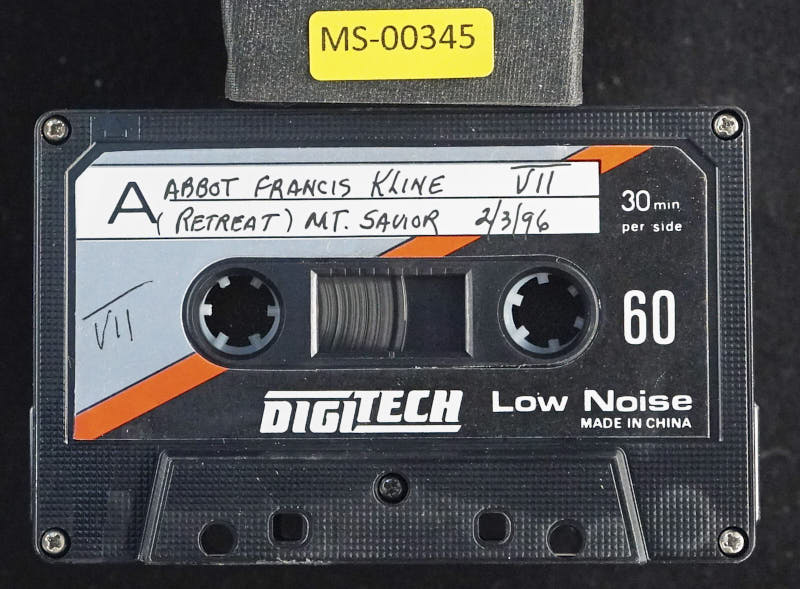
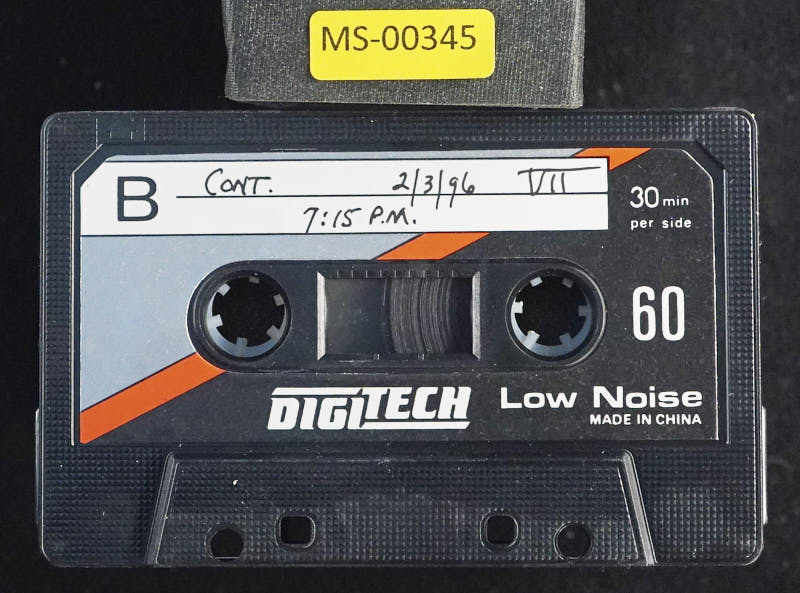
AI Vision - Possible Values from Photos:
Speaker: Abbot Francis Kline
Location: Mt. Saviour
Possible Title: Retreat
Additional text: VII
Location: Mt. Saviour
Additional text: Cont. 7:15 P.M. VII
@AI-Vision_v002
Okay. May the divine assistance be always with us. Amen. I wanted to finish my overview of the seven sacraments. We looked at baptism, Eucharist, and the anointing of the Spirit this morning. I'd like to cover the others, that is reconciliation, marriage, holy orders, and and the anointing of the sick. But before we do that, we need to talk about monastic profession, because monastic profession in many ways is a sacrament, or if it isn't one of the seven sacraments, obviously, then it shares in baptism. It's got to be that monastic profession refers back to our baptism. Now, you remember some years ago there was a a flurry of speculation about monastic profession as a second baptism.
[01:02]
And that stemmed from medieval texts about vows in the monastery as really constituting a second baptism because people threw off their old life and came to the, even though they had been baptized, that doesn't mean that there was such a dichotomy between living outside the monastery and living inside the monastery. The medieval conception was that you couldn't really save your soul very easily outside the monastery. So that when you came to the monastery in a Benedictine conversion, it must be the equivalent, they argued, of a second baptism. Because there's so much about monastic profession and about monastic conversion that is like baptism. Repent and believe in the good news. That's the hallmark of monastic spirituality. So therefore, if this is really a conversion, and so many of us speak about our entry into the monastery as a conversion, we turn our backs, literally, on so much of our...
[02:18]
former way of life and we embrace this new way of life. There's so many ways in which it is a kind of baptism. But there's another kind of theology that rejects that second baptism stuff. You can choose which you prefer. In my way of thinking, there's really no dichotomy. There is and there isn't, but I would prefer to think of one baptism, and that my monastic call is not opposed to the, so much opposed to the life I led before. It could be in some cases that I really do turn my life around, even though I had been baptized. But I think more often than not, for so many of us, monastic profession is a blossoming or a fulfillment of our life in the church before we came to the monastery. Maybe that's how it could work.
[03:18]
Since we no longer can say and don't want to say that it's hard to save your soul outside the monastery, we have a completely different conception of monastic life now, or we should have, because of the theological concept of the universal call of holiness, which all people have. We're not here to be holier than anybody else. We're here because this is our way to holiness, because Christ has... has called us to that. But that doesn't mean that we have any right to look down our nose at anybody else. The Vatican Council was real clear on that and we dare not have any backsliding into a former theology there or a former ecclesiology because what we're offered now is so much better. It may kind of clean out those who are nesting in monastic life because they think it's a sure way to holiness, but it isn't. There are more challenges and more obstacles in some ways to holiness in monastic life because there are bigger risks.
[04:26]
Remember, it's love that we're here for, so no risk, no love. And it's time that we start, you know, Fulton Sheen used to say, well, those in the monastery are like are like people on a banana peel. They have one foot here and the other foot on a banana peel ready to go to heaven. Well, that's okay, but some of the blokes that I know in monastic life, I doubt if they're ever going to make it. That's just an aside. You see, baptism is once and for all and can never be readministered. It can never be undone, can never be done over or added to. It is incorporation into the body of Christ, pure and simple. You can repudiate it, but Christ will never repudiate you.
[05:29]
And that's where you come into this other little theological anarchism of the marks on the soul, that's another argument really against the idea of a second baptism. And I think this idea of a mark on the soul given by baptism is, yeah, it's a kind of quaint idea and, you know, it gets poo-pooed nowadays if people even remember it. But I think it's pointing to a theological reality that is very, very correct. That is, you can never repudiate your baptism. Even if you were baptized in a non-Catholic ecclesial communion, we now, in the Roman Catholic Church, accept that, would never think of re-baptizing someone who was baptized in a Christian ecclesial communion. See, that reinforces the idea that baptism is forever, no matter how you receive it.
[06:32]
If it's received in the name of the Father and the Son and the Holy Spirit, baptized into the saving... saving stream of Christ's blood, that's it. And that can never be undone, nor can it ever be added to in any way. So therefore, if monastic profession is this tremendous move on God's part, this tremendous charism over and above our baptism, then we have to find a place for it. We have to figure out how it fits. And I think that we have examples in nature. We have examples in human nature. We have examples in sentient beings. We have examples all over the created world. It goes something like this, you know, we have these wonderful live oaks at Mepkin all in the southeast starting from maybe Hilton, from Myrtle Beach and going all the way down to the Texas Gulf Coast. Those trees tend to grow
[07:33]
not much further inland than 50 or 60 miles. And they need salt water, apparently. They need salt air. And then when you get moss on them, they need... The moss is not a parasite. It's an aerated plant that depends for its life on hanging from something so that it can get the air. And it needs salting. And that's why... And in plantations in South Carolina and Georgia and Florida, you get these wonderful hanging effects of the Spanish moss, which we have all over Metkin. And when the stuff gets wet, it's really a burden on the tree because it's just pounds and pounds and pounds of this. And the poor people use it to stuff pillows. It's wonderful. It's a wonder. It's clean. It's a nice smell. And so we have it all over the monastery.
[08:34]
You can see the pictures there. And you can see these tremendous shapes that the live oaks have, and it's a very heavy wood, too. That falls on and you're dead. But amazingly, these lateral branches will go out, and they'll go down like this, and they'll go up like this, and they'll go over like this, and it's still one branch, and it's very heavy. Very heavy. In fact, they make... used in the colonial era they made, that was what the wood, that was the choice, the wood of choice for ship, ship building. So when we had this hurricane in 1989, and all these trees, it's against the law to cut down a live oak in South Carolina. But after Hugo, you know, there was so much, so many of them, well, there weren't so many of them that were destroyed. Indigenous trees tended to do rather well in the hurricane. It was stuff that was brought in that didn't do well. which leads you to think that they've had a lot of other hurricanes before that one, and the trees survived.
[09:35]
But at any rate, there were a few that were damaged in Charleston and other places. And Mystic Seaport, Connecticut, where they have a shipbuilding, what do you call it, a dry dock, the airport, building replicas of colonial ships, whalers and all that. They were right on the scene. because the wood of choice for these boats is live oak wood. Incidentally, live oak, an oak, it's not really an oak. It's a species of beech. It's a beech tree, really. And it's not deciduous. It never sheds its leaves until, so we have greenery all year round at Mepkin, and not until March, when the new leaves come in, the new leaves push off the old leaves, and you've got 68 billion of these leaves just fluttering all over the place in March. It's a crazy phenomenon. Okay, so it's a beautiful tree. And the older they get, the more unusual they get in shape.
[10:35]
And so we have, we take care of, we maintain about 500 of these things on the property. Some of them have to be 500, 600 years old. And the reason that they have grown to such fantastic shapes is because the place has been a plantation, a rich person's estate since about 1670. foundation, Charles. So you've got plenty of live oaks growing wild in the woods, but because they're in the woods, they never get a chance to really, you know, grow out. Well, I've always been interested, you know, as soon as I got down there, I was interested in this tree. So I asked one of the brothers, I said, can you, do you have, are you planting any of these things? Do you have any young species around? Because I expected to see a little thing coming up that was going like this, you know, but no, no, no, they, And they said, oh, yeah, we've got them planted all around. In fact, you're looking at one. And there was this little squat, bushy little tree, little shrub, like I think, round and bushy, just real and tight and pudgy.
[11:40]
I thought, you're going to tell me that's a live oak? They said, oh, yeah, yeah. For about 30 years, it remains, it looks like a little round Christmas tree. It's just very tight and compact with branches that come out from the main stem like this, tight up. And until about 50 years, and then it'll start to flower out a little bit, but you'll never get any indication of lateral growth. It won't happen. After about 100 years, the thing will start to shed some of that bushiness, and it'll start to do this. And after 200 years, you've got... You know, it'll just start doing that. So I thought, ooh, now isn't that a lesson? Baptism. You know, it means one thing when you're 20. It might mean something completely different when you're 45 in Christ. That, to me, is one way to justify how people can suddenly, at age 40 or 50, receive a monastic vocation.
[12:42]
They had the seed, maybe, all their lives. and did many other things in the church. But at one point, this wonderful gift of the monastic charism, you know, suddenly blossoms out on their tree. And so that's a way of looking at baptism as a forever happening in one's life, but that carries with it certain hidden genes, which are late bloomers, you know. That's certainly the way it is with the live oak. I mean, that thing has to be, you know, a hundred years old or so before it starts to take on its final mature characteristics. Or you take people. You know, we're so used to the early and sudden bloomer. I was reading the biography of this Greg Louganis. Is that how you say his name? Does anyone know who that is? The great Olympic diver. And Tragic Life, really, although I see he's on Broadway this past season.
[13:44]
I don't know how he did. He took over the lead role in some Broadway show. I saw it in The New Yorker, but the show doesn't mean anything to me, so I don't know if he has been a success in it or not. But this little kid, he's part Samoan, apparently. Or all completely Samoan. He was adopted. And... And from the time he was that small, he just had limbs that flew. I mean, he just was a natural acrobat and, in fact, was a child star, you know, doing flips and doing little acrobatic dances and all this kind of thing. And by age 10, his knees were ruined, you know, from just overdoing it, all this acrobatic stuff. And at one point... His parents, they did this kind of test on him where very painfully they take a bit of your muscle and they do a biopsy on it. And I forget what quality it is.
[14:46]
The doctor would know. But there's a certain quality which means that the first 10% of your action is real quick in the muscle. There are others of us that don't get going until about 30 seconds after the body. That's how I am. I'm so, my muscles are just so like this. But there are some people, you watch them go up a step, and they go, boom, and they're up there. And other people, you know, like me, it's, oh, you know, I just, I can do all the exercises in the world, but, you know, I just don't have that kind of, that kind of, that my muscles just don't work that way. Now, I can stretch and all that kind of thing, which a lot of people can't do, but I can't, I'm not real quick. But some people are real quick just because their muscles are made that way. They have a certain, I forget the scientific name for it, but it's a quality that you can measure in the muscle. And so this poor guy now is, well, he's been through, what, three or four Olympic Games, and he's won gold medals in the last three.
[15:53]
And at age 30, I guess he was 29 or 30 when he won, what was it, in 1990? The last one we had, 92, I guess, yeah. But he also had AIDS at the time, or HIV virus, and so it was kind of a miracle that he was able to do this. So now he's, what, he would be 34 years old, and he's starting to look like an old, old man, and you think, well, And this biography, this autobiography, he speaks like his life is over. I mean, life is diving, and that's finished now. And so, you know, the one last stand he was going to make in the 1992 Olympics, and he did it with great personal triumph because the competition was extremely fierce, and here he was not at the peak of his physical condition, yet he did it. And so he talks, you know, but there's a certain finality about the autobiography because, I mean, he's peaked.
[16:58]
He's finished. I mean, there isn't a whole lot more that man can do. Now he's raising dogs in Malibu or something. But I did see that he's on Broadway this past year. Okay, that's opposed to someone like the musician like César Franck, the great composer, the great French-Belgian composer. Now, Franck never wrote anything memorable until he was way past 50. And you figure, well, how could that be possible? I mean, he was just a real second-rate composer and improviser until he reached the age of about 50, 52. And then something happened. I don't know what happened. Nobody can explain it. But after that, everything he wrote was a piece of genius. It just took him all that time to get it together. So we differ greatly in how we develop and how gifts develop and how we really come to fruition.
[18:02]
You take a Wordsworth, someone like a Greg Louganis, a great genius of a poet, but Wordsworth never wrote anything memorable after he was 32. His biography and all of the literary tradition is absolutely consistent about that judgment. All his great master, all the great master, Ode to Immortality, you know, all that stuff was written before he was 32. And when he turned 30, something happened. He got respectable. He grew up. The poetic muse dried up with his youth, and that was the end of it. He was the poet laureate until he died, but, I mean, he used to roll out this dog roll, and it was embarrassing because none of it was really any good. You only read the stuff that he wrote before he was 32. In all the anthologies where Wordsworth is represented, you check it out. There's nothing worth remembering, passage of 32. So you just wonder, you know, we do have a kind of hidden mechanism in us.
[19:07]
Some people bloom early, some people bloom late. The idea is that there are blooming periods. Now, in the spiritual life, we like to think that... Our hidden genes of spiritual development are still with us and can still be accessed and can still show forth the older we get. And that's true. That's certainly true in the spiritual realm. So that's a justification for considering that monastic profession is not something... It's not something that remakes or redoes our baptism, but it's a development of our initial baptism. Another justification for that is that so often when people come to monastic life, even if you came to monastic life in your 20s, as I did, still there's lots of memory to purify and redeem from the time I was born until I was 23.
[20:12]
And I find that in monastic life, that's one of the great graces of the monastic charism, the redeeming of the time before I entered, as well as after I entered. Did you ever notice that when I was a novice master, I used to find this so often people would come in and talk, and novices, and after about six months of monastic life and the experience of being cut off from their usual circle of social support, they start to think about the past, and one of the first things that comes up usually is mom and dad or very close friends or lovers or something like that. And all of a sudden, anything that was wrong has to be righted. Either there's a letter asking for forgiveness or there's a rapprochement of some kind. It doesn't happen to everybody, but it's a consistent enough happening for me to make it into a kind of theory that monastic life in Christ purifies or redeems or makes clear our lives from the past.
[21:21]
It works both ways. As we go forward in Christ, we also seem to go back and clear up the past. So in that sense, monastic profession is both a development of our baptism. It can't fix it. It can't change it. But you can trace God's design through our life of baptism up until the monastic charism is given. And then you can see how these great nodal points in one's life, you know, birth, baptism, monastic profession, death, that kind of thing. But those great points are really important and can be traced out in anyone's life. Another aspect to monastic profession is, of course, the vows, the vows themselves, and how are they to be understood with reference to our baptism.
[22:25]
Well, the theology of the vows, there's been a lot written about it, but a lot of it is so juridical. So you get the idea that, you know, I trust myself to God's grace that I will be faithful to to these three vows that I'm pronouncing, God will help me to be faithful to them. And they're publicly performed, publicly proclaimed in the church, and so the church will help support the person who's going to make these vows. And there's so much of this, I, I'm going to do this as a juridical person. Well, I'm sure that that's right, and canonists will stand by that. But it seems to me the vowed life is a lot more than that. It's probably more, from a theological point of view, it's more about God than it is about me. It's really more exciting, I think, to consider that God vows himself to me in monastic life more than I vow myself to God.
[23:25]
I'd much rather bank on that, God's fidelity to me rather than my fidelity to God. Because, I don't know about you, but I've been very unfaithful in many ways, even in my vows. Now, I can either take scandal at that or get so discouraged and depressed that, you know, I throw in the towel. But it should be neither. It's not my problem so much. I trust that God's going to take care of me in the vows. What my vows celebrate more than myself, I think, is God. God's fidelity to me. God's call to me, God said, I'm going to make monastic life the structure of your faith, your Christian faith. This is how your Christian faith is going to work itself out. This is going to be its structure, the vows of stability, the vows of obedience, the vow of stability, obedience, and conversion of my life or way of life. And that's really a tremendous thing.
[24:27]
that can only be done in the context of the church, whereby the church, as the body of believers who are baptized in the one baptism of Christ, now can say that this baptized person has been called by God into a further structure, a gift of a life that is structured along these lines. And God will be faithful to that. God will never take that back. You see? So here we're talking about one lasting promise, which is baptism, and the vows, another lasting promise, which is a development of the baptism. And so monastic vows certainly have to refer, theologically, they have to refer back to one's baptism. Either that or we're We're setting up monastic vows, monastic profession as something separate and good as or better than baptism, which is theologically nonsensical.
[25:34]
It may take a little bit of work and imagination to see how one's baptism is the fundament for one's monastic profession, but I think it has to be done. And when you see what the practical... constellation of monastic life is more and more. I would say that that's true. There's this whole movement as it developed in the 50s, 60s, and 70s where Christian monasticism was looked on as a kind of parallel with the church, you know, because Christian monasticism was anxious to design itself in line with other monastic movements from other churches. I mean, from other religions, other belief systems. And so, yes, we're Christian and we're Catholic, but we're also very parallel to Tibetan Buddhism and all that. And I don't deny any of that. But what I'm saying is, and I've taken a lot of flack on this, but for me, theologically, you come to Christianity first, and it's from within Christianity that you become a monk.
[26:45]
And our best candidates, I don't know if your community can say that, But to me, the best candidates that come to my monastery, either Gethsemane or Mepkin, are those who come from a rich, sacramental, ecclesial experience as a Catholic. Now, I've taken a lot of... You know, you can be a monk in any religion. That's true. But look at how monastasism works in any religious system, whether it be Tibetan Buddhism or Zen or or Christianity. The people who become monks in any of those systems are people who have bought into that system so much hook, line, and sinker that they dedicate their lives to it. It's another mystery that we run parallel to one another and even conjoin experiences. That's another mystery. But let's not confuse the fact that we have parallel and common
[27:48]
shared experiences in the spiritual life, let's not confuse that and say, therefore, we have shared theological convictions, because we don't. We do have a shared spiritual experience, and that's for us to develop and to explicate. But theologians have a harder time doing that because we come from a different system. So I just think, you know, it's really not important that consideration, but it helps me point out that baptism in the sacramental system is extremely important for our conception of life in Christ in the monastery. And Christian monastasism is going to be all the more healthy for finding its theological roots in this sacramental system. It's going to make a lot more sense because the Tibetans do the same thing. I know enough about Tibetan Buddhism to know that there are four philosophical schools, and especially one the Dalai Lama belongs to, is rich in metaphysics, and it doesn't make any sense unless you buy that system hook, line, and sinker.
[28:56]
So I'm speaking, I have a friend who's a Christian monk from the EBC who left to become a Tibetan monk, and he's now a Tibetan monk in Dordogne in France. And we're very close, we write all the time, we studied in Rome together, He's a brilliant Greek scholar, but now he knows Tibetan. He does a lot of official translations for the Dalai Lama. And he's the one who's assured me of this. That's a completely different system. And you can't take a Christian metaphysical system and translate it into Tibetan Buddhism and live Tibetan monastic life. You can't do that. You've got to buy into the whole metaphysical system of their cosmology, their anthropology, the whole thing, which is different from others. So that's not to say that we can't share experiences, and I'm going to insist on that, but I'm also going to insist that you can't have this kind of monk type out there that will be a monk anywhere they are. Yeah, there are some types like that, but I don't think they really stand for the tradition.
[30:01]
What I'm talking about is people, I'm talking about a monk who comes from, who understands the Christian tradition and is a monk because of the Christian tradition. And I think that that's the order of things. And so, therefore, when we consider the vows and we consider our life in Christ, it seems to me it has to be in function of our baptism. And that the two, that is our baptism and monastic vows, are closely connected. And their connection needs to be more... carefully spelled out in our time, and I hope that sacramental theologians will be willing to do that. Well, that's enough time on that. Let's move on to reconciliation. Now, we're so used to auricular confession, and I'm sure your official constitutions, I know our official constitutions say, you know, this is, should not, the auricular confession should not be downgraded in our time.
[31:07]
And the monks should go to confession every, you know, frequently and all that kind of thing. Well, that's fine. I'm sure your official constitution and I know our official constitution say, you know, this is, should not, the auricular confession should not be downgraded in our time. And the monks should go to confession every, you know, frequently and all that kind of thing. Well, that's fine. And I have no argument with that, and I think it's true, as well as it goes. But what I think is more cogent in our time is the communitarian aspect of sin and the communitarian aspect of dealing with sin. And so you have in the parishes a tremendous move to communal penance services and a tremendous debate going on within the Vatican as to whether or not local bishops should permit this on a large scale.
[32:10]
And I don't want to get into that, but it points up the fact that this communal realization of sin and communal practice go hand in hand. And it may be of Reconciliation has found itself in the last 40 years. We've been through this before. You all know the history of the Sacrament of Reconciliation. From public penances up until the third and fourth century, where people were designated as a public sinner and a public penitent, all the way through the harsh ways of the late Roman Empire and into private confession with the Celtic monks through what God knows what they did in the Middle Ages. We've been around this circle almost in a complete way now.
[33:13]
And so now the thing is developing in a further way, and it's developing in such a way that we see, as we've always known theologically, that sin is not my affair only. It is a communal affair. I sin... against God, and that means I sin against his people. Now, in the monastery, we had a tremendous problem with dealing with infractions against the rule. We had chapter of faults, or we had the excommunication penal code in the rule, all of which now seem to us quaint and harsh and not to be continued. And yet, there's a growing awareness among monastic communities that we've got to find some way to deal with guilt and sin in the community. If we keep insisting on kind of a low-grade maintenance of observance and everybody can do what they want to do and nobody's really a paternal charity equals being nice to everybody no matter what they do, the community is going to be very much weak if that's the case.
[34:26]
And of course, we know, I know in my community, you know, at Gethsemane, you know, we went from a kind of rigid observance in the 50s, when the visitor came, everything had to be, you know, just the way it was in France. We went and we threw that off almost hook, line, and sinker. When I first arrived at the monastery, they were about two years off the strict usages. And I remember just marveling. Because you can't get away with that in music and artistic circles. You don't toe the line in choral singing or in performance or anything. You're out. Your contract isn't renewed. But at Gethsemane in 1972, you could pretty much do what you wanted. It was a great big place, 115 monks, and you could write your own ticket and did it. Many of them did it. And, you know, they were very slow to come around, like, you know, no one tells me what to do. And everything was done by committee.
[35:28]
It was like the revolution all over again. God, and heads rolled, not literally, but figuratively, right down the coast. And in many communities, it continues like that. We're not about to bring in strictness and strictness of observance and all that. There is the rare community where that happens, but that's like an odd thing. We're not about to do it. We're not taken up with laws and rules, thank God. And maybe this is a fallow period in one sense so that we can recapture the essence of monastic life and what it is. But one of the indications that things are going in a different direction now, I've noticed at Mepkin that as we get new people, Their demand is, show me what to do and tell me how I'm supposed to do it. And stop giving me the saying, oh, well, in the old days we did this, but now we do this.
[36:29]
In other words, we've got a generation gap going in the community where the new guys say, well, I may not want the old time, but I want clear and concise direction on what's expected of me. Well, we have observances and usages at Mepkin that work. outdated in 1980. And I'm saying, yeah, but you guys don't realize what the new guys, you new guys don't realize what these old timers went through. And they're not about to have a strict regime put back on them. They've had to heal and all that stuff. They remember all that. So we've got a real problem now. And one of the things that happened in our recent basial discernment process was we've got a generation gap going in the community. And it wasn't as serious a problem as I thought. Once you get the guys talking, the old timers are quite willing to have some discipline. They're quite, you know, they're quite amenable to going back to some strict rules about silence and all this kind of thing.
[37:34]
It's just that they want it explained and they want to know what the sanctions are. And so actually from the older people in the community, we have developed a way to publicly acknowledge our faults. as we prepare for a communal celebration of reconciliation, which we do four times a year. And we pick a theme. The House Council picks the theme for each reconciliation season. We do one at Lent and around Pentecost, for the Feast of St. Benedict, and for Advent. Those four seasons. During those four times, And the community through the council decides what theme or what cluster of observances we're going to work on at each of those reconciliation times. And then for several weeks ahead of that, we have discussions or chapters on this. We've done, one of them was taking care of utensils in the community and tools.
[38:36]
That was one of them. Another one was liturgy, people being more careful about the office. That is how they perform the office and all that. And then the night before the reconciliation service, we actually have a public chapter where brothers bring to the chapter they accuse and fail. We don't have anybody accusing anybody else as we used to have in the famous chapter of faults. But it's a way for everyone to publicly acknowledge that things need to be improved and that there is a standard that everyone's expected to live up to. So this is nascent with us. But I'm very edified by them. They've done it with their whole heart and soul. And what it means is that as a group, the standard that we're trying to aim for in our observance is publicly known and publicly acknowledged. And that when you digress from those observances, that you're hurting the group. And so you have to have, therefore, as we try to develop,
[39:41]
some kind of sacramental way of dealing with that, of processing that. And I just find that it's extremely helpful. Now, it remains to be seen just how deep some of this will go in people's lives. I don't know. We've only done it for about a year and a half, so I don't know how much it will really transform things, you know. But we've had people, when people wreck a car or something like that, they bring that to the group in this context, and it's worked out real well. For my part, I think that theologically, the reconciliation move in the community is of extreme importance. And because the structure of gospel living, as we have it in the rule, the conversion of my life, is repent and believe in the good news. That's part of the ongoing... accessing of the love of Christ in my life. This exorbitant fourfold love that we've been speaking about is based on my willingness to be sorry for my sins and to have self-knowledge.
[40:50]
It's not based on how wonderful I am because we have to constantly acknowledge that we are sinners. There's nothing wrong with that. The church has taken a long time to get that in proper focus and balance. In the fourth century, If you went back on your baptism, if you sinned in some way, even if you did not, you ran from martyrdom, you had that big problem with the lopsy, the people who fell away from the faith because they didn't want to be put to death, and then came slinking back after the persecution. And Cyprian and others asked the question, what do we do with these people? Because they didn't yet understand the dynamic nature of baptism. They thought it was such a static thing that once you're baptized in Christ, you're no longer incapable of seeing. Well, that's not how it works. It's taken us 2,000 years to get that right. But that was the theology back then. You can read it in Augustine. You can read it in the letters of Cyprian. You can read it.
[41:51]
It's all over the place. If Augustine wasn't so preoccupied with the Donatists, you'd get more of this in his own thinking. But we now know... that part of the structure of faith in Christ is the dynamic of sin and forgiveness, even after baptism. That's what baptism means. That sin really doesn't have any power any longer. That doesn't mean that all faults are going to dry up. It's often through the process of fault and forgiveness of fault that baptism springs up into new life again for us. So, You know, it's time that we were a little more explicit about that. So let's not be afraid of confession or let's not be afraid of reconciliation. It's the very warp and woof of monastic life, it seems to me, because it's the very structure of gospel living. And you get that right in the gospel narratives with people like Peter. You know, the church used to say that Peter was the great...
[42:56]
The great example, once he was baptized in the blood of Christ, he was firm and became a rock. Yeah, but look at the evidence. He was a slip shot after as he was before. It's God that made him strong, God that used him for his own purposes. The personality of Peter probably remained pretty much intact. That's not to say that he wasn't transformed, understand me. But that he had to struggle as everyone else has to struggle. So I think this idea of reconciliation and how we deal with it in the community is extremely important because it's how we access the love of Christ. Moving on to marriage, why do I bring up marriage? Well, because for those in the monastery, those who profess celibacy, marriage has to be an important consideration because it's through marriage that people work out
[43:57]
their need for absolute love. They work out their need for absolute devotion to one another. This is a very human thing implanted in us by God and sacramentalized by the church. Jesus made marriage a way to God. How? By this process whereby romantic love, which is the way we're made, man and woman, and a mutual attraction, that's the way we're made, becomes Romantic love, which brings a man and a woman together, gradually gives way, or it should give way in sacramental marriage, to a deeper kind of fidelity. And people go through all sorts of agonies trying to work that out in married life. And because they don't understand that it's a process whereby romantic love gives way to something else, that doesn't mean romantic love has to stop. In many cases, it does. But that doesn't mean the marriage commitment stops. But in our day and age, in our culture, when romantic love stops, so does the marriage a lot of the time.
[45:02]
At least that's a justification for divorce. And when the kids are gone, the glue that keeps the marriage together, they're grown up, that's the end of it. How sad. Because the whole process of marriage is to teach people to be bigger than themselves. And to work out this need that we have for absolute love and absolute fidelity. See, Christian marriage can work even when there's infidelity. That's the whole point. People don't seem to realize that. Even if there's infidelity, I am still married to her. And I still have to work out my salvation by being married to her. And I have to work out the problems. Her infidelity to me, my infidelity to... I don't mean just adulterous affairs, but I mean, you know... When I'm emotionally gone, and I let her down, and she lets me down over a period of years, and we suddenly grow apart, we suddenly, after 20 years of marriage, we wake up and we realize that we were never really married to the last 10.
[46:08]
That happens all the time. You hear it all the time. Or you get two people after 50 years of marriage still arguing about things they argued about when they were 21. There doesn't seem to be a whole lot of growth there. But nevertheless, let's not fall down on the ideal. The ideal, as I understand it, in sacramental marriage is that people work out, they work their relationship through in Christ till it grows to the point where they're better Christians. And that means something like this. An ideal Christian marriage might look like after romantic love has kind of gone through, children are raised and all that, and do all the things that are right, and you're still going to mass and all that. It might be that that Christian marriage starts to open up to include other people, whether it be in social work or whatever, or more importantly, that their domestic household really does become a church, a domestic church, and people are welcome.
[47:14]
A more extended family, maybe not just family, but friends, are welcome there. And their love, the husband and wife's love for one another becomes a kind of magnet where other people, weaker people, can find strength and can find a domestic household or can find some kind of witness to keep going in their own lives. I've seen that happen a lot, more often than you'd think. And in other words, a marriage like that becomes a tree where all sorts of creatures come and make their home. And isn't that the way love works? operates. Love just keeps expanding if it's true. A kind of marriage where we just get so preoccupied with ourselves and we're like two old birds nested in a little teeny house and we don't let anyone else in and we just want, you know, well that's not, people have just found a way to nest through life. That's really not the dynamism of a Christian marriage. But when it really works over a long period of time, it means that a lot of other people are going to be affected.
[48:22]
And it works something like this. I may know that my dearly beloved, that I can't depend on her for absolute unconditional love. That through her, I have found, even through sex, I have found that the one, the person that loves me most, and the one that I'm going to have an unconditional relationship with, is Christ. And when I can learn to grow in Christ through my marriage, then married life takes on a kind of autumnal splendor, which, you know, I take it for what it is. She's a human being, and she's weak and frail like I am. But in Christ, we stand firm together in all our agility and in all our weakness. Now that, to me, is a mature, that's a mature aspect of the problem. I mean, I'm looking on the problem with open eyes. Because I've learned through her what real love is.
[49:26]
And I can hold her in her fragility, in her own weakness, in her own individuality. And I don't demand of her things that she can't give any longer. And I don't insist on my own way. You know, in other words, I've learned Christian love through her. Well, I say that because it's real important for celibates to understand what marriage is and what marriage isn't. We pine away for the ideal partner. We pine away in our loneliness. And, oh, I live such an ascetic life because I don't have a wife to go home to. You know yourself that many times the guy who's going home isn't going home to his wife. Or he'd rather not go home because she's going to start, you know, berating him as soon as he walks in the door. Let's be realistic about what celibacy is. For us, the way to the knowledge of unconditional absolute love is through thirsting for the partner. And after we've gone through mountains of sighing and loneliness and all that kind of thing and work all through that, it might come at one point when the sun rises that I'll realize that all my pinings and longings and loneliness is really for the Lord Jesus Christ.
[50:42]
And I've had to work out my sexuality problems and all that. And the figure who still remains as the one who's going to love me through thick and thin is Jesus and nobody else. So I'm saying that the marriage, and the more you can read about marriage and the Christian sacrament of marriage, the more it's going to help celibates to understand what the challenge is. Because the goal is the same. Unconditional, absolute love of the Savior. The goal is the same. Now, I may not have the reward of children, but the blessings of children, my God. You know what parents go through with kids and the grave and bitter disappointment of a son and a daughter that ends up needing me more as a parent when they're 45 than they did when they were 15. That's legion. That's legion in our society. How bitter for parents. If you're going to have children, you better be prepared for a lot of agony and heartache.
[51:46]
Well, we have a progeny, too, as monks, and that's one another. We father, we mother one another, and we make the community work, or we break it by our selflessness or our selfishness. We're in this human thing together. And we never live, a celibate life does not mean that one lives alone necessarily. Celibate life means that one has a certain route to follow to the point where my humanity is broken open for other people. And the married person has the same challenge. You know, it's really unfortunate that in our day and age we've missed that. You get all this talk about sexuality and you get all this talk about sexuality. the married state being the exalted state, and celibacy being unnatural, that's not true at all. You look at any advanced metaphysical civilization, and what I mean by metaphysical is where there's an advanced, where you have the possibility of metaphysical thought or philosophical thought, and you're going to have celibacy.
[52:54]
I mean, in every culture, since history began to be written, you're going to have that. You're going to have at least a segment in any advanced civilization where people are seldom. Because the human person instinctively knows that sex is not the last word. You know, it's very important. It's women and children. But it's not the last word. Certainly not the last word in meaning and richness of life. So, so sad that we keep this psychological model that we've got going. that disparity model, that it's so falsely exalted. It's really ridiculous. Now, if you disagree with that and you think I'm really wrong there, I will listen. I mean, I'm not trying to preach that as such. It's just that what I'm saying is that we're not going to find the true meaning of the monastic tradition until we get some real serious talk going on what sexuality is and what it isn't.
[53:57]
Now, I'm no fool. If you don't take care of it, it will break you. If you're not dealing with it, it will break you. I'm not saying that as celibates we can afford to just put it in a jar and seal it up. It will blow right out of the jar. I'm not saying that at all. But I am saying let's get off on hang-ups about it and look at what it really is in married life. And let's not extol all this romantic stuff about the third way and my need for sexual fulfillment and all that stuff. You know, it's a false bill of goods. It really is. And there's nothing wrong with Christian morality as we've understood it. But anyway, I want to talk more about that tomorrow. That's just to say that I don't see how, as celibates, we can talk about celibacy in the monastery unless we're willing to take a good long look at Christian marriage. It shouldn't be that fine to us. Passing briefly on to... holy orders, it's a real difficult one.
[55:04]
Everything depends on whether you come to the monastery already ordained or you come to the monastery and you're ordained in the monastery as a monk. It seems to me everything depends on that because the ordained person, as we understand it in the Christian tradition, is someone who's totally given, even willing to be a scapegoat or one who carries the sins of the community. And that's a real hard lesson. That's a theology that is not very much developed because we've run into so much problem about this persona Christi thing and women's ordination and all that. If we can ever get by that or around that problem, and I don't have a solution to that, but if we could ever get beyond that and focus in on just what is a priest, whether a man or a woman, then I think we would start to see something about Christ willing to lay down his life, being the servant of all, laying down his life, carrying the sins of all as the Lamb of God, has something to do with that.
[56:11]
It's along those lines. And, of course, it's not divorced from monastic community living. Finally, the anointing of the sick, and I spent some time on that this morning, so I won't develop that any further. I'd like to just conclude by saying that all these sacraments are ways in which we come in contact with Christ's love for us. And what is that love? It is God's willingness to share His imminent life in the Trinity with us in what we call the economy of salvation. We used to talk about the imminent Trinity, which is a speculation, a theological speculation of how God works in the three persons of the Trinity. And then we had the economic Trinity, which was God sending out the Son and in the power of the Spirit reconciling all of humankind to God and bringing all of that back up into the Trinity.
[57:16]
But now we're starting to break down the division between the imminent Trinity, the speculative transcendent thing up here, and the economic trinity, which is where God reaches out to us, we're starting to see that when God reaches out to us and pulls us up into his own life, that we do share in the imminence of the trinity, in what we formerly thought was way up here and not to be shared by us, that we only share in Christ. No, once we're in Christ, you can't separate Christ from the Father, nor can you separate the Father and Christ from the Spirit. So new theologies now are having a lot more to say about that. It has tremendous ramifications for us in the monastery because it means that what we're about as we serve one another in Christ, as we minister to one another in Christ, as we are Christ for one another, that we're really making present and acting the Paschal Mystery, but even more than that now, the very life of the Trinity.
[58:21]
God in relation to God. God in relation with himself and therefore with us. That's what it really means now that Christ is glorified. So I'll end it there and I want to conclude tomorrow with talking about friendship in the monastery as the ministry of Christ in our midst. Kind of late. I'm sorry for going on so long. I hope we see them on the road.
[58:55]
@Transcribed_UNK
@Text_v005
@Score_93.84