You are currently logged-out. You can log-in or create an account to save favorites and more. more info
Monastic Growth and Benedictine Balance
AI Suggested Keywords:
Talk at Mt. Saviour
This talk centers on the historical discourse of monastic community sizes and growth, particularly relating to Maria Laach and the Benedictine tradition. The speaker discusses the ideal size for a monastic community, considerations for founding new houses to manage growth, and reflects on the historical significance and evolution of monastic practices and governance. Also included are discussions about the Eastern influence on Western monasticism, emphasizing a balance between liberty and adherence to the rule.
Referenced Works and Concepts:
- Rule of St. Benedict: A foundational text for Western monasticism. The talk discusses its application and interpretation in monastic life, contrasting it with other early monastic texts like the Rule of the Master.
- Rule of the Master (Regula Magistri): Mentioned in the context of debates over its precedence and influence on the Rule of St. Benedict; used to illustrate different monastic approaches.
- Balthasar Fischer: Recognized as an influential liturgist consulted during Vatican II, noted for commenting on Maria Laach's absence in early council cooperation.
- "Verbum Divinum": Highlighted as indicative of less centralized monastic systems in contrast to the Benedictine order.
- Palladius' "Historia Lausiaca" and "Verba Seniorum": Referenced as sources St. Benedict drew from for his Rule, underscoring the origins of Benedictine practices.
- Vatican II Consultations: Explored in the context of monastic contributions to ecclesiastical reforms, emphasizing Maria Laach’s involvement.
- Albert Herwegen's Commentaries: Discussed in relation to the liturgical and monastic educational developments at Maria Laach, underscoring a dual focus on liturgical practice and monastic life.
These points serve to illustrate the complex dynamics of historical monastic traditions and their evolution concerning community size, governance, and spiritual practices.
AI Suggested Title: Monastic Growth and Benedictine Balance


AI Vision - Possible Values from Photos:
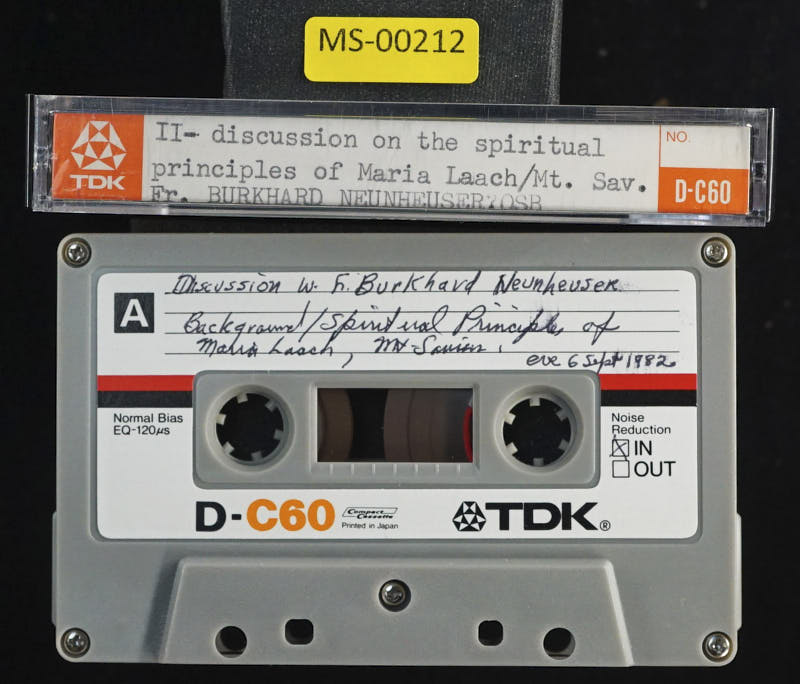
Speaker: Fr. Burkhard Neunheuser, OSB
Location: Mt. Saviour Monastery
Possible Title: Discussion on the spiritual principles of Maria Laach
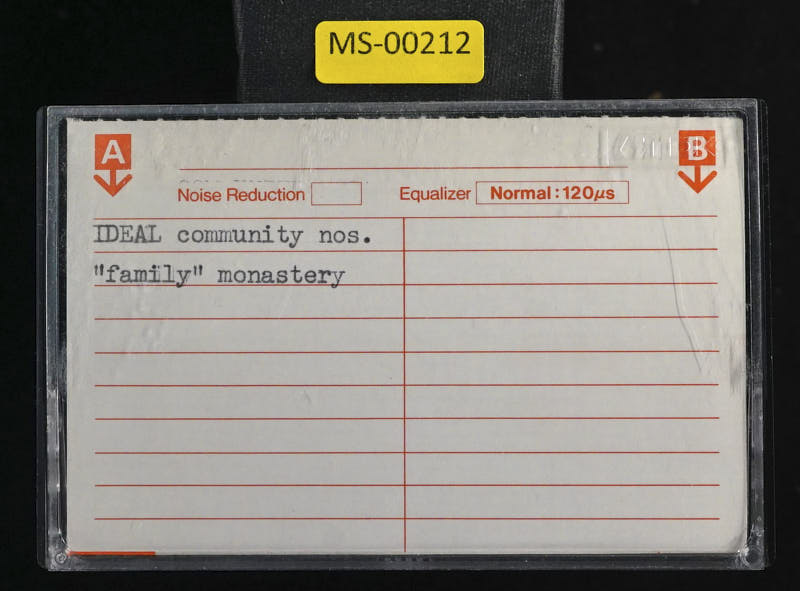
Additional text: IDEAL community nos. family monastery
@AI-Vision_v002
It's a little strange. On the other side, why not? Do you have it with you? No, no. I never use it outside of the monastery. But now, my dear confrere, if you have some questions about all this historical, the past things, you could also protest if my vision was not always correct. It's difficult to say. And of course, I could also ask you, is this really so? That was his intention, to remain a small community. at times what that meant, and it seems to me, and anybody can correct me, that we arrived at around 40, 35, maybe up to 50 or so, somewhere between 35 and 50, I think, was what it meant.
[01:14]
Therefore, not necessarily only 20 or 10, no. No, see, remember, the building there was designed for 40. Yeah, I think so, yes. But then you'd have a guest master and this, that, and there are other rooms where you would get there. Father Placid, did you remember any numbers we came up with on the discussion of the size of the community? Around 1962? No. Whenever Father would talk about the size of the community that he thought it should be ideally, how large you would get before you'd make another foundation, or what was the good size? 40 sounds like 70. How many did you have already? 33. That was part of the rationale behind it.
[02:18]
What did he say? He came in. Oh, that is not new. And one day, I asked the abbot of Genesee in Gethsemane. He was there. Or was it really so that you had 100 novices? Yes, but every day, another. Therefore, also, they're always moving. No, I said it wasn't the fact that in 62, 63, and 64 when we reached the optimum number of members, it wasn't part of the rationale for establishing Christ in the desert to be a daughter house so that I don't know.
[03:20]
It wasn't the idea that Then the overflow would be able to go to New Mexico with him. Opportunity. I don't think so really, no. He was the mayor of the situation here. I think the idea of the smaller community was more so many that it is possible to stay together as a family. For example, if you have hundreds, it's very difficult to talk together in hundreds. It's difficult. It's possible, yes. I have a question about the early history of Maria Lott. The monastery was bought from The Jesuits in 1890? Yes, 92. And when you joined in 1920, there were 100 monks?
[04:24]
We had perhaps 120, 30, yes. Were those 30 years a period of phenomenal growth, or did Boiron send many monks to begin to? The start, the beginning of Maria Lakh, The beginnings have been very splendid. Beuron has sent in one group 12 monks. It was a marvelous beginning. Beuron was very much impressed by the greatness of our church. In some of our publications is described the history of the first inspection of this house. And Odilo Wolf, one of the very important monks of the Bionic congregation, he was prior in Emmos in Prague, he said, Maria Lago will be the new cruny. It's also typical for this vision, powerful monasteries.
[05:32]
Escluny in the Middle Ages. Today, we don't like any more Cluny. We don't wish to become Escluny. But nevertheless, in this moment, Mariella is such a wonderful monastery, in such a wonderful scenery, that we must begin immediately. And also Beuron was in a situation, they must found a new monastery, because they had too many. They were growing, growing. And also, you must think, at that time, in the 19th century, More or less, the Benedictines have been nearly, not a unique order, but other orders, modern congregation, have not been. Steil, Verbum Divinum, was not yet flourishing, and so on. And we had especially, in Byron and in Maria Lager, many, many vocations for laborers. When I came, we had more than 100 prophets already, in 22, and perhaps 40 priests, or 30, and 10 novices and 15 clerics.
[06:40]
Nevertheless, it was nice and it was good, and for example, all this laborer was excellent men, pious men, ready to stay together like a great flock. I have been... Master of the Proverbs in 37, 39, no, 36, 37, until I was expelled from Germany by Hitler. And they were ready to stay together in silence during the recreation and the so-called instructor, the master, must speak, tell the news, or sometimes talking and so on. But to talk together, In 100 is impossible, nearly impossible. Therefore, so far as I see the situation, Damosos wishes to have a smaller community where it is possible to stay as a family together in greater simplicity, in greater also activity of everyone, which must collaborate for the common talk and common work.
[07:58]
At least so I see it, more or less. Therefore, the number is not so important. 20 is not enough. Also because we become older. Older. Older. Older. And then we need young people. Because sometimes the young people are serving to the old when they can no more move. I remember that... Occasionally, there would be those kinds of talks as to what would be the ideal number. And of course, nobody knew. But as far as I remember, it ranged between around, like, say, 35 or so to about 40 or 50. I mean, there was never any occasion to draw the line except in the building of the building. But it seems to me that I remember even then that it was said that those other rooms could be used for it. It was felt that around It would be very convenient also to take that in mind, to come to this possibility, if God allows it.
[09:06]
And there was still another point which I heard from himself, from Damasus himself, or somebody else told it to me. He never wished to become abbot. And in a certain day, Abbot Bernard Kelly, the primate, I said to him, Father Damasus, no, your monastery is well-founded, and you must become an abbey, yourself, Abbot, that you have a voice between our American abbeys. He did not agree. So for remaining a little bit... not just a smaller community, but here again, against this danger of the great abbeys to become big, excuse me, big prelates, the scapamagna.
[10:10]
If you remember also in the history of St. John's Abbey, you can see it. Very quickly, all this... Abbot of the new, small monasteries in the Kazenitz congregation became Abbot, and in the pictures you can see them with, no, no, first with, how do you call it? And then very quickly, the Art Abbot, Bonifat Zwimo, Kapamania. The Abbot of St. John, Kapamania. The Abbot of St. Meinrad, Kapamania. And we, in Mariala, too, in a certain occasion, also to have a testimony against our adversaries, Kapamania, in 26. No, we are laughing about it, saying it is a horse mantle. How do you say? A horse blanket. A horse blanket. We don't need a horse blanket to go into the eye mess.
[11:13]
Yeah, but here again, simplicity. Simplicity. Not so enormously great. This morning you mentioned, like, at the time of the Vatican Council, or the Second Council, that Mary Locke wasn't invited. But then, was it in the second session that you were consulting? I became a consultor already in 1964. Therefore, during the council itself, yes. I think it was per se the idea of Augustinus Meyer, the rector prior of that time in St. Anselmo, because St. Anselmo has been invited to give his names. And if there is any good prove that in that time we were not too badly estimated, then nobody was protesting against a monk of Maria Lach.
[12:25]
So that was the situation. And my cooperation, and mostly the cooperation of Theodor Buchler and Raphael Hombach, has not been too important. But I have said it only because Paltasar Fischer, a very important literarist, one of the great consulters, really, in this consilium, he has said it is a pity that Maria Lark was not called to cooperate in the preparation of the council and during the council. In the period after the council, it was different, he thought to me. Because my possibility was that I had been present in every of the great sessions of the bishops and cardinals. Thirty bishops and cardinals were sitting together twice or three times a year in Rome, in Santa Marta, near to St.
[13:29]
Peter, or in the Vatican itself. And thirty consultors have been present to help the bishops and the cardinals. And perhaps I said it already, sometimes the bishops became nervous. I said, we don't wish to work in the presence of the consultants. Go away. We wish to be alone. And the next day, they called us back because without the consultants, they could not go on. And then they said, you must come back, but you must not speak if you are not invited to do it. After some days, we could again speak in the best peace. No, no, we worked well together.
[14:34]
The Benedictine Academy. The Academy, yeah. It had the double focus of liturgy. And monastic, yes, yes. In the beginning, Abad Hildewans Herwegen have taught always for the monastic life of his community. That is quite true. But nevertheless, in his activity in the first years, also still in 20, liturgy was in the firsts. But then with time he was realizing, I must insist more, or at least in the same way, in the same measure also in the study of monastic life, monastic realization. And so also liturgy is growing better if we can show that we are living liturgically in our community, but we must do it also as monks. not as a Polish church and so on.
[15:36]
No, both, both, both. And he was always also, he himself was seeing that it is necessary to go back to the old monastic times. He did not yet see the importance, for example, of the rule of the master, regular magistrate. He said in his commentary to say that the rule of the master is before The rule of St. Benedict is ridiculous. You could not conceive that this strange rule would be the source for St. Benedict. It was earlier then. It was earlier. He said it. No, he said it still in his great commentary written and finished during the war, the Second War. The old generation could not agree with that. There is nothing of terrible in it that St.
[16:38]
Benedict has always said, I take from the tradition. He took it from the desert, Palladius, Historia Rosiaca, Verbas in Iorum, of all these old histories of the desert in Egypt, and also from the rule of the master. But we needed time to digest it. Father, you mentioned the apothegmata. Please. You mentioned the apothegmata. And Father Ildefant's use of that as a juxtaposition to the obedience to a rule as opposed to the liberty of the apothegmata. Could you say something more on that? In what way was he using the apothegmatite? In the first beginning, the meaning of monastic life was to follow a spiritual father and to hear, to listen to his words.
[17:53]
No rule. You could live... two, three, four together in the desert in some house. But you must listen to his edifying words. There was no concrete observance, no common rule for a greater group. Everyone could do what he liked to do. And there was a very great liberty, but from time to time a wonderful word. How, for example... like the little words in chapter four. Nothing prefer to love the love of Christ. We are ready to hear with great pleasure sacred lectures. Very frequently pray in private prayers. Pray always. that's enough only chapter 4 but in the rule you have much more and therefore especially in the not only the rule of St.
[19:08]
Benedict but the rule of St. Benedict is not enough then you have in the later times all these what do you call it declarations in Regulam Sancti Benedicti of Gruny of Hirschow of Melk and then of Santa Justina, of Monte Cassino, of Postfeld, and of Beuron, of American Cassinis, and also you have already some written, or not written, but you have some customs. You are already, you have some, yeah, your way to live. There is not total liberty in your house. Sometimes it's difficult. In a certain way, this first monastic life was more convenient to the inspiration of the Holy Spirit. Because the Holy Spirit is not always speaking, sometimes it's better to have a rule.
[20:14]
Otherwise you lose the Spirit totally. was attempting to recover something of that liberty. In a certain way, yes. I would say so. It is difficult to say it. In the first beginning, according to the tradition of Byron, he was insisting in the observance, and so also we learned it. We must do what is the uses of the house. one of the words of chapter 4, all must follow the common rule of the house. You know it, our observance in our monasteries was and still is very, very strict. And we, I was, the so-called holy who called it in English, the assistant of the master. You don't have that. I was a strong one.
[21:16]
insisting, and we old people, we sometimes today are suffering when we see that the young people don't do it anymore so, as we learned it. For example, we were learned, and always under the scapula, to go so is nearly a mortal sin. And many other things, but it's ridiculous. to insist too much in these things. But here it is difficult to say where is the limit of this liberty and where is the damage of the rule and so on. It was difficult for them to be a bit Also centralists in the organization. Yeah, also, in the first beginning. But then, very quickly, these different abbas obtained their liberty.
[22:19]
But still, in the 20th, we were fighting sometimes. Boiron, after the death of the first founders, the two archie abbas, the three first archie abbas, and Boiron, the monastery itself, did not wish to have always an old abbot, capable to be the abbot president of the congregation, they wished to have a young abbot. Therefore, they elected in 1918 the very young abbot Raphael Walzer. And he was too young to be president of the congregation. And therefore, abbot Raphael Molitor from Galilee was elected president. With time, the archie abbot of Poylon The young Raphael Walser tried to re-obtain the power. And by some things behind in Rome, he succeeded.
[23:26]
And the result has been a very big crisis. Finally, he must have left Germany. It was a painful situation for Beurund itself. And there were also financial difficulties and political difficulties altogether. And again, new government of the congregation was not centralized with Molitor from Gerleve. He did not wish to be a subject of . He was a canonist, wasn't he? He was a canonist, a good canonist. And he knew very well the history also of the Beniten monarchism, which is not centralized. But he knew also the consul. It's true. He was a master in the science of consul. He was very effective when canon law was being made up in 1930. Yes, yes. He was a very important man. He was in a certain way a terrible abbot. Terrible abbot.
[24:28]
Very powerful and strong in his monastery. But excellent for the entire congregation. Very liberal. When he came to Maria Lach, it was a pleasure to speak with him, to take him in joke. And meanwhile, in his own monastery, nobody had the courage to speak when he was present. It was a strange thing. But you were speaking about this. The other Boiries houses have the same tradition of scholarship as Maria Lach. Beuron, yes. It depends from the concrete situation. Beuron is splendid, also today still, especially in his works for the Vetus Latina and all the palimpsest institutes. And Gerdewa also has very important monks. Our monasteries are smaller, but they do what they can do.
[25:30]
There is no, per se, Beuron was according also to the sister of Solène. Beuron liked to have scientific work, especially because scientific work has given us the possibility not to go out. This was the tendency of Beuron. No parish churches so far as possible. You must work, therefore. If you do not work manually, then you must work in science. And when I remember the words of this letter of Father Albert Hammonsied to Abbot Alcou in Deutsch, where he says that the novices and clerics in our congregation did not work so hardly as the young monks in the American congregations, it is really true. And here again is a point where Father Damasus was criticizing us. We, in the novices, had every day three quarters of manual work. to learn it, to help a little bit.
[26:35]
And for the rest, we are studying and praying. And as clerics, in one day of the week, three quarters, and today, our young novices all must work like an old monk as you are doing it. Really, not only pro forma, doing a little bit, cleaning a little bit, so here, the floor, but also really in the kitchen and in the entire house and real work. Because we are not so numerous, also they are in the program of the house. Sometimes their life is not so agreeable as our life was in the Novus Sheet. We could enjoy it, certainly. Please.
[27:37]
About the movement that we heard from the Abbot Primate to have small houses like ourselves go under some of the bigger congregations. There seems to have been a little pressure there. Can you give us any reasons for that or pros and cons, in your opinion? Therefore, when I understood well, Father Damasus said, no, the Primer said to Father Damasus, you must become Abbot, that you have a voice in, no? No, this is very recently. Like our last visitation, Abbot Martin Byrne was mentioning to us the possibility of exploring larger congregations because Father Abbot Victor Damitz would like these independent houses to get underneath. How do you feel about that? And the reason for that is especially it is good to have helpers.
[28:44]
If everyone is alone, sometimes it can be very difficult. Therefore, it's better to have a fraternal help to stay together. And also, excuse me, the Abbot Primer does not like to have many houses where he is responsible. very far. He cannot do nothing, really. And if he must come to make the visitation, he must travel. It's too much for him. He wishes that all the independent houses with time come to a congregation. That is a good law of the Benedictine history since the 13th century. It is better for the different single houses remaining independent, not centralized as in Cluny, nevertheless to make a congregation. Especially in the end of the Middle Age, Burstfeld, Santa Justina, the actual Cassini congregation in Italy, and then Austrian, Swiss, and the modern congregations all, it is better so.
[29:58]
And then also, for the states here, I think the primate, and perhaps also you, you say there are different monasteries which have this new type, not as the big abyss, not as the trappists, but in a new way. You, Weston, Christ in the desert, and perhaps some... Maybe one or other, the English house is my... Yeah, St. Louis. And here you see also in St. Louis, I think, the influence of these new tendencies of Montsevier and Weston. The big abbess, so far as I can see, all changed a little bit. Reading in the history of St. John's, I see after a terrible crisis under the second abbess, Alexius, They were protesting, the younger, many monks, especially his successor, Bernard, I think, protesting against the too great activity of the houses.
[31:16]
The first beginning of the American Kassanese congregation has been only to be pastors for the German people, immigrants. And so in a certain way, they have not been benedict, so it's difficult to say it. But then, under the third, the fourth, and the fifth abbot in college, they changed to be more monastic, to do the work inside of the community. They have still, they cannot do otherwise great, many parishes. But they are changing, changing also in their monastic inspiration in the way in which they are celebrating liturgy in greater simplicity. They don't like the great pontifical function as it was before. This idea of Father Damascus is not his idea only. It's the idea of all the clever-minded people who say, who see, we must go back to a time when the abbot was not a smaller bishop.
[32:22]
Monastery is not identical with a congregation of priests. Monasticism and some other monasticists must fight to get the permission that somebody can become monk without becoming priest. We have seen always the difference between priesthood and monastic life. But to realize that really, we did not yet succeed in all these points. You know these difficulties. There are still some difficulties. But we must try to find our way with patience and also reasonability. One of the salient distinguishing factors, perhaps. Please. One of the distinguishing factors or elements in our tradition, perhaps, the very thing that Abed Ildefans wanted to recover, that is,
[33:27]
something from perhaps the Eastern. Yes, yes, yes, yes, yes, yes. That in the West, the development of law and. You are right, yeah. The concepts grew so much and took over organization. That is the Western mentality, yes. And we need the mentality of the Eastern church of charity and the greater liberty. Yes, which is, of course, actually pneumatic. Pneumatic, oh yes, yes, yes. But it is only with English that this began, new with the West, right? And in a certain way, in Maria Lach, we were discovering all these points one after another, in a very strange way, so that sometimes about Raphael Molito, an excellent man, and we have been great friends, Maria Lach and Galleve. Nevertheless, sometimes he was inviting us. Then he came to us and said, it's strange, Maria Rock. You are like a kukuk.
[34:27]
Like a bird. He used kukuk. What do you call it in English? Kukuk. [...] Kukuk It's not so bad. But all this has been new acquisitions. Still, we must try to go deeper. In the present time, this element, would you say, is very... Has it really spread very far? Yeah, yeah, of course. And we are not the only one who have detected it, but we have been one of the great elements, and therefore the book you have given to me is very, of this Franciscan father, is very strange.
[35:30]
He speaks about all our topics, never, never, never nominating. a name of Castle or of other people. He gives a citation of mine, a small article in the lexicon. Not important. He must speak about the first source. He did not do it. That's not right. We are one, one. We are not the only one. Therefore, the book is good because he is speaking about all these sources of other theologians, Jesuits, and Franciscans. Okay. But not to speak about us is not right. We have been really one of the sources who have detected these elements, Burma, Agape, Charity, and Eastern. Also, we have received these things from Lombard-Buru and from Belgium. In no way, I wish to say that we have been the only one to have done this. But nevertheless, we have received, we have conserved, we have tried to
[36:34]
deepen it and also to bring it to us. Would you say that this particular element of the numatic dimension in monastic tradition is something somewhat specifically discovered? Oh, yeah. which therefore also ought to be our author. Yes, yes, yes, yes. I would say, indeed, this little critique of Father Damasus is especially the accent given to these plumatic elements. But Abba Terweng has seen it already in his little book... and also he says explicitly when in my commentary to the rule of St. Benedict where I have received many information from other commentaries when there is some specific element then this sublineation this accent is given to the diplomatic element the pluma, the spiritus
[37:36]
Where the spirit of the Lord is, there is liberty. But liberty knows also obedience. And the Holy Spirit knows submission. Spiritus is spiritus ordinis. It's a spirit of a good order, not of turmoil. We must finish. Therefore, you see, it's very nice to stay together in a small group to discuss these problems. If you are 30, it would be better with time.
[38:31]
@Transcribed_UNK
@Text_v005
@Score_80.71