You are currently logged-out. You can log-in or create an account to save favorites and more. more info
From Medieval to Modern Worship
AI Suggested Keywords:
Talk at Mt. Saviour
The transcript primarily focuses on the influence of key figures and movements on modern liturgical practices, with detailed references to historical developments in liturgical life from the early 20th century onward. The discussion tackles the transition from medieval liturgy to more communal practices post-Second Vatican Council, emphasizing significant reforms such as the unified celebration of Mass and the decreased focus on private Masses. It highlights the contributions of figures like Lambert Beauduin and Romano Guardini to the liturgical movement, advocating for communal participation in the Eucharist and the integration of popular piety into formal worship.
Referenced Works and Figures:
-
Lambert Beauduin: A pivotal figure in liturgical reform, founder of the monastery of Chevetogne, and advocate for the active participation of laity in liturgical services.
-
Romano Guardini: Renowned for contributions to the liturgical movement, emphasizing the interplay of objectivity and subjectivity in worship, and the integration of personal devotion with communal liturgy.
-
Louis Bouyer: Criticized the traditionalist liturgical approaches of Beuron and Solesmes, advocating for a more dynamic understanding of liturgical piety.
-
Odo Casel: Major proponent of understanding liturgical rites as a re-enactment of divine mysteries, central to 20th-century sacramental theology.
-
Columba Marmion: Known for writings that integrated liturgical spirituality into everyday Christian life, although deemed somewhat conventional in his approach.
-
Pius Parsh: Focused on pastoral liturgy, bringing liturgical renewal into parish communities.
-
Second Vatican Council: Highlighted for its reforms promoting the communal celebration of liturgy, with adaptations to local contexts and languages.
Key Texts:
-
"The Spirit of the Liturgy" by Romano Guardini: Articulates the foundational philosophy of the liturgical movement, emphasizing the spiritual and communal dimensions of worship.
-
Mediator Dei (Encyclical by Pius XII): Critiques and upholds the importance of the liturgical movement while establishing norms for Eucharistic practices.
-
"Liturgical Piety" by Louis Bouyer: Critiques traditional liturgical practices of Beuron and Solesmes, arguing for a progressive perspective on liturgical participation.
The talk presents an in-depth analysis of how these influences and texts have shaped contemporary liturgical practice, underscoring a shift towards a unified, communal conception of worship.
AI Suggested Title: From Medieval to Modern Worship
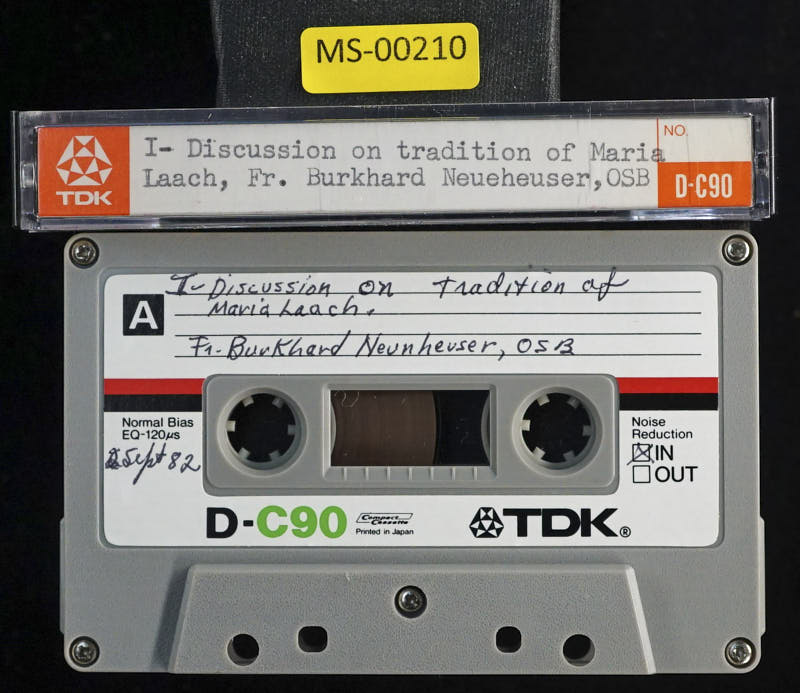
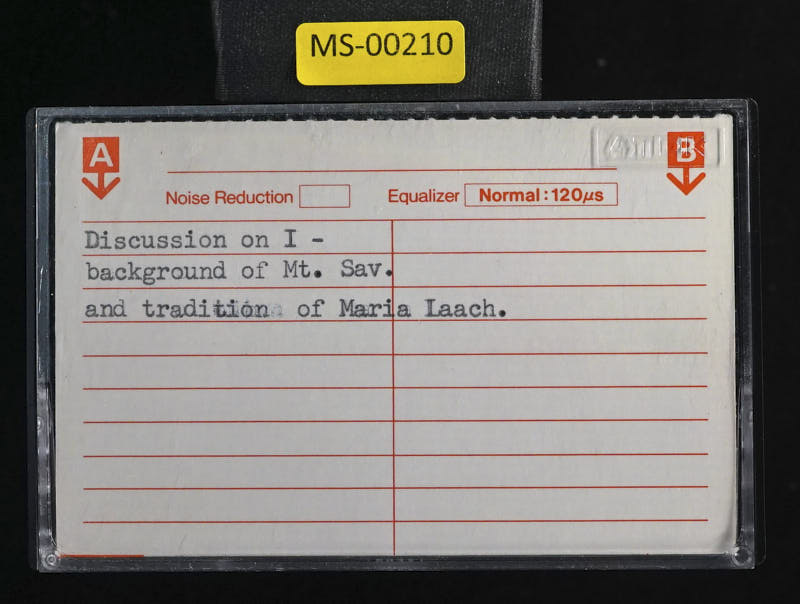
AI Vision - Possible Values from Photos:
Speaker: Fr. Burkhard Neuhneuser, OSB
Possible Title: Discussion on tradition of Maria Laach
Additional text: background of Mt. Sav.
@AI-Vision_v002
Is there anything you would want to say further than... No, perhaps it would be better that you are speaking. I wish to say this morning I tried to give you only a little bit of the atmosphere of which Father Damasus was coming. And then I must, in the next... next time, speak also about the difficulties. And he, in a certain way, when he went away from Germany in 1938, in a very famous conference he has given to the young people, young monks, was a little bit criticizing our situation. Not everything was perfect. For example, we had still, and we hadn't known it, We knew it, but we could not change it. There were many masses in the morning. It was not ideal. Only the Vatican Council has given us this wonderful opportunity to stay all together in one celebration at this point. And then also we had two classes of monks. We had 100 prophets, wonderful men, famous men, masters in their different branches.
[01:06]
And some of them also became famous in the world, for example, the great master of the mosaics in St. Anselmo in Rome, and of many of our works in Maria Lack, Rudolf Nuttke, our famous painter, in many churches entirely painted by him in Germany and in France, Alsace, and in Luxembourg, and so on, and Rudolf Reinhold, and so on, and all the masters in the different, how do you say, craftwork, electricity, carpenter, What's that? Forger. Forger. And Taylor. And Baker. And we have been an entire city. Today, Norm was so wonderful. Nevertheless, he came to organize a new life, but I must speak about it later. Therefore, only to give you a vision of this atmosphere.
[02:06]
And you can no more imagine... Oh, it was the enthusiasm, the admiration of the abbot, and also the wonderful way in which you could work together with him. And so many men we had, not only three, four, five, but six, seven, eight, nine, 10. And finally, we have been all together 170, only 60 choir monks. and then fighting, a little bit fighting, and at the same time receive enthusiastically by the young people, by many theologians, also by the popes. Pius XI has been very kind to us, but Pius XI It was also still more in a certain way because he was very friend to Abbot Ildefons when he was an apostolic nun in Germany. And more than all, Paul VI, who has been with us sometimes as Monsignore, as young priest when he was helping in the Secretary of State,
[03:20]
And then he nearly never, when he was spoken to the abbots, perhaps you remember it, he very often was speaking about the great abbots, Marmion, Herwegen, and so on. Yes, and then I must speak about this all this later. I need to show you the ground from which also Damasus was coming to realize this... world, but in a new way, in a more simple way, in a more authentic way, and also in a more American way. Again, here, pre-coming, before coming the idea of the Vatican Council of adaptation, we could not have one Roman liturgy in the entire world from there. First and to the last point.
[04:21]
Also, perhaps, Abad Herbig sometimes was thinking about it so. We must remain in Latin. We must remain in the old Roman liturgy. But nevertheless, he did it seeing the theological essence of the liturgy. Here, in this wonderful article of Bautista Fisher, the appreciation of Abad Ildefons after the Second Vatican Council, he says... In the former times, liturgy was conceived as the technique to celebrate Mass, to know accurately when you must say credo and when you must omit it. And when he was nominated the first professor of liturgy in the theological faculty of Trier after the Second War, the clergy of the diocese said, stupid people who are making... A professor ordinarius, therefore a great professor with a special cathedra, only to teach the clergy to know when they must omit gloria and credo.
[05:22]
But no, no, no. We must know the essence of liturgy celebration. And the essence is actualization, realization of the work of redemption, death and resurrection of our Lord. But I must speak about it later on. Perhaps no, you must speak. if you have some ideas. There's one biography of Baudouin in English. I guess his influence, I was really kind of astounded to read it, all that he was able to do. Of Lambert Baudouin? Yeah. His greatness is, you know him. Lambert Baudouin has been a monk of Mont César, the Abbey of Mont César in Belgium.
[06:22]
It was until the end of the First World War, Abbey of the Congregation of Beuron, of the old Beurony system. In a certain way, we must be, we, And also, in a certain way, you must be very thankful to Boyer and Solan. But on another side, you could say all these peoples are old-fashioned. So you remember the terrible judgment of Louis Bouillier in his book, Liturgical Piety, his lectures given to Notre Dame here in the United States, when he said, Guérangé has founded an antiquarian abbey with an archaeological monastery. Terrible judgment. And Father Damazostein has written an excellent defense to defend Soleim and Guérangé in the American Benedictine Review against Bouillier.
[07:31]
In a certain way, we have received from Soleim from Geronji and then from the old Beuron, this vision of liturgy as the center of our life. But sometimes Solène more still than Beuron, and Beuron also a little bit more too medieval still, and Lombard Brunner has been one of the first who was speaking in another way in this famous Congress of 1909, Malin, We speak about it as, in German, the event of Malin. It was a congress of the Catholic works in Belgium. And in this occasion, two men, Lambert Baudel, monk of the Beuronese congregation and of the Abbey of Mont-César, and a lay professor, Gottfried Baudel,
[08:34]
Godefroy, Kurt, from the university in Louvain, were speaking about the liturgy, and this totality of the Catholic works, and they could not find a place for it, only in the section of art. Liturgy is some part of aestheticism. And here, the words of both have been like a bomb, [...] exploding. Literary is not only an aesthetical work. It's not only some external apparatus. Literary is the soul of the church. Lambert Baudouin said it, and Gottfried Kurt, the professor, the layman, said the same. And the entire Congress was enthusiastic about it under the patronage of a great bishop, Cardinal Mercier, very famous by... because he was the first to begin a communical... dialogues with the Anglican Church, Conversation de Malin, also de Mechel.
[09:40]
It was the aspect of Mechel, Malin. Mechel in Dutch, Malin in French, the same name. And under the patronage of this eminent cardinal, who during the war was the great leader of the Belgian population against the German army as the cardinal in Germany. Poland. No, the former. His name. Yeah, the first who died already. Was the great leader of the Polish people. So Cardinal Mercier, a wonderful man in a communicative situation and in also political difficulties and a friend of these liturgies. And immediately after this wonderful Congress, they were starting a work of liturgical apostolate that the faithful could really actively participate in the Mass and in Vespos, both in French and in Welsh.
[10:47]
And then immediately later began this great controversy because the Jesuits were feeling that the liturgical movement would destroy their piety. They are methods of spirituality. And then to conceal the difficulties, Lombard-Baudon has written an excellent little book, La Pietie de l'Église, The Piety of the Church. And you can see the liturgical movement, which was beginning perhaps a little bit in the Illuminism, which started then with Solène, was acknowledged by Pius X remained always a stream under the earth. And only in Malin for the first time it came to public life in Belgium. Belgium was the wonderful country in which all his work was beginning. But the greatness of Ilde von Sertegen has been to bring it to Germany.
[11:51]
He was not alone. He was working with all his monks. with the other abbess of the Benzitten abbess. And he was working, especially later, together with Austria, with Pius Parrish, who was more working in the field of pastoral liturgy. And so the importance of Lombard Boudouin is to have begun, to begin this work. And the second point of his great, wonderful work is that he then were founding the monastery of Shevetomia, perhaps in 26, to make a monastery in which Latin and Greek and Russian light was celebrated together, therefore, for the Trinity of the Church. And he did so strongly, he was working so strongly liturgically, and this... tendency for unity of the churches, that he was exiled.
[12:57]
And now, the third point of his importance is that he obeyed, remained in silence in Paris during the war. And during the war, he had the opportunity to speak with the apostolic nuns there, or after the war. And this nuns is called . And when Roncalitin became pope, as far as I remember, he, under his pontificate, or at least some years later, he could come back to Sheveton as the great patriarch of all these works, liturgy and a communical dialogue, and also, in the same time, obedience to the church. And then we tried to go on with this work in Germany. for Olembert Burrow. And in the same time was in these years when he was monk of Mont César, there was a rector for the monastic students who was studying in the University of Louvain, a simple monk of Maritzu, the greater Abbey.
[14:18]
of the Byronese congregation in Belgium, Columba Marmion, elected then Abbott in 1910, I think, or 11, and 1909 already. Abbott, and he was the great spiritual writer who, in a wonderful way, has shown also this liturgical spirituality, which is coming out It's a liturgical celebration. In his wonderful books, you know them. Christ, Life of the Soul, Christ in His Mysteries, L'Ideal du Moin, L'Ideal du Prêtre. I list four big books, one of the great spiritual writers. Perhaps in a certain way, we can say a little bit too... I don't find the right word, pious, too fine. No, but Baudouin, and then later on also Odo Castle has been more powerful to insist in the necessity of a liturgical spirituality.
[15:30]
Nevertheless, he remains a great man. And yes, No, but Baudouin and Colombo Marmion. But perhaps now I would like to also hear your questions. It would be more easier. How does Romani Guardini relate? Yes. Romani Guardini was first a friend of Kunibert Mohlberg. And together, they were discussing in 1916-17 to start this liturgical work. And then in certain difficulties, yes, there were... saying we must begin immediately. We cannot wait for the end of the war. And therefore, Roman Egodini had already read some chapters to bring out his first book of the spirit of the liturgy, the first volume of the Ecclesia Orans, the collection started by Abba Dilde von Selbergen in Eastern 1918.
[16:49]
This book remained the great, how do you say, apostle, hero, herald, apostle of the liturgical movement for all the years. And Romano Guardini was an Italian by birth, but his father was general consul of Italy in Mainz, Mainz, and he as a boy was sent to the school in Germany and has chosen German language, German school, German university, and he became more German than we are. A wonderful master of German language and complicated in his ideas sometimes, but an excellent man who was also able to
[17:51]
speak in a living way to young people and therefore here is perhaps his second great importance he was the apostle of the first liturgical movement together with Maria Lark and he was the spiritual leader of this Catholic youth movement which is called Quickborn and when he came for the first time to the center of this movement to the castle of Rothenfels near to Würzburg in Bavalia, I have seen him for the first time. He was celebrating Mass, and we have learned from him for the first time how you could speak in the Mass itself in a wonderful living way to the people. Not very high ideas, but... insisting in the reality of the celebration, in the actuality of it.
[18:55]
Therefore, in a certain way, realizing the importance of liturgical celebration as it was shown by scientific means by Odo Kassel. They were working all together so that he was, together with Odo Kassel, the first editor of the first volumes of the the Liturgisches Jahrbuch of the Yearbook for Liturgiewissenschaft. And here, in the first volume, Guadini has written an article about the objective reality in the liturgical movement, commenting a very famous book of this first group of Belgian monks in 1909 and 1913, And this book was the origin of this famous controversy.
[20:02]
He was saying, liturgy is everything. Without liturgy, there is no church. You can live as a good Catholic only if you are celebrating liturgy, and so on. And therefore, the Jesuits were protesting against him in a very terrible battle. the Civita Catholica, the France, all these periodicals of the Jesuits, they are fighting against him. And it was so terrible that nearly the entire Jewish movement would have been forbidden by Rome. But nevertheless, the war stopped these difficulties. The war stopped. It's also a providence of God. And no, Guadini in 21 has written an article about his problems. the objectivity in the synagogue celebration. And he said, liturgy is the objective norm of our piety. But only the objective norm. To have the reality and the actuality of life itself, you need always a second element. Not only objectivity, but also subjectivity.
[21:05]
In German, he called it Gegensatz. What is Gegensatz in English? Opposition. Therefore, all... Concrete life is opposition. And when I came to the university in Bonn, where he was in his first semester as young professor, first beginning, I was in my first semester as student. He, when we were helping him, in the disposition of his library in his house in a certain afternoon and evening, he was telling us, the secret of my life is to show how the entire human life is constructed by oppositions. Concretely here in liturgy, objectivity and subjectivity. Therefore, you need to celebrate liturgy, objective worship of the church, and objectively, you must celebrate the Volksandacht, popular piety.
[22:08]
Volksandacht, in German, very famous element, Rosary, Via Crucis, and all this element. An excellent article. But the first editor, Otto Kassel, has written, has joined to it a very big note, saying, excellent is what Dr. Romano-Gadini said. Nevertheless, I am from a different opinion. Perhaps it is right to speak about opposition as a fundamental element of every human life. But in liturgy, the two elements are not liturgical worship of the church and piety of the people, via Cousin's rosary and all these devotions. But the opposition is liturgy and my private prayer after it, my silent prayer, my meditation, in which I give personally, subjectively my answer in a certain way, if we stay in the church only, without any personal prayer in the church during the liturgy, participating internally with our soul and also continuing after it, then it remains death.
[23:24]
It would be really the death of all. You need internal participation so strongly that after liturgy you are continuing in Continuous prayer and all the modern tendencies of charismatical renewalment and prayer groups and so on are going in this direction. But both together, liturgy already filled with personal participation and continuation after it. And this note, very famous, is the beginning already of the separation between Guardini and Odokassel. Guardini was furious about this note joined to his article by Kassel. And after this second volume, in the third volume, he was no more co-editor. And in a certain way, they were separated forever. But Guadini has been so great that he, some years later, for the first time the files, I remember, in 30...
[24:32]
No, 29, 29 already. Therefore, five, six years later, he was so great to recognize Castle in his fundamental intention is right. The mystery, the mysterion, therefore, the actualization of the plane, the disposition of God fulfilled in Christ... given to us in his redemption work, in the Pascal mystery, actualized by the mysteries. That is the center of Christian life. He said it in some articles, and then he could explain it in a wonderful way in this famous book in which he has given his Sunday homilies given in Berlin when he became a professor in Berlin, perhaps from 1932, 1933, the Lord. You know it, perhaps, the Herr. Christ the Lord, not only the man of Palestine, but also the Lord, the glorified Christ, the risen Christ, who died and is risen and so on.
[25:40]
Very famous. And in other books, where he said explicitly, the mystery, as Castle has shown it, is the soul of Christian life, of theological worship. Therefore, here is the greatness of Guardini. And he tried also, to join him again and came to Herstelle, where Kassel was the chaplain of the convent, of the sisters' convent, but he was not received by Kassel. He is one of the limits of Odo Kassel. He wasn't quite a different type, typus, type, type, type. as Guardini. Nevertheless, everyone has taken his way, and everyone has then contributed excellently to the entire work. Romano Guardini on one side, and Odokaslo in another way.
[26:42]
When you say that Odokaslo refused to receive Guardini, do you mean he refused to talk to him, or refused to... No. First, he refused to receive him only because Guardini made a mistake to come there in the hours of perfect silence in Hersteller. He was not admitted, therefore. But no, he was not against this exposition of Guardini. And he was not against the work of Guardini, but there are different types of thinking. Otto Kassel was the man of philological and historical inquisition, research. And Guardini was the great thinker. Guardini was also a man of exact study, yes.
[27:45]
My first lecture I heard from him in the University of Bonn in 22, my first semester has been the theology of the Roman Missal. Therefore, he was studying the texts, but his first quality was a philosophical, theological thinker. Kassel was first the man of exact research, but he was also clever in his mind. Nevertheless, the first... was so different they couldn't work together. But everyone in this area was working, and so they were nevertheless finally working together, to say so. We would say today it is a pity that they could not stay together. After the war, after the second war, there was one monk in our monastery, very famous too, who was trying to work to gather with Romano Guardini to remain, retain his friendship to us.
[28:57]
And Guardini himself always was remaining friend of us. And he sometimes, nearly every year, has written to Abad Ildefons Herwegen saying, from time to time, I must come to you to expose to you my situation, my ideas. Also both, Herwegen and Guardini, they are not working too well together, but different types of men. in a certain way. And this monk in Laag, who was working together with Roman Reini, was our prior, Theodor Bokler. Theodor Bokler, very famous man, too. He was officer. He was a Protestant man, officer in the First War, active officer. After the war, he left the army and was married and became an artist. How do we say? Baking ceramics. They are probably famous, a great man as artist.
[30:00]
And then his wife died, and he became Catholic, became monk, in 27, I think, or 26. And then, perhaps in 35, there was, in the times of the Nazi, a terrible book against religious life. from an ex-Dominican, two years behind the walls of a monastery, with a terrible description of religious life and calumniation and an awful book of a traitor. And then a Catholic edition house asked Fr. Albert, could you not write a book against this book? Fr. Albert once answered, we don't write against somebody. But I have a monk who could speak about monastic life. Our Theodor Buchler, still a simple monk, who has written then a wonderful book after the experience of 10 years in the monastic life, a very famous book, Soldat und Mönch, Soldier and Monk, where he in a wonderful way, 35, 36, when Germany was re-armed, was describing the first war, his activity as officer, encounters with the emperor,
[31:23]
with Marshal Hindenburg, and then comparing it to the Army of Christ, the monastery as an army, where we are fighting against the devil, and describing our daily life, our theology, and so on, a big book, who had many, many editions, also during the war. And then we, during the war, had a military hospital with 1,000 wounded soldiers sometimes. This book was read by everyone, and that time he became prior. and excellent man, and he was one of the great men of our liturgical editions, the founder of our review liturgy and monastic life after the Second War, and so on, which we did not continue when he died, in 25 volumes, and so on. He nevertheless was a friend of Guadini, and he went always meeting him in the liturgical commission of the German bishops.
[32:29]
They were working together in great liturgies as Jungmann, the Jesuit, Karl Rahner, the Jesuit, Theodor Borgler, and the Vicar General of Trier, Heinrich von Meures, and other people still, and the Oratorians of Leipzig. working all together. And he met all by squadini, working together with him. And so we remained friends to him. Also, a certain separation remained because we have been different types of men. We had different areas of work. But finally, all were working together until the Vatican Council has given the last approbation of all that. But again, perhaps it's better that you ask. This is more to do historically. But how was it that the liturgy of the hours, I mean, the more primitive, say, in the fourth century and the where the Desert Fathers would come on Saturdays and Sundays to receive the Eucharist, how did that, and then we see it fairly well maintained in Benedict's time, you know,
[33:49]
although the Eucharist was becoming more just a receding of the Eucharist than associated with the Mass, except I suppose on Sundays. But the liturgy became more, became, there were war hours. And then it sort of seems to have disappeared or faded because it seems like what you're talking about was to bring the Eucharist back into the Mass as a more high point. I don't think that Saint Benedict would separate already both. He does not speak about Eucharist. Perhaps he could speak about monastic Eucharist, a celebration according to the rule later on. But we have no certain security that he was separating communion from Mass. I would say with Armand Veilleux, the great trappist in Canada, who was Abbot of Misinia, yes.
[34:57]
But he was too radical, therefore he must resign already. But he was my student, and he had made his doctor dissertation about the liturgy of the Pakumingen monks in the fourth century. An excellent work, and he did not write it against Abbot Elisius Dekos, Abbot of a Dutch Abbey, a Flemish Abbey in Belgium. Elisius Dekos, in the memorial book of Oder Castle, he was a great friend of Oder Castle, has written an article, Les anciens moines ont-ils célébré la liturgie. The old monks did celebrate liturgie, And he answered, liturgy in the meaning of Solemne, of Beuron, a little bit also of the old Maria Lack of the times of Abbot Herrigan, was not so celebrated in the old times.
[35:58]
But OK, we are agreeing with that. But Armand Verhue shone a little bit against Abbot Eligius Decker, who was exaggerating his idea. They celebrated liturgy as it was common custom in their time, in the fourth century. Therefore, they came to the Sunday Eucharist in the parish church. They were celebrating as every Christian in the fourth century was celebrating liturgy. In a certain way, this remained typical for the monks in all the centuries. And we could say Until the late Middle Ages, monks were celebrating Eucharist and receiving Holy Communion in it as a sacrificial meal. And only in modern times, during the Middle Ages, in consequence of the certain evolution of the Eucharistic theology, there was a separation with insistence of the presence of our Lord in the bread and the wine.
[37:14]
therefore, under the species. And there is real presence in consequence of this wonderful theology of transubstantiation in the 11th, in the 12th, in the 13th century. And St. Thomas, in his theology in the 13th century, sees still really the wonderful... the wonderful union between the Deucharistic memorial of our Lord, where we are celebrating the memorial of his death and his resurrection, and are receiving, then, the fruit of his sacrifice in the Holy Communion, their unity. But nevertheless, with time, the consideration, the meditation of this wonderful work of transubstantiation, of the presence of body and blood, of our Lord, and that his kind has brought the Christians to see it only, to adore it outside, to expose it, to give benediction, and to celebrate the feast of Corpus Christi, introduced only in the 13th century.
[38:27]
And here, still in the liturgy per se, the accent is given, condames, and on the sacrificial meal, but also on the real presence. And then, after Thomas, in the end of the Middle Age, these Eucharistic devotions were growing always, always. And when Luther was speaking against the multiplication of masses, denying in a certain way the explication of the transubstantiation, And when Calvin were protesting against the doctrine of real presence, again, the Catholic theology must insist so much in the reality of this real presence that they nearly were forgetting the importance, nearly, not totally, of the Mass, and insisting on the real presence alone in the tabernacle, in the exposition, in the visitation of the sacrament, and so on.
[39:29]
So, no. On the other side, theoretically, we retained always the importance also defending it against the Protestants of the reality of the sacrifice, but it was separated. And when the Council of Trent must expose the Catholic doctrine against the Protestants by concrete, awful historical reasons, they were beginning with the real presence under the species of bread and wine. Speaking 10 years later, by terrible historical reasons, wars between the emperor and the Protestant princes and so on, 10 years later, about the communion, where it is not necessary to receive holy communion under both species, because under every species, you have the entire Christ. And still later, some years later, in another session, they were speaking about the reality of the sacrifice.
[40:41]
And this separation, real presence, communion, and sacrifice of the mass remained typical for the entire Catholic theology in the following centuries in our dogmatical treaties. We were speaking about the real presence. Therefore, we must worship and adore it. We must receive for the communion at least once a year. Sometimes. No, more or less. Not too often, because we are not worthy. And finally, we must also celebrate the Mass. Communion is not necessary. Only the priests must receive for the communion. The people not so much. And this remained for centuries and centuries until the lamb was beginning to change. It did not succeed immediately. in the beginning of the Byronist congregation, the not priests could receive Holy Communion perhaps every week, once, and so on.
[41:45]
And only Pius X was the man who said, no, we must receive Holy Communion very often. And he has formulated the word, at least he said so. Also, we could not find the real place where he has said it. You must not pray in the Mass. You must pray the Mass. Therefore, sharing actively in it. And nevertheless, also here again, I said it already this morning, when we received Holy Communion, and when we did it every day, when I was a boy in 1916 and 17, We were receiving Holy Communion very piously before the Mass to come then, give thanks to our Lord, so, with closed eyes, during the Mass. And then in 16 and 17, we were beginning to see the importance of the historical movement.
[42:48]
We had a shot, Lefebvre, a German missile. Then we were receiving Holy Communion, Thanksgiving, And when the priest was singing the gospel, but in a black mass, therefore in a mass for the deaths, then we proudly were following the Latin gospel with our missile in hand. And only in 1920, in the Catholic movement of Romano Guardini, and in consequence also of the work of Maria Lach, we were saying, no, no more so. We are receiving Holy Communion in the mass, and we are receiving Holy Communion in every mass. And then so you can do it actively in the and so on. And now we are beginning with your own question. You see this, yours, this evolution. We lost a little bit by certain reasons the vision of this essential union between memorial of our Lord
[43:57]
presence of his redemption work, and communion as the consequence, the fruit of the sacrifice. Sometimes, it is true, there were exaggerations. It's always in the history of the churches. And also in our groups, Catholic Youth Movement in the 20th, in the religious movement after 20, 30, people were saying, to receive Holy Communion altar of the Mass is not meaningful. We must not do it. Tabernacle has no importance. And that is also false. Therefore, the Pope, Pius XII, must protest against this exaggeration, especially because in 39, 38, 39, very pious priests up late in of our lady in Germany, has Cassipe has written a little booklet, Irrwege und Umwege im Frömmlichkeitsleben der Gegenwart.
[45:09]
False distorted ways in the life of piety in our actual times, in which he was very terribly criticizing the Jewish movement, denying the real presence. Denying the opportunity for the communion, author of the mass, and so on. And this booklet has divided the entire clergy in Germany into campus. Not young and old, but young and old here, and young and old there. For liturgy and against liturgy, fighting. And then also exaggerating against the nursery, against the via crucis, because you must pray only liturically. in the sense of your private prayer during liturgy, after liturgy. And the war, again, a little bit has stopped also these terrible questions, not destroying the unity of the church.
[46:12]
But the pope was nervous in Rome, Pius XII. And he asked the German bishops to say, how is the situation there? the cardinal president of Breslau was a good master of all these things, and some excellent theologians were defending the liturgy, Carl Ranaud, and the bishop of Trio, and other people still. We must not do it in Maria Lark. And then Pius XII has published his wonderful Encyclical Mediator Dei, where he is criticizing the the liturgical movement, yes. But at the same time, acknowledging the importance of it. He says then, okay, liturgy is really the source of the life of the church, not only in external apparatus.
[47:17]
He says, the liturgical authentically celebrated is the soul. That's just wonderful. Therefore, I against this meaning of the clergy who said sometimes liturgy is only the aesthetical apparatus of the church. And then he said it is right to receive Holy Communion in every Mass, after good preparation, also after confession and so on, in the Mass. But nevertheless, it is also allowed and sometimes necessary to receive Holy Communion outside of the Mass. adore it, to worship it, but to give the viaticum, viaticum, to give the last communion to the sick people, to the dying people, and sometimes also to receive for the communion after the mass. But because we must preserve it in the tabernacle, the real present body of our Lord, we must adore it, worship it. Therefore, from time to time, we must also make a visitation, pray before it, and expose it, and make possessions. But Pius XII has solemnly said, the first reason is not to adore, but to preserve it only.
[48:22]
And when we have edited, I was a consultor in this congregation, in the Concilium at Exequindum Constitutionum in the Sacra Liturgia, in the Council for the Fulfillment of the Liturgical Reform, when we edited in 1967, a wonderful instruction, the cultus mysterii eucharistici, the adoration, the cultus of the eucharistic mystery. We could recite this wonderful word of Pius XII. The reason for the reservation is not the adoration, but the last communion for the sick people. Nevertheless, it is really the body of our Lord, therefore we must adore it. And all the forms of devotion are good. if they are submitted, if they are subordinated to the liturgical celebration. And therefore, in this instruction, we have said the Eucharist is, first of all, the memorial of our Lord, the real presence of his sacrifice, to give us the fruit of the sacrifice in the reception of the body and blood of our Lord.
[49:41]
And then because, therefore, we must reserve it in the tabernacle, we must also adore it in certain forms of devotion, which cannot hinder the reality of the Eucharistic celebration, of the action, of the sacrifice. And therefore, from this time on, it is really forbidden to celebrate Mass as it was done in my young years. In our diocese of Rio, very often, quorum exposed to sacramento. It is forbidden today to celebrate Mass before the sacrament exposed. And then in this instruction, we were insisting then, therefore, the first form of Eucharistic priority is the communitarian celebration of the Eucharist in Sunday Mass, where the people must come together And it's not convenient to celebrate in the same times, in the same church, two or three messes, one mess only.
[50:43]
And you remember in our great abyss, also in Maria L'Arc, we were celebrating, after the communitarian celebration of the vigils, in 12 altars, our messes. Here, here, [...] in silence. And when the faithfuls came to the church and this mystical... atmosphere, only lights on the altars, in silence, very pious. He said, oh, it's wonderful. You can participate in 12 messes. Here for confession, here for gospel, here for consecration, here for communion, without communion, because you could not receive all the communion in these messes. It's the Winkelmesse of Martin Luther, the Winkelmesse, the mess in the angle. And we abolished it already in 1956 in Maria Lach, before the council, to insist in one mass only, the center of the entire day and entire life of the monastery.
[51:53]
And because in that time we must still celebrate private masses, we must build a new wing for private masses in... in the cloister, in the Kreuzgang, and so on. I don't know how Father Damasus... Oh, you have the same situation near and below. In the first years, you have said private mess in your crypta. And when we stopped it, the faithful protested. It was so nice. It was so pious. It was so mystical to assist with this mess. This is true. Our necessity is, and I think you do it really in your mess here. It is one mess... where all are sharing together be really pious recollected in internal participation not only in external apparatus so we insist in these instructions and then we said secondly so far as possible we must concelebrate and in certain occasions this is allowed to receive holy communion unto both species and I see
[53:05]
you in the States here, you are really realizing the possibilities given by the council and by the instruction after the council. In every conservation, it is allowed to give the communion under both species to all the assistants who normally assist to this mess. As you are doing it here, as they did it in Darlington, in Mogestown Abbey, Meanwhile, we in Maria Lark, we are not able to do it. We give Holy Communion, but under one kind only, especially because we are so many. To do it every day, every day with sometimes 50, 60, 70, 80, it's too much in a shorter, in a smaller community, it's more easy. In Morristown, they did it not every day, but at least in Sundays, also with many faithfuls. Drinking from the chalice. We are doing it in Maria Lague only on Easter night and Christmas night.
[54:09]
So the entire church also, if we have 500 there. So, in these instructions, therefore, we have given the conclusions. Now we must insist in this vision, which finally, after a certain deviation, in the last four centuries is given to us again. We must insist on it to celebrate the Eucharist all together, very piously, receiving Holy Communion, at the same time not denying the reality of the Eucharistic presence in the tabernacle, with Genoflexion, from time to time a short oration, and so on. Also, we don't do any more exposition. and so on. It's not necessary, but we couldn't allow it to ever, like, provisions to do it. And to remain, therefore, in a certain equilibrium, in a good sound, a good practice in all these points.
[55:24]
Oh, yeah. We don't have much of a reference, I think, of the... The actual celebration of the Eucharist liturgy in monasteries in the earliest centuries. You have never seen it. No, I haven't. You are right, yes. Libraries on the liturgy as celebrated in monasteries in the earlier ages. It is one of the difficulties of the wonderful years of our monastery before the Second War, before the Council. We had a solemn liturgy. A solemn heimes, pontifical heimes, with the greatest solemnity, according to the rights, more or less, of the order Romanus Primus of the first Roman order of the fifth century of the time of St. Gregory. It's awful. Therefore, we had a wonderful theology of Odo Castle, insisting in the greatness of the liturgical celebration in which we are re-actualizing the walk of redemption.
[56:31]
And in practice, last, complete, active participation was given only to the priests, in their own priests, in their little masses. And also the priests could not receive Holy Communion in the High Mass. And I can tell you, my first dialogue with Protestant theologians during the war, 1942 in Vienna, we came together with Lutheran theologians, later Bishop William Stalin, a great friend of Otto Castle, of our monastery, and other theologians, Karl Hanna, the young Jesuit, and some people of Wien, and all, though I myself was called to present the doctrine of Otto Castle there. Our topic was Mass, Eucharist. And we were discussing, I was trying to speak about this conception of Odor Castle in the Jewish celebration.
[57:32]
We don't celebrate a new sacrifice, but we actualize, we represent the unique sacrifice of the cross, which is not repeated, but is given present, more or less so. And after our discussions about it, the leader of the Protestant group said, We came here, we came to this dialogue, to this discussion, to this meeting with great preoccupations. Because we must discuss a problem about which our fathers 400 years ago was divided so terribly. And to our greatest surprise, we see that there is no distinction, theoretically. in our theological visions between you and us. But we must remain what our fathers has been because your praxis does not correspond to your theory.
[58:38]
And what was the praxis? The Winklemesse, the small masses, the private masses, innumerously repeated, paid by the faithfuls to make free their poor souls from the purgatory. to obtain everything, because every mess is, again, a sacrifice, a real sacrifice, repeating. I'm a little bit exaggerating, but more or less, for many Catholic people, the opinion was so. And no, this was so in 1942. We were protesting, saying, oh, my dear, One of the Protestant pastors who was officer in the war, he came from Sebastopol and to Germany on the Easter Sunday through Wien. He went to St. Stephen Cathedral to assist to the mess because he was a very pious Protestant pastor, the Catholic mess.
[59:40]
And he saw the priest celebrating his small mess on the side altar and a lady was assisting. On the Easter Sunday, he, the Protestant pastor, wished to assist to the great Eucharistic celebration, and he saw a small mess with one lady assisting. And we said, well, dear pastor, this poor lady had no other possibility to have a mess on Easter Sunday. Why not at least a small mess when she could not assist to the high mess occupied with sick people and other people and so on? Nevertheless, the situation was there, though. In 1942, In 1942, and now, where is the private mass? Practically, it disappeared. We could say, in a certain way, there is no more distinction between us and the Protestant in our good Eucharistic celebration, celebrated in this Eucharistic theological vision as we have given it by Odo Kassel.
[60:48]
No repetition, but... actual presentation of the unique sacrifice of the cross. The difficulty is, and we must speak a voice still a little bit, how is it possible that the unique sacrifice of Christ, passed forever historically, is still present again here. In a certain way, we did not yet resolve the problem. But also the council, the Vatican Council did not resolve it. But nevertheless, the Reality, that there is no repetition, that we are in Eucharistic memorial celebrating the unique sacrifice of Christ, having it presently here as our sacrifice, is approved, acknowledged by the Council. You must go to your walk, yes.
[61:45]
@Transcribed_UNK
@Text_v005
@Score_94.57