You are currently logged-out. You can log-in or create an account to save favorites and more. more info
Medieval Instability: Seeds of Renewal
AI Suggested Keywords:
The talk explores the decline of medieval civilization, focusing on the instability of the religious and cultural synthesis of the 13th century and the transitions leading to the crises of the 14th century. Key factors include economic limitations, political instability, and the Church's shifting role and influence, marked by the ambitious yet problematic temporal power of the papacy, particularly under Innocent III. The analysis includes discussions on the integration of classical Roman law into Church law, the tension between Christian teachings and a society inclined towards warfare, and the broader societal transformations that prevented the stability of Western civilization from mirroring that of earlier civilizations like the Roman Empire or those of the East. The underlying message suggests that Christianity’s inherent instability does not equate to disintegration, as evidenced by the eventual religious renewal and societal resilience leading into the Renaissance.
- Christopher Dawson, "The Rise of Western Culture": Provides background on the foundations of Western European culture during the Middle Ages, focusing on the role of the Christian religion in shaping civilization.
- Archibald Lewis, "The Closing of the Medieval Frontier" (Speculum): Explains the economic factors contributing to the breakdown of medieval culture, highlighting frontier expansion and subsequent contraction.
- Lynn White: Known for studies on technological advances in medieval Europe, placing medieval civilization as a leader in technological development by the late 13th century.
- Donation of Constantine (750 A.D.): A forged document allegedly transferring imperial power to the Pope, significant in discussions about the Church’s claim to temporal power.
- Pope Innocent III: His reign is highlighted as an example of the papacy's peak temporal influence and its integration of new religious movements within the Church.
- The Sicilian Vespers and the Hundred Years' War: Used as examples of the political and military tensions undermining medieval stability.
- Roman Law: Its revival and integration into canon law are cited as pivotal yet potentially problematic influences on the Church’s evolving authority.
The talk effectively places these historical components within a broader discourse of change and continuity in Western civilization, suggesting that while instability poses challenges, it does not inherently lead to civilization’s collapse.
AI Suggested Title: "Medieval Instability: Seeds of Renewal"
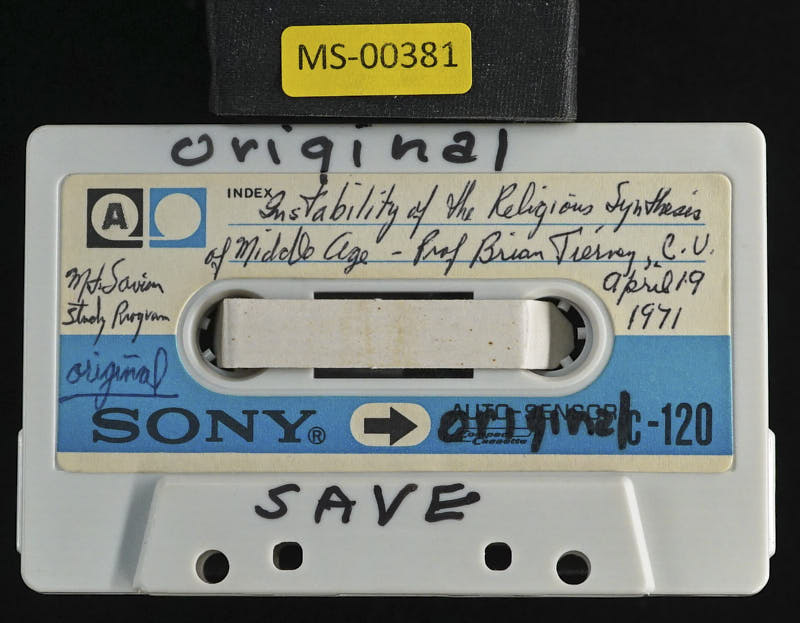
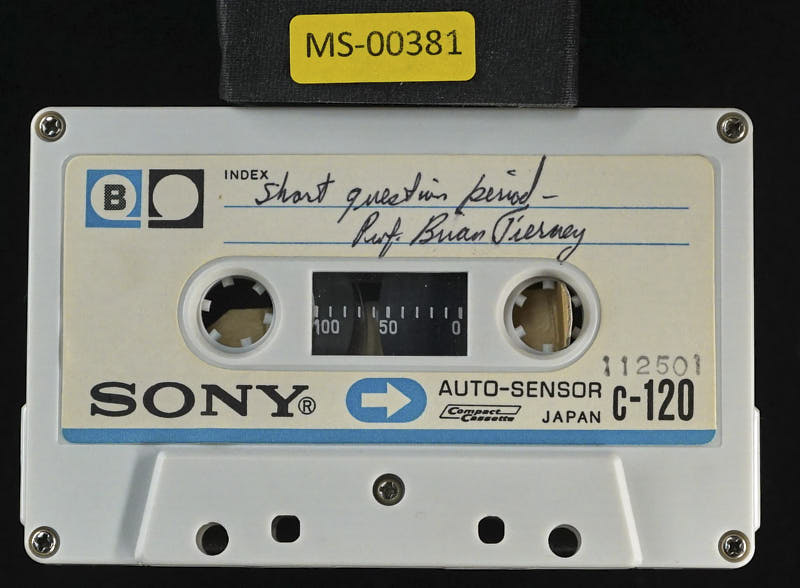
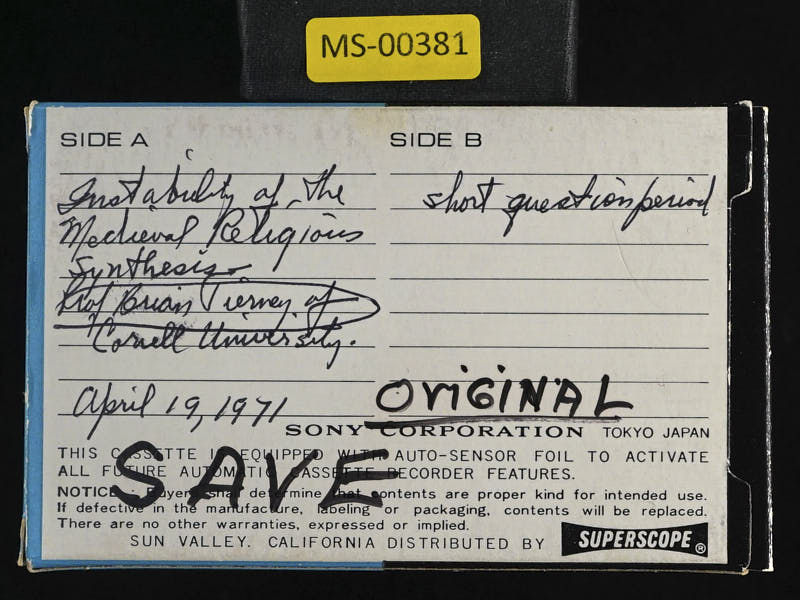
AI Vision - Possible Values from Photos:
Speaker: Professor Brian Tierney
Location: Cornell University
Possible Title: Instability of the Medieval Religious Syntheses
Additional text: Short Question Period
@AI-Vision_v002
And he's come to speak to us before, last time he was on the council, well, council, that was several years ago. And this year, the Greenland, the Countryman of our study program, which deals with the Middle Ages. And my brother John, well, Pierre and I were two difficult meetings. to just to ask, since this is the end of our study program, because the field work begins now, whether Mr. Turnick and I saw a lot of our reading and are talking about the Christian religion, Christian religion which was founded by Jesus Christ and which has been existing in time and therefore has developed and modified. And since that is, in fact, one of the subjects in which he is dealing with his classes now, he would have a .
[01:12]
What I am really going to talk about is a kind of negative aspect of what Brother Peter has just said. The kind of theme I chose for myself was the instability of the religious and cultural synthesis of the 13th century, or in effect, what went wrong with the Middle Ages? Why aren't we still living in a medieval civilization? Indeed, it is a problem of major concern to historians, but of a special concern to Catholics, I would suppose, because if there ever was a civilization, a culture which was shaped and formed in all its expressions by the Catholic Church. It is surely that of Western Europe in the 13th century. I want to ask you to forgive me if there are traces of incoherence in this presentation.
[02:26]
I have I am indeed not talking off the top of my head. I am trying to discourse on things that I have been thinking about for a long time. But I have been having an unusually complex and difficult life just lately for a professor. And I am indeed talking from rough notes, some of which were made in the car as I came down. This again is almost willful. I did not set out when I was thinking of this lecture weeks ago. it seemed to me inappropriate that I should try to present a formal logical discourse which would start at A and proceed flawlessly to Z. I knew that all of you had been dealing with different aspects of the Middle Ages and I thought it would be appropriate if I tried to touch on various aspects of this problem in the hope that one or the other might engage your interest and above all This corresponds to the nature of the issue.
[03:27]
There is no one simple answer to what went wrong with the Middle Ages. There are many complex ones, and some will seem more important than others to different people. I think one should understand at the outset, however, that in approaching a problem of this kind, we are dealing with one of the central problems that a historian has to deal with. in concerning himself with Western culture as a whole, I am inclined to think the central problem. The central problem is to explain why Western civilization never achieves stability, why we live in a process of ever-continuing change, so that since the Middle Ages, every century is radically different from the preceding one in its thought forms, lifestyles, forms of art and architecture. And in a world in which further, indeed, I would say, ever since the 11th century, the rate of change has perceptibly accelerated in every epoch.
[04:34]
And I would think that underlying all our immediate concerns, the fundamental problem for modern man is indeed how long one can stand the stresses of ever accelerating change. And if indeed they are intolerable, if this continues, what we should do about it. The point is that this is rather atypical. This is not how all civilizations go. In great oriental civilizations more often one finds persistence of lifestyles, artistic motifs, styles of government for many centuries. I do not wish to pursue this on a comparative basis, but I mean the Egyptians learn how to build a pyramid, which is quite a trick, and they go on happily building pyramids for thousands of years. Primitive peoples seem capable of maintaining a completely stable and changeless lifestyle for uncounted generations until external influences begin to play on them and disrupt it.
[05:41]
This is not the experience of Western men. And the place where you can begin to see the pattern establishing itself, I would say, is in the Middle Ages, which is indeed not a static period. Every medieval century is different from every previous medieval century. The special problem, if we are considering the achievement of a Catholic civilization in the 13th century, is that In the transition from the 13th to the 14th century, we are dealing with radical and rapid change indeed, but with change that is most obviously decline, decay, disintegration. As I said, I want to try to offer various approaches to this. If you are tape recording that, I would be glad to... Have a copy of the tape so that I shall know exactly what I said after.
[06:45]
I know the points I want to make. Up until the end of the 13th century, it seemed as though you were perhaps going to have a standard pattern. It seemed that medieval civilization was achieving a stable, harmonious balance. People talk about the medieval synthesis. It's the cliché. In the political sphere, nation-states have emerged, which form the permanent political units, which still exist in Europe typically. They are developing sophisticated structures of government, including experimentation with representative institutions. Some degree of unity among states is maintained by their allegiance to a common religious head. The pope is universally recognized as head of a universal church. The great conflict of empire and papacy has ended in the 1250s. An elaborate code of courtesy has been developed to regulate relations between persons of knightly class. In the world of thought, it seemed for a happy generation possible to reconcile all the exciting new world of Greek science and philosophy with the old truths of the Christian religion.
[07:56]
On a simple physical level, population had been expanding steadily for two centuries, and in the middle of the 13th century, probably the expectation of life at birth was higher than it ever had been in Western Europe ever before, including the best days of classical civilization. On top of all that, brilliant new forms of literature and a superlative new form of art and architecture characteristic of the whole civilization had been created in medieval Gothic. So there is our problem. They had learned how to build Chartres Cathedral, which is more of a trick than a pyramid. Why don't they go on building Chartres for the next 600 years? In actual fact, there is no period of serene, stable, persistent cultivation of the same styles of art and life and thought which had developed then. There is an almost sudden radical breakdown.
[09:00]
It starts just around 1300. This is one of those happy coincidences where a chronological transition from one century to another does seem to be marked by definitive historical events. I am thinking of the great crisis of church and state. A new kind of crisis, because it's a national state, a national monarchy, France, fighting the papacy, and totally new in its outcome. For the first time in any of these medieval struggles, the papacy is totally humiliated and defeated. There follow a devastating war between states in the Hundred Years' War, internal wars in most of the states of Europe, plague, famine. a mood of philosophical doubt in the schools, and by the end of the century, the great western system of the church, perhaps the greatest disaster that ever hit the medieval church. There were tensions such that it seemed that civilization itself might collapse by the end of the 14th century. So, how do we account for all this?
[10:04]
Now I am going to start on these variety of explanations. Well, there is an economic explanation. There is an economic explanation of everything, and there is one for the decay of 13th century culture. It was put in an engaging fashion, I think, in an article in the journal Speculum by the economic historian Archibald Lewis, who called his piece the closing of the medieval frontier. We have a frontier thesis for the Middle Ages, as for everything else. And the argument has sense in it. It goes like this. The great period of growth of medieval culture, the 11th, 12th, 13th centuries, are an age of an expanding frontier. The Crusades fling Western Christian civilization into the Eastern Mediterranean. Missionaries carry Christianity in the 11th century north so that for the first time the whole of Scandinavia is embraced in a single medieval unit.
[11:09]
Scandinavians especially carry their civilization to Iceland and you will recall even to Greenland where there is a permanent settlement. The frontier is obviously expanding but he goes on to say, I'm just summarizing this article, this is not the most important expansion of a frontier. There is going on in all these centuries what he calls the expansion of an internal frontier and he means the constant growth of agricultural land, the draining of Marshes produce all the polders of Holland. Great areas in eastern England, the Fenland, are drained. And all over Europe, uncountable hundreds of thousands of acres of forest and moorland are broken into the plough for the first time. This is accompanied by a great growth of medieval population. This is the expansion which underlies all the achievements of the Middle Ages. And then the author says... I always remember and like this line. I mean, given the fact that more food is being grown, we need not be surprised that a civilization arose with universities, Gothic cathedrals, romantic literature, and new institutions, and so on.
[12:24]
I always like these magnificent leaps of the economic historians. You've got more bread in your belly, so naturally there are Gothic cathedrals. It's rather simple. However, again... we can concede the underlying element of sense. You can't have a civilization without an economic basis. There is an expanding economic basis in these centuries. And then he goes on to argue that at the time when things begin to go wrong, he takes 1250 to 1350, as a time when symptoms of breakdown appear, the frontier is closed and begins to contract. It happens to the external frontier. The Crusaders get chased out of the eastern Mediterranean. Christendom is pushed backwards. In the north, this is, I think, agreed by all the people who know about these things, there is a perceptible climatic change in the late 13th century. The winters grow harsher. They used to cultivate grapes in England in the earlier Middle Ages.
[13:26]
No longer. by early modern times. Glaciers press further down in Scandinavia. The area of cultivated land is indeed diminished as you begin to get into the 14th century. Navigation to Iceland persists but gets more difficult. Navigation to Greenland stops just about the middle of the 14th century. It becomes impossible apparently. The last remnants of the Scandinavian settlement there are. apparently assimilated by the native Eskimo culture. The archaeologists have been working on this lately. It produces lower yields, typically, in the south of Scandinavia. There are terrible famines in 1317 and 1318. We seem to be on an unprecedented scale all over northern Europe. The external frontier in various ways is pressing in, but then above all, again, his crucial point is that there can be no more expansion of the internal frontier.
[14:29]
You've reached a limit. You're getting a problem, a precise problem of modern days, which they hadn't had before, of a pressure of population on resources. Population had grown because agricultural land was constantly... The amount was being increased. By about towards 1,300, you've pretty well... got to the limit of what is easily drainable and easily clearable and gives good yields if you take the labor to break it in. You've used up all the good land. This leads to a decline in total productivity, to economic depression, and hence to all these stresses and strains which you can discern in the civilization of the 14th century. Because there is less to go around, Classes begin to fight for their share of the wealth. You had in earlier times, you see, being able to build all these vast ecclesiastical institutions and even the vast physical churches, elaborate bureaucracies of state, more central government, without too gross of pressure on the people at the bottom of the pyramid because there was a constantly expanding economy which would finance it.
[15:39]
After this, the economy is contracting. And so, well, you can see how this could be pursued. Stresses in every kind of life appear. Well, I think that's a rational explanation, and I think that any account of what went wrong with the Middle Ages has got to take account of an economic constriction which is characteristic of the 14th century. But it's not quite a whole answer. One would want to say, why didn't they cope with it better? You see, Europe had not, in fact, reached anything like the limits of the human population that it could support by about 1300. In later ages, in the 17th century, for instance, there are vastly, vast increases again of marshland which is recovered and polders that are drained. The whole movement is resumed. One could say that it was getting a little more difficult, yes.
[16:42]
It needed a little more technology, yes. But why aren't they better at it? You see, the whole point is that the 11th, 12th, and 13th centuries had been incredibly fruitful in technological advance. This is one of the aspects of medieval civilization which used to get underplayed when we looked at it as an otherworldly civilization entirely. But really, you've only got to look at a Gothic cathedral to see that the people who built it had a lot of technological know-how. And this aspect of medieval culture is nowadays much emphasized And the man who is the expert on it, I suppose, Lynn White, maintains that by the end of the 13th century and for the first time, because of the achievements of the 11th, 12th, 13th centuries, Western civilization emerged as what it has been ever since, the technological leader of the world, the most technologically advanced civilizations hitherto having been in Islam and China, but being surpassed... by the rather extraordinary mechanisms of the late 13th century.
[17:46]
So, I mean, if you say the civilization ends because the economy constricts, one says, why didn't they do better? It's not that they lack this kind of know-how. Why, in fact, do all the disruptive, destructive forces take over? Why do they pull themselves to pieces instead of getting on with the perhaps slightly more difficult task of improving their economy when they're farming some more? Well, there are political explanations, after an economic one, to move on to a different area. If you lived in the 1270s, say, and you were an optimist, you might think that all the political problems of Europe had been resolved. England and France, two great antagonists of the 12th century, had been at peace for 50 years, the great incessant struggle of empire and papacy which gave rise to incessant warfare in Italy had ended with the extinction of the Hohenstaufen dynasty in the 1250s the Spanish reconquest had been proceeding through the early 13th century but it had ground to a halt by about 1250 and the kingdoms of Spain were more at peace than they ever had been for a long time before in the middle ages it might seem that all the causes of war all the
[19:10]
ancient wars had been settled and that there were no obvious reasons why you should have more wars. What I am calling politely political problems is really the problem of warfare, the incessant problem, how you stop warfare tearing a society to pieces. I am perhaps exaggerating the serenity of or say about the 1260s, 1270s for purposes of dramatic contrast, but it was rather peaceful, relatively speaking, at that time. The Italian city-states are feuding and fussing with each other, as they always are, but they're displaying rather more inclination than usual to accept papal arbitration in their problems. It is all an illusion. The 14th century is an age of the most beastly and brutal and destructive wars in Western history. I mean, we sometimes achieve better effects by having more advanced technology nowadays, I realize that, but for what they had, they had an awful lot of destruction in the 14th century.
[20:22]
And the instability was always there. The problems had not been settled. There is an interlude of peace in the third quarter of the century because there were some exceptional personalities, especially Saint Louis was king of France, who really believed in the Christian ethic, who really sought to maintain peace, in his kingdom and in Europe. The king of England was a weakling. Saint Louis would not take advantage of him because he was a saint. But one cannot expect this to go on forever. England still held a vast province of France, Gascony. The English king always bitterly hated doing homage for it. to the French king as a feudal overlord. French kings always hated having the English king with a foothold in their territory. The cause was there all the time. It had never been settled. It will blow up again in the 14th century. As soon as you get greedy and ambitious kings, which is the normal and natural state of affairs, which is set in again by 1300.
[21:25]
The immediate place where the top blew off the sort of volcano where all the suppressed tensions blew up however was the island of Sicily before England and France this was a relic of the struggle of empire and papacy the last king of Sicily was the Hohenstaufen Frederick and then his son Conrad after that the line became extinct that's about 1255 Sicily was technically a kingdom held as a fief of the papacy And the popes, there was a vacancy. The popes hawked this crown of Sicily around Europe for 15 years, finding someone who would pay enough for it and who had the strength to take it. And in the end, the person who was picked was Charles of Anjou, the brother of the King of France. He did, in fact, occupy Sicily. The kingdom then included all South Italy, past Naples. His accession was bitterly resented in various quarters.
[22:33]
Peter of Aragon in Spain thought he had a good claim to Sicily. The emperor, the Greek emperor Michael of Constantinople was an enemy of Charles because he felt threatened by this new growth of power in the Mediterranean, of French power. And above all, in all these intricate negotiations about who was going to be king of Sicily, nobody had ever thought to ask the people of Sicily themselves. And as it turned out, this was an unfortunate oversight. The people of Sicily, it turned out, hated their cold-blooded French king. They hated the foreign garrisons that he brought in to hold them down. They hated the taxes which he imposed on them to further his schemes of Eastern conquest against Byzantium. A network of conspiracy grew up all over the Mediterranean, and in 1284, perhaps by accident, as I say, the whole situation blew up when the people of Palermo turned on the French garrison and massacred it in the so-called massacre of the Sicilian Vespas.
[23:37]
It occurred at the hour of Vespas from the Monday after Easter. As if this were a signal, and perhaps it were, all the peoples in various cities of Sicily arose and slaughtered the French They were driven off the island of Sicily. The Sicilians immediately offered the throne to King Peter of Aragon, who gathered an army and occupied the island. Charles still occupied the mainland of Italy. A war broke out between them, and it went on and on and on between their sons and grandsons, an incessant embroilment in the Mediterranean. All the Mediterranean powers, one way or another, were drawn into it. About ten years later, in the 1290s, England and France were at each other's throats again. Gascony gave rise to the first series of wars between them. In this case, it was rather quickly negotiated a peace, but it was simply a prelude to the outbreak of the real Hundred Years' War, which was about exactly the same issues from the 1330s onwards.
[24:42]
Medieval historians argue technically about the causes of the Hundred Years' War. This is a good academic game. It's just as good as the causes of the Peloponnesian War or the causes of World War II or the causes of World War I. You can make an historical problem of it. But when all is said and done, underlying the outbreak and then the persistent continuity and the inability to achieve permanent peace in the Hundred Years' War was simply the fact that medieval men liked fighting, or at least the... aristocratic class that dominated medieval society liked fighting. They were called knights. Knighthood was their profession. That was what they were trained for. The Hundred Years' War, as I said, typically took the form of English raids into France. It was an ugly, evil, cruel war. The desolation and destruction of villages and cities and churches was on an appalling scale. There was incessant
[25:47]
burning and massacring and looting of unprotected civilian populations, all indulged in ultimately so that a noble class could satisfy as fully as possible what has proved to be an ineradicable taste for honour and booty. We are dealing here with an atavistic element in medieval society. We are not dealing with an accident. This is something intrinsic to medieval society. It is a platitude to point out that the synthesis is formed out of barbarian Germanic elements, the peoples who invaded the Roman Empire and Roman classical elements and Christian elements. But this truly, I do not think I'm being in the least fanciful. This is a barbarian atavistic element. The Germanic peoples who settled... It's not a particularly Germanic trait.
[26:47]
I mean, you find the same sort of codes among Zulus and Red Indians and all sorts of peoples. But this particular barbarian peoples who settled and provided the basic populations all over Europe were warrior peoples. Read Beowulf. Prowess in war. is the ultimate virtue they honor and respect. It is a proof of manly virtue to conduct yourself well in war. It is the foundation of honor. To fight is of the essence of being a whole man, not a slave, not a servant. The free man bears arms and fights. Loyalty to a lord in war. is the foundation of the code of conduct that these people can really understand. And all this is transmuted into feudal relationships. Feudal society, the society of the 12th and 13th century, is essentially a society dominated by an aristocracy organized for war in which all these primitive Teutonic loyalties have become transformed into loyalties between vassals and lords and have become much more complicated.
[28:03]
But the thing itself is... It seems to me continuous from barbarian days to the 13th century. And I guess need not rub in the obvious by pointing out that it remains continuous as an element in Western civilization. But here is an intrinsic tension. All this is alien to the ethos of Christianity. something that beginnings of the medieval unity emerge when these barbarian peoples are converted to Christianity in the sixth and seventh and eighth centuries. There is a contrast in the whole sets of value systems. The Christian religion is teaching meekness, humility, peace as the only appropriate way of life pleasing to God. In a hundred ways, the medieval church has sought to mitigate this raw, savage violence of barbaric and early feudal society.
[29:12]
Churchmen are conscious of it. I don't think this is anything that a modern historian has to read back into the minds of people in the past. The church invents, first of all, the peace of God and the truth of God to try to keep calm peace, at least in certain times and certain places. It invents later on the Crusades to export military violence and turn it to an end that seems useful, at least in the eyes of the church at that time. It prohibits tournaments. I mean, medieval tournaments are terrible things in the 12th century. People liked fighting so much that if there was no excuse for having a real war, you just had a war without any excuse and called it a tournament. Fifty aside, just... lined up and went for each other with battle axes and lances and people got killed. From about 1135, the church excommunicated everybody who indulged in such activities. There is automatic excommunication for any acts of violence against clerics or violation of holy places. I don't know. I was going to say somebody ought to write a book, but I suppose there must be a book.
[30:14]
But one could make a book of all the ways in which the medieval church was trying to restrain the savage, endemic violence of the society in which it found itself. And towards the end of the 13th century, before things began to break down, it looked as though the church was doing rather well. As I say, there was an interlude of rather unusual peace. There was, as it happens, a saint on the throne of France, as I said, which makes things look better than they were, perhaps. But the 14th century proves that all the forces of savage, irrational violence endemic in Western society had remained quite untamed by the Christian Church, as they have remained quite untamed down to our own generation. So there is a sort of political explanation as to why the Middle Ages go wrong.
[31:16]
They go wrong because they fall into incessant warfare. They fall into incessant warfare because this always has been a characteristic of medieval society. But still, still you would say, especially if you're a Catholic, why didn't the church do better? I say the church in the end hasn't succeeded in bringing it off. It hasn't succeeded in establishing itself and imposing peace and order on all this, in many ways, brilliant civilization which it has created. Why doesn't the church do better? This is the last thing I want to talk about, perhaps at a bit more length than the others. to me seems to be the heart of the matter. Just to go off at a tangent for a moment, there is a kind of complexity in the time structure of Western society compared with most others. There is, first of all, this persistence of what I call a barbarian element. That is rather straightforward. It's just a kind of atavism. Something persists long after it's ceased to serve any useful function.
[32:19]
But more complicated than that, in the Middle Ages and for long afterwards. Tension is created in medieval culture, sometimes fruitful tension, by the constant going back into the ancient world, into the classical and early Christian past, and re-assimilating elements which the society regards somehow as an intrinsic part of itself, but which really are alien to it. I mean, you could The obvious example in the 12th century is the revival of Aristotelian philosophy and the stresses in the intellectual world to which it gives rise. And I don't want to pursue an argument about formal philosophy, but to suggest another application of this. What I have in mind, and coming back to the question of why the medieval church isn't perhaps doing as well as one might hope by the end of the 13th century, What I am thinking of is the revival of classical Roman law, which accompanied the revival of classical philosophy in the 12th century.
[33:24]
There is from about 1100 onwards a most enthusiastic, almost passionate devotion to the study of classical Roman law. It is intelligible. because the earlier Middle Ages, as we've seen, had been a time of extraordinary disorder, verging on anarchy, of decentralization, of lack of state power, and the rediscovery of all this dream that law could be an ordered body of reason, principles providing for a central power to regulate society, came to medieval intellectuals as a sort of revelation. It's very hard to understand people getting passionate about Roman law, but you have to think of what they were coming out of. to understand that indeed it was so. This preoccupation of legal studies eventually helped to stimulate various nations to codify their own laws. The first man who wrote a treatise on the laws of England said in his first lines, it will not be unreasonable to call the laws of England laws, using the Roman word leges and referring to the written law of Rome, although they are not written.
[34:36]
And he went on to say that we can do with our English law. what has been done with Roman law. This is the beginning of legal codification. But where it happened, first of all, and before any nation got onto it, was in the church. And in the 12th century, and especially in the second half of the 12th century, there is an enormous productive growth of canon law and the growth of an ordered system of law for the whole universal church for the first time. And there isn't much good about it. It's a splendid system of law. This is something I used to be an expert on, and I have a deep admiration for the canonists of the 12th century. They create a structure which is as strong and supple and supple as the other two great legal systems of the Western world, Roman law and English law, and which I think in its best days is superior to either in its persistent preference for equity to mere formalism. It's a great achievement. It's a law. It's not an arcane subject like modern canon law. It regulates half the legal life of Europe.
[35:37]
It's one of the great achievements of medieval civilization. But I am saying what went wrong. I could praise much more, by the way, all sorts of good things. The assimilation of classical Roman law into the law of the church has this effect, that the whole classical Roman doctrine of sovereignty is taken over word for word and applied to the pope's position in the church. You find phrases in Roman law like, what the prince wills has the force of law. You will find in the canon law, what the pope wills has the force of law. It is done consciously and deliberately. This is the greatest, so they think, most ultimate sophistication of law that man has devised. Therefore, it obviously must work for God's church, which is the perfect society. You will read, the prince is not bound by the laws. And you will turn to the commentary of Bernardus Parmensis and you will read, the Pope is not bound by the laws.
[36:39]
Papa legibus salutis est. And above all, and this is my central point here, you will find the prince, the emperor, is lord of the world, Dominus Mundi. And often enough, by 1200, you will read, the Pope is lord of the world. By 1200, the theory that the pope is and should be the universal temporal lord of the world is well established in Western canon law. It is not universally accepted. It's an arguable proposition. And people are arguing like mad in the 1190s about it. But the idea has been formed and it exists. And... In 1198, there comes to the throne perhaps the greatest of all the pontiffs of the Middle Ages, Innocent III, who has an epoch-making reign of 20 years, roughly, and more than any medieval pontiff, presided over Europe as the lord of the world, or at least as the lord of the Christian world, and who, although his objectives remain very controversial, seems to me to have had this as a deliberate objective.
[37:47]
He had been trained in the law schools of Bologna. He was... He was not simply an opportunist. He had a most incisive and lucid and brilliant intellect. He became Pope when he was 37, the very height of his powers. He engaged in enormous squabbles with the King of France and the King of England and beat them both. The King of England for a time rendered England to the Pope as a fief to be held of the Pope. twice intervened in succession disputes in Germany, in the German Empire, and on each occasion imposed his own choice as emperor on Germany and Italy. Here is a pope, more than any before, successfully acting as a lord of the world. I'm going to go on to argue, of course, that this is probably not a viable enterprise. But... Again, the traditional picture which simply sees innocent the third, this is a sort of traditional, classical, old-fashioned point of view.
[38:55]
As a man who betrays his priestly vocation for worldly ambition out of a lust for self-glorification, this is a gross oversimplification. He's an infinitely greater and more subtle man than that. He has a vision which I can admire. He is, to begin with, not simply preoccupied with politics, although he is perhaps the most successful politically of the popes. He's a great juridical administrator. He promulgates an enormous body of decretals and legislation, and is humane and sensible legislation. He summons the Fourth Lateran Council of 1215, the greatest representative assembly of medieval Christendom, which again enacted a vast body of reform legislation, including a fair amount that has persisted down to modern times. People who technically study the history of representative assemblies now believe that the first technical representative assembly ever summoned in Europe was by Innocent III, the Papal States.
[39:56]
He is a man of extreme concern for the orderly administration of the church, for the uprooting of abuses, for the pastoral care through proper administrative channels of the Christian people. This is no simple, crazy, would-be world dictator. And what is most impressive of all about Innocent III, and this is a mark of the extraordinary degree, the closeness to which one came to a synthesis, is that he not only is a good administrator, and even a good reformer of administration, but that he is even open to radically novel and new ways of life which are welling up in the church. It's in the reign of Innocent III that the orders of St. Dominic and St. Francis are both launched, and through the Pope's personal intervention. They are both the creations, each of an individual genius, but neither could have ever grown into existence without the direct, deliberate, willful patronage and support of Pope Innocent.
[41:07]
and it was a difficult thing to support novel mendicant orders at this time. There was a good deal of religious discontent already in the 13th century, the terrible Albigensian heresy in the south of France that Dominic was concerned with, but in Italy, all kinds of anti-clericalism. The roads of Italy were filled with people who denounced the wealth and worldliness of the existing church, who were sometimes sceptical about sacraments administered by unworthy priests who tended to go bumming about the roads of Italy, preaching as the spirit moved them, and often preaching against the church. Some of them inspired men, no doubt, and some mere trying fanatics. Well, faced like this, you have to be a very broad-minded pope to encourage people who seem to share some of these views. Dominic, I can see. He had a radical idea, a radically novel idea as to how a religious order might be organized, but he was fundamentally a brilliant administrator and legislator.
[42:16]
The Dominican rule is a masterpiece of constitutional legislation. He was fundamentally a man after Innocent's own heart. But Francis... What was... innocent to say or do when this ragged little man with big brown eyes and a straggly beard came in from Assisi one day knocking at the Pope's door. There was such an interview in 1208, I think it was. We did not have shorthand writers present. This is one of the interviews in all history which I would like to have been present at. One knows the sort of things they said. that they must have said. Francis went for permission to found an order. He somehow got into the presence of Pope Innocence and said, no doubt, I want to found a religious order. I thought, what do you mean? You mean you're going to found a new monastic house?
[43:17]
No, no, no, no, they were not going to have houses. This was the point. They were just going to wander around the road. LAUGHTER He had some training for that kind of thing. He'd been to the schools. He was a priest, perhaps. No, no, he was actually just a layman, but he had found that when he went preaching, the Holy Spirit always told him just what to say, so he couldn't go wrong, could he? How did he propose to support this new horde? Ah! Well, this was almost the beauty of the whole scheme. He wasn't going to support it. He didn't hold with property. The sum of men had no place to lay his head, so why should the Franciscans need any place to lay their heads? What code of government did he propose to adopt for this new order?
[44:19]
Well, this was the supreme beauty of all. They were not going to have a rule. What they were going to do was they were just going to read the gospel, and day by day, they were going to just do what it said in the gospel. And a band of Christians couldn't go wrong if they just did what it said in the gospel. Could they? It must have gone like this. And it is an extraordinary tribute to innocence. depth of perceptiveness. Something extraordinary about this character who is giving all the wrong answers from an administrator's point of view and indeed sent him away and told him to get on with it and to start the Franciscan Order. This, to come back to my main theme, this is the moment of synthesis when it seems above all to be working. The church is being well administered, it is open to new ways of life, It is conducting a very overtly temporal policy, but it is conducting it with apparent success.
[45:23]
The Pope seems on the whole on the way to commanding the allegiance and respect of Europe and to having his way in political affairs. And I cannot see that this was an ignoble dream to build a Christian society of peace and justice under the presidency of the Pope. It is no mean thing to try and build the kingdom of God on earth. And yet it all went wrong. And it may be because although I say one can sympathize, one can understand how a great pope could dream this dream, it may be that it was against the intrinsic nature of the religion that the pope was professing for the church to strive to play such a role. And whether that is true or not, the ideal was flawed from the beginning And even in Innocent III himself, his greatest exponent in this way, that the claim to secular power of the popes was twofold.
[46:25]
On the one hand, there is this theory ever more increasingly embraced by the popes that the pope is or should be the lord of the whole world. But then there is the actual fact that the pope is indeed the secular lord of a little Italian duchy around Rome. And we find... sometimes with Innocent III, but far more with his successors, a persistent tendency to use the enormous spiritual resources of the papal office to support the Pope's position in the merely local politics of Italy. And this, it seems to me, induces an increasing credibility gap about the whole licitness of papal intervention in politics at all. It is classically illustrated by that... bit of Sicily that I was just telling you, when the war broke out. There is absolutely no religious issue involved. Peter of Aragon is a most orthodox Catholic king.
[47:26]
There is one orthodox Catholic king fighting another orthodox Catholic king because they each think they have a valid claim to a piece of territory. The Pope identifies himself wholly with his man, Charles of Anjou, and he preaches a crusade against Peter of Aragon. And you You can almost see this as a symbol, the degeneration of the crusade. We perhaps don't think much of holy wars anyway these days, but at least the first crusades had been directed against infidels who were themselves attacking Christendom. They were wars of defense to begin with. Insofar as crusades were ever justifiable, they were. By the early 13th century, you got a crusade directed against heretics in the south of France. This is, for the first time, a crusade in Christian territories. And yet it is a crusade against heretics who are rejecting and threatening the church in that region. And then, in the 1230s and 1240s more, Pope Innocent IV is constantly preaching crusades, with all crusading privileges and all, against his enemy, the Emperor Frederick II.
[48:38]
But still, he was... a Christian, nominally at least, but he did seem, certainly from the Pope's angle of vision, to be threatening the whole structure of future of the Roman Church by his political plans in Italy. It seemed perhaps essential. But then finally you come to a crusade where the integrity of the Roman Church isn't even threatened. The Christian faith isn't threatened. There is nothing threatened except the Pope's position as temporal lord of a little Italian duchy. And he releases every kind of pain, penalty, censure that he possesses as the vicar of Christ on earth to serve his political ends in this little dispute. It is extremely dissatisfying. It also is unsuccessful, which is perhaps worth it. The king of France did, in fact, lead a crusade over the Pyrenees and got badly mauled. It was a failure. And the war just went on in South Italy. And this is the setting of the opening of the 14th century, when the next great clash of church and state occurs.
[49:46]
The alliance between the French and the papists, it breaks down about 1300. There is this These are topics all of which one could go on about forever, which I don't wish to do. But there is a great conflict between Boniface VIII and Philip IV, Philip the Fair, King of France, which turns essentially on the claim of King Philip to tax the French clergy and to exercise jurisdiction over the French hierarchy, both of which claims the Pope vigorously resents and denounces, leading on to an open conflict between them. Philip the Fair is presenting essentially the same kind of claims that Henry VIII would be presenting in England. I'm thinking of the Reformation period, a kind of a national monarchical church almost, professing a rather nominal loyalty to Rome. The point is that in this dispute, as I said, the Pope's position is so weakened by all kinds of things, but I think especially by this disinclination to give credibility to papal
[50:49]
interventions in the political sphere any longer. The Pope's position is so weakened for so many reasons that it ends in a gross humiliation of Pope Boniface VIII. First of all, he has to, in one struggle, totally give way and concede that for reasons of state, almost as many words are used. The French king can indeed tax the French church, for this must take precedence over everything else. In the second dispute, Boniface is actually denounced by the King of France before an Estates General of France for every kind of filthy and scurrilous crime you can imagine. You have a very vivid picture of Boniface VIII because Philip the Fair collected a great dossier of evidence against him which is all scandalous tales that were going around Europe and they're nearly all untrue but you get a kind of picture of the man he was from sort of reading between the lines.
[51:50]
He's accused of heresy. I always like this bit because he said that he would rather be a dog than a Frenchman, which he would not have said if he believed the Frenchman possessed immortal souls. But it's a heresy to say that Frenchman does heresy. The first charge, as I recall, is read against... I mean, you can see how... You can read between the lines. The charge of heresy is ludicrous, but you can just see Boniface saying, I'd rather be a dog than a Frenchman. I'm sure he said it. It starts out with that, and it goes on to accuse him of, you name it, simony, sorcery, sodomy, murder, heresy, and somewhat as an anticlimax, he does not fast on fest days. He is... accused publicly in Paris of all these crimes, and he can never make a comeback.
[52:51]
What actually, the thing comes out in a symbolic climax. The French king actually dispatches a little army of thugs into Italy, and they corner the Pope, an old man, in his summer residence of Anani. They beat him about the face, and he refuses to abdicate. He's He's brave in the final confrontation, but he collapses. He never recovers. He dies a few weeks later. It's just total humiliation, but it goes on. The next pope is, because of the incessant pressure of the French, in the end compelled to commend the King of France for his Catholic zeal in his dealings with Boniface VIII. That was in 1311 at the Council of Pien. This is a total humiliation for the medieval church. It is opening a new chapter of church history. This is the doorway to all these other breakdowns of ecclesiastical life of the 14th century and of the scholastic culture of the 13th century, too.
[53:54]
The church is not destroyed as a great force. in Europe by this enormous setback of the defeat of Pope Boniface, but increasingly from this time onwards the church seems to turn in on itself, on the defensive. Popes now established, you may recall, in their palace at Avignon instead of at Rome. devote themselves in the 14th century to building up an extraordinary, efficient and elaborate bureaucracy for the regulation of the internal affairs of church government. I mean, they're turning away from this bit of hoping to dominate all the temporal kings of the world and be temporal lords. They turn inwards to build a splendid bureaucracy for the taxation and the support of the church. It is a magnificent bureaucracy which kept splendid records in the way of bureaucracies, many of which survive and are valuable for historians. It was the greatest machinery of government that had ever grown up in the Western world since the Roman Empire. But as the Catholic Church came to look more and more like the Roman Empire, it came to look less and less like the Church of Christ.
[55:07]
to many ardent spirits of that time. The 14th century, although in many ways an age of decline, was not an age of worldly cynicism about religion. Life would have been rather easier for the popes if it had been, I think. But on the contrary, the 14th century was pollulating with religious vitality. There were Towler and Suso and all their followers, the mystical movement of the Rhineland, they were friends of God and Baggins and Begharts and brethren of the free spirit and more orthodoxly, the brethren of the common life. The great failure of the papacy, and this is bringing to my To a conclusion, my catalogue of possible things that went wrong with the Middle Ages was its inability to canalise all this abundant religious energy that existed in any kind of constructive fashion.
[56:09]
As the popes became increasingly preoccupied with the worldly details of ecclesiastical administration, they lost the capacity for dealing sympathetically with all the more fervid evangelical movements of Christian thought that kept welling up outside the ecclesiastical establishment, and if they were not officially punished as heresies, were barely tolerated and disliked by the official establishment. But these movements of popular enthusiasm, although they are indeed usually embarrassing for clerical administrators, are of course essential to the continuing vitality of a religious faith. This is the difference. In the early 13th century, Pope Innocent III had had the courage and faith to launch a Francis of Assisi on the world, he himself apparently quite convinced that a movement devoted to preaching simple gospel truths could not conflict with the aims of the Roman Church. By the early 14th century, a pope is burning the more radical Franciscans at the stake because he sees in their excessive zeal for poverty apparently a threat to the whole
[57:22]
established institutions of the church over which he presides. 14th century popes look with suspicion on every new kind of religious thought or religious sentiment. In every previous century of the Middle Ages, there had been a great or one at least great reform movement which had been patronized by and supported by the papacy, which had been drawn into the official structure of the church. the Cluniac movement in the 10th century, the great papal reform movement itself in the 11th century, the Cistercians in the 12th century, the Franciscans and Dominicans in the 13th century, the last time it worked. All these new movements which keep coming in the 14th century are all outside the church. For a time the Roman church seems to have lost that reservoir of spiritual strength that always in the past had enabled it to reform itself and to assimilate and direct other movements of reform. I think I would be inclined to come to a conclusion with the thought that the Christian civilization of the 13th century was unstable because, at least in the Western world, with this peculiar complexity of time structure, because all Christian civilization is unstable.
[58:46]
Christianity doesn't exist in an abstract world of pure dogma. Christianity lives only in the life of a real church. And in every age, the church lives in a changing society. And in every age of the Western church, The church can only express its own inner being and message in the changing lifestyles of human societies, assimilating something of them into themselves, shaping them with something of itself, but expressing itself in liturgies, literatures, art, philosophies, institutions, folkways, popular devotions. All this is not to be deplored. It's not only inevitable, it's desirable. Where can Christianity live except in the life of the church? Where can the church live except in human society? But because the church is...
[59:52]
least in part, a human society, stress is set up, and above all throughout the church's history, most perceptibly from the 12th century onwards, there is a persistent tendency to identify the particular ways of thought, and I think one might even say ways of morality, of particular changing human societies with the quintessential core of the Christian method, the Christian message. This might be all right. You could settle in. But then always, this is what we see in the 13th and 14th century, there are these constant deep upwellings of the primitive gospel message from a Francis of Assisi or someone in every century, a message that cannot be contained in and defined by any human culture. And so over and over again, the new wine breaks the old bottles. But finally, to end on a cheerful note, if this is a necessarily perennial phenomenon, inability does not necessarily mean disintegration.
[60:57]
Instability does not mean disintegration. And after all our consideration of the 14th century, and most historians regard it as a time of decline and collapse, and so do I on the whole, perhaps the ultimate truth of all about medieval civilization is that we do not finish up with a kind of decline and fall of the Roman Empire and a new wave of barbarism and paganism sweeping over Europe. The 16th century, as we come out of the Middle Ages, is an age of fantastic religious vitality and reform. Once again, it sees an unhappy new schism with the Protestants and Catholics, but the Protestant reforms and The Catholic reforms of that period also make enormous positive contributions to men's religious understanding and insight. In the 14th century, the Catholic peoples of Europe had to cope with a quite unprecedented combination of plague, war, famine, schism, all occurring simultaneously, all affecting each other.
[62:00]
But in the face of all those stresses, in the end, as we come out of it all, they did not succumb to a death wish. They did not lose their nerve. They kept working away at their problems as best they could. They solved their great schism. They coped imperfectly, but coped, so that this time of troubles of the Middle Ages did not, in the end, lead on to a total disintegration of civilization, but to a new era of expansions and achievements and spiritual insights. Unlike the people of the ancient Roman Empire, in fact, the peoples of Catholic Europe, in the end, conducted themselves with just enough fortitude and nerve to avoid the obvious threat of a new Dark Ages. And I sometimes think perhaps that was the greatest achievement of the Middle Ages. Why don't you evaluate some later appearances of the activism that you referred to in Western civilization, et cetera.
[63:22]
Do you think that's something that in any way comes down through Western civilization or despite it? I think we have a persistent propensity to fight unnecessary wars. The moral doesn't need pointing very sharply in 1971. I really do. The upper classes of Europe have been bred to war. I do not seriously present this as an explanation of all the international problems of the modern world. It is certainly absolutely non-fanciful to see a survival of simple love of fighting as the root of the reasons why you have wars in the Middle Ages. And... I really wouldn't...
[64:31]
I don't think I want to discuss on modern history. The point is there. Western society, from its origins, has been given to wars. But then, it is not peculiar to Western society. You'll find some other societies have been warrior societies, too. But not all. Some are very much more peaceful. Some wars are perhaps unavoidable if there's only enough territory and two tribes, only one tribe can live, perhaps. War is built into the situation, but it's, again, it's characteristic of our society that we have endless wars for rather silly reasons. Like World War I is a precise example of this atavism. There was no real need to have World War I. It would have been unconceivable unless there had been a willingness to resort to war. And then when it turned out to be much more horrible than anybody ever dreamed of, a rather enthusiastic mood of patriotism and glorification of the carnage which carried people through for four years.
[65:32]
However, I claim no expertise. Well, you know, Again, I was sort of throwing out a lot of random thoughts. But you know, when you think of it, there isn't any such thing. The Roman legions conquer. They are in, say, up to about the beginning of the first century AD, there is a splendid professional army, forms like splendid professional armies do. But the whole truth about the Roman Empire, once it has been created, is that they can't fill the armies. So that by as early as 250 AD, Roman armies consist of barbarians because barbarians like fighting and Romans don't like fighting.
[66:35]
A sort of elementary bit in the school books about the fall of the Roman Empire. It's one of the main reasons the infiltration of the armies by barbarians. Hmm? Violence is still a characteristic of Roman society. What? I would have thought that the characteristic of Roman society, I mean, they go through a phase of aggrandizement, which is Athens tries it earlier, and all kinds of people do this. Rome does it more successfully than others. But I would have thought the characteristic of Roman society was precisely the maintenance of an extraordinary high level of peace and order when the society was working, and the use of a professional army precisely as a police force. But I'm afraid you're picking on things that are not of the essence.
[67:37]
My argument really is not that the Germanic peoples are a warrior society and all other peoples are not. Zulus are a warrior society. As I said, Red Indians are a warrior society. My point is that simply among warrior societies, Western Europe is built on one, one among several. So, he This is a... Yes, this is a very late survival of this.
[68:40]
Of this move of the medieval faith. There was a strange medieval claim that the Pope was lord of all islands, which was involved in this. And I think it is an obscure phrase from the Donation of Constantine that forms the ultimate basis for this peculiarity. But among other things that he was lord of, he was lord of all islands. Of course, they thought they were dealing with islands at that time, not with the great continental masses. So that was how he came to have jurisdiction in that peculiar dispute. basically in the way he would believe in the so-called doctrine, the doctrine of the Constitution. I think that wasn't an operative kind of thing in Pope's claim to be ordered, was it?
[69:47]
I think it was very important. Well, I think you might say that before the Renaissance humanists began to criticize this Latinity, and so on. Everybody believed in the Domitian at Constantine. Fundamental, absolutely. Yes, absolutely. On the other hand... On the other hand... From certainly the early 13th century onwards, while the validity of the document, so far as I know, was totally unquestioned as a document, I'm not choosing my words correctly. While the authenticity of the document was not questioned, the validity of the grant was questioned. That is to say, there were lawyers who were saying, but the Roman emperor has no power to give away the Roman empire like a piece of property. It's a public trust, she holds, from the Roman people.
[70:50]
So there were arguments against the nation of Constantine, but they were on a legal basis, still assuming that it was indeed an authentic document. However, in the 13th century, the Pope did not claim did not base their claim primarily on that document because they passed beyond the stage where they wanted to admit that they had ever received it from the emperor because they wanted to say they received it direct from God. The donation of Constantine is a document which purports to be a document issued by the Emperor Constantine at the time when he left Rome to found his new capital in Constantinople, bestowing the whole Roman Empire on the Pope of Rome as its temporal ruler. And it is now believed to have been forged about 750 A.D. It is believed to have been associated with the actual origins of the papal state.
[71:52]
The actual origins around 750 AD was that the king of the Franks invaded Italy, chased out the Lombards from central Italy, gave all that territory to the pope, who from that time onwards until 1870 remained the temporal overlord of that region. And somewhere in about there, some ingenious cleric in the papal curia felt they would like to have a more authentic and antique claim to this. meant. It is to be said, however, that there was a legend which goes right back to the 5th century telling the story. The story is ancient. The document was probably invented about 7th. I trust he was given a suitable bill or something. He is supposed to have been the librarian, but whether being a librarian is a sufficient reward for such enterprise, I don't know whether such people should be let loose in libraries. But that was probably the relation of that. Yeah, the donation of Pepin is authentic.
[72:54]
I mean, Pepin really did make the donation. Yes, it is, indeed, yes. But it is probably in connection with those whole proceedings that the other donation was forged. In Hans Holm's inquiry, this historical arguments he makes in dealing with the problem of privacy, He does deal with these fortresses, et cetera. Which could you comment, from the point of view of a medieval historian, on the development of privacy, the idea of privacy into the idea of evalibility or whatever evidence of that. A belief in evalibility or incipient idea of evalibility that results in the mind. I cannot do it. I have spent the last four years writing a book on the origins of papal infallibility and I cannot do it in response to a question.
[74:07]
I believe, however, and I shall not expand this any further, that the idea of infallibility was not implicit in the earlier ideas of primacy and did not grow out of them by a kind of natural process, but was indeed created at a specific point in time to meet certain very specific needs of a group of Franciscan theologians who got themselves backed into a corner which could only get out of by positing infallibility of the book. But I've written a book about it, and I cannot compress it. Good. The discovery of the Americas? Yes. Ah. It's an enormous phenomenon in the transition from the
[75:08]
Middle Ages to the modern world. I don't know quite how one could respond, you know, give a direct response to your question. It's a time of enormous change. This is one of the great changes which, of course, is going to have enormous repercussions for the church because of the reinvigoration of a kind of missionary enterprise, reopening of all kinds of new problems. on the political level, this gigantic aggrandizement of Spanish power, and so a Spanish preponderant influence in the church, Spanish forms of piety becoming dominant, the Jesuits founded by a Spaniard dominating the whole Counter-Reformation. It's enormously important, but as you see, enormously complex in its ramifications. Thank you.
[76:04]
@Transcribed_UNK
@Text_v005
@Score_95.33