You are currently logged-out. You can log-in or create an account to save favorites and more. more info
Monastic Resilience in Modern Times
AI Suggested Keywords:
The talk primarily focuses on themes of adaptation, monastic growth, and cultural engagement within a Benedictine community as it navigates demographic changes and evolving societal contexts. The speaker outlines the challenges and opportunities of decreasing community size, discussing the integration of young people through outreach and hospitality, and reflecting on the enduring relevance of the Rule of Benedict across generations. Critical discussions include the impact of the monastic lifestyle on addressing contemporary individualism, identity ambiguity, and the role of monastic communities in offering an authentic alternative to virtual culture.
Referenced Works and Concepts:
- Rule of Benedict: A central text in Benedictine monastic practice, guiding communal living and spiritual growth; emphasized as timelessly relevant across generations.
- Virtual Faith by Tom Beaudoin: Investigates how young adults engage with religious practices in a media-saturated culture, highlighting identity challenges linked to virtual experiences.
- Article on Values in Contemporary Culture (AIM Bulletin): Analyzes cultural issues such as individualism and identity, relating them to monastic responses and benefits.
- Carl Rahner's writings on Sacrament of Penance: Discusses the richness of forgotten church traditions, illustrating how monasticism can similarly rediscover and expand its practices.
- Marjorie Proctor-Smith’s work on liturgical tradition: Explores the construction of religious tradition and the importance of acknowledging diverse historical contributions within the church.
AI Suggested Title: Monastic Resilience in Modern Times
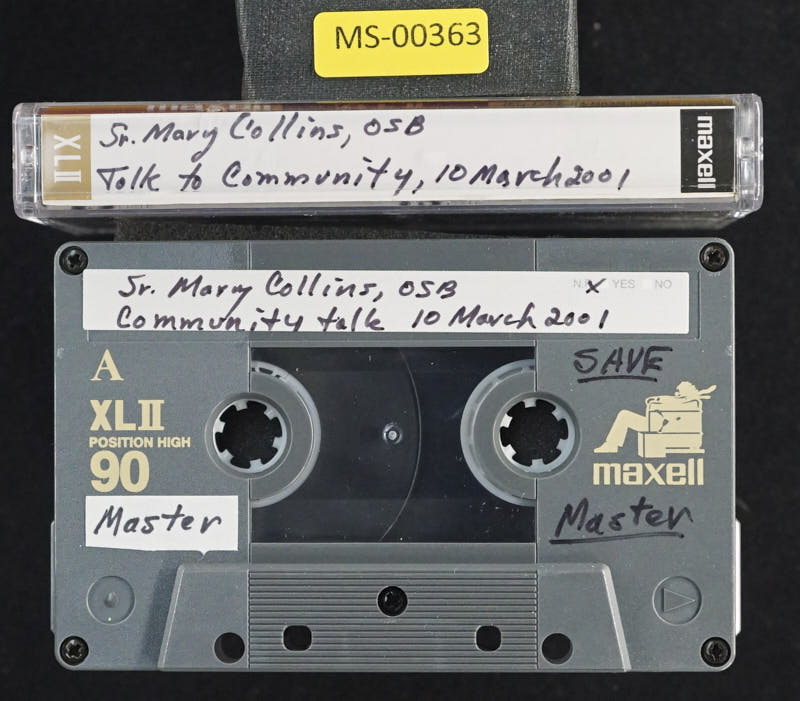
AI Vision - Possible Values from Photos:
Speaker: Sr. Mary Collins, OSB
Possible Title: Talk to Community
Additional text: Community talk, SAVE, Master, contd., Common Room
@AI-Vision_v002
I appreciate the opportunity to spend a little bit of time with you this evening as a community. I think one of the great advantages that I have had over many years is the opportunity to visit many different communities, lots of women, not too many communities of men. But it's always been a blessing for me that I always feel like I am the one who gains by having a chance to see other communities. living the same life in the great variety that we are. So I thank you for the welcome that you give me and welcoming me into your community. I talked with Father Martin, or actually corresponded with him about what I might talk about, and I thought I would talk about monastic culture as But before I go into that, I'd like to just back up and say a little bit about my own community and the way we're trying to re-explore the question of monastic culture as good news.
[01:11]
Some of you asked me how large my community was, and I said right now we're about 210. But at one point in our history, and I know these statistics because we've just had some charts up on the walls in the corridor, put there by the archivists. At one point we were 657, that was in 1956. I entered in 1957, so I arrived in community just about at the peak of its history in terms of numbers. That number was obviously artificially inflated for a monastic community, and at the present time we are about 210 Of our 210, our median age is 71, which means half of us are 71 or older, and the other half are under 71. That tells us that in a not too far distant future, we're going to be smaller again than we are now, that the community numbers are going to decline.
[02:20]
We have been fortunate that we've been getting one or two locations a year. That's been fairly steady. But since I've been priorists, 18 months, we've had 17 sisters die. So the ratio isn't real great in terms of how many are coming and how many are dying. So we really are becoming a small community. And you can go back and look historically at a time when we were that small previously. I mean, we started out as eight, and then the numbers grew, because we're 137 years old. So what we're trying to deal with as a community is the question of we can look at those charts on the wall and we can see where we have been and what kind of community we were in different circumstances. And what we're trying to do now is to imagine ahead what kind of community we're becoming. Most of us, well, people my age and older, have a strong memory of us being a very large community and have seen the...
[03:26]
decrease in numbers. And as I was saying to one of the, I was in the hall looking at the charts with one of the sisters in formation because she was telling me she was really frightened about, you know, whether or not she wanted to stay here and what was going to be happening in the future. And so we went out and looked at the charts and I said, well, you know, there is no right size for this community. We have been every place from 8 to 657 and who's to say which was the right size? But we have got to come to terms with the fact that we're going to be a smaller community. And that's given us an opportunity, in a way, to begin a process, starting with ourselves, of just reflecting on what kind of community we are becoming and what kind of community we want to become. That is to say, this is an opportunity for us to... take the values that are important to us, are essential to us, that we understand as at the core of our Benedict and monastic identity, and to make sure that those move forward with us, though they'll have to move forward in new ways, and then to leave things behind that we have to leave behind just because we can't manage them anymore.
[04:47]
The summer after I became prioress, in the spring, I was working with the business manager and the sister who was in charge of maintenance. We were looking at all the properties and the buildings that had to be dealt with and capital improvements and so on. And one of them, there was a question about whether or not we were going to put a new roof on the chicken house. And I said... I've been in community 43 years and there have never been any chickens here. So why are we saving the chicken house? You know, we're probably not going to get the chickens back. Or if we do, this chicken house isn't going to work. So we just quietly decided that the more sensible thing to do was to take down the chicken house. And I asked, what are we doing with it? Well, things are stored in it. Well, apparently, every vase that has ever come from a florist or from anybody has been stuck in this place. And also, it seemed to have one whole floor in which we stored boxes that someday we might need if we wanted to pack something.
[05:51]
So we got rid of the chicken house. And the day that they were simply going to use a bulldozer to knock it down, after they cleared out stuff, although I kept saying, don't even clear it out. Just knock it down and haul everything away. But what was interesting to me was that everyone was out there, lots of people anyway watching, and I didn't hear one word about the chicken house coming down. And I thought, now this is interesting. If nobody is unhappy or thinks this is a mistake, we're 20 years late. You know, we probably could have gotten rid of the chicken house 20 years ago. if not a sole even registered, you know, concern about it. But I've been really, since last year, also talking to the community regularly about what I've been calling contemplative spring cleaning. We did it last year for Lent and we're doing it again this year. And we're really simply trying to begin the process of, in a very reflective way, looking at the things that we've accumulated,
[07:00]
throughout our lives, whether it's family pictures or whatever, and maybe women are greater accumulators than men of these kinds of things. But whatever it is, we all have stuff. And so my request to the community was, let's look at what we have, just do it one drawer at a time or one shelf at a time, wherever your things are. Take it out and look at it and just reflect where in my life did this enter? Why have I kept it? What has been important about it? And am I ready to let go of it? Or do I say, no, I'm not ready to let go of it yet? And then I can just put it right back on the shelf and next year I'll look at it again and say, you know, is this yet the time to let go of this? Because I think that that's what we have to do as a whole community as well as, and partly because of this great change that's happening But within that context, some exciting new things are happening, too.
[08:04]
And one of them I would attribute to the same meeting at which I was with Father Martin down in Mexico. I happened at dinner one day to sit down next to Father Simeon Toll from St. John's, who is an administrator for the community St. Leo in Florida. He got talking about one thing or another, and then he was telling me about the project that they had begun, what was a youth ministry at the monastery. And he gave me the circumstances of how they got into it. But then I began to think we had a woman who was just finished hearing a vitiate who had been a youth minister. And I was talking with our vocation director and so on. And we recognized that... There's a whole generation, maybe two generations, of young people out there, young Catholics, who have never had any contact with sisters, limited contact with priests, no contact with brothers, just because of the circumstances of the church during their lifetime, that religious are almost invisible from their lives.
[09:15]
So we decided that we would start work of inviting young people in. When I left, there was a group of high school students, 16 of them, young men and women from a parish at which we, at one point, had taught in the schools. We haven't taught there in 25 or 30 years. The parish still thinks of us as connected. This is a whole new generation of young people who've had no contact with them victims. But they came in for a weekend retreat. And what Father Simeon had told me they were doing it out at St. Leo's was not hedging with the high school kids, but actually really inviting them to come in. I mean, they prayed the office with us. They will do this this whole weekend. We don't know where this is going. We simply recognize as part of our outreach and hospitality, there's a whole generation out there. who is looking for some kind of meaning and direction and structure and purpose in their lives, and whether or not they ever consider a monastic vocation, there is still some reason to open up for them the reality of
[10:30]
the fact that there are people who live this way in the church and that, as we know, many, many lay people just looking at your bookstore on the counter out there, all of the books that are being written about the usefulness of the wisdom of the rule of Benedict for ordinary people's living and so on. So we see this as a kind of just an outreach so that even as our numbers are dwindling, we see trying to reach out to the next generations without having any kind of guarantee of what that means. I mean, the community may get smaller and smaller and smaller, but our sense is that what we have come to know, what we have come to live and to share, is something that really needs to be disseminated. And one of our tendencies has been, and tendency in many women's communities, is to reach out to people our own age, most of our oblates are like us in terms of age and background and so on.
[11:35]
And we decided that while that was good and they support us and we support them, we needed to reach out into this strange territory of young people and try to share with them something. Now, we probably wouldn't have had courage to do it if we didn't have this woman who was just finishing her novitiate who had spent six or seven years and in lay ministry, in parishes, and so on, and was absolutely enamored of working with young people. I mean, she really wanted to do that. So we thought, well, God has given us this member with this interest. We need to let her show us the way. But Father Simeon had told me that what he had done down there was a woman that had kept bringing young people, a woman from a nearby parish who kept bringing young people to the monastery. And so he finally hired her to just, you know, kind of be the liaison between the parishes and the people who come. So my point is that I think as I have become priores and have been trying to deal with the community, that I'm very aware that my community right now is probably...
[12:49]
We're many, many different generations in terms of our background, our expectation, our understanding, our culture. As I review to myself, you know, we have many people who are Depression folk who still have, as a frame of reference, monastic life in the Depression. We have the post-World War II and the 50s. I enter in at that point. We have people whose basic formative years were the 60s and the 70s. Then you end up with the baby boomers, and now we even have some Generation X people. And at one level, there is so much that's different in terms of people's life experience and their culture. And at the same time, the more I work with this, the more I am convinced that the rule of Benedict is good news for every generation. that there really isn't a group there that cannot be fed and nourished by what Benedict offers us and what the living tradition has offered us.
[14:02]
So my sense is that it's a real challenge for us in community to try and approach... this from many different directions. And more recently, I had been, well, starting a year ago, I had started reading a lot of the research and literature that's been being done about young people and what their interests are and what their concerns are. And one of the people was this young man from Boston. Actually, he's from Kansas City, but he's been studying up in Boston, a young man named Tom Bedoyne. It's spelled Beaudoin, but he says Beaudoin, and I recognize that pronunciation because I grew up in Chicago. And Danny Beaudoin lived down the street from us. So I was not surprised to discover he said Beaudoin. Probably the neighbors had started many generations earlier, and they just went with what they got called.
[15:07]
But one of the things that I came to recognize in... reading that literature was how the monasticism in its very, very traditional elements, I mean the core elements that are absolutely essential to our lives, are really communicable to and in fact attractive to young people at the present time. I don't know, I noticed on the bookshelf out there that the aim The most recent AIM bulletin is out there. And I don't know if any of you have read the article about values in contemporary culture. And if you read that, you had, again, a kind of a review of characteristics of modern culture, individualism, preoccupation with rights, the cult of immediacy, and confusion about identity.
[16:11]
And as I was... reviewing those, I was thinking again, as I'm sure the article was inviting us to think about the way monasticism responds to those cultural challenges. It used to be, I think, that before the struggle for equality, individualism and high degree of autonomy was a charge we laid against men but I am here to report to you that individualism and high degree of autonomy is characteristic now of men and women so equality has manifested itself in those who come to the monastery but I think that while outside in the larger culture there's an attempt movement toward the communitarianism, and again, if you're doing any of the contemporary literature, there's a whole communitarian movement talking about people have to start thinking about the common good as opposed to individual autonomy.
[17:26]
Monasticism has required of us, because of way of life, we make a commitment to live communally. And so we, in fact, have chosen an alternative to... That doesn't mean we like it. It doesn't mean we don't fight it all the time in terms of our struggle in community to be oriented toward community and not to be pulling back and trying to carve out our own space. A couple articles that I've read recently have emphasized the fact of the choir as a place where we experience the culted community, and I was very aware tonight in singing with you that maybe you were showing off, I don't know, but my sense was that you do have a sense of one voice, and that's a discipline, we know. I mean, you have to work to become one voice in choir, and that becomes a kind of a model or symbol of community living, that working to be one voice, one heart, and so on.
[18:38]
With regard to the second concern that was mentioned in that article, the whole question of preoccupation with rights, whereas the monastic community asks us to think about what is good for the community as a whole. And this, of course, is what we're struggling with right now in my own community as we're thinking about the kind of community we're going to be in the future, that it's very easy for us as we are listening to one another talking about this, to be trying to protect our own turf and to make sure it's the kind of community I want, and particularly to make sure that if I don't get what I want, I sure as heck don't want you to get what you want, and to try and really listen to one another and to think about what this good for all of us is, which demands of us... to use philosophical terms, a capacity for self-transcendence.
[19:42]
You know, we've got to be able to go beyond ourselves and our own interests. But again, monastic life offers that as a day-to-day opportunity. I mean, if we were out simply working in the larger marketplace, the way to get ahead is to protect your rights and to go aggressively after somebody else so that they don't crowd your turf. In the monastery, we may in fact have those impulses, but the structures of monastic life encourage us, in fact, to develop this capacity for going beyond ourselves. The cult of immediacy, I think that we all can testify that while this is something that young people really struggle with, that the constant experience of immediate satisfaction, I want this, I get it.
[20:44]
And again, I've been teaching young people, and there is a sense more and more that something I want is immediately translated into, and therefore I get. But in that whole process, the individual becomes the sole criteria of what's valuable. And in the monastery, again, we have the opportunity to over and over again to recognize that we are not the sole criterion for deciding what is valuable or what is good for the group. So there is a sense, again, in which this is an alternative to what the culture is requiring of people. Now, with regard to the confusion about identity, I think that one of the things that we hear over and over again is that in this modern culture with all of the stuff that's put out there before us in terms of images and symbols and cultural heroes and so on, that young people are constantly putting on identities, trying out identities, because they constantly have so many
[22:02]
thrown at them and they are super saturated with stimulation. And I think that that whole business of trying on personas and trying on personalities is something that also we've discovered that monastic life asks us, however slowly, to correct, that we end up having to be disillusioned many times, disillusioned about ourselves and disillusioned about one another. in order to really come to terms with what it is to be human. And that always comes as a kind of a shock to us. No matter how many times we run into the opportunity for disillusionment, it still is disappointing. I've been dealing with a novice right now who is... And it's helpful to talk with a novice because it's useful to be grateful that... at least something she left behind and that expectation that everyone should be perfect and that there's something wrong because things didn't go well is one of the very fundamental points of disillusionment.
[23:18]
But it seems to me that the general cultural struggles that are outlined in that article in AIM are addressed by monastic culture, but I'd like specifically to talk about where I think this is significant for a next generation. And I think it has implications for us as communities because I think the way we present ourselves to others, the way others see us, we can either be transparent or we can be fuzzy and foggy in terms of how others see us. And I think it's useful for us to reflect on that. One of the things that Tom Bedoin says about young people, he actually identifies four characteristics of young adults. And he says, we know this, they are suspicious of institutions.
[24:21]
And they've learned this from the culture from the 1960s forward. We all learned to be suspicious of institutions, and I share that so I can understand it, but I also have learned to live with institutions because they're there as part of the human reality. So, suspicion of institutions, the notion that their experience is absolutely key. their own experience is the key to living and the key to meaning. A third characteristic is that they have experienced a lot of suffering and want to give religious valence to their suffering. And then the fourth one, he talks about their conviction that ambiguity is part of being religious. He, in fact, says that most young people make very good heretics because they...
[25:28]
are much more comfortable with ambiguity and redefining things to fit their own ways of things. But with regard to the suspicion of institutions, which is really a problem for the young, I think one of the things that a monastic community communicates, and I think people who come to us respond to us in this way, in the sense that we don't, even though we are institutions, that We don't present ourselves as bureaucracies. We present ourselves, and it's important for them to see us, we present ourselves as community of persons working out and struggling with human relationships. And that is something that is likely to be attractive to a next generation, to see something that isn't a bureaucracy.
[26:29]
that isn't a totally rule-bound operation, but that there are people who have structure, they have commitments, they have responsibilities to one another. There are rules, but that the rules themselves are meant to be structures and guides. But the reality is that this is a group of ordinary human beings trying to work out relationships and to let there be a way of working out relationships that goes beyond the sheer aggression of the self. So that can be good news for the young generation, that there are places where people live together and live together in non-institutionalized ways. The second thing that he points out about young people is this notion that experience for them is key and their own experience is normative so that what they know is what they've experienced and they really aren't prepared to get some responses from other people.
[27:50]
They want to name reality themselves and to name good and bad themselves, according to whether it's been good for them. If it's been good for them, it can't be bad. If it's been bad for them, it can't be good. So there's a notion there. And I think that, again, one of the things that the monastic community can be very clear about, and I think it's important in terms of our presentation of ourselves, to a next generation, is that the criteria for interpreting experience is really not ourselves, but that there are norms outside us. And I think that ultimately to see that it is the mind of Christ that is the criteria for judging good and bad, that it is the reign of God, and that we somehow know how to talk about that. that we have language to talk about a vision. We can talk about the gospel. We can talk about the spirit of Jesus.
[28:52]
And that as we talk about those things, we talk about them as persons who have some experience of this, have it mediated through community. We have come to know Jesus, and we have come to know the living Christ, and that we... can talk about that with them and be credible to them in terms of the values and the way we present ourselves to them. The third point that he makes about young people, and again, I see this as I have begun to deal more specifically with the younger women in my own community, but even when I was dealing with college students, this younger generation has suffered terrifically in ways that On the one hand, we can see them as very pampered and having everything they want and being very self-willed and so on. But the amount of abuse and neglect and betrayal they have experienced is phenomenal.
[30:00]
Again, I could tell you anecdote after anecdote from my teaching experience, but also a young woman in my community, Well, younger than me, not so young. But, well, she's 40ish and a very well-put-together professional woman, but in great pain and agony because as a child she was, her phrase, her father beat the hell out of her for years. And you kind of find that, I find that phenomenal. to have somebody who has all that anger built up in them because of really just physical abuse, but sexual abuse, emotional abuse, betrayal, neglect. And many of them, certainly from an outsider's viewpoint, affluent enough that the treatment that they have received at the hand of adults has left them very, very wounded.
[31:08]
And many of them just emotionally very, very bruised. so that they mistrust others. They don't have a sense that other people can be relied on. And in some ways, those experiences can be really immobilizing for them in terms of getting beyond the pain and the hurt to some other place in their life. And I think that, again, there is nobody in a monastic community who hasn't because we're all broken and wounded, who hasn't really dealt with some aspect of that bruising and pain and suffering that life has brought. But that, again, if we as monastic community members and as community can present ourselves as recognizing that anguish, acknowledging it, acknowledging the pain, but somehow
[32:11]
being able to locate it in the Paschal mystery and to locate it in the cosmic mystery of what it means to be human. And to acknowledge the pain, but also to recognize that we don't have to be that way with others, though others have been that way to us. There is the possibility of moving to some different level of behavior that one doesn't have to retaliate in kind. And again, I think that monastic communities are places where we've all struggled with that desire to try to come to terms with our own pain and the danger of absolutizing our own pain or of somehow trying to see it in the mystery of Christ and to see it in terms of the mystery of all things being reconciled. but also in terms of the continuing need of the world for redemption, the continuing need for prayer. Again, that is hopeful for young people if they see there are people who know and have dealt with and can simply help them to understand and deal with these kinds of questions.
[33:27]
And then the fourth thing that Baudouin talks about is ambiguity as part of belief. And he really puts it in the context of how young people today are... They live in, and Boydran's book is called Virtual Faith, that they live because of the amount of media stimulation, the amount of... the games that they've played on computers, the computer email, the whole notion of virtual identities and so on, that they try on many different identities and that the consequence of that for them is that they really are at loss, either to know who they are or who they want to be or what their purpose is or where they're going and so on.
[34:28]
I remember, and this is, you know, again, several generations, but I taught at the University of Kansas for seven years in the 70s. And at that time, there were a group of young Midwestern farm kids who had become Hare Krishnas. And every day at noon, across from the student union, and I taught in the school of religion building here, And they, in the student union across the street and just down a little bit, they would appear about 11 o'clock in the morning and they would all be in the saffron robes. And they would be beating the drums and then they were jumping. And I used to think those kids were going to have their brains completely addled by, you know, I mean, day after day after day, they would be out there jumping for an hour or so. And I think they probably did get some kind of a physical high from doing that. But I remember then sometimes they would come into the office, into the religion building and so on, to talk about religion or basically trying to find out if we were religious and so on.
[35:41]
But then they would have on business suits because apparently somebody had told them that they would make a better impression if they were in business suits. But just seeing them change the costumes... you know, in the course of a day, was a way of seeing this whole struggle, trying to figure out who they were. And underneath both costumes were these Kansas farm kids who weren't comfortable with that identity, and so they were trying out other identities. And again, I think that the present time, a lot of people who are studying young people say that those of them who have chosen Catholic identity, and have wanted to retain Catholic identity, literally want to wear it on their sleeve. They are not content with, again, because the culture is so full of public symbols. I mean, everybody wears advertising brands across their chest and on the patch on their back pocket and so on.
[36:43]
And so they want to wear, you know, in terms of the clothing, So they're very ostentatious about religious symbols and as a way of trying to establish an identity that is not comfortably inside them and so they tend to externalize it. I saw this phenomenon in Catholic University and it continues to grow but I've been away for 18 months. But young people who walk around campus not just saying their rosary but who swing it So you see that they're saying their rosary, which is a way of letting those who don't have rosaries know that they pray the rosary. And it's a curious thing for somebody in my generation. You know, it was used to people, if they were praying their rosary, they prayed it in their pocket. But this is, it's got to show so that everybody knows that you're doing it. But again, it's part of this... concern about identity and trying on identities, and if I'm going to be a Catholic, I've got to do something that looks Catholic, and then maybe I'll know I'm doing that, or I'll know who I am because of these kinds of identities.
[37:59]
Again, that can go so far, and it can be helpful to them at certain stages of their development, but I think that, again, That whole notion of internalizing an identity and really taking it on is something that our communities and we ourselves can present to a younger generation. Here are people who know who they are and are internalizing an identity. And as they are internalizing that identity, are becoming authentically who they present themselves as. And this goes back to the, it's not the habit that makes the monk, but the habit's a starting point, and trying to move in that direction towards some kind of embodiment. All of that I have reflected on in trying to think about how we present ourselves and how we focus...
[39:07]
A woman named Marjorie Proctor Smith wrote a book a number of years ago on the liturgical tradition and the whole construction of tradition. What she was basically writing about was the fact that in the liturgical tradition, in the liturgical calendar, and in the selection of readings and so on, historically in the Roman liturgy, women aren't mentioned very much. And she says, you know, all tradition is constructed. that tradition is not necessarily what happened, but what's remembered. And I think her point is, it wasn't that there weren't any women during the whole history of the church who were involved in things that could lead them to be models for the church. It was simply that that memory was not brought forward and publicly affirmed. And so we end up with a lopsided history. Well, it seems to me that... in terms of our public presentation of ourselves, but our also public exploration for ourselves as a community about who we are, we need to look at all of those dimensions of what our monastic heritage and pull forward in some way in which we really reappropriate and then embody and offer to others
[40:35]
dimensions that are what people are seeking in the culture, what young people are seeking in the culture. And I guess Karl Rahner, a long time ago, used a phrase which I return to often when he was writing in the 60s and he talked about forgotten truths about the sacrament of penance. And it was at the beginning of that essay talking about the fact that the church had a long history in terms of how the sacrament of penances had been celebrated. But we had forgotten lots of things and had focused on just a few things. But the tradition was much richer than what we were currently using and retrieving. It got the image, I think, again, of monasticism as a very rich and vital tradition. And we are probably only living part of that heritage, that there are many things there that we yet have not really claimed because we ourselves are growing.
[41:48]
And that's the hope that I have for my own community, that we can retrieve and maintain what has been helpful to us, but then retrieve and pull forward and grow into those dimensions that had not seemed important in the past, or had not seemed significant, or we just took for granted and never talked about, but now need to talk about because other people need to hear about that. So that's what I'm up to. What are you all up to? present you know resistant Irish school and I'm not sure how it came about but she was wait and buried in the parish where she lived and she was also a parishioner years ago and I was kind of moved by a large community of sisters that came you know to celebrate the funeral and
[43:01]
And I also was touched by a great number of girls who she had had in class who were present also. And I just wanted to talk about external manifestation with the rosary. I was thinking, you know, wouldn't that be a good opportunity to have the different stages of a religious sister's life taken in a parish setting. I know it's not our tradition, but I was, you know, there had to be about 200 sisters there. They were all together, and the major superior at the communion gave us a little bit of vocation, and I thought, isn't that a possibility to deal with vocations, too? And I think for those orders that are active and their work is out in the parish, that probably is appropriate.
[44:05]
But I think that to the degree that, and I kind of appreciate the recent definition of the monastic by Timothy Radcliffe, the Dominican Superior General, who said monastics are those who don't have any, I can't remember the turn of phrase now, Nothing in particular to do. Yeah, we're not going anywhere. Yeah, there's nothing in particular that we have to do. And so our approach more recently has been, and we've been trying to do this with the few professions that we've had, is to invite people in. I mean, inviting people in is a burden, as you know. The more guests you have, the more work you make for yourself. But our sense has been that they don't get the... People don't have the same experience of community as community. Although it sounded like you were saying this whole community moved out. But I think that our sense has been that we need to let guests see us and see us in our ordinariness.
[45:19]
Because I think that our ordinariness is mysteriously... somehow mediating the mystery of community and the mystery of Christ. And I think we are so close to it, we don't see it. But I'm sure you have guests who come here and say, this is the most peaceful place they've ever been in their lives. And you don't know where they've been because you know what's been going on. But somehow or other, I think that what they experience among us is the genuine search to open ourselves to the spirit of Christ and to put on the mind of Christ and that this is always something that is at work among us, no matter whatever else is at work among us and all of our human frailties and so on. But I think that sense of seeing us in our own setting and seeing us, and I understand that this is something that's been a part of your presentation
[46:24]
community here from your founding, that you have always been a place where people came and have witnessed to you. And I think that that's really important. We probably did not do so much. We probably did more going out. But we're recognizing now that people are coming in, coming in, coming in. And I think that's saying something about the fact that whatever they're finding out in the parishes, whatever they're finding, isn't quite enough. They want something more. And many of them have no intention of becoming monastics, but they simply need to know there are people who take this seriously, that there are people who have somehow some clue to how to live life well, or who at least are trying to live life well. And I think that it's the communal... witness I think that we take so much for granted that we don't really hear other people telling us that it's not so much that each of us individually is saintly and mysterious and a perfect witness to God's holiness but somehow or other the whole reality of whatever is going on here creates
[47:52]
a way of being that is something beyond what they experience. And I think that we, to the degree that we don't really perceive that or take that seriously, I think we may be underestimating. And I don't mean there are always some that will not like that at all, but there are others that will like it too much. It's kind of mean overall. Because I found, like, within myself, for example, if I'm traveling, I want to travel in Cognito. Right, right. Because the minute, if I wear a collar or whatever, the people, because they want to talk. But out of, in a sense, selfishness, I don't want to be bothered with that. I'm on vacation, you know, going to a home visit, and that's it. But within communities, I found the monastic life, too, that communities can react the same way.
[48:58]
One of our big challenges, and we really are struggling with this, in one of our topics, we're talking about monastic identity, we're talking about monastic hospitality, and that balance between boundaries set so that we can live. openness to welcoming others and finding what those right boundaries are. And I would say we're struggling. You know, we struggle with it. And we aren't anywhere near agreement on it. But there are some things, for example, last year, I guess some various people had come up and, you know, people told friends. Last spring, we were getting calls from parish... what they were really was day outing bus tours and wanted to know if they could come, you know, and have lunch. You know, the bus could come and have lunch with us and so on. And I finally had to say, you know, we are not, I don't remember the old Stookies on the highway.
[50:03]
These places where, you know, they took buses. So we're not a Stookies. We can't handle people who want to come in and simply have lunch. And so what we would do, finally, and it came out and said, we have like a short tour that we have some sisters, you know, and they see the chapels and so on. But I have to say, we really can't provide lunch for you. And, you know, our kitchen can't provide it, but we can't take the time day in and day out to be talking with busloads of people. So then you say, well, but we like to recommend that you go such and such a place and give suggestions. We have a lot of school groups where people want to bring... We seem to get fifth graders and seventh graders. Again, we have a particular way of showing them around the place and so on. But we still have an academy on our property.
[51:04]
It's run by primarily a lay board, but it's on our property. And... Once a year, the freshmen who are taking a church history class come over, and they, in fact, usually we invite them on a Benedictine feast, and we usually, they have a meal with us. But that's a, these are kids who are going to school here, and they, you know, we do something different. So, but we're struggling all the time to maintain, because if you, if there are no boundaries, then the community loses its identity. And the thing that we're really about doesn't get done because we're busy, you know, playing tour guides. We've just done people playing at least two nights because we would stop in one. And, of course, that's it. The people kind of want to circuit. I've been to Mount Rushmore. I've been to Mount Savior. Yeah, yeah. And so it's just another stop and that's the mentality.
[52:07]
So we take the one group of of Franciscan tertiaries that come once a year, I think. Actually, it was a hotel or a motel in Reston down the road in about 40 miles. And they had a thing where you went to the Niagara Falls in Corning Glass, which Mount Savior, and, of course, they're a place for supper. And we had no one. And the kids, of course, come up. Well, as you say, when they're studying medieval history, they come to look at a medieval monastery. But I'm just thinking, while you're speaking, we put up this thing about a summer program. And so I decided this year we should have some of the quotes from the people. And of course, I took them from last year's group, but without putting any initials right now, so if you know where it came from. But it's amazing.
[53:09]
guys, there were six of them, and four had them received for these possible jobs and things. And in all their letters, they would read for the hospitality for being brought into the community. And the love that they received and all those other kinds of stuff. And as you say, where in the hell was I when these kids were here? Because I didn't see them. Come on close. But they actually saw it, and it was here. It was going on. And the And they picked it up, and that's what we made in Bristol. Yeah, and I think that you hear that over and over again. We're right near the University of Kansas, and we have friends there, so every so often we'll have somebody, most recently a young woman, who's doing a doctorate in nursing, and it's trying to deal with spirituality and physical health. And so she wanted to interview spiritual people. And so, you know, she wrote, and could she come and interview the community?
[54:13]
And so I corresponded with her a little bit and asked some sisters if they would talk with her. Well, I mean, she and they, she was absolutely overwhelmed. And she belongs to the Church of the Nazarene, but, you know, now she's going to come up for a retreat and so on. And I don't think it's... I don't think it's fake at all. I mean, I think it's very genuine. And I think we tend to underestimate how important that is. And for me, the thing that I've been discovering is how really important it is for young people. Because there is so much exposure to virtual reality and virtual identities. And... And for them to actually come into a place where something else is going on, I think is really a... I think it is participating in the world's redemption.
[55:15]
And that may sound like we're giving ourselves credit for too much, but I don't think it is. I think the mystery is here. And that somehow or other... I suppose exposing ourselves to the gaze of others, not because we're exhibitionists, but because it's a way of witnessing to them the truth of the Christian life. And so I just think that's something that wherever we go as a community, I think that we've got to be ready. to accept some responsibility for that evangelization that comes just out of our being, that we don't have to go out and be evangelizers in necessarily some kind of active way, but we have to let our lives evangelize.
[56:17]
Mm-hmm. And then we had a little house that we were using for the parents, because not only our parents did come here for between, they just came to visit kids. We were using that for the parents of that. And most of us kind of grew older, and parents could move, could come. But we opened that to married couples who came with children. And it kind of multiplied, and then we opened the second one, and then the third one, so this week, thank you. And then we had some bad experience lately with families, you know, would come, and then they would go eat at the ladies' guest house. Well, you had grown up over there who wanted to be quiet, and you know, you know.
[57:27]
And we came up with some limitations. But I think we would. I hope that we will review this, because now we said 18 years old, no less than 18 years old, at the Ladies and Gestalt. And in some ways, I had some experience with some kids who came with their parents. And it influenced them, it's ancient. We have one family that now the third generation is coming. They are coming with their children. But it can't be a problem. With the little cows, they can do their own protein and things like that. I think that one of the things that you see when you talk about the kids, that so many of them are really... not adequately guided or supported by parents in terms of recognizing when you go someplace that isn't your home, that you don't turn that place into your home, that you respond to that.
[58:43]
That's a learning process for kids, and it becomes difficult for you. But my guess is that, again, setting limits and saying, what can we manage is a real part of it. My guess is also that even with the unruly kids, that they went away thinking these were nice people. That, you know, they didn't experience you. I mean, you may have experienced them as a problem, but they probably didn't experience you as unkind. You know, you again, accommodated yourself to their reality as best you could. And again, I think that does make a difference, even though we may have to say at some point, we can't keep this up because it just isn't possible. He looked at our website and he said, my parents have been going to the monastery for 15 years. I couldn't figure out what they were talking about when they came back. And he saw some pictures. Now I understand what they are talking about.
[59:49]
Do you get on your website here a lot of inquiries from young people? a lot of communications. We don't get, the age thing is not on there. The number of hits and things. Yeah. But from what people identified. Even the hours of the day that you got to know what it is. But it doesn't give what they can. Yeah. But you don't, in terms of, do you have like a place where people can write you a message or something like that? Yeah. Yeah. And that they, you know, somebody will identify. Like this week. Yeah, this week somebody wanted to have information about it. One of the things that Bedouin says, though, in terms of this virtual reality, that there is a kind of fascination, and what makes even the fascination of the monastery a kind of indulgence in virtual reality is that
[60:55]
You can, in a sense, play interested in monasticism by listening to chant records and by going and visiting monasteries and so on without any commitment that involves any responsibility or any kind of change in your own life. And that, of course, can be just as much of a dead end for the growth of young people as watching MTV in terms of simulating identities rather than really moving toward it. Our sister Diana, who does our website, has done a lot with pictures of the community, and I initially was not sure what I thought about this, but again, the response we get from people is, I mean, one night, people were out last summer picking corn and shucking corn.
[62:07]
We don't grow that much corn, but we just, enough for a few meals in the summertime. But they were out doing something with corn. in the backyard and tasseling and so on and somebody went out with a camera and took pictures of them and Diana put the pictures on the digital camera put them on the website and she generally has community photos a variety of things but it's interesting how many responses you get to those photos where people will say I just happened across your website and it was wonderful to see the sisters looking so happy or just something that kind of confirms for them something that a lot of the rest of the web doesn't confirm for them, that there are real people out there who really are trying to live in some kind of serious, authentic way. So I think that, you know, our, I think in the past to us of our vocation as a
[63:14]
a gift to us, but I'm beginning to think more and more now that it's a gift to us to be used for others. I think it's the fact that people see us trying. We get sort of discouraged with our failures, but anyway, what they see is trying, and that means more to them than succeeding in us, not only accomplishing great things. I know that's, and sometimes Radcliffe was saying, you know, we're praising God. singing. That's a better witness to him. I think I heard that. I think I've heard the bell. Thank you all for your interest in most of what you've been doing all these years. You have been witnessing
[64:06]
@Transcribed_UNK
@Text_v005
@Score_94.4