You are currently logged-out. You can log-in or create an account to save favorites and more. more info
Living the Word Through Silence
AI Suggested Keywords:
Talks on Prayer
The talk delves into the intricacies of contemplative prayer, emphasizing its integration into life as a reflection of peak spiritual experiences and highlighting the interconnectedness of faith, hope, and love. The role of living by the Word of God is explored as a core biblical tenet transcending mere ethical obligations, urging a deeper nourishment through God’s Word that permeates all aspects of life. The discussion also touches on the importance of silence in understanding divine communication, drawing parallels with Buddhist traditions, while also presenting contemplative action as a means to embody spiritual truths actively.
Referenced Texts and Teachings:
- Bible: Reference to the biblical tenet of living by the Word of God as a spiritual fulfillment beyond ethical imperatives.
- Martin Buber - "Tales of the Hasidim": Highlighting the story of Rabbi Susya, stressing the power of divine speech.
- St. John of the Cross: Mentioned in the context of prayer of silence, illustrating Christian alignment with Buddhist contemplative practices.
- Bhagavad Gita: Referenced to elucidate the Hindu dimension of understanding in contemplative action.
- C.S. Lewis: Cited regarding the silence of the divine as an inexhaustible depth.
- "The Trinity and World Religions" by Raimundo Panikar: Discusses the comparison and progression of understanding within world religions.
- Paul’s Letters (1 Corinthians 2): Insight into understanding God through divine spirit, aligning with contemplative practices.
Concepts and Themes:
- Contemplative Prayer: Positioned as integral to life, incorporating the vision of God's life within, distinguished by facets of faith, hope, and love.
- Peak Experience: Seen as a catalyst for contemplative prayer, interconnecting heavenly vision with earthly action.
- Silence and Word: The dynamics between spoken word and contemplative silence in spiritual tradition.
- Contemplation in Action: A concept spanning religious traditions, especially within Christianity and Hinduism, promoting active embodiment of spiritual insights.
- Interfaith Dialogue: Reflection on how different religious traditions offer unique dimensions to understanding prayer, emphasizing contributions of Buddhism, Hinduism, and Christianity.
AI Suggested Title: Living the Word Through Silence

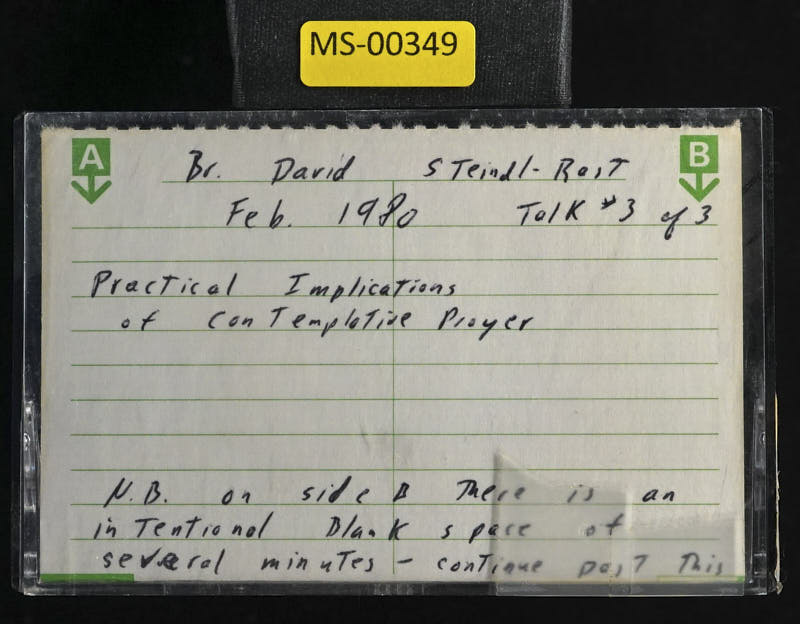
AI Vision - Possible Values from Photos:
Speaker: Br. David Steindl-Rast
Location: undefined
Possible Title: Practical Implications of Contemplative Prayer
Additional text: Talk #3 of 3, age #3, N.B. on side B there is an intentional blank space of several minutes - continue past this
@AI-Vision_v002
Well, in our discussion of contemplative prayer, we come to the third section in which I promised to explore some implications for a Christian worldview with you, stemming from what we have said so far about contemplative prayer. And we started out just to... refresh your memory, with the peak experience, which provides the point of reference in our own experience for contemplative prayer and for anything that we can say about contemplative prayer. It is a moment of that vision of the heavenly pattern, if you want. which is one half of contemplation, the other half being the action which, the process which puts this pattern into action on earth as it is in heaven.
[01:13]
And then in the afternoon yesterday, we went a step further and we saw gratefulness as a key to how to go about this contemplative process, namely, to put that vision into practice, the vision being God's very life within us, of which we become aware in our peak moments. And then throughout this idea that this paradox which we experience, we lose ourselves and so find our true selves, becomes through faith or in faith... The courage to give thanks, that tremendous courage that we need to give thanks because Thanksgiving is not so much appreciation of the gift, not primarily, but trust in the giver. That's the first thing that thanking expresses, trust in the giver. And then we explored the thought that the paradox which we find in the peak experience that yes is the answer to all our whys,
[02:25]
becomes through harp that openness for surprise, that ultimate openness for surprise that must transcend all our hopes, must go beyond anything that you could even envisage and hope for by our hopes. And then we saw that God's real life in us, Archer finds its expression in that paradox that we are alone in a happy positive sense when we are most one with all and that we are truly one with all when we are most deeply and happily peacefully alone and this belonging which is really the mystery behind this paradox of being alone together this belonging becomes through love and as love simply grateful living. Love is the grateful living that flows out of that ultimate longing.
[03:31]
And now I want to once more emphasize that what we're doing here is merely putting a grid work over a reality that is in itself whole and undivided, cannot be parceled out or cut up into pieces, and that we merely... We are merely trying to distinguish without separating. Life cannot be separated without being cut into pieces. We can only distinguish. But we must distinguish so as to understand better and more fully. It's merely a matter of emphasis. And if we keep that in mind that it's merely a matter of emphasis, then we can now, this morning, explore three... What I would call dimensions of contemplative prayer, of all our prayer life, because as you saw, contemplative prayer is not separate from prayer. It isn't even separate from life. It's in itself a dimension of human life, the most comprehensive one.
[04:34]
So when I call them dimensions, I do that to forestall the idea that these are boxes into which we put things or pots that are pieced together to make a whole. there are simply aspects of one and the same reality. And the first aspect that I'd like to focus on is contemplative prayer as prayer of faith. And under that aspect, it is particularly familiar to us in the biblical tradition. And the way the Bible speaks about contemplative prayer as prayer of faith is as living by the Word of God. That is the expression that the Bible uses from the Old Testament all the way through the New Testament, actually more or less from the first to the last page of the Bible. And today we are in the lucky position on this Sunday to have the central portion of this marvelous unfolding of the idea of living by the Word of God right before us in the Gospel because it's the Gospel of the Temptation in which Jesus answers the first temptation by saying,
[05:45]
Man lives not by bread alone, but by every word that comes from the mouth of God. That is almost the node that binds this whole wonderful development of living by the word of God together. When the Bible speaks of living by the word of God, it means much more than we would offhand suspect or are inclined to think. And the reason why we don't offhand get it correctly is that our understanding of religious truths here in the West, and particularly in the United States, is always slanted towards ethics. We can't really be religious, because the moment we open our mouths, we are already slanting towards ethics. We want to say something religious, but we say something about morals. Now, morals are an integral part of religion, but our talking about religion always slants into morals. As somebody put it very well, We are praying theology like people who are playing a football game on a slanted football field.
[06:54]
And every time they kick the bar, it rolls down onto the one side. And that side is ethics. So every time we start getting the bar rolling in religion, it rolls down into ethics. And the moment we're here living by the word of God, first thing that comes into mind is God gives the command and you carry it out. That's living by the Word of God. But that's not what the Bible calls living by the Word of God. That's part of it. But the most important aspect is that you are nourished by the Word of God, like you are nourished by bread, that you come alive by eating and drinking the Word of God. And therefore, the imagery of eating and drinking is always associated with living by the Word of God, very much as in our English idioms where we say... If you are really interested in something, oh yeah, I ate it all up, or I lapped it all up. There you have the eating and the drinking, or the book, I devoured it cover to cover. Very much like in the Bible again, Jeremiah eating the scroll, and John in the apocalypse eating the book that the angel gives him.
[07:56]
That's the idea of living by the word of God, that you eat it all up and assimilate it, and it makes you alive. That's the idea. And not merely carrying out something that's outside of you as a command. And this idea of living by the word of God is quite central to the whole biblical tradition. That means quite central to not only to Christianity, but to Judaism and even to Islam, to all the book religions, to all the Western religions. This is central. Their great insight is that God speaks, if you want to put it in one word. And Martin Buber has a beautiful story there in the Tales of the Hasidim, in which the great Rabbi Susia, one of the great Hasidic saints, is said, never to have been able to quote... his master which is a great lack for any rabbi because a rabbi is always expected to quote a good saying in the name of him who said it because that hastens the coming of the Messiah.
[09:07]
First of all you are spreading the light by quoting and secondly you are spreading humility by attributing it not to yourself but to the one who said it. And this poor Rabbi Susie couldn't even quote his own teacher because he had never heard a sermon that his teacher gave because his teacher was in the habit of starting every sermon with a reading from Scripture, and he would open the Bible and would say, and God spoke, and then he would read a particular passage. And when Rabbi Susie heard God spoke, he was already in ecstasy. And so he carried on so widely, they say, that he had to be taken out of the synagogue or out of the school. And there he was standing in the hallway or in the woodshed, beating against the walls and yelling, God spoke. Imagine, God spoke. And Martin Buber ends the story by saying, probably Rabbi Susie understood more than all those who could quote the sermons from beginning to end because with one word the world is created and with one word the world is redeemed that when God commits himself to the world by speaking as we hear in creation and this creative word through which everything is created becomes the redeeming word that is made fresh
[10:31]
Not only the word spoken now, but the word addressed. That's what we humans are. All the rest of creation, as far as we know, is word spoken, the sense of embodying the message that God has. But we are not only word spoken, we are word addressed. And then in the midst of all of us who are merely word spoken and word addressed, there comes one who is even word answering God fully. That's the Christ event. And we all have a share in that by entering into it through, again, faith. And that's where we are. So living by God's word means eventually living in the word made fresh through faith, through Eucharist as we understand it, which is the word made fresh given to us to eat and drink, It means much more than that.
[11:33]
It means Eucharistic life, which is the overflowing of that Eucharist into every part of life. That means the overflowing of that sacramental thanksgiving, which is the making present of Christ's thanksgiving sacrifice in every part of our life. And that means simply that grateful living with which we started out. which is the key to everything. That grateful living in faith and trust implies living by every word that God speaks and learning to live by every word that God speaks. And God speaks many different words. And in the gospel today, the temptation consisted precisely in making God... say something else than God said, the tempter suggests. Now, here God is saying stones. Why don't you make God say bread? And Jesus says, but man lives by every word that comes from the word of mouth of God.
[12:39]
And if the Father says stones, then I, as the obedient son, the one who really listens to the word of the Father, will live even by stones. Now, stones is the one thing by which one cannot normally live, and therefore is even a symbol of death, just as bread is a symbol of life. And Jesus, in saying, I can live by stones, says, I can live even by that word of God which spells out death. And then that is why Luke says at the end of the temptations, and the tempter left him for a season to come back at the time of the Passion. and then comes the real showdown whether Jesus can live by every word and even by the word that spells death and if we can live by every word and we can also live by that one word that God says to us in the end and that spells death so we can eat it all up and that is why Paul says death is swallowed up in death
[13:51]
eaten up as Christ is eaten up. While he is swallowed up by death, he swallows up death by death and so enters into life because I can live by every word that comes from the Lord of God. Every word is a word of life. And our whole spiritual life, in a sense, consists particularly in its that is particularly for Christians and Jews and Muslims in learning to live by every word so that ultimately we will be able to live by that final word of God which is dying into fullness of life. We learn this now and that means that whole joy of... Learning are the many ways in which God spells out the one eternal word. Because God's theologians tell us it's so simple that God cannot say various things.
[14:56]
God is too simple for that. God says everything God has to say in one eternal word. And that is the logos. But that is so inexhaustible that it needs to be spelled out forever and ever. In everything there is. And all there is is only around because that one word is so inexhaustible. Very much like lovers who have really nothing else to say to one another but I love you, but never come to an end saying it in so many different ways. And God being love has nothing to say but that eternal word which is the word of God's love. But that needs a spelling out forever and ever. And no lover will say, well... I told you that last year, didn't I? I love you. So what's to be added? Anything to be added? You have heard it once and for all, that's it. Nobody says that, but you go on in spelling it out over and over again in words and songs and gifts and flowers and caresses and everything else. It just goes on. And so everything there is is a spelling out of that one eternal word that always says the same thing, namely that God loves us, but...
[16:04]
It does make a difference whether we taste and see how good the Lord is by eating apples or whether we taste and see how good the Lord is by eating brownies or whatever else it may be. There is an untranslatable way in which God says that we are being loved in which we cannot know unless we have ever tasted brownies. So if we want to know all the languages of God, we better open all our senses, not only our taste buds, but our eyes, our ears, our sense of touch, our sense of smell. This is one of the most neglected areas of the spiritual life because for most people there are just two smells, good and bad. So why did God bother to create noses and smells in an infinite variety? Biblical religion, living by the word of God, when God said lilac, God meant something there, something very different from saying gasoline.
[17:12]
But there are no bad smells. There are only different smells because God didn't make anything that's bad. And so we have to rise to the occasion and use our noses and go around and smell all these different things. That's why we are around, we Christians. That's what it means to believe in the incarnation, not to shut off our eyes and our ears and everything is just an occasion for temptation. And in the end, you get the impression that we would be best off if we had no senses at all. That's obviously nonsense. This is our particular task as Christians, let alone the Muslims and the Jews, to live by every word that comes from the Muslim God and live it up, to come alive to this, in this full sense. But there is a very profound word that comes very early In Christian tradition, and unfortunately I cannot tell you who it was, I've been looking for the last few days, and the particular book in which I found this quotation has disappeared from our rivalry.
[18:25]
But it is a very early one of the Christian fathers who said, those who can truly hear God's word can also hear God's silence. That's a very profound word, you see, because the silence is an entirely different dimension of contemplative life, an entirely different dimension of prayer. It's the dimension of hope, if you want. It's the contemplative prayer of hope, which is the prayer of silence. And that, while it is familiar to us and should be familiar to us in our Christian tradition, in our Western tradition in general, is really more typically the dimension of Buddhism. That is where Buddhism comes into our view of world religions.
[19:29]
When Jesus is asked, who are you? It gives an answer that is very enigmatic, or at least the way we have it now in the Gospel according to St. John. You might want to look it up, John 8, 25. A very enigmatic answer. And apparently it took us 2,000 years, and we still haven't figured out what Jesus really said in answer to who are you. But one thing is sure, it says something about, I am the one who is speaking to you. More or less, I am the one who is simply identically with the message. You see, I'm nothing apart from the message. I am word. That's somehow what comes across. The exact wording is not clear. And there is only one other person in the whole history of religion, one of whom with equal importance and with equal emphasis, we are told that he was asked, who are you? Very much in the same sense, and that's the Buddha.
[20:30]
And the Buddha's answer was, Again, like Jesus, not I am this or them, I am that. Simply, I am awake. That's the answer of the Buddha. I am awake. And that means I am awake to that silence which no word can exhaust. I am awakened from words to that silent message which is in all words. To wake up... means to let the limited words lead us into the limitless silence and that is that openness of hope which transcends our hopes which transcends everything we know word in that sense is silence come to word and silence is the word that has come home just as form is emptiness and emptiness is form this silence is as central to the Buddhist tradition as the word or the notion that God speaks is to the biblical tradition one of the sure things that we know about the historic Buddha is called the noble silence of the Buddha and that means that
[21:59]
He didn't say anything about all those questions about which religion normally speaks. He didn't say anything about metaphysics. He didn't even say a word about God. That's something we don't talk about in Buddhism. And the reason he gave for his noble silence is that famous image of the poisoned arrow. He said, A man should be shot in his arm by a poisoned arrow. He is not going to say, well, I won't pull this arrow out until I have found out who shot it and whether this was a tall man or a small man, whether he was white or yellow or black. or whether this is a green arrow or a blue arrow, or whether it came from such a bow or from a different bow. And all these questions, Buddha says, all these questions that religions normally concern themselves with are like those questions. They are just alibis from the only thing that's important, and that is, pull this arrow out.
[23:06]
And we are shot by God with an arrow. It sits in our flesh. and now do something about it rather than philosophizing about God. This is the Buddhist notion. Now, you will see when you study Buddhism a little more closely that there is plenty of word in Buddhism, too. The Buddhist scriptures are many times as voluminous as the biblical scriptures are. But the Buddhists will say, burn the Lord. It doesn't matter. Burn them all. They don't burn them because they're human and because the world and the silence belong together and because it is only a matter of emphasis. But Christians or Jews or Muslims would not say about the Bible or about the Koran, burn it all. We cannot say that because our emphasis is different. But Buddhists can say that even though they don't do it. They are completely centered on the silence just as much as we are centered. on the word and therefore when you speak to a Buddhist about the Christian truth and I can tell you that from experience I have had many wonderful experiences of talking with Buddhists in situations in which there was no pressure and in which there was just each one was convinced that the other one was simply trying to explore the truth and even gave the other one the benefit of the doubt that the truth
[24:32]
wasn't something that you had anyway but it was something that had you and so the truth had part of us and so in those situations when you come to talk about mystery Edo Roshi for instance I had many conversations with Edo Roshi and When you finally came to, he was always sort of sitting at the edge of his seat, just listening very intently when you're explaining Christian truth, when you came to say, well, now this is a mystery. This is where words just come to an end. We talked about mystery yesterday, that whole dimension of mystery, which comes from the Greek term, which means to shut up, shut your mouth, shut your eyes. This is a presence that is too great for words. when I came to this point where I had to say, well, this is just where words and we have hit upon one of the Christian mysteries again. He was already anticipating that. He was always only waiting for this. This is the point where the Westerners, when you talk to them, say, now, come on.
[25:34]
This is where I have my problems. Explain this again. Can't you explain it a little more? What do you mean, mystery? And so forth. When you came to the Buddhist and you said, well, this is a mystery, he was only waiting for that. He was sitting back with a big smile. I understand, understand, no more problems. We had entered the Buddhist realm of the Christian message, you see. But if I was, then of course sometimes he got carried away too, and he would talk about Buddhism in this exchange. And in the middle of a word he would break off and he would just start laughing and say, I've been talking again, I've become a Christian. You know that there was also a Christian dimension to Buddhism, and it's the dimension of the word. Or if I explain something, he said, now, did I understand directly what you said? This is how I understand this, and I would give Buddhist doctrine as precisely as I possibly could. He would just laugh, and he would say, absolutely correct, but what a pity that you have to say it.
[26:40]
Or Buddhists, many different Buddhists you might have come across that yourself would say, oh, St. John of the Cross, oh, he was a Buddhist. You see, we have no problem with John of the Cross because the prayer of silence, which belongs to us, is the Buddhist dimension of the Christian tradition. And that's very obvious to Buddhists, still more obvious to them than it is to us at this time of history. But... It should be obvious to us, too. And therefore, Buddhists will say to us, and that's not so much a criticism, but a tremendous help at this point of salvation history and the unfolding of the revelation that was given to us in full, but certainly hasn't been understood in full yet. Buddhists will say to us, sort of half laughing, Everything's fine with you Christians. There's just one problem. You have a tendency to get stuck in Christ.
[27:43]
You get stuck in the Word. And Christ himself will be your judge because Christ says, I am the way. Now, the way isn't something to get stuck on. The way is something to be followed. The Word wants to lead you somewhere. And where does the Word lead you? it can be looked at under two aspects. On the one hand, the word always leads you into the silence out of which the word comes. You really understand you get very silent because the word, a true word, comes out of silence. It is the silence of the heart come to word and it reaches into words, into silence. But there's another direction or other aspect is rather an aspect only of this leading of the word, the word also sends you into action. When we really are touched and moved by a word, we'll say, it sent me, it sends me, it sends me to do something.
[28:53]
And that action is a third dimension of prayer, is a third dimension of prayer. that contemplative prayer. And that is the dimension of love. The contemplative prayer of love is what we call contemplation in action. We have this in our own tradition, although it isn't in the focus of our tradition. It is there, just as prayer of silence is there, as our Buddhist dimension. The Buddhists have that in the center. So contemplation in action is here. but it is not in the center. It's in the margin. But it belongs to the religious quest in any tradition because we said that the religious quest is the quest for meaning, and meaning always has those three dimensions. There must be a word in the widest sense, otherwise there would not be anything that has meaning.
[29:55]
Word is simply that which has meaning. It doesn't have to be a spoken word. that we heard after Mass was every bit as much a word as the gospel was, or the piece on the flute that Brother prayed was every bit as much a word as the words that preceded and followed it. Whatever has meaning is word, but then the word isn't really word without silence. It's just chit-chat, but a real word is silence that comes to word and leads, and word that leads into silence. But there is then this third dimension, and that is understanding. If there were not understanding, there wouldn't be meaning either, or it wouldn't be meaning for us. We must understand it. And understanding is neither the word nor the silence, but it is rather something that ties together word and silence.
[30:57]
It is that process by which we so give ourselves to the Word that the Word leads us where it comes from, and that is the silence. And this is the process of understanding. And one could make a good point that just as living by the Word is the biblical dimension of contemplative prayer, and the prayer of silence is the Buddhist dimension, of contemplative prayer. So living by the word is really the understanding or contemplation in action is really the Hindu dimension. As one of the great exponents of Hinduism today, Swami Venkatesh Ananda says, and we have had him here as a guest at Mount Seve, and if I remember correctly, it was even here at Mount Seve that he said this great word, although he's probably said it on other occasions, Yoga is understanding.
[31:58]
Yoga is understanding. Yoga, which is the central discipline of Hinduism in many different forms, don't just think of yoga postures that are familiar to us, but yoga in all its different forms, yokes together, and it comes from that same word as yoke, it yokes together, it ties together the word and the silence. God has manifested. Atman and God as unmanifest, Brahman. And that is why the central assertion of Hinduism, if you want, is Atman is Brahman. Brahman is Atman. God as manifested is the unmanifest God. The unmanifest God is manifest. That the word is the silence. I and the Father are one. That is how Jesus put it. And this cannot be understood until... We enter into it and know the word and do the truth in love. It cannot be understood from the outside because understanding means standing under.
[33:05]
And Ada Roshi, again, is the one who keeps saying, you Westerners say you want to understand, but really what you want to do is overstand. You don't want to stand under it. You don't want to get into it. You are like people who take a shower with an umbrella up. You say you want to understand, but you only understand by doing, by entering into it. And that, again, would be the gist, if you want. I can't prove that to you, but I can only remind those of you, and I'm sure many of you are familiar with the Bhagavad Gita, which plays such an important part in Hinduism. It's so central to Hinduism. If you want, the gist of it is that... Krishna says to Arjuna, you will never understand until you do it, and do something which Arjuna cannot understand. He finds himself confronted as the leader of an army with another army, and quite apart from the fact that he doesn't want to fight in the first place, he is to fight not only another army, but his very cousins and uncles and relatives.
[34:22]
the God appearing to him instead of encouraging him in his peacefulness says you have you find yourself in that situation and so all you can do is do it and then you will understand this is that is where we reach the point where we have really reached the limit of understanding it is it is a way of understanding God by God's own understanding, which is something which, again, to Hindus is perfectly understandable, but should be understandable to us too, that no one can understand God except by God's own self-understanding, because St. Paul very clearly tells us in 1 Corinthians 2, no one knows what is in the mind of a human person except the spirit of that person. All one knows what is in your mind except your own spirit, ultimately.
[35:24]
And no one knows, and Paul goes on to say, no one can fathom the depths of God's mind except God's own spirit. And you would think that from these two premises, Paul would draw the conclusion that therefore no one can understand God because if you can't even understand another human being, how could you understand God? But Paul jumps to this point translogical conclusion that we have received the very Spirit of God so that we can understand the gifts of God. Even though this means having received not more of the Spirit of God than a thimble can hold of the ocean, still whatever understanding we have of God is understanding God by God's own self-understanding. And that means getting into it, understanding by doing. And contemplation in action means understanding God by acting in the action, not doing the action, not also keeping our mind on God while we're doing something else, but understanding God by acting, by doing the truth in love.
[36:39]
You can keep your mind on God while you're knitting stockings if you're a good knitter. That might be a wonderful way of knitting stockings, but it is contemplation during action. But if you find God in the knitting of the stockings, that means if you find God's love in the love that goes into the knitting, then this is contemplation in action. And there are many actions in our daily life in which it is better not to try and think of God while we are acting, because otherwise things will go wrong. The knitting of the stocking may not go wrong, but taking your children to the zoo may go very wrong if you don't keep all your attention on those children. And therefore, it will either be time cut out from prayer, or it will be contemplation in action, in this very action, in this very complete attention that you're paying to those kids there. you contemplate God's love and attention to you from within.
[37:41]
You understand it from within because there's no other way of understanding, understanding, except by understanding. There's no way of understanding, understanding from the outside, just as there's no way of tasting, tasting, except by tasting. Take a bite and you will taste, but you can't taste it any other way. We are told, taste and see how good the Lord is. So contemplation in action is a... and seeing how good the Lord is. And this notion of contemplation then is really, if you remember still, contemplation is the mirroring, or more than that, the channeling of the eternal pattern, of the heavenly pattern into action. This process of contemplation then is a a channeling of God's very life into everything through gratefulness because the Father is the giver and the Lord is the gift and the thanksgiver and the one is totally gifted because the son has nothing as St.
[38:54]
John tells us that he has not received from the Father and he gives himself back to the Father and that means in the spirit of thanksgiving which is the Holy Spirit spirit of understanding. And that is what the Greek fathers called the round dance of the Trinity, where the word comes out of this abyss of silence into which creatures can drop their thoughts forever and ever, as C.S. Lewis says, never will they hear an echo coming back. It is the abyss of the father, eternal silence. But that abyss of silence becomes the womb of the Word because God is Arch-O-Mother. And God speaks that eternal Word, that one Logos. And the Logos says incarnate, I have come forth from the Father, I have come into the world, and I'm leaving the world, and I'm returning to the Father.
[39:59]
And that movement mirrors the movement of the Trinity in the Spirit We go through the word to the Father from whom we have come forth. Therefore, this round dance in the Trinity is mirrored in the dimensions of contemplative prayer, in our prayer of silence, in our prayer of living by the word, in our prayer of contemplation in action. And it is also mirrored in the dimensions of grateful living faith. as that courage to give thanks through living by the word hope as that openness for surprise and complete silence love as doing the will of God in love doing the truth in love contemplation in action and it is mirrored finally in this round dance of the traditions in which the word tradition of the West dances with the
[41:04]
Buddhist tradition of silence and the Hindu tradition of understanding. They are all at one piece. They are all dancing together. And that is one of my favorite images for the relationship of the world traditions to one another because it allows you to see that as long as you look at them from the outside, you are like a person who stands outside of people who are engaged in a round dance. And wherever you stand, you can always say, look, they're going in two different directions. The ones closest to me are going this way, and the ones further away are going in the opposite direction. Imagine if you were now dancing and somebody stood outside. You would say, look, the ones over there are going this way, and the ones over here are going this way. And then you look from another side and from whichever side, as long as it is outside of the circle you look, always the ones closest to you are going in one direction, and the ones furthest from you are going exactly in the opposite direction. You allow them to open their hands and take you in, and the moment you are part of the circuit, you notice without any further explanation that everybody is going in the same direction.
[42:08]
And if we can do that and enter into our own tradition, wherever we stand, we recognize that that is really the ultimate of contemplation, that we mirror that dance of the Trinity that is going on. Many people find themselves in that situation already, and many more people will find themselves, of course, as history flows together and becomes one.
[43:50]
Very good. And the most beautiful thing about it is, of course, that without distracting or detracting, At the slightest bit from anything that we have, it opens up so many more possibilities that we anyway have, but that we need the stimulation of other traditions in history to bring forth. We don't need it for the fullness. The fullness is there, as it is actually in every one of the traditions. But we need the stimulation of one another to bring out that fullness. That is, again, God's plan. That isn't just something that happens. And it's so clear in our own tradition, you see, I live, yet not I, Christ lives in me.
[45:21]
Well, that is true today, St. Paul said it. That means that the Christ is not exhausted by Jesus of Nazareth. Optimistic? We don't come to terms with the movement of history that the world taught. That's not done at all. And that's why I think they are a little optimistic. Well, I can point out to you others who have spoken and written about it more eloquently than I. And one is Raimundo Panica. And you have his tapes here. I don't know whether he speaks about this matter or not.
[46:22]
Another one is Dr. Hewitt Cousins at Fordham, who is very much into that. And there are others. We have not only now, relatively recently, progressed to this Trinitarian approach to world religions beyond the Anonymous Christ approach, which is all right, theologically correct, but practically quite ineffective. And Panika himself wrote a book first called The Hidden Christ of Hinduism. And if you want to see what happened in this process, he then wrote this book, The Trinity and World Religions. And that's a very interesting comparison of progress that he has made. Another thing is, of course, that it is now the accepted Catholic teaching... come down to the pulpits in the parishes yet, but that's your responsibility. That's why we have meetings of this kind, I guess, to explore this and spread it a little.
[47:25]
I think there's more of a continuum with you. I think... In India, we would identify Christianity with the action on the beginning. And in the traditional Western model in 30, they exactly love that is going out in the world. And maybe there is a continuum in which the emphasis shift in the Hindu slide . I would have said the Marxist clarity is perhaps closest to the totally action end of that. And this heretical form marks on the surface to being the action reprimanded it. Well, first of all, I felt a little inadequate anyway to propose this in your presence here, because I'm sure you... But secondly...
[48:29]
the emphasis here really was not so much on action and I'm glad you gave me this opportunity because that would really falsify the picture almost because The dimension of this particular dimension of prayer in our Christian tradition is called Contemplation in Action. That just happens to be the title, and it's a relatively late one, comes from the 16th century. Contemplation in Action has been here from the beginning, and we just didn't call it by this name, and this has been here from the beginning of every religion, so not only in Christianity. But the... That was just the title of this particular form of prayer, dimension of prayer, while the emphasis was on understanding when I spoke about Hinduism and on the spirit. This is interesting for Christians, particularly with the charismatic renewal in the church and so forth, but I've spoken to several people who are very much part of the charismatic renewal and quite knowledgeable.
[49:32]
in this manner, quite open. And they will agree that the emphasis, even in the charismatic Christianity, is not on the spirit. The emphasis is on Christ. It's on the word. The word is in the center. The one religion in the world where you will find the spirit in the center is India. It's Hinduism. That's where you find the spirit. It doesn't mean that we don't have the spirit, nor that India doesn't have the word. It's just a matter of emphasis. But there's where the understanding is, where you enter into understanding because you know that you have the Spirit of God and that everything is filled with the Spirit of God. That is, we didn't know that. The Old Testament knew it already, long before Pentecost. The Spirit of the Lord fills the whole universe and holds all things together. And we were created, human beings were created by God breathing the Holy Spirit into our nostrils, as the Bible tells us. So this whole... idea of the spirit and filling us and so forth, that's nothing new to us.
[50:37]
But the emphasis is not there. That's more or less how I would correct that impression a little bit. But the most important part is, as you say, that they are already interlocking and overlapping and we are just trying to make it a little easier for us to see where the points of crystallization are in this whole fullness. Understanding. Yeah. This is how I put it, you know, the spirit of understanding, because the Holy Spirit is often called the spirit of understanding. And that word, that notion of the round dance of the Trinity comes from a very early Christian tradition. It comes from the Cappadocian Fathers.
[51:38]
fourth and fifth century, which goes very far back, and Christ being called the leader of the dance, which is something that was then picked up by later tradition. No, the connection between the do and the way I presented it, and again, with all apologies for it, No, it's quite deliberate because the contemplatio, the matching of the pattern in heaven with the action on earth, which is the essence, as we said, of contemplatio, of bringing the two together on earth as it is in heaven, in that sense, then Buddhism mirrors the silence of the Father. the western traditions mirror the word that comes out of the silence and hinduism mirrors in some sense the spirit of understanding or better still channels it into life
[53:05]
that we do not have hope because of our hope. We don't see the forest of trees. We don't see the forest of hope because of our hope. So we never get into action because of the forest, because of the trees of our action. I hadn't thought of it in this way, but I think there's some truth there. That's a very beautiful point. I hadn't thought about it in this context, but of course it... St. Ambrose says, if it is the truth... Don't ask who said it. It's always the Holy Spirit. Which is also a very important thing to keep in mind when you're talking about world religions. If it is the truth, don't ask who said it. It's always the Holy Spirit.
[54:07]
But it ties in with Taoism, you see, that the real action is non-action. Because our meddling, our busy-bodying, is precisely, as you put it, I think, if I understand it correctly, what prevents that action, this ultimate action, which is non-action, you see? Non-interference with the great action of God or flowing with the great action of God or response, which isn't so much action, but it's passive action. It's response. Doing by non-doing. That is the great teaching of Taoism. which in turn has influenced at least Japanese Buddhism to a great extent. It's interesting because I'm just giving this off the cuff.
[55:18]
I haven't worked that out. But as you're asking the question, I'm inclined to think, first of all, the mantra in Hinduism, in this context of understanding, is probably, to a large extent, the word dimension that belongs to that understanding tradition. So, as we said, there is a Hindu tradition within Christianity. that's contemplation in action, so there must be a Christian or biblical dimension arched to Hinduism. And to a certain extent, probably the mantra belongs to that. But it immediately calls to mind that there is a great difference between the way in which the mantra is used in Hinduism and, for instance, the way in which the Jesus prayer is used in the Western tradition. Because Jesus prayer is word. There is no question about that at all. The mantra is, to a large extent, A melody with which you swing, you see?
[56:19]
It isn't a word on which you concentrate to understand it. It is rather putting you in the swing of things. You sing the mantra within yourself quietly. Rhythm, well-written, melody. Music. You're knitting your sweater. Can you swing as you're knitting your sweater? Does that interfere with the contemplation and action of the knitting? Well, no, it wouldn't, because you cannot say the Jesus prayer while you're knitting and all the rest. But the essence of contemplation in action, the essence of the concept of contemplation in action while you're knitting would be to swing with the rhythm of knitting. That's Daniel. And when you're driving, contemplation in action is to swing with the rhythm of the driving, even though you may repeat all sorts of other things while you're doing it. Yeah, closer to the liturgy.
[57:22]
I mean, in a sense, it is a micro-liturgy. I think the way I'd like your opinion on the Hindu and the Japanese tradition did much more with getting the body to synergize with the spirit, to, in a sense, use our bodies and get trained through yoga, through exercise, physiology. And the mantra is part of a verbal physiology, a way of verbal physiological aid. When I went to the chapter the first day, I noticed the same thing. I hadn't been in a year. I arrived in a setting, which is putting me orally into an excited state, which is closer, to be able to see the wood from the trees and all that. So we need some physiological aid. And I think the east has been much better at that except, of course, in the monastic tradition. But for the average labor, they have none of the stuff, none of the physiological days which they each provided.
[58:28]
I mean, bathing, the whole yoga exercise, the entire backup. And I think the mantra is tiny little verbal backup. That was actually true for instance of the psalm singing before we laboriously translated it to English which is a help in some respects, and a distraction in other things. In other ways, because it distracts you from this marvelous hum of the great beehive into which you entered when it was all hum sort of in Latin, which was very good, too, in itself, and was meant to be partly that. The Latin mass, I think, had some of this effect. But what you're pointing out is, actually, the responsibility that monasteries have towards the world, or to just... others because it isn't right, I guess, to say, yes, yes, it's only in the monasteries, it isn't in the church.
[59:35]
The monastery belongs to the church. The monastery is, in a sense, the heart of the church. And so if you really want to know what the church is like, you ought to come to a monastery, and this ought to be possible. problem is it isn't practically very well possible because if too many people come to a monastery, the monastery ceases to be a monastery. So we are stuck with some problem here. Don't call it a mistake. Don't call it a mistake. It was very, you have all these people come in today. And with no, with no opportunity. And it's very important. And it seems to me that we, that the action, as we think of action, that this, this has,
[60:45]
to do with, the Foundation Army has to do with the YTA, has to do with very specific ethical things that you've done. And making this plan now, from businesses to action, is a British Protestant affair. Well, now you make me bend backwards in the other direction because it is true that once you start with religion, you will inevitably get into ethics. And the main reason why I stress so much that we shouldn't start with ethics is that if you start with ethics, you might never get to religion. This is what has happened. You go to any church and you hear morals. And so there's where it begins and there's where it ends and mostly ends because nobody is particularly eager to hear moral precepts.
[61:51]
We are only willing to take them for the reason of something else. One of my favorite stories is Swami Satchidananda giving a talk at Manhattan College And it was so crowded that the students were climbing up with ladders and coming in through the windows because they couldn't get in by the doors anymore just to listen to those wise words. And sort of towards the end of it, one nun was overheard saying to another one, he isn't saying anything that my novice mistress didn't say. It was absolutely true. The only difference was, possibly, that he started out with kids. making people, bringing people to that center from which they are willing to listen to the do's and don'ts. But when you start out with the do's and don'ts, they leave before you ever get to anything else. Isn't it a danger today and now? It is religion without it.
[62:52]
Right, and that's why I'm so happy to say this now and sort of to redress the balance because... something like you did when I came in is absolutely essential to a meeting like this and I would feel terrible if I would leave and just having sprouted all these things about religion and then people go out and think that this has no implications for nuclear disarmament or anything of that sort. That is absolutely essential and I can only afford not to talk about it explicitly because I can trust in you because that you will do it anyway. If I couldn't do that, I couldn't open my mouth about the other part. Yeah, he's a good example. Yeah, he's a good example.
[63:53]
I see the need of the world more clearly than if I'm out there on a red line for the Catholic work. And it wasn't only a matter of seeing, you see. He did more or less what Krishna tells Arjuna. You find yourself in this situation, now act. Don't think that you can start acting where you would like to be. You can only start acting where you are. And our problem in the spiritual life is that we always wait until we are where we would like to be before we start acting. But we never get there. So start acting where you are. Now, he found himself as a contemplative in this cell. And he did not leave that place and go somewhere else where he could maybe start acting. But he acted where he was in this very humble and very limited way. And it moved more slowly. people than if he had, certainly more than if he had gone out and found his own way of acting. That's very significant.
[64:54]
He has had an enormous influence on many people, making them politically conscious and in many other ways, but not by going out and doing it in the, but by simply doing what he could where God had put him. That was the decisive thing. And that's also the decisive thing for our political action, that we do it wherever we are and not wait until we get in a position where we could do something about it. Every one of us is in a position where we can do a great deal about it. Just by writing a letter to the editor or just by sending a letter to your congressperson or something like that. I've been converted to that only recently. That's why I'm a fervent convert. Because I always thought that these congresspeople get so many letters they couldn't care for whether they get one or more less. And now I find that one letter can be the straw that breaks the camel's back. And one vote can change things in such an enormous scale. through something that seems to have nothing to do with world hunger, some import tax vote that you have hardly ever read about, can change everything so much that if you gave...
[66:07]
everything that you ever earned in your whole life, it wouldn't make the slightest bit of difference if you sent it directly to the poor. And that little letter then to change that vote makes billions of dollars being channeled in the right direction which otherwise would have been channeled in the wrong one. And one person couldn't really hope to be well informed, but there are agencies now that will provide you with this necessary information and one of them that I'm very happy to have a chance to mention is Bread for the World. just write to them and send them a dollar and they will supply you with very detailed and precise and succinct information which it doesn't take very long to read and then you can make up your own mind whether you will do something about it or not but you will at least get from a fairly reliable source you can always make allowances for their errors if you can but you'll get from some source you at least know where they stand
[67:33]
very succinct and specific information. Network. Yeah. Play for the world is almost exclusively for hunger. Network, as you say, has a much wider application. And there are others like that. But I do think it's a very important thought these days to put your money and your energy, it's more a matter of energy really than of money, behind those efforts that change the causes then where it is more gratifying when you adopt a little orphan in Chile or something like that. That's very nice and I'm not saying that you shouldn't do it also. Maybe that's what conscientiousizes you and what gives you then the energy also. to do something on another level. But if you have only limited energy, then where it should be channeled is that little leverage that changes.
[68:37]
That's why it's so important for us to face the fact that we are living in this country with all the criticism, with all the problems that we have. This is the place where we can also have the strongest leverage on government and through government on the rest of the world. what's done wrong or right in other parts of the world. with silence and understanding, or when actions are infused with proper silence, then they become action.
[69:37]
That if they are lined up, it's so that one of the discipline, and I think again, the monastic tradition, unfortunately, they do it, but other people don't have a chance to do it. It's difficult to make bread for the world, organizing its part about the weak world. That's difficult, except we don't have the time and energy. But if we said that if we were thoughtful and prayerful and silent and deep about our actions, then they would form a pattern instead of being random motion. Then the dance would go on in step. And what happened, most of our actions were two feet back and three sideways. We would learn to trip the step. So maybe one of the tragic, I think the discipline is saying, what the role of discipline is coming to the question is that how the discipline mates back with your peak experience. We have this rhythm of saying, there must be possible discipline approach.
[70:43]
There must be room for deep experiences and unplanned. How are they mated? And it's the same kind of mating, I think, of this. the understanding in the presence, with action. Well, what does it predict? Well, you've got to find it somewhere, where you are. You know, it might be an office. It might be a failure. That's a character. That's what your life is. That's what prayer really is. If it doesn't be that, then it's prayer. That would not be prayer, and that would be my opportunity. My students would not wear the laundry because it's too quiet.
[71:44]
It just terrifies me. Don't tell me, I can't study this. It's quiet. I think sometimes the Americans rest, he was most afraid of. But when he walked in, he said, what do you want? Call him silence. If anything, he's a great start. Because it's that, it's not so much that we don't like the silence. We don't like the dealing with uselessness if nothing happens. It's not the silence itself that we don't like it. It's what we think it could be. One of the management ideas is that kind of money. That Benjamin Franklin? Yeah. Money, and you go to any courts, and management, practice management, and that's what it jumped in, and kind of money, and what the... That's why you're teaching it enough.
[72:44]
You get... I think this is partly something that we said yesterday, David, about the eternity. You know, God's time is much different from our time I think that we're so impatient about thinking that part of the same thing about being uncomfortable with silence because we want something to happen, and we expect something, and when we think that there's nothing going to be accomplished, that's the way we think about things, that something has to be done or accomplished, and we're impatient. The story in the Bible I always think of is Moses being out in the wilderness 40 years before he fell the burning bush.
[73:53]
That maybe he had to take that long before he could see the bush burning. But there's also a beautiful saying of the rabbis about this burning bush. The story starts with saying, and Moses was in the desert minding the flocks. And those rabbis say, if Moses had not been minding the flocks, he would have never seen the burning bush. And that's the other half of this contemplation, you see, and action. One shouldn't say ever, I catch myself saying contemplation and action. This is wrong. Contemplation implies action. Without action, contemplation is only templation. But the con is precisely putting the vision in action. So you shouldn't say that. The two belong together. What do you say today?
[75:19]
What do you say today? What do you say today? You spoke about discipline. This is a beautiful discipline. Yeah. Yeah. And Eliot Archer has the passage almost literally, time, not our time. Be attuned to time, not our time. Not when we feel like it, but when it is time.
[76:26]
And that's one of the things around which the whole monastry experience revolves. We do things when it is time, not when we feel like it. Which reminds me that maybe it is time now. I would like to end it with a thing, and I think it would be very appropriate that we end it in silence. thank you
[79:21]
@Transcribed_UNK
@Text_v005
@Score_95.37