You are currently logged-out. You can log-in or create an account to save favorites and more. more info
Liturgical Life: Sacred Rhythm Unveiled
AI Suggested Keywords:
Talk at Mt. Saviour
The talk explores the centrality of liturgy and expression in monastic prayer life, highlighting its function as both the summit and foundation of ecclesiastical activity. It emphasizes the importance of balancing objective liturgical actions with subjective spiritual engagement, referencing critiques of American liturgical movements by figures like Maritain and discussions on the Eucharistic presence and its continuous role in everyday monastic life.
- Referenced Works and Authors:
- Liturgy Constitutions of the Council (Number 9 and 10): Explores how liturgy serves as a source and summit of Church activity, relevant for understanding liturgical practices.
- Jacques Maritain: Critiqued the excess of activism within liturgical movements, emphasizing the mystical and contemplative dimensions.
- Mediator Dei by Pius XI and Encyclical Concerning the Eucharistic Mystery by Pope Paul VI: Discusses the presence of Christ in the Eucharist and liturgical actions.
- Apostolica Traditio by Hippolytus of Rome: Highlights the liturgical hours as a memory of Christ's actions.
- Revista Liturgica article on the Paschal Mystery: Discusses the centrality of the Paschal Mystery in the liturgical year.
- Peter Brunner: Known for works on Eucharistic theology, addressing the dual realities of word and sacrament, particularly in "Gottesdienste im Namen Jesu Versammelten Gemeinde."
This talk outlines essential theological discussions and criticisms pertinent to understanding contemporary and historical perspectives on liturgical practices within monastic and broader ecclesiastical settings.
AI Suggested Title: Liturgy as Life's Spiritual Nexus
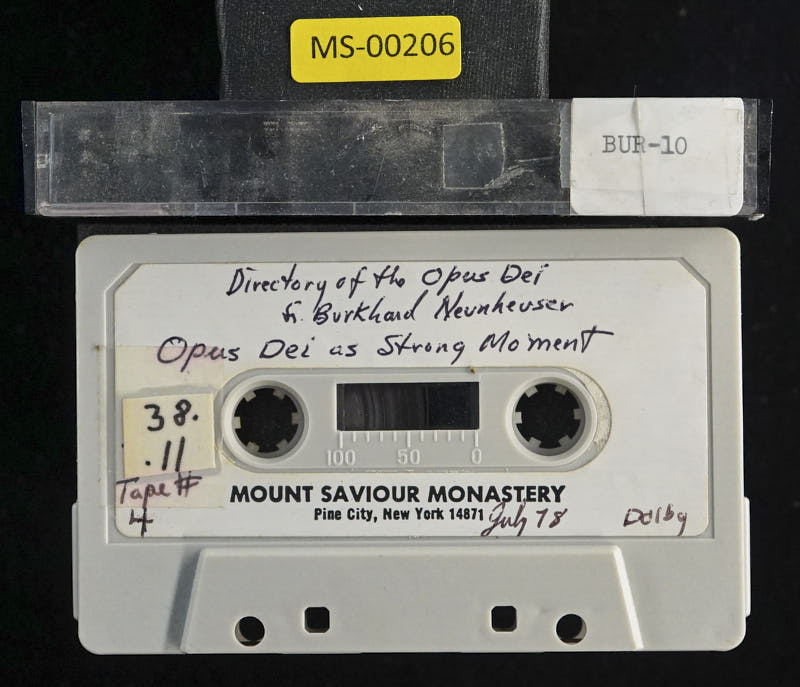
Speaker: Fr. Burkhard Neunheuser
Location: Mt. Saviour Monastery
Possible Title: Directory of the Opus Dei / Opus Dei as Strong Moment
Additional text: 38 // Tape #4
Side B:
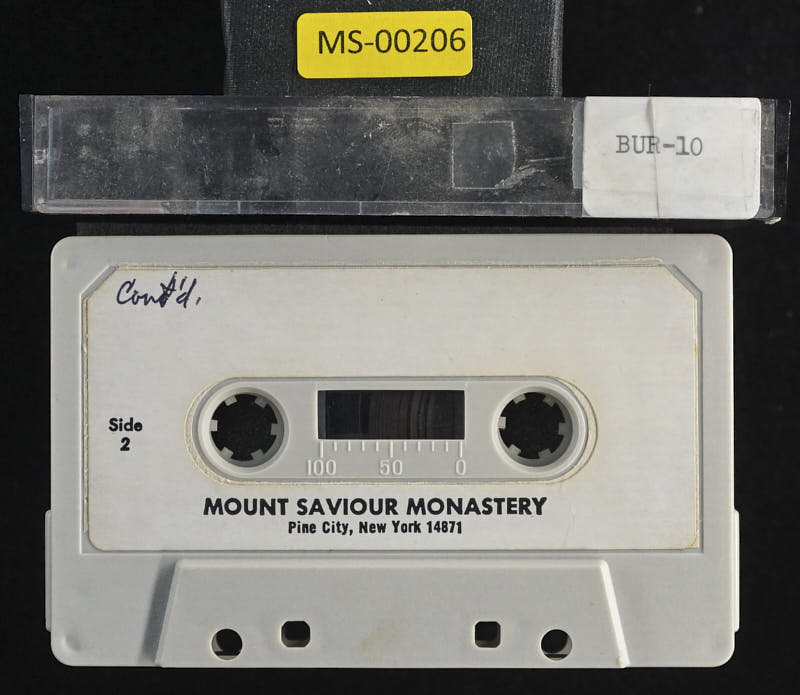
Side: 2
Location: Mount Saviour Monastery
Additional text: Contd.
@AI-Vision_v003
English text, which says in number eight of the Latin text, the inscription Tempus validum in vita orationis monarchy. And it's translated in English, the strong moment in the life of prayer of the monk. In a certain way, you have in this number a monastic, a benedictan transposition of this fundamental principle in number eight. nine or ten of the liturgical constitution of the council. Liturgy does not exhaust the whole potential of prayer and nevertheless it remains the summit and the source of all the activity of the church.
[01:05]
Therefore, Opus Dei, though enjoying a poeminence of fact and of value in the monastery, does not in itself exhaust the whole potential of prayer, but it should be the strong moment of monastic prayer, of the monastic prayer life. And in a certain way, this number is a very excellent a very equilibrated expression of our situation. We love liturgy, for it is the most important work, but it's not enough. It's not all. And we must agree also about this point. And nevertheless, in all our intention to pray always, the monk must be a man of prayer. He must always pray in the choir and in every occasion. He must very frequently seek a possibility to pray, to go, guided by the inspiration of the Holy Spirit in the church to pray there.
[02:06]
Nevertheless, the work of God remains the most important reality, the strong moment. And we have already spoken about these different points. First, because... It brings back again and again, and in a more vital manner, contact with God. Contact not only in the sense of his continuous presence in the community, where two or three are together, he is in the middle of them, but with the mystery of salvation, according to the particular way that God foresees it realized by the community. And here again, And this element is giving the interpretation of the liturgical constitution itself. We are clearly in the liturgy, especially in Eucharist, but in every liturgical action, the work of redemption is exercised, not only in Eucharist.
[03:15]
Also in the Opus Dei, we have the... deepest reality of our contact with God. And we have said already, if this contact is really so great, then it must be continued. But first, here is the highest point. And here again, I could remember this controversy perhaps 10 years ago. It was beginning in the United States in the review of the Carmelites, which is the name, where somebody was writing against the historical movement. saying it's only a movement of noise, of activity, of activism. And the man who was writing it was Maritain, Jacques Maritain, with his wife Raissa. They at once, in my youth, 50 years ago, the great apostles of liturgical prayer and of many other good things, in that seers, they feared the activism movement
[04:20]
excuse me if I say so, of American liturgical movement. It is not totally wrong. Nevertheless, so, as they said, it was not right. Because they said, literacy is okay, yes, but the most excellent way, the summit, is mystic. It's a mystical experience. And then many people, because the deep one, and Bernard Herding, and I don't remember. Many were responding in an excellent number of worship against it. Cipriano Vagaggini, and other good people, saying, especially Vagaggini, for many years our rector in Tantanselmo, excellent, you know him, if it's the logical dimension of the liturgy, he said, the summit is a liturgy. excellently celebrated, where you have both the reality of liturgical action and your personal answer.
[05:27]
And if you are doing so, after this summit, you go on also to a mystical continuation in silence. meditating it. But this meditation, this mystical experience is the second point only after the high contact, after the high moment, after the strong moment, after the tempus validum of the liturgical reality. Therefore, you can say it is better to tend to this mystical experience after a bad liturgy, which is nothing else than an external celebration to do what the church officially wishes to do. But if you are celebrating liturgy as it really is the actualization of the work of God, then here is the summit. And as we said last time already, if you stay in the summit, you must have the tendency to remain in it, also in the breakfast, also in your work, also in moments of silence, the entire day, until you go back again to the summit, from summit to summit.
[06:33]
in the hope that you, at once in eternal life, can stay forever in this summit. In this atmosphere, in these perspectives, this number is speaking. Therefore, here is the greatest reality and also the maximum of expression of the communion of brothers among themselves, realizing that harmony in of Matthew 18, 19, of voice and spirit, which assures the favorable response of God in virtue of the presence of Christ, praying in the community. And then, thirdly, also, this summit was celebrated so strongly with life, with, I would say, mystical experience in the celebration itself. disposes each monk to be more open to the inspiration of divine grace so that he can continue, privately, in a silent, quiet, and continuous prayer, the dialogue with God, which was initiated in a communal way.
[07:41]
Therefore, about this we have already spoken. Therefore, now we can go on to take number eight. In English, number nine. the hours, the hours of the work of God. And here, the number is insisting in this vision. The hours are not only intervals in cosmic time, a little bit speculative construction of Salvatore Massili, but it's very nice, but only intervals in cosmic times, chronos, but moments changed in sacred moments of the history of salvation, Kairos, that in every hour you stay in the today of God. You say it strongly in the beginning of the day, but in every hora...
[08:50]
You stay in a moment where God is speaking to you, in sacred moments of the history of salvation. It's always again a confrontation with God, moments of encounter, of realization of the know of Christ, of the hour of Christ. And this hour of Christ, in which this entire book is brought together, is realized, is Pascal mystery. It's Pascal passage. My hour is not yet arrived. It's not yet come. It did not yet come. And this hour is the hour in which he loved... as until the end, in which he was passing from this world to the Father, in which was he dying and resuscitating. And these are all, we are realizing it every time when we are coming together to celebrate liturgy in the worship of God in the Opus Dei.
[09:53]
Again, according to number seven of the liturgical constitution, in every liturgical action, Christ is present to his church. especially in the Eucharist, in the highest degree, as sacrifice, as Holy Supper, and also in the entire celebration, and in every sacramental action, and when solemnly the Holy Scripture is proclaimed in the church, but also if we are coming together to pray together, then the Lord is in our midst. And therefore, there is the... Hora, in which, again, Christ is giving us this Pascal mystery, the participation in his transition from this world to the Father, every time again, in every sacred hour. In this hour of Christ, which is introduced in our earthly time,
[11:04]
that we can worship in spirit and truth. And this number is insisting especially in that to pray in these different hours, in vigils, in laws, in hora diurna, in the daily hour, in the day hour, noon hour, in Vespas, in Compline, and so on. It's not only a necessity to really pray always because When we will be obedient to the word of Christ, we must always pray to the commandment of the apostles. Without any intermission, you must pray. If we wish to do it really, we can do it only in so far we are praying always again from time to time. But it's not enough. It's not only this fundamental necessity to pray at least from time to time, that then we can say more or less we have fulfilled the word of Christ that we must always pray.
[12:12]
But it's more than that. Here is precisely in all this hour and confrontation with Christ to stay in his hour, in which he is going away from this world to the Father, that we are participating in it. That is the meaning of this number nine, number nine. eight in English, nine in Latin. And then we are going towards number nine in English, in Latin ten, where the Latin title is Memoriale Mysterii Christi. It's always the same idea in these last three numbers. The theological prayer. The hours are the strong moment, the highest moment in the prayer life of the monk. Because in all these hours, we are encountering, we are meeting the Lord in his hour of salvation, in which his Pascal mystery is brought together, that he can participate in it in every hour.
[13:27]
In different way, we are doing it in the noon hour, not four hours. greatly as in the visions and in the vespers. And in visions and vespers, in laws and vespers, we are not doing it so intensively as in Eucharist. There are different degrees, but nevertheless, in every ritual action, we are meeting our Lord in his own to participate, to share in its Pascal mystery. To realize in different degrees, but nevertheless, always really, our participation with Pascal Mystery. And now we are insisting precisely in this point, our liturgical prayer, the highest summit of our entire prayer life, the canonical hours in which we are coming together in the morning for lords and noon and for vespers and so on. And these hours are
[14:30]
Memoriale Mysterii Christi, the memorial of the mystery of Christ. Here again, and during our driving back from this afternoon from Genesis Abbey to here, we were speaking about this. Memoriale, the memorial, of the mystery of Christ in the most eminent way, Deucarist. But also, in a different way, every hour is a memorial of the Pascal mystery of Christ, in a different degree. We could say, Now, we must say first, again, with number seven of the liturgical constitution, in every liturgical action, the Lord is present to his church.
[15:33]
He is present, not only as person, but also with his work, dying and resuscitating. Do notice different moments. A very important point, already expressed by Pius XI, in his Encyclica Mediator Dei, and then taken again in number seven of the Jewish Constitution, taken again by the Pope Paul VI in his Encyclica concerning the Eucharistic mystery. Christ is present to his church in the most eminent way in the Eucharist. in the person of the president priest, in the sacrificial action, under the species of blood and wine, in his body and his blood.
[16:34]
But he is also present in every sacramental action. It is not Peter, it is not Paul, but Christ who is baptizing. So in every sacramental action, he is present, doing, working, And he is present when the Holy Scriptures are read. He speaks to us. He teaches us. His word is coming to us, and he must hear it. And he is present when two or three are gathered together in his name. He's among the midst of them. And so we must see that also in the liturgy of the house, we are in the presence of Christ to celebrate, to actualize his Memorial. We have already spoken about it. It's our remembering that he has done all this work, but our remembering not in a subjective way, but in a way that we are really touching this reality.
[17:37]
It's only one historical action. He did it in his time under Pontius Pilate in Palestine. But it was done in such an extreme and extraordinary way that we today, celebrating liturgy, celebrating Eucharist, celebrating the hours, praying together, can touch him, stay in him, hear him, participating in his work, sharing in his work. That in every liturgical prayer, staying together, we are rearing in the mystery of Christ. And you can say again, here's the strong moment of our prayer life. Here are the most eminent hours in which we can meet Christ. Therefore, here is the summit of our prayer. But the summit to be continued in our entire prayer life, in our entire monastic life, our daily existence. Therefore, in different degrees. And we could say then also, and the number is insisting in it, in a certain way,
[18:42]
You have in the Deucharist a very objective presence of the work of Christ and his person. Ex opero operato. So much that if a priest is a very bad man, a great sinner, nevertheless he is really celebrating the Deucharist, the sacrifice, consecrating, giving the body and the blood of our Lord to the faithful. Ex opero operato. And nevertheless, if we are... trying to have a good theology of this concept ex operato. We need always, also in the midst, some reality ex opero operantis. We must receive it in faith. This is true so much that Karl Rahner at once could say, if per impossibile in the world would not be nobody anymore believing, and some bad priest would celebrate Eucharist, this duperist would not have any meaning.
[19:44]
Really consecrating the body of the Lord, but God does not need it. If there is nobody who can receive it in faith, it would be nothing. And then he is saying, in a very terrible comparison, if somebody would play a tape on the pole of North, or the pole of South, and nobody could hear it. Nobody. Only the icebergs. God would not be glorified. But if somebody hears it, and no other man is coming to the Pole of the North, and he hears that somebody before him has met this tape, Gloria in excelsis Deo, singing, oh, marvelous, God is glorified here. But because he is listening in it, and therefore, a mess without faith, also, it is objective reality. Without our faith, would not have any real consequence. In the liturgy of the hours, things are a little bit different. If there is nobody believing, there is nothing.
[20:47]
There is no consecration. And if there is a choir of monks who are terrible sinners all, and they are praying psalms, you see the difference. Also in our liturgical prayer in the choir is reality. objective reality, ex operato, but we need much more of faith to can realize it. And no, I would insist in this point. Likewise, as in the Deucharist, where is an objective reality, this must be received in faith. So, but quite more in our prayers, in our liturgical prayer, in our hours, there is an objective reality, the memorial of our Lord, but we must receive it in faith, in real faith, otherwise it is only a service of multiplication of words.
[21:54]
It has no meaning. And I must say, I don't know if the English translation presents really the meaning of the Latin text because it seems to say that ours are the subjective realization of the objective reality of the Eucharist. That's not right. We must try to celebrate Eucharist in faith. Also, it is a very great reality in every way. But we must see that also in our liturgical prayer, liturgical hours, therefore, in the literary of hours, there is objective reality. The church is coming together, the local church, celebrating the memorial of the Paschal Mystery of Christ. But we must try to, that is the essence of these hours, to do it in faith.
[22:56]
We must call the Lord. God came haste to help me. Glory be to the Father. Thinking to it. Believing it. Doing it in faith. And then we are singing hymns, we are singing psalms, we hear the word of God. If we are doing it only externally, then it would be meaningless in a certain way. Or you could say this celebration would be a very feeble witness for the people outside. But if we are doing it really in faith, then this would be a splendid memorial of the mystery of Christ. Therefore, I say again, also the opposite day in the liturgy of ours is a memorial in the same way as the Eucharist, in the twofold way. Objectively, because in this prayer of the church brought together, Christ is in her presence.
[23:57]
But it's a memorial of the... Pascal mystery of Christ objectively to become appropriated? Subjectively. You must take it. And in the literature of the hours, we must do it more still as in Eucharist. On the other side, it's ridiculous to speak so, because also in the mass, we must do our best to do it in faith. And when I, many years ago, in a certain day, was discussing with Otto Kassel these problems, asking him how Where is the difference between the presence of Christ in the liturgical world, epistle and gospel? And then in the sacrifice, in the communion, he said, you must not ask though. It is ridiculous to ask though. It's too scholastic to ask though, because the entire mess is presence of God, presence of Christ, presence of his mystery. In our prayers, in our canticles, in our readings, hearing it,
[24:58]
announcing it, and then in bringing bread and wine, and then celebrating. Also, he exaggerated a little bit, because there is a difference between the word and the sacrament. And nevertheless, he is also right. There is one great presence, and we must take it, have it, realize it, take it in us, in the Eucharist and in the hours. Therefore, there is reality of the memorial of Christ objectively to be appropriated objectively. But, and he says it so in the letter A and B, but then in the letter C he says, the Eucharist is the example, the model. There is an objective reality to give by the way of faith and personal devotion, the contact with that reality, to can live by its grace.
[26:02]
And so here in the Liturgy of the Hours, personal relation and experimental condition is necessary, is possible to extend the praise and the thanksgiving of Christ, which we are, gaining in this liturgical hour through the different hours of the day it's a little bit difficult to explain it but nevertheless I would say the hours are not only the subjective way to continue the reality of the Eucharist through the day but they are also in itself the possibility to get contact with Christ, that then we can still more bring this reality into our daily life. Here is the Eucharist, we are celebrating it, realizing it personally, subjectively, that our life is formed by Christ's sacrifice in the communion and so on.
[27:11]
And then we are continuing this hour, contact with Christ, also in the hours. But in the hours again, we are getting contact with Christ. We stay in his presence. We are celebrating his memorial. And then again, we are able and also obliged. And we are asked to bring this contact with games in the hour, in the next time, after the loss, in our prayer, in our breakfast. Then again for the high mass, after the high mass to our studies, to our walk with the cows and so on. And so finally we have a great reality of the entire day which is the celebration of the mystery of Christ in objective reality given to us as we continue, as we can continue it during the day. So I tried to explain this number nine, and you can read it and then perhaps discuss with me if I did not speak clearly enough.
[28:24]
And then again, you could continue in number 10, Latin 11. The title in Latin is Tres Cicli Temporales, a triple cycle, of time. This is quite evident, but nevertheless it's very nice also to think about these three cycles. The liturgical year, the liturgical week with Sunday, and the liturgical day with the hours. In Latin it says, or you can read it immediately in English, the Opus Dei, a celebration of the mystery of Christ in time, is the time in which the history of salvation in its totality, comprising the past, the present, and the future, is inserted in cosmic time.
[29:36]
There is one war of salvation, past, present in our actual cosmic time, in the hope of its eternal fulfillment, past, present, future. And in every liturgical celebration, these three times in a certain way are brought together. We are celebrating the memorial, presently, hoping. memoria, mortis, which gives us grace for the moment in the hope of eternal resurrection. In a certain way, this identity of three times is expressed marvelously in the antiphon of the solemnity of Corpus Domini, or sacrum convivium in Quo Christus Sumitur.
[30:40]
Therefore, we are celebrating the memorial of his death, receiving his praise, receiving a pledge of the eternal life. And the only limit of this Antiphon is only that he is speaking only about the Holy Communion, in Christus Sumitum, or Sarchum Convivium, we must say, in the entire Eucharist celebration, sacrifice and communion. And finally, if you could say, in a not so high degree, in every liturgical celebration, also in the Liturgy of Hours, we are celebrating the memorial, of his death and resurrection, receiving presently grace, receiving in the same time a branch of eternal glorification.
[31:46]
And so, having had the participation in his threefold walk of Christ, we are able to live always in our entire life, remembering death and resurrection in the present grace of our Lord, filled with hope for eternal glorification. And we are doing it now in different cycles. Year, week, day. And here is evident, the entire liturgical year, celebration of the Paschal Mystery, with Eastern Ascento, prepared by 40 days and continued by 50 days. We must say, and now the liturgical year is continuing with the week, with every Sunday, where we are celebrating again, every Sunday, every Sunday, in the joy of the Holy Spirit, waiting for the Pascha, his servant resurrection, presently, in the hope of eternal salvation.
[32:56]
So every Sunday is a little Pascha. But it's not enough so, because we are celebrating in the year, not only Pasqua, the entire pascal time but also epiphany and nativity but also epiphany and nativity are nothing else than the celebration of the pascal mystery in its beginning we are celebrating and receiving and waiting in christmas in epiphany for nobody else than for our glorified lord and epiphany is the manifestation of this savior of the world who is arriving Manifestating his glory to the sharp hairs, to the kings, and in his resurrection, and in the hope of his coming back again. Also in Epiphany, and also in Christmas, we are celebrating the memorial of his heaven resurrection, Eucharist, and so on.
[34:04]
In a certain way, yes. Then, after a year, we must continue to speak about a week, which is really the Sunday, and the Sunday continuated through the week. In a certain way, we are living from the grace of Sunday during the week, coming back again, preparing, as in the last days of the week, to the new Sunday. The week itself, 30 days, I would say, has not the same importance in the liturgical time as the year and the Sunday. And nevertheless, we are celebrating Sunday, one day, then we must work in the power of the Sunday celebration. And in the actual discipline of the church, also repeating every day, Pucharist. But you can remember that in the old times, Pucharist was not celebrated every day. Only in certain solemnities, feast days, And in a certain way, there was more time to live in the power of the Eucharist of Sunday to prepare ourselves to the next Sunday.
[35:11]
But nevertheless, today, we are celebrating every day the Eucharist. Therefore, we are celebrating Eucharist of Sunday every day to live always Eucharistically, to say so. And therefore, to insist in this fact that Eastern, Paschal mystery remains the center of the entire liturgical year under every aspect. Year, great solemnities, Sundays, ferial days, festivities of saints. I have written some two, three years ago in the magazine Revista Liturgica, an article, the Paschal mystery is the center of the liturgical year, not only by the Paschal time itself, but so that there is no celebration in the year where the Paschal mystery stays not in the center. No Christmas, no Feast of Our Lady, no Assumption, no Immaculate Conception, where we don't see the death and the resurrection of the Lord as the fundament, as the pledge of this solemnity, of this saint, of this martyr, and so on.
[36:22]
And nevertheless, there is not only the temporal cycle of the year, the entire year in which the mystery of Christ is coming, is there, is resurrection, and is coming again, is celebrated, but there is the week, this is Sunday, and here the text is insisting also in the, of the mystery of Advent, the week of the mystery of Christmas, and so on. No, it's also here. The week of the mystery is the same. The English is also good. It's a Latin text. Therefore, in a certain way, the week is expanding the reality of Sunday. In the actual discipline, we are doing it. We are repeating more or less during the week the antiphons of the myth of Sunday. And if we would not have readings, we would repeat the readings of the Sunday as we did it before. Therefore, in a certain way, the week It's a second cycle in which we are rhythmically celebrating in a minor way, in a not so high way, the Paschal Mystery of Christ.
[37:35]
And finally, we are doing it in every day where we have the hours, as we said already, to find, to meet our Lord. In the liturgical day, we have the hours to place the mystery of Christ against the background of the Paschal event. Whatever aspect is being celebrated that particular day, if it is a feast of a saint, of a martial, of a virgin, of Our Lady, all that is possible only in consequence in the power of the Pascal mystery. He has given to the martyrs the possibility to do it. He has given to Our Lady the grace of Immaculate Conception because she was saved in Tuitu Meritorum Christi, in the provision of his death.
[38:37]
She is not, and she, we must say so, is nothing without this Pascal mystery of Christ. Therefore, Immaculate Conception is the first beginning of the victory of Christ in this Paschal mystery. But here the text is continuing again, insisting that also the hours in itself, there's sex known. And we must say and insist more strongly, especially in the morning, in the laws, in the Vespos, we are always seeing the Paschal event. In the morning, his resurrection. In the afternoon, his death. And also, if we don't think explicitly as these elements, nevertheless, in the Benedictus, in the Magnificat, we are always celebrating the totality of the Pascal mystery of Christ. The text here says that Hippolyte of Rome, in his work Apostolic Tradition, concludes that all the hours of prayer
[39:43]
in the day are in memory of what Christ has done. But in a certain totality, we don't precisely remembering this or that point of this question, but we are saying always the totality of the walk of redemption. And the Church of the Constitution says it very well in number five and six and seven. Christ has saved us precisely by his Paschal mystery in which he was passing from the death to eternal life. And this totality brought together, which we are celebrating in Easter, in Christmas, in the Assumption of Our Lady, we are celebrating it too in every hour, especially in the morning, glorifying the Lord because he is our Savior, and in the evening because he helped us today to stay in his Paschal mystery. during the liturgical day, we are celebrating in every canonical hour the Paschal Mystery of Christ.
[40:53]
Therefore, again, we can say, with this number nine, the Opus Dei is a prayer that is distinguished from and greater than all of us because it has its specific content, it has... as its specific content, the celebration of the mystery of Christ, and it achieves contact with God at the level of the history of salvation, that it becomes a total memorial, be it on the objective or the subjective plane. We are in all these hours announcing the glory of God, who saved us in Christ, especially by his Paschal mystery, objectively. All together as the local church, in the most eminent way in the Eucharist, but in different degrees in every hour, where we are encountering God, Christ, where we are meeting him, objectively, that we are also personally, subjectively, are filled from it, that then we can go out to continue to work and to pray, because, literally,
[42:06]
does not exhaust the entire activity of the church. We must do many other things. But here is the summit, the highest point. And so far as possible, we must realize it personally, subjectively, piously, already in the celebration itself. It would not be right to do as Maritain seemed 10 years ago to insinuate we are celebrating liturgy piously. And then finally comes the moment where we can pray to find him. after the Mass. No, that is the false subjectivity from all times, as we are learning it at Little Boys. After the communion, you must stay so for 10 minutes to pray. Here's the great moment where you can speak with your Savior. No, you must speak with him when he speaks objectively in the liturgical celebration, where he announces his marvelous deeds, where he is realizing, re-actualizing his marvelous deeds of salvation. In itself, praising the Lord, being united within.
[43:11]
And it's so much that then, after it, you can do so. And you can also go to take your breakfast and to work and to study in Christ Jesus, always, until finally you come to the eternal life, where you always really, with our sacrament, in the total... reality of this mystery so for the moment we must do all this wonderful reality in the summit of our liturgical prayer life in three historical time cycles in the year in the week with the sunday and during the day in every hour in the hours of our prayer life two hours three hours six hours seven hours according to the disposition of the local church a little bit different But perhaps no, I think it would be better to finish for a moment and to remain, if you wish, some minutes still in a short discussion.
[44:19]
The reality of liturgical prayer at the summit, inviting us to, as Cardinal Newman said it, to realize it. immediately doing it personally piously to continue also in another sense to realize it in our life our work life do you agree with these ideas or let me ask was i able to give us some interpretation of this text. Do you think about this difference between objective reality and subjective appropriation of it? It is good, it is convenient to see objective reality also in the hours or only in Eucharist.
[45:32]
It is right to say you can celebrate Eucharist as objective reality, but you need to have personal appropriation. Otherwise, premise is nothing. It's something, but it's not enough. In a certain way, we could say in modern Catholic piety, we were insisting so much in the objective reality of the Eucharist that we were more and more losing, at least outside the monasteries, the possibility to pray together. Especially today, after the council, the last relics of vespers in the parish churches are lost. And morning and afternoon and night, mass, mass, mass, Eucharist. The wonderful introduction of the evening mass, and Father Jungmann said it very clearly too, we are too Eucharistic. And we need, besides the Eucharist, also prayer, vespers, especially vespers, and other canonical hours, and especially we monks.
[46:45]
And therefore, we must see also in these other liturgical celebrations the reality of the presence of God, where Pope Paul VI, and also the liturgical instruction of 64, yes, and the cultural mysterious Eucharistic of 67 was insisting, all these people, Pope and the instructions were insisting, the highest reality is in the Eucharist. But if we speak about the highest reality in Eucharist, that does not mean that the other things are not also real. There is reality in the presence of God, in the word of God, in his proclamation. There is reality of the presence of the memorial of our Lord in the hours. Also, the reality of Eugenia is greater. In a certain way, the Protestant theology was retaining always the second aspect, reality of the presence of God in the solemn proclamation of the word and of the prayer.
[48:02]
But they were forgetting the greater reality of the sacrament, at least a little bit, not totally. And today, both we are coming together, we saying that Eucharist is the highest reality, but the word of God and ours are also reality. And the Protestants, at least good theologians between the Protestants say, we are insisting in the highest reality of the word of God, but also in the reality of the sacraments. Protestant theologian, who in the most excellent way was expressing this wonderful double reality is Peter Bruno in this marvelous book. I think you have it here in German, but perhaps not in English. Liturgia. The worship of the community gathered together in the name of Jesus. Excellent explanation of Eucharistic of prayer, of the word, and then highest summits as the Eucharistic prayer itself.
[49:11]
And he, in this work, also is reintroducing for his church the great Eucharistic prayer, realizing that Luther was destroying the old tradition in a false biblicism, because he wished to go back to our Lord, and he has destroyed every church. being what our Lord has done, because our Lord has consecrated bread and wine, changing it in body and blood of himself. Thanksgiving, Eucharist stone, celebrating Eucharist. Never this was happening without Eucharist, without Thanksgiving, without the memorial and supplication and so on, as Bouye is telling it. And it's said by Peter Bonner in the first book volume of this big work, Liturgia, a handbook of liturgy for Lutheran churches in Germany. Peter Brunner, the first volume of Liturgia, you have it here in the library. Yeah, four or five volumes must it be.
[50:12]
Liturgia, Peter Brunner is B-R-U-N-N-E-R. Ah, Brunner, yes, Peter Brunner, excellent man. And to be quite sure, one of our doctor's students in Rome has written his doctor's dissertation about the Ducharistic Doctrine of Peter Bruno, studying for a semester with him in Heidelberg, inviting him to write the foreword to his book, he published it, and then giving the Doctrine of Peter Bruno and criticizing it from the Catholic standpoint. In the collection of the Economic Center of Paderborn under the guidance of Cardinal Jaeger, and so on, a very Catholic book, and a doctor's dissertation in Rome, a monk of Beuron. Michael Seemann. I have spoken again too much. Objective reality is appropriated. In different degrees, in Eucharist, more objective reality, but also subjective appropriation.
[51:22]
But in the literature of the words, of the hours, we must be very strong in our faith. can get the reality of Christ, of God. But there is then also objective reality and we will stay in it and appropriate it and continue it in the daily life. No, no. My critique was shown in page 7. In the middle of the first section, after the middle, this very personal contact by which one enters subjectively into the memorial of the mystery, once it is transformed into praise and thanksgiving, will be extended in the opposite day to different hours.
[52:24]
No, that is not enough. But here I would say it is not only in English, but this time it is also in Latin. It will be too few. There is an objective reality already in the celebration of our hours. And the hours are not only the subjective continuation of the objective reality of the Eucharist. You need subjective appropriation in the Eucharist As you have for your subjective appropriation in the hours, the objective reality of these hours, which are already giving you the contact with our Lord and his mystery. But you need to be more strong in your faith, to have in your faith, as I said already with the word of Anselm Scholz, objectiva quidem, the obscura anticipatio with juris eterne. You have...
[53:26]
and real, objectiva, realis, but very obscure, anticipation of the eternal vision. Therefore, no applicating it to this. You have here a real, but very obscure, participation in the mystery of Christ, in faith, in every faith, where we have faith. If you cannot celebrate the sacrament, you can at least have contact with our Lord in faith. And in a certain way, this contact in faith is the last and highest reality to which also is tending the Eucharist. But in the Eucharist, you have nevertheless, in a certain way, more, because you have there the presence of the sacrifice itself in a way as you don't have it in the hours, and you have there the presence of the body and the blood of our Lord, what you don't have in the liturgy, in the hours. But... this presence of the sacrifice and this presence of body and blood are given that you stay in faith with him.
[54:31]
And the faith you have in the house is given to you also by a certain reality of the presence of his mystery of the Lord himself, which is given because here the local church is covered together to celebrate the memorial of our Lord. Also here again, you must do it otherwise the local church is not gathered together, and you must appropriate it personally to you. I wish to insist in the reality of the presence of Christ in the hours without taking nothing away from the great reality of Eucharist. We must have a certain balance between the two. The celebration of the hours are not the same as Eucharist. The Eucharist is more, nevertheless. Yes, you are right.
[55:32]
But the local church is only present if you are really there. You are right. This reality in the words is given by the word, where we singing the Psalms, are singing with Christ in crystal, and hearing the chapter on the readings, the Lord is speaking to us. He is speaking to us. In this word, you are right, He is speaking, but we must receive it in faith. And his faith must be, to say so in the hours, stronger than Eucharist, because in Eucharist also, if your faith is very, very, very, very small, there is really the body of our Lord. Also, if all the celebrations are sinners. But Hannah said, if there, per impossibile, would not be nobody in the world to believe, then Eucharist would not have any meaning.
[56:37]
lived there by impossibly nobody in the world would live anymore. Without faith, sacraments are sacraments of the faith. Not so as the Protestants are saying, it is too few. There is real reality, but in faith things are staying together. In a certain way, yes, yes, yes, yes, yes, yes, yes, yes, [...] yes. One mass participatory faith is more than four mass where you are going on very quickly only to have the mass. I think we must finish.
[57:36]
@Transcribed_UNK
@Text_v005
@Score_92.14