You are currently logged-out. You can log-in or create an account to save favorites and more. more info
Listening Hearts, Silent Souls
The talk explores the triad of monastic life emphasized by St. Benedict: obedience, silence, and humility, focusing specifically on the virtues of obedience and silence. It delves into the etymology and deeper spiritual significance of obedience, reflecting on its critical role in monastic life, and how it contrasts with authority and coercion. The discussion further examines silence as a fundamental component of spiritual practice, emphasizing its role in creating a listening heart capable of encountering God.
- The Rule of St. Benedict: Chapters 5, 6, and 7 emphasize obedience, silence, and humility as foundational virtues in monastic life. The prologue and Chapter 71 highlight the necessity of obedient living and mutual obedience within the monastic community.
- Philippians 2 (The Christ Hymn): Referenced in relation to humility and obedience, illustrating Christ as a model for monastic virtues.
- Michael Casey: His interpretation of the role of the abbot and the concept of "antecedent willingness" are discussed as integral to understanding monastic obedience.
- Columba Stewart: Cited for insights on obedience rejecting isolation and fostering community.
- Sister Meg Funk's "Thoughts Matter": This work is mentioned regarding the importance of silence for internal reflection and spiritual growth within the monastic context.
- Gerard Manley Hopkins: His poem "The Habit of Perfection" is quoted, highlighting the beauty and necessity of silence.
- C.S. Lewis’: "The Screwtape Letters" is referenced metaphorically concerning the distractions from true spiritual seeking.
- "Into Great Silence" (Film): Cited as an illustrative portrayal of the impact of monastic silence.
These works and ideas are essential for those studying the interplay of obedience and silence within monastic settings and provide a framework for evaluating the role these virtues play in broader spiritual disciplines.
AI Suggested Title: Listening Hearts: The Silence of Obedience


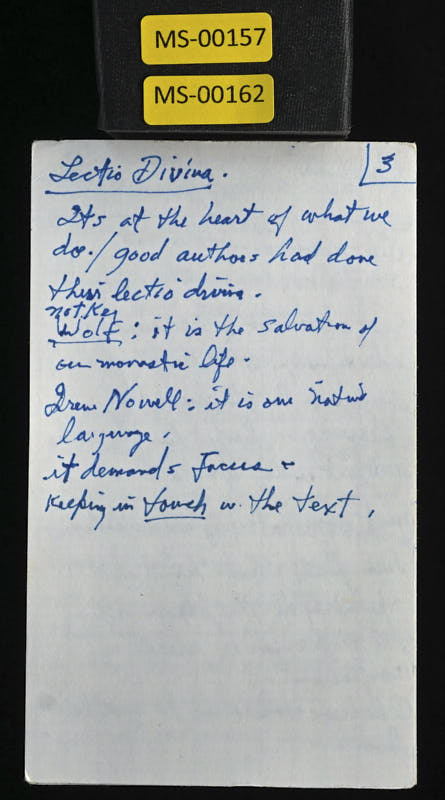

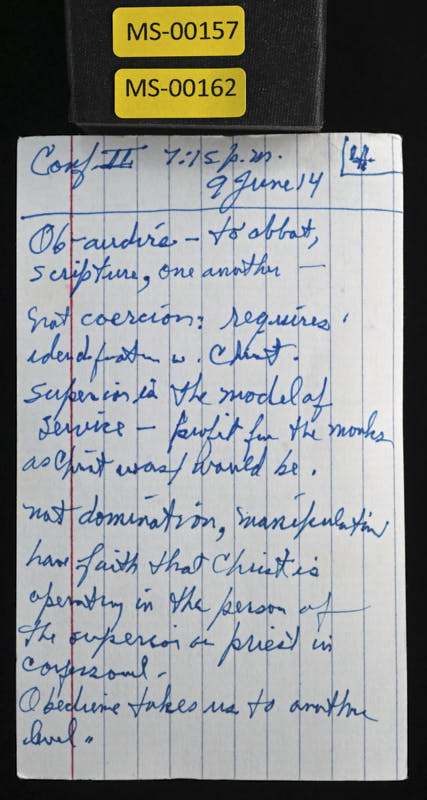

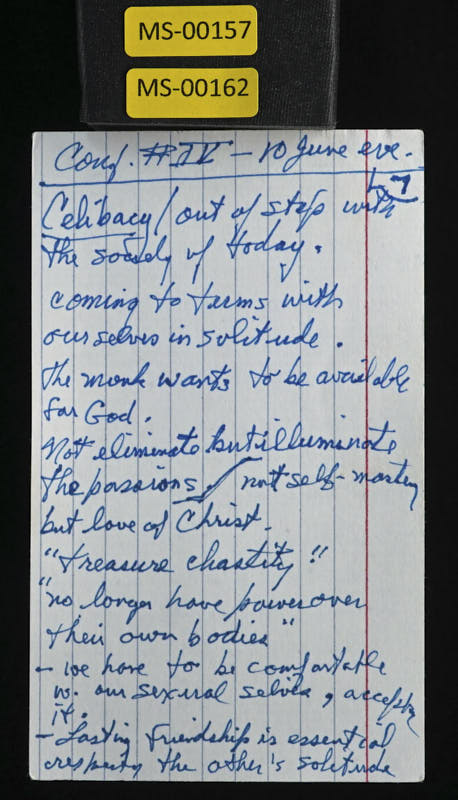

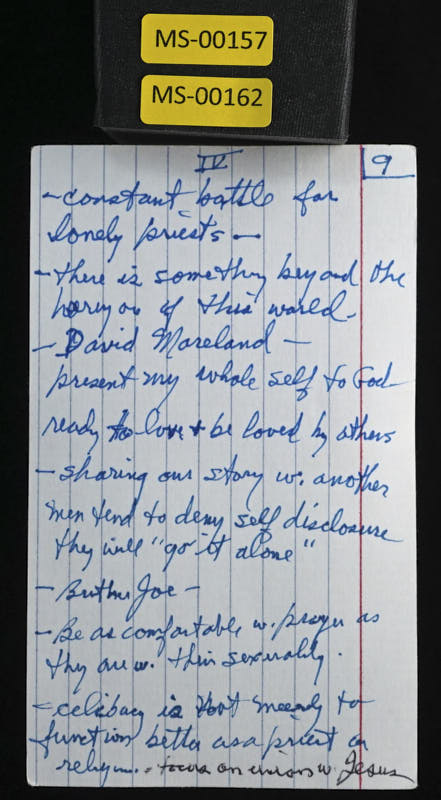

Two talks from this date.
Obey the orders of the abbot unreservedly. Hate the urgings of self-will. Guard your lips from harmful or deceptive speech. Refer moderation in speech and speak no foolish chatter, nothing just to provoke laughter. Do not love immoderate or boisterous laughter. After taking up the... work of God and our prayer life, I thought it would be good to focus on those three virtues that are the priad of monastic life for Benedict in chapters 5, 6, and 7, obedience, silence, and humility. And this evening, just to enter into the first two of those, obedience and silence, the word obedience, if we look at it its Latin roots, ob audire, captures the real uniqueness of what this is all about.
[01:09]
We listen to someone else. It's that posture, that mindfulness that's at the heart of what the transformation of monastic life is all about. And of course, within the course of our normal monastic day, we're listening to a lot of things. We're listening to the word of God and the liturgy and Lectio. We're listening to table reading or music, as we were this evening. We listen to the commands of a superior. Of course, the rule begins with that word, abskulta, listen, exhorting us to do so with the ear of our heart. An invaluable skill that every newcomer to monastic life must attempt to acquire is this facility in listening. Because only insofar as we're receptive to the voice of God and his attendant graces can we be formed in this school of self-understanding.
[02:17]
A school that has this pedagogy of these three virtues of obedience, silence, and humility. Obedience given by the monk is obedience given to superiors, but one that is given above all to the person of Christ. The abbot for Benedict is seen as Christ, we know that, and is obeyed accordingly. The vow of obedience that we all take implies at the same time that we're obedient to Scripture, the Word of God, we're obedient to the rule, and... we're obedient to one another. We are to move, Benedict tells us in the prologue, from the laziness of disobedience to the labor of obedience. And Benedict is certainly drawing from all the layers of monastic literature that went before him, where obedience was the primordial monastic virtue.
[03:23]
We know, of course, he gives us a separate chapter on it in chapter five. He, at the end of the rule in chapter 71, on mutual obedience, gives his own very personal spin to it. And it surfaces throughout the rule as this very elemental way of somehow conforming our will to the will of Christ. And of course, it's important to spend some time on it because obedience doesn't have much of a good press today. I think part of that is because many people have confused religious obedience with the exercise of authority or power. And obedience is not the same thing as authority and its exercise. If we are vowed to accept obligations as part of the common life, it doesn't mean we accept coercion. There certainly has been an abundance of abuse of power
[04:27]
in our political, our corporate, our ecclesiastical spheres where surrendering one's whole ethical compass to doing something that we know leads to terrible consequences is not something that we as Christians would even think of doing. But the obedience of monastic tradition is not about that. It's not about creating some type of spiritual automaton. And it really presupposes, it requires a deep identification with the person of Christ. Especially in chapter seven on humility, Benedict is talking about the Christ who became obedient unto death from the famous Philippians passage in chapter two. He's the model, the motivating agent for every act of obedience we should give. The fact that the superior's role is prominent in a Benedictine house should not be surprising.
[05:31]
But it's a role of one who models service more than one of exacting submission. This is so because the model of authority is the Christ who served, the Christ who washes the feet of his disciples before he gives them his last instruction. Benedict puts it succinctly in his directive to the abbot in chapter 64, The goal must be profit for the monks and not preeminence for himself. Or as Michael Casey has aptly put it, the abbot's task is not one of ruling grandly over a robust elite, but one of constant care for those who are less than perfect. I think we can make a compelling case for the fact that obedience in any context in our contemporary world where freedom is so dearly prized is going to have to free itself from some contending associations we make with obedience domination, manipulation subservience we've seen where that has brought us I think the the whole record of the show up and the concentration camps is still something we carry and
[06:54]
we think of prisoners, we think of our own day, those terrible photos from Abu Ghraib in Iraq, what still takes place at Guantanamo Prison. People doing these things are people whose consciences are unmoored from what is really good. And sad to say, you know, we suffer, I'm sure in one way or the other, Mount Savior has suffered from the sexual abuse crisis in this country and Many people in chanceries, people who were considered the great models of church, who simply went about doing what people said was good for the church and in the process wrecking terrible havoc on the lives of souls and individuals. So we know that the just following orders idea has become a bankrupt rationale for making world choices. Obedience is something we give to a human being.
[07:59]
And that's important. Not unlike what confession does for us, the instrumentality of a human being requires that we have faith that Christ can operate through this human being. Now, history certainly reveals that religious leaders, no less than political ones, have never been immune from faulty reasoning. But obedience to a will other than our own is itself a necessary step in our spiritual learning curve. That's ever more the case when the obedience causes us to see how inflated, how misdirected our own will can be. I think that's one of the reasons why Benedict speaks in chapter 71 of the objective good of obedience. They call it a bonum obedientiae. Columbus Stewart, a contemporary Benedictine scholar, puts it quite well too. He says, at the most basic level, obedience acknowledges and rejects the futility of isolation.
[09:07]
Obedience is imperative for the common life. And let's face it, we see now what some people have called institutionalized individualism in monasteries. And you can see where it's taking us. Obedience has to be operative. If we do any amount of personal examination of conscience each day, I think we can see too clearly how self-will inevitably alienates. Obedience leads to communion. That's the point of the notion of the futility of isolation. Obedience... takes us to another place that's a better place. John XXIII has it as a personal model throughout all of his life, and he certainly lived it. Unless he passed through obedience, he would never arrive at peace. He arrived at peace.
[10:10]
But if you know anything about the life of Saint John XXIII, you know he has some tough obedience. You know, obedience refuses to trust the fragile prudence of our personal judgment. You know, we have someone else who's going to be living with us, hopefully for the rest of our life, take the measure of us. And I think a lesson learned in the monastery is that our motives are more often than not less reliable norms for making a decision that affects our life than a motive of someone who a superior or just another member of the community who's looking for the common good of the larger body of individuals. We talked this morning how divine authors provided a supportive structure for the prayer life of the monk. Well, I think the authority in the monastery provides the structure, establishes the boundaries of how decisions are made and who makes them.
[11:15]
The superiors in the monastic community are those whose exercise of authority is usually done gingerly, aware as they are of the fact that they're representing Christ and they need to manifest this tenderness and sensitivity that are modeled in the person of Christ we see in the gospel. Obedience to God given to the intermediary of the human being as the added benefit of clarifying and purifying our own motives. Benedict certainly was aware of this. And it was connected to his counsel in chapter five that obedience be done without delay and with a willing heart. If obedience is given over to second guessing and hedging of bets, it undercuts this whole Benedict trust that is at his heart. And it leads, we know, to resentment, passive aggression, all these things that are just cankers to the
[12:19]
commonweal of the community. As we heard in our reading at lunch from the Desert Banquet, obedience always trumps asceticism, and that was for the hermit and the Cenobite. Now, we can have heroic acts of asceticism, but if we don't accept the will of another as the instrumentality of Christ, it just all breaks down. I think there, too, we have this realization that progress in the spiritual life is intimately conjoined with difficult obedience. It's why Benedict gives it a chapter of its own in chapter 68. Recall what he says there when someone is assigned a burdensome or impossible task. It's something that happens not just in a monastery, but in many other situations, in the corporate world, in the family, a faith community. And the type of response given in such a situation is important as much for its motivation as for its alignment with the common good over personal preference.
[13:30]
We have to trust, as Benedict says, in the Lord and obey out of love. Perhaps a better characterization of this obedience in difficult circumstances is a term by Father Michael Casey, he calls it antecedent willingness. It's interesting if you would think about that. We enter into situations and we do so with this disposition that I can expect that the superior is going to be communicating the Holy Spirit, Christ, and its will for me. And we know, sad to say, that oftentimes, we're doing the opposite. We're just, you know, gritting our teeth already and got our argument all laid out. That's why this shouldn't be. Which is why, of course, in chapter 68, Benedict says we do it with all humility. And, you know, that's a wonderful, you know, it's worth rereading chapter 68 because the dominant words there are patience and gentleness.
[14:38]
You know, we at the end trust in God's help will be out of love. It's much the same thing we see in the chapter on humility. One of the things I did for a while in the monastery was serve as formation director, and I was always willing to tell the novices that it's not if you will undergo difficult obedience, but when. And it's better to have it sooner than later. And in line with that, I gave assurance that For the novices, if you stay in the monastery, two things are going to be guaranteed. One is that your gifts are going to be used. And the second one is that you're going to be called to fill certain jobs and roles that you never would have chosen for yourself. And that's a good sign of opinion. Because we discover qualities about ourselves we wouldn't have otherwise. But this is always dependent upon the willingness to follow the command of another.
[15:40]
I know when I review my own monastic life, I can see there were instances of unexpected and challenging obedience. And they came early on. And I may not have agreed with the rationale of the superior's decision or even seen the benefit to the entire community. But I remember in my early years, I would look around the community. Of course, this is back in the 50s and 70s. I could see the monks that openly questioned all obedience. the obediences from the abbot. They didn't stay around. They left. But those who would instinctively accept even the difficult obediences were more likely to wind up being satisfied with what they were doing, both in and outside the community. And those monks stayed around. And I came to learn in the process that... I wind up obeying not because a particular superior's command is necessarily persuasive to me or even sensible, but because I believe it's truly reflective of God's will for me and the good of the community at this time.
[16:51]
I obey not because I believe my thoughts are in complete harmony with those of a superior, but because I believe the voice of the superior is in a special way the voice of Christ. coming to me at this moment. Only then, I think, can obedience begin to be transformative. And I think that's connected to what we talked about this morning, the purity of heart. If we have purity of heart, we're more likely to make that instinctive acceptance and response rather than be caught in this quagmire of second guessing and self-doubt. I think one of the difficult lessons to convey in monastic formation is the correlation of obedience with freedom. Talk about this with poverty too, with celibacy, you know, we take these vows and we discover at the other end this incredible freedom. It's so difficult for our modern sensibilities to see that and of course
[17:57]
we all went through some of the same stories from the desert fathers you know you're watering that dead stick every day and you're just raising your eyebrow what is this? it's performing a menial task and it's repeated and in the process we come to a deeper underlying truth and whatever monotony is there does not disguise the truth you know it's a little bit like the 12 step programs you know the addicts go to the meetings and They say the same things, they hear the same things, but they've got to do it for the truth to come out. I think we can only recognize our truest freedom as children of God if we first identify with the will of another and see that all of our cheap substitutes for God's will enslave us more than they liberate us. Only if these elements are first in place will the posture of obedience be capable of generating listening that is done with the ear of the heart.
[18:59]
And that leads us to the whole question of silence. Because the presupposition of this posture of obedience is silence. We know Benedict has a separate chapter on silence, chapter 6, between those on obedience and humility. And he wants to remind us of their essential linkage. In the monastic tradition, silence is certainly not an end in itself. It's more intent on what the Latin term conveys, taci turnitas, restraint in speech, a judicious use of the gift of speech. Most of the spiritual masters of monasticism certainly had a very steepened understanding of how silence in itself can be used in different ways, and they can be unhealthy ways sometimes. The bitter, alienating silence of the conferrer.
[20:00]
We've come to know that. It really has potential for creating this toxic climate in a monastic setting, as it does anywhere else, in the home or at work. We think of the sulking adolescent or the self-pitying spouse. And in contrast to such dysfunctional silence, The silence of a monastery should be motivated by the desire to learn, to be formed by others, by the sincere desire to seek God. And we know that the seeking is going to be conducive to our personal growth and the community peace. I think if there's a spiritual climate control index in a monastic house, it's an atmosphere where we can all enjoy the freedom of space, space that's not invaded by the pervasive din that holds sway in so many of our public and private spaces today.
[21:02]
I mean, it's always good to travel you, but go to an airport and try to find a quiet space, even in a chapel. It's not to go to, go anywhere. I mean, I defy you. It can be very enervating. And I think, you know, it makes you begin to think uh all this is of course meant to divert us and uh i think of you know something like screw tape in the c.s lewis's screw tape letters just there's some big uh console and in hell and he's just pushing all those buttons the more outlets you can have the more diversion the better and of course this diversion deters anyone from the context of seeking true union with god In a true sense, the demand for intimacy, which is at the core of every human being, has its deepest fulfillment in silence. And certainly for the monk, that should be the case.
[22:05]
Not unlike the lovers who can gaze at the face of the beloved in silence for long periods, those engaged in the pursuit of intimate union with God find silence as the expected context where this in conflict will take place. Certainly, you know, if we think of our past, I know at least for me, a lot of our spiritual formation may have put too much of an accent on the negativity of silence. But far from connoting emptiness, I think silence should signal plenitude. It's not so much an absence of voice, but an awareness of presence. And it's God's presence that is so involved with silence. with Meister Eckhart that once said, nothing so much resembled God as silence. And only those who have made silence in attitude and action can really appreciate how intense and fulfilling a silent room or space can become as a place of communication.
[23:11]
Again, this is the paradox. By maintaining silence, we encounter spiritual eloquence. I don't know how many of you saw the film Into the Great Silence. You know, I actually got the DVD and showed it to a confrer and he lasted 35 minutes. And I tried to get him to come back and see, because it takes us into this world where, and fortunately I've talked with other people, I saw that film and they were just incredibly moved because you can have this sensate understanding of, again, the transformative potential of silence in people's lives. And when there is speech, it's so much more evocative. I think it's a bit like poetry, you know, and all paradox.
[24:15]
You need... Just a few words. In fact, there's a poem by Hopkins. I can quote here. Elected silence, sing to me. And beat upon my warlit ear. Pipe me to pasture still. Be the music that I care to hear. There's something about... silence that allows us to enter into mystery. And, you know, for liturgy too, without silence, effective liturgy is going to be shackled through it. Which is, I think, why we can see that silence is the normative environment for our community prayer and Lectio, for meeting meals, for walking the halls, It also eliminates what is so often the fruit of frequent speech in our contemporary culture and what Benedict certainly reproves, especially in chapter 7 and chapter 4, vulgarity, words and phrases that are meant to demean the other rather than show deference.
[25:36]
And, you know, Benedict's giving us a lot of admonitions on the quality of speech. And that's so relevant to our situation today because I think the particular curse of our popular culture is that we're surrounded by people who just have to talk. I get into nasty situations of rash judgment when I look at people on cell phones and I'm bewildered in one sense. they're talking and they're talking and they're talking and they never stop and you know i am is is too facile to just be dismissed and say it's all blather i'm i'm sure a lot of it is important and they're and people at busy lives i've realized all that but uh... look at their faces sometimes i mean it's it's not uplifting clowns and princes and you know they're and the worst yet i mean uh...
[26:44]
we do a lot of parish work I'm driving out to the mass and I'm looking at these people on their cell phones and I've never become a more defensive driver but the point being you know we just have this intense concentration on speaking and speaking at all times and in all places and what it does and I'm going to give you all my biases here it demeans language and our appreciation of language I think The intent of silence for the monk is also to retrieve something of the richness and reverence we should have for length. Again, I'll go back to the poet. You know, the poet's spending countless hours getting just the right word. And silence is the context of that. There's a sentiment you have where you have to get the right rhythm and the right word. And, you know, the silence is elected silence. It's not repression of free speech. We don't enter into silence because we're resentful, but we're doing it because we're seeking Christ.
[27:49]
And we want to do it without them any distractions that come from an inflated sense of small talk. All the scripts, you know, that dominate the concourse of the world around us. And I think silence also reminds us that in that context, we readily come to know our thoughts and and know them in a true fashion. Sister Meg Funk has that wonderful little book on Thoughts Matter, and they do. And sometimes our thoughts, our good thoughts, simply don't have room to find a home because we're constantly talking. Or we've got our little tapes going on in our head. I'll talk about hospitality in the course of the retreat, but I think we should also say guests who come to a place like Mount Savior expect silence.
[28:52]
I know some people are rather surprised to come to the monastery. Even our workers, I'm sure you've had an experience saying, what gives? You know, a bunch of deaf people. No, we just don't talk. And one guest came in and said it's more like a health spa here than the doctors waiting no more in the library it just struck me you know that yeah this is about your spiritual health so if that's it fine that's the the bathrobe will give you silence and you're going to get better if you put that on I know the biggest surprise I think I had in my first month of the novitiate year in the monastery was being reminded rather regularly of how loud my voice was in comparison with the rest of my conflers and how you needed to chill there, Joel. And, you know, it was very good learning how to temper my own speech and grow accustomed to listening to others.
[29:59]
Of course, we've got all types of programs now that hone our listening skills, but I really began to have an understanding of the importance of listening, deeper listening, when I was told, you know, you're dominating the room here. Just take a more moderate tone. And I think Benedict was enough of a realist to know that we needed that. Because left to our own devices, we go under... All these bad habits come in. And this, of course, is also... one time to talk about murmuring and we know when Benedict is giving us all these admonitions about the danger of mummeratio in the monastery uh he sees this corrosive effect on the community and how you know it's silence is is a challenge to murmuring you know we've got to find ways to you know the stage whisper with the look at you know I mean that's it's
[31:05]
It's the last thing in the world we need. And I think, you know, that's not to stifle what is the freedom of speech we should truly enjoy. You know, again, Benedict in Chapter 41, he talks about justifiable murmuring or criticism. It's there, but we have to, again, because of the quality of speech, know when and where to do it. And Benedict says, if we're going to make a suggestion or complaint, do it with reasonableness, with respect for the other, regard for the common good. Rare is the person who can communicate a criticism with that combination of qualities. So it becomes evident that one's formation in the monastery over time needs to cultivate this stance of an abiding regard for the truth, a truth that exists outside the formulation of my own messages. I think people who give evidence of a deep interior life acquire that only through stages of long periods of silent encounter with the Word of God, especially as it's transmitted in the context of stillness and through the voices of others.
[32:27]
I think a capacity to be comfortable with interior quiet and stillness has to be the precondition for living in a community where silence is the normative climate. As wrenching as that is for a lot of people coming into communities today, it beats what's out there, that white noise that is just reducing us to really a pitiable state in terms of how our ability to listen is measured. Benedict was directly set against, uh, scurrilitas. You know, the Latin word for what we might describe as, uh, the basic parts of what passes as comedy today. You know, I, I gave up a long time ago trying to, I think I was at, uh, visiting with my brothers. And, um, I will admit to being, I don't know, any Jon Stewart or, uh, you know, fans of The Daily Show or, um,
[33:35]
Steve, who's the man who's just been cursed? Good thing you don't have all this. In any case, Comedy Central is where you bash people and, you know, you style your humor to go after the weaknesses and vulnerability of anyone, you know, in eyesight. And it's really, you know, something that... benedict was was on to and no doubt sixth century italy had his counterpart but you know this is where we get benedict and gravitas and you know the opposite of squirrelitas is gravitas which is is really this this temperament that guides our silence and should guide our monks and michael casey gives a good description of that and i think i'll conclude with that Gravitas suggests a certain removal of real or manufactured storms that move life in the direction of soap opera.
[34:41]
Monastic life is about anything. It's not about soap operas. So I'll let things go there and we'll pick up with humility tomorrow. And just as a last coda, I... I certainly don't want this to come off as the visiting retreat master giving you his lecture. If you have questions during the course of any of our sessions, please feel free to come in. You're probably fortunate. As a teacher, I go with the Socratic Method, so I'm always asking questions to the students. They were saved as Father Joel terrorizing them, but it keeps them awake and keeps them active. I'm not going to subject you to that. You don't need that for the retreat. But any questions you have or reactions, I'm very open to them. So please feel free if you wish to do that. But for now, I wish you a pleasant night and good sleep.
[35:44]
@Transcribed_UNK
@Text_v005
@Score_93.8