You are currently logged-out. You can log-in or create an account to save favorites and more. more info
Journey to Newness Through Surrender
The talk explores themes of spiritual transformation through Christian monastic traditions, beginning with an analysis of Ephesians Chapter 3's prayer as a source of inner strength via the Holy Spirit. Highlighting the monastic journey, the discussion emphasizes the transformation from the "old person" to the "new person" through suffering and spiritual surrender, drawing connections to the writings of early church fathers and mystics, as well as contemporary spiritual leaders.
- Ephesians Chapter 3: Discussed as a potent prayer for transformation within early Christian traditions, reinforcing inner strength through the Holy Spirit.
- 1 Peter: Referenced to elaborate on the concept of the "hidden person of the heart."
- Galatians: Cited to illustrate the necessity of crucifying the old self for spiritual rebirth.
- 2 Corinthians 3:18: Highlighted for its prominence in mystics’ experiences of ongoing transformation, reflecting the journey from God's image to likeness.
- Thomas Merton: Mentioned in relation to his understanding of grace realized through vulnerability and failure, highlighting the paradox of "poverty as a success."
- Gerald May: His distinction between "willfulness" and "willingness" exemplifies the transformation from self-centeredness to other-centeredness.
- William of St. Thierry & Cistercian Theology: Discussed regarding the spiritual transition from estrangement (ellipse symbol) to unity (circle symbol), symbolizing homecoming to God.
- Dietrich von Hildebrand, "Liturgy and Personality": Emphasized for its insights on the significance of reverence in spiritual life.
- Dorothy Day: Mentioned as an example of prophetic discernment and deep connection to the Holy Spirit.
- St. Benedict’s Rule: Examined for its emphasis on humility and presence in spiritual practice.
- John 12, "The Grain of Wheat": Symbolizes the necessary spiritual death for fruitful resurrection, resonant with monastic principles.
- Gregory of Nyssa: Referenced regarding the concept of continuous spiritual transformation and growth (Epectesis).
This structured exploration ties scriptural interpretation to monastic practices and broader Christian mystical tradition, advocating for transformation through humility, suffering, and deepening one's spiritual journey.
AI Suggested Title: Journey to Newness Through Surrender
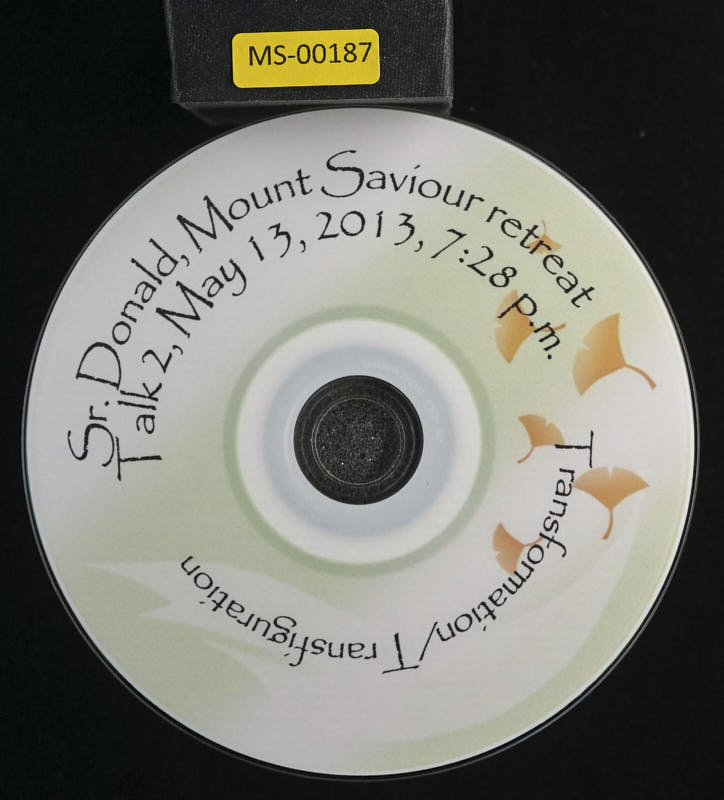
AI Vision - Possible Values from Photos:
Speaker: Sr. Donald
Location: Mount Saviour Monastery
Possible Title: Mount Saviour retreat Talk 2
Additional text: 7:28 p.m.
@AI-Vision_v002
There is a section of chapter 3 of Ephesians, which is a very powerful prayer for transformation, for the work of the Holy Spirit in us. And some scholars think it's actually a little bit of an early baptismal prayer from Christian tradition. That he may grant you according to the riches of his glory. to be strengthened powerfully through His Spirit in the inward man. Another translation, I think it's the Jerusalem Bible translation, says, may your hidden self grow strong. So the inward man, the hidden self, it's a theme which Father Andre Loof frequently refers to, to become the hidden person of heart. That's a passage from Pope Peter, I believe.
[01:02]
On the inner level, to become that giant that I talked about earlier today. In fact, Andre Loof's book on prayer is a wonderful book on prayer. I lived at the Catholic Worker from 1969 to 70, my first year of studying in New York City. And in November, I gave that book, Andre Loof's book on prayer. to Dorothy Day for her birthday, and she said it's the best book I've read on prayer in 30 years, which is quite a recommendation. So the hidden person of heart. I think monks in particular have that kind of hidden strength and hidden fullness of the Spirit. We read in the Acts of the Apostles, especially this time of year, it's obvious that something happened to the early Christians after Pentecost. They're referred to continually as the spirit-filled people.
[02:02]
Father Bruno Barnhart, the prior of the Commodities, retired prior now, of the Commodities at Big Sur, says that Pentecost in the early church was the Big Bang. It just sort of flew this energy outward across the globe. The Big Bang. So how do we become spirit-filled or spirit-bearers? That's a long tradition in the monastic tradition. Olivier Clément, no, Father Placide de Zay says that there's a very clear tradition in monasticism of being a spirit-filled person. How do we become spirit-filled or a spirit-bearer? Well, the spirit-filled person in the monastic tradition was always linked with the notion of the cross-bearer, the stavrephor, a nematic host.
[03:08]
You cannot be a nematic host unless you're a stavrephor, which means a cross-bearer, that identification with the crucified. Unless you take up your cross daily and follow me, you cannot be my disciple. Or Paul in Galatians, the old person in us must be crucified. And again, I'm not talking about the death to the ego, but perhaps the ego's relativization in terms of the transcendent mystery. To live the mystery of Christ, to be immersed in the Paschal mystery, is certainly to encounter suffering, death, death. resurrection, and then the release of the Spirit. And we don't talk about the release of the Spirit very much. But that's all part of the Paschal Mystery. Suffering, death, resurrection, and the release of the Spirit. Jesus is the one who runs before us.
[04:08]
He shows us the way. And so we too live the Paschal Mystery. To become a fountain of light and love, and healing energy, maybe even prophetic discernment. I think of Dorothy Day as a person who had that energy of prophetic discernment. She was a quiet, humble, sweet, gracious person, but when she really believed something such as injustice about injustice or war, whatever, she could be a lion. Fierce. God was with her and she would not be moved. so the Holy Spirit also creates that very vigorous sense of prophetic discernment the Holy Spirit creates wisdom and compassion and I'll be concentrating on that in the last conference I'll give this week so I said this morning all my studies of spirituality of all traditions basically underscore the fact that true spirituality is about transformation
[05:20]
It's St. Paul's distinction between the old person and the new person. Gerald May, the psychologist, has a wonderful way of putting it. The old person in us is rooted in willfulness. And when we are transformed in grace, we're transformed and become full of willingness. So the contrast between willfulness and willingness. It's a contrast between self-centeredness and generosity, narcissism and a true capacity to relate to others. It's deliverance from the bondage of anxiety to peace and so on. So you could go through a whole phenomenology of, you know, what kind of liberation the life of grace brings. But the Cistercians have a wonderful way of talking about this passage. from the old person to the new person.
[06:22]
And they draw on a theme that they drew from classical philosophy, especially William St. Thierry. He says, and it comes from Augustine also, we're lost and we must experience a homecoming. We're all prodigals like the prodigal son. And the image they use is an interesting one. I sometimes draw this on the board, so if you just imagine it. When we're lost, it's like an ellipse, a circle that's flattened, like a flat tire. And an ellipse, according to geometry, has two centers, ourself estranged from God. But when we return, when we experience the homecoming, then there's a circle with one dot of these centers. I used that in a talk in Dinghamton one time, and a gentleman came up to me and said that he does scouting. He teaches Boy Scouts. He teaches them trail signs and so forth.
[07:26]
And evidently, there's a sign that's sometimes used in scouting for if you're walking on a trail and you're lost, you carve on a tree an ellipse with two dots. That indicates lost, estranged. But if you're looking for a path or trail for the way home, you look for a circle with one dot, and that's the sign for home. So we're all lost, we're all like the prodigal son, and we must return to the father. You know, usually the translations say that the prodigal son, when he was, you know, lost and he even ended up eating corn husks with pigs and so forth, he came to his senses. But actually, the true translation is, and I think that was pointed to in the reading today, is that he came to himself. And I pointed to that in a talk I gave to some Methodists up in Denver one time. And I said, it really means he came to his own self.
[08:28]
And a lady who was in the group who was a classics teacher, whipped out her Latin and Greek Bible, looked up the Latin and says, yes, that's what the Latin says. Without the Greek, yes, that's what the Greek says. So, you know, that's a much deeper sense. He came to himself. He just didn't wake up and realize, boy, I'm in misery, I've got to go home. But he came to his true self. He was lost and he came home. And the Cistercians, in the Cistercian, you know, there's a whole school of Cistercian theology in the 12th century, which is... a flowering of the monastic tradition, right out of Patristics and Benedictine, and then a flowering in the Cistercian Fathers, which is a wonderful school. And Bernard, obviously, being the most important, but William of St. Tudori and Derek Vigny and some of the other Cistercians. They said it's the passage from the image of God to similitude to God, the passage from image to likeness.
[09:33]
that were transformed from glory to glory, 2 Corinthians 3.18. I read an article on the Western mystics recently, and the author said that 2 Corinthians 3.18 is the verse that many of the mystics point to to talk about their experience of transformation. To be, now where the Spirit of the Lord is, there is liberty. And we with unveiled faces, which means we take off that mask, you know, and find our true self, and we with unveiled faces reflect the glory of the Lord and are transformed from glory to glory. It's that ongoing process of transformation. It's what we live in our Vow Conversatio Morum. So Galatians 3 says, all that matters is newness of life, but how does that newness of life break out in us? How does the process of transformation happen?
[10:36]
Obviously in many ways, but I think usually it's a very incremental growth, very, very small changes. Someone said recently that monastic life works ex opere operato. that just living monastic life transforms you. And so that you see in older members and community the kind of transformation that can happen by ordinary faithfulness to monastic observance and the monastic way. But certainly that newness of life, the power of the spirit breaks through by loss and diminishment, by pain, suffering. There is a poem by Merton I thought I brought along, but I couldn't find it in my notes. It's an untitled poem, and I happen to know what happened in his life when he wrote this poem, because I had a friend writing another biography of Thomas Merton.
[11:40]
He never got it published, but he told me what was behind this poem. And the poem goes something like this, just the first two lines or so. One in the soul of a serene disciple, with no more fathers left. Poverty is a success. He's talking about his own poverty and his own awareness of his vulnerability and weakness and his failure. Poverty is a success. It's a beautiful poem. And it happened because of an event in his life. It wasn't the situation with the nurse, but it was another situation which he had just been totally... foolish and experienced shame and chagrin at himself. But he was ruthlessly honest about it. And he realized that in that very poverty, grace was working through his vulnerability and his weakness. That's where he really had discovered God working in his life.
[12:43]
That newness of life, the power of the Spirit, is revealed by coming again and again to our center. We don't have to be self-conscious about that, I think, you know. It doesn't necessarily mean pillow sitting, you know, half hour of the day. It can happen at liturgy if we're truly there and truly involved and reverent at liturgy. It happens through recollection, recollecting ourselves to sitting down before liturgy and and really centering ourself, instantio, and so forth. Saint Benedict, in the chapter on humility, talks about the presence of God and a sense of awe. And he said, if you don't have that, what it creates is non-oblivionum. Oblivionum is forgetfulness. But to have reverence and awe is to have a sense of presence.
[13:46]
I made a list of characteristics of Benedictine spirituality a number of years ago. I think there are 15 or 14 characteristics or elements of Benedictine spirituality. And the first one I put down was reverence, even though that's not a big theme in the rule. It's certainly chapter seven on humility and reverence and prayer is mentioned. But I think it's so fundamental to Benedictine life because it grows out of the liturgical spirit. To be a liturgical person is to be filled with a sense of awe and reverence. A wonderful older source on that is Dietrich Ralph Hildebrand's book, Liturgy and Personality. One of the chapters is on reverence. It's a beautiful chapter. Every person in formation should read and study that chapter. So suffering can open us and deepen us. It can relativize the ego, or it can make us bitter, self-enclosed, can make our spirits smaller and shrivel.
[14:55]
The Buddhists have a wonderful image that you have suffering like in a begging bowl in front of you. There are two things you can do with it. You can pour it up and let it go and be free of it. Or if you pour it back into yourself, it becomes toxic, poison. it makes for bitterness. For example, resentment. Resentment is a painful emotional experience, but if you pour it back into yourself, race and theory means to re-feel and re-feel and re-feel, and it's circular. It just keeps going on and on until you recognize it, until you're watchful and recognize it and say, I don't go there anymore. Just stop that tape working in me. But suffering can also widen us and humanize us and make us more compassionate towards other people's loss and suffering and so forth.
[15:56]
It could even bring a marvelous spiritual freedom and joy. I'd like to share a story about a monk I met, a Russian monk at Jordanville. You probably know that Jordanville is a very, very conservative reactionary, almost, Russian monastery up near Cooperstown, north of Cooperstown. Originally a white Russian monastery, so they were czarists, and they didn't even, they weren't very open even to other Orthodox. Well, I happened to be driving down from Albania, I thought I'd stop there. I had been there once before, I thought I'd stop for Vespers. I thought, you know, they have a reputation for not being very ecumenical, so I thought, I'll hide behind a pillar in the back, sort of quietly participating in Vespers. And so after Vespers was over, I thought, well, that went all right, I think I'll go over to the bookstore. So I went over to the bookstore, and I'll probably get thrown out.
[17:01]
I went over and started looking at some books on a shelf, and I saw a very old monk over by the cash register, And I'm looking over the top of the book, and he was coming towards me. He looked like he was 90 or more. And I thought, here I go. I'm going to be tossed right out of this place. And he got to me, and he had a huge smile on his face, and he said, something in Russian. I said, Father, I'm not Russian. And he says, I know. He says, how much is this book? It's a huge book of Isaac the Syrian book. great big thick book, you maybe know it, and it was a $45 book, and he says, oh, it's too much, I'll give it to you. And that was my experience of hospitality, you know, just bowled me over, you know, with how gracious he was. And I remember, you know, the smile and the welcome that I got and so forth, and a year later, somebody from, a friend from New York had sent a box of books, and on the top,
[18:07]
was a magazine called Orthodox Word. And I happened to open it up, and there was Father Vladimir's obituary. And it gave us background. He had joined the monastery in Russia, I guess. He had been captured by the Nazis as a young man. And during the duration of World War II, he did forced labor, digging bodies out of rubble in bomb cities in Germany. And so that's a kind of experience of suffering and, you know, human misery that he had experienced. And I think that that's what changed him and enlarged his heart. I also found out from someone who had lived at Jordanville that he was not very well appreciated by most of the community who were very rigid and critical of him and suffering. He was a free spirit. Now where the Spirit of the Lord is, there is freedom. And he had that Spirit of the Lord. The last line of his obituary said, and many miracles have already occurred at his grave.
[19:14]
I thought, wow. So the next time I got up in that area, I stopped and went to his grave. And I have no doubt that he was a very, very holy man. John 12 says, unless the grain of wheat falls into the earth and dies, it remains alone. But if it dies, it bears much fruit. And so allowing the grain of our life to fall into the earth, maybe bit by bit. Maybe it's a small death of giving up an ingrained attitude that we have or a judgmentalism that we have. Maybe it's diminishing health, but allowing the grain of the wheat to fall into the earth to die. And then it bears much fruit. The Paschal Mystery is about allowing the seed grain of our life to fall into the earth. That's what it means to be a stopper for it. I gave a retreat down at Butler, Pennsylvania, I think about seven years ago.
[20:17]
And you may know that Butler's Byzantine monastery was Benedictine. But they chose to leave the Benedictines. Well, they were advised to leave. because not many Benedictine communities felt they could guide them. So they went on to their Ruthenian bishop. So Father Leo asked me to come down and get their retreat, which was a wonderful experience, actually. And when he met me at the door, he had like an extra scapular over, and it was what the Eastern monks called the Great Shema. It was not like the Eastern... monks have, but is certain, like the Unigate Eastern Rite monks evidently wear. And it indicates this consciousness of becoming a spirit-bearer through being a cross-beader. Dorothy Dee says in one of her books, the disconcerting thing about offering God everything is He might take you up on it.
[21:27]
And that's the way I felt on my profession day. Here goes, you know. And I remember, you know, our profession was in the St. Paul Cathedral, Minneapolis-St. Paul Cathedral. And kneeling, I looked down, and right next to me was the grand seal of the Archdiocese of Minneapolis and St. Paul. And one of the symbols on the coat of arms of the diocese is some wavy lines that represents the Mississippi River, and I thought... Gee, for the rest of my life, I'll be living on the banks of the Mississippi River. Thought I had it all tied up. This is how it's going to be. I never thought I'd end up like a Susquehanna. So the disconcerting thing about offering God everything is that He might take you up on it. The rule of taste A says, that work of Christ in you demands infinite patience. It's a wonderful line, I think. That work of Christ in you. demands infinite patience.
[22:29]
Patience comes, as you know, from passion to suffer. And to endure, to remain faithful, is to be patient. And that is the work of Christ in us. The old person in us must be crucified. The gold must be refined and fired. Another image that's frequently used, and it's influenced by Jeremiah and also by passage in St. Paul, is that if the potter is shaping the clay of our lives, and William of St. Thierry says that when God shapes the clay of our lives, he uses three fingers with theological virtues of faith, hope, and charity. But we must keep the clay moist and, you know, capable of being molded. And then God exerts the pressures to mold us, but then we're put in a fire.
[23:30]
A pot finally has to be fired to bring out the color and the depth. The important thing is to remain supple. The Holy Spirit does the work of completion. You know, in the old days, high school, when I learned some theology, we were told the Father is responsible for creation, the Son for redemption, and the Holy Spirit for sanctification. That kind of thing is out. You know, all the persons of the Trinity are involved. But I think in a special way, the Holy Spirit is what's responsible for the completion, the completion of God's work in us, which has never ended, as I said this morning. because of even in heaven, and Gregory Mrs. says, there's going to be ongoing transformation, the effectuses. All creation grows and our hearts grow too. And so the Holy Spirit is what's yeasting the growth in creation and in us, nudging us towards further depth and inwardness and completion and so on.
[24:46]
Give us, O Lord, a generous and willing heart. Complete your work in us. Make us spirit-filled persons. May we drink as a fountain of living water. May our lives awaken, refresh, and heal others. A Benedictine sister from Virginia had this poem in Benedictine's magazine last year, Conversatio. Tindle my heart, O God, as you will. Reform, refashion, restore, renew. Recreate it all, my Lord. I am not afraid. Just grant me, as you work, one gift, a gracious faith, steady, sure, and true, that dares in darkness to dance. to dance is to have that joy, that deep spiritual joy, which Abbot Marmion said is the unmistakable sign of God's life in us, to have that kind of deep joy.
[25:56]
Praise be Jesus Christ. The paper is here with the slots to sign up for conferences with me if you're interested.
[26:17]
@Transcribed_UNK
@Text_v005
@Score_94.24