You are currently logged-out. You can log-in or create an account to save favorites and more. more info
Incarnate Love: Bernard's Theological Devotion
AI Suggested Keywords:
Talks at Mt. Saviour
The talk concludes a series of lectures by exploring St. Bernard's devotion to the humanity of Christ, emphasizing how his approach was deeply theological rather than purely sentimental. St. Bernard's teachings are distinguished from later, more popularized devotions which became sentimental and detached from theological depth, particularly notable in the Renaissance. The central theme revolves around the significance of the Incarnation, with St. Bernard emphasizing the presence of God in the flesh as a means to draw humans to divine love. The talk also touches upon the medieval method of meditation, advocating a focused contemplation on Christ's humanity which influenced later spiritual practices.
Referenced Texts and Figures:
-
St. Bernard of Clairvaux, Sermons on the Song of Songs: St. Bernard emphasizes the love attracted to the humanity of Christ, specifically in Sermon 20, highlighting the theological strength beneath the perceived sentimentality.
-
St. Bernard's Christmas Sermon: A dramatic exposition on the Incarnation, revealing the presence of God in the flesh as the sign for humanity.
-
St. Bernard's Influence on Devotion: Noted for his theologically rich devotion to the humanity of Christ, contrasting with later superficial devotions.
-
"The Imitation of Christ" by Thomas à Kempis: Explores how imitation of Christ has been popularized, contrasting Bernard's theological base with more superficial imitations.
-
St. Ignatius of Loyola's Spiritual Exercises: Mention of how these exercises are indirectly influenced by earlier medieval meditation techniques, reflecting contemplative practices initiated by Bernard.
-
John 6:63, 2 Corinthians 5:16, Lamentations 4:20: Scriptural references highlighting the transition from flesh to spirit in understanding Christ, emphasizing spiritual growth beyond sensory perception.
-
Dionysius the Areopagite: Influence on Bernard's mystical theology.
-
Henri de Lubac: Referenced for discussing typology in theological transitions from Old Testament shadows to New Testament realities.
-
"The Mystical Theology of John Chrysostom" by Swami Oman: This work explores allegorical methods in spiritual interpretation, potentially used by Bernard.
-
"Christus Amabilis" – Cistercian Monk Article: Discusses how Christ, being both human and divine, is approachable to humanity.
The summary and references provided highlight the central teachings of the talk, focusing on St. Bernard’s integration of theological richness within his devotion to Christ’s humanity, and how it differentiates from later movements, providing a historical context for the evolution of Christian spirituality.
AI Suggested Title: Incarnate Love: Bernard's Theological Devotion

AI Vision - Possible Values from Photos:
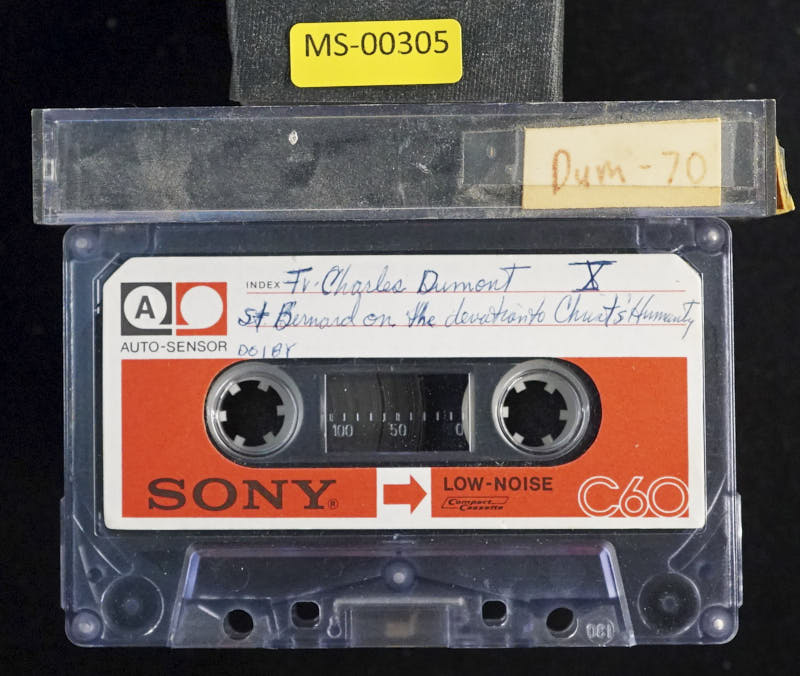
Speaker: Fr. Charles Dumont
Possible Title: St Bernard on the Devotion to Christs Humanity
Additional text: X
@AI-Vision_v002
I would like to end this series of lectures by trying to shortly develop some reflection on the devotion of St. Bernard to the humanity of Christ and of his school. It is well known that St. Bernard started something... not invented, because origin already and devotion to Jesus and to his humanity and all the scene of the Gospel, but what St. Bernard had it was the human touch of his time, this affective, lyrical, somehow, poetical, imaginative expression of this devotion to Christ, to his humanity.
[01:07]
For Saint Bernard, when you read carefully the text, Saint Bernard has a devotion to the humanity of Christ, which was very theological. Later on, after... St. Francis of Assisi, who are still very theological, but after that, the Franciscans vulgarized, popularized this devotion, and therefore everything which is popularized loses somehow its deep theological, doctrinal strength and purity. So you have this devotion of Christ, which becomes very much... sentimental in the following centuries to reach its complete humanitarian and almost pagan aspect in the Renaissance. In the Renaissance, the old lady with the child is only a mother with a baby, very moving, but having very little to do with theology.
[02:25]
or even Christ on the cross is men suffering, and in a very expressive way, men tortured on the cross, but no more. This theological aspect, which is very strong, very clear in St. Bernard, all the devotion to Christ is directed to God, to the Word, in Christ, not beyond, not beside, but in the humanity of Christ, after all, that is the mystery, the central mystery of our religion, that God is man, that God has been made man. And perhaps all the goal about spiritual life is to render present Here, now, in me, among us, Christ, God, a substance, a spiritual substance, which is not an idea.
[03:36]
We always think that spiritual means rational or abstraction. It's not an abstraction. It's a reality. It's a presence of an intelligent and loving being. So for St. Bernard, He looked at incarnation that way. God wanted to be present. God wanted to be real to the human flesh, to the human mind, as we saw in the very beginning, who is not able to love anything but what is visible, tangible, and in the flesh. because he has a heart of flesh, and he doesn't understand, at the beginning, only what is flesh. And that is the intention. And there is a quite clear text of Saint Bernard, perhaps the most clear text of his...
[04:48]
St. Bernard is not very dogmatic but from time to time he is clear and very precise and in the sermon the 20th sermon of the canticle he says this notice that the love of the heart is in a certain sense carnal because our hearts are attracted most towards the the humanity of Christ and the things he did or commanded while in the flesh. The heart that is filled with this love is quickly touched by every word on this subject. Nothing is as pleasant to listen to and so on. The soul at prayer should have before it a sacred image of God's man. Now, this sacra imago hominis Dei is the crucifix.
[05:57]
imagined or present as the real crucifix. It is Father Callistos where, when he was here and speaking with him, who meant very well having lunch there on the grass with him, and Father Callistos told me that the beginning of the devotion to the crucifix starts in Constantinople in Byzance, which I didn't know Orthodox sometimes accuse Catholics to have a sentimental devotion to the crucifix. Now, it started in Constantinople, according to Father Callistos, and was brought to the West by the crusaders and immediately spread by the Cistercians. It's very interesting. I should have written a paper for the Symposium of Oxford on that, but unfortunately... my limitation prevent me to do it.
[07:02]
But it's very interesting to see that how much Cistercians were attracted by this way of presenting the mystery of incarnation. So also, Elrath, when he writes to his sister, says, you may have recluse, you may have in your oratory, oratory, only one image, that's the image of Christ on the cross, or the image of the truth on the cross. And don't have any birds and all these angels and things, pictures of all animals who will distract you. Very imaginative, but without the help of all images. He has also a very beautiful development of meditation on the linen. You see, if you want to make meditation, well, meditate on the linen, the tablecloth which is on your altar.
[08:07]
And then he describes all the fabrication of linen from the very beginning, giving an allegorical interpretation. of this fabrication of linen from the time it was on the field until it is on the altar as the life of a Christian, everything which happened. So this crucifix is certainly important. Now, when you see the devotion of St. Bernard, St. Bernard in the history is reputed for having this very sentimental relationship affection for Christ. All the miracles, so many miracles, Lactatio, or the famous thing when about Mary, the same thing, about the devotion to Mary, the same thing. Very sentimental or very affective. Saint Bernard saying Ave Maria and her lady answering Ave Bernardi or something like that.
[09:16]
So, legends, legends of the 13th and 14th century that. In an exhibition of manuscripts we had in Dijon in 1953, all the manuscripts of 12th century, 13th, 14th century about Bernard's work were exhibited, and we could see the progress of all this legendary aspect of St. Bernard's work. It's very typical, and Don Leclerc pointed out very cleverly, that there is only one miniature of the 12th century referring to this devotion to Mary, and it's not very... It's just the opposite. There's a miniature of the Canon of Lyon kneeling before St... No, in front of St. Bernard and showing the finger, because, you know... St. Bernard refused the feast of the Immaculate Conception.
[10:22]
He refused to accept the feast of the Immaculate Conception. And so the Canon of Lyon was started to have this feast celebrated in their liturgy. They were very upset because St. Bernard refused. And so the Canon of Lyon was upset and showed a finger to St. Bernard. That's the only miniature of the time. So St. Bernard was not so much on this line of external sentimental devotion, which is not reputation later on. But he started something. But It was very, very much theological. Martin Bernhardt was looking at the crib, the child in the crib, or Jesus on the cross. He was very moved, but because it was God. And there is a famous beautiful sermon, Second Sermon for Christmas, where in a very almost theatrical way, dramatic,
[11:27]
He says, we are waiting for a sign. A sign. What is this sign? What is this sign, you see? I will give you a sign. God said, the angel said to the shepherd, I will give you a sign, shepherd. And what is this sign? Then he quotes all the Old Testament, the sign and the sign. We are looking for a sign. What is this sign? And then finally, after this suspense, he said, there is a sign. The baby in the crib. And then... Immediately after that, he quotes St. Paul, the mystery hidden from all eternity. It's the theological value of the world revealed present. Now, the doctrine is this. I think this is the principal reason why the invisible God willed to be seen in the flesh. And he says that he knows very well that the theological discussion about the principal reason for the incarnation, it's been going on for a long time. Why did God came?
[12:29]
Is it for redeeming the sin or to appease the wrath of his father and so on? I think this is the principal reason why the invisible God will to be seen in the flesh and to converse with man as a man. He wanted to recapture the affections of carnal men who were unable to live in any other way. by first drawing them to the salutary love of his own humanity, and then gradually to raise them to a spiritual love. It's very clear. So you see, and again, we should and we could easily situate this devotion to the humanity in all what you have said. First of all, it's to attract the affection, love.
[13:32]
It's always that which God tries to touch in us. It's our dynamic power of love. And also as an image. It is an image. And therefore, he comes to reveal at the same time what God is and what man is. since man is at the image of God. So in himself, he's a mediator. Mediator, drawing close God and man. And that's the whole goal of spiritual life, of revelation, of the church, to draw God and man close, and the closest possible. to so that God become really intimate, familiar, and live in our very daily life and in the inner center of our being.
[14:41]
The affectus of love, this dynamic of this Dynamics of our spiritual being, this desire or restlessness of the soul will find its fulfillment in the perfect likeness with the word. And this union of his will with the will of God, his charity, his division, as we have seen, is finally the goal of all the redemption and incarnation. So it is by conformity of charity or conformity that the soul is read it to the word when, namely, loving even as she is loved, she exhibits herself in her will conform to him to whom she is already conforming on nature. So this text, but it's the same, we could say it's the same process than the process we saw yesterday about friendship,
[15:49]
is an experience of complete agreement of two wills. And this expression or this experience is the experience of love, of friendship. And with Christ, it is almost the same thing. Christ comes as a friend. And the conformity is, after all, the basis, the theological basis of the imitation of Christ. There again, imitation of Christ has been popularized by Thomas Aquentis and by Devocio Moderna and became sometimes something very external, very artificial to imitate Christ. But to imitate Christ is precisely to become or to unite, join your will to his will. to do the will of the Father, but to do it with and as Christ.
[16:52]
That is the imitation. Imitation is not a copy. You don't copy something. But if you love somebody, you're going to imitate it. You find sometimes in community people walking and talking just the same. You don't know who is imitating whom, but it's very, very clear. Sometimes the whole community imitates somebody, which is usually the ambass. But it's an imitation which is out of devotion, out of love. It's not a copy. You don't imitate somebody because that would be a mockery. Purely external. It's a play or a show, acting. A real imitation is... unconscious. And if we really live with Christ, contemplate him as he was living in his earthly life, and also as he inspires us by his spirit, we shall become like him.
[18:04]
It's a sort of deep imitation because we are like him by nature. And then you have the beautiful passage of Sermon 83, mania res amor. A great thing is love, if yet it returns to its principle, if it is restored to its origin, if it finds its way back again to its fountainhead, so that it may be thus unable to continue flowing with an unfailing current. Always going back. And that's what Christ, is to return us to the principle of love. St. Bernard then say that this devotion to the humanity of Christ, now, to the humanity of Christ itself, is a gift of the Spirit.
[19:05]
A great gift, he says. I have called kernel this love with comparison to that other love which does not He doesn't see the Word as flesh so much as the Word as wisdom, justice, truth, and so on. But it's a gift. And it's a gift of the Spirit that you can reach God in the flesh, in the humanity of Christ, because of the union to nature. So you can, if you remain there, you are in contact with God. But the whole... Progress is precisely to be led by this humanity to the world, to the spiritual union with the spirit, with this spiritual substance of God, spiritual reality of God, which is revealed in the flesh.
[20:10]
And all the spiritual life is then organized on that. All the liturgy is that, reading of the Bible, meditation. The Cistercians started this meditation, which has been also very much organized and popularized, and finally came to something very ridiculous, with the French devotion, or the Devotion Moderna, with the Methodic meditation, one, two, three, conclusion, one, two, three, bouquet spiritual and whatnot, you see, affections. I heard that some community in the beginning of this century, there was still meditation in choir for a quarter of an hour, and the abbess, or the abut, every five minutes was... So it makes point, you see. LAUGHTER That's just ridiculing things.
[21:18]
But St. Bernard started the method of meditation precisely because the Western mind is a very imaginative mind. We should not forget that. St. Teresa of Afila, for instance, this fantastic imagination. Needs symbols, images, affection of all kinds. Emotions even. You have to use all that. You have to make use of that. You are not the Japanese brain, you have a Western brain. It's important to remember that. So try to control this movement, this continual cinema in your head. Try to control it, to lead it. And to lead that, focus it. to something you can imagine, and that is the humanity of Christ.
[22:20]
There's a beautiful, one of the best, St. Bernard gave the doctrine, and one of the best example, application of that, is to be found in St. Elret, later to his sister, the recluse. In the introduction of the text, when I published it in the Sous Chrétien, I think I proved that This example, or this method of meditating, ensures indirectly, or almost directly, St. Ignatius in these exercises. In the second read of exercises of St. Ignatius, you'll find that, try to compose the place, be present, and all that, the application of the senses. look to Christ, hear the voice, and so on. Well, you'll find that in St. Lawrence in the 12th century. Developed very, very, and a bit more humanly there than it's by St.
[23:21]
Ignatius. St. Ignatius got it from the Cartusian there, Rudolf the Cartusian, who in his Life of Christ, anytime when he finds In St. Elred, the description of one of the evangelical scenes, Ludovic Cartugian just copied it. So you have, in the life of Christ, this meditation of Elred Obrevo copied literally. And St. Antignatius used that when he was in Manres, when he was preparing his retreat. spiritual exercises. So, this has a great influence on the history of spirituality. But you have to see it in the sources, which is very beautiful and very moving sometimes. He said to his sister, and it's very typical, he was asked by his sister to write a rule.
[24:27]
Cistercians were not very much made to make rules or to make constitutions. That's probably where there are no constitutions yet, so we are not very capable of doing that. But St. Bernard was also asked to make a rule for the Templars, the Knights of the Templars. Then, while he tried to do something about this rule, he said you should be clothed properly, you should have your hair cut and so on. And then he went quickly on the meditation process, But you should specially meditate and you will be in Jerusalem. Remember Christ and the way of the cross and so on. And he gave one of the first way of the cross. Follow Christ, follow the steps of Christ. And St. Eric, when he also was asked to make a rule for the recluse, he tried something. Then he went to switch on quickly on a meditation. What is more important, he says, I'll give you an example of a meditation.
[25:28]
And then he described Slowly and methodically, perhaps more methodically than St. Bernard, various scenes of the gospel. It's always the same thing. Be there with Mary when she will receive the angel. Be there in a corner, corner of the house. Listen and be prepared. And then when Christ is with the adulteress or during his passion, just be there next to him. Look at him, hear the voice, and what he says to Mary Magdalene, it's to you. Or even during the Last Supper, be there in a little corner, just behind St. John, and listen to what he says. It's very beautiful. The most dramatic scene is when Christ and Mary Magdalene meet after the resurrection. It's absolutely beautiful.
[26:29]
It's very moving. It's an exchange of Mary, Rabbi, Rabbi, and so on. It's splendid. The emotion, which can be used and should be used in order to render Christ present and eventually to be led by this devotion to the world. Now, there are some key... a quotation from the Bible which indicates this movement of trying to transcend the vision or imagination of Christ and to go to the world in Christ. And I'll just give three things which if you read... in the Cistercian text, be aware of the meaning of this quotation.
[27:35]
It's John 6, 63. The flesh is of no avail. It is the spirit that gives life. And then another quotation is 2 Corinthians, chapter 5. Even though we once regarded Christ from a human point of view, we regard him then no longer. Or then the most, even most quoted, This Lamentation, Jeremiah 4, chapter 4, 20, which is, of course, completely different in the original text, but anyway, on the Vulgate, it is very expressive. Christus Dominus Ante Facium Nostran. Christ the Lord is a spirit before our faith. Under his shadow shall we live among the Gentiles. You know, the two elements there. Christ is a spirit, but we live under the shadow. And this shadow is a shadow of faith.
[28:37]
God wanted to be approachable, visible, amabilis, Christus amabilis, a beautiful article by a Cistercian monk, Christus amabilis. He could be loved by a man in a human way. But it's God who has wanted that. St. Bernard commented very well the gospel we had yesterday at Mass. See, the veneers in the veneers. The last thing God wanted to, he sent his son because perhaps they will love him because he's my son. That's the idea. Spirit has become flesh, light, shadow, and the spirit is under the shadow. If you like to read a text, only one short text, it's page 27.
[29:48]
Chip is the famous, beautiful, Sermon 31 on the Canticle, where St. Leonard gives various ways of knowing God. But then, he comes to this point, and you have quotation there, page 26, paragraph 8. In all his manifestation, he is kind and gentle and of tender mercy. For as in his embrace, he shows himself loving and tender, so the oil and perfumes and other remedies of which he makes use, and so on. Then on the road, see, that's origin expression. Everything is for origin, or the way Christ appears as a different spiritual meaning.
[30:52]
See? Christ is nearer or more intimate in the way he approaches the allegory of origin. There's a book written on that by Bertrand, Mystique de Jésus sur Régène, in Collection Théologie, number 32, if you want, but it's only Bernard, borrow it from origin. It is thus that you will find the world shadowed under a all through this song of song. It is that, I think, which is signified by the prophet when he says, Christ the Lord is a spirit before our face, under his shadow shall we live among the Gentiles. Which, however, we see now only in a glass and darkly, and yet not yet face to face, but that we endures only while we live among the nation. For when we are among the angels, it shall be otherwise,
[31:54]
then we shall enjoy a felicity similar to theirs, then we shall see him no longer in types and shadows, but as he is, that is, in the form of God. And then he says here, and it's de Lubac, certainly, I don't know if he exploited this text, but de Lubac shows that very well, that the same typology or allegory, which is from the Old Testament to the New, the same is for us in the New to the eschatology. So we are not the fullness. The Old Dispensation had not the fullness of Christ, but then the fullness of Christ came, and yet it's not the fullness. Again, we are waiting for another fulfillment. For Joseph, they were only typed in shadow to make him known to those of the Elder Dispensation, as they have said, but to us through the grace of Christ present among us in the flesh.
[32:58]
The truth shines forth by its own light. So also, it cannot be denied that we ourselves, in comparison with the life to come, live now in, as it were, the shadow of truth. That's the doctrine we said yesterday when I said that even the Eucharist is not the full presence. We are still in the shadow. And then paragraph 9. And if faith be a shadow, yet it is good, for it tempers the light to a weak and dark not eyes, and prepares them for its brilliance, for it is written, purifying their heart by faith. Faith then does not extinguish the light, but preserves it. Whatever that be, and however great, which is open to the vision of an angel, the shadow of faith preserves for me, wraps it, as it were, in an ample and trusty bosom, to be revealed to me in due time.
[34:05]
Is it not better for you to possess, though in a shrouded and hidden state, that which is uncovered, if uncovered and bare, you would not be capable of grasping? Even the mother of the blood, and then you have a succession of allegory there. Even the mother of the blood, the shadow, you see. When he started Umbra, he remembers all the Umbra of the liturgy. Yes, in the Bible. Even the mother of the Lord lived in the shadow of faith, for of her it was said, blessed is she believed. She lived also in the shadow, cast by the body of Christ. According to the words of the angel, the power of the highest shall overshadow thee. Christ in her, or Christ next to her, in her life. Now, is this a shadow to be lightly thought of, which is cast by the power of the highest?
[35:09]
There was assuredly power in the flesh of Christ, which overshadowed the Virgin. You see? That's the sacrament. the power of the flesh of Christ. And that which was impossible to a mortal woman to sustain the presence of the unapproachable light of the divine majesty, she was unable to endure by the sheltering shadow or envelope of that vivifying body. This is the doctrine of the incarnation or the humanity of Christ. So this carnalis amor, which is again a carnalis amor, you see, it's flesh understanding flesh, heart of flesh and understanding the gift of God coming near to him as a friend, approachable, desirable, understandable in his words, in his presence.
[36:22]
And it is of food, our apprenticeship of love during our pilgrimage, during the interim. It must be, even in its superior form, completely absorbed by the spiritual love because God is spirit. And as you remember, St. Helrette said that our memory is restored by the scripture, meaning that the memory of God is restored by by the meditation, the attention, this loving contemplation of the humanity of Christ. And all the liturgy has a pedagogic role, like the incarnation itself and the church. It's a pedagogic role, you see. We have been taught, we learn how to come together continuously and in our life, continuously closer and more deeply affected by the presence of our Lord.
[37:32]
And he speaks of the liturgy as re-cita-re-tour. So they're re-quoted. The words are quoted again, but render actual presence. an even better expression, the mystery is re-presented. It's a representation. The representation in the ethelomagical world is rendered present again. By the power of the spirit on the altar, the mystery of the cross is present. It's a representation in that sense. You can remember all the representation they had on the altar from the cathedral, they are all mysteries. It's the same idea, to render present for the people this mystery in a very human theatrical world. But it's the idea to touch our imagination and our emotion, even our emotions, in order to bring our attention and our deep concern and contemplation on the world.
[38:45]
on Christ, God in him. This is the doctrine. So I just will conclude. The image of God in Christ is, after all, what unites us. I've been living with you for a short time. short time, a short relation, as Riker would say, but it's not a short relationship. Because, as St. Exupery says, friendship, or love, is not to look in one another's eyes, but to look together in the same direction. Well, this can be applied to our life, or Christian life, or monastic life. And if you look in the eyes of one another, it's to discover Christ.
[39:48]
And we look together to Christ. And that is what really unites us. In the Russian icons, very often when Christ was represented as God, and also very human, and very often the text of the Gospel was written... who sees me, Philip sees the Father. See Christ, see the humanity of Christ, you see the Father, you see God. So we are suddenly all of us united by this contemplation of the beauty of Christ which attracts our hearts and unites them in one love. Because, just to quote a modern author, Canon or Monsignor Nédancel, Nédancel, the philosopher, existentialist philosopher of Strasbourg.
[40:55]
I find this text very relevant and very important to understand what we are, how we are united. because psychology, sociology can do a lot to help us to communicate, to be related, to be united, to live together, to adjust to one another, but still there is more in the Christian community. The we, the we so much exploited by the existentialists, the we of the mystical body transcends what can be commonly observed and is accessible only by faith. There is a force of spiritual renewal in the church which comes from Christ and his spirit and is sacramental. It renders the communal soul active and it is something ontologically higher than our psychological awareness of our social relationships.
[42:06]
I had it in this article where I quote it, this should reassure those who dream of an impossible transparency. We cannot be transparent. We can try to be as much natural as we can and reveal the imprint of God in us, but we can, this is a limitation, human limitation, but this mystical body, this grace of Christ, does more than we can do, and that's the grace of what St. Bernard speaks, the social, social is gracia, grace of the social life, and that transcends time and space, and that gives us confidence that we remain united. It's very much talked today of our Domonasticus, by Father. But I don't know if we want another superstructure organization.
[43:19]
We don't know that. As soon as you make superstructure, you make laws. And laws usually limit things. So better be united in all the monasticists. I must say that the week I spend with you makes it very real for me that we are certainly transcending the limitation of Cistercian or Benedictine, that we are part of the same ordo monasticus, which is chiefly a life of the soul and a spirit. Thank you very much.
[43:53]
@Transcribed_UNK
@Text_v005
@Score_93.77