You are currently logged-out. You can log-in or create an account to save favorites and more. more info
Humility's Path to Spiritual Truth
Talks at Mt. Saviour
The talk focuses on Saint Bernard's "Steps of Humility" from 1125, exploring its significance in Benedictine spirituality and particularly highlighting Chapter 7 on the steps of humility. This chapter is used to discuss the relationship between humility and truth in spiritual theology, emphasizing the process of self-reflection leading to intuitive knowledge. It also compares this progression of understanding with teachings found in the works of Teilhard de Chardin and Kierkegaard, exploring how these ideas contribute to a deeper comprehension of truth in oneself and others.
Key References:
- Saint Bernard of Clairvaux's "Steps of Humility": Essential text attributed to Saint Bernard, illustrating the path to spiritual truth through humility.
- Teilhard de Chardin: Mentioned for having a potentially similar systematic approach to understanding reality, though not directly influenced by medieval philosophy.
- Kierkegaard: Prominent existential philosopher, noted for critiquing monastic life while acknowledging its deep spiritual commitment and its role in comprehending deep personal truths, specifically referencing "Fear and Trembling."
- "Collected Works" (Collectanea): An article involving theological debate around the humanity and divinity of Christ, revealing tensions in contemporary theological discourse.
Referenced Philosophical Concepts:
- Adequatio Rei Intellectus: Scholastic idea of logical truth, contrasted with spiritual truth.
- Jungian Psychology: Referenced in relation to the concept of the persona and true self, comparable to traditional spiritual wisdom.
- Greek Philosophy Influence: Saint Bernard's teachings likened to Socratic principles, emphasizing self-knowledge as foundational to wisdom.
AI Suggested Title: Humility's Path to Spiritual Truth


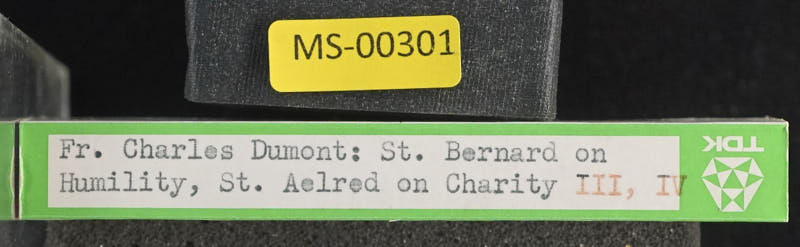
AI Vision - Possible Values from Photos:
Side: A
Speaker: Fr. Charles Dumont
Possible Title: St. Bernard on Humility, St. Aelred on Charity
Additional text: 75.2, Japan, Compact Cassette, D C90 TDK, Dum-70
Side: B
Speaker: Fr. Charles Dumont
Possible Title: St. Alred on Charity
Additional text: III, IV, Japan, Compact Cassette, D C90 TDK, Dum-70
@AI-Vision_v002
We shall tonight read some text of the Steps of Humility, the second treatise St. Bernard wrote in 1125, which is perhaps more characteristic of his doctrine, where he personally describes the main line of his spiritual theology. St. Bernard has any Benedictine abbot to comment the rule of Saint Benedict, which is the summary of all Western monasticism. And in this rule, especially the chapter 7, on the steps, degrees of humility, which is certainly also the core of all the traditional spirituality. of the West and the East, of course, but it's a joint military commission meeting with the Viet Cong, the center of the rule there, certainly is the best expression of the progress of a monastic soul toward God.
[01:22]
So with... Start in chapter 3, page 9. I have shown so far as I could to what end the steps of humility should be ascended. I will show so far as I can in what order they lead to the promised prize of truth. Since the knowledge of truth consists itself of three steps, again three steps, It's not artificial, but it's also natural. If you like to speak of structure or structure of the mind, there is certainly a structure of the mind which normally these three steps are naturally a note of thinking about the whole reality. I found them in Thea de Chardin. the same system. Actually, I certainly never read the medieval philosopher.
[02:27]
I will briefly distinguish them, if I can, that I may disappear more clearly to which of the tree of truth the twelfth of humility leads. Very often, St. Bernard announced things like that, and he just forget about it completely afterwards. Anyway, the twelfth degree of of humility is the first degree of truth. But he forgets to develop that later on. For we see truth in ourself, judging ourself in our neighbors, sympathizing with their health, and in its own nature, contemplating with pure heart. It is important perhaps to point out from the very start that the truth in question here is not the logical truth. Logical truth, according to the scholastic, that you are exact.
[03:38]
You don't make any fault in your statement. You say truth in that way, that it's a logical truth. You have not made any fault in your reasoning. It's not the ethical truth, moral truth. I mean, it's not a question of saying the truth to be sincere or to lie. It's not a question of that. It's much deeper than that and much wider. It's almost metaphysical truth, truth in itself. Of course, in also a biblical sense, what is real, what is really solid, which is not vanity in the sense of the Bible, not vanishing illusory or mendax in the sense of the Bible. because you cannot build upon it, because it's vanishing.
[04:46]
And so the process is a reflection, means say ante say, to have oneself before oneself, and it goes from the individual to the universal, and it's a question of intuitive knowledge, because by which we shall reach the knowledge of truth in itself as an intuition. The three degrees are a progress of the soul, and that is what is interesting about this method, this treatise. Now, this first page, St. Bernard will go backward and say that if you want to see the truth in itself... God, you are first of all to seek it in your neighbors, and in order to seek it in your neighbors, you need to seek it first in yourself. And it takes an example of which is traditionally the way in the Bible, where he says, well, in the list of Beatitudes, which he distinguished in his sermon, the
[06:04]
He plays the merciful before the pure in heart, merciful quickly grasps truth in their neighbor, extending their own feeling to them and conforming themselves to them through love, so that they feel their joys or troubles as they hold. They are weak with the weak, and they burn with the offended. After the spiritual vision has been purified by this bodily love, They enjoy the completion of truth in its own nature. Then be of the seal for love of it. See, it's a purification. Sharing in bodily love is a purification of the vision. It's very important that everything is there. The second step, which is asectic spiritual purification, catharsis. Who are now in prison. But those who do not unite themselves with their brethren in this way, but on the contrary either revile those who weep or dispass those who do rejoice, not feeling in themselves that which is in others, because they are not similarly affected, or can they grasp truth in their neighbors?
[07:22]
For the popular proverb will apply to them, the healthy do not know how to seek fear. No, no. not the sick, not the fool or the angry suffer. The sick sympathize with sick and angry with hungry. The more closely, the more they are alike. It's knowledge by similarity. The same seeks the truth, the same the like understands the like, which is a great principle, very important, and everything is based on that. including the doctrine on the image, which we'll develop later on. But in order to have a miserable heart, I've been told several times that this miserable heart is a very miserable translation. But I'd better say merciful, misericord, misericord, misericord.
[08:26]
merciful heart, poor understanding heart, compassionate heart. So a compassionate heart, because, you know, to have a compassionate heart because of another misery, you must first know your heart, so that you may find your neighbor's mind in your own and know from yourself how to help you. Everything is there now. Again, in order to understand... truth in itself, you understand it in your neighbor. And in order to understand it in your neighbor, obviously you have to understand it in yourself. It's impossible to know. And you see very well here that it's not an intellectual knowledge. You can imagine or understand intellectually what it is in another mind, even in another heart. But you cannot You understand it by experience. And that is real knowledge.
[09:30]
Because the main thing which are reaffecting people, as you say here, to feel sick, to feel angry, it's absolutely necessary that you have your self-experience. Otherwise, you don't know what it is. You have often headaches, and if my habit or something, somebody would want to... console me. I just ask him if he knows what an egg is. If he doesn't, well... So you have to know yourself first what you are in order to begin to understand another in order to help him. And then St. Bernard starts here, a very long excuse, as he used to make long excuses. And you have to know, by the example of Saviour, who will dispassion in order to learn compassion, his misery to learn commiseration.
[10:44]
For just as it is written of him, yet learn the obedience by the thing which he suffered... So also, he learned mercy in the same way. Not that he did not know how to be merciful before. He includes mercies from everlasting to everlasting. He knew it by nature, from eternity, but learned it in time by experience. In today's report, a new explanation... And then five paragraphs will develop this knowledge of Christ through experience. It's very difficult. It's all a mystery of incarnation, the two natures in Christ. And it's very difficult to know what means he knew by nature, and he learned the experience. Anyway, we
[11:46]
certainly have to believe that there is a human experience which was necessary for salvation, and that it was absolutely true. When a cancer virus enters a cell, very vague ideas of the humanity of Christ. Either we don't believe, of course, in the divinity, which is sometimes today, some people are completely forget about the divinity. But sometimes, most Christians and most biased Christians don't believe really in the full humanity, fully in the humanity of Christ. Vaguely, they are all apollinarists. I think that The Word is the soul of Christ. That Christ does not complete humanity.
[12:48]
So, recently or two years ago, there was a symposium in Oval, something a bit similar to the symposium of the Savior on prayer. There are not enough antibodies, and the body itself... And there was just with Pietro Fontaine, who is one of the best commentators of Gabriel Marcel. He wrote two big books on Gabriel Marcel, even so good that Gabriel Marcel wrote him a letter after that, and he said, at last you understand what I meant. LAUGHTER He's a good philosopher. He's professor in Namur, faculty of philosophy in Namur. And it's a long time now, several years, I know, his idea that he thinks that
[13:50]
He has a theological opinion, which is free, I believe, not completely free, but anyway, he thinks that it is free. He says that Christ renounced to enjoy the beatific vision during his life. Because he says it's very difficult to understand that Christ would be fully manned if he had only, he was all the time enjoying the beatific vision. back in the old time, what was coming, what was happening. It's very difficult to understand the human reaction. It's temptation to understand, so surprise is surprise sometimes. But he asked me if he cannot accept that Christ made mistakes. He said, maybe not. Just like men accept sin. Mistake is not a sin. But it's very difficult to deal.
[14:51]
If you speak of that, if you propose such an opinion, very quickly people think that you don't believe in the infinity of Christ. It's not the same question at all. Christ is more God, he is more man. Mystery is, it's only God who is capable of this mystery. So the more is man, then the more is good. This article has been published in the Collectania. And I can say that I regret it, but I had a lot of trouble with this article. The Abogener wrote me a very stiff letter, consulted all the theology in Rome. went from community to community, be careful of this article, be dangerous. The effect that no article of the review has been so much rave.
[15:53]
Anyway, you can see it's been condemned. Yes. No. No, no. So this is very close, the problem we have. The theologian will say that, especially in the Garden of Gethsemane, Christ is definitely there. We are not enjoying the earthly vision when he was in such a crisis. And then, why not, if for half an hour, why not just this lifetime? So it's still very, it's a terrible problem, but it's on this problem there where somebody is here. If you learn the experience, you must have had the full human experience, and in order to have an experience which is fully human, you cannot have been helped, except by the means men have grace, faith, and hope, charity.
[16:59]
So that's it. Now, let us return to our thesis and then ask these long excuses. Very, very often a piece there. But now, and if he made himself wretched, who was not wretched before, in order to learn what he already knew, how much more should you? I do not say make yourself what you are not, but observe what you are. that you are wretched indeed, and so learn to be merciful, a thing you cannot know in any other way. You cannot be merciful in any other way than by knowing yourselves very deeply. So, paragraph 14, let us see how well the disciple of truth followed the master of the beatitude, which is referred to and both, Christ has the merciful are mentioned before the pure in heart.
[18:01]
So are the meek before the merciful. And when the apostle exalted the spirit of meekness. And that plays easily with reference to the scripture. Restoring your brethren is the work of the merciful. The spirit is that of the meek. As if he had said, none can be considered merciful who is not meek in himself. So all the apostles clearly show, see, all the apostles clearly show what I promised to show above, that truth is to be sought in ourselves before we seek it in our neighbors. Considering thyself, he says, that is, how easily tempted are liable to sin. Do not deceive yourself.
[19:08]
For by considering yourself, you grow meek, and thus you come to succor other in the spirit of meekness. But if you will not observe what the disciple commands, eat what the master commands, the hypocrites first cast out the beam out of their own eyes, of their own time. Then you will be able to help your neighbor. The great beam in the high is pride in the mind. By its great signs, although empty, not swollen, not solid. It dims the mind high and overshadows truth in such a way that when pride fills your mind, you can no longer see yourself. You can no longer feel yourself such as you are actually or potentially. But you either fancy that you are or hope you will become such as you would love to be.
[20:13]
For what is pride but love of your own excellence, as some saints have defined it. We may say likewise that humility is contempt of your own excellence. Humilitas virtus. Qua homo verissima sui cognitione, sibi ipsevileci. Verissima, a very true knowledge of itself, doesn't precede himself or not, and contempt himself. Now, this very important basic statement, truth, this knowledge of self. From all antiquity, you have this knowledge of self as a basis of wisdom.
[21:18]
Modern psychology have insisted very much on that. The description of the mass persona. All distinction you find in other psychologies between empirical self and true self, which Thomas Merton was very keen on using. And we know very well by experience, and all the religion, then once you come back to this naturalness, be what you are, simply not trying to... to play or to have a show or have an idea of yourself. Even St. Bernard said, you fancy that you are or hope you will be. Even that, don't try to imagine what you could be. Perfect. Because we all live in this mass.
[22:22]
And St. Paul, all men, is... live a life which is short, or less. Even people die by saying a very famous word, which can be repeated in the community after a while. So, that's human. That's human. But you see, to know that, that we are false, and we are trying to cover up is the beginning of wisdom. And of course it's not very modern, popular today to say that you are wretched. Remember in one community a good young man say, well, I don't feel wretched. You have to develop today and to be what you are with all your talents and so on.
[23:25]
And you are beautiful and admirable. And you have to encourage people to be what they are instead of trying to find out that they are wretched or to diminish the human value. Well, it's not a question of that. And especially here, it's very important to see this wretchedness or this state of humility is not a question of your personal history. It's not a question of guilt, personal guilt. It's a question of knowing what man is, what you are. And if you really go deep enough and avoid all these false truths about yourself, all your imagination, all your fancies, and even your hope to be something great, then you realize your weakness
[24:25]
your sinfulness. And at that level, you understand what your brother is. Because at that level, he's just like you. And then you become to be understanding and loving. Now, if you know me, I will quote the text of Kierkegaard. I've heard Kierkegaard this lunchtime. Kierkegaard is certainly one of the... great master who has influenced all time with Dostoevsky and Nietzsche. We live in the seduction at that time now. It's always 100 years after that, become popularized. But Kierkegaard, as regards to monks, is very important. I've been reading Kierkegaard for a long time, almost being an addict. but I can recommend you read Kierkegaard. It's very deep. And as a monk, he always, in all his great treaties, his great book, he has a passage on monk.
[25:34]
In the big book on the Postscriptum, he has certainly ten pages on monks. In his diary, he always speaks of monks. And in his major book, Fear and Trembling, and all the... He always referred to monks as the Vahidio, which cannot accept fully because of his Lutheran criticism of the monastic vows, and also of his criticism of Egil, because monks are exteriorizing, should be completely interiorized. But you say we know very well what happens when everything is interiorized. There is nothing at all. So his criticism is very interesting to follow. But he considered the monk as really the night of the absolute renunciation or renouncement in his steps and description of the stage of the truth, aesthetic, ethic, and spiritual.
[26:44]
Now, this is a text of In Fear and Trembling, which is the problem the third, the appendix. It is my opinion that it is not the highest thing to enter the monastery. But this here will say something else in another place. He's very changing his mind about this question of the monastery of the monks. But for all that, It is by no means my opinion that in our age, when nobody enters the monastery, everybody is greater than the deep and earnest souls who found peace in a monastery. How many are there in our age who have passion enough to think this thought and use himself honestly? This mere thought of taking time upon one's conscience, of giving it time to explore with its sleepless vigilance every secret thought.
[27:55]
With such effect one is able with dread and horror to discover and by dread itself to lure forth the obscure evil which is concealed after all in every human life. Whereas, on the contrary, when one lives in society, one so easily forgets, is let off so easily, is sustained in so many ways, gets opportunity to start afresh, and so on. And what loftier emotion has the age found since men gave up entering the monastery? It's a very beautiful text. In footnote, Kierkegaard himself says, people do not believe this in our age so serious. Yet in paganism, more easygoing and less given to reflection, the two representatives of the noty certain, know yourself, know thyself, as a conception of existence.
[29:11]
to know yourself as a conception of existence, intimated by that, by delving into oneself, one would discover, first of all, the disposition to evil. And these two great wise men were Pythagoras and Socrates. So, we are with Saint Bernard, whose system has sometimes been called Christian-Socratism, We are really in the tradition of Greek philosophy and classic and the fathers. Then St. Bernard goes on describing this, especially in this second step, where if you discover what you are really, you understand what all men are. especially on these words of the scripture, all men are false.
[30:16]
The whole page 11 and 12. You may be pleased to read that if you like. We have no time. And paragraph 18, page 12. Now, to return to the thesis. Those whom truth has caused to know and so contend themselves must now find...
[30:45]
@Transcribed_UNK
@Text_v005
@Score_90.39