You are currently logged-out. You can log-in or create an account to save favorites and more. more info
Humility and Transformation in Monastic Life
AI Suggested Keywords:
The talk explores the Rule of Benedict with a focus on the transformation of the monk through the integration of body and spirit, emphasizing humility, discipline, and prayer. The discussion touches upon interpretations of humility in the Rule of Benedict and works such as John Cassian’s Conferences 14 and the Life of Antony. The speaker critiques translation choices in modern interpretations and highlights Benedict's distinct approach to communal and private prayer, particularly his innovative use of the prayer of "Deus in adjutorium" at the start of monastic chants.
Referenced Texts and Works:
-
Rule of Benedict:
Described as a text emphasizing the transformational integration of body and spirit into a monastic life, with specific attention to humility and communal as well as private prayer. -
John Cassian's Conferences and Institutes:
Notably referenced for influencing Benedict, particularly with the concepts of the "ladder of humility" and "purity of heart," describing the progressive steps towards spiritual growth. -
Life of Antony:
Used to illustrate the internal transformation manifesting in outward behavior, paralleling themes of bodily discipline affecting spiritual change. -
Rule of the Master:
Mentioned as a precursor to the Rule of Benedict, providing a background for the structural and spiritual development of monastic practice. -
Rule of Columban:
Cited in the context of monastic prayers, showing an earlier tradition influencing Benedict, particularly with the use of the "Deus in adjutorium" verse. -
Esther de Waal’s book on Benedict:
Referenced briefly as a contemporary interpretation of the Rule, highlighting its importance in understanding monastic silence and murmuring in prayer.
Key Concepts:
-
Integration of body and spirit: The synthesis of external practices and internal spiritual growth central to the monastic life as outlined in the Rule of Benedict.
-
Ladder of Humility: A central theme connecting Cassian’s teachings to Benedict’s Rule, illustrating spiritual ascent through humility.
-
Communal vs. Private Prayer: Explored through Benedict's placement of the "Deus in adjutorium," which blurs the lines between communal and individual prayer, emphasizing Scripture's universal role.
-
Translation and Interpretation Critique: The talk critiques modern translations of Benedict’s Rule and their potential loss of historical context and linguistic nuance essential for a full understanding of its teachings.
Analytical Reflections:
-
The interplay of tradition and innovation in Benedict's Rule is examined, particularly how Benedict adapts earlier monastic teachings to create a distinct spiritual framework for his community.
-
The significance of Scriptural grounding in monastic practice, according to Benedict, demonstrates a theological synthesis that supports both individual and communal spiritual pursuits.
AI Suggested Title: Humility and Transformation in Monastic Life
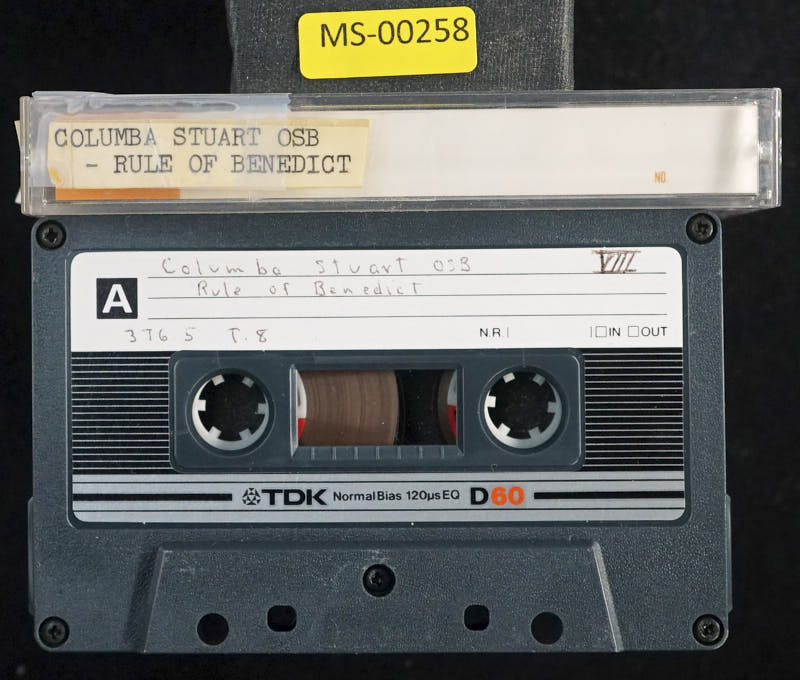
AI Vision - Possible Values from Photos:
Speaker: Columba Stuart OSB
Possible Title: Rule of Benedict
Additional text: 3765 T 8
@AI-Vision_v002
Well, theoretically, looking at the rule of Benedict should be a great summary for us, but I don't offer a grand synthesis. Instead, I have a few reflections on some portions of the rule which might relate to some topics that we've discussed, and then I invite your comments, either on the chapters that I have chosen or on things that you yourself have come up with in line with some of the issues that we've raised the past few days. I think what must be obvious at this point is that it's very difficult to read the rule of Benedict in the same way after reading the things that we've looked at, in the same way that one reads it before one does that kind of investigation. You begin to realize that behind every word and phrase of the rule of Benedict lies a whole wealth of tradition, not only the rule of the master, but all the stuff that precedes the master. And you begin to realize there's a whole vocabulary of technical terms that we're dealing with here that we've got to try to come to grips with, both to understand Benedict's source and to understand what he does with it, because he certainly does more than just collect everything and write it down.
[01:18]
He is shaping the material, just like John Cashin is, and just like we do when we read The Rule of Benedict. Well, you're all aware of the issues involved in trying to read the rule today and issues of interpretation, so we needn't go into that. I guess I might as well jump in and mention a few points that have struck me which might fuel our conversation and enable you to kick in what you found. What I'll do is stick pretty much to the themes that I've brought up in the past few talks, and that way we won't... try to work our way through the entire rule in an hour's time. So first, I'd like to say a couple of things about the thing I opened with, and that is this business of integrity of body and spirit, and the idea of transformation of the monk through prayer. In a way, this is kind of the reverse of the praktike, because when we read The Life of Antony, we saw someone...
[02:26]
who was doing all of those bodily labors and disciplines, but the result was that something came from inside outward. So you do the practicate to affect this kind of inner and spiritual change, but that in turn shows itself in an outward manner. And I think that's what was so remarkable about chapter 14 of The Life of Antony, was the way it described his spiritual transformation as manifest in his very bearing. his face, the fact that he seemed not to have aged despite twenty years in the fortress. This whole idea of integration of body and soul are related to a primarily Eastern patristic conception of the goodness of creation and the notion of redemption as restoring creation. And we talked some about resurrection and so on. A noteworthy thing about Benedict, which is often observed, is his own respect for this integrity of body and of spirit and his attention to the outward aspects of monastic conversatio.
[03:39]
The prologue is full of it, and you've all gone through that business. I'll just point out one thing about that that I find striking, and you may well have marked in your books too, but go through there sometime and circle... either mentally or on your page in a pencil, all of the references to sight and to sound. It's remarkable. Every other line, at least in the first portion of the prologue, is dealing with something that you see or something that you hear. And it's a very clever alternation of those senses throughout the first part of the prologue. That's a commonplace. There are other examples of this kind of whole conception of the person in Benedict. Just a couple little ones before I get to the one I really want to talk about. The fact that the abbot is to be living example of all of these things in his actions as well as in his teaching. Chapter four, the tools of good works.
[04:43]
All of this is the work of the praktike and all of this is to achieve that kind of inward transformation which manifests itself in an outward fashion. Same thing for the chapter five on obedience. But it's in chapter seven on humility that I think, at least I find, the greatest echo of this business that I was trying to pull out of the life of Antony. The first thing to note is, of course, the root of this chapter in John Cashin. at least what we call the ladder of humility, or the steps of humility. As was pointed out the other night, in Cassian, this is not given as a ladder which is progressive, but as a series of traits attributed to the humble. And it's the master who turns it in to the ladder, which is familiar to us in Benedict. And the language that the master and Benedict use, I think, will begin to be very resonant to us after what we've looked at.
[05:49]
The ladder erected is our life on earth. What is our life on earth? But the life of the praktike. We may call our body and soul the sides of this ladder. There we have that kind of integration, that goal of wholeness, into which our divine vocation has fitted the various steps of humility and discipline as we ascend. Now, at this point, discipline... should have a resonance to us from our encounter of the word in the life of Antony, where the English translation keeps translating ascesis by discipline, and by our encounter with the praktike in Cassian, which is very often in Cassian termed disciplina, discipline. So Benedict's steps of humility, based on the Master and on Cassian, come right out of that tradition of the praktike, And so too, I think, does his goal.
[06:56]
First, I want to read a little snippet from Cashin's Conference 14, to which I referred the other day. Apparently, what the master is doing is taking the indications of humility in the fourth book of the Institutes and interpreting them according to a statement that Cashin makes in Conference 14. And that's how we have these traits turned into the latter. which is progressive. This is chapter 2 of Conference 14. Practical knowledge, praktike, can be acquired without theoretical, meaning contemplative. But theoretical cannot possibly be gained without practical. For there are certain stages so distinct and arranged in such a way that man's humility may be able to mount on high. And if these follow each other in turn, in the order of which we've spoken, man can attain to a height to which he could not fly if the first step were wanting.
[08:05]
That seems to be the basis for this idea of a progressive ladder of humility. Now, we've talked about the problem with systems. We recognize the limitations, the imposition of structure, ranking, and so on. But despite that, I think there's something... very impressive in what the Master and Benedict do, and that is how they reach the twelfth step of humility, which has been an interest of mine for a while, and I've just never had the time to really sort the thing out. DeVoe Guay and other commentators point out that the first degree of humility and the twelfth are very much related because they both discuss internal and external aspects of humility. Now, the difference between the two is that in the first step, the issue is controlling one's actions. It's a matter of fear of the Lord and therefore responding to that fear by saying, I won't do this, I won't do that, I will control this, I will control that.
[09:13]
That's the emphasis on the external. Now, the difference in the twelfth step is that now... the humility is not something which is to be acquired by control of the body, but the humility is something which is manifest. And so it's a movement not from outward to inside, not controlling the body so as to achieve this goal of humility. Now the humility is indeed an inner possession and quality which inevitably shows itself outwardly. Now, maybe I'm reading more into this, but this is kind of how I look at it. So that we reach the 12th step. The 12th step of humility is that a monk always manifests humility in his bearing no less than in his heart. The implication seeming to be that it is rooted in the heart at this point and then manifest in his bearing, coming from the inside to the outside, as with Antony.
[10:22]
so that it is evident at the work of God, the oratory, monastery, garden, on a journey, in a field, anywhere else. And then it describes what traits of the monk's posture would exemplify this. Benedict then goes on to say that having achieved that state, having mounted all of the steps, is the short step to the goal, which is the perfect love of God, which casts out fear. Now, we talked about Cassian's description of purity of heart as also being understood as charity. And what is Christian charity but the perfect love of God, which Benedict discusses? So therefore, if we want to be kind of tricky with the tradition, we might rewrite Benedict and say, after mounting all of the steps of humility, the monk arrives at purity of heart. What a vagaries would call apotheia, Cassian calls purity of heart, what the Latin translation of the life of Antony calls purity of heart, what Benedict calls the perfect love of God, which casts out fear.
[11:33]
Furthermore, if we want to be tricky, we could look at the next line of Benedict, where he says, all that he once performed with dread, he will now begin to observe without effort, as though naturally from habit. Now remember, in that chapter 14 of The Life of Antony, one of the descriptions of Antony when he had achieved this kind of transformation or integration was that he conducted himself according to nature, katafusen. And I mention that as kind of a creational echo or kind of a reminiscence of paradise, humanity being what humanity was intended to be. And Benedict says here... the works are performed naturally, as if from habit, in a natural state, as we are meant to be. That may be a little bit much, but it seems to me you might make that connection.
[12:36]
I would also mention here the apothem attributed to Antony, which I read, I think it was that first conference, when Antony made the statement toward the end of his life, I no longer fear God, but love him, for love casts out fear. And that, of course, is Benedict's summit, the achievement one has after mounting all of the steps of humility. Now, that's maybe more a spiritual midrash than anything really based in the evidence, but I find that helpful. Let me say... couple of things as well about oratio prayer and once again the day is an auditorium and then i'll turn it over to what you came up with the two places that i think are most interest to us in trying to get a hold of benedict's understanding of this tradition of prayer that we've begun to discern and the things that we looked at are chapters 20 and 52
[13:45]
so I'll skip the whole treatise on the office and go right to chapter 20, Reverence in Prayer. It is in this chapter that I find some of my real problems with the translation we have before us in R.B. 1980, which I think does a good job of trying to write something contemporary, but misses a lot of the echoes of the language in the original. So this is one of those places where you really have to look at the Latin. And then you begin to see, aha, this reminds me of Kashin, or this reminds me of so-and-so, or so-and-so. Benedict sets up a kind of parallel between the way that we approach a powerful human being and the way that we approach God. He says if we ask a favor from a powerful man, we do it with humility and patience. With reverence. Cum humilitate et reverentia.
[14:50]
This is chapter 20. He says when we pray to God, we also do it with humility, as we would to the powerful man. He strengthens it by saying, with all humility. Cum omni humilitate. And then he says, and also with... puritatis devotione, puritatis devotione, which R.B. 1980 translates as sincere devotion. If you look at the Latin with devotion of purity or with intention of purity or with purpose of purity, you begin to think cashen, purity of heart, and all of those bells start to go off. And I don't think it's reading into the text. to make that kind of connection. If you go on to verse 3, RB reads, We must know that God regards our purity of heart and tears of compunction, not our many words.
[16:01]
First of all, not many words, and we remember this desert tradition of short aspirations in prayer. It is not a wordy form of spirituality. Then this business of purity of heart, which we've traced from the Latin translation of the life of Antony into Cassian, where it becomes a predominant motif. And here we find it turning up in Benedict, precisely in the context of prayer, which is where we found it so richly developed in Conferences 9 and 10 of Cassian. Then when it talks about compunction of tears, That would send us back to Antony, where it talks about praying with tears, to Pachomius, where there are numerous mentions of that, but I think especially to the end of Cassian's Conference 9, where there's a discussion of the prayer of tears and how that fits in to this kind of scheme of prayer that Cassian is developing.
[17:05]
Verse 4. Prayer should therefore be short and pure, unless perhaps it is prolonged under the inspiration of divine grace. Now, pretty clearly, this, to me, is referring to an individual's prayer. Brevis et pura oratio. Pure. Again, we make that connection with the preceding verse and also with the tradition. Unless prolonged by grace. Now, if I were fanciful, I might see that as an allusion to this kind of prayer of fire that Cashin talks about, but I can't really safely do that. But I think if you read this again with the background of that tradition, you realize there might be some echoes or hints here. That's speculation. Then a note with verse 5. In community, however, prayer should always be brief.
[18:11]
When the superior gives the signal, all should rise together. Now, De Vogue Way has led the way in having us see that verse as referring to the silent prayer between the Psalms, and in our case, after the reading, that we found in Pachomius as an essential aspect of the communal synaxis. So, that's really kind of a footnote. Briefly, chapter 52, the oratory of the monastery. I'm interested here in verse 4. If at other times someone chooses to pray privately, he may simply go in and pray, in the Latin that's really nice, intret et oret. Just go at it.
[19:13]
Not in a loud voice, but with tears and heartfelt devotion. Now, here we are with another awful translation. With heartfelt devotion, in the English side, if you look at the Latin side, it is intentione cordis, with the intention of the heart, which sends us back to Cassian's Conference I on the goal and aim of the monk. conference nine where he restates that with his discussion of prayer as part of the goal of the monk and that whole sense of purity of heart as singleness of purpose or intention so again the English side of the page would not help us to make that connection but if you look at the Latin side you realize aha that's got to be an echo of that tradition as well as the tears. Now, should I go on and talk about the Deus and Aditorium, or would you like to stop for a minute and get your reactions on those two chapters?
[20:25]
Can that also be the new man, the new nature in Christ, a new creation. Yes. We have discussed this here. We have read things. I think Brother James mentioned that before, too. I'm just wondering. Yeah, and that's probably a good clarification. I guess what I would say to that is certainly. But again, I think the Eastern perspective is to regard, to have a much closer link between the new creation in Christ and the original creation. Christ is certainly the fulfillment. Christ is certainly more perfect than Adam and Eve were, so it's not just returning to the original level.
[21:41]
But they're very much linked. And I think... The Western perspective is to have much more break between the two. So I'd say it probably is an echo of original creation, but certainly gains all of its power from the fact that it's a new creation, which is certainly more exalted than the first. That's a good distinction. What did you speculate? But I know some scripture people have said that they thought that Paul, I guess especially Father Augustine, stopped when he was here. Anyway, how that the Gnostic heresy came in so close on the early church in scripture that they backed away from some of these ideas or the real radicalism or so forth, that notion of creation.
[22:45]
And so you wonder, did some of the things like this temper the East in a way? Because it does make a difference to us. I mean, it's true. It's the way you see the whole thing, not the way you see a part of it. But just to go back. to go back to the beginning, we have to do that in a way, because we have to go from what we know and what we don't, like the famous exoduses, you know, out of Egypt, but then out of Babylon, and so on and so forth. But anyway, you wonder if something like that has, and then still, you know, in our tradition, have kept something of that kind of fear of getting too speculative and too new and doing away with everything that the state books have. The idea of the the goodness of the original creation, not that Gnostic dualism of matter. So you're going to be over-spiritualized in creation.
[23:50]
That's a good point. I was, of course, more thinking of the all-in traditions that we studied in that one article, maybe Adam and Christ. The whole Philippians hymn, what people have done with exegesis on the Philippians hymn, has been kind of along those lines. Some of the most recent stuff. I think what's interesting in that regard about this whole creational business is that precisely those... Greek writers who are attacked for being neoplatonic and intellectual and so on, like Gregory of Nyssa, Gregory of Nazianzus, are also the ones who have the strongest emphasis on this creational business. So I think they get maligned a bit. What some people regard as the intellectualist tradition of monasticism, what an awful word, you know, as if that means it's not something that's rooted in real experience and creation.
[25:02]
Anyway, should I go on to the Deus and Auditorium, and then we can try to pull it together after that? Now, we're very aware of how Benedict uses the Deus and Auditorium in the rule. He places it at the beginning of the day hours of prayer, mentioning it for the little hours, and by extension, we understand it as an opening versicle for laws and for vespers. Now, I find this to be strikingly appropriate, and I mention this a little bit in my thing in monastic studies. Certainly, Benedict would know the traditional use of this verse in Cassian's writings, because Cassian was extremely popular, and by the time Benedict comes along, Cassian's stuff has been around for quite a while. And this is something that we do not find in the rule of the master, nor do we find it in the Roman office at least the way I read it, until after the rule of Benedict.
[26:06]
So we ask ourselves, why does this verse appear for the first time in the rule of Benedict, and why does he place it as the opening verse of the office, given its traditional use as a verse for the private meditatio of a monk? Now, just as a kind of a textual caution, since this came up the other day, There is controversy about whether or not the references in the rule to the institutes and conferences are to be seen as referring to Cashion. It seems to me that it is perfectly safe to say that even if they are broader than simply referring to Cashion, they include Cashion. So I think anybody who says that Benedict does not know Cashion, I just don't understand that. It may be he refers to other texts as well, but I think certainly Cashion is known to Benedict. So that he and his monks would encounter this verse, God come to my assistance, Lord make haste to help me at the office, knowing full well the tradition of the verse in John Cashion.
[27:18]
Now what's the connection? I tried to make a point in reading Conference 10 with you that Cashion is not derogating the canonical prayers, in other words, the psalmody and so on, associated with the regular obligation of a monk to pray at certain hours of the day. And that's something anchorites did as well as synabites. And we have that business at the end of Conference 10 where Cashin says, you now return to the rest of Scripture and the psalmody and so on with this renewed understanding. Now maybe I'm attributing more to Benedict's creativity than I should because Maybe it was instinct, because formed in this tradition, his instincts, I think, could be trusted. I think it's striking to take that verse, considered as meditatio on Scripture privately, and to place it at the head of what is, at least in large part, a communal meditatio of the Scripture.
[28:23]
Now, I would make a liturgical theological point about that, and say that what it is saying is that there is not, in fact, a radical distinction between private and communal prayer, although communal prayer has its distinctive dimension, as we found in Epicomius. It's ecclesial. Something happens when people pray together that doesn't happen when they pray separately. But Benedict is saying, I think, by using this verse, that God's Word is God's Word, God's Word encompasses the life of the monk, and it is there at the communal meditatio as it is at the individual meditatio. Now, in saying that, I'm not trying to equate common prayer with private prayer.
[29:29]
and therefore take the devoke wayline of the fact that the work of God is simply the support for the monk's unceasing prayer. I think it's clear from the rule of Benedict that Benedict has very strong convictions about the distinctive quality of communal prayer. And something that struck me today when I was reading this morning was that when he uses the phrase, prefer nothing to the work of God, which he inherits from a tradition of of Western monastic rules. He doesn't come up with that himself. The only other places in the rule where that same formula of words is used, prefer nothing, is with reference to Christ or to the love of Christ. So I think that makes a rather significant statement about the office. Something that is of interest is that the only other place I know of where this verse, the day it's an auditorium, turns up in a monastic rule, not based on Benedict, and not being used in the same way as in Benedict, is in the rule of Columban, who dies in 615, so we can date him a century later than Benedict.
[30:39]
In the rule of Columban, after every psalm of the office, all of the monks are to kneel and to say three times to themselves, silently, God come to my assistance, Lord, make haste to help me. I think... In that case, it is indisputable that it comes from Cassian, because there is other evidence of Cassian's influence on Columban, and a general affinity of the Irish monks for Egyptian practices, which would be mediated through the Latin of Cassian. And I think there, too, we find an interesting liturgical use, although much more in line with Cassian's tradition, of the Deus and Auditorium. which might for us only highlight all the more what Benedict does with it. Everyone says it together, and it is said at the head of the office. I can't prove that, but I haven't found anybody who can come up with anything against it, and I've found no other explanation of how the Deus and Auditorium gets into the Benedictine office.
[31:52]
and I've waded through all the Devogway stuff, and it's just not there. So I'd stake something on this, I think. One other little footnote about something else that I was thinking about a few weeks ago and struck me, and I'll just pass it on in terms of kind of a spiritual thought more than anything else. It struck me, while we were reading at table this book that you've just started at supper, Esther DeWall's book, which is just a wonderful little book, that I think one could interpret Benedict's horror of murmuring, especially when he talks about murmuring in the heart in chapter 5, as somehow, this is tenuous, related to some of what Cashin discusses with prayer of the heart. Because in Cashin he has this image of the heart and the essence of the meditation. That just struck me as kind of an interesting way of understanding why murmuring is such an awful thing, not only because it's not charitable toward other people, but that could be one reason why Benedict feels it destroys the very soul of the monk.
[33:06]
Maybe that's just speaking to me, but it really hit home. That's all I have to say about the rule, at least with regard to what we've done. I'd be interested in your reflections or what bells went off in your heads as you heard some of this stuff the past few days or looked over the rule in the light of it. saying that by putting the versicle in front of the offices, saying that this in effect constitutes a form of an integral part of constant prayer.
[34:34]
Now this is tricky because it becomes, the issue is one of perspective. I think it's very clear that Benedict following much of the ancient tradition does not draw a radical distinction between private and public prayer. However, I think he does attribute to liturgical prayer a distinctiveness which is much greater than that found in our previous authors. Pachomius perhaps accepted, although I think in Benedict it's even stronger than Pachomius. I'm trying to figure out how I can say this carefully without making it sound like to Vogueway's thesis, which I disagree with. I think what Benedict is trying to do is to show a common ground between the prayer of an anchorite and a synabite, a common ground between the communal prayer of the work of God and the private prayer that the monk would make in the oratory between the hours of prayer or at his work.
[35:44]
And I think he's making a point about the role of Scripture. and the role of the word. Because it seems to me that's the essence of the deus and adjatorium in Cassian's conference. So if I say any more than that, I'll get into trouble. So maybe you should ask your specific question so I don't spin that off and get you confused. Maybe the easiest thing which... for me to do would be to read my paragraph from my article in monastic studies because there I was really careful about what I said and I can't duplicate that off the top of my head because I tried to make the point there The book just opens to it.
[36:47]
I'm very impressed. You're checking me out before I came. All right. Okay. All right. Where is it? Okay. St. Benedict's placement of this verse. at the beginning of the day hours of prayer is strikingly appropriate. His monks, familiar with Cashin's writings, would mark the joining of the meditatio of solitary prayer to the psalmody of the office, which is the meditatio of communal prayer. Benedict takes Cashin one step further, refusing any absolute dichotomy between personal and corporate prayer or between the prayer suitable to Anchorite and that proper to Cenobite. And then I make the point about Cashion.
[37:50]
Far from excluding the other practices of the spiritual discipline, then, the deus and adjitorium sustains them and is sustained by them. Vigils, meditation, psalmody. That's what I'm trying to say, I guess. Clear as mud. It's striking a column when you put it at the end, and St. Benedict put it at the end? I was just thinking, you always remember the beginning or the end of things. Well, Columban is after every psalm. So it would be in the intervals after each one, which is much more, you know, kind of Cassian's thing. And in Columban's rule, it is prayed silently by the monks. So it's a much more private thing. And in Benedict, it's said by all. Or, you know, it's replied, it's responsorial. And at the head of the office, which is an interesting difference.
[38:54]
And where the directory speaks about, well, there's a lot of liturgy texts out of, you know, way back in place, the 12th, even before, but anyway. And the directory speaks about, you know, the strong woman, and this is, gathering unlike any other gathering and so forth. And at least at the moment, it seems to me that that's not saying that, or what it is saying is that, it's not saying that God is more present when we're all together. I think it's saying that the sign of God's presence, or the sign of God's love, or the sign of God is more, palpable and stronger. We are together. It's the phrase we have out of the psalm, which is a Hebrew thing. I have not hidden the justice in my heart, but made it known to the full assembly.
[39:59]
So I think it's wrong to think of them in terms of, say, better and worse and so on. It's no different. But the sign value, both for ourselves and for others, is stronger. We can all ignore signs of words, so it's not, you know, inevitably affect everything else. But the sign of God's justice and presence of love, uniting us all together, is more visible when we're all putting together, than it is more, separately, or dealing with the sick, or so on and so forth. But other aspects of God's love and presence are visible when we're dealing with the sick, or so forth. It's not a question of better or worse. It's a question of being a more visible or stronger sign. Anyway, that's where I came. I think it's interesting to compare Benedict's treatise on the office to that in the master. Because in Benedict, everything is quite positive about the office.
[41:02]
It's the work of God, nothing is preferred, all of that stuff. And the master has those things too. because Benedict works with the master, but the master is full of all kinds of little negative comments about what you shouldn't do during office. He talks about blowing your nose and all this kind of stuff. And it really makes it sound like an ordeal, you know, as much as anything else, because you've got all these cranky people to deal with. And Benedict, that just drops out. So there's, again, a matter of tone in Benedict that is, it's unmistakable, just unmistakable. The thing says something about that. I think it's the difference of that. Only when we come here, when we come to the end of that, is Christ present or something.
[42:06]
I mean, I might be wrong. What he says, the only part is on ritual. Right. The other onlys are that there's only one resurrection, which is going on, let's say, at that time. But I would say the sign of that is more obvious when we're together. Because in a sense, the resurrection is going on. It's a cosmic reality. It doesn't happen just because we come together. But in a way, we offer our humanity but the same, you know, Joseph, for that to take place within a human context. But, and you'd have to get Patrick, I mean, Patrick's very good to describe his own, but he used the only, with regard to ritual, which means to come into contact with that, he said, it can only happen, come into contact with that reality of place, it can only happen through ritual.
[43:20]
I have a question. In your opinion, it said that lessons should be preferred to the work of God. If you're referring to the divine office, or to private prayer, or to pause? Well, I think it's pretty clearly to the divine office. That's the tradition he's in, because that phrase turns up first in that series of um Gallic monastic rules you know the rule the forefathers is that where it's first or second rule the fathers it's one of those two is where it turns up first and it's very clearly they're referring to the divine office and I think Benedict too um but I was real struck by that parallel with prefer nothing whatever to the love of Christ or to Christ and the only other mention of that phrase is prefer nothing to the work of God it's really striking and maybe makes that connection that Father Martin is trying to make about Christ being realized in the work of God, you know, effectively in the communal prayer.
[44:33]
Conversely, would they also say that the private prayer of the monk receives an ecclesial dimension? It is not just private, right? I think I read that thing the other day from that French book that I've been reading that says that when one reads the scriptures, one never reads them alone. It is necessarily ecclesial. You're always taking in your immediate community as much as the society when you do things. And the more you're God, the people with you, the more that there are others around you.
[45:37]
I got that out, Patrick. The more you're in with your community doing something together, the more Christ is in you. It doesn't mean he's only in him instead. Sure. more humans. It's like Villiers says in his big book on the Pocomian liturgy, I think I mentioned this the other day, the church, the mystery of the church is primordially communal. I mean, at heart, it's communal. And, you know, I tell my freshman theology students that you cannot be a Christian if you don't go to church or if you are not part of some sort of Christian community. You can't be a Christian on your own. It's by definition impossible. that just freaks them out. But I think that there's a lot to that. Whatever it means, and I don't know what that really means ultimately, but I think that comes through in some of this stuff as well.
[46:41]
Well, I think it means having some contact. with others, with the body of Christ. And I wouldn't be so rigid as to say, you know, Sunday Mass every Sunday. I mean, that's a little legalistic, I think. But I think some contact with the body of Christ, and even in an explicit way. No, a solitary is very much in contact with the body of Christ. Very much. That's the paradox of the solitary life. A solitary is in a community and goes apart from a community and remains in some relationship to a community. But still, a recluse is defined in relationship to a community. In other words, a recluse is a recluse from people, comes from a Christian community. and is seen in relation to the Christian community, even if there's no contact.
[47:46]
That's very different from someone who says, well, you know, I like this stuff, I'll be a Christian, and has never had that kind of contact or relationship with a community. I guess my gripe, the reason I said that harsh statement to my students was that, you know, it's TV evangelism, it's individualism, and I think that is... utterly antithetical to Christianity. So maybe I overstated it because of that. But there's a state that I mean that if you are born in that process of being purified, it's like you've reached a point that you are with the Church. There's never been a recluse yet that wasn't dependent on people.
[48:59]
Dependent on people, that doesn't mean that you are in communion with your heart. It means you are relating to them. You are connected to this, a bit different, you know, being, you know, because we might be here together, here together, but we might not be related. We might not be in communion. Physically, we might be together, but we might be more than one another. So that's the fact that they need somebody to provide for that material need, that doesn't mean that they have to be, for that fact, in communion with those people. And then by definition, they will not be Christians. Exactly. That's your own question. They will not be Christians. But I would like you to comment that this is a problem, not like.
[50:03]
What is that? So much fear about the position of the public and the other one about the office and the private prayer. They've always seen, well, just in the beginning, he had to go to his tenure because he was afraid to do something, to put it in the same position of the public. I mean, in a sense, you've touched on the question when you talk about communion. Because I think some people, when they read some commentators, de Vogue would be one of them, all of the primary one. And he's especially, I think, to be reckoned with since he is the commentator on the rule of Benedict. Nobody has done a tenth of the stuff that he's done. And I think some people are afraid that his interpretation of the rule of Benedict, viewing it in a more exclusively vertical abbot-disciple relationship and emphasizing the obligation of each individual to pray unceasingly, rather than the horizontal relationship between the brothers and the distinctive value of communal prayer, is dangerous.
[51:26]
Because it might make us tend to think of a highly individualistic approach to Benedict and monastic life and also is kind of threatening to a lot of emphasis that people have recovered in the past 20 years on relationships between people and monastic community and the importance of a horizontal dimension to liturgical prayer as well. Now, that's not to say that he is really doing that because, I mean, he's not a bad person. But I think that it could be said that he tends to emphasize one view over another, and other people try to balance it. To help you fulfill your obligation.
[52:31]
One was at the heart of the Benedictine life, which is destructive of it. I mean, if you want to follow the vulgar way, that's one thing, but it's destructive of the Benedictine notion of what life in Christ is. But what I see positive about the coming with prayer, from the point of view, is that you made that kind of obligation that you have to give. But I guess I would interpret that too, that not only do I have an obligation to God to pray unceasingly, but I have an obligation to you people you know, to turn up in that church at certain hours. And I think that is extremely important.
[53:32]
But I don't go there, I mean, I don't go there only because I'm afraid that your private prayer depends on it. I mean, I go there because something happens which eludes us in its mystery. And I would be real hesitant to... you know, to try to sacrifice that. Otherwise, we could go into church and have, you know, little confessional boxes as our choir stalls, and we could all go in there at the same time and read our office privately. But we don't do that. That's being denied. There's a divine reality being expressed. And it's more than just obedience to a priesthood. It's the flow of God being manifested by drawing us together. And to deny that or not let that happen I mean, to do it simply on obedience is to be a slave. It's to keep your God on a survival level and never get to a feeling of a real love of God. And that's the thing that fits that domain. That's why I'm getting so terribly. Prevention from allowing God to love you when you're loving God without keeping a rule.
[54:47]
If I'm obedient with that, I believe that if I go to the office, yes, the power of God, Jesus, will meet that thing that will maybe go to the office, no, but I will speak. looking for something that I know I will get there. It won't be any duty anymore. I will do it our duty. But I have to start my obedience first. I cannot look at it. I have to start my obedience. But to both ways, it will not let you get beyond the obedience. That's the problem. It won't let you get beyond that. It is only in response
[55:52]
He said, it's that only that destroys the whole thing. It's very, very little, but it turns the whole thing off. But that's putting limitations on God. The border is, it's exactly. The border is obliging me. He's putting me, go to the office. That's a duty. But he must say, That's the only thing. God will take it from there. We want peace, no put any invitation on God. If I go off my duty, God will get me to work. But the Lord is saying the only reason you're there is to... That is not the only reason. It's one of the reasons. Once I fulfill the precept, I'm finished. I fall short of the love of God that does the whole point. And I won't let it get to me because I will not be united with all of them. I'm simply there following one precept of Christ out of the, out of the, not the whole thing, but just one.
[56:59]
It's right. It was a fetish in some sense of what it is. It's an oversimplification reductionist of the whole thing, and it winds up with a human precept. Just as Christ said, you're following the precepts of man and replacing the precepts of God. And to be one with God. Exactly the automatic word shows that you're skillful as he fell as God. You're skillful at putting the precepts of man, following him in such a way as you're destroying the precept of God. Isn't it worth about where you are? And then where you've also been. No. We're not just men. We have the Spirit of God. We have the Spirit of Christ. And we are the humanity. We unite with the humanity of God. We are men. But as St. John said, we know what we are, but we don't know what we're going to be yet.
[58:01]
It's fantastic. But we're God's children. Born directly of God. Not even of our parents, but born directly of God. That's what we are. And as he told John... As Christ told John and James, you don't know what kind of creature you are, but it's all fired up. And that's the problem. We don't know what we are. We know we're men, but we're a lot more. And that's the thing that the bold way, you know, get that in. You've simply got a human tradition that you follow. And it gets you to the depths of hell in my book. Those things that some wise men could eventually be to the depths of hell. That's one of them. I don't want to be the advocate of the book, but he wrote so many books, you know, that maybe in one he emphasized that bit overboard. Well, it seems that there's also other things that he mentioned that maybe we're... Well, I think this thing is so dangerous.
[59:02]
And he is such an authority. He is such an... There's no question about it. And really, I... almost give my right arm to know what he knows and to be able to, you know, have the erudition he has with relation to the rule and the oath. I think it's fantastic. And I've been the greatest admiration for all that. But this is wrong, and I think you have to say it. Yeah, I, yeah. That thing out of Josiah Royce, we thought William James was absolutely a god figure, frankly, for him. He said, this, the master, is Ramon. And one thing he talked about, and And all these other things, terrific, but in this he is wrong. In the same ways that God said about David or Moses or anybody else in the past, we could take all these things, but in this he is wrong. He will say in his commentaries, yes, there's a communal dimension, but at heart, at base, the important thing is fulfilling the precept.
[60:06]
And so it becomes a question of essential points. And there, it's problematic. Because I would argue, you know, that at base, there's a mystery, and it's a mystery of communion, as much as it is a mystery of an individual encountering God in prayer. I know he mentioned it very directly once, which was in Gethsemane and that lecture. For him, in a monastic life, it's a medium. You know, that But at the same time, you can say that obedience also has a communion dimension. Sure. You know, we have a schedule. It's for the sake of the whole group also. It's not just for my sake, because I could eat what I want, if I want, then what I want. But, you know, we have three meals a day normally, and the schedule, they don't have certain hours for most people. And you see, there's something...
[61:07]
good for the individual so that I'm not in the cooler night and day. And at the same time that other people will know that there's something left in the cooler because if they have to prepare the meal. That's why I find that a bit unfortunate that it turned into a preliminary to me. Yeah, you're right. It is unfortunate that it has to be that. And it also has to be said in fairness to Devogwe that a lot of people get mad about him and don't really read it. That so often happens in this kind of thing. But I think what it highlights for us is a central problem in Cenobitic monasticism and one that I really wrestle with and that is there is inevitably a kind of tension, hopefully creative, between the individual and the community. We had a homily one day at Mass in my monastery, and the celebrant stood up, and the basis of his homily was, when we go to God, we ultimately go to God alone.
[62:16]
And that sparked such a fuss, because my first reaction was entirely negative. You know, that's not true. We're a church. We're communal. But then, you know, I tried to sort out the arguments, and I realized that you could easily argue both perspectives. When we go to God, we go together. We cannot go alone. Or when we go to God, we do go alone. And it becomes very, very hard to sort it out. And I guess the problem when you hit someone like DeVogwe, whose writing is so clear, and he's so strong in what he feels, is you think he's opting for one or the other. And I'm here trying to juggle both. And I don't know any other way to do it. Which is... frustrating. But I do really feel like St. Paul, there's some things you've got to get up in your back legs and it's this notion that takes away the mystery and the action of God and the body of Christ, gives the spirit, all that, you know, and puts it off in simply a precept.
[63:28]
I think it's going to have to, in this one area, it's going to have to disaster. I think he's terrific. And I'm even happy for him clarifying the problem for him. Because we have a double dimension as people who are unique. And we're relational. And both of those are activated. Something's been left out and it's difficult. And that's it. It cannot be done logically. Because we're both man. And you can't split it if you split us off into unique. that's not what we are. And if you make us a blunt, a collectivity, that's not what we are. But I think it's important, the red boat we are, and the best we can do, the only thing we can do is say we're both unique and relational. And both of those elements have to be part of the Christian history. And without that, as I say, with either one you're gonna kill what there is, and it could be very
[64:30]
logically, but then it's a typical human condition, and so on and so on. So I think on that one thing, I think somebody asked me, and I'm not ordinarily contentious and so on and so on, but that one really, it's just so clear that that's where it's, you know. Where is this off here? I haven't read the page 132. The spiritual and doctoral commentary that came out just over the last year. Yeah, the English came out. Because, I mean, even to use, you know, to have a precept, say, of unceasing prayer, you know, then to deny, you know, the witness dimension of it, say, the congenital dimension, would be a contradiction in terms of things. I mean, if it depends how he defines what does he mean by prayer, You know, what is this he's really prescribing, it seems to me.
[65:34]
And then, of course, he gets that from the scriptures, you know. So if it's really going to be prayer, it's going to have to be all these other things. So I just wonder what context he was writing in, or what else he has to say all around that statement. You see, this is what I don't know, because I haven't read it. See, part of the problem, I think, is that he leans very heavily on monastic tradition and is loath to say that something new is developed in Benedict. And I would say that that communal thing is not new.
[66:13]
@Transcribed_UNK
@Text_v005
@Score_91.19