You are currently logged-out. You can log-in or create an account to save favorites and more. more info
Humble Strength in Stillness
AI Suggested Keywords:
The talk centers on the theme of humility within the Christian tradition, emphasizing that true humility is often misconstrued as weakness in contemporary culture. Instead, it is presented as a significant strength derived from acquiring the mind of Christ. The discussion also highlights the practices of contemplative prayer and apatheia as means of developing an inner stillness and a non-reactive approach to life's challenges. The concept of presence and its importance in both personal growth and ministry is explored. Trauma and the healing of memories are addressed, positing that safety, care, and the grace of God are crucial for healing.
Referenced Works:
- Saint John's Gospel (Prologue)
-
Saint Isaac's insights on humility draw upon the incarnation theme found in the prologue, encapsulating humility as divinely inherent.
-
Thomas Keating, "God's First Language is Silence"
-
Establishes that silence is central in understanding God's presence, highlighting the apophatic tradition in prayer.
-
Judith Lewis Herman, "Trauma and Recovery"
-
Offers extensive analysis on traumatic experience and coping mechanisms, relevant to discussions on trauma and memory healing in the talk.
-
John Kabat-Zinn (Mindfulness)
-
The principles of mindfulness are paralleled to Christian practices, emphasizing awareness and non-reactivity.
-
John Chrysologus (Orthodox Theology)
-
His perspective on self-discovery in silence and facing one's own demons is echoed in the speaker's insights into personal encounters with self through contemplation.
-
Paul Claudel, "Jesus did not come to take away suffering…"
-
Frames suffering as an area to be filled with divine presence, offering crucial insights into understanding Christic presence amid hardship.
-
Saint Teresa of Avila and Apophatic Theology
- Highlighted for distinguishing between cataphatic and apophatic approaches, essential for understanding contemplation and humility.
Other Points of Interest:
- Practice of Apophatia (Non-reactivity)
-
Explored as a significant spiritual exercise in monastic life.
-
Concept of Hamartano (Missing the Mark)
-
Offers a broadened understanding of sin beyond moral offense; more about imperfections and frequent need for repentance.
-
Hesychastic Prayer
- Related to cultivating inner quietude and essential for comprehending distinctions in theological discourse.
AI Suggested Title: "Humble Strength in Stillness"
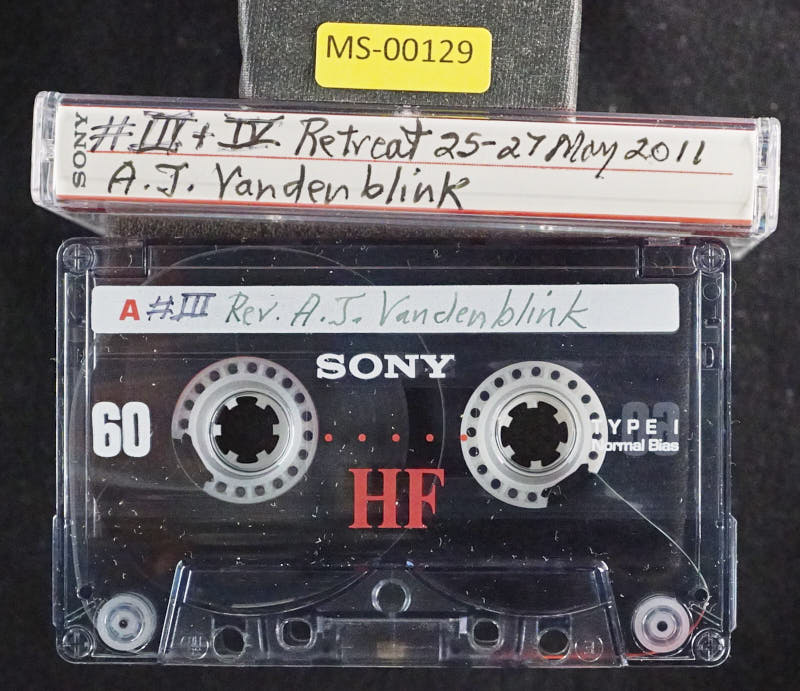
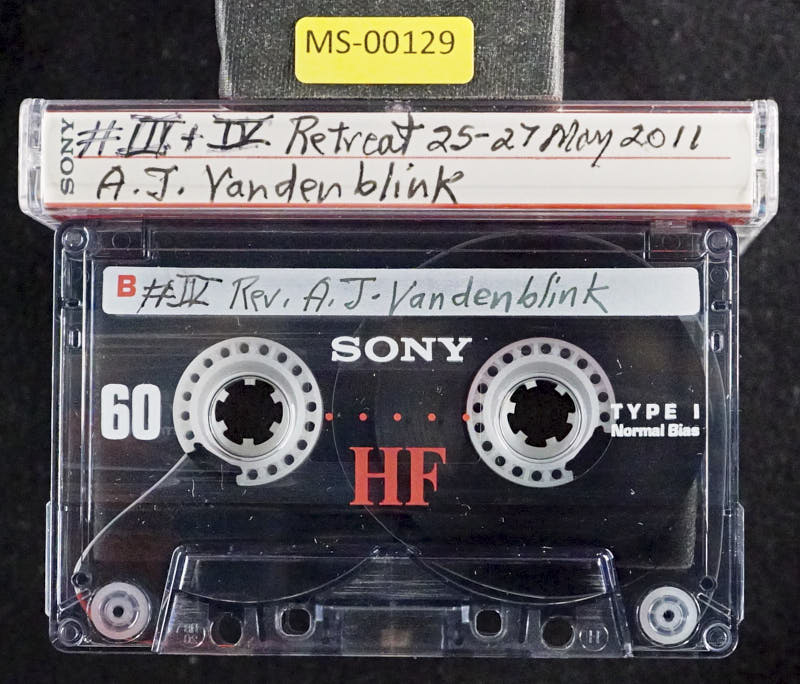
AI Vision - Possible Values from Photos:
Speaker: Rev. A.J. Vandenblink
Additional text: Retreat 25-27 May 2011
Speaker: Rev. A.J. Vandenblink
Additional text: Retreat 25-27 May 2011
@AI-Vision_v002
Two talks from this date
Let us pray. O Lord and Master of my life, take away from me the spirit of sloth, despair, lust of power, and idle talk. Give rather the spirit of chastity, humility, patience, and love to thy servant. Yea, Lord and King, grant me to see my own transgressions and not to judge my neighbor. For blessed art thou unto ages of ages." Amen. Before I get into humility, I was talking to Brother Bruno about Akkide, and he reminded me that the Desert Fathers and Mothers called it the Noonday Devil. I think the reason for this was that the Noonday in the Sinai Peninsula, the Egyptian desert, is a very hot place. So you're going to lose all energy.
[01:02]
And this reminded me of another reason for which we need to be aware of, because that isn't always because of spiritual or emotional reasons we fall into a kidney. It can also be physiological reasons. So if you suffer from repeated a kidney, make sure you have a checkup with the doctor. Because that can really be a reason. And I forgot to mention that. Well, I'll talk to you about the experience with the Anticrater, being aware of the characteristics of truthfulness and compassion of the mind of Christ. And now I'd like to look at humility. We're going to have to say obvious things here, but humility is not very much in favor in our present culture. It's a bad odor. We live in a culture, winning is everything, radical individualism, competing with others.
[02:06]
You mentioned it yesterday. And this attitude is so humility, forget it. And this is not just in the world, but also in convents and maybe monasteries. For the last 10 years, I've been the chaplain general of the Anglican Order of Women in Cincinnati. And through my position, I have a privilege, really, to be on the inside. And there's often quite a lack of humility. One of the most macho people I've ever known in my life was a sister now, the Lord, who was a true bulldozer. and nothing could stand in her way. So, it's not just the world that has troubled humility. I think we ourselves in the church have quite a bit of trouble with humility. Because humility to many people in our culture, and it's kind of, we've taken it in with the drinking water, conveys a lack of power, spinelessness, a submissive, a masochistic behavior, being a doormat, and all that kind of stuff.
[03:18]
Now, needless to say, this is not what humility means in the Christian tradition. But I think it is important, at least has been for me, to be aware of the cultural understanding of humility because we all kind of carry with us whether we like it or not. So we can be aware of it when it kind of comes up. There's another pitfall in practicing humility, which is that a lot of us are kind of perfectionistic and like to be really good at it. In Irish say, that doesn't work with humility. As soon as you think you're really good at humility, humility is kind of out the window. So humility is a byproduct, this is my definition, of a certain way of living and dealing with reality, which leads to an inner disposition through spiritual practice in community. It's quite a mouthful here. But it's a byproduct. of a way of living in the community.
[04:21]
So I want to focus at this point on this practice of becoming more humble. And again, St. Isaac, whose definition of compassion I read to you earlier, has helped me to understand this better. Not only why humility is an important part of the mind of Christ, but how humility of the degree to which we acquire humility is a direct reflection of our progress in acquiring the mind of Christ. If humility is an important part of the mind of Christ, then to the degree that we acquire some of that humility in our own little minds, our own we are making some progress in acquiring the mind of Christ. And this is important because when that happens, you might say we shift from an ego-centered way of living to a more Christ-centered way of living.
[05:35]
So if that makes sense to you, then Instead of humility being a weakness, it is evidence of a potentially enormous strength because our power then does not come from ourselves but from our being in Christ. Does that follow it all? It's a very important thing to realize that in the Christian view, humility is just the opposite of weakness. It is great strength, but the strength comes from acquiring the mind of Christ. So here's St. Isaac, when I wish to open my mouth and speak on the exalted theme of humility, I'm filled with dread, like someone who is aware that he is about to discourse with his own imperfect words concerning God. For humility is the robe of the Godhead. The word who became human clothes himself with humility.
[06:41]
and thus spoke with us in our human body. So St. Isaac is really paraphrasing here the prologue to St. John's Gospel, that the Word became flesh and dwelt among us. And then he gets to the point where cultivating humility through prayer is important. Everyone who has truly been clothed in humility becomes like him who came down from his exalted place and hid the splendor of His majesty, concealing His glory in lowliness, so that the created world should not be utterly consumed by the sight of Him." So again, authentic humility does not reflect our own prowess, but the light of Christ. Or to put it differently, because I've been looking for a way to put this in more modern language. enables us to de-center ourselves and re-center in Christ.
[07:47]
There's no humility without some kenosis or some self-emptying. But there is the unfortunate assumption among many people in the church that we need to get rid of the self. And this is not what this is about. The self itself is a gift from God, because without a self, we couldn't operate very well in this world. but rather to decenter the self from being the ruler of all in ourselves rather than Christ. Now, two aspects of my own experience have been most critical in pulling the very pieces of my own life together and contributing more decisively, you might say, to my own spiritual formation. And they, more than anything, hath taught me about the meaning of humility. And these two aspects are a renewed understanding of the traditional notion of purgation.
[08:51]
So purgation is the ability to respond to difficult times as invitations to spiritual cleansing. So purgation in the Christian tradition is understood as the ability to respond to difficult times of incitations to spiritual cleansing. And the second thing that has been very critical, really, to my own formation and still is, is the regular cultivation of hesukia, or hesukia, the word I'm sure you all know. a Greek word, which means not just absence of sound, but inner stillness, inner quietude, equanimity. And as you know, the whole movement of monasticism in the fourth century was called the hesychastic movement, and still is called that way in the Orthodox Church.
[10:03]
So this is an act of spiritual practice. that is centered on the prayer of silence, or the Jesus prayer, or contemplative prayer, or is now, we often now talk about centering prayer, they all are pretty much the same kind of thing. Now I have to tell you that when I became aware of the critical role that pregation and practicing asuchia played in my own life, I was really surprised. because as a psychologist I was accustomed to thinking of personal integration in psychological terms. And I began to see that this process in me through purgation and practicing Hisukya had very little to do with psychological terms at all. As a matter of fact, Hisukya is the heart, the very heart of spiritual practice.
[11:09]
of cultivating this inner openness and tranquility to the Spirit through, as I said this morning, brief prayers and especially the Jesus prayer. And then contemplative silence, they all go together. Now the apophatic tradition of our faith has always known that the closer we get to God, the more words fail. I think Thomas Keating, Father Keating, has said this really beautifully. God's first language is silence, all else is bad translation. Have you heard that one? It's excellent. God's first language is silence, all else is bad translation. Apophatic theology is based on the profound insight
[12:10]
that God can never be adequately apprehended or understood through words or reflection or definition or description. And that's why we also have catathetic theology, which uses images, language, ritual, candles, all kinds of things to illuminate our understanding of God. Now, the Western Christian tradition, both Catholic and Protestant, is very cataphatic. I'm not saying that there isn't as much more apophaticism than, thank God, the Roman Catholicism than the Protestantism, but there could be a whole lot more. Apophatic comes from the Greek word for denial, and cataphatic comes from a verb meaning to assent. So, cataphatic theology is talking about God in terms of, like, God is a king, a shepherd, a rock, love, justice, light.
[13:16]
That's cataphatic. And apophatic is saying, you know, God is not a rock. God is beyond all those things. Saint Teresa of Avila, the marvelous, she talked about this too. She talked about, God is not at this, not at that, not at this, not at that. You could say, God is this, but then you immediately have to say that what I say about God is inadequate because God is much more than what I just said about God. Now, the practice of contemplative prayer or hesychastic prayer, the practice of it has made me understand the distinction between cataphatic and apophatic much better than ever had before. Also has made me painfully were of how often the disagreements in the church within denominations, but also between, but especially in my case in seminaries, where everyone is an expert, that these are cataphatic fights, not to say cat fights.
[14:26]
The error we fall into is that we assume that our cataphatic way of talking about God is it rather than an approximation. Are you with me? So it's a very profound difference. So we, again, this ties into humility that anytime we talk about God, we need to, as Isaac said, he's trembling, talking about God because the words are inadequate. We need to be aware of that. I think this is also one reason that contemplative prayer, sitting in silence, is so amazingly difficult to do. I think most of us know it's important, but then we start to kind of start doing it. There's all some reason not to do it. I don't know how this is here in the monastery, but I'm an expert at this. Oh, wait a minute. Instead of sitting and contemplating. I think a major reason is that we run into ourselves.
[15:37]
And this is widely testified to by the desert fathers and mothers. Well, they left the civilization of their time because they thought it was a shipwreck, that's the word they used, to go into the desert to find God, and then they run into themselves. Here's the Orthodox theologian John Krasavagas, a recent contemporary. In the desert or in silence, you discover your true self without any masks or myths. There, in the presence of God, you are forced to come to terms with yourself. Ultimately, you're called to face up to and fight against the demons without blaming someone else or your past. But to avoid this practice, is to deprive ourselves of experiences of God because God is in the here and now. And our being open to the here and now enables us to be more open to the Spirit of God.
[16:45]
John the Cross called this practice cleaning the windows of our soul, our heart, in a very apt description. because the windows of our heart and soul get constantly fed to all kinds of other stuff. Watch the time here. My first experience with sitting in silence was not in a Christian way, it was through Buddhism. I was kind of searching and I encountered Buddhism. I didn't become a Buddhist, but I found some of their writings very helpful, including their insight about the importance of sitting in silence. One of those Buddhists, an American named John Kabat-Sinn, has actually used a lot of these techniques of sitting in silence to help people who are enduring chronic pain. He started a pain clinic in Boston that has become very famous. So they talk about mindfulness, which is being able to be aware of what's happening right now, good or bad, but not to get caught up in it, not to get captured by it.
[17:58]
Let me quote from Kabbalah Zen. One reason we might want to practice mindfulness is that most of the time we're unwittingly practicing the opposite. Every time you get angry, you get better at being angry and reinforced the anger habit. That certainly applies to me. When it is really bad, still a quote, we say we see red, which means that we don't see accurately at all. And so in that moment, you could say, still quoting, that we've lost our mind. Every time we become self-absorbed, we get better at becoming self-absorbed. Every time we get anxious, we get better at being anxious. Practice makes perfect. I found this very helpful. In other words, he flips it around. But we're practicing, in a sense, all the time.
[19:02]
But as Christians, we need to focus our practice on what really counts. We're not just going to be formed without knowing that we're being formed. Now, years after my encounter with Buddhism, I discovered, again, I come from this Protestant world that doesn't pay much attention to anything that happened between the New Testament and the Reformation. I discovered my surprise that in the early Christian tradition, there was the practice of apathia. Excuse all these Greek words here. Apathia, our word apathy is related to apathia, but it doesn't mean it at all. Apathia can be best translated in modern English as non-reactivity. So, those hesychastic monks were practicing non-reactivity. So you want to be fully present to what's going on.
[20:06]
You don't want to deny anything. You get upset, okay, I'm getting upset. If you can name it, you name it. Sometimes we can't name it, but you can always say there's something going on that is troubling me or that makes me happy or whatever. But you don't get caught up in it. You keep some distance from it. Most of us are, I think that's fair to say, are reactive. So when something comes up in us, before we know it, we're kind of hijacked by it. When it's irritation or anger or lust or boredom or whatever it is, before we know it, we are hijacked by it. This is especially true of something like anxiety. Something goes on that's difficult, a crisis in our lives. We get anxious, obviously we do. But before we know it, anxiety stops being, let's say, passing weather through us, like rain or clouds or thunder.
[21:15]
But we become the weather. We're just one bundle of anxiety. Or a temptation. whether it be that you wanna... Let me tell you, I think at the time, a funny instance. When I first started this practice, this was years ago, I had organized in my study a kind of a prayer corner with a nice chair and an icon and a candle and everything. And I had set the timer for 20 minutes and I started being pious and being open to God. And the next thing I knew I was in the kitchen making coffee. And I thought, how did this happen? Well, what happened was the activity. I love coffee. I'm a Dutch guy. At 10.30 in the morning, which is when I was doing this, everyone in Holland has coffee. The whole country has coffee. I'm conditioned to have coffee at 10.30.
[22:18]
I was sitting there being biased and contemplative. The coffee thing came through. and I was in the kitchen. I felt like a damn fool. It was very illuminating. But that kind of thing was kind of a crazy example, but that kind of thing happens all the time. Now the Abbas Anamas in the desert, for that reason, for the practice of apathaya reason, did not consider temptations a bad thing, even sexual temptations. Because every temptation gives you a chance to practice non-reactivity. Is that what I'm saying? That to me is something I've never really thought about, but when it became clear, I said, oh yeah, of course. So no matter what happens, it's always an invitation to be non-reactive. And that explains something, for instance, that the great Abba Anthony said, that whoever has not experienced temptation
[23:23]
cannot enter the kingdom of heaven. He also said, without temptations no one can be saved. Remember, saving and healing are closely related. So we cannot, our noose cannot be healed unless we have withstood the temptation and not be caught up in it, but have been honest about it, but let it go and not be captured by it. So what's happened to me, imperfectly to be sure, through this practice, is that I've had more self-confrontation than sitting regularly in prayerful silence before God than all the psychotherapy I've had. I'm not knocking psychotherapy. I have been a therapist myself. I've benefited. from some very fine therapists in my life.
[24:25]
But let me tell you, this practice confronted me with myself much, much more. Because with a human therapist, after a while you get to know them, you kind of know what they're like to hear or not to hear, and you kind of pitch it across the plate a certain way, so you get out of the hour without too much damage. Try to do this before God. Become aware of your You end with self-justifications, you're spinning of things to your own benefit, and you become aware how frequently we miss the mark. And let me end with a remark about missing the mark, because that too for me was a revelation. In the tradition I grew up in, sin had to do with moral offense, something that you did wrong. or ethical offense, that you then need to confess and make restitution and ask for forgiveness.
[25:31]
But sin was definitely kind of limited by that understanding. This is not the understanding of the New Testament. And it completely blew my mind, again, excuse the Greek word, that the verb for sinning in New Testament is hamartano. The hamartano means to miss the mark like when you shoot an arrow. So you aim and it glances off. Or it really misses the mark because maybe you shoot yourself in the foot. But that is hamartano. Now this to me was a real revelation because hamartano includes obviously the really bad sins. It also includes a lot of these little missing the mark that we do kind of all day long. And especially what it made me aware of is how it kind of challenges the, what you can, what you have to call a pernicious moralism in so many churches.
[26:33]
Where it ends up being kind of with, you know, the people who are very, no, they know they're not perfect, but they're basically good people. But then there are the bad ones over here who really are the sinners. Well, Hamartino shoots it out of the water. Because we're all, we all missed the mark, and we all missed the mark quite a bit at the time. And we all need to confess a lot, and we all need God's forgiveness all the time. So that's why it's not surprising that—and I don't know how you do this here in the monastery—but that frequent confession is so important. I know that in the Orthodox monasteries, often they confess every day. I know that I was doing a little bit too often. It is very important that as soon as we know we have missed the mark, that we confess. And I can't quote the exact name here, but one of those Desert Fathers actually talks about that.
[27:34]
That as soon as you miss the mark, confess. Make restitution. Apologize. Ask for forgiveness. And then go on. dwell on it. This is another great insight that does benefit to me, because I tend to kind of get preoccupied with my failures. The very first time I went for a life confession, I had pages and pages of stuff that I've written down. And I confessed, this was to a monk in Boston, and it was a profoundly moving experience. to have the absolution pronounced, and it was just wonderful. But then when we were all through, he said, give me those papers. Now, I don't think he knew what was going on in my head. But he took them, and he started to tear them up.
[28:35]
And I had a feeling of, hey, wait a minute. Those are my sins, and I was going to file them under harm's sins. No. As soon as you confess, have received mercy, made restitution, apologize, move on. Because otherwise you get preoccupied with yourself, rather with the mercy of God. And you stop there. I think, first of all, you don't try to clear your mind and not think of you.
[30:02]
This is not possible. But it really is not possible. So what you try to do is to be open to whatever is passing through or coming up. And if you can, to name it. Like, for instance, I worry a lot. I worry about coming here. Can I say anything worthwhile? felt that worry come up. Okay, you name it, I'm worried about speaking about Savior. But then, let it go. These things kind of tend to pass through. Now sometimes, again, feeding has been very helpful in respect with images. He talks about images of sitting on the banks of a river. And these feelings and images that arise in us are like boats coming down the river. So let's say you're really angry at someone. So here's an angrier boat.
[31:05]
So ideally then you don't deny it. O Holy Spirit, Heavenly King, the Comforter, the Spirit of Truth, who art everywhere present and dwellest in all things, treasury of blessings and giver of life. Come and abide in us and cleanse us from all impurity and by your goodness heal our souls. The fourth characteristic of the mind of Christ, that I've come to known experience, beginning with that powerful encounter with the Sinai Ponticrat or icon, is presence.
[32:08]
So presence is the ability to be fully present in the moment to another person or activity. Now, this seems like a very obvious way to describe it, but actually it's a very complicated process. It includes the ability to be present, to be intentionally able to focus on the person or activity that invites or deserves our attention, while at the same time attending without getting distracted to ourselves, and to everything that's going on around us. Moreover, the act of attending is itself a multi-layered operation that includes taking in the verbal and the non-verbal as well as contextual and relational dynamics while at the same time being mindful of but not responding to whatever would
[33:17]
else would draw our attention away from the present situation. I mean, the more I think about this, the more complex it gets. Yet another aspect of attending to being present is our own disposition, a positive or a negative or whatever, that influences not only how we attend, but how we are perceived by the other. Now, the ability to be present in itself is not a Christian virtue. It has been pointed out that a really competent assassin has to know how to be present for just that right moment to pull the trigger. A more peaceful example is that tremendous feat that was accomplished by those pilots in the US Airways plane that lost both its engines So two years ago now, when Captain Sullenberger, by being fully present in his professional capacity to a whole array of stimuli, you might say, was able to make very important quick decisions that led to the safe landing on the Hudson.
[34:37]
I recently read a paper describing that event. I think the whole thing took three and a half minutes. It was unbelievable. The input and then the processing and the right decisions is unbelievable. Now needless to say, when trying to wrap our minds around presence as that is manifested by the mind of Christ, we are talking about more than our ability to be fully present in the moment or to focus on the person or activity that wants our presence. And to do that without getting distracted by what goes on in our inner or external environments. So the presence we need to practice, if we want to acquire at least a modicum of the mind of Christ, is a presence that is informed by a compassionate, truthful, and humble disposition. It is this kind of presence that affirms the humanity of the other, that restores relationships.
[35:46]
It offers the possibility of forgiveness and renewal that begins to diminish isolation and that elicits hope. As with the other aspects of the mind of Christ, it is a gift. But it's a gift we can practice. Now, it's easy to talk about being present, to reflect through our presence some of the mind of Christ— when things go well. It's another story altogether when life is difficult and when we are involved in a crisis of some sort or another. So I want to focus at this point on the practice, the ancient Christian practice, monastic practice, which I mentioned yesterday, of apotheia. which I think is best translated as non-reactivity, as an important part of practicing the presence of Christ that forces this disposition of being fully present in the moment in a way that is compassionate, truthful, and humble, without getting distracted, overwhelmed, paralyzed, or flooded.
[37:10]
In moments of crisis, we easily get flooded, we easily get overwhelmed. The mother, so to speak, of all crises is trauma and trauma reactivation, and I have learned myself a great deal from trauma and trauma-reactivation, and I'm going to go into this a little bit more now, not because everything is trauma or trauma-reactivation, but if we can understand a bit more what goes on when those things happen and how best to deal with them, we are also better equipped to be present to lesser difficulties, either in our own lives or the lives of others. There was a time, maybe 20 years ago, when many of us believed that the instance of traumatic experiences was diminishing.
[38:32]
This was before the Iraq wars and so on. There was more awareness of the importance of dealing in a better way with people who had been traumatized or abused, There was much more awareness of how many women are abused, but also men, how families can deal with it better. It seemed to be a hopeful time. And those of us, and I will talk more about this a little later, who are dealing with traumas from the war, I'm talking about in my case, the Second World War, felt hopeful. But maybe, you know, things were getting a bit better. Well, they didn't. And the incidence of post-traumatic disorder after the wars in Iraq and Afghanistan are still going on, of course, is unbelievable.
[39:37]
And I think you've read about this yourself, so I don't think you need to explain that further. There are many people walking around, not only veterans, but many people, who have been traumatized and are trying to live in a way that is not too encumbered by these experiences. Now, trauma is the Greek word for wound. But in our time, trauma has come to mean an extremely distressing and harrowing personal or communal experience that exceeds our normal ability to cope. In other words, the tornado in Joplin, Missouri is such an instance. I think it happened, what, two days ago? Traumatic experiences can leave us feeling, I already mentioned some of this, overwhelmed, emotionally flooded, disoriented, unsure of ourselves, no longer able to trust others, or even our own ability to perceive reality correctly.
[40:47]
One of the best books still, I think, if you want to read about this, is called Trauma and Recovery. There have been several editions. The author is Judith Lewis Herman. And she has had the wisdom of putting the traumatic experience on a curve. In other words, that whether you abuse in a family or by other people or whether you abuse in war, it's all kind of abuse and trauma. She talks about complex traumatic disorders, and she has a whole range of symptoms, such as dissociation, which I'm very good at. Dissociation is when you remember what happened but you have no feeling about it. Dissociation can be a major gift from God when things are really tough, because if you
[41:51]
could not kind of block the feeling out a bit, you wouldn't be able to make it through. But the problem is that it becomes a habit. And then even when things are okay, you still easily dissociate. And the dissociation is unconscious, so you hardly know when you're doing it. You don't know when you're doing it. For instance, to give an example, after the attacks in 2001, 9-11, some of my own World War II stuff was reactivated without my really being aware of it, but I was beginning to dissociate. Unfortunately, one of my daughters said at one point, are you all right? I thought, uh-oh, I'm doing it. And then I could go back to what caused it. And what often happens is that a trigger in the present will activate or reactivate the abuse or trauma from the past.
[42:59]
And it happens very quickly. It happens very, very quickly, like in a quarter of a second. I think we all have the experience of feeling perfectly okay. All of a sudden, we don't feel okay. Am I right? Thank you. We know what that's like. Well, that is often due to a trauma reactivation that has been triggered by something in the present. I've heard many, many stories of trauma and abuse and trauma reactivations, both when I was still a practicing psychologist and an equal number in spiritual direction. But unfortunately, that's all confidential, so I cannot share that. What I can share is one of my own experiences, to give you an example of this.
[44:03]
In the summer of 1988, and my father was still alive, he died later that year, And he lived in Holland, in the Netherlands. He was used to sending me clippings. It was very nice. And it came always in a certain kind of Manila envelope. But he had very distinct handwriting. So it was a beautiful summer day. It was 10.30, having coffee. The mail had come. I was at the kitchen table. I was alone in the house. And there was my father's envelope. Oh, that's nice. He's sending me some more clippings. and I slid it open, and I went through the clippings, and then I saw a photograph of a statue that had been commissioned to be placed on the cemetery in the city in Java, Indonesia, where I was imprisoned as a young boy. When you were 11 years old, they took you away from your mother and put you in a men's camp.
[45:11]
And it had to do with the reunion that was going to take place of survivors. So this is 1988. It was a long time after the Second World War. And I distinctly remember that I felt like someone had hit me in the gut. I went from feeling perfectly okay to just weeping. I'm a guy, right? I don't cry easily. But this was, I couldn't stop it. And I kept looking at the photograph of that boy. The boy was clad in a loincloth and had a pickaxe because we had to work in the fields. And it said underneath, they were still so young. They were still so young. So I felt like I'd been physically hit.
[46:17]
And like the scab had been wrenched off, a wound that I was hardly aware I still had. And I sat at a kitchen table, I don't know how long, maybe an hour, I don't know. But I just couldn't stop. But after a while subsided, And it was a very painful experience, but also became in the long run a healing experience. I did go to that reunion in Holland. It was quite an amazing experience to be with guys I haven't seen in about 50 years or so. Sometimes when you've been through bad experiences, you begin to wonder if you made things up. Have you ever had that experience? Were you exaggerating? Well, I realized that I was not exaggerating. as we swapped stories about the experience in that camp.
[47:22]
It also, that experience that morning in July, revealed a lingering grief that I had. It was often exposed in a trauma re-activation. Grief over a loss of life. The guys I knew who died. Grief over loss of youth. You grow up pretty fast. I came out of there. I was 11 years old, but I was basically already an adult in terms of the way I had to function. Grief over loss of innocence. Grief over wasted years. I'm sharing this with you. The details are mine, okay? But the phenomenon is all over the place. And I have to assume that some of you here have had those experiences yourself. Now, in Memory and Hope, Eastern Galilee, in the second chapter of Resurrection, which you have read, Rowan Williams writes that the returning of memory is very far from being a congenial and painless process.
[48:39]
That is to put it mildly. I mean, extremely painful. Yet the refusal or denial of memory, and this is still Roland Williams, is likewise diminution. In other words, a diminishing. Perhaps the deepest diminution, the lessening of our humanity. Now, he was referring to the reaction of the disciples to the risen Christ, the very Jesus they had abandoned and betrayed. But what he writes also applies to traumatic memories of those who have been abused by others or have been in war experiences. For the reactivation of trauma, or a very difficult time, always brings these painful memories in its wake, and memories that can be extremely upsetting. But the experience of traumatized people also shows
[49:42]
that over and over again, that these memories can be healed by the grace of God and with the help of others, provided, this is very important, there is a caring and safe environment. So here we get to a very important topic, which is the healing of memories. You've heard of that, right? How do memories get healed? But they don't get healed by insight. That's for sure. Nor do they get healed by forced recollection. We now know, and I'll talk more about this this afternoon, that forcing people to go into traumatic experiences and tell me more and what's exactly happening, that kind of stuff, can actually re-traumatize people. So that doesn't help. But what does help is to be with people who love you, care for you, who who respect your boundaries and who protect your space so that you don't get intruded on again.
[50:49]
And then people willing to listen to you talk about the memories when you are ready to do so. Again, Rowan Williams, there's no healing of memory until the memory itself is exposed and exposed as loss. Now this is a pastoral task that we, responsibility may be a better word, that we need to assume for each other. We can live with people I have, like professionally I would say, people I've seen daily or have seen daily for years. and not understand that they are carrying with them past traumatic experiences. And then suddenly they may come out as they did with me that July morning in 1988.
[51:58]
If that happens and we are there to provide a safe environment and the listening ear to be not intrusive, but to be willing to listen when the person is ready to talk about it. This, over time, by the grace of God, with the help of our Lord Jesus Christ, affects the healing of memories. Because of the way we are created by God neurologically, and I'll talk about that also more a little later, we never lose the memory. But the pain connected with it can diminish greatly. At first, in my own experience, the reactivation is like a shrill sound that you can't shut off.
[53:05]
There's always a fire alarm. It just goes so when it hurts your ears. But I've also noticed over time the sound diminishes. And then after a while, maybe years, when the thing gets reactivated, it's more like a buzz. Another image that has been helpful to me is to think of a color photograph of a horrible scene. Let's say a car accident. And you look at it and you shudder. And every time you look at it, it just shudder, especially when it involves yourself. But over the years, the colors bleach. They fade. And then you can get out the old photograph and you can hardly make outputs on it. That's another image. Now what, you may ask, does this have to do with presence?
[54:08]
with Christic presence. It has everything to do with it. And one way to grasp that is for me to quote to you a saying of the French diplomat and spiritual writer Paul Claudel. Have you heard of him? He was active in the time of First World War and between the wars in Europe. Paul Claudel once wrote, this is a quote, Jesus did not come to take away suffering or explain it. He came to fill it with his presence. Jesus did not come to take away suffering or explain it. He came to fill it.
[55:09]
with his presence. About 10 years ago, someone sent me a card with this saying by Paul Cordell on it. I immediately framed it as someone writing this. I look at it daily. Jesus did not come to take away suffering or explain it. He came to fill it with his presence. Now, the more we can practice apathaya through the day, because every day things happen that make us reactive. We get discouraged, we get angry, we get irritated, we get anxious. The list is endless.
[56:10]
And then if we're not non-reactive before we know it, those feelings will just dominate our whole being. So the spiritual practice is to, if we can name it, and then pray for help to let it pass, not to deny it. Denial would really make it worse, but not to attach to it, not to let it hijack us or take over. but to let it pass like the boat on the river, our Father Keating, or maybe the weather that passes through the sky of our being. I think this whole matter of presence, of Christic presence, is at the heart of our ministry. I think we all know that
[57:12]
when we are called in to be with people who are suffering badly or just been bereaved. It's not our words that do it, meaning I want to say something. But that's not what does it. It's our presence. And especially the presence reflects to some degree the presence of Christ. And when I think about that, and let me end with that remark, it's also been very helpful to me in pastoral ministry to realize that it's not up to me, nor could I do it anyway, to carry Christ into the situation. I was at a funeral last Saturday, a very sad situation. I don't carry Christ in. Christ already there.
[58:13]
Maybe I can reflect some of that to the people to whom I try to be present. I think in a community like this, it's not easy to live in a community, whether it's marriage or a convent or a monastery. But if I'm right, It affords plenty of opportunity to practice apatheia, non-reactivity, with the help of Christ. Let me stop there. Well, I had the blessing of being able to talk about what happened with my wife and a Dutch friend who had been in the same tent.
[59:44]
So that would have helped. I think the reunion It's going to reinforce that. Yeah. That makes it much tougher. It may not be the same degree, but it makes it much tougher. I know that a few of you, or some of you, all of you, are doing spiritual direction. You're going to run into it if you haven't already. Often it's so painful that people will have built a little wall around it. So they themselves may not be aware of the fact they carry this wound with them.
[60:46]
Because our culture, and I'll get more into this this afternoon in terms of neuroscience, which would be helpful to explain some of this, our culture believes that you can, it's a typical arrogance of our culture, that we can work something through and then, you know, it's over, forget it. So people say things like, hey, that's now 40 or 50 years ago, why are you still worrying about this? Well, that's not the way we're made. These are encoded in our bodies. We have no control over that. Well, we have control over what we do with it. And again, I'll talk some more about that later. But to answer your question, I think it makes it harder. But if we, as priests and monks and spiritual directors, have some sense that there's something here, we can be invitational. We don't want to intrude. But we can say, you know, it sounds to me like there's some painful stuff here.
[61:49]
If you want to talk about it, I'll be here for it. I've said that to people, and then maybe months later, they finally say, well, you know, you told me if you want to talk about it, I want to talk about it. It usually doesn't happen right away. Sometimes it does, often it doesn't. But it's a kind of... I'm probably going too long here with my answer, but I think Christian spirituality... Jesus' spirituality is invitational, is not impositional.
[62:20]
@Transcribed_UNK
@Text_v005
@Score_90.49