You are currently logged-out. You can log-in or create an account to save favorites and more. more info
Human Freedom: Bridging Divine Likeness
AI Suggested Keywords:
Talks at Mt. Saviour
The talk explores Saint Bernard’s sermons on the concept of the image of God in man, focusing on free will, freedom, and the likeness of God post-fall. It examines Bernard’s interpretation of these concepts through a Platonic-Augustinian lens, juxtaposing views from classical Christian theology with modern philosophical critiques, such as those by Sartre and structuralism as represented by Lévi-Strauss. The speaker highlights Bernard's unique approach to the diminished gap between God and man, compared to the Thomistic view, emphasizing man's freedom and moral capacity. References to other theological perspectives, including those of Gregory of Nyssa and Maximus the Confessor, illustrate the development of Bernard's thought.
- Saint Bernard of Clairvaux, Sermons 81 and 82: These sermons delve into the nature of the image and likeness of God in man, the concept of free will, and human dignity after the fall.
- Saint Bernard, "Dei Gratia et Libero Arbitrio" (1128): A treatise addressing grace and free will, regarded as a scholastic masterpiece, exploring free will as the image of God in humanity.
- Augustine of Hippo: His influence is evident in Bernard's work, emphasizing the Platonic-Augustinian system where beings return to God by degrees, as opposed to the Thomistic infinite gap.
- Jean-Paul Sartre: Sartre's existentialist view that true freedom includes the liberty to sin contrasts with Bernard's idea that freedom not to sin embodies true human fulfillment.
- Thomas Merton: Referenced for presenting Sartre’s viewpoint in a booklet suggesting the liberty to sin as a form of human realization.
- Gregory of Nyssa, "De Homine Opificio": This work on the creation of man is integrated into Bernard’s discussion on the doctrine of the image of God.
- Maximus the Confessor: His theology, transmitted via translations by John Scotus Eriugena, contributes to the texture of Bernard’s reflections on spiritual likeness.
- Structuralism and Claude Lévi-Strauss: Mentioned as a critique of human liberty, suggesting universal patterns of thought that undermine individuality and freedom, contrasting with Bernard's view.
AI Suggested Title: Human Freedom: Bridging Divine Likeness

AI Vision - Possible Values from Photos:
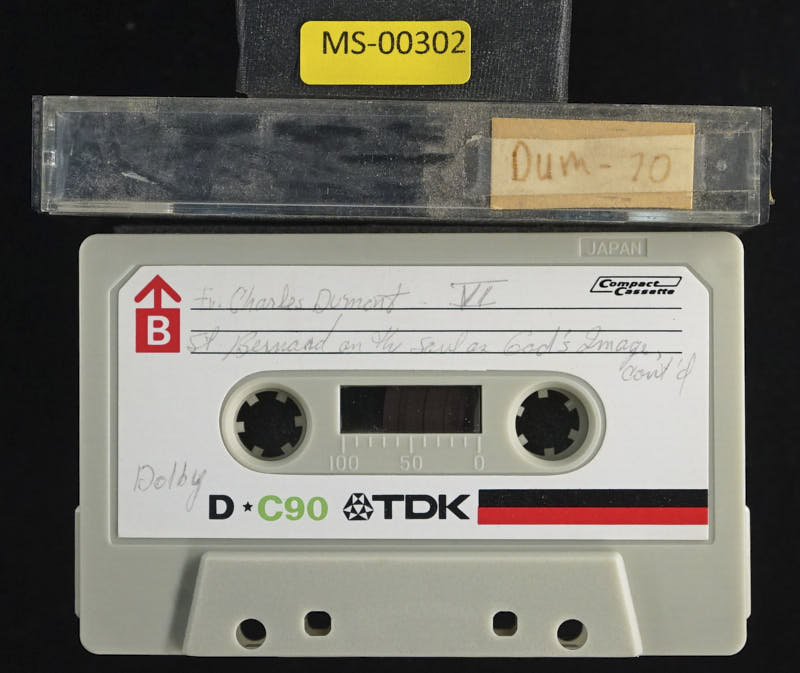
Side: B
Speaker: Fr. Charles Dumont
Possible Title: St. Bernard on the Soul as Gods Image
Additional text: Dolby
Side: A
Speaker: Fr. Charles Dumont
Possible Title: St. Bernard on the Soul as Gods Image
Additional text: 75.3 Dolby
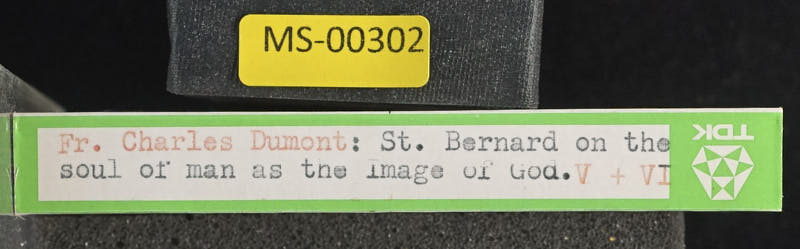
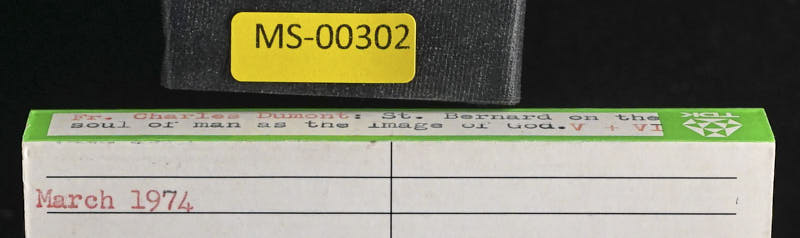
Speaker: Fr. Charles Dumont
Possible Title: St. Bernard on the Soul of Man as the Image of God V + VI
Additional text:
@AI-Vision_v002
Read the Sermon 81 and 82 on the canticle. Well, St. Bernard chooses another way of looking at the image of God in man. We saw yesterday this... and the image was the greatness of man, his dignity as, nobility as a man, noble creature, and the likeness was righteousness, rectitudo, which he lost, and therefore man or the soul of man is curved towards earth, and he has to straighten, but he is capable of doing that, because he remains great.
[01:17]
And here, we shall discern, he will take another system. And it's interesting to know, as we shall see at the end of this Sermon 81, that Saint Bernard dealt with the problem or the question of the image of God in man in his one of his first treatises, 1128, De gratia et libero arbitrio, grace and free will, which he wrote to William of Saint-Cherie. In that, which is considered by the theologian or the scholastics today as a masterpiece of scholasticism. He takes the very classic Augustinian demonstration where free will is the image that the liberty of choice
[02:26]
image in men and men has only lost the the faculty or the easiness to use this freedom for good. I was told that in English there was a slight difference between freedom and liberty but just now somebody gives me a reference, Peter gave me a reference from the Webster Dictionary, and there isn't any clear distinction. Freedom, somebody told me, was more free choice, and liberty, free from entrance, obstacles, or determination, and all that. Well, there is a difference, obviously, when you speak of liberty or freedom, from these two kinds of freedom.
[03:28]
One is free choice. Free choice is simply to do this or that. And that remains in men. If a man is devoid, if a man does not have this liberty of free choice, he is no more a man. And that's what Sartre pointed out very clearly. That is the basic or most Elementary human quality is this free choice. That is not in a man, man is no more a man. Think, for instance, of people who have been brainwashed in communist countries. If I sign a document or if I confess all sort of kind of so-called free confession, you cannot say that there is a man anymore.
[04:32]
Man is defined by this liberty of free choice. And St. Bernard said that remains in man after the fall, obviously. Otherwise, he would not be a man. But what he lost was the free use of this faculty of freedom for the good. after the sin, is no more capable of easily decide for the good. There's something happened there, a sort of entrance that is blind, or at least not completely in possession of this freedom. He's tempted, he's submitted to sin. He is not able to be without sin if grace does not come to his help.
[05:39]
And more than that, he cannot freely enjoy to do all the time good, the good. which should be normally the condition of man and which will be a condition of heaven. Because the good will be so evident. God will be so clearly seen that it will be impossible to do evil, to turn your back from this truth and goodness and beauty. So what has been this freedom to turn your back from the goodness has been said by modern philosophy precisely to be the real freedom of man, to go against God, which is blasphemous.
[06:43]
But you see very well that, as we say yesterday in the question, that if God does not exist, There's only one possibility for man is to be the absolute himself. And if precisely the definition of man is his freedom, he has to give to this freedom this complete, he has to be absolutely free from any other suggestion or determination different from his own decision. So Sartre will be, in the text of Thomas Merton, which is there in this booklet, you will see that Sartre would say that the liberty to sin is really the summit of men, is realization.
[07:46]
Now, the Christian will say, or the traditional will say precisely, the liberty not to sit, to be free from this tendency is precisely what makes men more fully at the image of God. So it is only to see all this, it's always to point out all this important is this doctrine, to know exactly where we stand, what is the possibility of men. Let us then start this reading, the text. Preceding this course, my brethren, I inquire into the nature of the affinity between the word divine and the soul. And so on. Then you will
[08:49]
Examining to the various point of relationship between the word and the soul. For who is so dull as not to be able to perceive how closed must be the relation of conformity between the image and that which is made according to the image. Now, conformity is a technical word, conformitas, going to the Greek philosophy of forma, the cause, the example of cause. To understand this doctrine of image, we have to go to this early Greek philosophy of Plato, that to cause a being, a being here below, a finite being, is continuously caused by the four causes. one of which is the exemplar cause. So there is a continual relationship between the being here on Earth and its cause, is exemplar, which is perfect, which is beautiful, which is eternal.
[10:05]
And if the creature turns away from this exemplar, this model, He loses identity, we would say today. He doesn't know anymore who he is because he lost this dynamic relationship between the cause and the effect, which is exemplar, exemplarity. That's the background of all this theory of image. In yesterday's sermon, if you remember, I gave the former this name to the word, the image, and the latter to the soul, according to the image. And in the same discourse, I pointed out to you, not only the relationship which comes from the souls having been made according to the image, but are due to a being made to the likeness of the image, image and likeness.
[11:14]
I have not yet, however, explained in where this likeness essentially consists. Now, he's going to speak of the likeness, and he will forget. He will just drop the distinction between the image and the likeness. That's all. Cistercians were not systematic. That never would happen with St. Thomas. St. Thomas always remembers clearly what he announced. You cannot escape. But here, you just forget it. So you will not have the distinction between the image and likeness, but you will just speak of the likeness just indifferently with the image. Now, this likeness, paragraph the second, Let her take notice, therefore, that it is to this prerogative or likeness to the word, she owes the essential simplicity of a substance, in virtue of which it is the same thing for her to live and to exist, to the simplicity of the soul's substance.
[12:31]
Although for her it is not the same to live virtuously or to live happily, has to exist as difference between the soul and the world. But between earth and the world, there is only similitude, no equality. There is a degree of affinity, yet it is only a degree. But it is extremely important for us to understand that it is a degree. Because we are all being brought up in scholastic philosophy and Thomistic, which is Aristotelian philosophy. And it's a very, very clear-cut distinction in the history of spirituality between the two systems, Platonist, Augustinian system, St. Albert, and the Flemish, Rhino-Flemish mystics, And the other side, you have Aristotelian co-Thomist and all the Thomist system which follows.
[13:40]
The two, to just have an idea, just in a few sentences, the difference, the main difference, which is very important to our understanding of this spiritual doctrine, is that in the Thomist, Aristotelico Thomist system, you have an infinite gap between finite being and infinite. And this gap cannot be bridged. It's only by analogy, which is a process of the mind that the gap can be bridged. which is process, intellectual process. In the Platonist, Augustinian system, or Platonian, Neoplatonist, there is a degree.
[14:41]
Everything remains in the mind of God, even for St. Augustine. All beings remain in the mind of God, but fall from this perfection process by degrees. And then the return is also by degrees. But you see that there is no infinite, finite, clear distinction. Because here it's quite clear this is a degree of affinity. All the beings have then a scale, a sort of ladder of degrees. And you return to God by degrees. for there is now this unbridgeable gap. And then it goes on a bit. Now, page 35, paragraph 4.
[15:47]
None of these things, or the qualities of God, I mentioned yesterday that modern men, or modern philosophy, or atheistic philosophy, or existentialism, or Sartre, is to give men the classical attributes of God. We always try to give to men classical attributes to God. Now, what St. Bernard is doing here, he's doing the same thing. But... These attributes are given by God, not stolen by men from God, which is a Promethean challenge. Furthermore, none of these things whose being is not identical with life can ever advance or attain their virtue to happy life. Amen. The human soul only, which is known to stand upon this eminence, has been created thereon as life from life, as simple from the simple, as immortal from the immortal, so that she is not far below the supreme degree.
[17:12]
You see the same theory here. She is not far below the supreme degree that namely... where being is identical with blessedness of life, in which he alone stands, who is the blessed and the Almighty, the King of kings and the Lord of lords. The rational soul, accordingly, has received at a creation, if not the actuality, at any rate, the possibility of happiness. and she therefore approaches as near as is possible to the highest degree, which, however, she can never attain to. He acknowledge likeness and not the equality. And page 36 says,
[18:18]
He will now distinguish three attributes of God, which also are in the soul, immortality, simplicity, or simplicity first, immortality and freedom. In the world and in the soul, but according their condition, this present condition. It starts with the immortality here. Change is an image of death. There you are, again, the idea of Saint Augustine. Indeed, everything which undergoes change, while it is passed from one state of being to another, must necessarily die in a certain sense with regard to what it is, so that it may begin to be what it is not. But how can you have immortality there where you have as many deaths as changes?
[19:25]
Therefore, the soul has lost bodily immortality but kept immortality of the soul. And then we go a bit further. And yet what has been said in the present discourse has enabled us to understand how exalted is the dignity of the human soul, which appears to approximate to the word of God by a twofold affinity of nature, affinity of nature, namely by simplicity of essence and immortality of life. Yet another point of relationship, that's paragraph 6, page 36, yet another point of relationship now occurs to me, which I must be by no means pass over, because no less than those already mentioned, and perhaps even in a greater degree, it renders the soul glorious in herself and like to the world.
[20:37]
I refer to the faculty that the mind possesses, the power of judging and the liberty of choosing, between life and death, between light and darkness. And if there will be any other object which in the same manner appear to stand in mutual opposition as we get the state of the soul, between these also, this vigilant arbiter, which may be called the soul's high, judges and determine, free choice, as free in electing, as it is peremptory in deciding. Hence, it is called the faculty of free choice. Because, namely, it freely chooses between opposites according to the pleasure of the will. And so on. Then paragraph seven, man is the only mortal who can resist the coercive power of nature.
[21:38]
And consequently, he alone is free amongst all earthly creatures. This is an important statement that we could develop on this and comment on this very long commentary, comment comparing with the present way of thinking and so much has been said in recent philosophy and modern psychology or sociology to diminish even to the extreme this power of man to resist the coercive power of nature. One of the last attempt to reduce man to nature completely nature is the structuralism in France, which is structuralism in France, which is the great fad, now everybody is structuralist in France, you know.
[22:49]
There's a collection of books in France, tout le monde en parle, everybody speaks of it, therefore it must be true. Everybody speaks structuralist today. Structuralist, the ladies on the bus speak Structuralist in Paris. Structuralism is a dreadful thing, especially as it is exposed, developed by Lévi-Strauss, the great success in Paris, now Sartre, and all these people are the dépassés, and Lévi-Strauss is the great success in the Sorbonne. Levi Strauss is born in Brussels and become professor of philosophy for a time in Paris, then was just fed up with philosophy as so many people are when they see that all the systems are contradictory and destroying one another.
[23:56]
And then he switched on ethnology. Ethnology, and he spent most of his life in South America, going from one tribe, little tribe to another one, and collecting all the myths. And he published four volumes of Mythologiques, where he collected hundreds and probably thousands of myths. Put that in the computer, computing machine, and classify all these myths. H. Schmitt having a number. And eventually, he overstepped his own discipline, which is always very dangerous and fatal, and tried to make a philosophy of it. And say that, well, from the study, from the ethnological study of man, you can say that there is a pattern, universal pattern of...
[25:02]
thinking which is absolutely determined and that you you can see that not only for the primitive tribe but for the professor in the Sorbonne or the mystic or anybody. Mind is bound to act or reflect or think according a determined pattern. This pattern of thinking is determined by it, which is not explained, of course, which is most probably a sort of materialistic power, like the stoic logos or something. And therefore, you resume this philosophy in saying that You cannot say that man thinks, or man loves, or man imagine, or man speaks, but it speaks.
[26:09]
It speaks. It thinks. And it is not the subconscious, which is still personal and historical. It is absolutely unhistorical and completely anonymous. It's a force. So that's being said that it was the death of men. No liberty, no freedom, no conscience, since what you say is dictated to you by force, it, anonymous, and determined, you cannot escape it. So that is the last word now about men. which is the death of man after the death of God. Not much left now. It says the universe starts without man and the universe will end without man. So don't make too much fuss about man.
[27:13]
This will perish like a mushroom and that will be the end. And take it lightly and cheerfully. Okay. will analyze the freedom and what happened to freedom. The necessity and the freedom. Page 29. Paragraph 9, line 10. Now, where there is will, there is also liberty.
[28:18]
Yet I am speaking only of natural liberty, not of that spiritual liberty, whereas, as the apostle says, Christ has made us free. So we distinguish two kinds of liberty, free choice, and the liberty which makes us free. Excuse me. free from, from the temptation, from sin, from this necessity. For with regard to this latter liberty, the same apostle tells us that where the spirit of the Lord is, there is liberty. Thus, my brethren, in a certain evil yet marvelous way, the soul is held captive under this voluntary and sinfully free necessity, at one and the same time bound and free, which is a sort of position, paradoxical, voluntary free necessity.
[29:24]
She is bound slave by reason of her servitude, and she is free on account of the voluntariness of this servitude. And what is stranger, still and still more pitiful, she's guilty because of her freedom and she's born slave because of her guilt. Consequently, she's born slave because of her freedom. That's St. Bernard at his best. Unhappy man that I am who shall deliver me from the dishonor of this shameful servitude. I am unhappy yet I am free. I am free because I am a man. I am unhappy because I am a slave. I am free because of my resemblance to God. I am unhappy because of my opposition to God. O keeper of men, why does to set me opposite to thee, exclaim Holy Job.
[30:29]
And then at the end of this sermon, 40, end of the Sermon 88, page 40, he has again this, what is very constantly can be found in St. Bernard, this effort to decrease or diminish as much as he can the gap, the difference between or the distortion of the image. And it's about Well known, I see another law in my members fighting against the law of my mind. St. Paul, famous chapter to the Romans. And then at the end of the sermon, you see this very beautiful. Now then it is no more I that do it, but sin that dwelt in me, says St.
[31:31]
Paul. And perhaps, says St. Bernard, it was for this reason the law which he found in his members was expressly called another law, because, namely, he regarded it as something alien and advantageous. That will be the next sermon. Everything will be on these advantages. Therefore, I will venture to go even further and to say, surely, without rashness, that Saint Paul is no longer evil on account of the evil law which he has in his flesh, but is rather good by reason of the good law which dwelt in his mind. So there is more good than evil anyway. That's the optimism of Saint Bernard. How can he be other ways? than good himself who consents to the law of God because it is good.
[32:33]
He also indeed confesses that he serves the law of sin, yet he does so not with his mind, but only with his flesh. Now since he serves the law of God with his mind and the law of sin with his flesh, I leave it for you to decide, my brethren, as to which should be the more particularly imputed to Saint Paul." As for myself, I have been easily convinced that which belonged to his mind was more truly his own than what appertained to his flesh. Now, is this conviction confined to me? Since I have remarked, it was also entertained by the Apostles himself, who says, if then I do that which I will not, It is by no more I that do it, but sin that dwell in me. It's a typical passage of St. Bernard trying to see more goodness in men than probably there is.
[33:41]
So, optimistic tendency. And then you have there, at the end of this sermon, so much... That suffice on this subject of liberty. In the little book which I compose on grace and free will, you will perhaps find the questions concerning the image and the likeness treated somewhat differently, yet without any real contradiction of what I have been saying now. You have read that work, and you have heard the sermon, as mid-bows to your judgment, choose that which you find the more pleasing. That's also typical. So the shows that you have to take that as it is, speculation, reflection, meditation, on the condition of men according to the reading of the scripture and based on the text, but in a very free way. But however, this may be remembered, what I have now said concerning the soul-street characteristic of simplicity, immortality, and liberty.
[34:50]
which formed the three principal point of today's discourse. And I think that this much at least is now clearly evident to you, namely that the soul, by reason of our natural and ennobling likeness to the word, which shrines how to conspicuously in the characteristics referred to, has a very close affinity to him with the bridegroom of the church, Jesus Christ of Lord. sermon 82. We shall start and continue tonight because it's a long sermon and probably the best on this question of the image. Now, between 1128 when St. Bernard dealt with grace and free will and
[35:53]
This series of sermons, 20 years have elapsed. During these times, St. Bernard read a lot, and especially he read The Greek Father. Nobody knows exactly how or to what extent. He said he didn't know Greek. There was some translation, most probably... Florida age, they got some kind of knowledge, but sometimes also some texts. William Centuri most probably knew the Greek fathers through Regina who translated, also Regina translated, the Greek theologian forgot. 6th and 7th century.
[36:56]
Maxime the Confessor. That is the link. Maxime the Confessor gave Theology of the Greek Father. That was translated by Scotta Regina, the Irish Carologian master. The last who knew Greek in Europe at the time. Great pride for the Irish. And then fast unto the Middle Ages' fathers. Most probably Cistercians, and Bernard, and certainly, William St. Thierry, have had some contact with the, what they call, orientale lumen, eastern light. And St. Bernard, definitely here, takes the exposition, or the system, or the method, yes, the... of Gregory of Nyssa on this question of image, which you can find in the work of Gregory of Nyssa, which is called the creation of man, the hominis superficial, the creation of man.
[38:09]
What's in you, my brethren? May we now return to the point where we digressed, also all the time digression, and resume the order of our exposition. For the digression was made for the purpose of demonstrating the affinity between the word and the soul, and it has already been rendered sufficiently plain. May we go back. As it seems to me, did I not feel conscious that there still remains some little obscurity in regard to what has been said? This is a very interesting passage. It's very often quoted of the way of St. Bernard dealing with his own meditation and also his way of teaching. I desire not to defraud you of nothing, I should not like to pass over anything at all which I think might profit you. How then could I dare to withhold from you any part of that resource being given me for you especially?
[39:25]
See this close relation between a master and the community, the disciple. It's very important because it makes it real. It's not purely speculative. I know a person, this is the famous passage here, I know a person, that's himself, of course, I know a person who once, while delivering a discourse with a diffident, although not with a faithless soul, wished to keep back and to reserve for himself some of the thoughts wherewith the Holy Spirit was inspiring him in order to have matter for another circle. On the same subject, but lo, he heard a voice saying to him, so long as though with all this, though shall receive nothing else. What would have been the case had he kept back what was given him, not from any desire to make provision for his own poverty, but through envy of his brethren's progress in virtue?
[40:34]
And so on. like the unprofitable servant of even that which he seemed to have. May God continue always, the future, and so on. Well, paragraph the second, just to introduce. To introduce the question, as St. Bernard introduced it himself, almost in the way of St. Thomas would do it, say, by objections. Well then, as I was saying, there is a difficulty arising out of my last two discourses, which I am afraid will prove a stumbling block to some of you unless it is explained away. And indeed, if I am not mistaken, there are some here present whose minds are already perplexed concerning this very point where I am about to speak. So probably...
[41:37]
Some monks have been telling him what about this and what about this verse of the scripture. Are you sure of what you say of the affair? With regard to that threefold likeness to the word which you have assigned to the soul, or rather to which I have called your attention as naturally implanted in the soul, do you remember my saying also, that it inheres inseparably in the soul, inheres. Yet, this appeared to conflict with certain passages of Holy Scripture, for example, with these words of the psalmist, a man, when he was in honor, did not understand, he is compared to senseless beasts, and he is become like to them. See, this objection is exactly the objection, pointed out yesterday at the end of the lecture, is that man is corrupted completely.
[42:46]
It's like beast, since he refused. And with the other passage, Psalm 106, they change their glory into the likeness of a calf that eats an heated crust. And with what the same prophet says, speaking of the person of the Lord, Psalm 49, Thou taught unjustly that I shall be like thee, as well as with all those other testimonies which seem to agree in declaring that man's likeness to God has been lost, utterly lost, by sin. How are we to solve this difficulty, my brethren, and so on, when we shall leave that suspense for tonight. Do you want any questions?
[43:45]
@Transcribed_UNK
@Text_v005
@Score_96.06