You are currently logged-out. You can log-in or create an account to save favorites and more. more info
Hope's Promises: Faith in Action
AI Suggested Keywords:
This talk explores the concept of hope as a profound Christian virtue, emphasizing its roots in the biblical narratives of Mary and Abraham. It draws parallels between the promises given to Mary and Abraham, highlighting how faith in these promises nurtures hope. Three central promises are presented: carrying Jesus to the world, being empowered by the Holy Spirit, and the enduring mercy of God. It concludes by framing the monastic life as a manifestation of living hope, involving trust in divine promises.
Texts and Authors Mentioned:
- Paul's Letter to the Romans: Used to illustrate the nature of hope through the story of Abraham, who believed beyond hope.
- The Magnificat and 1 Samuel: Comparisons are drawn to highlight the element of mercy in Mary's prayer, distinguishing it from Anna's song.
- Henry Nowen's Uncertain Quote: Described as the concept that "a promise nurtures hope," similar to how a root nurtures a plant.
- New Jerusalem Bible: Cited for the phrase "though there seemed no hope," related to Abraham's story of faith.
- Dante's Paradiso, Canto 32: Quoted to emphasize seeing Mary as an intercession after Christ, leading to an understanding of hope through divine proximity.
- C.S. Lewis: His description of "severe mercy" is referenced to elucidate the dual nature of divine mercy.
Speakers/References in Discussion:
- Father Michael Casey: His teachings about underutilizing the Holy Spirit's power are referenced to emphasize the latent spiritual potential in believers.
- Brother James and Father Martin: They engage in the discussion, exploring the interconnection of theological virtues and the essential role of hope in monastic life.
- Sebastian and the Curé of Ars Story: A noted anecdote is shared regarding contemplative practice, illustrating a vivid simplicity of faith.
AI Suggested Title: Hope's Promises: Faith in Action

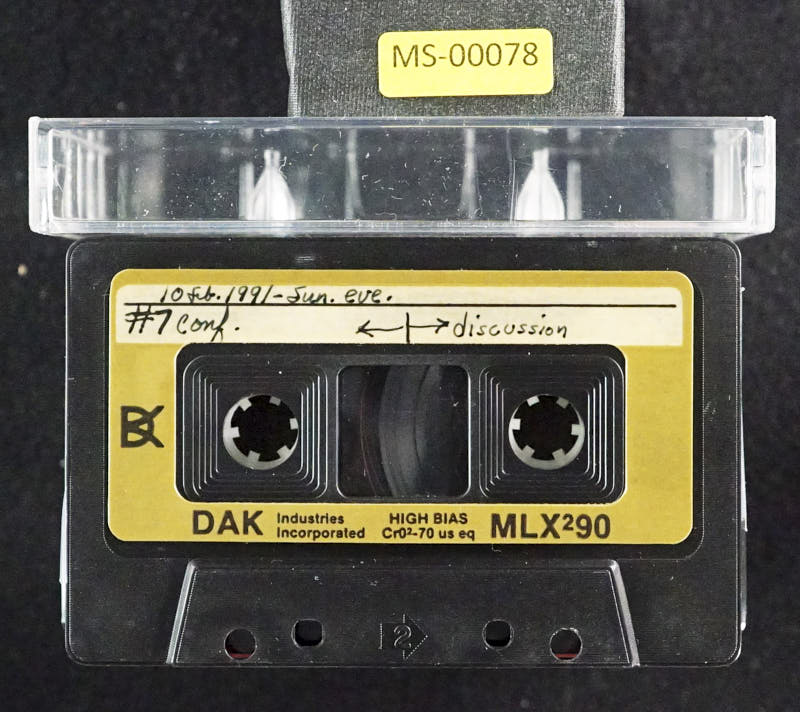
AI Vision - Possible Values from Photos:
Possible Title: Retreat 6-10-1991 Radical Obedience
Additional Text: #6
Possible Title: 10th. 1991 - Sun eve
Additional Text: #7 Conf. discussion
@AI-Vision_v002
So we come to the end of our retreat. And I'd like to leave you with one last word. And that word is a word of hope. Hope for me is one of the most uniquely Christian virtues. Many, many good people are loving and patient and honest and heroic. But to have real hope, I think this is a gift from the risen Lord. And it all starts with his mother. Mary is the mother of hope. And we began this retreat with a story of a mother looking at her son with a long look of incredible love. And now we, her sons and daughters, daughter, might take a minute to look on Mary, our mother, with love.
[01:10]
And if we look carefully, we will see in her a cause for hope. And just for a moment, I'd like to recall the special atmosphere of Advent Because Advent is the season of hope. The liturgy of Advent is about Yahweh's people waiting. Right down to Elizabeth and Zachary and Mary. Waiting. And all this waiting is because they believed in a promise. And so they can wait sure of that promise. because they are sure of the God who has promised. I lifted a quote from somewhere, and I can't remember where. It might have been Henry Nouwen. The root that nurtures the plant is like a promise that nurtures hope.
[02:19]
And that really struck me. I think it's a beautiful image I guess we all have some experience with growing things and we know that for a plant to grow in a healthy way, it has to have a healthy root. If there is hope, there has to be something on which that hope rests, from which it grows, and from which it gains nourishment to continue. We cannot have hope for something that we have never heard of. A promise nurtures hope. And the fuller and the stronger the promise, the greater the hope. As Mary waded through the first Christian Advent, this was the promise that sustained her hope.
[03:28]
You will bear a son. He shall be called Son of the Most High. And Mary believed in this promise, and she assented totally to all that it would mean. In the fourth chapter of Paul's letter to the Romans, we hear the story of another who believed, who took God at his word, and who assented wholly to the promise of God. Abraham believed the promise God made to him. In hope, he believed beyond hope. Both Abraham and Mary were in an impossible situation, and sometimes we are too. The impossibility. of the human possibility. For Abraham, a great nation from a dead womb.
[04:36]
And for Mary, a child from the womb of a virgin. When we take God at his word, we can have hope and we can take risks. We can believe that the impossible can happen. because of God's promises. In hope, Abraham and Mary believed beyond hope, or as the New Jerusalem Bible says, though there seemed no hope, he believed that he was to become the father of a great nation. No distrust made him waver concerning the promise of God, but he grew strong in his faith as he gave glory to God. When I reflect on these texts and the reality that they portray, I have to ask myself, what is the promise that nurtures my hope?
[05:41]
What is the word that sustains me really and truly in the days and months and years of my waiting? invite you also to question yourself, to look into your own heart. And what is the promise which is your hope? I think that Mary can reveal to us three promises that are our promises. From the moment the angel greeted Mary and invited her to yield herself totally to the word of God, she became disciple. She was the first disciple. She is the people of God, the church, us. And therefore the reality that takes place within her is our own reality.
[06:49]
Through the power of the Spirit, she became pregnant with the Word. And this is our promise also. Through the power of the Spirit poured into our hearts at baptism, we also become bearers of the Word. We will bear Jesus to the world. So this is as I perceive it, the first promise that sustains our hope in life. Mary needed a strong promise and she needed to believe it deeply because her life was turned upside down and her days of waiting held very painful misunderstandings, even censure and rejection. In our own waiting, waiting for Christ to be fully formed in us.
[07:55]
We too may experience upheavals and times of confusion and a testing of our faith. Can we return to our heart and remember this promise on which our life of waiting, of hope is based, and then go on with peace and confidence We will bear Jesus. Through our baptism, he will be formed in us. And there's a second promise to Mary and to us, which sustains hope. The power of the Most High will overshadow you. All of us have this power, the power of the Holy Spirit from God. And very often I wonder if we really believe this.
[08:57]
In one of the retreat conferences that Father Michael Casey gave to us, I don't know if you know him. Have you ever, has he ever been here? He's a young Cistercian monk from Australia. Very, very fine communicator. He can really express truth. And he said in our retreat, we don't use the power we have. And I really think he's right. I think each one of us has a power within us by the Spirit given to us in baptism that can do great things, not necessarily in ostentatious ways, but is a very real power of the Spirit. The Greek word is dynamis, a dynamic movement. And it led Mary to leave her security and to run to her cousin to bring the joy of new creation to her old cousin.
[10:09]
And Elizabeth is filled with the Holy Spirit just at the word of greeting of Mary. And she gave a great cry. And someone pointed out to me once that that word, mechale, is from the same root as the word Mary will use in the Magnificat. My soul magnifies the Lord. So these are not timid women, afraid to speak up. But they proclaim boldly all that God is doing in them. They aren't afraid. They express the power of the Spirit at work within them. From this, I guess we can guess where John the Baptist got his boldness of speech. I think he inherited it from his mother. The same power is within us.
[11:13]
We are baptized into Christ, and his Spirit is poured into us. Do we allow the spirit power to move us on? Do we proclaim with joy the new creation happening within us in some way? Not necessarily going around saying, look at me, but look at the wonder that God is doing and then perhaps to share what God is doing within me. good to be a little bold in our trust that God can do impossible things in us too when we yield to him and take him at his word. In this way, Mary of the Annunciation is cause of our hope. By looking at her, we become more aware of who we are, disciples, and of what we are called to become.
[12:23]
bearers of the word. And we become more aware of the promise that the Holy Spirit will overshadow us and be within us a power, a movement forward. And so the second promise, the power of the Holy Spirit will overshadow us. And I think there's a third promise that nourishes our hope The Magnificat of Mary is often compared with the song of Anna in 1 Samuel, and there are many similarities. But there's one great difference, and that is mercy. Anna does not mention mercy, but Mary proclaims the mercy of God. a mercy promised to our fathers.
[13:28]
And his mercy is from age to age on those who fear him. And then Mary describes the work of God's mercy. He uses the power of his arm to root out the proud-hearted and to cast down the mighty from their thrones. No one is mighty but God. And if anyone think of himself as mighty or takes a place over others as mighty, he will be cast down. The empty are filled. The rich are sent away empty. The mercy of God acts according to our need. Mercy for the poor is to fill them. Mercy for the rich is to send them away empty. It's the same mercy, but it touches us in our need.
[14:36]
It's paradoxical, but it is one mercy, and it is a necessary mercy. C.S. Lewis calls it a severe mercy. And sometimes it really does feel like that. But the heart of God is inclined toward mercy. I think we really know this even if at the time suffering and our own vulnerability seem like a big mistake. Often enough, as we wait it out, go through the suffering, allow it to happen, we can even begin to experience the meaning that God has for us, and we can understand it as mercy. We've probably all experienced times of being brought low, either in our own esteem or in that of others.
[15:43]
And as painful as it may be at the time, we also may have experienced being filled with a great peace perhaps a freedom in our hearts that we had never experienced before. When our hands are full, God can't pour his peace and love into them. And so he empties the hands that he desires to fill. And this is his mercy. Whatever else may... captivate us in our lives. In the end, it is the mercy of God that holds us. And I saw that happen once. In the 31 years when this happened, it was 31 years of my monastic life, I had never witnessed a death or a funeral.
[16:49]
That's one of the consequences of being in a young community. When I was at Rentham it was a very young community and now at Mississippi we're a fairly young community. So I've never had that experience and that real joy of being part of the death and funeral of one of my own sisters. But a year ago my brother was taken very sick. He had had a bad heart all his life. He had rheumatic fever three times when he was young. So we all knew that every year of his life was pure gift. He lived to be 63 years old. But he was stricken by something that caused him to go unconscious. And it was very clear that he was going to die. I was supposed to go to Rentham for a meeting in another couple of weeks.
[17:56]
And so the sisters were prevailing on me to go early to be with my brother. We don't necessarily go home at that time. We would for our parents, but at that point we hadn't stretched it out to siblings. So after 10 days of my brothers being unconscious, I did change my ticket. and I arrived at the hospital in Connecticut on the Feast of Our Lady of Sorrows on September 16th. And never having been with dying people, I really wasn't sure at all what to do or what to say, how to be with him. And as I walked into the room, it became extremely clear what I should say and what I should do. All I did was pray with him He was not conscious, so I don't know that if he even knew I was there, although I think he did. Let his mercy hold you.
[19:01]
Let his mercy receive you. And those were the only words that came to me. And when I had walked in, he looked very tanned and very healthy, and he looked as though he could have that up and asked for his trombone and start playing for us. And the next day when I came back, he was entirely changed. He had no color and he was running a fever and he died that afternoon. And I think that he yielded to the mercy of God and I believe that that mercy did receive him. And later, I remembered a quote from Father Lewis that had always meant a lot to me. The mercy of God is like a calm ocean. An ocean holds us up, but it also works on us, on the rocks and the pebbles of the beach, purifying, smoothing out.
[20:15]
So the mercy of God is in our lives at every moment. emptying and filling, purifying, always holding us. And in the end, the mercy of God will receive us. I don't know if you have the same custom in the Benedictine order. I think you do, but we, in the Cistercian order, as we enter into a new stage of our moving ahead with profession, We always are asked by the abbot or abbess, what do you ask? And the traditional response is the mercy of God and of the order. Do you have that tradition? It's really very striking. And I noticed that over the years, we were free to change the response. When a little bit more flexibility moved into the liturgy, we told the
[21:23]
young sisters that they could answer anything they wanted and so for a while it did change and people said something in their own words but now I've noticed that it's going back to this response the mercy of God and of the order and I think it's good that it does because when you think about it isn't that amazing Because that really is all that we ask and all that we need. The mercy of God and the mercy of our brothers and sisters. It seems very right to me because in the end, that is all we have. The mercy of God and of our brothers and sisters. And it is enough for us. It's all we need. In her song of joy, Mary speaks of this mercy as promised to us.
[22:30]
So again, we come back to the promise. God promises to us in the person of Mary, his mother, and ours, that we will bear Jesus to our world, that his spirit will always be with us. empowering us, and that his mercy holds us. Mary is truly mother of hope. In her annunciation, she assented to the promise. Fiat, let it happen. In her assumption, she receives the fulfillment of that promise. And in between, there is hope, a lifetime of hope. I'd like to end this talk and what I have shared with you during these days of retreat with the words that Dante put on the lips of Beatrice and St.
[23:40]
Bernard when Our Lady is revealed to him in the 32nd canto of Paradiso. I think it brings out our theme of looking with love to a point of rest. Look now at the face which is closest to that of Christ, because only its light can prepare you to perceive Christ. I found it, that face, shining with such happiness that nothing I had seen thus far had filled me with so great an enchantment and offered me an image so similar to that of God. O virgin mother and daughter of your son, humble and higher than all other creatures, you are the one who enables our human nature. Excuse me.
[24:41]
You are the one who ennobles our human nature. In your womb, the fire of love was relit. You are for us the torch of love's high noon. Look with love on the face which is closest to that of Christ, because only its light can prepare you to look on Christ. I suggest Psalm 44. and the Magnificat. Any thoughts you'd like to share? Any thoughts you'd like to share?
[25:46]
radio project spoke about being his anecdote about Limey when he took Westminster in the field and one of his associates he was in it a long time he said what were you doing he said well I was just how do you praise well I look at God I look at God and he looks at me this thing came back over the years but I thought that's a succinctly a very good definition of I remember that too, Fred. Yes, oh yeah, I do. In fact, I had it written on my paper, but then I decided not to tell it. Oh, I hate to say. Could be... I hate to say it, 40 years ago. Oh, yeah, I could understand things at one, two... any suffering that Mary must have sustained from the fact that she wasn't married and had a child.
[27:06]
I don't know. Maybe that was accomplished in some way where there wasn't any sexual union, but maybe to everybody else. The names that may have appeared that Joseph and Mary were married. I don't know. There's never any reference to that. I mean, she does have an imagine of the worst community that Oh, I think so. I think they had pretty rigorous penalties for adultery. Well, I think the scene with Joseph or the whole experience of what Joseph went through with Mary's pregnancy, I think that was pretty much suffering for Mary. That would be my guess. Your fiancée told you she was pregnant, but it wasn't by him. Yeah. Right. It would be a hard thing to believe.
[28:07]
Yeah. Took a little divine intervention to get him over the hump. I heard that story from Sebastian from the Courier of Art. It's not an English story. Was it, sir? that there was a peasant in the back of his church, and he couldn't understand what he was doing there all day, and that's what the peasant told the church about it. You've got a good story. You've got a good story. The story about this divine came to America, and he wanted to go to Christ's church. He got into a taxi cab. And he said to me, take me to, have you heard this? Take me to Christchurch and the man got knocked to St. Patrick. He said, oh, this is not Christchurch.
[29:08]
He said, let him Christchurch know what we're saying. You don't hear about hope very much. You hear a lot about faith and a lot about love. And I don't know what put me on to it. But it means a lot to me. Especially in the kind of tough things in life. you face difficulties that you're just not sure how it's going to turn out. I feel that hope has a very important place in how we face the unknowns of our lives.
[30:13]
Not that it's necessarily going to mean everything's going to turn out just the way we want it, but the ultimates, that it will be for ultimate... happiness and ultimate sanctification. Yeah, I always had a lot of trouble distinguishing them. I was going to say maybe faith is more common than hope because for me faith is more sero than what hope is more emotional. In modern America we can't intellectualize it but it's very frowned upon to to wear your heart on your sleeve and say, I'm hoping, and say, I believe. Yeah, that's true. Would you say that hope requires faith? Oh, I think so. I think it's faith that takes the promise, and it's hope that runs with it. Were you going to say something about that before?
[31:16]
I think he has something similar about the three sisters. Hope is a little as well. But she's leading the other two, actually. Uh-huh. Uh-huh. Because everybody can hear something. But when you actually believe it, that's what makes the difference. And that, to me, is the faith. I really believe this. And then to live out of that belief is the hope. To keep moving out of that belief. That's right. That's right. and all the vicissitudes of whatever it is. I think one aspect of hope is anticipation. You know, like you hope for a trip, the thing, on the material model. In some ways, sometimes it's more interesting before the trip than the trip itself. Then there's a question, no longer what you expected, the truth, the reality.
[32:21]
that there was war in the world than the reality. In Spanish, the word whole boat is similar to wait. Oh, is it? To wait and to esperar. Uh-huh. Yeah. What's the word for wait? Expect time. Yes. [...]
[33:22]
But then it seems like thankful and vividness. The only one that remains is charity. Because faith and hope are based on the blindness of them and not knowing. In the end, it'll be just love. I'm in trouble with trying to understand the three promises in regards to hope. In those three promises, there is the fear of the word. The power of the spirit. The power of the spirit and the mercy of God. Hope is pointing toward something, pointing to the promise, pointing to the promise.
[34:34]
That's a good question. First of all, the way I'm saying that is very subjective. I don't say that this is the only way that you can express on which our hope is based. It's a way of seeing things that is personal to me and it's subjective. The way I would express it is that in baptism, which is the fountain of our Christian life, our life of faith, hope, and charity, I see these three things happening. And in a sense, we only know they happen through faith.
[35:37]
I mean, it's a question of belief that we have been baptized into Christ. Christ is living within us, and the features of Christ are being formed in us. We only believe that the power of the Spirit actually is within us as a living power. And that's the promise. that I have accepted this belief, or rather, I believe that this is true, and I'm believing a promise. Now, in a sense, I can't tell you where the promise is stated, so it's not the same as Abraham and Mary. I can't point to something and say, maybe there is someplace, but I haven't dealt into it that far. So I'm not pointing to a written promise. I'm only pointing to baptism and the effects of baptisms. as the promise, we accept the promise in faith, and then our hope is living out of that promise.
[36:39]
Does that make it any? Well, I was just saying that the three promises are all part of the interior, the barrier of the word, the power, and the mercy of God are all part. You might say that an unhelpful person It's a mark of a person of hope. You might say that's part of, you know, we always think the promise maybe is, well, the kingdom of Abraham, you know. But there's also the promise that we've all had, in a way, and said, but, you know, he may be the Messiah. You know, it's totally possible. which is, you know, as you live it, it's being accomplished.
[37:41]
And that only person of hope can do that. In other words, what is it in? I mean, otherwise, what is it in? And what's in for me? Well, the only thing to think for you is to have your personal hope. And the stronger the hope, the stronger the faith, which will in turn make our hope strong, we will be able to do that with greater facility and it will be more a part of us, become second nature to us. You look for something that's out there. The three promises are about something that's within you.
[38:46]
Maybe also out there, but it's within you. Right. And I was trying to kind of put it all together. Father Martin used the image of the seed this morning. As the seed cracks open, you know, it's buried within it. It's not a question of intellect either. It's a grace. How much is it you and how much is grace? It's very difficult for hope. It's hard to talk about it, yeah. That's right. You don't decide to hope. That's right.
[39:49]
You have to cooperate. I think you have to assent. Like if I promise you that I'm going to send you a letter. Well, at that point you might begin to hope that I will send a letter. You believe my word And then you might begin to hope. And if you really want that letter, you'll begin to hope a whole lot. So I think the hoping begins with the ascent, which is the act of faith. And then it's going to be fueled by love. As Brother James said, they're all together. I mean, they're inextricably tied together. But I think we're living them. all the time, constantly. It really is our life. I just think it's good sometimes to realize what's happening, what's going on within us.
[40:52]
Because to me, monastic life is a life of hope. It's a faith and love, too. But if we don't have hope, it doesn't make any sense. Because we'd all we would have had easier ways to live our life. Send him the monastic life. Do you know what I mean in that? Does that make any sense to you? Yeah, yeah. The eschatological, yeah. And then when you, why do you hope to see somebody soon? And then it's because you believe in something, because you believe something, then we love this belief, and then this hope is always there as a parent.
[42:01]
Sometimes people, after they've come to our monastery or speaking of being with another monastery, will say that renewed my hope. I just feel a little stronger in my own life for having been with these people. And I think that's what they're touching into, that our life always points to something beyond ourselves. I don't think they're just looking at the fact that we're living together or the fact that we're praying together. But I think that the life itself points to something else. And maybe that has some other little nuance of a bearing to your question last night, Fr. Martin, as far as what's specific to monastic life. And I think that's part of it. It's eschatological in its being basis. A lot of our old ways of, or I should say a lot, some of our old ways are very much
[43:09]
concerned with vocations and the monastery, you know, some of them, they worry a lot about it, it lasts a bit. Some of them are older than we are, and they worry about it lasting. It's like they just get very tangled up in that. When they come here, that's all we want to talk about. You know, that type of thing. So what do you say to them? No. That's what I feel, you know.
[44:11]
We had a breast man without hurting the air. The whole thing, oh, it's going to go away someday. Not in the air, it's probably going to go away someday. God, it's supposed to be different. It's not forever in there. That is forever in there. But this is really, you know, over a bit. It's less than when you give me the ball. That reminds me of a story. It's not a story. It's just something that an abbot shared with me once. You really have to intend to go there. So they've never had many vocations. The present abbot is a friend of mine, and he told me that when he was first abbot. he began to get very discouraged because I guess he hadn't had vocations for a few years or something and he was worried and kind of anxious and he said one day in prayer he just got this intuition however it came of Christ saying to him this is my house and it will be as long as I want it to be this is my house and it's for my people
[45:38]
and it will be as long as I want it to be. And I think that's all we can say, really. It's not ours. There's the other thing about faith. It's the people that are the Jehovah Witnesses, and people around proving all these things about God. I remember on Christmas, on Christmas one, this photo just came out, and we walked in the door, and we went to the door, and we were all up open presently, and we learned a talk that she wanted to do about the wedding in. And she asked you where his faith was.
[46:38]
You know, you've got to prove all this stuff. Where is your faith? Heaven came back. These things, that was very hard at all. Does he come? Do you have a Jehovah Witness coming here? We do, too. We've met some wonderful people in the Mormons. She's 18 years old. Yes. Yeah. Do they come to talk to you and see if they can convince you of that? Yeah. Yeah.
[47:42]
I like very much what they said, but I said I couldn't agree with the Smith, the thing with the Smith. I think he was kind of fighting too much with the script. It wasn't since Smith. Yeah. I think it was by the name of the drink. That's it. You're very welcome. Thank you very much for your welcoming. I really felt very much at home among you. If you've had women or a woman sharing quite so much of your life before, well, you have been very gracious in making me feel at home.
[48:53]
So thank you very much. You're all brothers. I suppose Morris is going to be leaving for Rochester right after Mass. And I've been asking him out to lunch, y'all, to meet with him in the diocese. He's a liberal warrior for the diocese. But, you know, what's to happen to them? People are eating assets and so forth. And then the legal aspect of the government. So, you say, you're eating all of that? Well, some Jews. Somebody else are relating to it now. LAUGHTER I'd like to be back on Thursday, but I don't. Unfortunately, the only U.S. air flight out of there is 6.15 in the morning, so I think maybe Friday.
[49:58]
But it was going to take Wednesday for lunch. I'm going to fly to Rochester to Montreal. Tomorrow. Tomorrow, yes. No, I'll be back. God willing, I'll fight you. I hope you like Thursday when I show back. That was so cool. Well, he's going to cook. I'm going to cook. That's what he's doing. Yeah, that's what we're doing. Christmas is here. You're a wonderful brother. Somebody's in Thursday and somebody else is right, you know. How about Fran? Oh, my God, everybody's leaving the community. Call me in all of my states.
[50:58]
Yeah, we need to call them. It made a new program for Tuesday. Then the people have any kind of... I would ask if you have to put who's not going to be here, so I've ordered chicken breasts already for lunch. And there's going to be a pizza for the evening. There's 15 or 16 guests. They'll be here tomorrow, yeah. So, that's like a chicken breast for them and a pizza for tomorrow.
[52:04]
And then if I can see, just breathe together. It's so good.
[52:19]
@Transcribed_UNK
@Text_v005
@Score_83.68