You are currently logged-out. You can log-in or create an account to save favorites and more. more info
Holistic Understanding of Monastic Texts
AI Suggested Keywords:
The April 1981 talk, Serial No. 00226, addresses the methodological challenges and contextual considerations when studying monastic texts and traditions, particularly focusing on asceticism, humility, and prayer. The talk emphasizes the importance of understanding monastic sources within their historical and cultural contexts, resisting the urge to selectively read only parts deemed applicable to the present day. It highlights the necessity of approaching monastic writings holistically to capture their true spirit and meaning. The discussion also covers the influence and integration of broader religious and cultural traditions in the early formation of Christian monastic life.
Referenced Works and Sources:
-
The Rule of St. Benedict
Emphasized for its role as a comprehensive embodiment of monastic tradition in 6th-century Italy, stressing the importance of reading it in its entirety rather than selecting applicable parts. -
Pachomian Monastic Community Records
Discussed regarding its distinct lack of Greek philosophical influence, providing a more direct view of monastic life as experienced in the fourth century. -
Nag Hammadi Library
Cited as an essential collection providing insight into Gnostic texts and its historical discovery, opening discussions on connections to early monastic locations and traditions. -
The Desert Fathers and the Life of Antony by Athanasius
Referenced to illustrate the early monastic ties to Christian martyrdom and the ascetic lifestyle's intrinsic witness function. -
Epistle to the Hebrews (Hebrews 11:37-38)
Quoted to underscore the continuity of monastic life from Old Testament figures to Christian martyrs, aligning the monastic journey with longstanding religious witness.
These citations provide a foundation to understand the interconnectedness of monastic texts with broader religious and historical narratives.
AI Suggested Title: Holistic Understanding of Monastic Texts


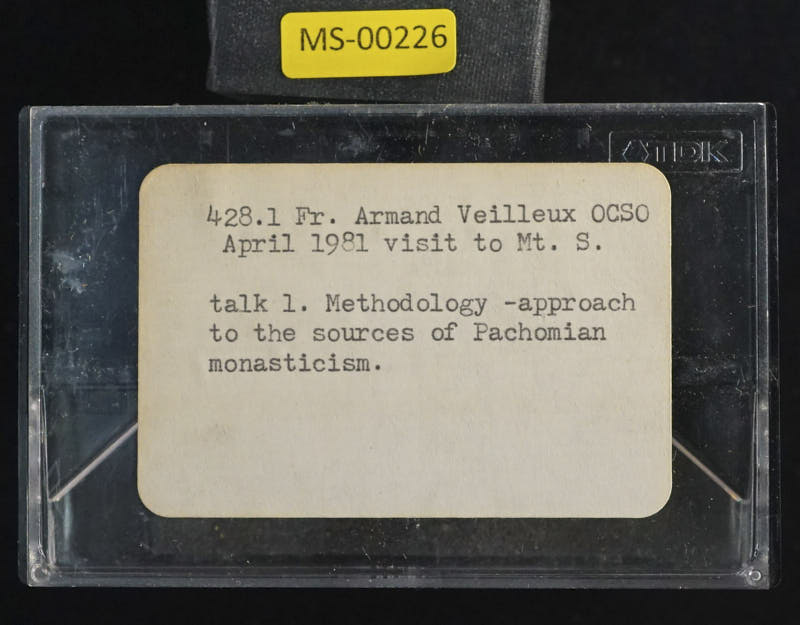
AI Vision - Possible Values from Photos:
Speaker: Fr. Armand Veilleux OCSO
Location: Mt. S
Possible Title: Methodology - Approach to the sources of Pachomian monasticism
Additional text:
@AI-Vision_v002
For the greater few days, I'm going to be with you. I will speak about the . And in the literary school, I've given me a long list of questions to figure out. I want to be able to speak to all those questions. First, because I don't know all the answers. And second, because we want that to find. I try to organize groups for various projects that we're going to do. One of the three types. One will be asceticism. The other will be community. And the other will be prayer. But before I started to deal with those trick topics, I would like this evening tomorrow to give something as a kind of introduction.
[01:16]
This evening about methodology, because I think most of the questions, many of the questions who are given to media, really said methodological questions, how to approach the mathematics courses. with what we might have, what tools to use. Is it right to compare, to make comparison with Takunis a projection? And did we do it? How do we do it? And also, I would like to Mauro to sit with you again, and I know you know that, but to place Takunis in his historical context. He belongs to a long history, a long tradition. It's just one. The other is that long monastic tradition is part of the long recording, and this is what they do with it. So I'll just sit with the community and this type of monastic body within the problem, not the context of monastic tradition, but tomorrow.
[02:26]
This segment, I would like to see how personally I approach monastic tradition. I think elastic life is something that we know about experience. We learn about experience. We don't learn elastic life through writings or through talks, being good, or listening to lectures. But we learn what we got through our own experiences. We may talk about it. We may write about it. And I think it is important we may read about it. We know it only when we live. And it is in our living that we are new. And we know it in as much as we live in this country. Now, all those needs that we take now, we become more not aware of our own and we can live in this country.
[03:32]
So in order to live consciously, we need to be comfortable with us. And so within our life, we need to be confronted to other people who are . So it is in the process of formation. And when one needs in charge of formation, it's about to fill the They're not just like a recipient who filled with knowledge, but to help them become more aware of what it is, what God is calling it to be. We learn, and learning the first time at the top, we learn this Christian life, according to the holistic way of life. So what they go to go back to people like ,, or ,,
[04:36]
of the early fathers that we read about it, it is to be exposed to a deep, magnetic experience. I want to live, essentially and deeply. And as convict to us, or somebody walking about this convict to us, is experience. And that will make something else. a wicked cloud that we are with. The classic light is something that has been lived long before us, and we could have lived long after that. And I would want to guide the personal cloud from God that we have to listen to . That cloud comes to us through attention. People who have lived in this minister here, where we are, people who are living there with us, but also the several generations that have lived that one of the people.
[05:51]
It's a part of the great tradition of the church. It's a country in your prediction of the gospel. I'm not just a Christian. And so it's a man who has received the Christian call to live in this Christian life, according to this . So every religion tradition is a concrete legal interpretation of the gospel. In each one of the aspects of the tradition is a legal interpretation of the dimension of the gospel. which is the path to the perfect life, the life of contemplation, the life of solution, the life of seeking death. Each moment of abolition is a moment of the dialogue between God and his people. So the path of God is always coming down to the world.
[06:54]
Human beings are pursuing this path. And through their life, through their lived exterior, Transmit this call to public. So the call I receive is both the call people before we receive and their answer. And it is in their answer to the call we receive that I receive the call. And then I add through my own answer to that to transmit the call to other people. I don't have to be simply the author. I think there is a sense that I have learned to have read things about realistic life, and then I got the idea. What I got with my lived experience, I received the job, I lived it, and in as much as I lived it, honestly and sensitive with them, it would be a part of it. But if I know that lived it authentically and deeply, it won't be a part of it.
[08:00]
So when we go back from the back, I think we should take this history up as a whole. It would not to let something come. We're not going to go on to read a community, the rule of life, in order to find some . Or some . and to be in the restaurant because it can be useful to them. Because then, we look for things that we think are useful. So we are in our choice before beginning to be. And we are interested and edified by the things that correspond to what we are expecting. But we should take that as a whole, and then they are needed in all the aspects of their life. And it's . is a global answer to all of God. That's the reason why I think that if you read the ,, we should read it conflict.
[09:18]
And I personally that can be . But I am against reading only because of the rule that we find can be applied today, because there we make the choice to subject the choice. And then we can consider the rule as something that can be a country description of our life today, and cannot stay with the rule as a meeting, because it is the incarnation of the monastic heritage within the complex of the Italy of the sixth century. And it doesn't mean it as such. It is the incarnation of monastic tradition in one very, very specific period of time, and one very, very specific geographical area.
[10:25]
And then, if we take it as of all, And then find its soul. And then try to apply it in our own context to this. But we will discover that only it could be all of the elements. It could be about prayer, about food, about coaching, meditating, absolutely. But it is that form that can't be a spirit. And then we have to reinvent that spirit in very different contexts. And perhaps we will keep many of us practicing a little bit. Perhaps we will keep very sure. Perhaps we want to . But the important thing is that through that all the ourselves of . And we will reinvent it today in our .
[11:26]
That's the reason why it's very difficult to make a comparison between the, let's say, and another . Because the way we make those comparisons, there are various approaches we can use. We can use the . And what is the idea of . in . What is the . What is the difference? But then, with that approach, we can compare with the , with the , with the . Because always, it will already be . What does that bring? Because in order to understand what is the conception of contemplation, we have to take it all understanding.
[12:39]
The other approach is the global. We have to take the full approach to life, to God, to man, [...] to man. And compare it to the full approach of God. That's not who can be gospel. use various approaches, and not to make a global country. And what is the use of that? First of all, I think there is not you, because what is important for me is to be exposed in all this life, this mentality, it's approachable, and then perhaps we change. And the only comparable result I would receive my own talk. Then I would be exposed to the spiritual experience.
[13:41]
And then there is really a contact relationship established between him and him. There is, of course, the possibility of textual approach. Is there a connection between the writing to this author and that author? And that can be very useful to help us to understand exactly what this author or that author learned. If we are using the same source, or if one is using the author, then I would be able to understand more precisely what it means when you see this person. And that's a lot of aspect. If I want to be exposed to the experience of the family fathers, then I have to pay the price.
[14:44]
I have to pay the tools that can make it possible to me to get in contact with their spirit to the one, which is not it. If I take any of the author, let's say caption, and I write the video, and I open the book of caption when I stop reading, without any preparation, I can find a lot of people can be used by what I want to read caption. I will read myself. I will read what I discovered there. will be what I want to discover. But in order to read ,, I must study . Because when we use the word contemplation, all the word I could like, perhaps he's saying something very important of what I understand, what I use that word to do.
[15:47]
So I have to understand what was meant by people who use that word. during that period. And so on, I have to know the whole historical context. I have to learn how it is dependent on that other church. There is a technical tool. We are technical tools to begin. And if you don't have to find more to rest your youth, I think we're sure that speak really about . And in that area of comparison, Father Victor mentioned the connection with the Gnostic lottery of .
[16:50]
. I don't want to know very much about . But I would like to say if you were listening about . Because this . I'm working with the team at Laban University for the publication in . In relation with the . I don't know what it is in . which is the other name for .
[17:52]
It was the place where . The place where . And that was one of the most important monastery . Now, in 1946, they discovered in a cave in a few months, less than a month, from the monastery of . And just a few months from the great monastery of ,, the mother of . They discovered a series of books, which from those old library of . So we knew about it less as unique as a sect in the early church.
[18:56]
But we knew very little about it up to that time. We knew about it only through illusions made by and so only the negative aspects. And too much . And so it is a tremendous discovery for understanding of religion, because it was not only a sect, but before being a sect, one of all the trends, which was spread throughout Judaism and throughout the people .
[20:00]
And then what it became a system . But for the first time, we have collection of . But since they were gathered together as a library, . Now, this was discovered in aborigines near the . It was . Was it the doctorate of the . Has it anything to do with the . And those manuscripts go back to the fourth century to the time of .
[21:05]
A lot of theorists elaborated about that. One in addition is that The letter which is inside the cover, there are several layers of . And they used to So when they .. They found that one of them was a .. And one is kind of bookkeeping of the ..
[22:19]
. So . Does that mean that the lottery came from the . I don't think it's . But those are the only editions we have. Now, about the . The is very concerned about the orthodoxy. And . There is a real opposition to . But how is it possible that whether we end up there? And I began to study that person, but I have not yet.
[23:25]
In the books, you know, there is a mention of the other monastic communities. In the same area, obviously, there were several other communities. There were elastic groups as we see from those texts at the same time. So is it possible that those .. But from the .. up to the death of , up to . But after that, we knew about .
[24:30]
And from other very few sources, we know that . And then they were persecuted. And in one of those periods, it is possible that one of the . And the other possibility is that We know that after the ,, there were some crises in . And ,, who took the course years as well, to reestablish peace.
[25:36]
But then, it seemed that there were . Maybe one of the . I went through the last six seconds. So we know practically nothing about a real connection between . All the negations from the . We should be aware, I think, of people who make too easily to connect . I would like now to agree with the of the . I think that will teach us also a lot about how to .
[26:45]
how to consider the place of classic life in the old tradition of the church, and more like that, in the old history of salvation. The word of God, at the beginning of life, the text is practically the same in the Catholic life, in the Greek life. The word of God, who made all things, came to our father Abraham And Paul came to sacrifice his promise. They start with the Word of God. Paul is a critic of God. And then the Word of God comes to the Word of God made out of it. But the Word of God is creation of all things. And then the Word which is addressed to Paul Paul Adrian, beginning of history and salvation of the people of Israel. And he said to him, I will shower of blessings on me, and will make your descendants as many as the stars of heaven.
[27:54]
All the nations of the earth shall be blessed in your pursuit. The beautiful picture was the salvation of the word of God from the nation, Abraham, and the blessing of all the nations. And after all, Abraham, the word of God spoke to Moses, his prophet and servant. and to all the problems. Then he appeared, and spoke as not, as the seed of Abraham, for he had promised to be a blessed population. And he commanded his disciples, all nations, the blessing of any father, and the soul, and in the original plate, just one second, one page. complex in the view of all the dimensions of the word of God, creation, the eternal creation, Abraham, the prophets, Jesus, and Jesus who sent his disciples to all the nations of the world.
[28:59]
Then the gospel is spread. Then as his gospel spread throughout the world, the old Lord, by God's permission, and to put faith into the test, take it up first, stir it up, The persecution against Christians everywhere against the gospel is the right that persecution against Christians. Many martyrs offered themselves to various structures under that and received it from .. That faith increased greatly in the holy churches in England. It's very important to see the way they make the religion the first markers and the first months. Because we often hear that after the period of the markers, because markers are no longer possible, that ones want to test to replay the markers.
[30:10]
This image is not here. Yeah. Just almost the opposite. Well, in this kind of ,, we have seen things . But as some basis ,, because the church had become lukewarm after the ,, say, the . But here is the opposite. You see, martyrdom brings . And monastic life, the beginning of the life, is considered as a proof of . Many doctors operate on the mission. They're failing to increase greatly in polychurches in the area. And monastic reason places where facilities begin to appear. For those who were the first ones, can't see the entrance of the marches. But they weren't much at the time the doctor opened it. But we see, for example, in the life
[31:11]
with Anton the Athanasius during the time of persecution. And then it goes down to Alexandria with his disciples. And he wants to become martyr. And of course, for the teaching of the bishops, he will not offer himself to martyr them, which will be considered as a . But he goes to the poor to go to the place where Christians are tortured, maybe martyrs or something. So there were martyrs. And those martyrs, they self-injured martyrs. Therefore, they revived the conduct of the prophet Elijah of those of whom the apostle Paul said They were not treated .
[32:14]
That's a text of Hebrew. Chapter 11, which is quoted very, very often. The epistle of the Hebrew is describing to that text the martyrs of the Old Testament. And the Christian minds always sucked into that text the description of with the life of their ancestors, the photographs of the prophets. Elijah was supposed to be one of the ancestors of the monks. Then they offered their souls and bodies to God in strict assesism, and with the shippling parents, not only because they looked they are not to the holy trust, but also because they saw the martyrs take up their squibbles. So the fact that these Southern actors could be so trickled in their troubled, it encouraged them to become more and more fervent in their romantic life.
[33:21]
They saw them and such was the virtuous life of our holy father, Abba Anthony. We have an old picture of the creation of the world, Abraham, the prophets of the Old Testament, and their witness. the Christ and his teaching, the apostles and their teaching, the spreading of the gospel, then the witness of the martyrs. And then the Christians, the monks, are encouraged to be witness also, to their life, to their ascites. But ascites is not understood as a small martyrdom, a small type of witness. But as a witness, it is a A consideration of martyrdom, because it is a witness. When we hear today, they were martyrdom. They needed to be about torture, about suffering. But in that time, when they heard the word martyrdom in Greek, they were thinking first of witness.
[34:28]
And martyrdom is a witness. And the word was more and more reserved to do to witness to the death of the curse than the dish. So what they might say that they want to be mindful, they said that they want to witness the cross for their whole life. And that implies that without education, that the word . Such was the life of . Then he speaks about ,, the brothers living in the mountain of ,, which is ,, but there were also the monks of . Theodore's disciples. Then he says, the other view, in Egypt and ,, there are not many of them .
[35:36]
up to that time. But there were months before the land of that period. It was only after the persecution and the theotation of Maximus that the conversion of the pagans increased in the church. With the bishops leading them to the teaching of the apostles, they brought forth virtues, fruits of the Holy Spirit, and they became brothers of Christ. Beautiful word of the whole Christian community. And then the next sentence, There was a certain . I think it's very difficult to see how the author of the fourth century is replaced in the context of the whole story of salvation, of the salvation brought to all the nations, and is shown as a fruit of the holiness of the local church. And that's a reaction against ,, which is kind of this, but .
[36:44]
So I think that is what I said at the beginning, that is one expression of Christian tradition, is one in which the the message brought to us by Christ and by the first disciples of Christ has come down to us. And then, in the beginning of that text, there is a mention of the Word of God speaking through the creation. So I think we should also is that it's not something which is specifically Christian and not proper to do with Christianity, but is found in all the great cultures of mankind, nowadays, sex-wise, and long before Christ. So when the Catholic Christian went into the desert and adopted this way of life, they were answering a call that they felt in their heart.
[38:01]
that came to them through the witnessing of the first martyrs, through the gospel message to the writings of the Jews. But in answering that, they used the forms of life that had been witnessed to them through the oldest of mankind. And they had seen them not. They had seen them not. They had at least heard in Alexandria about the .. They had heard about the .. That was one way of life that was used by the .. It was used by them to answer .. And so in .. can see also that in trying to find the will of God, that was the continuous preparation of the community, to find the whole will of God on this community.
[39:18]
They were listening to all the channels through which God is speaking to them, through their own heart, through the the witness of the authors, but also through the history of mankind, through the Egyptian witness. We see that is inspiration also in the old Egyptian witness, . And then human . Is there a question? Yeah. We said that the colonel officers were destroyed by the . I mean, the idea is that we're destroyed.
[40:24]
I realized that there weren't attached And a lot of turmoil came from that happening between the . One of the other was . Just a day before I came here, Mr. James was in charge of the .. English publication of the text that made all the excavation . And it said we copied the people in the museum kind of used to speak about the invasion of by the drone soldiers.
[41:30]
And I don't study with it too much, but it is one text. Very old text. And the other text that mentioned the tax that was collected from people to defray the expense of the massagers living in the . So there was a . The technical work with this section of ,, that was living at the time within the . Coming back when 3, 4, 6, . And RCS is .
[42:58]
after . And then the redestruction of the at the time of . Yeah. There were other . Yeah, well, the . Yeah. Yeah. So it was still . Well, you know, to the publication, I'll do what's . OK, the probably different orientation. And the very . with arms against the division.
[44:01]
Because when the organized personal division was a part of the much larger movement. The tribes were in one place to the other in the east, something very similar to the division material, but successive to waves. The tribes, the same thing, the eastern part of the Africa That's the thing. We know almost nothing . And probably searching to unpublished manuscripts to people . That's it. For the idea is it true that a lot of candidates came without that?
[45:30]
Yeah, and . . People talk into that. We want to talk that way. Absolutely. . It is true that a good number of disciples came directly to Christianity so that their entry into the Monastic Life was their entry into Monastic Life. And their initiation to Monastic Life was at the same time to their initiation to Christian life. And they were prepared for baptism in the history They were for a few years.
[46:34]
And every year at Easter, there was the general of all the . And every year, all of us will gather for Easter to celebrate and then in the Easter I think that the monastic community was an answer. It was the consequence of that. And that was an expression. And that expression was attracted people.
[47:35]
People were attracted to live that life, which was a witness to live that world. Because they found it was a beautiful life for the charity of the shivering of the common service that came to me. For example, what is He's converted because he is put in contact with a lot of Christian . And he's made a prison to become a soldier of the Roman army. So the young people, their colleagues, prisoners, who bring them to the . And the soldiers are And the Christian of that place, there's a Christian community in Thames.
[48:37]
And they come to the jail and they bring to a prison. So he's told that they are Christians. And they do all kind of good things to everyone. out of the .. .. And he would promise that it is freed from that captivity .. And then he promised that he would say .. Until that time, all his seeking would be to find out to serve him. And his founding of the domestic community would be an answer to that, to will to serve him.
[49:40]
And then, for him, the image of Christianity has been his first image, and that would remain always. His image of Christianity, his mutual service, is how to live in action in some way. something . And so immediately, when he is three, he goes back to ,, and he starts at the first village where he meets a bishop and decides to live there. And he lives in the outskirts of the village. And he stood to . And right from that time, people started coming there to . And people started to live around him because he was . And then later on, he would become one. He would grow and would be born by the Old Mount Paladin. And after six, it would be three years, which is seven years under the formation of Paladin.
[50:42]
And then he would be . And as soon as he's dead, people come to believe that . So it is always this crucial charity that attracts people. evil will be established because they find their expression of the Christian life. So they come there to live that life. And that life happened to be a monastic expression, first of all. And so to become Christian and love at the same time, they have not been about Christian life, about this . You just saw a bunch of people living along .
[51:46]
The company, N-A-G, . Which one? The big one? The big one? Is it? I didn't look up and I saw . So under the . a group of people that have made the translation of all those groups. And now they are doing the addition of each one of the groups.
[52:51]
That one was great. has to be correct in the many ways. But the idea was to make those texts available to people as soon as possible. So that's the idea to make a two-spirit way of the book, and to be on the edition of the book in one book. See, so I discovered it in 46, but... The history of that discovery is about the same as the history of . Practically in the same way, by a young shepherd with that all too much at once. And he brought some of those . Some of them were used as . And then he moved on to a somewhere that was so
[53:53]
And I think we realized it was a bit more than . One of the transport to Europe and was moved by . It is back now to Cairo. But as long as they . The one of the of the foundation. One of the is . And it was very great to respond with . So it is . So they brought . And then others were gathered .
[54:56]
But there was no . It was published in photographic edition in the late 60s. It is only in the 70s that they started to publish the taxing of the edition, photographic edition on the . But with the U.S. government, there is only a . So the first . Now, there is a . The potential also would be . So that will be the diplomatic division with the logging production.
[56:20]
. But all the people who were paying of that collaboration with other publications that sent the attention to . He was a cat, an immune only cat, from Paparajit, and Paparajit was very catwalked. That's the difference between them. It's very important to know that . What we call the operation is, if you look at the map, is the .
[57:25]
Yeah, because you have that bit there on you, and then . See? You can see? You have a . This is . And so this is called the lower region, because it's lower toward the sea. And then people are away from the sea from the upper region . They have to go . And so here you are Alexandria. Alexandria is the very large city. It's open, that's a seaport, open to ships coming from all the countries of the world north at that time. There you have all the religions, all the cultures.
[58:28]
It's basically a Greek city, a Greek language, and open to all kinds of philosophical and religious and culture. Then you allow the monastic life the nuclear nuclear, nuclear, and the cardiac cells. That's what's in that room. It's there. So the ones that are here will be influenced very much by the school of Alexandria, by philosophical and theological reflections. Most of the response are ignored. But along them, there are a few very, very young people who will learn the same experience, will be formed by the experience of all those illiterate ones, and will reflect on that experience with the tools of the neo-realization philosophy, and ,, that they will become .
[59:45]
and they are always in. Now, Egypt is a lot of mine. You have a little stretch of land on both sides of the land, which is for time, when there is the rising of the water. If one year you don't have the rising of the water, you have the rapid, you know, but they may get broke. I mean, there's seven years of the stretch of it. Seven years, I mean, you see, from the body. And as soon as you grow a few other yards from the line, you are in the mountains. And then there is that they grow, so they call it the desert. So when they speak about desert, that means they go backyard. A few other yards from the village. And they have the same way in counting for mountain, desert, and cemetery, because they live very quickly. And those nations were very, very poor at that time. They were small .
[60:47]
Many of them were abandoned because . And also because of the exemptions of . And I think we were there only to get food and to get the meat and get the tax. And we both . So that was very poor. And there were very, very cheap . It was very rare to find anyone there to learn to read or speak to read. So they were probably captured. But so was born in one of the .. And yeah, we sleep here. I don't think there is no evidence that he ever went to .. That's it. And this is important to know that the main characteristic of is that neither in its origin nor in its literary expression was influenced at all by philosophical thinking or theological thinking.
[62:12]
So all the other monastic sources are ,, which is the tools that allow them to make up the . But then it's very difficult to distinguish between the experience, the monastic . And on the other side, it's the elaboration on that. The charism is always presented to you in those sources, wrapped in philosophical elaboration. But here, because of that lack of ,, you have the charismatic experience in its puberty expression. It is poverty, too. Those attacks are. are that very rich text.
[63:15]
They are very, very simple description of what happened, how they did, what they did, in a very simple way and . If you look at the city quotations from this culture, any other text would be much more in the writings in the letters. at the end of my turbo-level
[63:43]
@Transcribed_UNK
@Text_v005
@Score_84.85