You are currently logged-out. You can log-in or create an account to save favorites and more. more info
Freedom's Call to Love and Serve
AI Suggested Keywords:
The main thesis of the talk is the moral responsibility of using one's freedom to assist others in liberation and the notion that ultimate sin is the failure to use this freedom in the service of love. The discussion explores the complexities of freedom, guilt, and moral accountability, emphasizing that the most severe crime is having freedom and failing to engage in acts of love. It also critiques society's quick judgment on individuals without understanding their restricted freedom and promotes the act of seeing and nurturing goodness in others.
Referenced Texts and Concepts:
- Biblical Narrative: Peter's refusal to allow Jesus to wash his feet during the Last Supper is discussed to illustrate the resistance to servant leadership and the transformational power of accepting love and service.
- Paul's Letters: The speaker references 1 Corinthians 13 ("Love is not resentful, love is not irritable...") to emphasize the attributes of true love and the responsibilities attached to freedom.
- Pope John XXIII: Cited for his ability to find goodness in every day, even in the face of terminal illness, illustrating the power of habitually seeking and recognizing goodness as a form of faith.
- Salvation History: The speaker alludes to the unexpected delivery of divine gifts, exemplified by Jesus, showing that divine salvation and insights often come through unforeseen sources, urging openness to them.
The reflection insists on the critical examination of one's freedom and challenges individuals to use their liberating experiences to free others, suggesting a constant and humble application of love and service in daily life.
AI Suggested Title: Freedom's Call to Love and Serve
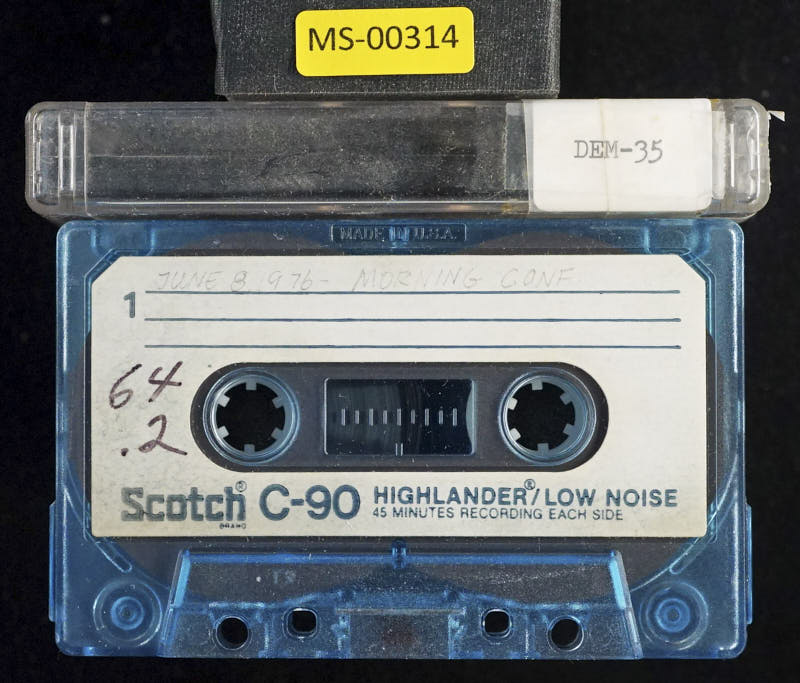
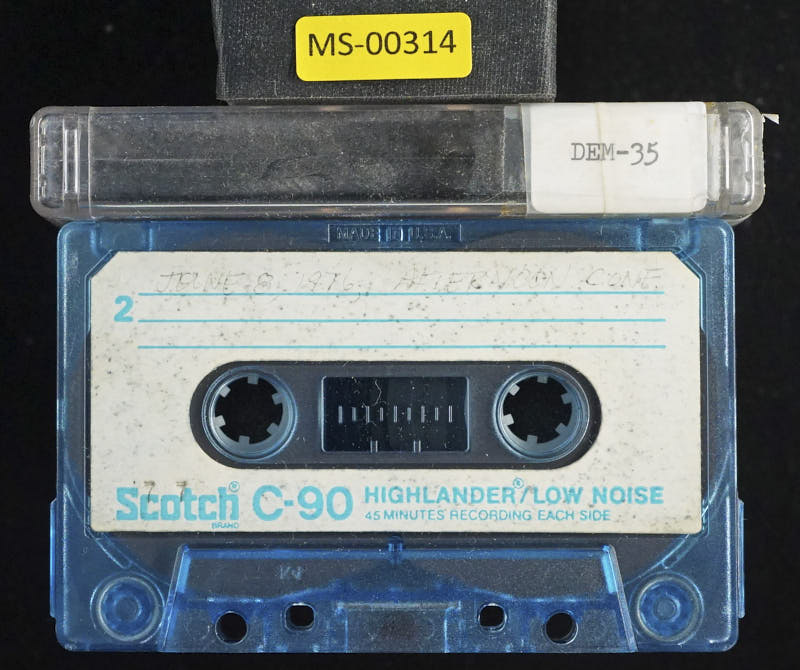
AI Vision - Possible Values from Photos:
Side: A
Possible Title: MORNING CONF
Additional text: MS-00314, 64, 2, Scotch C-90 HIGHLANDER/LOW NOISE 45 MINUTES RECORDING EACH SIDE, MADE IN USA
Side: B
Possible Title: EVENING CONF
Additional text: MS-00314, 2, Scotch C-90 HIGHLANDER/LOW NOISE 45 MINUTES RECORDING EACH SIDE, MADE IN USA
@AI-Vision_v002
Two talks from this date.
Lord, Father, we ask you to put so kindly upon us. Help us to understand and discover that our obligation to the responsibility of the light is not required to gather an opportunity, lest we pass through light. and miss the goodness which you put there for us. Be at this in truth. Amen. I mentioned this morning that there are always indefinite ramifications to the principle that the ultimate moral and clarity and the ultimate responsibility for anyone who has gone through a liberating experience in any way saving experience is to use that freedom that God used it to bring freedom to others one will be held accountable for this use of freedom
[01:27]
and what will be held accountable according to the exact measure of that freedom. And so it is impossible to determine now who is more or less built, because it is so difficult to know who is more or less free. There are some people who commit crimes who have part of any freedom. Many crimes are not safe. Many sins are not wrong. Very important, I think, for us non-criminal people, to understand that. Because most crimes are committed by people who have very little freedom. People who have been tried. Most spectacular crimes are usually committed by people who should be in trouble to look at
[02:30]
childhood, some of these things. Now God knows what has happened to them. He knows. And he knows also about the freedom of those others who sit before their television sets and pluck their tongues at these women, these delinquent Why don't they crack down on them? These three people. Well, God will ask them what, I think, what did you do to treat these people? What did you do to give people more confidence, to deliver them from their fear and anxiety so that they would not be driven to violence? What are the plays for you?
[03:36]
Get your picture shot. No, I think it's very clear. And, you know, it's impossible for us officially. We're very free to be clear. I look at this crowd, boy, free. Man, good parents, good teachers, good friends, good community. We've had a lot of love to share and affirmation. Oh, we're not completely free. Wanted hangups yet. But relatively speak, we are very free people. But it seems possible almost for us to understand how unfree some people are. I recall an incident that developed this for me. Glenn picked up Florida. were having committed murder, so it would kill a gas station operator or a robbery attempt. He texted the police station and he signed a confession.
[04:47]
I killed him. Well, some time later, when he was waiting to be executed, somebody else confessed to this crime. Well, unfortunately, it's inconvenient development. It's all for me at this point. Then an enterprising journalist began to check the end of this thing, found that through all kinds of inconsistency in this man's version of what happened. Well, to make a long story short, it turned out he had not done it. But the interesting question is, if he had not done it, why did he confess and sign a confession that he did it? Seems it's reasonable to us. Well, he said, when they asked who that didn't go, this policeman picked me up and took me to the situation. And he said, you criminal, you did it. The man, the policeman, he said, you did it.
[05:52]
But the lawyer said, you did it. But even my lawyer thought I did it. Chief Lawyer I did. Run up to that poor crew and they all said, you did it. So I must have done it. So I must have done it. Well, you know, to me, this is not a frightening thing. And it's a true story, of course. But there are people who are so unsure of themselves, so much involved, that they don't even know for sure what they did or done. That's going to be, for God, to understand why it's going to be very merciful to these people, even though they may be criminal to panic. And they shouldn't be panic, like this saying. It's not quite that simple. But we have to ask ourselves, of our use of freedom, do we care for the wayfarers, the widow, the divorcemen,
[07:02]
all the vulnerable people? Or do we take advantage of their vulnerability and their weakness? Do we allow this destructive competition to destroy the possibility of the community action? Competition. Well, if I harm this person too much, that'll put me in jeopardy. No. I'll lose too much if that person gets too strong, so I won't come with anybody too much. No, we're going to have to ask for freedom. And so I would say that the great sin, common sin, the ultimate sin, is to be free and not to lie. Now, it's something to say about what's not in the name that doesn't even go in our own hands.
[08:05]
It may be a time for that. It's lovely to say the Bible I understand is very unromantic. 3, 10, 13, Paul, what it is written. Nothing in there. Childhood, not material at all. Love is not presentable. Love is not fearful. Love does not rejoice in evil. Love rejoices in the good. You can't make a movie out of that. That means that kind of thing, very ordinary things. Resisting temptation to not to find goodness in others and so forth. So the great sin is, of course, to have freedom, which is a gift. And to point. not to use it to allow others to be free, not to use it as the source of freedom.
[09:10]
And there is another sin which is very close to this one and needs to be mentioned, I think. That is, it is sinful to be in bondage and not allow oneself to be loved. It's very possible. It is not true that everybody wants to be loved and wants to be free. Not in a responsible way. Everybody wants to be loved as a child of luck. Luck, not a way. As soon as one begins the sense that, well, now, wait a minute, to find luck and freedom, I'm going to have to start loving people. I think I'll pass. Now, I believe that this part of that very interesting conversation between Jesus and Peter, when Jesus tried to wash the feet of Peter at the Last Supper. He said, you'll never wash my feet.
[10:12]
Oh no, you're the master, I understand, I'm the servant. And next, later on, I'll be the master of the servant. So we've got to keep these things distinct, because I want to be master someday. In effect, you've got to be... Very human. Peter was human above all. So you shall never wash my feet. Jesus said, look, if I don't wash your feet, we're not friends anymore. Well, I want to make an issue up. Wash my whole body then. No, no, Peter. It's a symbolic action. Only your feet didn't be white. Oh. Now, I think Peter discerned very clearly. If I allow this Lord and Master to wash my feet, what does that mean?
[11:14]
Well, that means I'm going to have to spend the rest of my life washing feet. I'm not going to ever graduate from this school Well, I'll get my feet washed. No, I'm going to spend the rest of my life washing feet there. You know, that thing is graduating from the surrogate hood. No, no, I don't like that. Then he said, yeah, all right, I understand. Then Jesus said, do you know what I have done? If I have washed your feet, would you not also wash the feet of one another? Exactly that. And so, When one understands that being loved, being free for service, what compared will side to side, well, the easiest way out of that is, you like to be loved. No, I'm sorry. But to understand I'm unlovable, for goodness sakes.
[12:19]
Unfortunately, there are people like that. They challenge you to try to love you. trying to do something, I don't mean love, but gushing away, but trying to be nice to them. But I really think that this is the kind of tragedy, and of course, it's much harder for the person to keep trying in front of everything. Well, I think the person who has slipped into this philosophy ought to know it's been disagreeably said, get that defensive attitude that nobody's going to make, nobody's going to make the mind no good. Nobody's going to get missed the other one. That prevents the very possibility of freedom. I didn't expect that one is responsible for that, and one can be committed to it, but if that tune is simple. Now, how could one translate freedom into loving?
[13:25]
Well, of course, it all depends on the nature of the bondage. How one loves another person's freedom depends upon the nature of that person's bondage. The first thing, of course, is to be aware that there is bondage. It allows the possibility of it. Then you try to find some way to deal with it. But to speak in a kind of a general way, I would say the first obligation of freedom is to choose freely to give the benefit of the doubt to goodness in life. Choose freely to give the benefit of the doubt to goodness. Most of life is evidence.
[14:33]
I'm not quite sure what it's clear. I don't know what proportion are exactly like. I picked up them 10% and everybody knows it good. Even the tech means cheap. Sunshine after a lot of rain. Fun after a lot of fun time. Vacation after a lot of school. you know, food after hunger. There may be no left to it. But then there's about 10% that hardly anybody can read D. I think there would be more fewer than 7. I think there's about 80% that said that... ...the other day, Z-57, the other day, might be a decline. A little better. But the great majority of... ...situational kind of digits. Well... It is simply not possible to look at that and say, oh, that's good, of course. Well, because it's not good.
[15:40]
It's not simply good. But it is possible to choose, to look at the good side of it, to see the goodness in it, to give the benefit of the done good. to be prejudiced for the goodness in life. I think in the beginning, for one who has perhaps only a little bit of freedom, it means simply to be ready and open for goodness, to allow goodness to be. And so it counteracts that tendency to reject favors and compliments, or at least not to receive them in a way that is helpful and useful. It is open, ready for goodness to manifest itself.
[16:44]
And when one becomes a little more free, and by the way, receiving this goodness that is offered is a classic way to acquire more freedom. And when one becomes a little more free, then one gets a little more look more courageous to get to actually seek for goodness. To seek for it. Look out there and it grows. Look goodness there as far as I can see. Of course, we'll always have a Greek chorus over on the side saying, It is all equal. That's always there to remind you what it's taught to do. So you have to kind of put that out of your mind and look and begin to search around for goodness. Heart over stone, looking for it. And then finally when one has become expert at that, one requires a kind of deep conviction.
[17:55]
Because this kind of search will usually be successful. This will lead to a deep kind of addiction, which can then deal with that better set that seems beyond redemption. And that addiction is knowing, being certain, that goodness underlies everything. Goodness is under the surface of everything. even though it does not always appear. I think this is what St. John referred to in that text of me recall of the old ministry of Whitsunday. This is the victory that conquers the world, our faith.
[18:56]
world, for John, is this philosophy of negative, pessimistic, cynical, unknown. This is the victory that conquers the world, our faith. There are so many examples of this. On John 23, I recall when he applied with cancer, inoperable stomach cancer. He didn't talk to seminarians when he was falling in the wrong. And he said, every day there's a book, one day to order what it's wrong. There's a lot of easy things to say when you've got this thing with stuff.
[20:14]
Now, you don't say that in the last month or so of your life, but you say that after having been accustomed to say for years and years and years, to get out with pouring rain on your door in that wall. It sounds stupid sometimes. Some day it seems true. But we get in that habit of looking for the goodness in every day. Then at the end, when that evil day is in it, one can say, even that one is good. I don't know how that I got this habit and I can't break this happy habit of finally goodness in every day. And so, faith, faith is not just reciting the greed.
[21:16]
Faith is an attitude toward life. Faith is using one's freedom with the free act. Part of the gift of God, of course, freedom itself is a gift. Using one's freedom to look for the goodness that God has placed in creation. To liberate the goodness from its ambiguity. God used his freedom to liberate beings from nothingness. Liberate Israel from Egypt. to liberate Jesus from the grave. Our freedom expressed in faith looks at nothing and finds something. He looks at plainness and finds beauty. He looks at death and finds life.
[22:19]
He is expecting good. Now, this seems so simplistic that one said, well, it can't be that simple. Well, I think it is. One realized all the implications of this. And if you look at the great men of faith in the Bible, I think you will find that they were men who had a great deal of evil in their lives, but who look for and count goodness. Abraham, Moses, David, Jesus. They expected good things to happen. And because they were ready and open and looking and searching, they happened.
[23:23]
that other people looking in the same direction saw nothing because they have not acquired this expectation One of the places where it is most difficult to look for goodness is in another human being It's hard enough to look for goodness in the weather, in the landscape, in the newspaper. It's hard enough there. It's much more difficult to look for goodness, to search for goodness in other human beings. And so we tend to allow ourselves to see the evil in ethics, to see their shortcomings, their faults, and begin to dwell on them. And let me grudgingly admit other things.
[24:29]
Well, this is worth my portion. And we are confused. Because my salvation, my life, my very existence is the end of the other people. I cannot save myself. Only they can save me. They can only save me if I make them strong enough to do so. I cannot give freedom to myself. Only others can give it to me. So, God has made this trick on us. That we can give, but we cannot take. We can receive, cannot take, the things we need most. For example, freedom. I cannot tell myself that I'm all right. I can't believe myself. I'm a good person.
[25:33]
Somebody else has to tell me that. That to do it freely, which means to do it effectively, I want not a difference in freedom. I never do it. It's very difficult for me to ever benefit from it. So what happens is, when I discover this, I try to use all my freedom, and of course, we won't fail any time. I try to use all my freedom to make others as strong and free as possible. Then I wait for the gift. Knowing it late that it will come, but not knowing when or how or from who. And so I respect everyone. I don't know who has the gift that I need. I recall one time, I got that four-period inauguration seminary.
[26:34]
And one of the students said after marriage, boy, there's some unexpected results. What do you think? Well, the deacons are so nice to us. You know, when you get that deacon here, you don't need to afford not to be nice for the younger children. Well, now all of a sudden they're evaluating. So good morning, how are you? Well, we choose really very often who we want to be nice to. But if we don't know who has the gift for us, then we have to be nice with everyone. And I think if we look at the Salvation Mystery, You will find that God puts the gift we need in the most unexpected place. The Pharisees did nowhere to look for it.
[27:36]
That was their trick to speak. They could not look for it in chief. I know it's impossible. He works miracles on the Sabbath. It's clear he could not be the one. What? Rules don't solve something free. No work on the Sabbath. No, they prove you to God. What we have to do is that. We don't know. And often it is a person who does not fit our definition of Savior. She does not fit our definition of finding a person God will trust a gift with. often the unexpected, the surprising, the unpromising person's situation is precisely where the gift is and what life is. So, youth want freedom to love means to be ready for the goodness in the other person.
[28:48]
To search for the goodness in the other person. To refuse finally to be convinced that there is no goodness in the other person. It doesn't mean denying evil. It doesn't mean forgiveness when it cannot obscure goodness. characteristic of love in chapter 13, because it's not irritable. It's not actually hypersensitive. And one question would be the spiritual director of the seminary, you tell the seminary translation, I'd like to run a lot. It's not really a perfect translation, but it is good.
[29:52]
And there he says, love cannot be irritated. Let's not say it is not irritable, but cannot be irritated. I think ultimately it comes to that. Love cannot be convinced. But tell what you need. For the evil has taken over a concept. cannot be convinced of that. And of course, in most cases, it is so easy to find the good. It is adamant that one must be ready for it, open to it. And, as I said, when this happens, it's the old business of Katharine Burnett on the water. I am for what we've done. When I point out all this goodness that I see in my neighbor, the first thing my neighbor becomes my savior, my gift.
[31:05]
I channel my group to God to make salvation available to me in fullness.
[31:14]
@Transcribed_UNK
@Text_v005
@Score_82.16