You are currently logged-out. You can log-in or create an account to save favorites and more. more info
Freedom in Contemplative Spirituality
AI Suggested Keywords:
Monastic History Seminar
The talk centers on the life and influence of Augustine Baker, a notable English spiritual teacher and controversial figure within monastic circles, particularly during the period marked by the tension between Ignatian and mystical approaches to spirituality. Baker's teachings on contemplative prayer and his opposition to the absolutist nature of spiritual directors are discussed in detail. The speaker emphasizes Baker's role as a pivotal figure advocating for freedom and individuality in spiritual practices, challenging the prevalent norms of his time.
Referenced Works and Figures:
- Augustine Baker's "Holy Wisdom": A collection of Baker's teachings on contemplative prayer published posthumously, which argues against methodical meditation and advocates a more individualistic approach to spiritual life.
- "The Cloud of Unknowing": Medieval mystical text that Augustine Baker commented on, emphasizing the transition from thinking about God to experiencing God directly.
- Dame Gertrude More: A significant disciple of Baker, noted for her mystical experiences and her transformation under his guidance.
- Jansenism: A theological movement during Baker's time that influenced and intersected with his teachings, advocating for rigorism in spiritual practices.
- St. Teresa of Avila: Cited in relation to the "prayer of quiet," a key aspect of contemplative prayer and mystical experience.
- Madame Guyon and Fénelon: Figures related to the later development of quietism, with similar undertones to some of Baker’s mystical thoughts.
- David Knowles: Mentioned as a modern scholar who revived interest in Baker's works, drawing parallels between his contemplative practices and Baker’s teachings.
- Thomas Merton: Reference to his influence in contemporary spiritual discussions akin to Baker’s standing in his own era, focusing on social justice and existential concerns alongside spiritual practices.
AI Suggested Title: Freedom in Contemplative Spirituality
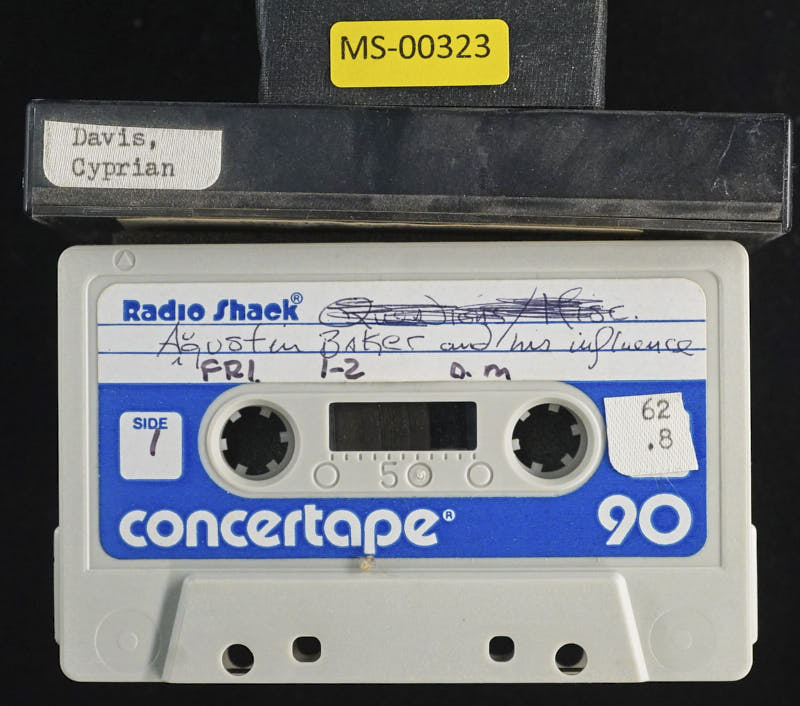
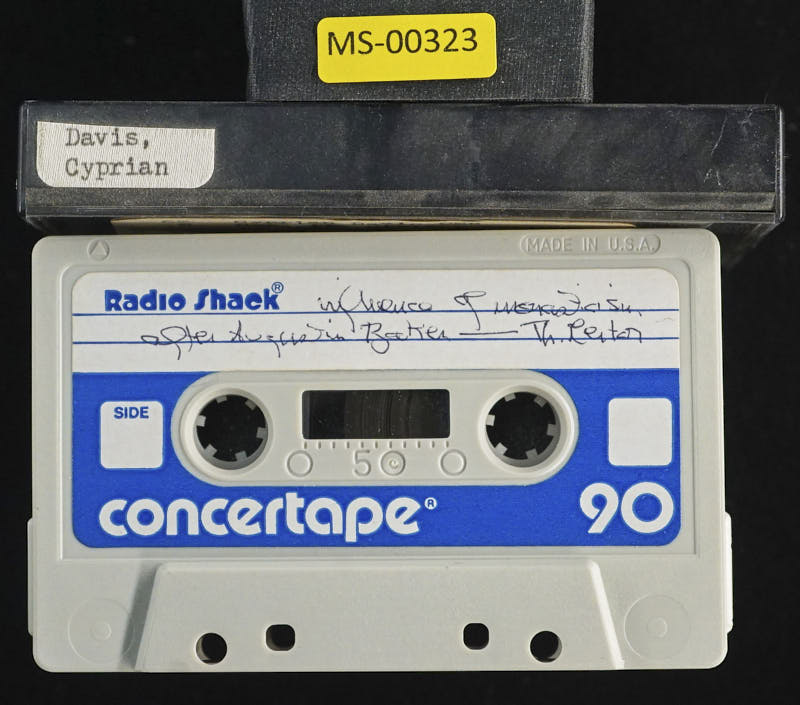
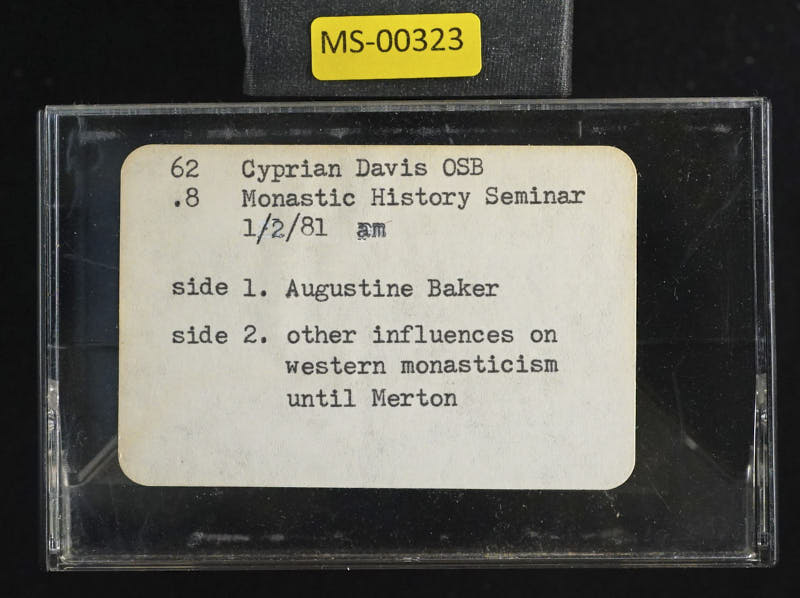
AI Vision - Possible Values from Photos:
Speaker: Cyprian Davis OSB
Possible Title: Augustine Baker and his Influence
Additional text: Monastic History Seminar\nother influences on western monasticism until Merton
@AI-Vision_v002
about a monk who was renowned as a spiritual teacher, but who only spent about five years in his monastic life in a monastery. What would you say of a monk who was known for teaching on his traditional mystical life, and during those five years in a monastery... He almost never went to choir or took part in any community. He never got along with his fellow, no. He tried with his superior, even when a lot of had to come to him. And he spread most of his long life. And he had a lot of difficult conflicts with others, with Raheem, and stuff. Well, that's why I got them very good.
[01:06]
A man who should be better known, he tried all of it, he's a very new one of his parents, you know, he's very, very important trickier. And then he developed like a monastic trick to our own. He was born in 1595. In England, I was born in 1595. Born in White House. He's not a Catholic, from a Catholic family. He wasn't his family, but now he has a Catholic family. In fact, he becomes a Catholic. when he was a young man, relatively young man, at the age of twenty-eight. He studied law in London.
[02:08]
For a while, in terms of monastic life, one time of where everyone would have to go in order to leave the monastic life, I talked to the entry of the monastery saying, just stand outside today. That was yesterday. Well, he didn't stay, I think, was trying out. got to return for a while to England, and only joined the community that would begin the form of any better term on the continent. So I joined the community that would later on become Applefoot advocates, and Lawrence, if we are new on. later on become amortized. Navishas was part of a very definite, very clear, and shortly after, Navishas was for a while in England, and spent much of his first period of administrative nine years
[03:25]
I've just learned because the English students didn't learn the convoy. At that time, it was part of the Spanish Netherlands. Like for many of the, at that time, the English members of the English and our faculty were able to establish with the wealthiest of the continent. You must understand that in the far and large, those families that were able to survive through the heart of the nation and the inland, were usually the individual families of the aristocracy who are under the great of states will be able to support a priest, keep him in high room, and uh... to some extent uh... were able to face down all of the very important aspects that would be part and parcel of being a a catholic and not belong to the official spirit and under their protection to protect uh... the peasants, the farmers, and the others might be a little patronage and therefore could
[04:53]
could undergo the luxury of maintaining a Catholic faith in that time. And it would be then schools for the time and broader that they are in return to the local families that could be uptown and places where young women wish to embrace them in actual life. because all the Irish people are trying to defend, everybody was talking about on the continent. And that is, right in the face, like, the English Benedictine Mounted Combray, which later on returned to England and became Stanbrook Avenue. That's the case, in fact, even for their clothes, their little house in Gent, in Belgium. All the English ladies are working out for their old children. I think they're still still in the world. a monastery of Akhigura at the same time. They're parked and zapped to that period.
[05:54]
So there's more in terms of the men, those who become monks, become monks with the idea, you know, we're going to be part of the mission, the clandest and Catholic activities, moving from one great country with men of all to another, to our ministerial people. Very interesting studies in these later years may guide to our question of conflict survival in the Middle East in England. We often forget that the work of Catholicism, both in Uman and in Ireland at this time, was marred by real controversy between the, uh, and the Jesuits.
[07:04]
The Benedictines also were part of this, uh, in England, were part of this controversial, uh, patented, usually siding, of course, with, uh, against the Jesuits. Perhaps this would form part of the background as we look at Augustine Baker, who comes forth primarily as a teacher on prayer, a man who most of his religious life was very, very much into his friend, Mr. Superman, in contempt of this prayer. He himself began as a young man, for a while at least, a life of intent on prayer. interior prayer. Then he gave it up for a while and returned to it. But his work primarily were the nuns who were to instruct them in the ways of the holy prayer. His teachings, his treatises, that he delivered to the nuns he called Bray, were being rattled together after his death by a sequester and disciple, Don Serenus, who were born into a work that is known today as
[08:21]
the Holy of Wisdom. Augustine Baker also wrote a commentary on a work which, which he helped in the firm tense, keep popular, namely a commentary on how the unknown, and a short autobiographical account. It is here at Cambrai that he had his first real period of constable. He was with the regular chaplain. He was not the regular chaplain. He was not the Benedictine monks who was the chaplain appointed by the general chaplain under Cambrai. He was more like living there. His health was never very good. He was more like living there, teaching, and offering. Becker rejected. the use of the spiritual exercise of the family.
[09:25]
Do you reject it, my God, [...] my God And certainly, after the brief period of the novitiate, they should be ready for that first week. But by that time, following the teaching of the Spanish mystics in elsewhere, will consider to be the beginning then of the concept of life, namely a prayer prayer for our silent regard. In other words, to some extent, that after going through that period of beginning preparation, I went on a prayer life, and that's concerned with the spiritual meditation and desire for the open world.
[10:46]
He said, when you reach that point, to paraphrase him all this spiritual exercise. Another controversial point, of course, was that he insisted that the police director was secondary. And you've got to understand, the thing that they have to do now is that the sixteenth century and the seventeenth century are what I would like to call go even able of spiritual direction not that it's not that it's stark but not that we might say the great years of spiritual direction have grown as an arch and as a sign would really be found among the desert fathers
[11:49]
where you have the profound examples of what spiritual direction is, and so forth. This golden age of spiritual direction, we really want a spiritual directory king, and literally so. The age of the 16th and 17th century, the age of St. Francis for sale, the age of the great ladies on the court, who spent hours and hours with their confessor and sang, well, that's the great ladies to date for an hour and hour with the analysts. The age when only the wealthy would have the time, the leisure, and perhaps the idonest worry about the state of their soul and therefore spend all that time with a spiritual director. And the age, of course, when it was very typical that the spiritual director treated as penitent in an absolutist fashion. He was absolutist in the confessional that Louis XIV was absolutist. in the Kingdom of France, in Europe.
[12:50]
The age, of course, when the widow, Saint-Jean de Chantal, as a widow looking for someone who would beat her into a more devout life, finds this Barnabite monk who has her confessor and who makes her swear and promise. that she will, if she becomes a spiritual director, that she will go to no one else, that she will never reveal to anyone the substance of her, of her conversations with him, that she will follow exactly everything he says. In other words, she takes an oath of absolute and total obedience to a spiritual director and there's no way to get out because you can't talk about it to anybody else. and that she's bound absolutely soul and body to him and he proceeds as a director and without really directing only in, we'd only do after much fear and apprehension if she approaches Francis de Sales and begins then getting out of that control of our spiritual director.
[14:12]
That was typical. the age of the spiritual director of absolute master. And it's this kind of thing that he's very clearly acting against, which, of course, is very total. Remember, this is the time, too, when the spiritual director, the J. Loops, the spiritual director, the Jackson's spiritual directors, fight with each other in the arena of their parenting slides. They slip on. At any rate, Augustin Baker is causing a conflict with a spiritual director and a chaplain. years of following the normal spiritual teaching at this time, training the nuns patiently in the exercise of its own notion, assisting on the primacy of the position of the spiritual director.
[15:30]
And here is this man who was without any—and Takt was not one of the strong suits of Arthur Alaskan Beghe. It was a God's conjecture undermining, he felt, everything that he stood for. And the controversy raged. It became so bad that the community, that finally the English general, the general chapter of the English congregation, had to take a start. You must understand that under this circumstance, the abbeys were not that independent. They were the monster. They were all powers of the general, the general chapter, and the presidents were really in charge of taking care of the main work of the English congregation through the circus monks over to missionary work in England, and that's the thing, so forth. General Chaplin decided the only thing to do was to settle a matter equitably was to get rid of both.
[16:35]
So both were dismissed from the madness at Cambrai. It is while he was director, while he was working at Cambrai, that Augustine Baker had the most profound influence on the one woman at the time who really could be considered. They find an example of English Benedict and Mr. Sidney of that age, and that was the Andrea Troop Moore. When he, in the beginning, rejected him, did not like a baker at all, and then gradually came under his influence and was born by him. A very remarkable woman. A very remarkable mistake. Augustine Baker then leaves, Tom Warren. Goes to a duet in the Lowcountry. He was now part of Northern France. And there he lived in the monastery, but he never really went to choir or took part of any of the community.
[17:48]
So he mostly stayed in his room, and there he engaged in spiritual direction. He was very popular in spiritual direction. But then again, you know, you're kind of suspect. He was, well, a subject of controversy. He was not typical. He was straining. something very popular. He was in bad health. Augustine Baker was in bad health. Augustine Baker was a particular character. It was actually at the monastery in 2008 that he continued to write to influence And he was not a man to pull punches. He didn't think that, just because you had taken my part, that I must prove whatever you stand for. And so that's the reason when it was time for him to try to write about the contemplative monk at the time.
[18:52]
And of course, you must understand the position of the English Pernodic Pernodization, where the average monk would spend only a short period of his life actually on the monastery and view a short period of formation. And then, by and large, will find himself on the English mission, which could be a time of a very frightening experience, an old time who was living in history, supported by the aristocratic records and families of time. A kind of division that could be rather anonymous sometimes and so forth. But at any rate, it was hardly an ascetical light and hardly appraised for the development of solitude. And, of course, it was a time of particular controversy. And the beginning of the really tremendous spiritual controversy in the church, especially the movement of rigorism, of which Jacksonism would be a major part of it.
[20:01]
and also the movement, the strong, the work of the Jesuits who were deeply redacted by many, many different doctors and sections in the church, and who themselves are, I suppose one would say without being, without objectivity, tended to be, to use their power and influence in rather, at times, a little high-handed way. So, you had to have, so the Securias tended to be very strong, had to be very strong people. I don't remember the name of the Securia, but the president of the English, I think it was Rudison Barlow. At any rate, Rudison Barlow, But I only had it there. I couldn't find his name.
[21:02]
I apologize for that. I defended Baker. In fact, he stood up for him. And he was one of the strong, independent leaders. But he was highly what you might call your typical retiring contemplative type of monk, you know. His task. Anyway, Baker writes a sort of a treatise in which gives you the picture of what the... what the contemplative monk should be, who should look like, sort of the ideal. And then he says, I'll give you the opposite of that, and that's a perfect portrait of the English benedictus of the time. So in a way, it was a veiled attack on a man who was really a supporter and who was a superior, by the way. Well, this, of course, The English Benedict from Fresno at that time did not want to take anything lying down from anybody, be Jesuit or follow up in England. And so on. So Augustin Baker found himself from short period of time back in England on the English mission.
[22:13]
And in fact, he only lived three more years. Three years later, he died, age 66. He was in bad health and with more or less quite a combination, quite a punishment with hardly like we will survive very long without it. Baker's, as I said, Baker's teaching was summarized in Holy Wisdom. And probably we have to be grateful to the English Benedictines more or less of this century for renewing interest in Augusta Baker, a man like David Knowles, who to some extent was remarkably similar, both in his career, perhaps, and with loving personality.
[23:19]
Drew Augustine Baker. By the way, there was a man like David Knowles, certainly in modern times, and others amongst the downside, who renewed an interest in the writings of the government. And I think it's very worthwhile, very worthwhile. Augustine Baker At the time, it was high time that a voice like a dust and breakers should be heard. In a period where all of us were being trained in a kind of devotional modernization method, it was high time that someone who was coming out of another tradition, what should have been our tradition, should say that there is another way in spiritual life. And I got a stone, but I have some very fine insight. Now look, do not think that the holy wisdom to his treatises cannot be criticized.
[24:23]
They can be. I am not that cognizant with him, but I myself can sit down and give you a, tell you all the things that are wrong with him. But there are certainly many criticisms that could be made of the teaching of Augustine. A scholar was not that orderly. This is against methodical meditation, and he was that very quick methodical in his presentation there. He takes a point of view which perhaps at times may have been somewhat extreme, and that he himself, in his own life, In one sense, he was interested in mystical prayer, but was he really himself a mystic? That's one of the questions that Knowles asked. He said he was very much given to contemplative prayer in certain periods of his life, but one may wonder and guess exactly about the authenticity of his own spiritual life.
[25:34]
Maybe that isn't important to ask. Yes, there's several sections that are interesting. I myself tend to admire Dustin Baker because I do think that his main thesis, that all the contemplations for, some people argue, but I go on to use another word, talk about the growth in prayer. and to add prayer that becomes more simplified and more intense. But I find myself convinced that there is no such thing as a special soul, especially daily for the mystical life. I think everybody is called eventually as an evil. A full light of prayer. We can try to go live. We will. And I think that it is personal. I mean, it's very absurd for certain monks and certain
[26:36]
not in this era, religious religion or whatever you want to be called to say, well, these are actors and these are contemporary. He himself would say that, but I would not. I think that we have been fooling ourselves, but we think that a serious life of prayer is only for a certain kind. I mean, anyone who gives oneself to a religious life is at the same time, let's give oneself to a serious life of prayer, which means that. to me, to my mind, contemplative prayer, mystical prayer really will. I am firmly convinced that anyone who says that he or she calls the ruler Brennigan cannot, has entered upon a way that inevitably should be to a more intense immune guide to prayer. And for that reason, I like what he has to say, because that means that one should be ready to move through various forms of meditation until you get to a more simplified form of meditation.
[27:44]
One should be prepared for this. I don't know. I think that part of our thought in English has been that in our formation, we have presumed too much, especially I'm sure in the United States, the formation of religious Men and women who follow the rule of Bernadette career presume, well, these are those mystical writings for those who live in a cloister. That's not for us. Well, I think it is for us. I think that the young mothers should be expected to be exposed to all types of mystical literature with instruction, obviously. is thrust upon him, no instruction, no corruption. But I should be part of the religious life. We should not be any more religiously illiterate than we are going to be illiterate by anything else.
[28:48]
It's part of our heritage and actually part of our formation. There's some interesting things to say. Let me quote this passage. I think, remember that most of his life he was, in a sense, he was a spiritual teacher to nuns. And so most of his writings were geared then to nuns. In a section dealing with the conditions necessary for contemplation, he writes this. Yea, both history and fresh experience to assure us that in these latter times God hath as freely and as more commonly communicated with divine mights and graces proper to a contemplative life to simple women. God with lesser and more contemptible gifts of judgment, but yet enriched with stronger wills and more fervent affections to him than the ablest man.
[29:55]
And the reason hereof we may judge to be partly because God thereby suret, as we most do, reap all the glory of his most we give graces, which if they did usually attend our natural endowments, would be challenged as due to our own ability and endeavors. And partly also because a substantial holiness, so the perfection of it, which is contemplation, consists far more principally in the operational will, than of the understanding. They shall be demonstrated in due place. And since women do far more abound and are far more constant and fixed in affections in other operations of a will than men, though inferior in those of the understanding, it's no marvel if God doth off-flying them bitter subjects for his reasons than men. And for this reason, it is, besides that women are not in common with solicitous businesses abroad, their secular employments being chiefly domestical within their own walls, that they do far more frequently repair to the churches, more assiduously perform their devotions for fair and at home, and reap the blessings of the sacraments more plentifully, upon which grounds the church calls them the devout sex, insomuch as a very spiritual and experienced author did not doubt to pronounce that, according to his best judgment, which was grounded on more than only outward appearance, for one man and yet ten women went to heaven.
[31:18]
I understand. I understand. Sure it is. Sure it is that the contemplations of men are more noble, sublime, and more exalted in spirit, that is, less partaking of sensible effects, as raptures, articacies, or imaginative representations, as likewise melting tendernesses that are virtual and those of women. Fearless to say in terms of when one must move and grow in the life from the use of discursive meditation on to the prayer quiet and contemplative prayer. A soul therefore being thus invited and disposed to approach continually nearer and nearer unto God. If she be, either by her own or other's ignorance, so fitted with customs or rules that she is deprived of due liberty or spirit to correspond to such an invitation and to quit inferior exercises, she will find no profit at all by her prayer, but on the contrary to extreme pain, which will endanger, to force her to relinquish her recollections.
[32:42]
It is otherwise where those whose profession is to live active, distracted lives, Well, they do seriously aspire to the complexion answerable to left state. For such may continue all their lives in meditation, and follow the methods of it, because what they lose by their distractions they may recover by their following meditation, the good images used therein and the vain images attracted in their external employments. True it is that in such a person, meditation will grow more and more pure and more in spirit, yet never so as to exclude their reproduces of your imagination. When a contemplative soul, therefore, hath for some reasonable time practiced meditation, and comes to perceive that a further exercise thereof is become dry and ungrateful to her spirit, causing great disgust, and little and no profit, she ought then to forbear meditation, and to relate herself to the exercise of a need-acts, which she will then doubtless perform a great gust at the sort of age, to a notable profit of her spirit.
[33:44]
What he's talking about there is what Centauri there describes in the interior castle and elsewhere. I use St. Therese as an example because, in a way, in her description of the beginnings of contemplative prayer, perhaps the easiest and clearest presentation, namely, and also with the cloud, the unknown description, namely that one ceases to think about God and wants to contact God, wants to come into his direct relationship with God, to experience God. one wants god and not thoughts about god and it's at that moment then that uh... it is simply one may report a prayer one may say a mantra or something a repeater word and uh... and experience and not so much kink and weaving and uh... and uh... make up with it and so forth but merely uh...
[34:48]
what he would call acts of the will, affection, namely to expressions of deep longing. His main thought being that we must not tie down sometimes where it's already begun to live a serious spiritual life as a nun. He goes on to say that others will point out that there's one kind of meditation, however, that he must never give up, and that is the meditation on the passion, like he goes to Ross today. He says, I can't even agree with that. And I think it's a mix of, behind the language, which is a little tragic and a little odd, it's hard to understand, and some of his own prejudices. It is a very good principle, I think, and he very, very benedictive, if you will, in quotation marks, is that for him the most important thing was freedom, freedom of spirit.
[35:55]
Notwithstanding, I cannot join with these authors in this position, nor agree that a due liberty of spirit should be abridged for any pretext whatsoever, the ground of which liberty is, the ground of which liberty exists, that a soul is to make the experience and proof of our own spiritual property, to be the rule and measure of all her spiritual exercises. And upon no colors or conceits of perfection in any subject or exercise, oblige herself there to further than she finds it helpful and gospel to her spirit. In the same regard, in terms of spiritual direction, again, one was not to be tied down by the I inclined directives of a spiritual authority. And he concludes that two sections of his treatise. To conclude this point, a spiritual life is subject to many and wonderful changes, interior as well as exterior, and all are according to the mere will and good pleasure of God, who is tied to no methods or rules.
[37:04]
Therefore, following him in all simplicity and resignation, let us wonder at nothing. Let us neither oblige ourselves to rigorously to any exercise, nor refuse any to which he shall invite us, seeming never so strange, or to natural reason, feeling senseless. For in his guidance there can be no danger of error, but on the contrary there is all security. And this may and ought to be a great comfort and encouragement to the well-minded present source." And that belief in the importance of the freedom, I think should be, and have no thought one has, to characterize a Benedictine, a fantastic spiritual way, if you will. Ah, Augustine Baker is one who still needs to be studied more fully. Ah, and perhaps there's been still too much neglected by a lot of
[38:08]
One has to understand where he was in terms of the spiritual climate of the time. He lived at what was perhaps the last great surge of the initial frost in Europe of that period. What was going to happen, and what was happening really during his lifetime, he died in 1641, was the great spiritual drama of Jansenism. The English Benedictines would be as involved in that, as were the English Catholic on the continent, as well as the rest of the church. And we probably read it as a period of times phenomenon, a phenomenon that is all of Europe, and also
[39:14]
There is beauty in this kind of world. And it's highly complex. Not just theological, but also spiritual. But that was about the end of any great spiritual movements. And the movements of mystical prayer and so forth. So that was the great way that the end of the prayer. That the end of the prayer. Any questions? You spoke about the prayer of quiet. I'm not familiar with the history, but what's your matter of jealousy of quiet? Did that play any role in this? Yeah, well, the prayer of quiet really shouldn't be considered to have any relationship to the heresy. Well, they're about this time. They come a little later. I was interested in talking about the prayer of quiet, another name is the prayer of a silent regard.
[40:15]
Namely, to be quiet, to be at peace before God, not to let yourself... There would be those who would say that this kind of contemplative prayer leads to quietism, which you're talking about the heritage of quietism. There would be those who would say that. And therefore you've got to spend all your time just actively engaged in setting the scene. as dividing and subdividing and rearranging and so forth. Otherwise you end up acquired it. But no, the prayer acquired meant the first kind of contemplative prayer which what others would call acquired contemplation that all of us, that everyone would say, everyone can come to. And that is when you cease to make these marvelous constructions in your mind and try to simply beat in God's presence and to look at God and be open and peace and that this is something that naturally occurs as you grow in the spiritual life you don't want to spend more time
[41:33]
The writing is still the writing, the meditation on the picture, according to Baker, he's hand-viewed. That's kind of just close to ground. And that's what Claudia Noah is describing, and it's really difficult to look like. I'm sorry, could we get a little bit more of a sense of the historical place that somebody like Dustin Baker has? I mean, you said in the last mystical grasp of what James says in the water. Is he in the company of others scattered around Europe, who are still trying to keep the mystical thing going, or is he a candle against the light of discreet meditation? No, no, but still, as he refers, he refers to Bennett Canfield, who was a Franciscan English but living in France, more or less in a French school. I think of the others, I was just contemporary with him. We're still running at the time. Is there a whole mystical process that's going on in opposition to this sort of Ignatian method that's more apparent, that's readily apparent, basically what's been happening 15 years before?
[42:54]
Ignatians was contemporary still with other mystics, even though I did not know. mainly people like John Weisbrook, who else is John Weisbrook, and the mystics of other countries, and who were, and the whole of the government was kind of, to use a German expression, a wedding mystical, marriage mystical, a school that all our relations, stressing really much that our union with God and return to the bride and die to them. We've been a bride. There is that whole school. There is a... And that was to be a town. And on the continent. But they can do it come a generation later. And I'll admit too that I'm less... Less cognizant with the... Nicholas Harpius.
[43:55]
And others. I'm less cognizant with the various... personalities of this latter period than I am the earlier one. Most, most of them are Franciscans, Capuchins. Most of them are not as well known. And most of them are, you'll find them described in a book that has not yet been controlled by the third volume of the history of spiritual, of Christian spirituality. by, man, he's not dead. He's going out of my mind, exactly. So that's a great volume. And... De Bruise, who is? De Bruise, that's... What is it? That's these Middle Ages. It's over there, you know. It's gone out of my mind, I'm sorry.
[44:58]
I'll tell you about the place. And he described that there was a lot of theory. But it's the beginning of the coming. Now, the work of the mystics of this time, who ended up in prior to them, in the period of the 17th century, is Fenelon, the Office of Bishop of Cambrai, who is today to the Salad Dauphin. at the court of Louis, Louis XIV, who becomes involved with a very interesting woman named Guillaume, Madame Guillaume. Madame Guillaume, but also, was also a client, so he was given kind of clientism and the clientism of Moulinois, the Spanish teacher, and, but he was acquired with another nonetheless. You have a Spanish teacher in Molina and you eventually come down in a prison for life and in tradition.
[46:04]
Or the congeneration of something that was written in a preschool idea, namely that when you reach a certain point in your mystical life, you no longer have to worry about what's going on with the rest of your body. And you should be quiet even in the face of temptation, even in the face of all kinds of execution. You should be, in other words, you reach a certain plateau in your mystical experience, then you're, that's it. You don't worry about anything about it. Just be quiet. You don't even resist temptation. And so, uh, that's what we do. And that's why, in the end, I don't prove, in the end, you can get a whole, [...] in the end and she is a multiple example of the spiritual weapon that's not only going to come to the spiritual weapon. It is all happening in the court of the year 14.
[47:05]
Namely, that would be very white, very British white, and what they had to marry. And I think that would be why it would be. And then, we don't know. We [...] had the wrong teachers in the wrong time. Here's a teacher who was formerly living, and how they were first directly out beyond the fashion. Very, very fine. I think it would be to have a lot of people coming up. who had his career. First of all, I couldn't demand any momentum, no. When all of a sudden, gee, you should get involved with it to me, and all of a sudden, you know, they're awfully upset. Chipsy never had to be young out, and then they'd cry, look out, and then they'd cry, look out, and then they'd cry, look out, and then they'd go to my mobile, when we're in mobile, let's examine them, let's teach them, and let's find it, go ahead.
[48:18]
So here's where he examined our teaching, On prayer, when you reach a certain moment in your love for God, you were on, you won't worry about anything. Find where you're going to be saved, but you don't tell them anything different. And so they stood out in a while, and both of these guys took credit, and a lot took them under. One has to give them credit. All his life, he's coming to the end. Who was that? It was partly hysterical. She would go up with me. And obviously, she'd be more hangier than that was the end of it. But he did the phone there. And she was pushed to the phone with that video. And then they were young. And then they would all retract. She would have to report to retract for the phone. And she died. And I'm meeting them through the video.
[49:20]
... [...] Mm-hmm. Mm-hmm. Mm-hmm. How much would you say of an impact that Augusta L. Baker made on his own time?
[50:49]
We're resurrecting the writing, and so forth. I'm a young person. Only deaf people, as you all know, outside of the English traffic community on the continent. I don't think so. I know you all know. So to a certain extent, the significance of what's coming out again, what's coming out again, in the beginning of the victory? What is the rest of us? The rest of us is really incontentable. And that's where his practice goes, goes through, you know, after that. And of course, it is kind of interesting, because normally the English tradition foundation itself has not changed its institutional territory, becoming independent, autonomous abbeys, with abbex driving a fourth-hour group, and with the accent on and lots of a lot of good in the community until the last part of the 19th century. And when I realized, how, uh, how very late, even after the masticity was brought in the wrong faith, but the English by which the congregation becomes monastically unfair by the way, and in the constitution of the monastery, even though they moved to England, uh, for the, uh, after the cultural revolution, and also from the staying in the country, uh, they never were going to maintain a character of being extremely, uh,
[52:17]
oriented towards poetry and so forth, and the mission, the English mission. And the English and the Benedictine president had much more direct authority over the individual monk than the abbot. And he stressed on your work on the mission rather than you had to even drop on your post-transport and so forth. All that is a gradual kind of work in the post-transport. that people like you, Edmund Thorpe, that was a downside that the United High School of Maintain century, and that's it. It's only very early in the committee in the time of the year the 13th that we wanted to make a thing to try to change. But if you had this, you had a new institution, you were going to cross that, so you were almost a bandit, you know, and you don't realize. Perhaps in the same way, I don't know. our experience of monasticism as frontier, like as it may have been, is longer.
[53:23]
Let's take a break. I want to mention only very, very briefly. Factories that have effects made of monastic spirituality. And then I want to answer any questions that won't happen. I don't want to... been a long time. But factors that have affected later monastic spirituality after the period of Augustine Baker are certainly the factor of Jansenism. And obviously, again, it would be ridiculous to think we want to adequately treat the whole problem, problematic Jansenism in what they meant. One of the factors is that there has been a whole renewal of historical study. You're dealing with something that is not simply a one theological teaching.
[54:28]
You're dealing with a whole conjury of teachings and feelings and sentiments. You're dealing with a movement that embraced not only a theological position on a spiritual or a spiritual position, but a movement that embraced something in a clinical position. You're dealing with something that is not just a well-defined issue, but something that tended on its periphery or in its extension to be not at all well-defined. In fact, perhaps so. And very nebulous. You're dealing also with something that went through various stages, including an hysterical stage at a final period. And you're dealing with something also that tended to be manifested in a secular stage also.
[55:32]
And that, of course, particularly politically potent. And at the end, well, they've been And then in a final re-pending on a day to it, with their total public perfection, and I'm not sure. I'm not sure. I'll tell you something, Bill. But it was something we told me, total pressure on George New Orleans, was the normal outcome, you might say, the last local bendings of his anthem as such. And we deal also with the movement with all these competitions. Well, the movement, again, has suffered from a lack of true historical perspective. And much of the work in the last 10, 15, and the 80s is going to re-stress the resources.
[56:35]
Obviously, I said that basically which was the cradle of dancingism. Although it also thought to be particularly involved, very sensitive to a whole issue, and very, very sensitive in its relationship with the geogos as well, by the way. It hasn't changed in a century. And we were dancing with him. They found it in great cobblestones. And also I think you want to take you down on that the Benedict and the monasteries, both the Moorists, as well as the English Benedict, as well as other groups including Bavarians and Austrians, all were affected or infected
[57:35]
But don't think that just because you're German speaking, I come from a German speaking tradition, The U.S. gave Janssen, and I had, uh, pterosinium. Ah. The, um, the, um, the influence of Janssen, well, it's always influence of Janssen's, uh, ministers at the court, at the Hatsby's Court. Well, they're familiar to it. So, um, we get more privileges. Of course, the doctrine is in a blank form, a political form, but it is truly interesting on the theologians and so forth.
[58:47]
But even to some extent, the actions of the Emperor Joseph II, which has certainly affected so much, the Bavarian Benedict for English. Anyway, there are some Janssen's Obertone positions. We got in a relationship with the church and state. And one way, Joseph II surpasses contemplative conflict. They saw no need for, they said, they saw no need for monasteries in which the people were idle. And that's true. And the only way the man could survive would be in putting up screws. and restricting the strings of the opposite choir, etc. Because the next great aspect is very important. Here is the holy movement of the Enlightenment, the art clerium, which again affects the Church deeply and profoundly, as the Yank's movement, to which it seems to be an attempt.
[59:54]
The Enlightenment, in terms of a philosophical reaction, very strong among them is the congregation of Saint Laurent. In other words, a way of looking at the world from a viewpoint or a way of looking at things, judging religion now and tending to be very critical of the supernatural aspect of the world, very critical of the superstition He went on the part of the clergy, and all that probably may not. So that the influence of the, or the enlightenment, not only in the planet, but also, again, in general, could capture the main-mind spirit. So, like, the period of the 1700s is a spirit of brain, very low, low, but steady, and decline.
[60:58]
I mean, that's the political narrative of the Jansen's controversy. and in other parts largely because of the Enlightenment. Many who answered it were men of the Enlightenment. At times there's no surprise, I think, no one knows the situation, that in some time, in France, for example, the community has its own Masonic group because Freemasonry, which is such a strong intellectual, spiritual force will grow that way in the upper classes of 17th century Europe, supposed to be found in Munster, Nexism, and a lot. The kind of nations had not yet occurred, but when the kind of nations occurred, many bishops were pre-masons. And in general, pre-masonry of the 18th century is anti-Claire, quite an honor. It was rapidly run by the anti-Claire.
[61:59]
So when the Commission of the Regulars had gone up or set up by 1915 in the 1760s as a response to the Norris Benedictians entirely, they learned to change how they were. They're just ignoring things like getting up at midnight for office. and going out, going out, uh, when they were traveling, people, when they found out, they were hoping what they wanted to do. They were going to make all these changes. We're going to build an opportunity now for, uh, They normally literally are the first poem to re-examine the last block, which would be later on, the 8th one and the 12th one, examine all the existence.
[63:09]
And here, because I'd say they wouldn't do times with the, for the month, for the month, just earlier. Namely, and it's true, it could be, we had month, we had extensive line holdings that were tied up, and we'll hold the month away. And you have many large large buildings with water on the two of the United States. It's huge, not always, but a little suspension, too, but other smaller than that, because we don't have any molecularity, too, but mainly the 12th group. 12th group. So back to town, I thought so, I couldn't tell. They are in other groups, right now, whose reputation was pretty bad. There was commission rights to all the visions, so what are you going to do? And 70%, 80% is great, not too much. There was more of them. So when they began the suppression, remember the suppression began long before the Part of the Revolution.
[64:15]
Again, my parents were still at times to get a capital capital. And this was, if you tell them, not on time period as well. You don't need only 8th grade and 11th. All of this obviously affected the magic ritual, in other words. It is no longer a period of great spiritual contemplation problems. And when the French Revolution comes, only a handful of monsters, you see what? Only a handful. And those who survived, who survived, are represented by the Baruch in the 17th century. And the revival of the Mastikin, the revival, again, in the spirit of the age, and we must, we shouldn't expect you to be otherwise, a romantic revival, a re-
[65:17]
a, uh, considered to all the scouts, mainly that we were going to reproduce a medieval conflict, a medieval life. And of course it was, it might have been gone. Their conflict, they were a medieval place if we had. Now, Gérard J., and of all their brothers, particularly Gérard J., They revived New York City in the 18th century in France, for the establishing so long. And again, I think that it should be, and it's being re- looked at again, re-evaluated. One cannot doubt that this man with all his shortcomings, because he had many shortcomings, was a remarkable purpose. They were a pioneer. And that didn't work, but it was a remarkable purpose. That can't be anymore. But one must understand that the establishment foundation of Salon, the establishment of the Borghese Foundation, was in the spirit of the time.
[66:27]
And this was a romanticity. And that important, we come up. We come up. The establishment, a man like Monica Splinger, was a 19th century romantic. And his vision of uh... [...] In a way, all of them were self-taught people, the times called already that. All of them had picked and chosen from the normal tradition.
[67:27]
And the same thing, even Holly's English-Swiss from native kind of world. They, too, are going to start coming to you, of course. But how they were matched. I figured that We have come to appreciate, I think, on the monastic spirituality that he developed in the 20th century, and a remarkable man, is Lombard Boyd, the guy in 19... Lombard Boyd Brown. I suppose Lombard Boyd, you know, John XXIII. But when we read about the time when we read about the time when we read about it, we read about it in France
[68:45]
in prison from the Monastery of Antarkat. All this happens, you can't think, it's part of the belief. And eventually he was able to move back to Belgium to the foundation of the Amédi-Shir-Tongue, so he started up on the English foundation of [...] Am and the kind of way or in a certain sense to you. But I'd rather be intrigued that those who are posed, you know, coming next year, the only way to get the problem is to it. And of course, you've got a real world run, therefore I'm passionate about it. But the only way to get the coming next year is to get the number of the run, and therefore they get the number of the problems. And I remember the infamous, or infamous of all the things where you start, and I was pretty sure D.B., who also was a Jesuit Archbishop, who was put into cultural exile and made a non-person—conocentric, by the way—and I, as a non-person, I implant, but who was his enemy?
[70:00]
I mean, I remember all the kind of—it really, it really is like a topic now, and yet it's—it happened in Jesuit, which was between the two world wars. And yet, this man, who more than anyone else, was responsible for the ecumenical movement, and the Catholic Church, and for the digital movement. And it's practical after that. Well, I think, but also responsible for the action in which Tonya Sunkin has experienced. They made a very keen sense of a relative church. And out of this devotion to the church, she came down a sense of the liturgy as being a prominent influence on this power.
[71:02]
Already a quite garanger written in the literature called Leon Sepport from the list of money. But it is Baudouin. Thanks to Baudouin. It was not a profound theology, but an excitement of the age. He's not one of the great, great thinkers, but he's one of the men of tremendous insights, and whose insights sparked off. Those who read French should read sometimes the memoirs of Janet Botte, the memoirs of when I lived, or when I lived in New York, when I lived in New York, New York, and then I thought, uh, the scribes, and he's all in a numerical array. We, um, we, uh, [...]
[72:15]
He's influenced in France, so if you get the French clerk, he got it into the church for me. It was remarkable, yeah. Remarkable and ridiculous. Most of his life in opposition, though. Most of his life considered by a superior to get born on their side. He's a fantastic character. But most of his life may say, this is far from being a holy man of speech right now. But with insulin, the blood sugar is like, he can't eat it. And I think it's more basic, more fundamental than anyone else, in terms of the, or the trust of poor Donald Whitman's have gone, and he changed it. At the end of the 19th century, now, the work of one of the older ones, with the control, again, and developing a certain type of magnetic spirituality, which are 70 degrees law in the laboratory, and a visual authority, I think.
[73:26]
It might be questioning as to whether it is really part of the tradition or not. They put it on in the predicament. It is rare, and we can't, that too, it's important. The other man is Colombo Marmion, an individual, Eddie Rawlings, who probably remember after Lombo Marmion, the contemporary. But what Marmion's teaching, and Marmion was quite acceptable, because he didn't have it in any way, and he was confessor in China, My mid-influence, of course, was truly retreats and so etc. But we read a young, bad little monk leave, and now I want to know how the Lord plowed through that quote.
[74:33]
How could anyone be excited by what he has to write because he seems so... And not precisely because we forget. We forget an age where the reference to the liturgical year, a reference to liturgical practice, and where even the understanding of liturgical talk was not to be taken out of Christ alone. And whatever else you did, your devotion, your meditation, all of that was on an entirely different level. You can't imagine that kind of world anymore. You can't imagine a world in which the mass could be upon very easily the backdrop of your daily communion and your daily meditation. And where one thought
[75:36]
nothing about it. It didn't tear apart. It would become interesting when they told you you could talk before you read it in Latin, and it had nothing, it didn't talk to you in any way. And where even, where even your approach to Christ was very much needed. It was to him again, but you don't read St. Paul, because that's much too intellectual. Everything is very effective. very much how you feel about it. And that kind of, how I'm on Namian, with an extraordinary cluster of stringent arctic air. Now we look at what we're going to do, and we look upon them for a dove. But Namian had a tremendous thinking, not only on every Benedictine generation, or my generation, generation before us, Bazaar, Indiana, Red Evington, Sun-Glass, and certainly we were trained by it.
[76:42]
And in that sense, we were put down again, I think, for this right. And then we became very known, and I even came up with real opposition with John Chapman, I would have downsized the enemy of him. He was a scholar, a artistic scholar, but his letters of spiritual direction, which I would like to talk about, are very important, because he, in a way, he announced it in his own way, most of the teaching of a freshman day. And if you kind of are down to oil, practical type of spirituality, but which ultimately serves what we are all tend to come close. But one of the best are few practices on the read, and the importance of letting oneself move from discursive meditation into the area of conversation or to other learning anywhere.
[77:56]
And John Chapman, who died until the 19th day, was a little downside. It's important to you. It's important to you. It's being again typical, I think, to the time to some extent, the monastic spiritual function of monasticity. One last question. Dimension of emotional balance. We took a close term here, not perspective yet. In terms of judgment, that would be Thomas Milton. In our own country, in our own period of which we're living, Thomas Merton's impact has been tremendous. I think it's hard to measure because I think that, first of all, one can't talk about Merton's teaching in a simple way. Translating a hilarious Thomas Merton.
[78:59]
Thomas Merton went through a whole series of development. And in some respects, you read his writings of the first period, and he would be almost directly contradicted by what he had to say from his lot of people. Merton developed a group. Each time he made an impact, each time he became a controversial behavior. But the other thing to do is I think merging does not prevent a consistent sort of development. It was a highly personal, highly unmethodical writer. And what you have again is merging at different levels at different times. With all of this being said, one cannot deny, because of his ability in life, because of the kind of person he was and just the... what he emerges out of the From the Storm Mountain as being almost a representative of our time.
[80:15]
He's as representative of our time as St. Augustine was of the later Roman Empire, and he struggled. and is coming to terms and turning to grips, is that of all of us, of a certain age, a certain period, coming out of the way to World War. And in that sense, he speaks so profoundly to our generation. He is the force to be contained to it. And also because Martin Martin, more than anyone else, was Federated, again, symbolized how One can be a contemplative or a mystic, be given to a life of prayer, and be deeply concerned about the things that are probably our contemplative concern, peace and justice, social concern. And that, again, he spoke then to many, many people within monasteries who do all this time.
[81:23]
Well, they're important. We can't talk more than anything else. In terms of spirituality today, the great problem is that spirituality be part of our kind of Christ. We are living in a world with a very, very long for me becoming divided. We are living in a time when we need to go to church. I suppose very clearly, if they are going very moving, they are opting to one side, or the other side of the poor. We all find ourselves in one way or another, one way or another, imprecating. And in terms of our spirits wrong to them, in terms of our people and deeper levels of our prayer, And the American in a way to find a certain response.
[82:38]
That premise is just where we are. You can't divorce plan from action. I can't divorce prayer from the major concerns of an age. We could problem with an age. I can't divorce prayer from being young. Even if you're at a monastery. I can't divorce prayer from God. For prophets. Letting you make prayers are problem-solving on you. What I like to do in the craft community is to sit back and get down and have a very little talk and sit down with the craft guy.
[83:56]
Well, in terms of where we are now, I have some questions. Well, I think the ability to sum this up, you're some kind of immune to it already. You have to do it when you dial R. And when you're putting your questions about what are you talking about? Would it be a question in order to try to create an anachronism out of it? If you read the Middle Ages and they are to a family, would it have been that kind of concept? Oh, you've got a family, you've got to have a plan.
[84:57]
I mean, uh... Well, I don't think it's really worth it. what you might have thought they missed. Well, no, not in what it did, we all... Well, a lot has often been quite a bit of [...] a bit I was a little recently, but I was going to call it the, uh, the, uh, and I think, uh, the name is, is a notion of what, of monotheism on the world of what you live, you know, what is, what is the figure of the monk, and [...] what is the figure of the monk.
[85:58]
if the implications were there at the time. So then, we didn't understand it, but so then we're part of that, you know, that supported the establishment. And that is because they fall involved in that movie, I think, around the middle eight of me and that's the same thing. That was the case with most of the family. They were almost up and up and up and down. And it's fun to be on the mountain. It was probably very accurately accurate, but as a vision of a church which I definitely was not the vision of a man with capital, on capital. I was dealing with macrovision in the church of those who were going to come to terms with the industrial revolution.
[87:08]
Your benedict and romantic revival was outside. And one may, if you need two hearts in contending it, I don't think it's going to go outside or go to. I don't know if you're at home, but in the period they go and and they're really really positive on the living. I don't know what they want. But they, um, they tended to adopt a critical attitude out of their mindset. Well, probably I don't know. An approach to the... Well, an approach to the apartheid... If you think about what he's trying to do a contemplative movement, the movement might be sort of easier.
[88:12]
We don't want to say about it, right? We don't want to say about it. We don't want to say about it. We don't want to say about it. I mean, it was, [...] it was It came out of an active tradition, but it seemed to be a good job. Over the 13th century, it wasn't really a great father. They got home. We weren't tired. It was really nice to get through, you know.
[89:18]
I was curious to come to make that all work. I'm not to blame, I think. Well, it's minor, but, uh, a frontier and all. And I'm really, I take the material for a lot of people. Oh, God. Uh, from this room I have known theologically, because I didn't think it was a lot of bad. So, you know, you understand it. I'm the father's truck company. I know I know I'm the clinic to do it. Thank you.
[90:24]
Good.
[90:41]
@Transcribed_UNK
@Text_v005
@Score_39.45