You are currently logged-out. You can log-in or create an account to save favorites and more. more info
Finding Self Through Contemplative Paradox
Talks on Prayer
The talk explores contemplative prayer, intending to differentiate it from other forms of prayer by focusing on its contemplative nature. It considers the relationship between contemplative and experiential knowledge through peak experiences, drawing from Maslow's concept of mystical experiences or peak experiences, and relates these to traditional spiritual concepts like faith, hope, and love. Three paradoxes associated with peak experiences are highlighted: losing oneself to find oneself, the unconditional acceptance of meaning, and being alone yet fully connected with everything.
Referenced Works:
-
"Religions, Values, and Peak-Experiences" by Abraham Maslow
Abraham Maslow introduces the concept of peak experiences, aligning them with mystical experiences, defining them as moments where individuals access a higher state of consciousness, similar to traditional religious experiences. This relates to contemplative prayer as a foundational experience connecting internal and divine truth. -
"Letter to the Hebrews" (New Testament)
References are made to the Letter to the Hebrews, emphasizing the importance of building according to a divine pattern revealed to Moses, akin to contemplation as a process of aligning one's being and actions with a heavenly order. -
"A Long Day's Journey Into Night" by Eugene O'Neill
A passage from the play describes a peak experience, exemplifying how such moments provide profound insight and connection to a greater reality, applicable in understanding contemplative prayer's relationship to personal and experiential knowledge. -
"Surprised by Joy" by C.S. Lewis
This autobiography frames joy as a central aspect of spiritual and religious experience, paralleling the unpredictable, illuminating nature of peak experiences which resonate with the insights of contemplative prayer.
Conceptual References:
-
Contemplatio
The Latin root of contemplation, embodying the idea of a measured and set spiritual gaze or outlook, tying ancient religious concepts of fixed divine patterns to modern contemplative practices. -
Templum
Originating as a specific area of the sky used for divination, this term is explored to explain how contemplation merges transcendent insight with earthly practice, creating a space where divine order can manifest in individual life. -
Paradoxical Nature of Contemplative Experiences
The talk elaborates on paradoxes inherent in peak experiences: losing oneself to find one's true self, finding profound meaning without clear logical answers, and experiencing unity with all while feeling individually complete. These paradoxes underline the depth and complexity of true contemplative practice.
AI Suggested Title: Finding Self Through Contemplative Paradox
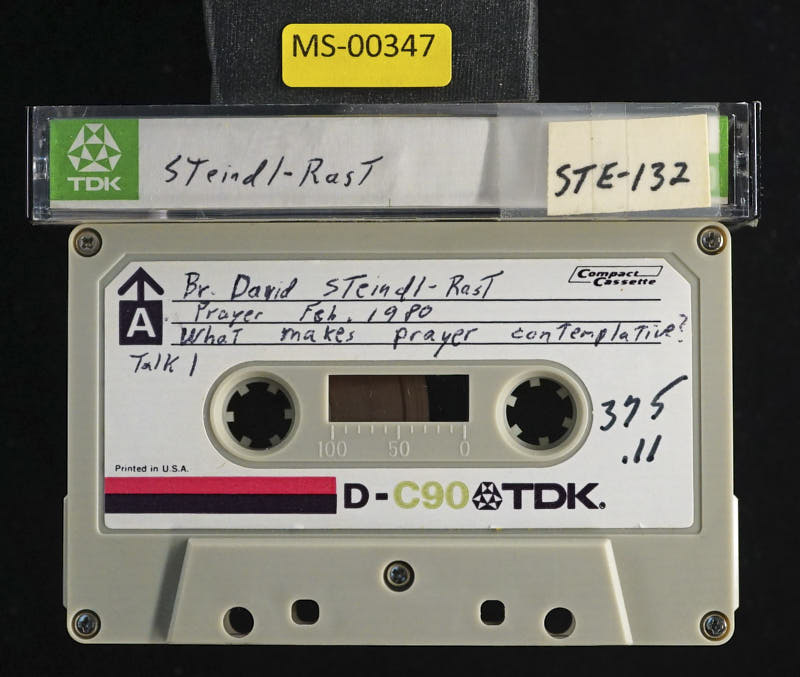
AI Vision - Possible Values from Photos:
Speaker: Br. David Steindl-Rast
Possible Title: What makes prayer contemplative?
Additional text: Prayer Feb 1980 - Talk #1; Talk #1 of III; ques. r answer
@AI-Vision_v002
prayed together this morning, we can start now by a moment of silence and put ourselves into God's presence before we start sharing. Diver of all good gifts, we thank you for bringing us together here and for giving us time to reorientate our lives in your presence. And we ask you to bless all those who have made this time possible for us, especially all those who are taking our place at home and all those
[01:01]
who would like to be with us and have been prevented. And we also pray that you may open our hearts to your word in whatever form it comes to us and that you may give us strength and courage to obey your word. This we pray in the Holy Spirit through Christ our Lord. Amen. Well, thank you very much, first of all, for inviting me to share this weekend with you. It's a joy for me. And I am also challenged by the topic that Tony suggested, namely, contemplative prayer. It's not the topic that I would have chosen. It sounds a little... pretentious, but it's a challenge, and we will have to tackle it.
[02:10]
What I would like to do, since we have three sessions available, is to speak this morning on the question, what makes prayer contemplative, and toss this around a little bit so that we get in touch with what. It even is that we are talking about. And then, by this, try and lay a basis on which this afternoon we can ask ourselves, then how do we go about it and get a little more practical. And then tomorrow, I would like to draw out some implications of all this for a Christian worldview, for a broader vision and for the wider dimensions of contemplative prayer. At our time, we really have to look at the whole world when we speak about the spiritual life.
[03:12]
Now, it's very important in this context that you ask all the questions you can possibly think of because obviously in three sessions we cannot cover all that needs to be said about this topic. at all. And so we want to cover that part at least that interests you especially. And I can only guess and suggest some thoughts that interest me. Then at least one person here will be interested in what I'm saying. But you are responsible to draw this out in the direction that really interests you and is of importance for your life and quite practically too. So I encourage you to make mental notes, at least, of all the questions as we go along. And there will always be a second part to our session. The first part will be input. And the second part, the more important part, will be the question period in which you will, well, raise those questions that have arisen because of the input.
[04:23]
And before we start, I would like to ask you some questions. Two, to be precise. And I brought some paper, and I would like to hand this out. Maybe we can just pass it along. Oops, on both sides. And I would like to ask you, right off the bat, without any input from me, what you think contemplative prayer is. Since you asked me to talk about it, you must have some sort of an idea of what it is that we are talking about. Any of it. Well, maybe we should give all the slips to Tony and he has to fill out 35 slips. Well, that's all right. Whatever you say, it doesn't have to be terribly profound. But somehow... your answer as to contemplative prayer is dot dot dot and then you write just what you think it is.
[05:29]
Because that will give me a chance then when I look over those slips to get an idea of where we stand and what I may already presuppose because it's obvious to all of you anyway and what might have to be supplied or Corrective possibly even. You used contemplative and meditative as interchangeable? I didn't say anything. I just said contemplative prayer. And then the second question would be, and you might want to keep that in mind right away as you're answering the first one, I would ask you to write, after you have written, contemplative prayer is such and such, very succinctly, of course, I would like you to write, contemplative prayer is important for me personally.
[06:48]
Because. Now you can presuppose that this is already written and you just make a little line and start with the because. But what comes before the because is, contemplative prayer is important to me personally, otherwise you wouldn't be here, because. And then say why it is important to you personally. the coffee break. But I would appreciate if you'd hand in the slips because, as I said, it would be great help to me and in a roundabout way to our sharing.
[07:52]
you will have afterthoughts and you will feel that what you said was very inadequate and so forth. It would be too bad if you really thought that you could adequately answer those two questions in such a short time anyway. So it should be that you feel inadequate. The whole point is just, first of all, to give me a little bit of an idea of where we stand and also to make you aware that you are bringing questions to this to this topic and that you're also bringing some of your own experience on which these questions are based. Because everything here will hinge on tying contemplative prayer in with your own experience. If you did not already have experience and a great deal of experience with contemplative prayer, nothing that I could say would be of great help to you. Now, I hear already someone sort of in the back of your mind saying, gee, I'm not a contemplative.
[09:00]
I'm in the wrong place here, or something like that. But this is not so. Rightly understood, we are all contemplatives. It would be a great mistake to think that contemplatives are a special kind of human being. rather every human being is a special kind of contemplative, each one a very different kind of contemplative, the particular contemplative which is constituted by your particular experience, your particular background, even your particular shortcomings. God finds a challenge in making contemporaries out of such unlikely candidates as most of us are. This is also something that enters into the particular kind of contemporaries that each one of us is invited to be and will have to become if we want to live a spiritual life fully.
[10:05]
Now This will become a little clearer when we ask what contemplation really means, what contemplative really means. That word contemplation is a very interesting word. It's, of course, a Latin word, contemplatio, and it is one of those... technical terms from Roman religion that has been taken into our Christian vocabulary. You know that the Christians at first didn't speak Latin, they spoke Greek for quite a while, and then they had already a whole vocabulary in the whole spiritual universe of discourse before they started now thinking in Latin and translating all this into Latin. And the tendency was not to use technical terms because there were still pagan Romans around who would use those terms in a pagan sense, and then the Christians didn't want to get this mixed up with their own Christian sense.
[11:13]
And so the chances were that whenever they found a term that was already in use with a very specific meaning in the Roman religion... They would rather replace it by another one, a less used one. But this one was quite central to Roman religion, and still the Christians took it over. The reason is that in this particular case, this is so central to human religion, to the basic primordial human religion, long before we come to the Christian revelation, that... It belongs to Christians and to heathens and to everybody else. And therefore, the Christians had no difficulty taking it over. Well, what did it mean for the Romans? The central part of this word contemplatio is this little syllable temp, T-E-M-P. And we have that in our... English language too in many connections we speak of temperature and of temperament and a template that a mason uses and so forth and it meant originally something that's cut out a measure a cut measure set measure cut out measure the
[12:38]
The temperature is the measure of warmth and coldness. And the temperament is the measure of your responses. And your tempers are the measure of your body in height and width to some extent. I don't know exactly how that works. And the template is the measure in which the mason lays the bricks and so forth. So this measure in the Roman religion was originally a particular measured out area of the sky. The arguers, and that also is in our English language when we speak of inauguration, the solemn inauguration of something. But when the Romans inaugurated anything, every day they had inaugurations of this or that thing. The arguers who were their priests would get together... and look at this measured area in the sky and then project from what they saw there what was to be done
[13:40]
here, among us, in this changing world, because the idea was that in the skies nothing ever changes. The sky, the blue sky, is the unchanging thing, and the weather comes and goes, and the clouds come, and the birds come, but the sky is unchangeable. And somehow this idea of the unchangeable eternal law of the heavens, the stars, and so forth, that stands behind the idea that you look to the sky, And from there, take the measure for your actions on Earth. And so the templum, which we call a temple, Greek or Roman temple, was originally not a building, but was a particular measure in the sky, area in the sky, which the arguers intently looked at with intent consideration. That word consideration, we'll come back to that. And then it was projected onto the earth, and some stakes were set up that corresponded to this templum, and that was then the templum on earth, and it was still not a building, but a precinct, a sacred precinct.
[14:55]
And maybe they would set up stones, because this goes far back beyond Roman religion. Our word comes from Roman religion, but the concept is this. It's very, very ancient in primordial human religion. And you all remember Stonehenge? Well, these enormous stones were set up. That is the beginning of a temple as a building, but originally it was more like a garden. or rather like a sundial, a kind of walk-in sundial and star dial, or calendar, walk-in calendar, because all the different stones in their relation to one another and positions reflected the unchanging order of the skies down onto Earth. And by... walking into this observatory, one raised one's heart and mind to the heavens, to that eternal order, and then was able not so much to predict, but to project the eternal order onto this earthly reality, which is anything but ordered and permanent and well set.
[16:08]
So it was an attempt to arrange everything on earth as it is in heaven. And since this on earth as it is in heaven was a rather important concept for the Christians, they saw no difficulty there in speaking about contemplatio. And besides, there was already in the Old Testament the great contemplative, in this sense Moses, who went onto the mountain, into the presence of God, into the cloud of unknowing, and then came down not only with the law that ordered everything on earth as it is in heaven, but with the design for the temple. And in those long passages, which we rarely read because there isn't very much in them, we find nourishing, like so many cubits long and so many cubits high and dyed purple and so many ropes and hanging and so many silver rings and all this, when the description of the tabernacle is given in the Bible, the one passage that comes over and over again and is extremely important for us and for our times is, and Moses built everything,
[17:19]
exactly according to the pattern that was shown him on the mountain, see, on earth as it is in heaven. That comes over and over again, more than a dozen times in one single chapter in the Bible. And Moses built everything exactly according to the pattern that was shown him on the mountain. And then the New Testament picks that up, as you know, in the letter to the Hebrews, saying that was the most important thing about the tabernacle, that Moses built everything exactly as the as it was shown him on the mountain. So contemplation understood in that sense, in a deeply Christian sense, but more than that, in a profoundly religious sense, in the sense of a primordial religion that has already influenced and informed the Old and the New Testament. Contemplation in this sense is the putting together of the heavenly reality of that which was shown to Moses on the mountain, in the cloud, in the presence of God, with what is going on here on earth.
[18:27]
Now, if this is so, and if each one of us has to in some way be a contemplative like Moses, And if we know what we mean when we pray on earth as it is in heaven, then we must have some sort of an idea of what it is like in heaven. And that must be more than just the description that somebody else has given us. It must be something experiential. If contemplative prayer is real, we must have some idea what it is. in heaven that we want to project onto earth because contemplation is the bringing together of the two is the bringing of the pattern into action into our action down here now unless we have the vision how can we allow the action to be informed by the vision often we speak of contemplation we mean only the vision we mean
[19:41]
intent consideration of the vision. But consideration, the very word consideration, is a very similar word to contemplation. The con in both is the same, and it means bringing together. contemplation, you have the templum, the heavenly vision, the order in the skies. In consideration, the word sidera means stars, and the word consideration was originally what a helmsman did on a ship. He considered, that means he looked up to the stars and plotted out his course. This is consideration. So to be considerate means to look up to the sidera, to the stars, and plot our course and the Earth according to it. It's exactly the same idea as contemplation. So to live considerably means that we somewhere have this vision. Now, where do we have this vision? Where is this vision in your own experience?
[20:44]
And I mean experience. I don't mean just reading the barber and reading something about it. Where have you experienced the vision that informs your whole life? Well, We all have our own mountain peak experiences like Moses. And something very important has happened in our time, namely that these peak experiences, which were always important in religion and were extremely important in the spiritual life, in the writings of the mystics and so forth, have been... discovered or rediscovered, if you want, by contemporary psychology. And all of a sudden, a very great psychologist of our own time, Abraham Maslow, introduced the term peak experience into psychological literature and meant exactly the mystical experience, meant exactly the experience of that vision.
[21:46]
which we are talking about. In fact, Maslow originally called it mystical experience, but then, because that is a little shocking for psychologists to speak about mystical experience, he sort of whittled it down and called it peak experience, which is a good term, too, particularly if you remember that mountain on which Moses saw the vision. But it is also A good term because it suggests that when we are up on this peak in our peak experiences, we are somehow elevated over our everyday awareness. We are more aware, just like when we climb up on a mountain, we see more. It's a place of vision. So these peak moments in our life are moments in which we see more clearly. There are also peaks in the sense that a peak is usually just a point and it takes a fairly long stretch to get up to it and a fairly long stretch to come down and get up to the next one.
[22:54]
The peak itself is just a point. And so these peak experiences are usually very short. And they are moments of vision and they are elevated. So artists suggest that peak experience is a pretty good term for it. It says more or less what... the term contains. But let's for a moment pause and look how Maslow discovered those peak experiences. He describes it himself. He says he was a young PhD. He was coming from the West Coast to the East Coast, and there he had two teachers whom he admired enormously. And he was just marveling at those great human beings they were, so healthy, so creative. And so he wanted to find out what made them so creative, what made them so great as human beings. And he says, my psychological studies... did not qualify me in any way to understand human greatness.
[23:56]
Psychology just doesn't do that for you. It does other things. You have to rely on something else. And so he set himself the task to understand human greatness. He set himself the task. As a psychologist, what can I say about this? What makes human beings great? And so he first started simply making notes on these two people and writing down observations about them. And then came the great day when, as he said, he suddenly discovered that there was a pattern in it all. It wasn't just... making unrelated notes. There was a pattern emerging, a pattern of greatness. And then he set this practically his whole life task in exploring this pattern. And he got the idea that maybe psychologists have now for about 100 years very intensively studied the behavior of
[24:57]
mentally sick persons and have drawn conclusions on the normal ones. So why don't we study the particularly healthy ones and see if we can draw some conclusions on the normal ones and maybe that's a better approach. And he set his whole life task doing that and he came and eventually worked with a great staff of co-workers all over the world and came up with, among other things, one type of experience that is particularly frequent among the creative people, among those who can cope very well with life and who are in every other way outstanding examples of what most of us would like to be. And that was this, what he originally called mystical experience. And it was described by those people sometimes in literature and in their diaries and sometimes alive when he could still find these people and interview them, was described very much like the mystics describe the mystical experience.
[26:03]
And so he came to explore that further. There was one more point of great importance in his research, namely when he discovered that not only the particularly creative people had those peak experiences, but everybody had them. The only difference was that the particularly creative ones had them more frequently, maybe were more ready to talk about them, because he also found that some people were very reluctant to talk about those moments. But those are little moments in which meaning flows into our lives, in which we discover what meaning means at all, but what makes life meaningful. And so everything depends now on your finding in your own experience something that you might want to call a peak experience. Think of something that would correspond to that description as a moment in which meaning flowed into your life.
[27:08]
And in order to make it easier, and so to say to climb the pump a little bit, I'm going to read you a good description of a peak experience. It's not easy to find, well, it's relatively easy to find them in literature, but it's not easy to find people who are eloquent about it. Most people just gasp and gasp for breath and say, well, it was terrific, but I just can't put it into words. And even the mystics do that all the time. And then after they have... written about it and waxed very eloquent. They say, oh, forget it all. This is more wrong than it is right. Words just can't hold such an experience. But here and there you come across a poet who will describe what all of us have experienced. And this is a description that comes from a play, which many of you know, I'm sure, A Long Day's Journey Into Night by Eugene O'Neill. And you don't need to know the play or you don't need to know any details about it. It's just a little piece in which
[28:09]
little passage in which Edmund tells Tyron about his peak experiences. And he says, you have just told me some high spots in your memories. Do you want to hear mine? They are all connected with the sea. Here's one. When I was on the square head, a square rigor bound for Buenos Aires, full moon in the trades, the old hooker driving 14 knots, I lay on the bowsprit facing a stern, with the water foaming into spume under me, the mass with every sail white in the moonlight towering high above me. I became drunk with the beauty and singing rhythm of it, and for a moment I lost myself, actually lost my life. I was set free. I dissolved in the sea, became white sails and flying spray, became beauty and rhythm, became moonlight and the ship and the high dim-starred sky.
[29:11]
I belonged, without past or future, within peace and unity and a wild joy, within something greater than my own life, or the life of man, or life itself, to God, if you want to put it that way. And several other times in my life, when I was swimming far out or lying alone on a beach, I've had the same experience. I became the sun, the hot sand, green seaweed anchored to a rock swaying in the tide. Like a saint's vision of beatitude, like the veil of things as they seem drawn back by an unseen hand, for a second you see. and seeing the secret you are the secret for a second there's meaning then the hand lets the veil fall and you are alone lost in the fog again and you stumble on toward nowhere for no good reason now I'm quite sure that this corresponds
[30:24]
to some experience that we may have had. We may say, well, mine wasn't so high a peak. It doesn't make any difference. A peak is a peak. You don't have to measure the heights. Even an antiole is a peak if it comes to a peak. But anyway, how can you compare your own peaks with somebody else's peaks? You know only your own. So all you need to know is that this in some way corresponds to your own experience, that you somewhere have had an experience in which you saw something that is hard to put into words, saw meaningfulness as something that need not be validated by any other experience, but that has all its validity in itself, in fact, against which you validate everything else. You know what truth means because you have seen truth in that way. You know what beauty means because you have seen beauty. You know what goodness means because you have experienced goodness.
[31:24]
That's what I mean. Somewhere these concepts are hinged. If somebody says truth, you know what truth means. Well, where did you experience it? If somebody says goodness, you know what it means. That's where you experience those peak moments. That's what we want to hinge everything on, anchor on what I have to say. Now, it's very important that we are together on that. If there are too many people among us who say, well, I have not the slightest idea what either Eugene O'Neill or Maslow or David is talking about, I have absolutely no idea. Well, then we'll have to spend a little more time on that. If you have some sort of an idea, then we can go on and we can... I will try and draw out this morning a few paradoxes that are always implied in that experience and that lie at the basis of our spiritual life, of our prayer experience, and so forth. But I really need to know where we are now, whether we are still together. And so we won't put those on the spot who are not with us, but if we could have a show of hands of those.
[32:32]
who are with us, who somehow know what we are talking about, who somehow have a peak experience, a very specific one, maybe just a little one, maybe something you had this very morning that lifted up your heart and mind, and it was something like, and seeing the vision, you are the vision, something like that, even just a very little flash. If you have that, if you know what we are talking about, would you please raise your hand? Wonderful, wonderful. Okay, then I will just, as a starter now, as a kind of laying the groundwork for what we'll need later, I will remind you of three aspects that should be there in your experience and will be there. We are not all that sure that you will be able to spot them and pinpoint them, but let's try. And the first one would be this. If you try to talk about this experience, if you try to tell somebody about it, and you may not be inclined to do that, and that might be very good because it's something very personal, very intimate to you, but if you tried it, you would find yourself inclined to say something like, well, at that moment, I was just carried away.
[33:56]
I just lost myself. That is why some people, a particular type of people, and Maslow found that too, find it very difficult not only to talk about their peak experience, but even admit that they have peak experiences. They are the kind of people who find that they need to keep everything nicely under control, and they find it very difficult to admit that they lost themselves, that they were carried away. They would refer to peak experiences as a momentary insanity that came over them. But Maslow tends to think that those may be the only sane moments they really have in their lives. So there are different points of view on it. But at any rate, whatever it is, we tend to say, I lost myself. I was carried away. I was swept off my feet. And, paradoxically, you would also say under the same aspect that those were moments in which you were more truly yourself than at most other times.
[35:01]
Yes, those were moments in which you were really yourself. Peak experience also in that sense that when you stand really on a mountain peak you always have the feeling There you are truly yourself. You're kind of king of the mountain. And even as children we have this idea. Children always want to climb up on any sand pile or anything that comes to a little peak and then they stand on top because that makes them feel important and makes them feel truly themselves. That is kind of this feeling. So a very strange paradox. We say at the same time about the same experience, I lost myself and yet I was more truly myself than at all other times. I was carried away, and yet at those moments, strangely, I was really present where I was. Most of the time we are not really present where we are. Forty-nine percent of us are still hanging on to something that has just passed, and forty-nine percent maybe are stretching out to something that has not yet arrived, and there is hardly any part of us left to be really present where we are.
[36:08]
Most of the time we suffer from that. But at the peak experience, even if it's just for a split second, we are truly present where we are. Now, there's a paradox. And of course, it is a paradox that is quite closely connected when we look more deeply into it with that famous passage, he who loses his life will find it. But we'll come to that later. We have all experienced what stands behind it. We lose ourselves, and at that very moment, we are more truly ourselves than ever at any other time. We find our true self with a capital C, if you want. Now, another peak experience. Let me have a show of hands of those who think they somehow have experienced this. I lose myself. I find myself. Great, great. Wonderful. We're really on the same wavelength. Next paradox. This is a little difficult to say, but Somehow, when you think about these peak moments, and that's why they are so meaningful, you would say everything made sense.
[37:17]
And the strange thing, the paradoxical thing about it is that there was no reason why everything should make sense. Because even if the greatest experience happened to you, let's say... a thunderstorm on Mount Sinai or something like that as you are visiting Mount Sinai, there still is no reason why everything should make sense. And what you experience is truly that everything makes sense. It is as if you had the answer to all those questions that usually bother you. That's not very well expressed because it isn't as if you had the answer. It is more like you can finally live with the question happily ever after. That's more like it. You don't need to wait for the answers in order to be satisfied. Or another way of putting it is that you drop the questions and all of a sudden you notice that the only reason why you were not ready to receive the answer is that your hands were full of questions and you didn't have any place to put the answer if it came to you.
[38:24]
And the answer is constantly pouring in on you, trying to get through to you, but you can't hold it because you're so busy with questioning. And all of a sudden you drop the question and there's the answer in all its glory. Or another way of putting it would be that You say yes, but you say a very special yes to whatever it is. And usually it's just a very smart thing. You look at this baby lying there in the crib and chewing, chewing, and you look at it, and everything within you says yes. And the moment you say yes, that's the answer to all your questions. And you discover that the answer to why is not because, but yes. Now, that makes no sense on the level of logic. But in that moment, you know what it means. The answer to why is yes. And anybody who has had this peak experience knows, yes, the answer to why is yes.
[39:25]
But then you... wake up, or rather you fall asleep, because this was the wake moment. And when you fall asleep, it goes the other way around than it normally goes in our dreams, where somebody will give you the answer to all your questions in a dream, and it will be something like, the answer to why is yes. And you say, oh, I must remember that. The answers are my problems. And then you wake up, and you have forgotten. Or you have written it down, and there it is on the page, and it says, the answer to why is yes. And you say, gee, that made so much sense in my dream. but now it makes no sense of God. It's the same thing, but it's in reverse, because this is the real wake moment when you can really say, yes, the answer to Y is that super yes. That's the answer. And then you fall asleep again, as I say. Now, that's another paradox. We just finally survey at the present moment. And the third paradox is... Well, let me start this way.
[40:28]
Suppose you were all alone when you had your peak experience, the particular one that you're thinking about now, alone on a mountain peak, alone on a beach, alone walking in the woods, alone in a church, wherever it may be. Even though you were alone, you were not lonely. That is for sure. At the peak of your peak experience, you were not lonely because somehow you were together with all. It was as if you were embracing everything, as if your heart were expanding to include everything and everybody. If there were no one else around to embrace, you embraced the rocks and the seagulls and the clouds and the sky and whatever else was around. You expanded. You were one with all. And even if the peak experience should have happened when you were with many people, maybe during some demonstration or during a concert or during a play or whatever, even though you experience then that you are really one with all, and all these spectators, they are one heart and one soul, and that's part of your experience, whether it's objectively true or not, you are seeing without, and you are in a special sense alone.
[41:44]
as if the Boston Symphony now was performing Beethoven's Symphony No. 5 just for you. And you wonder why. And you wonder why Beethoven wrote this third movement just for you. And you are almost rushed because you are singled out there in the audience and it's R for you. So the paradox is that when you are one with R, as in this last experience, you are really alone in a good and healthy sense. And when you are really alone, you are one with R. And the very word alone suggests a solution for this paradox, or at least also expresses this paradox, because while it means solitary, it spells out R1, R1, alone. And that suggests that when you are really one with R, You must be alone in this full and ultimate sense because when you are one with all, there is nothing outside left with which you could be together.
[42:49]
You're already together, all in one. And that ultimate togetherness, this ultimate belonging and all in oneness, that is also an aspect of the peak experience. And that would be the third paradox that I think we should focus on, that when I'm most alone, I'm one with art, and when I'm most truly one with art in a happy, healthy sense, I am truly alone, solitary, in a true and happy sense. Now, we'll come back to arties, and during the question period, we can explore them a little further. I would just now like to project for a moment what I would like to pick up later. If this peak experience, characterized by these particular paradoxes, is the mountain vision, is the vision of the templum in the sky, then the process of contemplation and of contemplative prayer must be a projection of this, an actualization of that vision in our daily living.
[43:58]
And how does that look now from the Christian point of view, from the traditional point of contemplative prayer in the fullest sense, contemplative life as a contemplative prayer. What we experience at that peak moment is God's life in us. It's God's life in us. We can talk about this more if you find it necessary later. What the divine life means, if it means anything to you rather than just words, is precisely anchored in your peak experience. Where else is it anchored? Where else have you ever gotten the slightest taste of what the divine life within us means? It is anchored in those peak experiences, even though you may never have established consciously that connection. But you know what anybody means who says divine life by reference to those peak experiences and by no other reference.
[45:06]
Maybe in a roundabout way, but ultimately that's where it ends up. And that divine life has traditionally, and now we get very traditional because the more you come to the core of things, the more traditional you can afford to be without getting stuck in it. This divine life within us has been traditionally seen as faith, hope, and love. And so these three, faith, hope, and love, correspond, if they are fully and truly understand, to those three paradoxes. And I'm not going to develop this now. I'm just giving you kind of an idea in what direction we're going to explore this afternoon. Faith could be fully understood, in the Christian sense, as the courage to lose yourself and so find yourself. He who loses his life will find it. That's faith. Don't think of anything else. You know it.
[46:06]
You have experienced it. And now all that depends is to put that mountain vision into practice down on Earth. And that unconditional yes. that is so different from all our other yeses. Most of our yeses throughout life are conditioned yeses. Yes, if. Yes, but. Every time we say yes, we say, somewhere in the back of our mind, we have a little bracket or a little footnote that says, if, and conditioned, unconditioned that, and so forth. But here, something happens. This little baby smiles on you. And you say an unconditional yes to only this little smile. That's all. But that is your downfall, or rather your uprising, or both. Because... When you say an unconditional yes to the smallest part of reality, you have said an unconditional yes of all of reality because unconditional is unconditional. And that's what happens there. You have committed yourself.
[47:07]
And that commitment to say an unconditional yes is the commitment of hope. Christian hope, which transcends immeasurably all the hopes we possibly can and is precisely that which remains when all our hopes go down the drain. That remains this unconditional, yes, because the hopes are all those conditions that we make. We'll explore that also. And to be one with all, to experience, not just talk about or know or wish for, but to experience That super integrity of belonging to all, of being one, really mean by love. It's not some sentimentality or some preference for this or that person or this or that. It is the experience of belonging and the acting out of that ultimate and limitless belonging.
[48:10]
That's another thing that we will have to explore. when we come this afternoon to the application. But this should be enough at the present moment to set a contemplative prayer into perspective, into a much wider perspective than making it just one particular practice of saying your prayers in this or that way. It is an all-embracing reality in the Christian life, in the spiritual life in general, Christian or not, which is the life of God within us lived. Now, the vision gives you a taste of what the life of God within us means. The lived is all that is connected with faith, hope, and love, and all the difficulty that we encounter in living that way. This is as much as I think is necessary for this morning's input.
[49:15]
I think there are many areas that we could explore later on along these lines. And besides, feel free to bring in anything that you would like to bring in. just to make sure that we cover it, I might say, well, this will come up tomorrow, this will come up this afternoon. But bring it up, if you feel. Before we go for our coffee break, I would just suggest that if there are any points of immediate clarification, then we might still take this up now. If either you didn't understand a particular key word between my Austrian accent, and the difficulty of the topic, well, then this might be important to pick that up or any other question. You spoke of the correspondence of faith, hope, and love with the three paradoxes. And then you spoke about and you corresponded faith and love. Did I miss what hope corresponded?
[50:16]
Right. Right. Hope corresponds in this view. And remember, this is just a grid that we lay over reality. There are no packages and no boxes and no barriers or walls in reality between those things. It's one and the same thing. And depending on where we look at it, it's always one and the whole. But for our purposes of approach, The hope would belong to, or we will talk about hope, under the aspect of that unconditional yes, you see, by which we open ourselves to anything that may come. And that's our, because the moment we say more about it, we have already gotten either into the area of faith and trust or into the area of love. Just that openness, that's hope. How far would Maslow go in identification?
[51:20]
Maslow, to my knowledge, has never written about faith, hope, and love in that connection at all. No. Maslow ended where we were talking about the mystical experience. That was the end of Maslow, as far as that's concerned. However, There's nothing that I came across in Maslow that would rule this out. As far as I can see, it's a perfectly legitimate, and I have a very strong feeling that Maslow would have been absolutely delighted in hearing it, although he was a Jew, but still he would have been quite delighted with this. But he himself did not draw out these lines of knowledge. Well, then maybe we can have a cup of coffee or something. And do you think we could come back in about 10 minutes, or is that not long enough? This means you can bring... A very quick question.
[52:23]
And I want to remind you particularly that asking a question is a great service that your arts are doing to the others. Because usually when you ask the question, there are at least three others who wanted to ask the same question, they really quite know how to formulate. One is that We've experienced this by denomination of almost minority phenomena. You see how a lot of them may use their future. But on the face, for the same token, they must be followed by the accessibility of power setters, phenomena, and I think it's probably recognized that we could think that we had one.
[53:30]
We didn't know what the future was, because I thought it was another question of, ah, this is a kind of creature. Yes, in fact, in his research, he died young, unfortunately, discovered what we call the plateau, that's what we are talking about now, namely that some people live on something on a heightened awareness level which could be prepared with the pletority of cheeks. And relatively, their teeth are not as high as they would be for people who live on a much lower level because, you know, they're already striding so high. It's like living in Tibet from a 12,000 mountain bed in a little hill.
[54:35]
This comes in in all sorts of different conflicts that you might not immediately think of, but some people have tremendous peak experiences in the context of marriage renewal, baptism of the spirit, they're horrific people for long. Another person, they did not be cool, they did better, and they didn't have much outstanding phenomenon or anything at that moment, because they have open themselves on the right to the Holy Spirit to what great difference doesn't make at this moment. You're not like a part falling off your point and being grown into your tree. If you are like St. John, he's gradually going into this.
[55:38]
So there are also the application of this paradigm. I think John's very enough to prepare one for another later on. The best way I'm wondering is that it's one of them not saying it, but perhaps one of them to the experience that I'm excited by having that in the midst of it, it was meant to I think that's a very important observation. The whole question comes up all the time.
[56:38]
What shall we do in order to expose ourselves? How can we bring them back? You can't bring them back. And that is obvious, not because I tell you, but again, you know that from your own experience, memory, It is always a surprise. No matter how you prepare it up, it is always a surprise. That's part of it. It really is a pity chance that it really is a surprise. It's simply part of it. Sears Lewis in his autobiography, which he called, surprised by joy, gives you three experiences around which the whole autobiography is built. Surprised by joy in a very description of it. So if it always comes as a surprise, the less you feel into it, the more likely it will come back. The more you pursue it, the less likely it will come. Because the whole, the openness for particularly ignoring the blood, the opening of the blood.
[57:51]
Yes, he has a unique kind of quality. But I would not stress that so much, because there are many people who speak about and say it's always the same, whereas there's one way in which he would say, always the same, no matter how different he is, it's always the same. And more than that, I don't know how much this gives a poetic way of thinking about it, but it's the only way in which one can speak about it. But somehow, we are always, in our peak experiences, stepping out of time. It's a moment in and out of time. And when we step out of time, we are always in the same now. And therefore, our peak experiences of many years ago as now, as those that we have this morning and those that we have tomorrow. It's now.
[58:53]
This whole idea of the now is very, very important. It's part of the experience. to the miracle. That's exactly what it is. I'd say that Bastion already spoke about it when he stressed eternity, that is, what corresponds to our time, is not a long, long time.
[59:54]
You know, sometimes when you are waiting for a full time, you say, I've already made it for an eternity for that part. Well, that's only where we are putting it. It has nothing to do with eternity. Eternity, say that I can say, is But now, the bird won't have it. And you know what that means for a lot of people here. Absolutely. Sometimes it's just a flash. Sometimes it's an hour, and it seems just like a flash. It's in and out of time. There's a lovely poem. And unfortunately, I don't know the author. I copied it. You can print the author. And I'll definitely read it a minute to you, because I always hope you can really recognize the author. And it speaks, it has something to say about trying to bring those people back. The whole idea is the whole frame of that. The whole frame of that.
[60:57]
And this poem is called The Place of Backs. When what has helped us has helped us enough, it moves off and sits down, not looking our way. After that, every time he caught it, it takes away one of the answers he had given us. It sits laughing among its friends with wrong names, all of them nodding yes. If you stay there, they make fun of us. As we grow smarter, because of the melting of our bones. So we know that only the peak experience, I think we know this type of thing also. One thing to go back, and every time we go back, it takes away one of the answers he has already given. Well, if you try to conceptualize or to write about peak experience,
[62:04]
Is that clean? I don't think so. But this is not what I meant to be connected to. On the contrary, to be very much aware of our . To a large extent, this is why our spiritual lives are so deeply, you know, and so deeply. On the line, it is precisely that we don't need that connection. We always think that the misfits are coming out, and we won't be able to have the great way of connecting with someone else. If I only were like Thomas Nervyn, well, you're not going to be like Thomas Nervyn, but I've already got one Thomas Nervyn. That's enough. And precisely the one that's like you, because that's the one I haven't yet got.
[63:08]
So you have to get from your own context with it. Now you could bring that home to all. But that's not feeling at all. It's more like what Jesus says, pick up the scraps and nothing really lost. I'm troubled over one thing, though. You mentioned sick experiences, and I think, I feel that there's not necessarily a connection between sick experiences and a healthy or a moral outcome of that situation. Some things that can be sick experience that people have in war, or under the insurance of propaganda, would actually do it one that would be all hope that they could be a better thing, and yet they go off to destructive things themselves. that may not even be, you know, they make you really want some experience back. I'm getting the feeling that there's an element of experiment with a few experiences coming in from a source that we'd like to come from.
[64:15]
It's accessible to our real life situation, but certainly it would have to then come to that experience. Is it accessible or is it possible to? Right. I think about it, there might be other ways that actually do our health insurance plan to provide their yearning for death and cancer and their interaction . I'm completely in accord with what you say. In fact, we're anticipating of why we have to have another person because you have only talked about the learning. Now we have to talk about the application of that learning. Well, there are different ways of approaching it, and I would not spend time on trying to determine what thought is coming.
[65:16]
Not because it may not be what may happen for someone else, The question from what source does it come and I will not be feeling like that and all those things Because as long as we think that you might be defeated with yourself, there's always a good chance that you're not defeated with yourself. But when you're absolutely sure that you're not defeated with yourself, and if you're going to be the goal of this copy, then you can be absolutely sure that you are defeated with yourself.
[66:19]
So you have to... If you live, you have to live out of the courage that you will do, you have to feed yourself. What a beneficiary man, if you all know, or what a fatherly monster, it would be shocked people by saying, never be concerned with the purity of the motive. Just be to present it with the atmosphere. . [...] Completely correct, I agree with you. And I'm just saying, now that we have sort of exposure, which is not as unimportant, but as somewhat unmanageable. Now let's see what is equally important and using more management.
[67:20]
In that case, how do we now bring the baby to be healthier? And the baby would always prove itself by how to deliver you. That is the point. It is not helpful to stay with the regime. Ukraine, you mentioned propaganda. What is it? You can lift themselves up if you don't think it's true. But what matters in the long run is what we do need for. in the most legitimate and wonderful day, right? While we are all familiar or something like that, also have to say, because you think, let me go out and ready and live happily ever after without making any happy people.
[68:27]
So where the physical experience comes from is quite prevalent. What you live I think you started with a tour of the course, I mean, I mean, no more therapy, no more community.
[69:29]
And I think there is such a good connection between this youth experience and finding unique, that he just said that I couldn't do it, not what happened, but what's in business. And I thought he put the grin on me, how did all I experience it? And I think that certainly when they were just in work, I was very illiterated by the conclusion of it, and I've always thought of the ontemology conclusion. in every place that he's using all life he was doing at uni. And I think that is something to do with this introduction. It's something to say, because you know, what are you going to get this thing to start with? I believe that I'm so biased, this is the same thing you can see in me. It's like looking for your People all make thousands of millions [...]
[70:57]
that I would never have thought that it would have done this. It would never have done it. So that's very easy. Well, I think that is quite possible, actually. But it also needs to be connected to each other. And I think that I'm not quite sure that I'm going to give you a regular question. But anyway, I would very much like to connect the search for the university. But using your image, I will put it this way. The peak experience is that crash in the land. You may have lost the coin somewhere else, not under that street lantern. You will always find yourself wanting to look under the lantern, even though you have a nose in the back of your head, but you can use the coin of the street somewhere else. It's a wonderful image. The exercise was pretty.
[71:57]
we hope in life, to fit exactly in going into the dark and not looking under the light. That's what it did. But if you do need the light, you do need this experience because the way I understand religion in general, what is religion, you may have to have some notion of religion, not necessarily, but religion is the quest of the human heart for meaning. Meaning is that what we need to do best. And you say that God needs a rescue of each other. So thank God God gives you those flashes of meaning so that you know what meaning means. When somebody speaks about meaning for experience and everything like that, we all think we know what it means. Well, we must have a point in that point. That's where the government seems not self-bounded in the field of the people.
[72:59]
They don't really know what we need. That's the key question. We need to get newly validated by a student or a student by a union. It's what I think we are for it, yes. And that's the, under a unit, being affiliated to great people, must be affected by the tertiary, greater union. If you look at Woodward's life, You just like, well, at the time there were a long-range community, and relatively deep experience in this forum. I like your images, so, what we, this is most likely to hope that we hear this past week, that you like, if you continue our audience, that once, helps the people to go on, but to purely avoid in the gap, which is stepping on, on the basis that the city of New York has led out of his wish, that he usually did mark the performance, but something, you know, intense, And I think I would stress that this experience, by the group of 15 additional units. That's how you do the lab to .
[74:03]
Well, that's one day of opportunity, but it's not mine. And what we say that comes to us, but I hope that if you are in the course of this afternoon, I know that tomorrow, you will see how it connects somehow. But I do have to say, quite honestly, that I think that the 50-point history is important because it makes it more what we mean. Otherwise, I see your concern. I fear. But we very much depend in the spiritual life. is taking responsibility for our spiritual life. And as long as you think that somebody has given us the meaning out there, whether this is the Christian or the Buddhist tradition, or anything else out there, we still have to ask ourselves, and what makes me convinced that it is meaningful?
[75:15]
And you always come back to your own heart because you're not known to be in it. And to consume that responsibility is the first step that you come in and you're too thirsty here. And it's not because you have never been invited to you. I would just ask for the religious experience, especially the Christians, especially the Christians. The scientific tradition that most recall these experiences are being the key factor, not more of the Dalek theory, which is preservation and not inspiration, and not inspiration, and not inspiration. And I couldn't put the truth in all that I agree with the hundreds of folks, but one must validate I see something that was very useful.
[76:17]
Certainly, I do not want to say that it is an exclusive point in the experience. But it's just a point of the left. You need to have to clean it out and edit it. I do see the spirit, and for the time being, you just have to maintain that, because otherwise it takes power. We will have to close now, unfortunately. But there was one more question over there, so mainly, and the opinion that I'm going to put to you on. I'll get to you to ask you to explain. and you're self-evalidated by your passion is there, and that when you're entering into something that's great inside of you, and that there could be things that fall out of it with their help, and it would also be important if that made a good experience.
[77:24]
And I'm just thinking of some other thoughts, I hope you can speak to what I was saying, that do you think you can have this experience, and you say, well, What's the big experience in that experience? Well, that's what happens. And if it works that way, it sounds like it's not the sense. But you sense what kind of guilt right there when you're talking, where it's at. And the reason why not to work out of that experience, however, is why it's the wrong thing. But that is true, and I think you could spend some time on Dr. Jack's afternoon. He had a lot of difference if you're just drifting around and you could.
[78:31]
Well, I'm happy that they asked me some 30 years ago. I'm probably not very grateful now. But in time, it's invariant if you tell me it's very long.
[78:44]
@Transcribed_UNK
@Text_v005
@Score_84.64