You are currently logged-out. You can log-in or create an account to save favorites and more. more info
Feasting as Communion and Identity
The talk explores the significance of meals as a symbol of community and identity, illustrating how shared meals embody both sacrifice and celebration, drawing parallels between family gatherings and the Eucharist. It emphasizes the communal aspect of the Eucharist as the body of Christ and its role in strengthening communal bonds and identity through shared experiences and preparations.
- "Confessions" by St. Augustine: Although not directly referenced, the narrative resonates with the introspective journey and identity exploration akin to reflections found in Augustine's work.
- Rule of St. Benedict: Highlights the importance of communal meals in monastic life, resonating with the speaker's emphasis on the communal aspect of shared meals.
- "The Eucharist in the Roman Catholic Church": Reference the link between Eucharistic participation and communal identity as explored in Catholic liturgical theology.
- Apostle Paul's First Letter to the Corinthians: Mentions the concept of the agape meal, reflecting on community unity and the practical and symbolic meanings of communal meals.
AI Suggested Title: Feasting as Communion and Identity
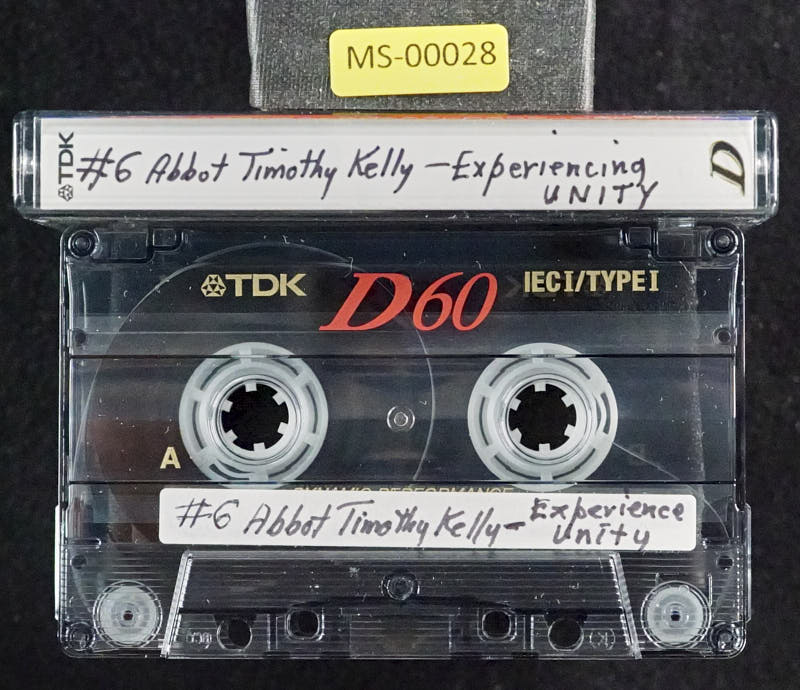


AI Vision - Possible Values from Photos:
Speaker: Abbot Timothy Kelly
Possible Title: Experiencing Unity
Additional text: #6 cond., 10 A. M.
@AI-Vision_v002
I want to do a little bit of reminiscing. That's always dangerous, particularly if you're Irish. Too many stories come up. But I want to go back in my own life, in my own experience. It's probably kind of a developmental thing of remembering some things of my earliest memories. I was born in Milwaukee. My sister and I were born in Milwaukee. The other older ones in the family, the four older ones in the family were born in Minneapolis. Then my father got transferred to Milwaukee and they were there about 1930 to 42. But every year we would go up to Minnesota, which was kind of a home base as far as my folks were concerned. and we would visit relatives and friends.
[01:04]
But the thing that I think we always looked forward to most was going down to Faribault, Minnesota from Minneapolis and visiting the relatives that we had on a farm. I grew up in the cities, I've lived in the cities all my life, pretty much so anyway. Going to the farm was a really very, very exciting thing for little kids. The farm belonged to my father's aunt and uncle. Well, it was great. We would see the animals, the cattle, the horses. Perhaps they had a few hogs and lots of chickens and all that sort of a thing. And we thought this was great. And we would go down there and we would go into the barn.
[02:09]
We'd go up into the hayloft and slide down the hay and all that sort of thing. It was good. It was really good. And then my great aunts. and uncles' children were all adults. In fact, they were probably closer in age to my father and mother than to anybody else. And they were wonderful to us kids. But one of the great things I can always remember about those visits was the meal that got put on later on in the daytime. And the women would be in the kitchen, they would be fixing this meal, and this thing would go on for hours and hours and hours in preparation. And we were getting so hungry, these wonderful smells and all the rest of it coming out of that kitchen. And of course we were being very active, running around outdoors, and by the time the meal was all prepared, we were ready to just dig in.
[03:19]
hands, feet, and everything else. It was a wonderful way of getting to know the family. This was the extended family. And we were living away from, basically from the extended family when we were in Milwaukee. But when we'd get back there, this extended family was just very, very good for us. It was good for us to know what our identity was. We didn't talk about it in those terms. It's just that you got familiar with people that you didn't see very often. But they were so friendly. They were so welcoming. They were so much obviously of our blood that it was nice to be with them. And it was a celebration. It was just a grand celebration with an awful lot of work attached to it. One of the things I think that it taught us children was the idea that here you had a farm you had crops you had cattle you had all of these different things and somebody was putting an awful lot of work into putting this food on the table I don't think we we didn't realize that immediately but I think we realized it on reflection that
[04:45]
Here was all this food on the table, but the work of getting it on that table was immense. The whole growing season, the whole preparatory methods of preparing the land for planting and so on. These were things that had gone on for years. Making all the preparations for this one meal. This one meal that we were sharing, it had so much to do with so many people, so much coming together. I think it made an impact on us because when we weren't visiting relatives and friends like that, at home, we had a mother who liked to bake. And when Thanksgiving would come or Christmas or Easter, you know, the week or two prior to the big feast, the big celebration, she would be in the kitchen making bread, biscuits, what do you call it, suet pudding, all the rest of it.
[06:01]
And we would come home from school during those days, you know, one more thing was being prepared for this big feast that was coming up. And again, it brought the whole family together, and not only the whole family, but even friends from outside. My brothers would come home on a Sunday, for instance, and my mother would always prepare far more than our family needed because she knew that my brothers were going to be hauling in a bunch of friends for Sunday dinner at the last minute. Do you mind if so-and-so stays for dinner on Mother's Day? Come sit down. There's a place. And there was enough food. There always was. But... Reflecting on the farm experience, reflecting on my mother's work on all of this stuff, a lot of work went into this. A lot of preparation went into it. It was really good. But it wasn't something that you opened up a package, heated it up, and put it on the table. That was it. It really did have an impact on...
[07:04]
on bringing us together as a family we knew we were family when we were welcomed at the table and even the friends my brothers coming in or whoever it might be we knew that we we had something in common because we could share the table together it was important then later on I started hearing stories about my not so much my grandparents as my great-grandparents who had growing up in the southern part of Minnesota. And we heard stories about the church. In many places, in those rural areas, he didn't have a church building. You may have had a pastor who moved around quite a bit, but Mass on Sunday would be at somebody's farm. And it would be announced ahead of time whose farm we would be at.
[08:04]
And every week, everybody would get together. They'd get the horse and buggy, and they'd go from one farm to the other to wherever it was that mass was. And where you had a farm that was going to have mass this following week, that week was in preparation for having the mass. Now, what would preparation entail? It would entail not only setting up an altar or some kind of a table that would act as an altar and having enough chairs for people to sit in it. It meant that you had to prepare a meal for that whole crowd of people that was going to be at your farm that day. Because otherwise, you know, I mean, that was their social gathering for the week. Not only having the mass, but having this big meal that you had to feed everybody. If they're going to come, you had to offer them hospitality. One of the pastors they had was a man by the name of John Ireland, who eventually became Archbishop John Ireland.
[09:05]
And if you know your church history at all, he was a rather outstanding figure in the history of the Catholic Church in the United States. He was that one. And he was also a teetotaler, which was, you know, the Irish are extremists, one way or the other, you know. they would come together. One of the things they had to do as well, they had to prepare the altar breads. That was part of the thing that was in preparation. You didn't have the Dominican Sisters of Perpetual Adoration making the altar breads, so they had to do it themselves. So they would make the altar breads as well. But all of this coming together, all of this work, you know, you talk about participation in the liturgy and everything the liturgy means. This was participation par excellence.
[10:06]
It reminds me of a story. It's kind of a side story here, but it happened when I was in the Bronx. We had about on Wednesday release time, I think it was Wednesday, release time classes from the public schools. We used to have about 700 or more public school students who would come every Wednesday afternoon for religious instructions at St. Anselm's in the South Bronx. I had a class one time of probably 10-year-old boys and girls who had, and there were only maybe half a dozen, if that many, four or five maybe. They were too old to be in with the little kids. in preparation for their First Communion, so I took them aside and gave them a class in preparation for their First Communion. If you didn't do that, if you didn't separate them from the little kids, they would just go home and they wouldn't make their First Communion at all. So I was giving a talk to them one day about transubstantiation, believe it or not.
[11:18]
And I was explaining in the best of Thomistic terminology, transubstantiation, where the bread becomes the body of Christ and the wine becomes the blood of Christ. And both of them, of course, are body and blood anyway. But I was going through this whole wonderful... I solved the mystery of transubstantiation for them in 10 minutes, you understand. I got all finished with this explanation and Jose is sitting there and Jose looks at me and he says, I can't believe that. I just can't believe it. So I went through this explanation all over again. I explained about the bread and the wine, body and blood of Christ and so on. It was a masterful explanation of transubstantiation, you understand. Jose sits there and he says, I can't believe it. I just can't believe it. So I go through it a third time.
[12:21]
I explain it to everything just perfectly. I mean, Thomas Aquinas would have been proud of me. I go through this whole explanation. I get all finished, and Jose sits there, and he says, I can't believe it. I just can't believe it. Finally, I said, Jose, what exactly is it that you're having a problem believing? He says, I can't believe that's bread. He had no trouble with transubstantiation. He just couldn't believe that the little round white things were bread. All right. Here is the sign value of our sacraments, and you can't even believe this stuff is bread. Okay. He didn't recognize anything of this as a meal, I'm afraid. He didn't recognize it as a meal. But the problem was that there are a lot of people in this world today who don't believe that the Mass is a meal either.
[13:29]
Because, oh, no, no, no, it's a sacrifice, it's a sacrifice, it's a sacrifice, it's not a meal, it's a sacrifice. Well, I'm sorry. When I was down on that farm... and seeing all the work that went into putting this meal together, when I saw my mother putting this meal together over a period of days for Thanksgiving or for Christmas or for Easter, whatever it might be, by God, I knew that that making of meal was a sacrifice. There's no contradiction between a meal and a sacrifice. And the meal is far more than a sacrifice, just as the Mass is more than a sacrifice. It's a totality of God's love. being expressed to us in the form of a meal. Sacrifice, yes, but more than sacrifice. It's coming together of people who discover their identity in their family because they're able to share this together. Work that they've put into it, you know, over a period of years even, putting all this human energy into the preparation of a meal that sustains the life of people.
[14:37]
It's a marvelous... sign of what it means to be the body of Christ. Not only that this is the body of Christ on this table, but that we are the body of Christ. We are sustained by this meal. We are the ones who become what we eat. And that's what we are. The whole idea of coming to know your identity is And to see that the Eucharist is not me and God. Oh, I am going to receive communion. Don't bother me now. Don't bother me with a sign of peace. Don't bother me with singing together. Don't bother me with anything that has anything to do with us coming together. This is me and God. I've got to have my time, my solitude with God at the Mass. Friends and... countrymen, please. This isn't what the Eucharist is.
[15:38]
The Eucharist is the coming together of the body of Christ to receive the body of Christ to become a stronger body of Christ. That's what it's all about. My oldest brother's family lives mostly in the Twin City area of Minneapolis and St. Paul. Every year after Thanksgiving, it's usually the Saturday after Thanksgiving and the Saturday after Christmas or some day nearby. The whole family gets together in one place. They have their own Christmas celebration at home, but they all get together in one place, and I always get invited to come. So I go to one of my niece's homes, I guess it was, and everybody else was there. Well, I had... a grandniece I don't know how old she was at the time maybe six and she comes over she climbs up onto my lap and she looks at me and she said why are you here you're not part of the family I said I am too she said you are not I said I am too I said I am your grandfather's brother
[16:54]
I officiated at your mother and father's wedding because I am your father's uncle. And I said, I baptize you. She said, you did not. I did too. Yes, no, you didn't. I did. I thought you didn't. Finally, her mother is sitting over at some place. She says, everything he says is true. That settled it for her. It must be all right. So I'm part of the family now. A few weeks later, I was down visiting a brother in Wisconsin. And one of my nephews came over with his five-year-old. And the five-year-old climbs up to my lap, sits on my lap, kind of squiggles around, and he's looking up at me. And he says, why do you have hair in your nose? I said, because I swallowed a rabbit. He said, you did not. I said, I did too. No, you didn't. I just said I did. No, you didn't. You didn't. Finally, his father is sitting over there.
[17:56]
His father says, yeah, he swallowed a rabbit. He did not, you know, which was a clear indication to me that women have more of the gift of infallibility than men have. You understand? The mother would be believed. The father would not be believed. You understand? Coming together, getting to know each other as a family is really important. For your identity, where do you come from? What are your roots? Where have you learned to be a human being? This is what the church is also. Where do we learn that we belong to God? Where do we learn that we are the children of God? Where do we learn that we are fed by God? Where do we learn that we are brothers and sisters? Where do we learn all of these things? Where do we come together in thanksgiving because of who we are? because of our parents, because of our relatives and friends, because of the providence of God who provides food for the table, who provides an earth and an environment, finally the Eucharist is going to bring us to an understanding that we are not in this world alone, that we are in this world with everybody else who's in this world, and that we have an obligation
[19:16]
to take care of this world for the sake of feeding other people, for the sake of other people's lives. We come to an understanding far better when we reflect on our own experiences of life that these are important teachings about who we are in our unity as a humanity. Now go back to what we started out with. What is the image and likeness of God in us? It's exactly this. It's exactly this. The image of God in us, the image and likeness of God in us is that we are for the other. We're able to love the other. Love not being this warm, fuzzy emotion, but love being this service to one another. It's a very, very important thing to see ourselves as the image and likeness of God. providing for others, but also receiving from others.
[20:18]
We're not only givers, we're receivers from one another. But we're also, as God is, free from anything that would stand in the way of our love for one another. That I am not going to discriminate among people, I'm not going to serve some because I like them, and not serve others because I don't like them. This is the image and likeness of God in us. It takes all sorts of people to make this meal, to bring this unity. So we have all of these preparations that speak of sacrifice, yes. We have planting, harvesting, preparing. And I think that today, sometimes in our fast food mentality, here you take part in preparing the meals. That's a wonderful thing to be able to do. But I think in so many places, we don't.
[21:21]
You go to the freezer in the store and and you put it in the microwave, and you sit down and you eat it. And a lot of times people just simply eat alone nowadays. They don't bother having a group of people that come together. So how can we understand the Eucharist if we don't ever experience what it means to have even a normal, ordinary, everyday meal with each other? But finally, what it does is that it brings us together to recognize the one common need, a common need, it's not the only one, but the common need that all of humanity shares. We must have food, we must have drink. We're equal on that. We are the body of humanity, but we're also the body of Christ. We have been transformed. Bread, wine,
[22:26]
are two very good things when they become the body and blood of Christ, but they're good before that because they're able to become the body and blood of Christ. So the Eucharist means that all bread is holy. The wine means all drink is holy. Water for baptism means all water is holy. The oil for anointing means all oil is holy. The laying on of hands for orders or for the part of confirmation. The laying on of hands. Touch is holy. All these things are holy. What is God saying? God is saying to us, embrace the entire earth. Embrace everything that people are doing. Embrace all of this that is there for the sake of humanity.
[23:27]
Embrace marriage. Because here this union in marriage of man and woman is the sign of the unity between Christ and the church. That's a holy thing. Sex is holy. It's very holy. All of these things are holy. And that they can be used as symbols and signs of bringing us to God. of revealing God to us. Revealing God to us in the nitty-gritty, down-to-earth things of life means that we're living in an environment of holiness. It is this that we bring to the Eucharist and it is this that we take from the Eucharist because we are the body of Christ. We are one. There's a unity here that we cannot forego. There's a unity here that we can't ignore. because it's a unity that finally is created, not by us, but by God, because it's in that unity that we are the image and likeness of God.
[24:30]
Comments you want to make? reading a little article about Harris Carter in the American Benedict and I saw it in connection with what you were presenting here in the conferences about identity. So he essentially was saying that identity was recognized by others. And as I was thinking of it, when he was studying the conferences out, it became very deep. was to being here and trying to make the transition of life and Wayne being in my own person, very meaningful. But I wrote this product from his article.
[25:40]
It was about actually, I can't remember. the healing of shame in the little sanctum of the argument. And at the end he says, but what if our true identity is not independence but radical rootedness in the other, whose knowledge of us is the only thing that really sustains us? The corollary is our connection with other persons. If we really cannot exist without the other, neither can we exist without them. It's an unsolvable problem. I can never get enough to eat. I'm never going to solve the problem.
[26:44]
But the magnificent way we've dealt with it, some of the meals you can get, absolutely fantastic. And you're glad that it doesn't, that it isn't complete, that there's more coming. But we don't look at other problems the same way, but they seem to be unsolvable, with an imagination and some good luck and a little bit of help. And it's kind of fun to have certain problems, certain unsolvable problems. Unless you can't solve those problems, you know, like the starving people in the world. We can solve them. We can, yes. I do that when I come here sometimes. I'm always conscious of, I think, about our weight, when I say, you know, gee, the fruits in here are so good, I just sort of think, not enjoy it. I try to hold myself back.
[27:46]
I would just enjoy it because the way to take care of yourself, and I think now we're more accurate than we're doing things during the day, and I'm sure things will get a lot more accurate. And I walk through that, I'm looking forward to that. It'll take care of yourself. I mean, I have to be moderate, of course, but just try not to get so crushed by, well, I should pull back. But I do, in fact, in a way to care for it, not compulsively. I mean, I'll show up for you. I think one of the things that a lot of us grew up on in monastic life was that you're not really supposed to enjoy food, which I think is quite nonsensical. I mean, it's there. You don't have to be...
[28:48]
eating, you know, T-bone steaks for breakfast every day, you know, once in a while maybe. I'm thinking of my own family. As you were talking, none of us had a farm. We used to go to Chicago, and my Aunt May would be like that in an hour. We used to have a kitchen and talk to her. My mother, too, spent hours and hours. My sister, too, carried on that tradition when my parents passed away. But with our family, the dinner was quite very important. We always had Sunday dinner together, and people were getting away from that, even back in the 40s and 50s, and all that was starting to get wiped out. but not with our family. It is important.
[29:52]
Those are the best memories. You could be the farm that was picked out to do the preparation for the social meal on the meal of the college. I guess from what I remember of Minnesota, but it's kind of widespread. It must have been a way that all I can think of is if you couldn't have done it by yourself, you must have had either sons and daughters and wife, or hopefully you might have made, or just a couple. Oh, absolutely. You know, it wasn't an individual thing. I would suspect. Otherwise, I'd get to see if I would have Yeah, no, I think that was very true.
[31:00]
I think the Amish still do that. Do they? Yeah. [...] I just, I mean, out there in the Second World, you know, and working and, you know, times of the essence, I can inhale food. Obviously, I look. But all the books I've been reading about monastic life up late, so I said, well, there's been a couple, I can't remember which ones, that referred to taking extreme time and pleasure in eating when you are eating the meal, thinking about All the preparation went into what you were talking about, where this food started, where it came from, the people that prepared it and the love and everything that went into this, and to really save each and every bite, take your time.
[32:02]
That's why we're really trying to do that. Well, the last one done every time. Well, which is right here, am I wrong? You got me confused. Slow down, guys. The change is looking. But you know, if you look at the rule of Benedict, one of the things that Benedict is very clear about, that you have to eat your meals together. You have to be together for your meals. There's a very practical reason for that. If you're not together for your meals, there's not going to be any food left. Not because everybody is eating so much, but you're not going to have any food left because there's no refrigeration. You simply have got to have the preparation done in such a way that when everybody can be together, that's when you eat.
[33:16]
If you don't have that, when he says if you're going to do penance, if postponing a meal is a penance, if somebody eats such and such an hour, you eat it three hours later, whatever it is. That's a real penance because the food is going to be cold and it's not going to be as fresh as it was very well. And mostly you're eating alone. You're kind of excommunicated. You're not with other people in this meal. For Benedict, that was a very, very important thing. At my place, I know very well that I'm able to, if I, well, when I have to go someplace and I don't want to have to eat out when I'm gone someplace, I will go down to the, we have a little snack room and I can get enough there to eat ahead of time. But I really miss, I really do, I miss, I don't want to have to eat just for the sake of eating, but I want to eat also for the sake of the people who are there, you know, sharing a meal with me.
[34:32]
So, I mean, it's, you know, eating is a communal thing. Of its nature, it is communal. And I think in our culture today, we've kind of made it exclusive. It's unfortunate. I remember being up on the border of Canada and Minnesota, and the people I was with, arranged that one, the Indians, a little quarter horsepower, outboard on a canoe and things like that. Anyway, we were getting started. He said, now, if we see someone along the shore and they wave to us, we're going to go in and eat with them. Because these people are all alone, and they really can't eat alone. And it means so much for them to have somebody to eat with them. We've had a couple of people come here who said, you know, that just eating alone is what I got to. Yeah. Oh, yeah.
[35:34]
That's amazing. Yeah. Again, when I was in New York, you'd go to visit a Hispanic family. And... If you're just stopping in for five minutes, you better have a cup of coffee with them. Because if you don't, you're insulting them. You've got to share something to eat. It's very, very important for the part of the culture. The Vietnamese folk folk talks about trying to have an attitude or a frame of mind that everything is intervening in the culture. intervene and he used illustrations of food that's been planned by a farmer in a field and taking time to grow but nurtured by God's brain and picked by a harvester that brought to market for and then shared with people together and I think it's very important that Mark wrote up that to eat along is very very sad it's a very long picture it's a very long picture
[36:44]
Yeah. Consistently. Yeah. Having, not a snack. Mm-hmm. Making their own, preparing their own food. Yeah. And I guess that's where I'm, you know, when we can invite one of the ends of this possessed of the boss. Mm-hmm. The broken into our meal, literally. Mm-hmm. But that meal of our tent to them. Mm-hmm. I guess that's up on salvation. It is. After I was an administrator at Belmont Abbey, North Carolina, for three years, in early 1992, I went out to Big Sur, California, to the Kamali Monastery out there and spent four months in a hermitage. They have, you know, they have a common prayer at whatever time it is in the morning.
[37:48]
And then they have Eucharist together about quarter of twelve, I guess it is, or whatever it is. And then they have evening prayer at six o'clock, Vespers at six o'clock at night. But I always had, I must say, I always had to look forward to the Eucharist at noontime because right after that was the one common meal of the day. And just to be able to get together with everybody in the community for that one common meal was a very, very important thing to sustain whatever else you were doing during that time. At night, each Hermitage had a little refrigerator and you had a hot pot And you could fix a cup of soup, or you could... I used to... I used to fix an artichoke. That's artichoke country, and somebody would always donate crates of artichokes to them, and I would always bring one up, you know, for my evening meal, put it in that much water, turned on low, and by the time vespers was over, I could get back there and eat an artichoke, which was always very good.
[39:07]
But, I mean, It was still, you were eating alone. And breakfast the same way. I mean, it just wasn't... Getting together for that noon meal was just such a wonderful thing. Such a wonderful thing. And maybe sometimes eating alone is the best teacher for us to appreciate what it means to eat with other people as well. Yeah. Yeah.
[40:12]
Yeah. Yeah. Yeah. And in fact, I think that the real solving does happen when we're all in a table and we're required of this being present in each other. And that's why we're leading the table and continue to share and solidate. The part of your thing is that we're all social beings. I think that when I was following 61, I came to 61, 63, used to have meetings that were connected with me. It'd be packed.
[41:15]
And all of a sudden, they didn't do it anymore. And you see, you know, in the rest of the time, you're lucky you get six people. These others, I used to ask, why is this guy very popular? Well, it's good for me. But that's not the Eucharist. The Eucharist and the meal follows. Well, it takes us back to the agape meal. Paul talks about in Corinthians, people coming together and sharing a meal.
[42:19]
Eucharist is going to be part of that, but he says, what he's talking about, he says, you know, you bring your food, some eat too much, some don't have enough to eat, and you don't share. He says, am I supposed to praise you for that? So, I mean, the agape meal was something that was just as expressive of the unity of the community, practically speaking, it was as expressive of their unity as was the Eucharist. And, you know, they're different, but they're joined. You know, you can't separate meal from meal on this stuff. And the thing was, the last whole day, when you got there, when you get all the eight and nine of the evenings, there was a big dinner, and we were down as two at our feet.
[43:28]
Mange, mange, you get sick. If you don't eat, come on, eat. That's right. And I think meals, in your situation, somehow, because of the encounter that you're experiencing, and you learn how to how to serve you and how enough people serve. That's right. And I think there's a spiritual lesson that is happening. And it's only as I can ponder it now that I realize that's so important to learn how to serve and receive, to be guests. Our second parish in the Bronx was in the East Bronx. And it was basically an Italian neighborhood. And I loved to go up there on a Sunday afternoon and walk through the neighborhood and hope to get invited into the backyard feast. And it did. Those things lasted all day long. They were marvelous.
[44:39]
Well, you know, the time of our, I think our Sunday dinner was always somewhere between 2 and 4 in the afternoon. It varied, depending. But, you know, during the week, you wouldn't dare do that at all. You wouldn't even think of doing that. But Sunday was the day the family gets together.
[45:11]
@Transcribed_UNK
@Text_v005
@Score_86.96