You are currently logged-out. You can log-in or create an account to save favorites and more. more info
Exploring Foundations of Monastic Wisdom
Colloquium
The transcript details an academic colloquium introducing studies of early monastic literature, specifically focusing on works within the "Vitae Patrum" or "Lives of the Fathers." It outlines the syllabus, which will include an exploration of the "Life of Anthony," "Apothegmata" or "Sayings of the Fathers," the "Lausiac History," and will possibly cover texts related to Pachomius, John Cassian, Basil, and Augustine. Discussions delve into the various types of monastic literature, including biographies, sayings, and travelogues within the context of the "Rule of Benedict," emphasizing its reliance on these early texts.
Referenced Works:
- "Life of Anthony" by Athanasius
-
A foundational biography for understanding early Christian monasticism, translated by Evagrius before 400 AD, and available in volumes by Mayer and Sister Keenan.
-
"Lausiac History" by Palladius
-
A travelogue recounting hermit and monastic stories encountered during journeys, part of the broader "Vitae Patrum" collection, available in Ancient Christian Writers, Volume 34.
-
"Apothegmata" or "Sayings of the Fathers"
-
A compilation of sayings considered an early form of Christian monastic writing, contained in Books 3, 5, 6, and 7 of the "Vitae Patrum."
-
Works by John Cassian
-
His conferences and institutes form a critical part of monastic spirituality literature and are discussed for their ethical teachings.
-
"Rule of Benedict"
-
Engages with "Vitae Patrum" elements for guiding monastic life, particularly referencing Book 5 on the sayings of the Fathers.
-
"Philotheus" and "Pratum Spirituale" by John Moschus
- Included in the "Vitae Patrum," these texts emphasize the spiritual teachings of early monastic life.
Secondary Sources:
- "The Desert: A City" by Derwas Chitty
-
A recommended reading for understanding the context of early monasticism in Egyptian and Palestinian regions.
-
"Stories of the Holy Fathers" translated by Wallace Budge
- A Syriac collection echoing the themes of the "Vitae Patrum," offering insights into early monastic life.
AI Suggested Title: Exploring Early Monastic Narratives
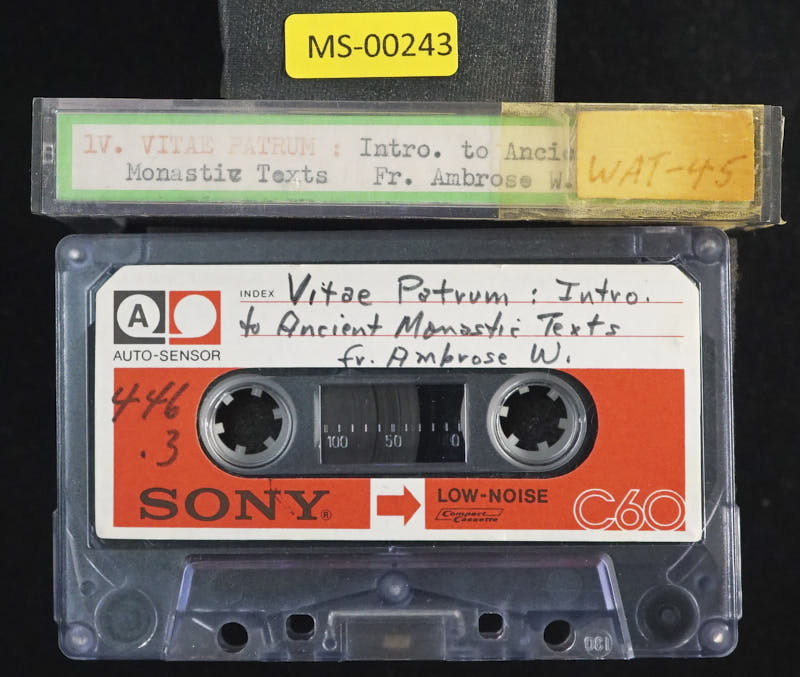
AI Vision - Possible Values from Photos:
Speaker: Fr. Ambrose W.
Possible Title: Vitae Patrum: Intro. to Ancient Monastic Texts
Additional text: MS-00243, 446.1.3
@AI-Vision_v002
We're beginning today the monastic sources for this year. And in general the syllabus, so that you have some idea of what we're going to be doing, is we'll take first of all today the background of the Vitae Patrum, just what we mean by the Vitae Patrum. And then secondly, we'll go into the Life of Anthony. So I ask you to read the Life of Anthony. It's in the Ancient Christian Writers and also in the Fathers of the Church, Incorporated. In the Fathers of the Church, it's called Ancient Biographies or Biographies of the Older or something like that. But in the Ancient Christian Writers, it's one volume by Mayer, M-E-Y-E-R. After the Life of Anthony, we'll take the Apophlegmata, or the Sayings of the Fathers, and you'll be asked to read that.
[01:03]
Then the Lousyak History, and then we also have a translation of that in English. And then we go into Pachomius, then John Cashin, and if we have time, Basil and Augustine, and then some other monastic rules. So that's the general outline. when we talk about the vitae patrum. As soon as we talk about vitae patrum, we're talking about ancient monastic documents. And the thing about this vitae patrum is that it includes various kinds, various types of writings. In the rule of Benedict, we have references to this vitae patrum three times. You may recall in chapter 18 on the divine office, and in what order the psalms are to be said, at the end of that chapter, or towards the end, he talks about arranging the psalter according to one's disposition, if they don't like the way it's done in the rule of Benedict.
[02:20]
Provided always that he take care that the psalter with its full 150 psalms be chanted every week and begun a fresh... every Sunday at matin. So you can arrange the songs any way you want, just so you be sure you'll say 150 of them. Then he says, for those monks show themselves very slothful in their sacred service, who in the course of the week sing less than the Psalter and the customary canticles. Then verse 25, whereas we read that our holy fathers and its santos patres nostros. strenuously fulfilled in a single day what I pray that we lukewarm monks may perform in a whole week. So he's referring back to our holy fathers. And what he's referring back to really is a story which we find in the collection called the Vitae Patrum. Now he doesn't use the term Vitae Patrum there, but in book five of the Vitae Patrum, and we'll see what these books mean, in chapter four, verse 57, we have the following little story. An old man came to a father
[03:23]
who cooked a few lentils and said, Let us worship God and eat afterwards. One of them recited the whole psalter. The other read and meditated upon two of the greater prophets. And in the morning the old man went away, and they forgot to eat their food. See, the story is that this guy comes and says, Well, let's pray first. And in praying, one guy recited the whole psalter. In many ways, this is a satire because it's sort of a dumb thing to do to come to eat with somebody and pray a little bit before you eat and then spend the whole night in prayer and forget what you came for to share a meal with them. But Benedict is referring back to this text where our fathers in the desert said the host altar in one day. Yeah, but how? They forgot what he was doing. and he said the whole Psalter. So in some ways, he's laughing up his sleeve about saying our fathers in the desert said the whole Psalter every day. But he's referring back to this story in the Vitae Patrum.
[04:27]
Now, in the other two places in the rule of Benedict, he specifies Vitae Patrum. In chapter 42, verse 3, chapter 42 is on not speaking after Compline. And in verse 3, we say that On a non-fast day, as soon as they have risen from supper, let them all sit together in one place and let a brother read the conferences of Cassian or the lives of the fathers or something else that may edify the hearers. So after the meal and before Compline, the sort of introduction to Compline, they sit together and they read. Now it says here the conferences and McCann's translation says of Cassian. In the Latin text it just says colaciones. It doesn't specify John Cashing. Now, I'll mention that again. But it's just the conferences. Or the lives of the fathers. The vitas patram. So, after supper, the monks are to read these things in common.
[05:27]
It's a common exercise. And it's for edification. To edify one another. Apparently, these things were read rather frequently. And daily, this reading took place if we had supper, at least. So... during the whole season of the year, during the Paschal season, when you had supper, you would be reading either the conferences or the Vitae Patrum. So apparently they were quite familiar with these things, having heard them over and over again. And later on in chapter 73, at the end of the rule, where Benedict says that not everything has been written in this little rule for beginners, he says... Then the conferences of Cashion and his institutes and the lives of the fathers as also the rule of our Holy Father Basil. These are a good rule of life. The scriptures, the Catholic fathers, then Cashion, conferences, the institutes, the lives of the fathers, the vitae aeorum, the lives of the fathers. Now, in this text, again, he doesn't say John Cashion.
[06:27]
That's another thing that McCann does. When he says, colaciones, he says, well, that must be the colaciones of John Cashin, because we'll see that John Cashin did write colaciones, or conferences. But in the text, it says, colaciones patrum, so the conferences of the fathers and their institutes and lives. Apparently, this is a generic term again, the conferences, just as the vitae patrum, and we'll see the vitae patrum exactly what this entails. One sort of point on this John Cashin problem, is that there were other monastic writings called conferences, besides the writings of John Cashin. So there's no need to specify these as merely the conferences of Cashin. For instance, there's a statement by Genadius in his book, Ver, it's probably the Veris illustribus, but I'm not sure what the title of the book is. But it says, Severus wrote conferences. concerning the conversatio of the Oriental monks and also the life of Martin.
[07:31]
So you see right away that the term is used in a generic sense, the colaciones, which concern the conversatio or the way of life of the Oriental monks. This is Severus who wrote that, not John Cashing. So Benedict in talking about colaciones could be talking about a type of monastic literature which was available to him and not referring only to John Cashing. including John Cashin, but not only referring to John Cashin. The only person that Benedict mentions by name is our Holy Father Basil, which is very interesting and tells us that Basil is pretty important for understanding the mentality of the rule of Benedict. He does not mention John Cashin by name. So we see that the rule of Benedict uses this vitae patrum once in this story, allusion to the story, and then twice specifying the vitae patrum. Now, what do we mean by the vitae patrum? In English, it's lives of the fathers. Well, in 1615, a Jesuit scholar by the name of Herbert Roseweed, R-O-S-W-E-Y-D, put out what he would call sort of a critical edition of the Latin tradition of monastic writings, which he calls the vitae patrum.
[08:47]
So if you've looked in the mean patrology in the Latin series. Do you know what the mean patrology is? If you look in there in volume 73 and in 74, you find this collection called the Vitae Patrum, and it's in 10 so-called books. Now this is the 17th century when he finally put this edition out, but he was basing this collection, his text, on 8th and 9th century manuscripts, which probably reflect a 5th and 6th century tradition. So it's possible that the same thing he calls Vitae Patrum is exactly what Benedict would include in the Vitae Patrum, although it's not exactly because we'll see some of the things that he includes in the Vitae Patrum weren't translated at the time that Benedict wrote. But it would be the general collection of monastic writings. So it's found in volumes 73 and 74 of Latin Pathology of Means. And it consists of ten books. Eight of the books are in volume 73 and two books are in volume 74.
[09:48]
Now just very briefly what these ten books are and what its official title is, The Vitae Patrum Sive Historiae Eremitice Libri Decem. So the Lives of the Fathers, that is, the ten books of the history of the hermits. So right away it tells you it's about eremitical life. But a lot of the things that are said there are not merely Eremitic, though it's bigger than that. But basically it is Eremitic tradition and the tradition of the desert. Book one is The Lives of the Fathers. I'll go through this again in more detail, but I just want to give you the ten books. The first book is The Lives of the Fathers. The second is what we call The History of Monks by Rufinus. The third is a collection of Verba Seniorum. or Sayings of the Elders by Refinance. The fourth book is selections from Sopisius Severus and John Cashin. Notice he's got both those together, the person that I mentioned to you that Severus wrote Colazione and John Cashin.
[10:55]
And it puts them both together, selections from them, in book four of the Ditae Patrum. Book five is the Verabasena Iorum, translated by Pelagius the Deacon. You recall when we were talking about the authenticity of the rule of Benedict, and I said that one of the ways of dating that was we knew that Pelagius had translated certain sayings of the fathers in a particular date, between 535 and 550, or 527 and 550. And Benedict used that. And this is what is in that book, this book five of the Vitae Patrum. So that would have been in existence. when Benedict wrote his rule. Book five would have been. Book six, which is the Verba Seniorum, translated by John the subdeacon, which is a continuation of the work of Pelagius, was not yet in translation when Benedict wrote his rule. So this section of the Vitae Potthum would not have been available to Benedict. Book seven is the Verba Seniorum, translated by Pascatius the deacon,
[11:58]
Now, Pascatius the deacon is a man who lives, if I'm not mistaken, in Spain and later than Benedict. So that wouldn't have been available to Benedict. Book 8 is The Lousy Act History by Palladius. Book 9 is The Philoteus or Theophiles, which means God-lover. And Book 10 is called The Protum Spirituale by John Moscus, or The Spiritual Plain. Just curiously, what's The Lousy Act? We're going to go into The Lousy Act History. It's... What it is is a travelogue by Palladius written to a man named Lausus, and therefore it's called the Lausiac history. But that's one of the things that we're going to in more detail. We're going to go into the life of Anthony from book one. We're going to go into the Verba Seniorum in book five by Palladius the deacon, and also then into book eight, the Lausiac history. So that's why I want to give you this general feeling of what's in the Vitae Patrum, because then we're going to take a look at particular aspects of it.
[13:00]
I'd like to give you a little more detail about what you find in these ten books of the Vitae Patrum. The Lives of the Fathers. I'm just going to read you a long list of the different lives that are found, and as we go through some of these names, I'm going to point out to you where you can find English translations of these things, because they're Quite a bit of it is available in English, but it's scattered all over the place. I just want you to have some idea where you could get a hold of it. So, the first book, The Lives of the Fathers, Strictly Speaking, The Biographies of the Fathers. That's the first book of the Vitae Patrum. According to Roseweed, The Lives of the Fathers was collected by Jerome and other people. Then the first life that he gives is the life of Paul the Hermit. Now, that life of Paul the Hermit is found in this copy of Helen Waddell, The Desert Fathers, two different editions of it, the English and the American edition of it.
[14:10]
The American edition, this is for the sake of the dear sisters, the American edition is put out by Ann Arbor, paperback, $2.25, the University of Michigan Press, the fifth printing in 1971. So in there you find the life of Paul the Hermit, which is the first life in this book one of the Vitae Patrum. Now it's also in, I think that life is also in that early Christian biographies in the Fathers of the Church Incorporated. Now the second life is the life of Anthony. The second life that we find in first book of the Vitae Potter, was The Life of Anthony. That, as I mentioned, is translated by Mayer in Ancient Christian Writers, Volume 10, and then by Sister Keenan in The Fathers of the Church, Volume 15. The Life of Hilarion. This was written by Jerome, and that may be in the ancient Christian biographies, too.
[15:14]
Pretty sure it is. The Life of St. Malachi, the Captive Monk. The Life of St. Onufrius the Hermit. Onufrius is famous because he's the man who only wore a beard. And you see in all of the pictures of his icons, this hermit, who has nothing. Sometimes he has a little garland of ivy around. But usually he just has a huge, long, flowing beard. And he lived in the desert in nakedness, which is a theme of the desert monks. The nudity of Christ. And so Onufrius is famous for being... the man with the beard. Then you have the life of Pocomius, the abbot of Tavanese, interpreted by Dennis the Little, the Roman abbot. I mentioned to that when we talked about the authenticity of the rule of Benedict. In 527, this Dennis the Little translated the Greek life of Pocomius into Latin. And that's the translation then that is collected into this Lute Patrum, book one.
[16:18]
So the life of Pocomius. The life of Saint... Abraham, hermit, by the deacon Ephraim. The life of St. Basil, the archbishop of Caesarea in Cappadocia. The life of St. Ephraim, the Syrian, the deacon of Edessa. The life of St. Simon Stylides. All of these famous hermits and saints of the desert are in this book. The life of St. John, the almsgiver. The life of St. Epictetus, priest, and Astonius, monk. The life of St. Macarius, the Roman, Now, when you come to Macarius, there are various Macarii. There's Macarius of Alexandria, there's Macarius of Rome, a number of different Macarii. This is Macarius of Rome. The life of the blessed Postumus, the father of 5,000 monks. Now, this is quite populated monasticism in those days.
[17:19]
The life of St. Frontonio, abbot. The life of Saints Barlone, the hermit, and Josaphat, the king of India. The Oriental Church, I think, still celebrates the feast of Barlone and Josaphat. It's one of the Oriental feasts. And that's written by John Damascene. The life of St. Eugenia, virgin and martyred. The life of St. Euphrasia, virgin. the life of St. Euphronosia, virgin, and then the life of St. Mary the harlot, the niece of the hermit Abraham. And her life is found in Helen Waddell, the life of Mary the harlot. Then you have another harlot, St. Thais, T-H-A-I-S. She's another one of these people who were converted and became a nun. The life of St. Pelagia, also a harlot. And that's found in Waddell, in the Desert Fathers.
[18:22]
The life of St. Mary of Egypt, also a harlot. The life of St. Marina, virgin. The life of Blessed Fabiola. The life of St. Paula, the Roman widow. And this was written by Jerome. They were great friends, Paula and Jerome. The life of St. Marcella, widow, also written by Jerome. So notice those are the lives that you find in this book one of the Vitae Patram. So that's really where the whole collection gets its name from, because there's where you really have the lives. Now in the second book, you find the history of the monks in Egypt attributed to Rufinus. There are excerpts of that in Waddell, The Desert Fathers. The third book is the Berbaseniora. So that's the first of the Verba Seniorum collections. Verba Seniorum means sayings of the elders. Now, we're going to go into the saying of the elders, also known as the Apothegnota in Greek, but we'll go into that later.
[19:23]
This third book of the lives of the fathers then is this kind of collection of sayings, and it was collected probably by Rufinus. Now, Rufinus lived at the time of Jerome, so around 400. So he was already collecting these things and translating them into Latin. There are excerpts of that in Waddell. The fifth book is the, no, the fourth book, excuse me, are excerpts from Sopisius Silverus and John Cashin. And what you find in the Desert Fathers, you find excerpts of Cashion, excerpts of the excerpts, because the Vitae Potter made excerpts of Cashion, and now she's come along and she's made excerpts in her translation. You find the thing on Assyria and of mortification. That's two of John Cashion's institutes, which she has translated. The fifth book is the Verba Seniorum, translated by Pelagius, who later became the Pope. And that's the one that's important for the rule of Benedict.
[20:27]
And you find books one, now all this book stuff is going to be confusing, but in book five, you have what you call five books of sayings. We would maybe say chapters, but that's not exactly what they're called. They're called the books. So actually, what Pelagius and... John the Subdeacon did was take a collection of 22 books of sayings, and they each translated part. And Pelagius translated book 1 to 17, and that's book 5 of the Vitae Patrim. And John the Subdeacon continued it, and that's book 6. So it's really a unit, which should be. You see, it's broken up in the Latin tradition. But you find this almost complete, this book five, translated in Owen Chadwick's book called Western Asceticism, which we have in the library. And this Western Asceticism includes sayings of the fathers, selections from John Cashin, and a translation of the rule of Benedict.
[21:31]
It's a very interesting translation because Owen Chadwick is quite a good Latin scholar. So we have that too, complete in English. And then there are excerpts in Waddell, Then, with regard to Book 6, which is the Verba Seniorum by John the Subdeacon, in Waddell, again, there are selections. Book 7, which is Verba Seniorum, translated by Pascasius, is found in the Fathers of the Church, Incorporated, in Volume 62, called Iberian Fathers, Volume 1. And there you find question and answers of the Greek fathers. And it's translated by Claude Barlow. So we have that in English too, that book seven of the Vitae Patrum. Now, Benedict wouldn't have known that one. Book eight of the Vitae Patrum is the Lausiac history. The history that was written by Palladius, who later became bishop of Hellenopolis, for a man in the court of the emperor at Constantinople named Lausis.
[22:41]
And that's where it gets the name Lausiak History. It was written about 420. And we have that also complete in translation with a fine introduction in Ancient Christian Writers, Volume 34, translated by Mayer. So you'd be expected to read that too. And then there are excerpts in Helen Waddell. Book 9, which is called the Philotheus or Theophilus. You may remember that name from the Gospel of Luke or Theophilus, which means God-lover. what exactly this is, I'm not too sure. I haven't read the Latin text, and I don't recall ever having seen any English translation of it. It means the God-lover, and it's probably spiritual nosegaze of some sort, or reflections. The tenth book is the Pratum Spirituale, or the Spiritual Plane, and this is rather a classic by John Moscus. There are selections in Waddell. So that's what that book those ten books that Roseweed presents us in need, consists of.
[23:46]
Now, what you notice right away of these different kind of things that are in the Vitae Patrum, you have various kinds of writings. And Owen Chadwick, in his little book on John Cashin, which is the second edition in 1968, Cambridge, and it's just called John Cashin, which is an excellent little book, in pages one to eight, talks about the four different types of monastic documents that the first Christian monks sort of put out. And these four different types are not rigorously distinct. They overlap. But he divides the monastic writings of the early monks into four different types. The first type he calls a collection of sayings. That's really the most primitive type of of writing. These are the apothegmata. Now these apothegmata, that's the Greek word which comes from, means a clear statement. So it's just little pithy sayings usually.
[24:49]
We'll go into those. We're also called in Latin the adhortationes patrum, or the exhortations of the fathers. Also known as the verba seniorum, or the words of the elders, the sayings of the elders. And because these collections of sayings, or the apothegmata, or part of the vitae patrum, this larger collection, you can also call these sayings vitae patrum. And frequently when they talk about the vitae patrum, they're talking about these sayings. So these words are rather confusing at times. Sometimes they use the term vitae patrum when they're referring specifically to the type of collection of pervasini or sayings of the fathers. And that's what makes it difficult when you're reading a history book. But I'm hoping I'm making some sense of the... the difference between these things. The Vitae Patrum is a generic term for this whole collection taken from the first book, which is really Lives of the Fathers. And then the Verba Seniorum is within that collection, but because it's in the collection, it has been also sometimes called the Vitae Patrum.
[25:52]
As for instance, the Vitae Patrum, book five, which Benedict would have known, are really Verba Senior. Am I making any sense to you? And so when you read history books, sometimes it gets awful. You say, well, what in heaven's name are they talking about? One time they used Vitae Patra, one time they used Verba Senor. What's the interrelationship between the two? Are they exactly the same or not? These little sayings were collected in various collections and in many different languages. So there was a tradition, for instance, of Coptic sayings. Then these things may be in Greek. The Coptic might have just been translated, or there were other sayings which somebody collected and wrote in Greek originally. They were in Arabic, in Syriac, and then you have the Latin translations. And all of these have variants to them. So it's just a big forest of different traditions, but a lot of similarity in the things, but various collections. Now, Rose Weeds, Vitae Patrum, if you remember, in Book 3, Book 5,
[26:59]
Book six and book seven are these kind of collections of sayings. Those are the verba saniorum. Now we will look at these later when we analyze the apothegmatos, so we will go into them and especially into book five, which is the one that Benedict used. Another type of monastic writing would be what we call biographies. Now, he says there are two types of biographies. The first is the biography of individual hermits, and the second are collections of sharp biographies. Now, the first type, the examples there are found in book one of Evitae Patron, The Life of Anthony, written by Athanasius in 367 AD. And then a Latin translation was made of this life before 400 by Evagrius. So already it was in existence very early. in the Latin West. The life of Paul by Jerome. The life of Pachomius. These are the kind of lives that are found in book one of the Vitae Patrum.
[28:02]
So that's another type of monastic writing. Now we're going to look at the life of Anthony first of all when we start looking at specific things in the Vitae Patrum because it is the earliest document that has been written as far as we know. I mean, Anthony is considered the sort of the father of monks. And then after him, you get all of these other writings, but very quickly after him. Now, some of the apothegmata are certainly as old as the life of Anthony. And some of the apothegmata are the sayings of the fathers. They say, Abbot Anthony said, and then they'll give you a little saying. So they're very old also and sort of contemporaneous with the life of Anthony. But the first actual document that we have that has been stabilized is the life of Anthony. And that's why we look at it first. And then after that, we'll take a look at the Apothegmata. Now, the second type of biography, or the second type under this second major category, are collections of sharp biographies like the Lausiac history of Palladius. What the Lausiac history is, Palladius goes on a journey to Egypt and to the Orient, and as he travels around, he writes stories of people that he's met, and stories that they tell him about people that he knew.
[29:13]
So incorporated into this travelogue are these stories of hermits and of monks. So it's a type of biography. But notice it also belongs to the third category that we'll see, the reports of travelers. So it belongs to the biographies and the reports of travelers. This is found in book eight of the Vitae Patrum. Also, the history of monks by Rufinus would fit into this sort of collection of biographies. Now, the third main category with... first collection, second biographies. The third is the reports of travelers. This we have the lousy act history on this trip, and he says what he saw. That's book eight of the Vitae Patrum. The history of monks by Rufinus fits into that same category too, because it's, well, I think what seven monks saw in, what they say that they saw in Egypt, and then they wrote the history about it. And that's in book two of the Vitae Patrum.
[30:14]
The dialogues of Sepetius Severus also belong to this category because he records what he saw in Egypt. He's traveling around and what he saw he writes down. And the conferences of John Cashin fit into this category of travelogues because what John Cashin pretends to be doing is giving 24 conferences that he heard the elders in Egypt give when he and Germanus were traveling in Egypt. So see, the literary form is a type of travelogue, although this is not very emphasized. He really emphasized what they said. So his writings really fit into the fourth category, which Chadwick calls ethical divinity. This is monastic spirituality. And the goal of these kind of writings is to help monks practice the good life and the contemplative life. So John Cashin is very important in this... category. And then people like Evagrius would belong here, Evagrius writing on prayer and on the spiritual life.
[31:16]
And also what you find in books 9 and 10, the Philoteus and especially the Pratum Spirituality by John Moscus in book 10, that would belong to this ethical divinity. And this gives us the theory of monastic life. Now there are various language traditions of All of these writings. And that's why it gets so complicated. Maybe not so much John Cashin, but everybody else. All of the sayings of the fathers are in all languages and various types of collections. The same way with Allosiac history. Latin, Greek, Syriac, Coptic, and Arabic. And besides that, the collections have been put together in various ways. So the little collections, for instance, the sayings of the fathers, one of the book five and six of... the Vitae Patrum, which is a translation of a Greek collection, has been put together a little bit different than the original Greek. And the Greek is a little bit different than maybe you find in the Syriac tradition.
[32:18]
Besides that, these little collections are put together in various ways. So that, for instance, we have the Latin collection of the Vitae Patrum of roseweed, which is based on the Latin traditions of the 8th and 9th century manuscripts, but reflects an earlier Latin tradition. But there's also a Syriac collection similar to what we would call the Vitae Patrum, which we have an English translation of called The Paradise of the Fathers. Maybe you've seen that in our library. It's two big volumes. And this is translated by Wallace Budge. Volume 1 and 2 are called The Paradise or The Garden of the Fathers. And then, to make it even more complicated, he republished Volume 1 of this Paradise of the Fathers and calls it Stories of the Holy Fathers. And this contains the life of Anthony, the life of Pocomius, the lousy act history, and the sayings of the fathers. Notice, it's the same ingredients that you had in the Vitae Patron, but it's just shuffled a little differently.
[33:20]
And besides that, the tradition is just a little bit different. So you have to be very careful when you're quoting from the lives of the fathers. What tradition are you talking about? I don't know if you are aware of this Thomas Merton, The Wisdom of the Desert. You may have read that. It's little sayings from the fathers of the desert of the fourth century. New Directions book, 1970. And it's got a very fine introduction by Thomas Merton. Then he goes into these little sayings. The problem is, of course, it's not a critical thing, but I don't know where he got these things from. whether he got it from the Syriac tradition, whether he got it from the Latin tradition, the Greek tradition. He doesn't say where he got it from. And so when you read something like this Thomas Merton, The Wisdom of the Desert, you come across an interesting little story and you say, my goodness, I wonder if Benedict was aware of that story. Well, one of the ways you could tell whether he was, if it was in book five of the Vitae Patrum, you know already that he had book five.
[34:24]
Suppose the story is in book... 7, which was translated by Peccasius the deacon. Benedict probably wouldn't have known it unless he knew it in some other tradition. And that's part of the difficulty and why it's necessary to specify where you get a text from so that you can see what the interrelationship is. But I would advise both of you to read this, Thomas Milton, The Wisdom of the Desert. It's a very fine little introduction to the whole feeling of the Desert Fathers. It's obvious then that there are various collections or traditions of the sayings, biographies, travelogues, and ethical teachings. The Latin collection is known as the Vitae Patrum. The Syriac collection is known usually as the Paradise of the Fathers. Now, I want you to read The Life of Anthony. And then when we get to the sayings of the fathers, I want you to read the one that Owen Chadwick has translated, the one that Benedict would have used at book five of the Vitae Patrum, and the Lausiac history.
[35:34]
Joel, if you have time, I would suggest that you read the Syriac tradition. It's going to have the same content, but it's going to be in a little bit different form. But it's easy enough, you know, it's too big volumes, but just... sort of take your time. It's called The Paradise of the Fathers by Wallace Budge. Now there's, as I mentioned, there's two volumes. Two volumes are in a collection called The Paradise of the Fathers, and then besides that, he's put out both volumes in different editions, which are called The Stories of the Fathers. So you might find one or the other, but it's by Wallace Budge. And I was doing one by Chadwick? Chadwick, yeah. But see, that... You don't have to start on that one yet, Mike. I want you to read the Life of Anthony first. And if you read the Syriac, then you're going to find the Life of Anthony in there. So you'll find all of these things in there, Joel. There's no problem there. So we see that these larger collections are made up of smaller collections.
[36:36]
And you just have this... It's very similar to what's happened in sacred scripture with the JPDE traditions. And they're all... joined together, and it's like the difference between the Sumerian Pentateuch and the Jerusalem Pentateuch. Pretty much the same, but little bitty differences. There's a variance there, especially when you get to the prophet Jeremiah. You know that in the Septuagint, it's much different than it is in the Hebrew text, which indicates that there were various traditions of the prophet Jeremiah. That's the same kind of thing that you find in monastic sources. So these collections of sayings, especially, are very complicated. And we'll see that more in detail when we go into the Apothegmata. Now, I repeat, we plan to look at the life of Anthony. That's what we plan to do first. Then the Apothegmata, then the Lausiac history. Remember, these are part of a collection called the Vitae Patrum. And these are things that Benedict would have known. Now, according to the source study of the rule of Benedict, the rule uses the following parts of Roseweed's collection.
[37:43]
From book one, the life of Anthony, the life of the Roman Macarius, and the life of Poconius. Now, maybe more, but at least that much. From book two, the history of monks in Egypt, the rule of Benedict, apparently. Now, this is based on Butler's study of the sources. I have to check Dave Old Way and see. He's brought it more up to date to be able to tell more what Benedict used from this collection that roseweed established in the 17th century. Book three and book five of the Sayings. So book three, the Verba Seniorum by Rufinus, and book five, the Verba Seniorum, translated by Pelagius the Deacon. And then book eight, the Lausiac History. Now, hopefully, as we go along, we'll get a better picture of this and see the interrelationships and where the dependency is. And as you read these mics, be very careful. If something sparks you that you see in the rule of Benedict, you say, my, that's awful similar. And then it may very well be that this is a source. And you see that Benedict's thinking has been determined by these kind of things that he has read.
[38:51]
Now, I'd like to go into a little bit about the procedure for this course that we're having this year. There will be lecture presentations. And, for instance, for the life of Anthony, I want you all to read it. And then I will present... my own analysis of the life of Anthony and what you can milk out of the text. Now, I want you to read it so that you can be critical if you think that I'm going too far with this. So there'd be an analysis and a synthesis of these various works, these documents, with reflections on what it really means to us and whether these things are relevant. You know, why do we read the life of Anthony today? Why waste our time in the fourth century hurt? Who is he to meet? So, the necessary reading is that we're going to read as many sources as we can find available in English. The Life of Matthews, Sayings of the Fathers, Lausiac History. When we get to Basil, one of the rules of Basil has been translated.
[39:55]
John Cashin has been translated. Augustine, some of his works are translated. His rule is not translated. There's some modern translations of it. And... Possibly by the time we get up there, if we still have time, the rule of the master will finally be out in English. You can go into that. When you read these documents, read critically. In other words, ask the documents questions. I'm going to suggest to you some questions that you can ask. Another thing I would highly recommend is that you read little summary articles in encyclopedias and books and in histories. For instance, just look up Anthony in the Catholic Encyclopedia, and it'll give you a very brief little summary of who he is, when he lived his life, and things like that. And this is always a good way of approaching something which is rather big. Now, one book that I want you to read, I'd like both of you to read it, but especially I expect you to read it, Mike, and not immediately the whole thing because it covers this whole period, is The Desert, a City by Derwas Chittin.
[41:01]
I think it's on your bibliography name. It's D-E-R-W-A-S-C-H-I-T-T-Y, The Deserted City. It's one of the finest books on early monasticism. It's an introduction to the study of Egyptian and Palestinian monasticism under the Christian Empire. It's put out Oxford Blackwell 1966. It's 222 pages. Now, I would like for you especially, Mike, to read that Now, Joel, because there's only one copy, you might not be able to get it. There's another book which is also of interest, but I have much more criticism about it, and that's by Jacques Lacariere, The God Possessed. It treats the same area, but I think that Lacariere is prejudiced and gives a prejudicial approach. Yeah. So... along with reading The Life of Anthony, begin reading Derwas Chitty.
[42:06]
Are these available in... They're in our library. Yeah. So, read critically and read these little introductory articles. Do you read French? No. Joel, you don't read French. Okay. I expect a project or a paper. Now, the way... we're going to do this is that, for instance, when you take the apothegmat of book five, you will be expected to give a presentation of what you've discovered from this. Sort of the background of it, what these apothegmat, I'll give you some of this too, but I want you to be able to present some of it too. And especially then an analysis of the texts. And it's very good when you do something like that is to ask questions of the book that you're reading. For instance, if you're reading The Life of Anthony, you can ask the question, what is the origin of monastic life?
[43:23]
Where does it come from? And this is a very early monastic document. And does it tell us anything? What can we read? Now, it's not going to say the origin of the monastic life is. This is where you have to read in the text and see what underlies the text for the origin of the monastic life. What is the purpose of monastic life? Why would Anthony do what he did? What is the purpose of this kind of monastic life? The motivation for the monastic life and the structure of monastic life. See if there's anything like this in the life of Anthony. These are the kind of questions that you ask a text when you read it. And then the text becomes alive to you because it's answering questions that you're interested in. You can, for instance, with regard to the Opus Dei lectures that Father Patrick has given you, while you're reading these things, keep in mind, well, how did these monks use the Psalms? How did they use Scripture? Is there any indication of fixed prayer times, as you find later on? And sometimes you find just merely little subtle allusions to something which gives you
[44:27]
a feeling for what's beyond everything. So that's the kind of questions I want you to ask as you read these texts. Now, is there any question or observation? I'll try to get a better bibliography, but this is just something you can be working with. I want to give you some maps and things like that. Because as we study, especially the geography and the history, it's good to relate with something real quick. Okay.
[45:10]
@Transcribed_UNK
@Text_v005
@Score_94.67