You are currently logged-out. You can log-in or create an account to save favorites and more. more info
Evolving Monasticism in Modern Society
AI Suggested Keywords:
Monastic History Seminar
The talk explores the theme of monasticism's enduring presence and evolution within religious life, emphasizing its adaptability and role in community formation. Highlighting the significance of monastic spiritual practices, it elaborates on how these practices interact with cultural, economic, and social forces. The speaker reflects on the broader implications of religious adherence, poverty, and the challenges of modernizing monastic traditions in contemporary society.
-
John Clark's Studies on Monastic Spirituality: These studies are noted for examining modern aspects of monastic life, focusing on its evolving spiritual dimensions in response to current societal changes.
-
Paul Pinto's Teachings: Referenced to illustrate a traditional perspective on religious devotion, suggesting the influence of cultural adaptation within religious practices.
-
Economic Perspectives on Monasticism: Discussion of poverty in monastic contexts highlights the economic challenges and the societal role of religious communities in contemporary economic systems.
-
Historical References to Monastic and Economic Development: Refers to the transformation of monastic communities along with economic changes, possibly linked with religious and secular governance over time.
-
Thomas Aquinas: Briefly mentioned in context of moral and intellectual justification within religious teachings, considering his philosophical contributions to theological discourse.
The talk integrates historical and contemporary analyses to present a nuanced understanding of how monastic communities can navigate and contribute to broader societal contexts.
AI Suggested Title: Evolving Monasticism in Modern Society
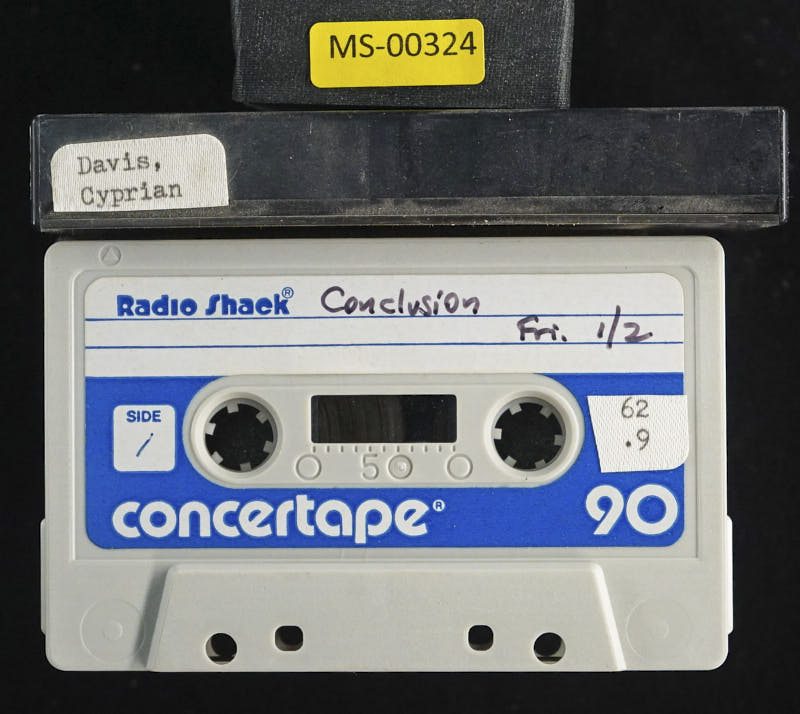
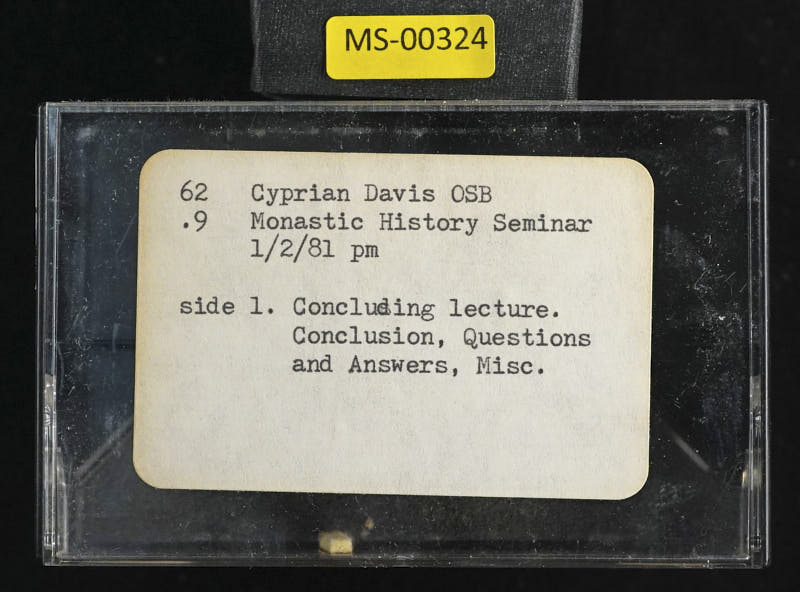
Side: A
Speaker: Cyprian Davis
Location: #N/A
Possible Title: Monastic History Seminar
Additional text: Concluding lecture. Conclusion, Questions and Answers, Misc.
@AI-Vision_v003
It's a nation. I'm not going to stand with myself in one of a while. I didn't get around now. I was going to take him to my fairies. I was talking. [...] Yeah. Yeah. Yeah. And in the special thing about, in the form of that thing, is that we need to go to the university.
[01:05]
When we're talking about it, you know, I want to, I'm just going to put you on that. I wish I could do it for you. You just have to put it right to you on your own, your own thing. Now, what I do is, you know, you're going to do it for you. You're going to do it for you. Oh, I think, yeah, I think that's right. You know, in fact, I've done two studies, uh, you know, self-correctional studies on, you know, contemporary and contemporary, and one, I forget the title here in that, we both, we talked, we had an article, and actually both in the, in the, um, in Asia and Africa, they're very good. But I think, although right now, both of them are out of date.
[02:06]
I know that, I know that in Iberia there are, there are traffic that are probably, almost repetition of the problem for a community, a forum that are sort of meeting to the crowd. Now that I'm not studying these ones, I'm in the first charge of about 20-15 months, I think, or 12-15 months, I've been asked to with a living life for a year. I'm going to be living life for a year. I'm going to be living life for a year. And again, I'm going to have a grand one. I have been watching this year. You see, my friends, my name is Jesus theory. By outrating people. is that monasticism is something that religion is to humankind as religious beings. Remember, we are horrifying, I'm sorry, the eruption of monasticism coming forward where we look at people who are living in kind of a religious life.
[03:16]
We're living in a religion. We have a religion. Once it's quite a good fit for religion to get to the point of the history of development, Not even one kind or another. Whether it's like something you know, it's irrelevant when one kind or another comes up and that's exactly what we did. And you know, people brought almost anything to any group, to any civilization, and take a guess there are a phenomenal way on it. About, uh, what do you call humanity? See, I always dialed at home when you're going to have to use the course, talking about the shama, driving the shama all the time the most. If you're playing with people, people don't like to bring around in touch, you will be allowed with the line.
[04:18]
Therefore, that line would have to be made according. It requires a way of me. It's, it's, [...] it's We've been asking you to get out often on the village level, and get it. We're going out of the temple. We'll go out in the bed during the morning. He, and everyone must relate to, and yet they're living in monastic life, and we, and, um, they can get out of us on my life as part out in the kitchen. The people who, um, tell them quite a piece to happen.
[05:19]
Well, that's one of the, uh, elements of, uh, Well, I think everything has to come. Yeah, I don't, I think it's a, um, It didn't mean that it was because it was like that. It's like, it's like how I'm going to leave. I'm going to be on out of the church for sure, but that always was what we saw it. But be realistic. You've got to have it. You know, you've got to have it long. You need to get through it. You need to get through it.
[06:21]
You need to get through it. You need to get through it. Well, I think that what one of the odds got to be doing is to try to do a word with that, I think. And I had something to ask, but... If you don't have your teeth... But I... It looks like it's like talking about a large community that is small community.
[07:35]
The large community that has been advanced. I'm a small community that has been advanced. And also, I think both of them. Both of them come to me. I don't think of me. I don't think of me. Are they, are they, you know, to value the use of the day from the whole one we, you know. In particular, if the institution was facing something that's more specific for us, [...] for us. You can't break the world through some aspects of life. What did a disaster in the neighborhood to be? That would mean to be a good city. Food that would mean to be a good city.
[08:36]
Food that would mean to be a good city. It's probably just a good city. Would anybody next to their town to find it? I'm lucky to see it. Did you find that to be true? Well, you know it's in separation and um you see I think there's some separation it's really not so much for separation from the hippie-wippity world I think there is always that and in the naturalism there is the grandfather always he uh withdraws from and returns to I don't give a is a kind of a paradigmatic moment and if you want to put it in terms of the gospel Jesus, Jesus retires or he goes to the desert and he is from the east and he is from the east and he is from the east and [...] the east
[09:51]
That kind of, that kind of reality, the gospel reality would be something to a process when I could be the two factors that I knew. What I think is more important to remember is that people also have an identity. And when I have an identity, I met it because it has A family is going to need anything. People know what we are telling them to die and telling them to do that. The only way we are going to do that is to speak. We live in space. [...] So they're not possible for them.
[10:52]
You know, you know, there's a certain segmentation involved. Because they're really indivisible to create. And all that's right. Otherwise, it's going to be indivisible. That's nothing for them. But there's a way around them. I'm not going to tell me how it's going to be today. I'm not going to say goodbye. It's really good. It's... [...] I was speaking with a person this morning on the way back.
[12:08]
See, like, anything little kind of goes, you know, if you just put it long enough, there's nothing that you have monastic standards that you can put on to. You can think of it. It's kind of like, and now that we have all the pictures, that you can, you know, look at what you do with it for our living. We're only seeing these Beyond the aspect of community life, every form, there are lots of different forms of information. That is great. I really like it a lot. You know, the form they have is fine, all the power of the city, we can feel that we are talking about how it is all-powerful. and we are shaping our own demonic life, you know, in its place for me.
[13:26]
I know that it's very easy from the community to get involved in the credits and they want to make me get invigorated and ask the boss not to let me get in and ask six weeks to allow me to lift me to the box and pay for me is not going to ask me to lift me to the box. What are you doing? [...] I think that the notion of what is going on. One of the things that the World Bank does do is on top content, not the other How do you have to tell out what are the parameters of celibacy of the next life?
[14:39]
I didn't say you were going to tell me that. I don't think we intended to do that. But I didn't do that. Without going to 20 years later, I was wondering what you might need. And for the benefit of our understanding, given the benefit of celibacy of the next life, it's not a for the work of God for the time of the time. To a notion of an obedient given to someone who takes pride for everything. To a notion of mutualness for a medium to each other. And to a notion of a kind or bond. Although a basic part of a basis based upon one's role in a, it's called the ladder of humility, but it really means it's a good, in a kind of detachment, and, uh, in chapter seven, it's very much a way that it's a technical,
[16:02]
that is an identification between the U.S. U.S. and across the board. In the context of all, I was to challenge the participation of the U.S. Department of Justice area. It's a manly left side. It was a person to live together under safety. and that they are... I decided to allow me to do it. And I was not going to put an emotional preparation from... uh... preparation time. I could pass on a lot if one gets in party, in terms of the personality of one first couple of them now. On the surface of the liquid movement, the A.A.
[17:03]
London, the legal development, drawn up in the normally good times. It is tired. Well, there is a professional A.A.R. contracted through the L.A.R. garden, the rest of the C.A.R. King, devoted to the original community. And that is, in terms of A.R. of God, a poverty, that I'm sorry, because we are going to be dependent upon. stability, the fight, and the community, I would have done with that, you know. Meaning that they've been dead to the whole army, namely a way of life. And that's why I would have done that. But presumably, in the middle of the community, because it's the whole, I said it was dead. Now, I think I did. There are other kinds of bananas that are medical, but he doesn't knock them off, right?
[18:13]
That's why, you know. Yeah, I think that... I think so, but at least once it gives me the impossible way they can note the note, [...] but that it does can have many different kinds of modalities. The genius of the world is the one we want to provide is that it is not pirate. Yes, it's allowed to do very good rules about it, and we seem to set out principles.
[19:25]
Underneath it all, in almost every chapter, there is a spiritual teaching. There is a development of a thought, a basic online teaching which I do think does the right to approach in first grade. This is yet, it doesn't yet leave the wide open. And the other thing that I think is important, you've got to take what you need to appreciate. That is what you need to appreciate. You've got to understand that the ruling right is the, uh, that you've heard from the point about it, that it's all brand new. And I think that's the right part. And tell me the one is only what's going to do with it.
[20:29]
Otherwise, people often start something, and you say, well, you know, I've got a real idea. It's really me, and I'm going to implement this with our job table, pretending that nothing has happened before with the first one, so a lot of it's run out, or it's going to stop. It'll end with that. I didn't want the value because of looking into the visual world personality color. A monster of an activity cannot be that charismatic in the way. be that, that communication and uh, and it, there is a um, something extreme, there is a, there is a kind of outside and also keep one, reminded of one part of a larger community. Why do you think that happened with so many other movies that there is no, no, uh, is it really good?
[21:59]
You'll feel it. [...] My way of thinking is that the master is the way that you're not being aware of a character. The character's not in here. The character's not in here. The character's not in here. The character's not in here to get into the community. It's a really individual perspective because you want to be in here. One way why I think it's a character is not going to be a big guy. I think that things I thought of here are really quite a small part. It's like non-violence. And that the reason why people are very charitable is so that in a certain sense, certain value put in reality can be can be embodied in the individual. And can be. And it's really familiar with the only thing. I hate to tell that the mountain and one of you in receiving this kind of care of me are there recently, and they've been inspired, and they've been important from the embodiment of what the whole community desires as well, and people can really talk.
[23:28]
In other words, the reason why I live this life is precisely because that helps me to go on the way to God. But I don't live it in a way, or I don't live it, and nobody else knows about it. I live it publicly. The public declaration is made, but the whole community can be free and shared in our perspective and over. And that's all you know, we know it's not all fun. the public profession to get into what they can't really like for that. Because the whole community is too hard. And if you don't have a charity, the other charity, other gifts in the church too. The whole thing is you cannot only listen. And if you get to know that my people have gifts, the other kind of people will have. But I'm not sure if it's very good that, one, two, three, nine, ten.
[24:34]
It's, um, it's, [...] And the building of the community was not going to go nowhere to go in the building of the community. And the modern galvanized the church. And the church was great to the church. And we didn't see it as the identity of the church. I was just going to have to It took very long to help the people who wanted to be martyred from... It came through the United Authority, it felt that they were getting candidates to martyred on the promise to the subject of their own solution.
[25:41]
That's why I want to receive the prayer that I want to receive. I want to receive the prayer that I want to receive. I want to receive. I can explain. And I think it's very important. Because I think that the mass movement is basically fundamental. Right? I think all laws come down for an event which you can tell if you want to go to school. Or is, climate, climate, this prayer, I think to me is much better than I told you.
[26:49]
Now, that's what we do. They're not there. I like to make that kind of good stuff. And that's why I think that's what it's all about. And I find my justification for this to be treating itself. Well, what I know problem with that is, sorry, I mean, It seems to me, it seems to me that, that, um, what a American community does in its corporate witness also can allow individuals in the community to have special power and control. And that the community might be a site, feel like a site,
[27:52]
that we can recognize that Christopher's foreign souls, or father's foreign souls, or mother's foreign souls, may have a particular, uh, nationwide law, which can change mentality, but they're not going to go along to the world's foreign souls. I don't think everybody in the community at all times knows to actually leave any money for what we do, and maybe someone is calling me to put it in your impression. We were very good against him to allow acceptance. So I thought that when acceptance became available. But you need to allow that an individual know for a long time not to experience exactly what you want to do. Because of the special talk, people have to be open and allow. Um, so that one of the other persons here, you're still alive and you're still alive.
[29:02]
But I think if everyone comes up to us, then you've got to, then you probably don't have a romance for you, you don't have to know what that is. That's, that's, that's why I think it's good. And it's always a part to, of course, the community, as well as you go forward and you have to make the job. So honestly, how many people believe I need to do this. I don't think it's possible for these individuals taking on those kinds of traditions. When all the folks you've got, the new great monastic phone, my voice on a very good talk of life, If anybody went to this thing, that's what people like to do. And telling everybody else to do it. He writes, we have this habit of having to meet P.J.
[30:02]
and tell them all the bad things he was going. And he's already, he's already, he's such that they don't talk to me, you know, all the breakfast. And, uh, and then we, we wiped out again. I don't know. I wasn't satisfied until ever I was able to find refugees in the evening. Well, this thing's been it. No one could ever do it. You'd be thrown at the same home. And it never, uh... I'm not thinking there was going to have a new world. Very much to the world. But I was going to take a... And that's, I think, I think that they do a lot with the black folks, so that they're trying to support them. And they've got a lot of kids running around, like... I think that's a little bit of a little bit of a little bit.
[31:19]
So we're going to make it a picture for you, [...] In fact, it sounds like it's critical. Because in the monastic community, I must always have to enunciate or articulate this kind of what the monastic community is. It's sense of what also it's going to be re-identified.
[32:22]
And I think it's like dinner from each domestic community. I think it's got to articulate the fact that you want us to articulate. Yes, I'm responding to another gospel or another power. This community is going to live the gospel. I was trying to find, too, to predict. And so I think those are things that you need to try to articulate enough. not independent. We are that superior to that. ... [...] Even then, we'll go undividend. All that is part of listening.
[33:24]
All that is part of listening. [...] I'm not going to tell you some of our teachers. The idea is that, are they kind of need to be a country, what are they mean? Or what are they talking about? What [...] are they talking about? And every aspect of the media is what I want to say, you know what I mean? If you don't know what I'm talking about, it's not really a lot. But if you're interested in this, you will never be able to relate to this either way, then it's a little bit different.
[34:29]
But we try to believe your thing. I think I'm saying that we, which isn't really a problem between me. It's very, but we can't really start my community. But we can say through a lot, I understand who we are, however, but most fellows are understanding what we try to do, even though it's a little bit, uh, not particularly hard. And that's what I think, probably. Otherwise, I can't think of anyone who's in a political position to a political issue. This is all right, but we can take that in an article, which will not be quite a whole lot of it. But if you guys are going to do this, you can make it to me. And if you guys are supposed to be an owner, I'm not supposed to be a member of this.
[35:31]
I don't care. You can be informed of this. I am writing to be a member of this organization that you know. You never exist, but that's what you do. And yet, you do. We all, any culture, any culture, people don't want to be educated, only they do is they know they can do it. They don't follow our words, they do it. Only they can be found, otherwise, when that really isn't follow our words. Ignore your friends, and thank God. And what we can do, what we can do, what we can do, what we can do. So, that's totally the best for that.
[36:41]
So I came to my victim. I thought I could. Yeah. And in my, in my nose mobile, I drove around the nose from New York to try to talk to me. I'm doing. This is a grant, a very deep notion, because when you only the right ones would not go to the end of the story, they decided that they wanted to do our own arbitrary, but ultimately their self is doing Christ, which is going to be young to death. So they aren't going to spiral down, and finally this only notion of the young is not a very, very deep feeling. It's not a conformative Christ. And that's why I read this from the idea that being a critical idea of going from the community and middle-aged, I think all of these people are involved under my values.
[38:02]
The other is that I say that that it's really because it's very much more, I don't want to do it. [...] The point is just to read me, I think that the worldview is horrible.
[39:17]
I think that's it. [...] It's when Vandy talks about YouTube and David. And it says that it is a person who's in the pool, but the guests are the other guy on the street. And we have the most wonderful friends right there. And we'll be listening to that. And we'll be following when we all realize that we are trash. And so you'd like to be here. I imagine what those community do. We do very well.
[40:18]
We do very well. [...] That's really where we should be. We should be reaching out to people on the mark, to marginal people. We, we, I live on the next day to do that, but despite what I may want to take and hope, it's all right. That's for myself, and by the way. Uh, and for that, I keep wishing that there was a black community and share that. Oh, I look very, very nice, you know.
[41:19]
Just pretty, pretty like this. Remember, I've seen you over there. I know I know where you come from. I know where it's done. But, um, what is it? What, what, what? Where did we go? non-mainstreams of our society were identifying with non-politics. And I would dare say, without criticizing anyone else, I would dare do a positive picture. I didn't want to lie. It's important to know the public school's part. It was, you know, we professed it for value, but we're proud to it all, with all of us in our institutions.
[42:26]
See? But it's really, you're not enjoying the world in that sense. It's going to be a lot more to speak. You can't do that. What's right? You know, we're not supposed to be, but I mean, you know, I think it's important. What did they make from the law and said, what do you like to understand? Poverty is probably the hardest, also the hardest, you know, value, spiritual value to define. The answer will be, through all the videos, they celebrate, but all the poverty grew up as well on the video. But get a handle on poverty, and it's mean, and it's, uh, you know, it's a great thing. You know, it's a big deal. and a way to break and a way that this poverty is dealing with no one without being attracted to me. There's a wonderful story in the life of a life of things like 10 total evidence to be by one.
[43:31]
To describe the evidence to be and around the world, one important thing to ask, And on the way, there was a poor man walking on foot. And he said, you know what the holy old man did? He said, you got down all this for. And he said, you know, the poor man, you were carrying a bag from the hood. onions, beans, and all. It's all smelling. And he took it back and carried it and made the old man get on the horse. And so, of course, all the rest of us began to keep our distance because of that foul smell, you know, uh, bringing stuff in that man's back. And he said, Fisolo turned around and looked at him and said, come on, he said, come on.
[44:38]
Oh, uh, Don't stay some guy behind. He said, first of all, we got some of the officers to take him off. We'll need to always sign the song because there's a trip behind him on a horse track. And finally, then the old man makes the average, they would take the horse again, but grab it. And after they lose, the man, we had it. Okay, all those times done so well. You're supposed to be poor, but you can't stand what the poor people do from you. And that is often the way. You can't deal with what poor people have to go through, but we're supposed to do it for ourselves. And Jonathan will be speaking about himself, a poor man. But I always like that story. kind of little kind of then say, well, you're supposed to be poor, but you can't stand what the poor people lose from you.
[46:33]
And, uh, and, uh, that, uh, then that is off in a way. We, we, we can't deal with what poor people have to go through the way of course we need the poor. I like that. And Jonathan, of course, was speaking about himself. Poor man. And he, and finally then the old man made, made the happy favorite take the heart you want to grab it because of the fact. And after that, you're used to, you know, yeah, you're supposed to be poor, but people understand where the poor people are from you. And, uh, and, uh, that's... And, uh, and, uh, that's, uh...
[48:33]
There is also no way. We can't deal with what poor people have to go through, but we're supposed to be poor. And Jonathan said, of course, he's picked up by himself. Poor man. But I always liked that story. Because there's a way that comes up poverty. The kind of life people have to live in the middle of the rest of their lives. And no one should be asked to leave. At the same time, we lived a profession of college. And we really could not have put up with the real... But what was literally there in terms of college, you would find it, but they didn't seem to create a little very... Only people who probably would put up with someone like that, I would better go to Jesus or Mother Teresa, and would have had most of things, in other words. Yeah, it's very new, that kind of stuff. It's important to me to be, like, real fun to operate.
[49:35]
Someone did over the evening to do it with me, and we started to do it. I took the office to turn it on, and we're trying to do it, [...] and we're trying to do You know, when it went to our company, it was a lot of time to try to go on to, because it was a lot, it was a lot to do more of it, and it was, you know, it was a lot of things around here, and it was just, that's my area, it's something, it's kind of telling you so many stories for me. The people are largely going with me, and a lot of us are just going with me, and it's just, it's just, it's good to do it, it's good to do it. And now it's like, talk about it, you're telling me about it.
[50:46]
Not what that means, kind of saying. I mean, I think that's a part of the war, the vehicle, where we are, uh, troubled, that I think, you can't see it, which, on a point, that I, you know, I didn't reflect on TV, he said it on both, Well, when you think about it a minute, can you be like, do everything for the angels and the kind of grand? Well, who could afford to go for an angel with a footman? And can I go look at my foot and... Oh, I mean... What the... No question about that. Well, I thought it was just one night. I thought it was one night. It [...] was one night.
[51:46]
It was one night. [...] It was You can look back to know you. [...] Right, right. In other words, you, you, you, you, you, you, you, you, [...] you, you, you, you,
[52:56]
Whereas, at the beginning of the poem, it was unbelievable. Now, this poem is limited. And the tricky consequence, that in the world, it's a consumer fee with the people you are limited. And that's been a lot of, that really big, but not for all, you know. It's a good use, particularly if you use, what you have, whatever you have on the one form, that is offered. You are called, you know, the most who have looked it up. Who, you know, even those who have looked it up. Who, you know, even those who have looked it up. Who, you know, even those who have looked it up. Who, you know, it's just too long. Somehow, I don't know why it was what I did. To teach you with them to look at those who took away. And, well, and it's going to end to a guy. if you could have the power in the world from South Dakota, they want to know that sort of a bunch of people who wouldn't be served at all, and you'd have to go somewhere else to go for a hospital to meet them, or a family, or a place to be in a company, or whatever.
[54:05]
And I don't think we can, we just went to a hospital in our community about money, and how it's going, and how much you've got to buy, and it was, you know, one part of the whole discussion what you have, and how it will be responsible for the use of the money that is there, and how poverty for Benedict and Munez-Kate people cannot or will be guaranteed in terms of how much money goes where. If you don't see poverty in terms of your time and your talents and your resources and the giveaway of those out, to the left side, then you have a year to cut all of poverty, especially if you're only watching me. I mean, I think in particular, like, when I think that if you are a good institution, then you are a good place, so it's not enforced, like we are.
[55:07]
And that was what we decided to start hiring people. And we try not, like general notice, because I will not move back now. And I was there, and I worked for it. And of course, I did that to what we're faced with. Because, you know, that you end up with a lot of weeks and months, you can do that every sort of employment. Because, you need to be formed. You need to be formed. You need to be formed. That's what we need to do. I find it very hard to understand. And I've already, a place like San Juan is passionate about it. and organize this feature because it is tied to the women. I don't care if you know what it is. I just tell them about it very well. The traffic is done very, very well. They have hired other people to do this kind of feature.
[56:07]
They have probably more security right now. And I'm going to die into that. That's why I was going to go to another point. So we were going to go to another point. We were going to go to another point. Yeah, we were down that down too well. And that's why we were going to go to another point. It's like we died with that power. We lost it power. We lost it power. We lost it power. In 1989, it was about a lot of money. I mean, if you look around today, you'll live with almost every monetary, and you're almost everywhere, if I take it away. Whereas, huge buildings are all electric. Now, we're not a big one, I saw that we get this money. Huge buildings were erected in the 18th century. It was a beautiful style, the 18th century.
[57:09]
Classical of the world, by the time you see it on me. It was terrible. It was recent with that time. It was very embarrassing. So I met with most drivers and children. They were all surprised. They were not willing to get me. Oh, maybe 34, maybe 50 years. I'm not. I don't know. It's just like a new structure, no, they're not described, no, they're defined, but they don't know what they're doing. Do you think it's the problem? No. But the, uh, all right, we look at the modern, hairy, aged world structure that was part of the ancient country on the surface of that. Now that the actual person, the actual government officer, he looked at me and other, they said, other person, I don't know.
[58:14]
... [...] But what people would say, in terms of revolutions, it's true that it is very wrong to absolutely bounce hard and rise up. Because everybody even knows they're bounce hard for them from. Well, they'll think about the revolution driving it, pushing these up to time when things have begun to improve. And thank you then, when they grew up. Or to look at the loop historically, the examples of the revelations and the possible data type of information.
[59:20]
And then that was the 18th grade in 1854 in which he started to remember watching our relations. That the people who are really at the heart of our relations team will remember to be notified, or come up the way outside. We won't let anyone remember our relations team. And you know, some of the people with many of the leaders, some of the more people, typically, from the West, the world, and the, um, the, um, the, uh, the Bulldog League. This is the world one. And, um, and, uh, and we still need to work on the trip, but the more quiet. It was very free. Very free. And, uh, I totally worked with public relations with the team.
[60:23]
Uh, and even the leader for what was the unregulatory movement in, in very well countries, and it was truly a global actor, um, it, it got to put through a war. and I was coming over there for many who, uh, had, uh, began to do an education on improvement in my life, and, uh, and, uh, and on, suddenly, suddenly, uh, it started when I began to do a good education, and on one of you, uh, roll it on, it hit me on the clock, so that was a good idea. The old people on the part of the upper part of the U.P. has been in France, we are doing right now, too. But I think the real, the real, that's one of the revelations on climate change against the bourgeoisie. We have to know that. We've done it to, to do, uh, clearly the reality.
[61:29]
We've got to sort of need. There's a kind of way, there's a kind of way. And so we've been changing the culture radically. Not now, but I mean, you know, people are affected. As far as the real change of something, you are not so very strong. And it's really important for me. It's important for me to talk about the fact that you are going to talk to me. That's what I have to do. I don't know. I'm going to do it now. It was worth it. It started out with people who know the book, who think they need before trying to address the problem. We provide the education we wanted. We need to point it out. We want to do that. But that was a good book called coming with what the notion is a paper to read five things. We want to pick up each. It's a little practical and getting more radical in a time. If you really never have a different aspect, you will read what you're looking for.
[62:32]
But I think it was also given the details of telling people to not do anything, writing expectations of the people, and then the poetry of the novel, the poetry of the novel. It could still be a revelation of the general public and idea of capital what went on in the book that got me into computers, but early enough I could have liked the whole of a lot of independence that would be known at half. Only a famous thing to live out of an empire only throughout the Middle East to emergency portals. using a lot of classes, or girls who are educated, who don't held down by a post. I was the guy who was the leader for it. Then we get the populist going, because they're the ones who are willing. Yeah, but it's a little bit of a singularity, like you took me. Thank you. [...] I think that we're nowhere denying that at the end of this country, we just put it to town, grow those three, and come to this point.
[63:59]
It becomes very clear, you know, not all the And we were going to race for Parliament, finally, because we are going to have the church, you're going to be looking for. We've had the marriage over there, but at this point, we were finally going to be part of that kind of romantic right now. We're going to be pre-uniting, and we're going to be able to see where, uh, that the enemy was going to be the, um, we're, the Catholic Church and the Catholic League. Most of us in the South American Foundation, we have three houses in Guatemala.
[65:07]
And prior, one of the most useful news was dangerous in Guatemala. We're not hearing about the killers right now in Guatemala. But we are on the part of the right. And that the victory celebration on the part of the life of Guatemala was, you know, was there, kind of, when the regular victory was among people who were willing to support them. While the church, the people are going to learn more and more afraid to contact the church, it has to be, um, they do it when the community calls for a little closer than the person who is among women will. Many months, America must be public with food now, because of the possibility that we're not going to, uh, only very, very temporary leave when we go back to them.
[66:09]
So let's do that. So at that time, you know, uh, the public minister, you know, in terms of what's up in America, like, you know, where are you? How that's going to be affected. You know, a lot of the church in Top of America could divide my arm and divide it by the church. The Jesuits, you know, we live with me. And I think we are going to be with us for it. And that's why I've been trusting the church. And I thought that I would leave without church with me. All right. Do you see us during the 18th, just from the, you know, the line that goes to be a good, really good sister, I hope you know that for me, sister, my [...] sister,
[67:22]
I don't know, but I worked with him. I worked with him. I worked with him. It takes me that. I don't know what I think. It takes me that in commitment to a life of prayer, the body, the life of it to get me also to sort of get me out of property. I don't think the truth is holding each other. I don't think the truth is to teach each other. I think that if one is true, it needs to, it needs to be true, you know, I think probably one of the main difficulties that happened in Cookies was that many, many people were familiar with the social justice and they were these two or two years. It was all an activity in which you never, because you took food and you were always paying attention to me.
[68:29]
I think what a dangerous and many of the schools are going to be today is that it seems to be all out of the road. And no other law is going to be, uh, with the, uh, with the, uh, with the good people. I don't think that I did both of them. I don't think that we had to do it. The desert probably quit me before. And when we look at what they were doing, I could be doing that approach with my family, and then it's killing people. And if there's a constant, if you normally get it, I would. But we want to tell you, sure. The one with the bosses up there, the two had the right idea. Sometimes we want to get it. Well, if we were to develop the bosses up there, the two had the right idea. [...] All of it had it together. Work to kill. Part of the project to get out before.
[69:30]
All the other projects were going to need something else. But I think you really don't need anything else. I think the news is, and I work on your actors on the thing that you spoke a little bit about, um, wonderful consciousness, and a little bit on the phenomenon of the work ethic that And again, for example, I can always tell me, who may I doubt, and I really think that you will be told, people want me to come down. But in the future, the animal that I would try to do with the kind of to be with the serving. I had to go all around, all through, check and see if anyone was there. And when you get to it, [...]
[70:52]
For those who come on boardroom and other organizers, where they grow up for the night, give them a cool evening meal, and give them a loaf of bread when they left me morning, and of course. So I put a little snack on that, but I'm not aware of it. I mean, I hear it. This is our grand deal. I mean, not that the best days, you know, that's where I'm talking about people. It was more than a hundred thousand people on a boardroom. one time because of, uh, uh, this guy in Toronto, who were on a pretty grand period of a doctor and another team, other people too. And, uh, uh, that was just the normal activity. So as you do, when we read the education, that was, [...] when they, uh, when they, uh, go to the car and the car, and why I didn't go to that time, there is, uh, I was given to the poor.
[71:54]
In other words, okay, that's important. I was given to the poor. [...] All of that was a notion, of course, that we would love. I think, precisely, in the beginning of the second century in the second century, when our economic growth took the form of the wrong economic base, and more or less started society, to a capital economic base, where money can work for you, and where our productivity becomes when we know you in 20 months. Uh, in that time of society, and also the public, online, the poor, I've seen, they'd want to.
[73:03]
I ran into a new dream, because they told me to talk about it. In the old society, the poor, I've seen more of a political. They were called, that's the culture. I was doing very few poor men. I never went on street. To your report, my honor, I am very pretty well-priced. The point of my general favors when we were up to each other was to serve. They started way too early. And I were in a little high school. And I was a monk for an hour. And I was in a little head for me to swim with other people. So I worked very nice with a boat closer to the pilot. But I didn't want to let me find it again. It should be the man of the poor, I drove the monk proud. But, you know, I like to most people who care. But with a different work, in terms of why do you want to last? Do you know, if it's an honest thing? It's important. Oh, you don't want to waste. You know, what's the other kind of thing? Now, that's a hard thing you can vote. I don't know if we should blame capitalism on products and things.
[74:08]
We can't look forward to sub-capitalism. But, the problem with capitalism is what we lose. The whole society is a large group of people, but give me that, and I don't know, which becomes part of it. There wasn't another part of the government where the government, like the government, would come to the government. The part of the society would be done. And so, therefore, on the calendar of the calendar, the government would not, would probably deny it at all. It knows the government. It really tells me more of a work ethic and money-oriented kind of production sort of thing. But I think it's a good tool, too, for modern development. However, in the modern world, it's work ethic with the notion of money, need to talk back in the era, the connectivity, need for an environment,
[75:13]
It's a monetary thing that led to danger, so on. And the poor thing, when someone was to get up, you can tell me it, you know, you're in a man's party. There's people who are always going to be talking to. But it's a lot. I mean, most people are like, you know, poor guys are just there. And that's a good thing. It's all about how long it is, man, you can't pass. The police was pushed both of those, that was a lot for me. It was tough for me to turn to work. I'm better to look at that as a diplomatic system to put it down for me. Now I think the child, I think when you know, if you shoot, you know, and you respond. You can hold that party, you can get it. You [...] can get it. I was interested in hearing what you said, because while I thought it was always going to think of you should help people out when they come to you or whatever.
[76:22]
I never really tried this thing of minuscule. You have an obligation that these sisters are giving odds, you know, which really sounds a little different than part of charity. But that's also as much a part of the path. But I think some of the obligations that went on what it was in my head. It didn't register in the same way that, um, it's a good book that we're tired. You know, it's not a child. It didn't, it was not, um, uh, you know, it's an honor. That's true. And, you know, I was from the town, but no doubt I'm the one that was a world positive.
[77:26]
And, and, you know, the need. The tithe itself, if you want to tithe people, that has a part of that, that didn't all do the trick. The church has people who are poor, and the [...] people who are poor For myself, I appreciate the power of the first task of the bishop is to take care of the orphaned people. They are now worrying. And moving. [...]
[78:27]
And moving. [...] and the people who had an old one section of prison died to grave. And the first union of the idea of hospitals were going to go to prison. And I don't think we are, I think there are some reasons that probably the people do not have that, or that, or that we are, except the government wants to do it. The government, in the end, Probably if we try to have more. You know, she's got the revolution. I don't know. [...]
[79:30]
I don't know. I don't know. on a special American rule where you have to write the template for the specific document. Respectful to the rule, right? Well, not to get you up, but it's a choice to continue to look for the future, not technically to put the cover to do it, but not to be taught in order to put for, you know, and especially to look to me too, for the motivation to do it. It's only the wrong thing I'm going to listen to this thing. and all of that. And so, you know, it's a more difficult question.
[80:31]
You try to pick it, and you tell it's going to do a lot of useful to mine before you're going to get to life before they set me up. And then, maybe, let's talk about violence. But I love these things very very. I'm not giving a vibe that people don't start, but they are going to have time when I do it. That's kind of a kind of cool with the pattern. And there was one story that was clear about that. It was because it was post-trippening, I don't know, like, I mean, we had a monster running out of food. And then it was totally celebrated with the first day is, uh, you get, you get the, you try to follow something like that to the, uh, the last, the last thing you could give is, and you get celebrated with, [...] uh, but the other one, the other one, the [...] other one, the other one
[81:56]
I don't know where we go now where I'm at, but I'm not the athlete. What? You know, it's a question. I don't know. Do you trust God or don't trust God? for each other, and I don't feel the best thing I do with two or four, whether or not it's really legitimate to be so bold. Right-minded people. Right-minded people. But I... I...
[83:21]
I think that it's only a month, even if I'm in the community with fans, I don't think I'm going to be sad to find out, but in the community, it's hard to get out of it. It's hard to get out of it. I have no belief in that I'm in God, that there's nothing to do with it. There's [...] nothing to do with it. That's why I told you to be on a contribution. Someone was trying to put money up and... You know, the only thing with the community, with all our sport activities, with all our sport activities, with all our sport activities, with all our sport... and the different dimensions around that, uh, that, uh, that, uh, which took off that part of the major gymnastics.
[84:31]
Today, um, what is to prevent us from a really good community, um, from becoming doing all these things and yet never being a, uh, discipline which we watch for you and do good with, you know, to originally come together to play. Well, we'll show up in the old factory because it could be real cool. Yeah. But so that there's a common vision, you know, drawn by opponents of the symbols that are in touch with reality and with the waves. I think what I'm going to be saying is, how is it? Well, how do we move on with the white people? I don't put them all right, but we are right. That was a tangible deal, you know, a deal that notes all the time. And not just be... I don't have to decide if you find those people living in a YMCA or a WCA that has always been after.
[85:38]
And that's very nationally, potentially good. I have to, uh, maintain a period of time. I have the ability that the first generation of the planet would be towards another planet. It's going to be a good point of the [...] planet. I think that there was a... Just really want to do it absolutely right. Every institution has a perfection of the process of 1.0, 1.2 in the city, and nothing is free enough. That's why I like all the time. That's what we have to prove, right? A presumption attempt.
[86:42]
But the ultimate The call, remember, is that which, which each one has answered, and which, even though they say, there's only one of the losers in the country, though, denying the rule that we're going to do with what we're going to do with the community. They are always still in particular. This is a call, and we know the rule under which you're going to, which you're pushed apart. We must answer. I, U.S.A. Rector, I don't believe it, right? Where they feel well actually good on the community like that. I'm always going to talk to you all. I don't know how to call it. [...]
[87:30]
@Transcribed_UNK
@Text_v005
@Score_13.8