You are currently logged-out. You can log-in or create an account to save favorites and more. more info
Eucharist: Transformative Communion and Community
Given to Benedictine Juniorates
The talk discusses the transformative and communal aspects of the Eucharist, emphasizing its role in expressing and experiencing divine love as articulated in John’s Gospel. It explores how participation in the Eucharist unites individuals with the living, dynamic presence of Christ and calls for genuine openness to communal living, emphasizing that the Eucharistic celebration makes and is made by the community. Notable considerations are whether one's motivation for seeking God is genuine and whether individuals and communities are willing to embrace transformation through engaging deeply with the spiritual and communal dynamics of Eucharistic living.
Referenced Works:
- John's Gospel: Highlights the commandment to love one another with the divine love Jesus shares through the Spirit, relevant for understanding the nature of Eucharistic love.
- Augustine's "Confessions" (Book V): Provides an analogy of being transformed into the body of Christ, used to illustrate Eucharistic participation as transformational communion.
- Dorotheus of Gaza: Offers a metaphor of a circle to describe relational proximity to God and each other, pertinent to understanding community dynamics.
- Benedict’s Rule: Implied context in discussing monastic and communal spiritual life, offering a foundation for behaviors expected in monastic communities.
- Martin Luther and Aung San Suu Kyi: Referenced for their ideas on community being more than just emotional bonds, connecting to discussions on intentional Christian community.
- Hans Urs von Balthasar: Not explicitly mentioned in the provided text but typically relevant in sacramental theological discussions regarding Eucharistic theology and divine love.
- Rowan Williams: Invoked for thoughts on the necessity of detachment and seeking God beyond spiritual benefits, which underscores the theme of genuine spiritual pursuit in the talk.
- Gabriel Marcel: His concepts on loving expectantly and the implications of communal relationships are used to deepen the discussion of faith and community life responsibilities.
AI Suggested Title: Eucharist: Communion in Divine Love
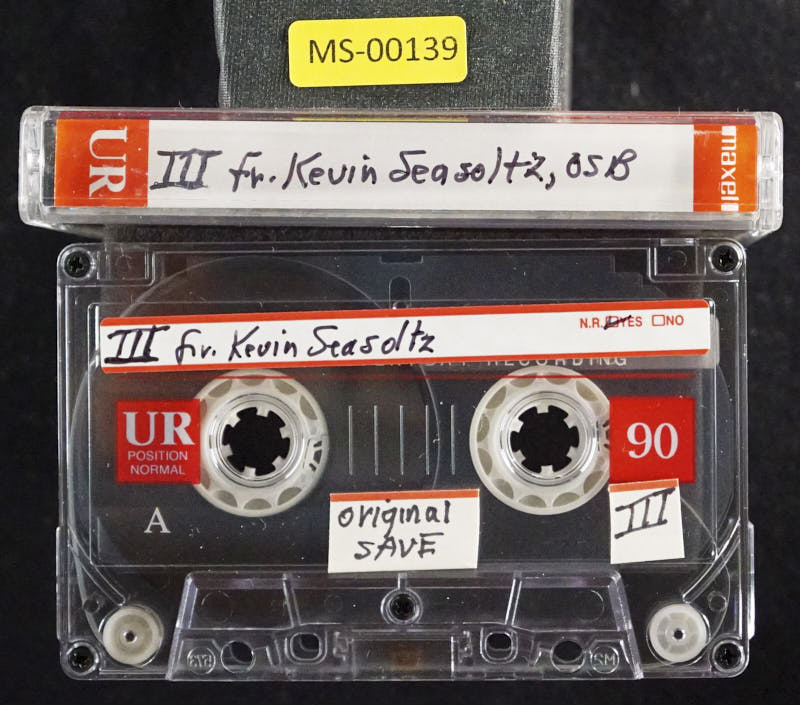
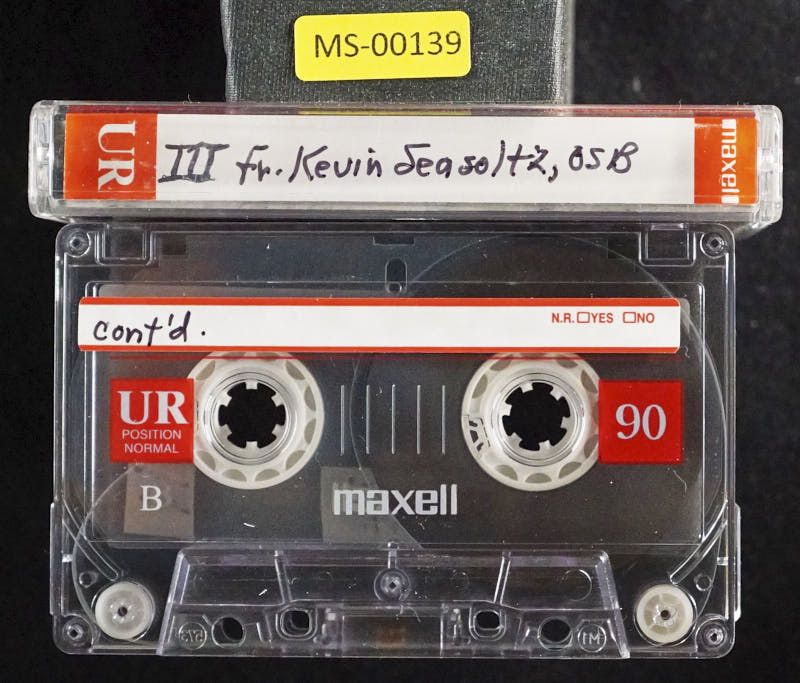
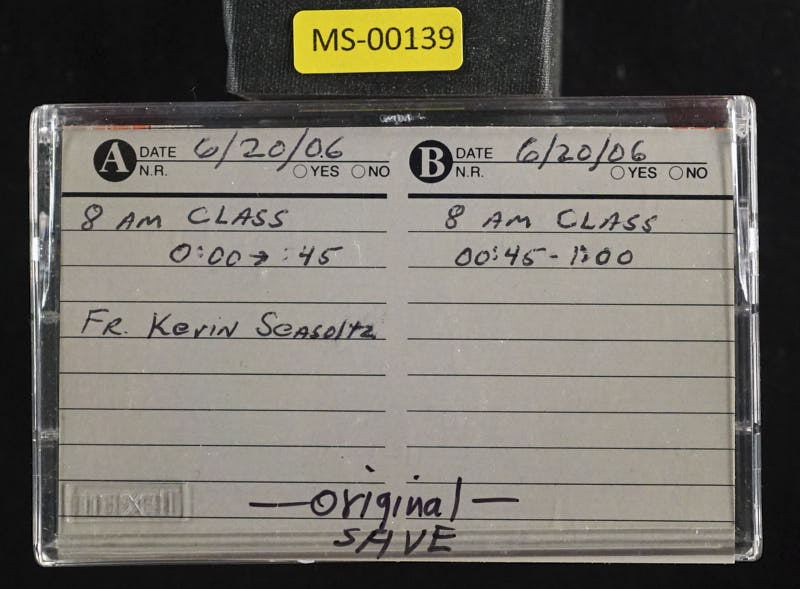
Side: A
Speaker: Fr. Kevin Seasoltz, OSB
Possible Title: 8 AM Class
Additional text: 0:00-:45, original SAVE
Side: B
Speaker: Fr. Kevin Seasoltz, OSB
Possible Title: contd.
Additional text: 8 AM Class, 0:45-1:00, original SAVE
@AI-Vision_v003
Two talks from this date
this. So it's recording. All good and gracious God, Master, Provider of all, as the grain of wheat falls into the ground, dies, bears no fruit. Can you grant us perseverance as we continue to seek you in silence and prayer, peace and joy and suffering and anxiety. But by losing our lives with you and sharing them with one another, may we come to the joy of Easter. In Jesus Christ, your Son and our Lord, and the power of your Holy Spirit. Amen. to apply the precautions that we did yesterday and most importantly put to the Eucharist this morning.
[01:07]
First of all, I would note that in John's Gospel, the great commandment that Jesus gave us is not to love others as we love ourselves, but to love one another with the very love which Jesus loved us. This is my commandment, that you love one another. I have loved you. Jesus was loved above all by the Father and by the Spirit. And it's precisely that love, then, that he shares with us through the power of the Spirit. In other words, as I mentioned yesterday, we become the bearers of God's light. But God always transcends our own limitation. So the Lord Jesus loves us with the love which the Father loved Him.
[02:12]
He communicates that love to us by abiding in our heart through the power of the Spirit. Now, this experience of sharing God's love in the Lord Jesus through the power of the Spirit is realized for us. It's made real for us in a special way in the celebration of the Eucharist. But now, there's a different way to look at that. In our own reflections on the Eucharist, we usually emphasize that it's the sacramental celebration in which we receive the Lord Jesus. And that's certainly true. I think we have to realize that it's not a static body that we receive. It's rather a vital, dynamic living person.
[03:15]
Not a static body. It's a dynamic living person. And so the celebration of the Eucharist then puts us in a profound relationship with the Lord Jesus in such a way that he enters into our experience. We also enter into his experience of the power of his spirit. He enters into our experience. We are in openness and availability. We also enter into his experience. to enter into the Lord Jesus who experiences our lives is at the same time then to enter into our own experience.
[04:19]
So I celebrate the Eucharist not as a person who approaches the Lord Jesus who remains outside or above my struggle, to be receptive, but rather as one into whose experience of struggle and pain the Lord Jesus has totally and sensitively entered, who, through his incarnation, his life, death, resurrection, ascension, and outpouring of the Spirit, continues now to enter into my experience each time I celebrate his Eucharist. Is that clear? Getting out here. All right. Now, if in the Eucharist, I really celebrate not only the life, death, and resurrection of the Lord Jesus, but I'm also celebrating the fact that my own life
[05:30]
has everything to do with his life. I'm really, at the same time then, also entering into the lives of others in the community because the Lord Jesus knows and loves their lives just as he truly knows and loves mine. I emphasize, first of all, was the Eucharist is constitutive of us as persons. Now on moving on, the Eucharist is also constitutive of us as community. By knowing and loving me, by assuring me then in faith that I am indeed lovable. The Lord Jesus sets me free to accept and love my own person.
[06:39]
I don't have to wear a man, play a role. But at the same time, I'm liberated from fears so that I'm not threatened then by the strengths and the weaknesses of the other people, the true idea. I am, in fact, able to accept and embrace their life, their person. Why? Precisely because Jesus, the Lord, accepts and loves them as persons. And I am in fact in the Eucharist entering into his dynamic experience. I'm saying here then, it's in the Eucharist we celebrate not only the Lord Jesus, We also celebrate ourselves and one another. In the Eucharistic liturgy, we are known and loved by the Lord Jesus to the gift of the Spirit.
[07:43]
We are empowered then to the power of the Spirit to know and love ourselves and to know and love one another. Martin Buber, he says, the true community does not arise primarily to people having feelings for one another. So indeed, he said, not without feelings.
[08:45]
But the true community, he says, surfaces, is formed, develops, first of all, to people taking their stand in a living mutual relation with a living vital center. Consequently, because they are all related to this vital center, they are also then vitally related to each other. Dorothea's abdaza in the sixth-century Palestinian note makes somewhat a similar point. In terms of this circle, he said the closer individuals, then, get to the circle. What happens to their relationship with each other?
[09:51]
It gets closer. The farther away we get from the center. The farther away we get from each other. Yeah. Is that clear? Yeah. Can you define what was that again? Truth to liberty is what? My tape recorder doesn't go backwards very well. I'm talking a little more. You were saying... Oh, the quotation from Boomer. Yeah, if I... It's not simply because we have feelings for one another. But he says it's not without keeping. However, the key thing is that we are related to a living vital center. And he emphasizes it. It is the center that's the builder of the community.
[10:53]
Not my feelings. And certainly, in so-called intentional communities, for example, in communes in the 60s and the 70s, people were, in fact, often brought together not because they were relating to a dynamic center, often because they were fleeing from something or because they had feelings for one another. Consequently, when they disappointed or disillusioned one another, what happened to those communities? They collapsed. Whereas in the Christian community, we should acknowledge because we are saved and yet sinners, we will, in fact, disappoint and disillusion one another. the Christian community in that context should not disintegrate. Why? Because Christians acknowledge that they have a Savior who is other and greater than they are.
[11:57]
The God whom I talked about yesterday is the one that continues always to give, to forgive. That's what the Savior did. The Christian community found ordinary to me. All right, now, Augustine picks this up in another way. In his Confessions, this is in Book 8, he says, I am the food of grown men and women. Grow, and you shall feed on me. You will not change me into yourself as you change food into your flesh. but you will be changed into me. In other words, his point there is that the Eucharist makes present on the altar the body and blood of Christ. And those who partake of that body are changed into the body of Christ.
[13:09]
In one of his sermons, it's 272, he makes a similar point. He says, if you want to understand the body of Christ, listen to the apostle Paul telling the faithful, you are the body of Christ and its members. So if it's you that are the body of Christ and its members, it's your mystery, meaning that you have been placed on the Lord's table. What you receive is the mystery that means you. It is what you are that you bring to the table. It's what you are that you say amen to. What you hear, you see, is the body of Christ. And you answer amen.
[14:10]
You'll be a member of the body of Christ in order to make that amen to. What I'm saying here is that Christ is not only on the Eucharistic table. Christ is at the Eucharistic table and in all those who celebrate as well. Until yesterday, most of us don't have much trouble believing in the real presence of Christ under the symbols of red and white. If we struggle all night long, really, to believe that the reason why Christ is present under the symbols of red and white is so that he might be present in us. Sacramentum sunt procter opus. Sacramentum are for people. The whole question then, there's nothing automatic that happens here.
[15:14]
Everything is, in a sense, in terms of our transformation, will be dependent on our dispositions of receptivity and availability. Any questions about that or comments? All right, let's go on then. It follows that the price we have to pay. The genuine entrance into the Lord's experience is in fact a willingness to enter into our own experience and the experience of the people that we get. Now I think everyone here knows that there are often groups, monasteries, conferences, in which people do not even speak to one another, let alone love and know one another, yet they don't hesitate to celebrate the Eucharist, sometimes even together.
[16:37]
The question is then, what kind of Eucharist do they celebrate? Or do they celebrate the Eucharist at all? What do we mean when we say, oh, it's a valid Eucharist? A valid. The origin of the possibility of our Eucharist is always, first of all, the Eucharist of the Lord Jesus and the outpouring of his sinner. The outpouring of the Spirit that is key here. Systematic theologians are emphasizing very strongly right now that we must approach sacramental theology in a Trinitarian fashion. The Father has two missions, always. The mission of the Word and the mission of the Spirit. And they always have to go together.
[17:40]
As I mentioned yesterday, in the West we have a very diminished lunatology. very Dominican theology, which we tend to be almost exclusively Christo-Modic. All right. In the context of faith, then, the light and the person of the Lord Jesus and our belief in the power of the Spirit, that is always normative. It's his life and this person of the law that we celebrate. Consequently, it follows then that at the Eucharist, we should come together expecting something of the Lord. Expecting something also of ourselves. Expecting something also of each other.
[18:44]
And I think the spirit of expectancy is extremely important. If we simply take people, take one another as they are, I think we ought to make them worse. But if we treat others as if they were what they ought to be, and can be, help them really to become what they are in fact called and then capable of becoming. Gabriel Marcel, in a beautiful way, lays this question of expectancy out with great clarity. He says, to love somebody responsibly is to expect something of that person. something which can be neither defined nor anticipated.
[19:53]
He goes on and he says, no longer to expect is really to strike with sterility the person from whom no more is expected. Yet so often what here in community, oh, what can you expect of him? Don't you know he's been like that for 35 years? We tend to marginalize people, put them up to the margin. And again, one of the points that Marcel makes I think is very interesting, what we often do in our communities, we can subtly make those marginal people or Let's find the neurotic people. We don't walk around. Oh, be careful isn't it?
[20:57]
She's not approachable for after crime. The fact is though, if we make the neurotic normative, the house soon becomes a hospital because the diseases are in fact very He says a lot of us about legislation and the kind of laws we make. Do we legislate always for the deviance? Do we always legislate in terms of violations? Or, in our legislations, do we set the bar somewhat high? so that everyone in the community has something to strive for. It's an ideal. It affirmed me that we are Christians.
[22:05]
We first of all affirm that we ourselves are willing and desirous of change, that we really want to be transformed, that we are willing to allow death to happen to us, to die to our self-preoccupation, our self-centeredness. You know, that explanation that we had after the Chexed Institution, Christ has died. Now, in the Eucharist, the question is, is Christ dying in me right now? Instead, through the power of the Spirit, I, in fact, now, am empowered to change, to die in self-reoccupation.
[23:10]
Christ has risen. Is Christ rising in me now? Am I in fact coming to light on deeper and deeper levels? Where I was at closeness, am I at least somewhat more unopened? Third point, Christ will come again, not simply in the future, but he's coming again now. Do I expect for one anything to happen here? The blood helper in cost of discipleship talks a lot about cheap grace. Cheap grace, which has no price. The price for God's life
[24:12]
in us is always the desire, the willingness. Crash up in a wonderful poem about the great St. Teresa called her the Undaunted Daughter of Desire. The Undaunted Daughter of Desire. What hopes do we have for ourselves or for the people that we live? Are we always in competition with one another? And even in monasteries, it can become extremely soft. Those of us who might teach at colleges or universities, we are forced into a competitive situation in terms of publications, in terms of promotion, in terms of tenure. So in many ways, what can happen in our monasteries is that we simply reflect the consumerist
[25:14]
competitive culture that is characteristic of so much of Western life. We would hope that everyone, as you just said, is willing to die to self to benefit from depths of the community closer to center. You have lots of situations in various communities, whether it's a monastery or not, where you have a person that is either resistant or, you know, even in terms, I don't care, or it doesn't matter, or things like that. Is there a way of enticing? It might sound simplistic. I think you try to love those people today. I think we all know from experience that we ourselves are transformed when we're lost.
[26:21]
That's when we're transformed. And often it might take a long, long time to get through. But that doesn't mean that there's nothing back. It's a long twist. Anything else. All right, let's just talk a little bit. Deep is then that provides us with a context, a very important model for sharing our lives together. And it is in the Eucharist in a special way We struggle to open our lives to the gift of the Spirit. Knowledge, understanding, courage, love, all those gifts of the Spirit.
[27:26]
And that Spirit of the Lord Jesus is, in fact, with us now. But in another way, the Lord Jesus is always out in front of us. calling us along the paths of transformation so we might become more and more transformed in the future. Ours is not a dormitory church. We are meant, you know, we went back yesterday, Jesus' great affirmation, I had come that you might have life and have it to the full. What we're called to do is engage in life. You know, what's all that happens, and this is the tragedy, I think the great tragedy often in an empty life. Come to the division, junior, get solidly professed.
[28:30]
Got quiet in the mouth. And what happened? We get a rut. You know what a rut is? The rock is a shallow grave. The rock is a shallow grave. You have to say, you know, what happened in this life? What happened? What's wrong? You just give up on it. It went into assault. This is the way I am. It's so easy to assume that attitude, kind of take ourselves for granted. We expect everybody else to take ourselves for granted, too. We lived in our Christian life of faith often mixed up lots of doubts.
[29:42]
But I am convinced that Thoughts aren't always bad because we're sometimes convinced that there's more to life than we're really living right now. And do I want to live that life? There are, again, decisive moments in our lives when we really are forced to confront the decision-making process. Decision comes from the Latin, decilere, to capital, to amputate. And so there are moments where we have to ask ourselves, what do I need to make decisions about to move into the future by Embracing the creative gift of new life.
[30:46]
I refuse to do that. What happens to me, I end up being a prisoner either of the present or of the past. Consequently, I spend so much of my life in nostalgia or daydream. An awful lot of nostalgia in our church today. and often on the public people who has ever experienced what was old. Those who lived in pre-Matic and Tunei are apt to tell you, wasn't all that was made out to be liturgically or otherwise. There's a wonderful Japanese haiku. that I'm very involved in this regard. It's by . He says, since my house burned down, I now have a better view of the rising moon.
[32:00]
It's loss. Loss for the sake of king. Sometimes, you know, in our life, God can be very present to us, conscious of being loved. Other times, God simply appears to be very absent. And often there are the times, I think, when we are, in fact, being invited to cut off and to leave behind what's really inferior or inferior. what in fact is good and gracious and grounded in truth. With your hand, where your foot causes your downfall, Jesus says, cut it off and throw it away. It's better for you to enter like name than to keep two hands or two feet and be thrown into the eternal fire.
[33:09]
The hand and the foot there are simply symbols What is the hand, what the foot, that needs to be educated in my life, in your life? Is it, for example, my whiteness? Breaches of the still teeth are weak and ingrained in this country. It's my attitude then to destroy a number of Muslims who are now in the U.S. Is it my gesture? Except it can be extremely subtle, ideal liquid. It's so easy.
[34:15]
play games of one option to share. So we're always in competition. One of my great depths of gratitude, I must admit, you know, for the company for many years, is all that I have learned from students at 3540. And to be delighted. to be delightful. Or how one's life is enriched by diversity of personality. I would like to be terribly bored if everybody was like me. God reveals God's self, not in the saneness of people, but in the great variety Am I happy about that?
[35:22]
The difference has always threatened me. So this is where he has a wonderful authority on Eastern spirituality. He just retired from Oxford. He was an Anglican priest under the name of Timothy. He'd done a lot of publication. And in his reflections on the Pentecostal experience, he makes three significant points. First of all, what should be noted, he says, is that the Spirit, in fact, is given to all. And he points out that Pentecost is not simply an experience that happened 2,000 years ago. The Father is sending the Spirit on a mission now, and sending the Spirit To all. To all. We're all guilty.
[36:26]
And I think this is extremely important, you know, when we're making such efforts these days, to dismantle a pyramidal church, a pyramidal approach, you see, to church. Where some people sit one top of the pyramid, everybody else down here obeys, craves, We're trying to go back much more to the Pauline understanding, a plain old understanding of the church. Where Christ is the center, where the Spirit is going out, there's a great variety of gifts. Great variety. Great variety of courage. It carries them as a gift given to one for the benefit of all. And it's so important, I think, today, you know, as we're striving to appreciate the gifts of people in our communities, especially women, we must put our money where our mouth is in that regard.
[37:41]
We can't go on telling women that they're basically equal to men. And yet, continue to get an unjust salary or to dismiss them from ecclesial positions where there's downsizing. It can't go on during that. Yes, there are dioceses in this country, but because of downsizing, have dismissed all offices, and the majority of the people in those offices were women. You're just sort of assuming And that's not effective. It can be both. It can be both. Other dioceses who have made a very conscious effort to promote women in the chancery positions have paid the way. In the same way, the dioceses support seminarians. Are they also going to begin to support lay ecclesial ministries? I mean, that document that the division probably did last November of co-workers in the venue.
[38:50]
Extremely fine. Extremely fine. But how do we implement that in our duties? One of the unfortunate things, I think, is that because of the shortage of ordained ministers, what documents come before, for example, often from the diacastries in Rome, are Exalting the ordained at the price of the labor, at the price of baptism. The ordained in lay ministry is one of the courses of the top figures at St. John's. And I would always emphasize that both must be rooted in baptismal dignity. Equality, first of all, and then difference of ministry. These shouldn't be at the top of the pyramid. They should really be down there at the bottom as servants. But that raises the question then, you know, do women have been these boys?
[40:15]
There's no reason why we could not have women as cardinals, by the way. That's purely an ecclesiastical institution. Laymen have been cardinals. For example, a dicastery like the congregations or religious institutes. Many more women were religious in the world than men. So some of the best doctoral students I've had in Canada, like Catholic University, were women. Where is this lead saying? What is it about to do? Their function is to coordinate. The function of leadership is to coordinate. Organize the terms. They don't have the kinds of more. Right. I'm not saying I did that all. No, no, no. But that's something to share.
[41:18]
No, that's the function of trying willing to organize, to provide organization in the diet, in the pattern. That's how they function as leaders. Not by character culture. There's still a lot of it. And I think most of all, we would learn what this means by effective modeling. I'm always intrigued at St. John's, for example, when we have the washing of the feet on week Thursday, the German language people don't wash. The novice is always why he washes up. He gets his feet washed. But at the end, what is very interesting, the abbot always sits down and punishes his feet. Basically, it's a very powerful symbol, because what he's saying is that I not only minister to others in this community, in this church, but I also need to be ministered to.
[42:28]
I think it's extremely important. Are we always on the giving, the giving end of the world? You know, I find it very interesting, for example, in John's Gospel, when Jesus washes the feet of the disciples. Before that, he had his own feet anointed with precious oil. And what that really demonstrates is the need, first of all, to be receptive, and then to give. And I do think there's so much help this is often put upon service in church today, even. that there often is very little time for enrichment, for receiving. And so many ministers, as you know, suffer from extraordinary birth. Anything else along this way? I guess some people would say, you know, if you're trying to go from the pure mineral approach, something else, they would say, well, that's anti-authority.
[43:36]
That's anti-authority. And I didn't look up for names. Hey, it looks like nobody can say. These shepherds can't say no to each other. See, what I need to do is go back to the etymological understanding of that term, authority. It comes from autoritas, to author life. It doesn't mean domination or control, but beginning life in people. Well, they all verbate that. Yes. That doesn't mean that you don't. But how do I begin mine? That's why I want to make sure. The birth, for example, the birth of the baby is always a pink. The priest said, well, we can't have anything doing that. It's been good. Well, I mean, you're saying we have to get away from the command structure.
[44:39]
Yes. Okay. And then the hierarchy says, well, we need to stop doing that. People will say, well, you're just sticking to the old clericalism. Well, I think there's up there and we're not going to, you can't help. That's a simplistic approach that I think. I think it's much more complex than that. Well, let's get clear. Yeah, it's much more complex than that. But it's the service and the beginning of life, man. I know, I agree with you. Okay. I don't want to go back to the reigning of authority, giving light to people. But that's simply keeping one another down at any place. I mean, I used to be the director of the seminary at St. John's, and I used to ask seminarians, which would be delighted. and you go out and become a pastor, if somebody joined your parish with a PhD in liturgical studies today, would you be delighted or would you be threatened to those who are potentially going to be happy?
[45:50]
We evaluate, for example, our lay students who are going to be laid with the same criteria with which . Because in some curses, a certain person could be just as bad in one sort of curses. That's right. That's right. I mean, the big joke about liturgies and the terrorists, huh? You can negotiate with the ones you can negotiate with the listeners. Again, it's the circus model that I'm talking about today, right? It's applicable to everything. Not simply to be ordained, but to everybody. But I just wonder if part of the apprehension is sort of the upcoming generation is a theory of things kind of committee. At times you'd like to have decisions. Well, the law of the church, [...] the church.
[46:54]
But in the same way, the poor always invites the other to listen. Listen. To be attentive. Including the young. And that to be able to listen. So that decisions are made that are in poor decisions. Okay. The warehouse kind of gave it was the only line at the start. And you guys in the front, the... want more senior people in the back. The people in the front, you should always be aware that all those people in the back there are there to support them and guide them. And people in the back, the further the more you go backwards, the more you're obligated to provide for and tell the guys in front of you and support the people behind you. So it's kind of like you're saying, it's all I cannot connect with it.
[48:00]
We're both server and server. Sorry. And when we share someone's only server or only server or our master, we ask for it. All right. Let's move on. I have to let you go. What I'm trying to share with you this morning is that Christian community is really the realization of the Eucharist happening to those who are members of the body of Christ. Now, if we participate in the Lord's Eucharist, not only when we gather to celebrate the every effort to be receptive in knowing and loving, every effort to receive and love ourselves and each other through the power of the Spirit that certainly enlarges then our understanding of our whole lives as Eucharistic.
[49:19]
It's always through the power of the Spirit that I come to know and love myself, know and love one another. So the Eucharistic liturgy, when we gather around the altar, in a real sense, should be the climax of our lives that's Eucharistic. The Lord's Eucharist and our Eucharist. are intimately related. But as I emphasize, the origin and the possibility of our Eucharist is always the Eucharist of the Lord Jesus. Hence, every effort that we make to know and to love ourselves, to know and love each other, should be understood then as anamnesis, as remembrance.
[50:22]
remembrance of the saving presence and power of God in Jesus Christ, which makes that presence a reality in our lives, so that we are more and more fashioned into the body of Christ. In the Eucharistic liturgy, we break the bread that is the body of Christ, and we drink the cup of salvation, which is his blood. so we might nourish the communion with him. It was originally created in us in a prophetic. However, around the altar, we should not only make an act of faith in the Lord's presence, but also an act of faith in ourselves and in one another, since we believe that our lives as persons and as communities have everything to do with this life.
[51:38]
When we're away from the Eucharistic table, as we are here, we are meant to look at ourselves and each other and ask the question, what do I see? I see? Do I see you as the body of Christ? What do I see when I see? What do I touch when I touch? What do I hear when I hear? What does the mystic tradition mean when it talks about learning to live presence and the power of the Lord. Now, another point that we want to make, and I think this is important to petitions, but frequency that we celebrate the Eucharist.
[52:45]
Each Eucharistic celebration is, in a sense, unique. really unrepeatable. The simple reason that not only is Jesus a dynamic, active person, we also are dynamic, active persons. We're not static persons in communities. Tomorrow, we won't be exactly the same as we are today. We're always making a unique difference. And so if we are deliberately cut off from one another, deliberately, by fear, by ignorance, by indifference, by hatred, if we really don't care for one another, our Eucharist simply becomes ashamed.
[53:51]
If the Eucharist makes community, the community also makes the Eucharist. It's a very powerful thing to remember the Lord Jesus in the Eucharist if that remembrance makes his presence so real that in the celebration, once again, he invites He invites us as participants to become like in other tribes. Means that we have to learn how to be vulnerable, be willing to abandon false securities that we build into our lives, the securities that often prevent us from really loving and knowing each other.
[54:54]
The final question that I would ask is, you know, we come to the monastery seeking a God who has already sought and found us. I think the big question that we have to ask today is, are we searching for God or are we simply searching for God's gifts? Is it spirituality that I'm looking for? Is it mystical prayer that I'm looking for? Is it consolation in time of difficulty that I'm looking for? Again, William Williams in another article, he asked that question. He said, do we want spirituality, mystical experience,
[55:59]
peace, or do we really want God? He says, if you want God, then you must be prepared to let go of all. Let go and let go. Let go of all substitute satisfaction, intellectual, emotional, He says you must recognize that God is so unlike whatever can be thought or pictured that when you have got beyond the states of self-indulgent religiosity, there will be nothing you can't securely know or feel. Never possess God in doctrinal statements, in structures,
[57:00]
To some extent, they are possessed, owned by God. Rowan says, if you genuinely desire you unite with the unspeakable love of God, then you must be prepared to have your relentless world shattered. If you think devotional practices, theological insights, even charitable actions give you some sort of purchase I'm gone. You're still playing it. And he says that's really what detachment means. Not being about the battle, but being involved in such a way that you can honestly confront whatever comes to you without fear of the unknown. It's always a readiness for the unexpected. Good evening.
[58:15]
Take what I shared with you this morning and apply it then specifically to give Chris a sacrifice. Context of this incident. We've got today. Have a good day. See, before we go, I think I lost a cap. Who was on this trip? I gotta get a head down. Two, four, three, six, seven, eight, nine, 11. Wow, 34.
[58:44]
@Transcribed_UNK
@Text_v005
@Score_83.48