You are currently logged-out. You can log-in or create an account to save favorites and more. more info
Eternal Communion: Entering the Trinity
AI Suggested Keywords:
The discussion centers on the conception of the Trinity as seen through the lens of Andrei Rublev's iconic depiction, exploring how this artwork symbolizes participation in divine life and prayer. The analysis delves into the geometric and theological intricacies of Rublev's work, emphasizing how it invites believers into the Trinitarian interaction, embodying the interplay of love and communion within the Godhead. The talk also briefly touches on early Christian and Jewish theological perspectives on creation, as reflected in Genesis, and contrasts these with human fallibility post-Fall, explaining how these theological elements inform human understanding of sin and redemption.
Referenced Works:
-
Andrei Rublev's Icon of the Trinity: Painted in the 14th century, this icon is central to the discussion of Trinitarian theology and is used to demonstrate the interconnectedness and invitation to partake in the life of God.
-
Genesis 18: The biblical story of Abraham and the three visitors is analyzed as a formative revelation of the Trinity in scripture.
-
First Letter of John: Used to substantiate the notion that "God is love," forming the theological basis for understanding the nature of the divine.
-
Milton's Paradise Lost: Referenced for its portrayal of Satan's encounter with Eve, highlighting themes of innocence, temptation, and the dynamics of sin.
-
Gregory of Nazianzus: His insights into the creation account and the interplay between the persons of the Trinity provide historical theological context.
The talk invites a reimagining of the Trinity not just as a theological abstract but as a relational dynamic that believers are called to participate in, particularly emphasizing the role of the Eucharist in this spiritual communion.
AI Suggested Title: Eternal Communion: Entering the Trinity
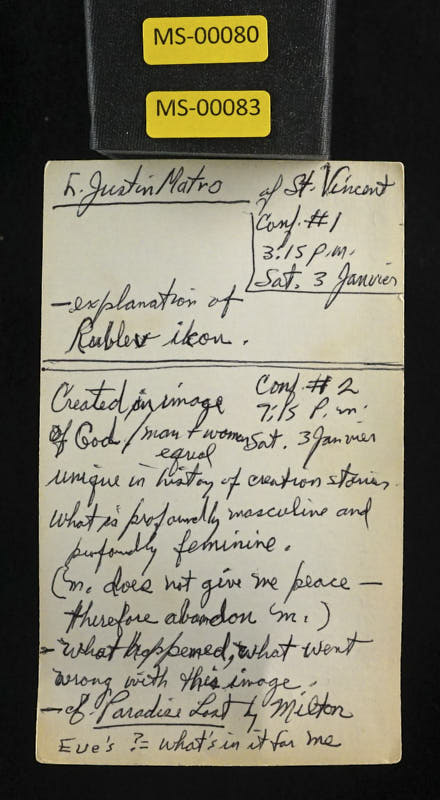




Side: A
Speaker: Fr. Justin Matro
Location: St. Vincent
Possible Title: Explanation of Rublev ikon
Additional text: Created/formed image of God/man movement 3 personae equal unique in history of creation strain...
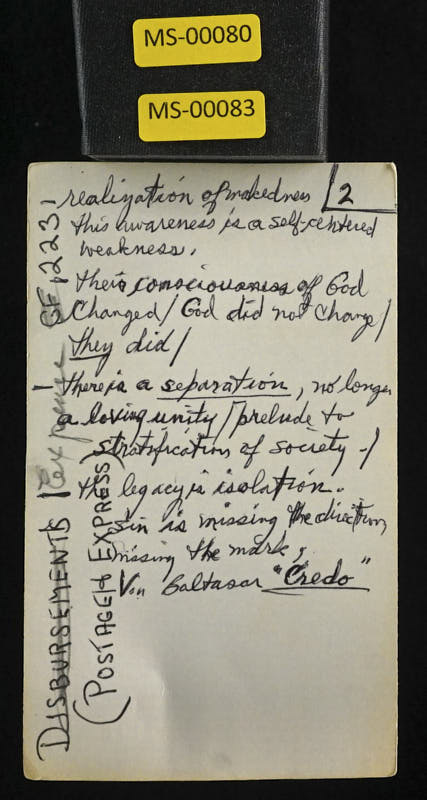
Side: B
Speaker: Fr. Justin Matro
Location: St. Vincent
Additional text: Realization of brokenness... Their consciousness of God changed, God did not change, they did...
Side: C
Speaker: Fr. Justin
Possible Title: Gospel of Luke
Additional text: Greeting role of the Holy Spirit... Fiat = OK lets do it!
Side: D
Speaker: Fr. Justin
Additional text: Consoliderated theology that sees Marys role as the fruit of... P.S. Original sin - goal
Side: E
Speaker: Fr. Justin
Additional text: Marks acct of rich young man, Go away sad, because he had many possessions...
Side: F
Speaker: Fr. Justin Matro
Additional text: Johns Gospel. Called to share in divine intimacy... Calls his mother woman...
Side: G
Speaker: Fr. Justin
Additional text: Jesus suffered because we suffer; it was his love...
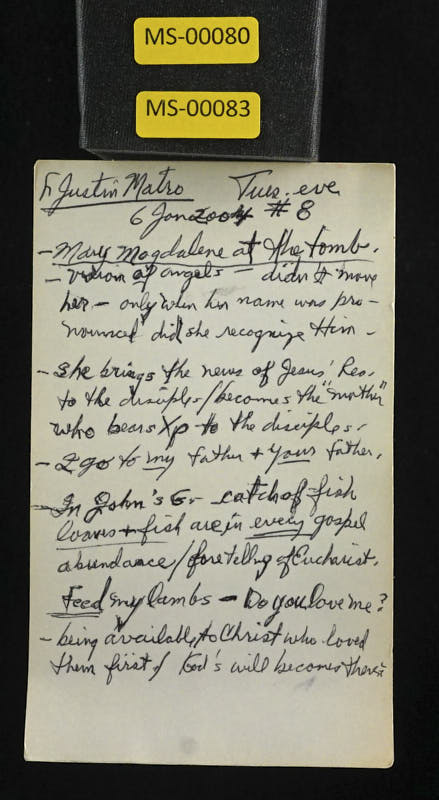
Side: H
Speaker: Fr. Justin Matro
Additional text: Mary Magdalene at the tomb... Feed my lambs - Do you love me?
Side: I
Speaker: Fr. Justin Matro
Possible Title: Apocalyptic Literature
Additional text: Shepherd of Hermas... Humanity broken into two female entities; brides or prostitutes...
Side: I Contd
Additional text: of the Christ. 12 stars/12 gates/12 stones... My happiness and my function are one.
@AI-Vision_v003
Two talks from this date
And I saw your icon of the Trinity over there because I like to begin these retreats talking about the Trinity and in talking about the Trinity, the nature of the Trinity, how we're called to participate in the Trinity. But in fact, the retreat is more on prayer and how we are meant to participate in God's own life in prayer. when we speak of the Trinity, I like to first reflect on specifically this icon, and so I'm gonna have to ask Abbot Martin and Brother Joseph to crane their necks a little bit as I talk about the different details. You're obviously familiar with this icon, but just to go over what the history of the icon is and what it comes to represent, Thank you very much.
[01:28]
In Byzantine tradition, I want to step on this thing. The altar would be behind the doors, and then the doors would normally have a depiction of the Annunciation. Most commonly on them may be a depiction of the four evangelists, the symbols of the four evangelists, or both the Annunciation and the four evangelists. But most commonly the Annunciation, the angel Gabriel on one door, the Virgin Mary on another. Her yes is our access to the Eucharist, her receiving Christ. Christ is our access to our reception of Christ. To the right, actually my right, but actually if you're facing, if you are looking towards, it looks to the left, there would be an image of the virgin and child, the Theotokos holding the Christ child. And then to my left, to your right, would be on the other side of the door, an icon of the panocrompter, Christ holding the book.
[02:32]
The book is closed. He's coming as the judge. And so the mystery of the Eucharist occurs between the two comings of Christ. He came first as a child. He'll come again as a judge. But now we live in the period of grace, the period of the church, and we share in the Eucharist. So it's a very beautiful image. To the left of this icon of the Panocrater is always the forerunner, John the Baptist, pointing to Christ. And then to the right of the Theotokos is most commonly an icon which celebrates or commemorates whatever that institution is dedicated to. In the case of this monastery, it's dedicated to the Holy Trinity. But whatever particular saint or whatever mystery it's dedicated to, this monastery was dedicated to the Holy Trinity. And so the monks, when they came forward for communion, were asked by the abbot, of course, always to be reflecting upon the mystery of the Trinity, their...
[03:46]
their patron, of course, but also the very being of God. And so he wanted Rublev to present something for the iconostasis there that was going to help the monks to focus more fully on the mystery. So what he did is he did what all good iconographers do. He went directly first into seclusion. started fasting and meditated on the 18th chapter of Genesis, which was the annunciation of the birth of Isaac. And as he meditated upon that, he looked at the text, and just as you're probably familiar with the text, but just as the fathers commenting on the text will always say, particularly starting with Irenaeus, and it drives modern exegetes crazy, but they'll say that it's the first real revelation of the Trinity in Scripture because Abraham is outside of his tent underneath the terrapinth at Mamre, and looking up, he saw three visitors.
[05:02]
But the text opens with, Yahweh came to Abraham. Looking up, he saw three visitors. Yahweh came, but then he saw three. And one of them spoke to him. And when one of them speaks to him, he responds to him and says, Sir. So, in fact, Abraham is having this dialogue with the three and the one. Yahweh comes, three come to Abraham, but it's Yahweh who's come. And when he looks at them, he says, Sir, please do not go past your servant, but stay here. Let me prepare something for you to eat. And so he calls Sarah, of course, and Sarah and he then get busy with preparations and they feed them. And then when they finished eating, one of them speaks and says... I will surely come by here next year at this same time, and Sarah will have a son.
[06:05]
Now, the interplay between the three and the one has fascinated the earliest fathers because they saw in this the first real suggestion of the Trinity that at the annunciation of Isaac. Isaac, who is going to be the ancestor of Christ. Isaac, the child of the covenant. Because Yahweh comes, but there's three. Abraham speaks to one. And the interplay between the three and the one occurs until finally one of the three speaks and says, when I come back, she will have a son. So, Rublev, focusing on that mystery, took a very common depiction of that icon, a very common iconographic depiction, but he streamlined it because it wasn't unusual to see at this point these images of the three at a table, but it was a busier scene.
[07:12]
Off in the distance, it was more the way that it looks here, it's, you know, more of a rectangle this way. The other way is usually more this way. It's longer. Abraham's coming over here carrying something. Sarah's over here carrying something. You see preparations in the background. You see all sorts of things going on. But he took the scene and he streamlined it. He took out Abraham and Sarah. And what he did is he wanted to present the Trinity for us not so that we have so much of a snapshot of the historical event, but something that invites our participation in the Trinity. So he worked very hard to make sure the figures resonated with the Johannine sense of the divine indwelling. Geometrically, if you follow the external forms of the bodies of these angels, and they are angels because they represent God, you follow their pattern and you find
[08:16]
the contours of a cup. But if you follow the interior lines, you'll find actually the same pattern inside and outside. And if you look inside, there is a cup on the table, a cup that contains the entire feast. And so the mystery of the indwelling geometrically imposed here, these lines and these lines and this, meaning to show the entire mystery is contained here. They dwell within one another, but the meal is also a part of their communion, if you will. There's absolutely no access, no way in which we can enter into this, Because it's blocked here and it's blocked here. And if you try to sneak up from above, their angels, their wings are blocking our entry. And yet they're on a little bit of a pedestal.
[09:18]
And the carpet spills down. And that's a little welcoming carpet for us. We're invited into this mystery. And we're invited from below. But we'll return to that. the figures themselves are of great significance. Now, there's arguments over which is whom in the Trinity, but most commonly in the interpretation that I find to be really the most substantial is that this figure is the Father, this is the Son, and this is the Spirit. So, the figure in the rose-colored garment being the Father, The figure who's dressed like Christ is normally dressed in icons is the sun. And the figure in green, which is the color, the Byzantine tradition's color for the Holy Spirit green, ours is red, their color is green, is the spirit. Why would we say that?
[10:20]
Because the father seems to be linked with Abraham's tent. Abraham's tent now has become palatial and resonates with the Johannine sense as the indwelling does. My father's house has many mansions. Behind the winged figure of the son, there's a tree, the terebinth of Mamre. It's also the tree of life, the wood of the cross, the tree always being linked with Christ. And vaguely in the background, you can see behind the spirit, the mountain, The mountain of revelation and the ways in which God is revealed on mountains throughout the Old and the New Testament, be it Tabor or wherever. There's generally some revelation of the Spirit on a mountaintop. So, this figure who seems to look like the Father...
[11:22]
is making a very tell-tale sign. He's pointing to the sun using a gesture that's most commonly used in blessing. The two natures of Christ, the three persons of the Trinity, through the two natures of Christ, we know the three persons of God. But he's pointing. He's not blessing. He's pointing. He's sending the sun. He's dressed in a rose-colored robe. Why is he dressed in a rose-colored robe? For the same reason why we wear rose-colored vestments at Laetare and Gaudete Sunday. It's the color of the dawn. And he is the dawn of all things. From him, the life of God begins. He is the first person, the first among equals in a co-equal, co-eternal communion.
[12:22]
He's the source of all things. From him proceeds the Son and their communion in the Holy Spirit. He points to the Son. He commissions the Son. The Son is dressed as Christ is dressed in icons. He looks to him and makes the exact same gesture, but he points to the Spirit. The father commissions the son and the son in a very real way commissions the spirit because his incarnation will take place through the Holy Spirit. And so seeing in this whole this whole annunciation of Isaac the preparation for the incarnation of the son. The father in the original icon I noticed that she's got a little bit of a difference with the staffs in there so The Father's staff is perfectly straight. The Son's is tilted just slightly. Again, subservience in the best sense of the word, subservience without being unequal.
[13:25]
And the Spirit, who is completely at the will of the Father and the Son, His staff is tilted all the more so. The Spirit, the new life within God, the communion of love between the Father and the Son, The eternally new, the ancient of days and yet eternally new, is the color of the eternal spring. His head is tilted in far more submission even than that of the sun's. He bends sort of between the two union. The father and the son are looking at each other in an exchange of love. The spirit's head is bowed between the two of them, facing them. And he's in a green robe, a green vestment. Again, the color in the Orthodox Church, the Byzantine tradition for the Holy Spirit. His staff is bent even more strikingly to show his complete cooperation to the will of God. The carpet, green again, because it happens through the Holy Spirit, spills out and invites us to join into this Trinitarian mystery.
[14:34]
We come from below. And as we enter, we see that the table that they're seated at is no ordinary table. It's an altar. It's a stone altar at that. And there's a stone missing as well. There's a stone missing in the altar. And we make up that which is missing. As St. Paul says, I make up in my own body that which is missing, that which is missing in the suffering of Christ. What's missing in the suffering of Christ? Nothing but our own desire and our own participation in it, our own self-gift. That's all that's missing. Christ gives himself completely. It's up to us whether or not we take full advantage of that. And we enter and we're beneath and within the Son. We enter into the Trinitarian life with, through, and in the Son. And we come to this great feast that they're sharing, and the great feast seems to be a Eucharistic vessel. So our participation in the Trinitarian life comes through the reception of the body of the Son, by our own access to him through the Eucharist.
[15:45]
and through the various ways that he gives them, but particularly we receive, and particularly as the monks were coming up to receive the Eucharist, we are entering into the Trinitarian life. We're entering into the very life of God. So I'd like to present that as a focus for us during our retreat, that image, and we're going to be looking mostly at Scripture and ways in which we come to participate in the Trinitarian life, what does that mean, how we're called to participate in that life, and how that specifically happens with, through, and in Jesus Christ, the second person, the Trinity, the Son, through whom all things have come to be, through whom we're created, through whom and for whom we exist, and what that looks like in the Christian interpretation of the Hebrew scriptures and then in our own scriptures as well.
[16:49]
So what Rublev wanted to do, he wanted to present a picture of God, but God as an invitation to us, very much the economic manifestation of God, the God who reveals himself through creation and in salvation, the God who calls us to share in his own life. and focusing specifically on how we're called to share in the divine life through the Eucharist. But we have to ask ourselves first and foremost, who is God? What's God? The definition given of God in the first letter of John, a couple of places he says, God is love. the profound Christian revelation of who God is, what God is. God is love.
[17:52]
It's not enough to say for Christians that God is loving. It's not enough to say that he's caring. He is love itself. What does it mean to say that God is love? You know, we sometimes think of God as being, you know, Santa Claus on a cloud, you know, a big Valentine in the sky. You know, I don't know. Most of you probably didn't grow up in the 70s, but I did. And all these horrible, you know, youth retreats, they put you through and they'd pin a cotton ball on your shirt and they'd say, that's God. He's the warm, fuzzy feeling deep inside. And they meant well, but he's more than a warm, fuzzy feeling. He's not just what makes me feel good. Love costs. God is love.
[18:55]
And love means a relationship. Love is a relationship. I don't just love. I love someone. If I love... I love another. There's an object to my love. If I love, then I receive the love of another. Love immediately implies a relationship. But God is completely perfected himself. The Father is the Father because he is the source of love, of all love. He exists in an eternal state of complete self-giving. We talk about the self-giving of the Son upon the cross, but as he says to Philip, Philip don't you know if you've seen me you've seen the Father. We see in Christ how the Father exists.
[19:57]
The Father without ever losing himself, without ever becoming empty, exists in a complete act of self pouring forth. of giving himself in love. And that's why he's the father. That's why he's the first in God. All things begin with him. He is that very aspect of love which is complete self-giving. And what happens when he gives, when he completely empties himself? The son proceeds from him. The son, the second person in God, receives the fullness of his being within the context of the Father's pouring himself forth. The Son is the absolute receptivity of love, if you will, the feminine aspect of love. In a realm in which masculine and feminine go beyond what we mean by man and woman,
[21:00]
and yet somehow contained and revealed in those mysteries of persons. The second person of God is completely receptive, receives the fullness that the Father desires to give, shields nothing. For us, to receive love, to really receive love is difficult. For him, that's the way in which he exists, and yet he completely freely receives the fullness of his being, and then in this great wondrous exchange, desires to return the fullness that he's received. And he that's received everything from the Father desires to give back what he's received, and the Father now receives from the Son. Within the context of that interplay, of the Son proceeding from the Father and the Son receiving giving back that love to the Father, the third person in God proceeds like a child in the divine union, the fruit of their love, the eternal spring, always pouring forth, always new and yet eternal, the spirit who's like a testimony, the third person in God, because love demands fecundity, love demands fruition.
[22:20]
Whenever there is truly a giving and receiving in love, there will always be fruit. And the Spirit, the third person in God, is as if the eternal child in the communion of love, always the testimony to the love between the two. The will of the both. Ultimately, you know, the Orthodox always shoot us down for adding the filioque. Ultimately, they're right in the sense that they won't disagree with us in saying that the Spirit proceeds from the Father and the Son in the sense that He's the shared love of the Father and the Son, but ultimately all things originate in the Father. The Son himself originates in the Father, and so the Spirit proceeds from the Father and the Son and proceeds from the Father. This image of love begetting, love of self-giving, of self-reception, of the fruit of that communion, that's the very foundation of all that is.
[23:26]
That's the very communion of our existence. That's in essence the form in which we have been created. And being created in that light, in that love, we are meant to be a sign of it. We won't get into the problem of sin yet. That's the next talk. But when Rublev again, wanted to focus on the Trinity, he wanted to focus upon the way in which we are called to respond to the Trinity. God is love. Love is a communion. Love, in essence, is a community. We're Cenobitic monks. We live in a community. We live in communion we have the opportunity to give and receive love in a way in which maybe other forms of Christian witness don't necessarily consciously focus on the way we are able to.
[24:42]
It's a very mystery that we're dedicated to. Certainly married couples share in this, all Christian communities share in this. but that's the very basis of the Cenobitic community, the Cenobitic concept. Any discipline, any rules or regulations that we follow, any aesthetical practices are only in the service of our capacity to really share in a loving communion. because Christ has given us a double command to love. If we love God, then we will love one another. That's what this life is about. It's also the way in which we exist in prayer, because love is a dialogue. Love is a relationship. The Father speaks in all eternity one word. The one word is the Son.
[25:44]
What does it mean to say that Christ is the word of the Father? He's the Father's only way of revealing himself. When we see Christ, we see love revealed. We see the Father, the Father who is otherwise hidden, revealed in the person of Jesus Christ. Our capacity to pray is first a capacity to listen to that word, to receive him. to be present to Him. As we receive Him, then we, with Him, desire to respond. Love exists in this, not that we have loved God, but that He has loved us first. And once we truly have received His love, made ourselves available to Him, then we of our own nature and in communion with Christ's divine nature living within us desire to respond and to give ourselves completely hence we've answered a call to him in our lives and we've decided in a radical way to dedicate ourselves to him and that's a great movement but it's an ongoing action which includes
[27:09]
Our daily prayer, our greeting of each other, our interactions with each other in the hallway, all the ways in which we live and move and find our being somehow is a response and meant to participate in the way in which we receive and respond to the love that's been revealed to us in Jesus Christ. In essence, God isn't, of course, just... the being whom we laud when we gather together in prayer, but he's the very basis of all that is of our being. And every element, every aspect, every matter of being throughout our daily lives is a participation in him. We all know these things. but that's what we believe has been revealed to us in Christ because Christ taking flesh somehow has demonstrated to us the blessedness of this life and every element of this life.
[28:18]
So throughout this retreat I'd like to again and again refer to the Trinity and how Christ through whom we've been created for whom we exist, can never be understood apart from the Father who sends him and the Spirit through whom he comes to us, and that our return with and through the Son is again aligned with the Spirit, and our ultimate goal is the Father, that there is no separation of the persons of God. They live within one another, and as they make their homes within us, so do we, hopefully, allow ourselves to receive others and give of ourselves to one another. And hence this communion of love, this divine life, isn't just an abstract theological discussion, but it's just the very way in which we live and move and have our own beings.
[29:28]
Glory be to the Father, and to the Son, and to the Holy Spirit. It was in the beginning, shall be. Amen. Although Rupert has several different geometrics, if you want, designs, or the triangle, if you want, is there. But if you really look at that, it's a circle. Yeah, this. And it's kind of interesting that there's an infinite, a circle, or a line that's got an infinite number of points on it and make a circle out of it. There's an infinite capacity then of persons to be a part of that circle. I mean, the whole, the geometry also sets up an infinite number of persons that can join that. to be a part of the trinity or part of the godhead, you know.
[30:33]
Yeah, yeah. The circle is right here, yeah. You can actually literally... I just basically outlined for you, and probably read a lot on it, the real basic geometric designs, which are the cups that indwell, and then are weighted. But exactly that, yeah, this whole circle, and then there's a triangle, too. But I hadn't realized about the cup... Yeah, and actually, this film strip I had in this class, of all things, I had this in a class on Catherine of Siena in Italy. I don't know how it happened, but this teacher, when she first exposed us to this, basically because she wanted to present, it was a course on the Trinitarian nature of Catherine, the development in Catherine of Siena's class. my doctorate is in spiritual theology. This course was an elective on specifically the Trinitarian foundation and development in Catherine of Siena's writing.
[31:36]
And towards the end of the class, the teacher brought up this discussion on the Trinity icon to show how an actual, a contemporary person, but completely cut off culturally from her, had very similar themes, and that would be Rublev, and so basically this film traced all that, but the top, and this, I've only seen it in this one film, but it was very clear, because it was a close-up, they moved, hunged it on the image. There's a human face in the cup. And in fact, the face matches. If you notice, all the three faces are the same because they have one nature. But the face is, it actually, it's very, very faint. It's very, very faintly put in.
[32:40]
And no copy really carries it. But the face matches the faces of the person. It's really... The man that was revealed, I think that, you know, I really think that, you know, artistic pieces, and certainly something like Icon, there's something beyond human ingenuity that's at work. But yeah, geometrically he brings that in, he brings in the circle, he brings in the triangle. And then the cups, they show the indwelling, because the cup then would be the way in which we participate, so we're brought into the relationship. There is, in a sense, there's a fourth person in that thing, it's the viewer, it's just a part of the icon. Yeah, so the cap, the stone, all that, yeah. Just about every icon should somehow have a point of contact to bring the viewer in, but that's how she's done it, because none of them are looking at us,
[33:47]
Because, you know, if you notice normally the virgin and child, she'll be holding him, but she's looking to us, you know. The eyes are usually the entry point. Most obvious is the list of you. Point of the right, the middle of the center. Leaning, I think, towards the wall on the left. Well, the European yard. one on your left and one in the center of reading to the one on your right. Yeah. Yeah, that's why, that's why I, one of the reasons why I so strongly, you know, there are some people who say that this would have to be the Father because Christ would have to be to the right of the Father. But it doesn't make sense otherwise. Now, why we would have put it there and not to the Father here, I don't know. But everything seems to be proceeding from this figure. emanating from him and going forth, and returning too, so I can't see any, and plus the color of the robe, that rose-colored, which is the color of the dog, and the action, the gestures, it all, everything's proceeding from him, but then there's a returning to him.
[35:11]
I just looked at it, if we look at the plane of the heads. plane of the two that are leaning towards the one I'm calling the father. You're calling the father too. That had poop on the other two heads on the same plane. Yeah. Leaning towards the father. Almost like we did it on purpose. Oh, I'm sure he did. There's a real genius though that he could bring, as it were, the not putting the father in the center. It's... Emphasize it in a much more wonderful way, that flow, if you want, between them. I have the off center. And of course, in the original, he is almost diaphanous. I mean, all these reproductions, making him as solid as the son, as I understand anyway, the one in the hermitage in Russia, the father is almost invisible.
[36:14]
I mean, he's very, very diaphanous. Yeah. rose, but, and the sun is the most, what, palpable almost, who became incarnate and so forth. But I think the real stroke of genius, which you see often in different stages in heart, that the artist really broke through past conventions to show something deeper of faith, not just artistic talent, but there's something of faith, but that's a real, and the courage to do that, to move the Father off-center, as it were, you get strong upward, stabbed in the back or something, went in the church for some people, because really, you know, but it was a real, I mean, to end this insight, really, the faith, I think, to be able to do that and bring it out. Well, I'm sure it was controversial at the time. And I don't believe he wrote anything at all to proclaim what he's done here. So it just seems to be, it seems to be what he's done.
[37:15]
To me, it does seem... But you're right. It was daring, and it was... Again, I suspect there's something more than human ingenuity at work here. He was very bold, and he... Yeah, because the way the Trinity had been depicted most commonly would be the Father seated on a throne, and again, almost... in the darkness, almost hidden, but then holding the sun on his lock, the sun far more clear, and then the sun holding an orb, which would be the universe, and the spirit as a dove with wings extended in the middle. Not a very attractive dove, I might add, but nonetheless there. And so each showing a progression of, you know, proximity to humanity but yeah but the son of the father back in the distance more but still holding the summer so that's how that's how the tradition they would show begin dwelling here this is a all with geometric points and it's it's it's really fascinating you've got a big icon collection i saw but i don't know what did i miss a little from
[38:44]
a handy man who was German and he did business in Germany, and he brought a number of them back. But then these were painted by the wife of an Orthodox beacon, or a transfiguration downstairs. But I mean, in your library, there's a lot of little classic iconographies. But yeah, that's lovely. Yeah, she took some, she's taken some library, she's made the the staffs, the Orthodox crosses, and they're not, they're not, and she must know she's broken somehow with the traditional, it looks like the sun's staff is actually a little straight, and the fathers, but none of them are completely straight. But she's, she's pretty tall with it. So she must know what she's doing. Who do you want to ask? Marina, the domestic. I think she said that the original deep log, the auto-criture, was damaged somehow by the leather of it.
[39:50]
I'm not sure that it was that more iridescent color in the air. Really? And so she chose that iridescent rose. You know, you have a blue canvas to it also. Yeah. Well, the color... There's something of the green in the... Yeah, there's a blue for each of them. There's a celestial blue. That's underneath the bottom. That peeks through the rose-colored vestment. That is a photograph of the original. Yeah, this is a photograph of the original, yeah. And again, photographs could do so much, but this is a photograph of the original. And it's pasted on top of a board. I bought it for about 50 bucks. Who knows, I might have ordered it for you.
[40:52]
Well, I got this one from... I think I got it from St. Vladimir's press, I'm pretty sure. Okay, well, we have a, you have a singing practice then, when? Tonight, before, before. We can do a few minutes before. Yeah, we can do a few minutes before. Yeah, we come just a few minutes before. Before Westminster. Oh, before. Oh, before Westminster. Yeah, what do you say? No, I said, you're the cantor, so whatever you want. That's convenient, sure, fine. Is it the true make of the book? of the morning, or is it, you think of this? No, I'm a bit old. So, what were you thinking from that morning? I was thinking actually, actually, after it felt that way, I'll be sure we're all here, but that's, that's just practical consideration.
[42:01]
Yeah. Well, I think one of the best reasons it was. Or you, or just the best version, the first best person. Yeah. So come here at one time. Well, we'll just walk over now. Maybe the safest thing is to go there right now, because we're all here, otherwise we'll disappear. Charlie, let's go over there right now. But the end, you will start. You've ruined in the night and its fearfulness. You've drawn the day into the summertime. You move the edge of night into the margin of day. You live at the hinge between fear and enemy. You take the feeble light and give us strong day. You take our fatigue and bestow curtail. You take our drowsy reluctance and fashion over the deal. What shall we say? You, only you.
[43:02]
You, you with a hint. And then today, you and then now, from you and faithfulness, for us today, us in the freedom and courage and energy, and then back with you in trust and gratitude. Amen. I had a big answer to the drowsiness. I was warned about this drowsy reluctance, this reluctance here. It should break into a song or something. That's what we can do. We can do some liturgical dance. So what we were talking about before was the Trinity and the dynamic interaction between the persons that we're called to participate in. What I'm interested in talking about is
[44:05]
the stance of prayer, the disposition, the correct disposition towards God that's presented to us in Scripture, and what does that disposition look like, what is the prayerful heart. And I wanted to begin by talking about the Trinity, basically putting this understanding within a very Christian context. God is three, God is one, God is relational, and But God calls us into that relationship that the whole meaning of Jesus Christ's coming or the greatest revelation that he offers to us is to reveal the triune nature of God, not just as an academic exercise in the least, but a dynamic reality in which we were created that we're called to participate in.
[45:07]
So, you know, in the early church fathers, when they're looking at the scripture and they're looking at what exactly has been achieved for us in Christ since, despite the downside review, he really is the Messiah. I want to clarify that. But he, what it is that Christ offers to us, what's happened to us in Christ? And so all of the early church fathers, sub-apostolic and after, pay very close attention to the first three chapters of Genesis, the creation of humanity and the account of the fall. And they write tomes on it. So we see that first account of the creation of humanity, chapter 1, just verse 27, very, very succinctly stated, God created man, Adama, the human race, in his image. In the divine image he created him.
[46:11]
Male and female he created them. God blessed them saying, be fertile and multiply. Fill the earth and subdue it. What is this divine image? In a Christian reckoning, the divine image is this triune God. the life-giving lover, the receptive beloved, the fruit of that love. And here we see man, woman, and a commission to be fruitful and multiply. It's not just that humanity is created to have dominion over the earth. We've got to appreciate what this text is saying because the Jewish tradition is stepping beyond some of its boundaries from Semitic cultures by claiming that men and women are created equally. That the divine image entails both the masculine and the feminine, as well as this commission to increase and to multiply.
[47:19]
For a Christian reading this, particularly one of the church fathers, any one of the church fathers, The life-giving lover, the receptive beloved, the fruit of their union, that's God. The divine image, that's what humanity is. The masculine, the feminine, the commission to increase and multiply. Then we go to the more familiar account that we know, which basically reiterates that sense in a lengthier and a more elaborate and a very beautiful way. The story of the creation of the man not yet called Adam. Adama is a term at first applied just to all of humanity. And he's called the man-ish. And the man is created first in a sense that he is a conscious acting being. But there's something radically missing from him. And so God allows him to go into a search, and he looks beyond himself to find what's going to fulfill him.
[48:30]
He looks beyond himself, and he names the animals, but he still has a deep yearning inside of him. And then God himself acts, puts him in a deep sleep, and then actually proceeding from the sight of Adam. is Eve. It seems that she was created within him, present within him from the very beginning. And when he at last sees her, he says, this one at last is bone of my bone, flesh of my flesh. The quest for communion has been ended. And again, we see this divine intimacy, the very image of God. We see that being realized here and God again commissions them to be fruitful and to multiply. It's really, I think we really have to appreciate how unique this creation account is.
[49:33]
Other Semitic sources and other contemporary ancient sources of creation really don't present man and woman being created equally. And there's a plethora of gods, and there's always a counterpart, feminine entity, to the Creator God. That's lacking. That's lacking. There is no Mrs. Yahweh. There's no Mrs. Creator God. That's an interesting thing, because we're going to see that Israel itself has a self-understanding of being feminine and bridal in nature, of being receptive to Yahweh, that somehow... Israel is going to see itself as a she and the feminine response to God. So it's a very interesting dynamic. But we see, as we've already, you know, the Christian understanding, the selfless, generous, self-giving father, the receptive, beloved son, the son who receives the fullness of the father's love and then returns, the spirit of their communion.
[50:42]
We see really we see the platelet set for what is profoundly masculine and what is profoundly feminine and the fruit of the union. And we see what's masculine and as feminine as being co-equal. You know, just as if you're going to look at a partner and a man and a woman in a traditional dance. You know, yes, you know, One leads and the other follows the leads, but you can't say who's more important to the dance. The one who follows the lead is just as important to the dance as the one who leads. And so in the Trinity, you know, the Father is the one from whom all things proceed. You can't say that he is more important than the Son because he exists in begetting the Son. And you can't say that he exists before the Son of the Spirit because the Spirit and the Son and this eternal now proceed from the Father and are the expression and is the expression of the Father's and Son's love.
[51:47]
That's just the very context of their living. What many of the Church Fathers and Gregory Nancy Anson, who thanks to Adelard we celebrate today instead of yesterday, thank you, Gregory Nancy Anson sees in this creation of Adam and Eve really sees a reflection of the Son proceeding from the Father. Even as Eve is drawn from the side of Adam, he sees a reflection of the Son proceeding from the Father and the commission to increase and multiply again, being assigned to imitate the divine love, the fruitfulness of the Spirit. And so we see in the Christian understanding of this text, the divine image is specifically modeled upon the divine life. The divine image is the very foundation of all creation.
[52:51]
God the Father, it's not as if God the Father says to the Son of the Spirit, back up boys, I'm going to go out and I'm going to create. It's a Trinitarian action. It's a Trinitarian process. All things begin with the Father. The act of creation begins with the Father. But as with everything in the Trinitarian life, it begins with the Father. It occurs through the Son in the communion of their spirit. It's a complete Trinitarian process. And that life is the very foundation of creation. And humanity is the pinnacle of this creation. A communion of love which It's intended to reflect and be a sign up to the entire world of this dynamic interaction of the persons of the Trinity. Something went wrong. Something went wrong. We're created in the divine image. We're created in the image of selfless giving, of absolutely selfless receptivity and fruitfulness that is completely at the will of
[54:00]
of the generating entities. And yet that's not the reality that we know now. We know a human condition which is marred by sin, which is a condition that seeks self-gratification, often at the expense of others. And we know that human community and human communion is often very tragic. That's not what we were created for, and so how did it go wrong? So, depending on who you want to look at in the Fathers, they've got a million things of exactly what the Fall entails, but the idea of the Fall is consistent through all accounts. We became selfish. We became self-absorbed. Pride. pride went before the fall.
[55:01]
Eve isn't gone after simply because, as woman, she's the weak link. I don't think that that's the sense at all coming from the scripture, although various writers you'll read will say that. Eve comes late in the presentation of this story, and lateness doesn't necessarily mean that she's secondary it somehow could be a deeper sign of the human condition is that feminine nature really more of a reflection of the stance of what the human heart is meant to be how we're meant to stand in eternity because Eve is the one who gives Adam direction Adam just knows he's unfulfilled and he looks around. It's not until he sees Eve that he begins to recognize who he really is and what he's about.
[56:05]
She does it very selflessly and she does it very naturally just by being who she is. Her disposition of availability, of receptivity towards him helps him understand who he is. And the new life that is to come into being is to come into being through her. How like the Son? How like the second person in the Trinity? Is she in fact a sign of how Christ relates to the Father or the Son relates to the Father in the imminent life, the life beyond creation? She's the one that the serpent goes after. I don't know if you've ever read Milton's Paradise Lost book. But he's got a very beautiful passage of Satan making up his mind to break into the garden and to cause the downfall of humanity to take this prize away from God. And his mind is seething with plots, and he's got nothing but malice in his heart.
[57:12]
And when he comes across the creature Eve, he's so struck by your simplicity, and her beauty, her absolute humility. He's so struck by this childlike humility that he almost repents. That's what Milton says, his view of it. But being the devil, he decides not to repent and he goes ahead and seduces her. So he steals himself and he goes into the garden. And he says to her, why can't you eat this fruit from the garden? We all know the story. And the fruit of this one tree. And she says, well, that's what God says. And he begins to put doubt into her mind and to her heart. It's because if you eat of the fruit of the tree, you will become like God.
[58:15]
That's why he's holding it against you. He's jealous. She's already like God. She's already in the divine image. But now this doubt has entered into her mind. She's entertaining the doubt, the suspicion. And her heart begins to go towards a self-gratification, a self-absorption. What's in it for me if I eat of this fruit? Do I become like God? Do I enter into some greater capacity than I currently know? She's already existing within the divine image. Not to say that she's a complete creature, yet we're created to participate in the divine image and to increase. And certainly the increased participation in the divine image would be something that... God would have in mind for Adam and Eve as they learn to appreciate his limits, his obedience, his will.
[59:23]
When they increasingly submit their own will to his will, then they're living by their own will because they would be living in their own volition. They'd be living more with the freedom that exists in the Trinitarian life by their own cooperation, their own participation. But what she does is that she decides to seize what she's not yet intended to have and she goes for it. She takes the fruit and there is a change of her consciousness. She offers the fruit to Adam. He goes along with it and the scripture says their eyes are open and they see that they're naked. and they start to cover themselves. So what's going on? Is it that their eyes are open or is there a consciousness of self-awareness, of self-focus that's occurred? Their eyes are open to a new reality, a new reality which includes guilt and shame, self-absorption, a reality in which we pay attention to ourselves and we, you know,
[60:34]
Everyone's been around children. There's nothing a little kid likes more than to run around the house naked. That's to them the biggest treat that they could do. They have no shame yet. Their parents have to convince them that it's not a good idea to run out in the yard that way. Adam and Eve become, in this story, aware of their nakedness, but that awareness isn't a good thing. It's a self-focus. It's a self-absorption. they begin to cover themselves. They cover their vulnerability. They cover their exposure. If humanity is created through the Son and in the Son, and the Son is the one who is completely receptive, always disposed and available to the Father, then they're breaking with the image in which they've been created. They're covering themselves. They're shielding themselves. They're not letting themselves be seen and known.
[61:35]
When God comes into the garden, they take it even a step further. They're not just covering themselves with leaves, they're jumping into the bushes. They expel themselves from paradise. They remove themselves from God's presence. Has God's voice changed? The eternal, the changeless God? Has God's voice changed? No, but in their new consciousness, what was heard before, as a loving whisperer presence that they were familiar with and responded to gladly now becomes a threatening, booming voice and fills them with terror. They remove themselves from his presence. And what does God do? God presents them with the results of their choice against love and the curses. He first, of course, goes after the snake and basically tells the snake how he's banned from all animals.
[62:48]
And then he turns to the woman. "'I will intensify the pangs of your childbearing. In pain shall you bring forth children. Yet your urge shall be for your husband, and he shall be your master.'" There is now, there had been to this point a harmony in the garden, a sense of balance, a sense of communion and unity with Adam and Eve as the stewards of creation. Now there seems to be a division, a breaking of the relationship between the creatures, just as the divine life is knows itself in this mystery of indwelling, always being radically available to and receptive to one another, so now in sin there's a division, there's a breaking apart, a separation, and there's enmity between this creature and the woman and her offspring and his.
[63:58]
The woman through whom life is to take place, that character of her existence isn't destroyed. but it will be characterized by incredible suffering, by pain. And she'll have urges for her husband, and he will have dominion over her. We're not looking any longer at a relationship that's characterized by a loving equity. We're looking at a social disorder, at a social disease, a disunity, domination. yearnings that aren't going to be fulfilled, and subjugation. We're looking at the beginning of all subjugation of humanity, one group over another, certainly woman from man, but all the social stratification and the ways in which we have, as a race, stratified our societies and claimed one to be higher in the cultural scale and level than another.
[65:07]
and justified our hatred for others all as a result of the sin he turns to Adam and he says because you listened to your wife and ate from the tree which I have forbidden you to eat cursed be the ground because of you and toil shall you eat its yield all the days of your life thorns and thistles shall it bring forth to you as you eat the plants of the field by the sweat of your face you shall get your bread to eat until you return to the ground from which you were taken, for you are dirt, and to dirt you shall return. To this point, it's not as if work is unknown to Adam and Eve in the garden. They're the stewards. They're gardeners. They're given jobs of their creation. But the work seems to be a joy. It was work... work was actually a way in which they participated in the creation in a joyful and in an equitable way.
[66:13]
It gave meaning to their existence. Now work is going to be drudgery and there's going to be fruitless toil and labor and a lot of suffering involved. What we're looking at with the fall is sin's division and the very beginning of it. That's what the church fathers will love to say, especially if they get into the Neoplatonic mindset of what this means and how we become distanced, not just from one another, but from ourselves. But the idea that we who were created in love's communion have been driven apart from one another in sin and not just not just separated blindly but willfully choosing against one another seeing things in a new light we've started in a downhill spire and as we continue down we become increasingly distant one from the other until finally ultimately we as individuals
[67:34]
would be lost in absolute isolation. Each of us created for communion and each of us so focused on ourselves and our own gratification and our own wants and the bitterness of unfulfilled needs and desires that we would ultimately be burning forever in flames of anger, of resentment, flames that are in fact in a very real way icy cold and yet burning us. Cold because there is no love, there is no warmth, and yet consuming us, being consumed by our own anger and our own sense of outrage. we would each be in our own isolated hell. That's the track that we're heading towards in this vision, because it's just the beginning of human dissolution.
[68:41]
From this point on, we're going to continue to go off the mark, the New Testament term for sin. There's many terms for sin in the Old Testament, but in the New Testament, the favorite term for sin is hamartia, you know, which literally means off the mark. If I'm aiming for, I don't want to aim for Christ's head, if I'm aiming for that, you know, I'm shooting an arrow and I'm aiming for that little flame and my arrow is the slightest bit off the mark, I might not be able to tell it is being shot, but... it's going to continue to, as it travels on, it's going to continue to veer more and more and more and more away from its intended direction. And so that's what sin is. We're living in a way, in a pattern, against that for which we were created.
[69:43]
We were created with the direction, with an intention, with an intensity. And in sin... were somehow off that pattern. And we would go there helplessly. We would go there eternally. We would continue to pull away from love's communion. That's the need for the Savior. And that's something that we could not do on our own. Because Adam and Eve, the whole human condition is presented here as being changed, transformed, blinded. seeing things in a new light, but in a fallen light, seeing the world with a different set of eyes, but eyes that are turned on themselves, not towards the other. Adam no longer looks at Eve to see his fulfillment. He's intent on his own wants, his own needs. That's the image that the Scripture wants to present to us, that we who were created
[70:51]
in this divine image, and specifically through a Christian reading of the text, we who were created in the divine image of love's communion have, in a very real way, chosen against this. And having chosen against it at a very primordial level, it now characterizes the condition in which we live. We live in a way other than than the one in which God has intended us to live. That's, I think, enough for now. But just the sense of where sin is, what sin has done for us, and tomorrow we'll look at how God responds to sin through the people of Israel and specifically through the voices of the prophets. Glory be to the Father, and to the Son, and to the Holy Spirit.
[71:53]
Just stay awake. Just barely.
[72:08]
@Transcribed_UNK
@Text_v005
@Score_94.34