You are currently logged-out. You can log-in or create an account to save favorites and more. more info
Encountering Divine Love Through Prayer
AI Suggested Keywords:
Prayer: Encounter With the Thou in Faith
The talk explores the concept of prayer, particularly through the Psalms, as a means of encountering the divine and addressing alienation in life. It emphasizes that prayer is not just an act but a way of life, reflecting the unity of faith and existence. The speaker highlights the role of lamentation and joy within the Psalms as expressions of human extremes and points to the significance of Psalm 3 in illustrating the struggle between alienation and divine protection. The discussion draws upon concepts of the 'I and Thou' relationship, particularly through references to the teachings of Martin Buber and the message of love as found in Christian theology.
Referenced Works and Texts:
-
Psalms: Used to illustrate the fusion of life and prayer, with a focus on the unity of human existence between joy and sorrow, as well as divine encounters.
-
Psalm 3: Examined as an example of lamentation and divine protection, expressing the tension between alienation and the assurance found in faith.
-
The Old Testament: Highlighted for its concept of faith as an encounter, particularly in the relationship between the 'I' and the divine 'Thou'.
-
Martin Buber's Philosophy: Emphasized through the 'I and Thou' framework, exploring the personal encounter with the divine.
-
Saint Teresa of Lisieux: Referenced for her focus on experiencing divine love in the present moment.
-
Pauline Theology: Mentioned in relation to exploring unfathomable depths through faith and divine encounter.
-
Saint Irenaeus: Quoted in context with Christ's resurrection to illustrate the continuous cycle of dying and rising in Christian life.
-
Aristotle: Critiqued as representing a philosophical view of God in absolute, impersonal terms, contrasting with the personal relationship emphasized in the talk.
-
Epistle to the Hebrews: Cited regarding the understanding of rest through faith, reinforcing the idea of divine love's unpurchased gift.
Conceptual Ideas:
-
Lamentation: Described as a crucial component of prayer, connecting with deep emotion and bridging alienation through divine dialogue.
-
Selfless Love and Freedom: Characterized as the liberation from alienation, found in divine love that provides space for true personal development and freedom.
-
Existence and Resurrection: Presented as an ongoing cycle of dying and rising, analogous to daily life experiences encountered through prayer and faith.
AI Suggested Title: Encountering the Divine Through Prayer
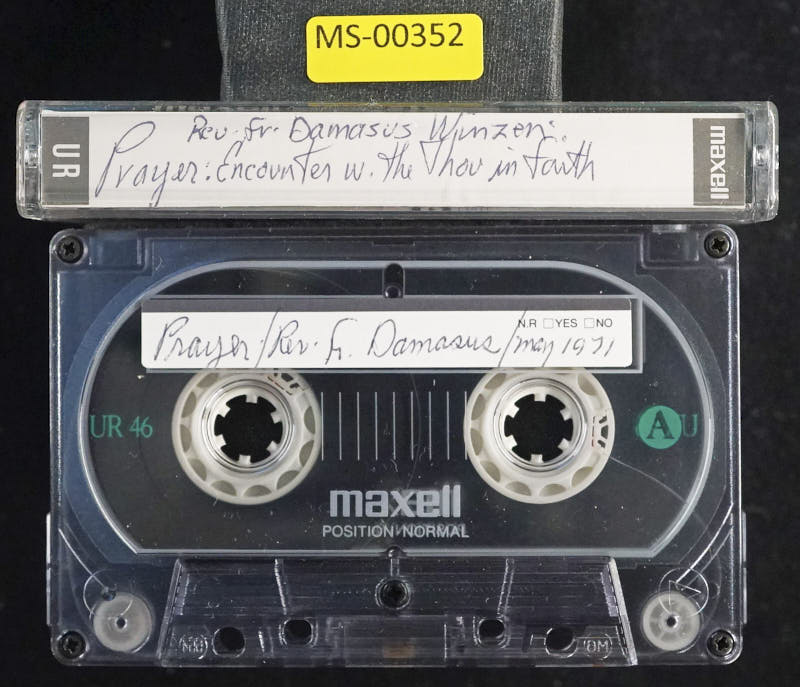

Side: A
Speaker: Rev. Fr. Damasus Winzen
Possible Title: Prayer: Encounter w. the Thou in Faith
Additional text: Prayer/Rev. F. Damasus
Side: B
Speaker: Rev. Fr. Damasus Winzen
Possible Title: Prayer: Encounter w. the Thou in Faith
Additional text: contd: 2/Thou Encounter
@AI-Vision_v003
And about prayer maybe in some way, because I think the Psalms, you know, are important for us because they are really a deep inner union, you know, with life and prayer. When you get older, you realize how the life of man is kind of suspended between heaven and earth, you know, with our feet. we stand on the ground and in our head we are up there, somewhere. And I think that's very important that one used to express that we express it too, standing and kind of holding up our hands in the form of a cross. That means that our entire life becomes prayer. One of the decisive words of the Psalter is the Hebrew Psalter is, I am prayer.
[01:06]
I am prayer. And that's the keynote I would say to the whole Psalter. I am prayer. That means my entire life in that way is, I pray my life when I pray. In some way, prayer is an act in which the entire life of man is condensed, you know, concentrated, and at the same time brought into fulfillment. Because if you get, you know, if you consider your life, it's everywhere in every direction. It goes beyond itself, you know. So strange for man. But if you take, for example, you take joy, take a day like this, and you really enter into the moment, then you realize that joy in man is something that gets beyond all limits.
[02:10]
As every moment has a depth which is without limits. For us, eternity is not something that we expect for after this life is over, you know, in another life. What is the name for that? The other life or the afterlife, that's the thing, afterlife. Not for afterlife, but it's for now, at this moment. That was, shall we say, the greatest copy of something like Saint Teresa of Lisieux, you know. Now, at this moment, to love, with all my heart, in the love that Christ at this moment has for me, which is infinite. That shows how much our life is tending and reaching out, as St.
[03:18]
Paul says, into a depth which is just unfathomable for us. That's the same, for example, in pain and sorrow. Man is at times so overwhelmed by pain and sorrow that again a kind of infinity is opening up before him. And then how can he, let us say, how can he I wouldn't say dominate this infinity, but how can he make this infinity his own? Only through prayer. And therefore one of the most important aspects of the Psalter is lamentation. Lamentation. Lamentation is something which the Anglo-Saxon world doesn't like too much.
[04:22]
But the Mediterranean world is full of it, you know, full of it. Lamentation, really cry out your heart, you know. In our well-tempered piano of life, you know, we don't go too much for these extremes of emotion. But they are there, you know, and they are really human. So in one way, we have an abundance of joy. At the same time, we have an abyss of sorrow. And in those two moments, those extreme moments, we feel we just cannot help but react and plumb the depth of the moment through prayer. plumbing the depth of the moment.
[05:26]
Now that all is very evident in the psalms. So I thought today we might just take Psalm 3. It's a psalm that I worked on a little during these days. Did you take, do you have a book there? I just read, you know, my... I read the whole thing. How many are my foes, O Lord? How many are rising up against me? How many are saying about me, there is no help for him in God? But you, Lord, are a shield about me. My glory, you lift up my head. I cry aloud to the Lord. He answers from his holy mouth. I lie down to rest and I sleep. I wake, for the Lord upholds me. I will not fear even thousands of people who are wanged on every side against me.
[06:27]
Arise, Lord, save me, my God. You who strike all my foes on the mouth. You who break the teeth of the wicked. O Lord of salvation, bless your people. Now you see right away the psalm starts with, one can say, with a lamentation. And what kind of lamentation is it? What would you say? What makes the Psalmist at this moment, and we, what makes, what ails him, so to speak? How many are my foes, O Lord. How many are rising up against me. How many are saying about me, there is no help for him in God. What is he facing at that moment? What would you say? Hmm?
[07:32]
Yes. But in which form? I mean, what is the, what is here the, what did you call, what is the, the mood or what is, what is the difficulty that he, that he meets? Huh? Public opinion. How many? Yes. So it's the many, you know, that is true. It's the many, you know. The many are the anonymous mass of people, you know. I would say what he faces here is the problem of alienation, you know. It's alienation. It's all the thing that you know from your own experience, you know. You get, for example, all you who came, you know. If you get here into a place like this, There's always this feeling of alienation, you know, see. You feel in a certain way foreign, you know, or strangers.
[08:35]
You have this, at least I feel that very much when I came to the monastery first. You know, you meet a group of people who are kind of closely knitted together in some way. You feel that you don't belong, you know, see. That you are out of it, you know. I looked at all these holy faces and I thought, oh my God, I really don't fit into this at all. And that is simply, that is a thing which comes over us so often that we are thrown back upon ourselves, that we are kind of surrounded by anonymity. Strangeness surrounds us. Alienation, we call it. And of course, we suffer from it. It's always this, in Holy Scripture, that difference between the many and the one.
[09:36]
The many and the one. The many is the anonymous crowd. And you can never rely on this many. Because there is no specific direction there. You know, the crowd is always apt to fall, to be under, for the, as victims under the spell of some agitators, you know, all this kind of element, you know, there's power involved, you know, there's uniformity involved, all these things that frighten us, you know. And now simply the opposite to what we call our home, the house, the home. We have our roots where we feel understood, you know, where we feel that we are protected, that we are living in peace, in the surrounding that is understanding
[10:52]
or sympathetic to us. The mass of people is the opposite. The mass of society is the big alienating factor in our lives today, one of the most alienating factors. The mass is either has no real form by itself, no direction, it's unpredictable in reaction, It's subject to oppression, you know, the oppressors, the agitators, and it is always somehow completely skeptical. The man in that way has no, let's say, faith in that way. It's not confronted with the one, with the divine thou. That's the reason I think in the root of all alienation. That man loses to see the eye, my deeper tail can only develop as long as I'm in contact and confronted with a vow.
[12:07]
Martin Buber has always explained that and developed this thought so beautifully, of course, on his foundation of the Jewish faith, you know, because what is faith? Now, in the sense of the Old Testament, the same in the New Testament, faith is an encounter. I meet, I, as myself, I meet the thou. What can be, what only can be is thou to us, if you think about it. Never a he, never an it. Only a thou is the real, let's say, counterpart to my deepest self. Why? Because when we say thou, we enter and we leave the it fear, you know, and we enter the fear of the person, the living good.
[13:18]
And this what makes the encounter between me, myself, And the other person, a real encounter between I and thou, is love. There's nothing there. And I would say it's always a love, and that love, which does not seek your own. That means the specifically Christian love as Christ, who is the thou, that means the man for other men, We had for other men that Christ, the essence of Christ, the Word, the Thou, the Divine Thou, that became flesh. He is our Thou. He is the mirror in which we find our own self. Why? Because we know He loves us until the end.
[14:18]
That means He accepts us as we are. He doesn't come before us and he demands, but he needs us by dying first, and that's quite a difference. Any kind of a philosopher, an ideal, let's say, Christian ethics man, you know, and so on, can come and can show his wonderful example of a composed and mature personality, you know, and in that way be a kind of an example. But it's not yet an encounter. Encounter is only then when the great man smiles at me. Then we encounter again. As long as he's just kind, you know, with a very serious and solemn face, to encounter. And if God smiles, yeah, then it begins.
[15:20]
So it's therefore the thou, becomes thou because the other one, and insofar as the other one who we meet, takes the initiative to love us. And is not waiting for us, you see, to love him. You know, if you meet other people you can always see that, you know. There are those who are kind of ensconced in their position. And they wait until you show the sign of love or something, or admiration, or mutual admiration for society. But that's not yet an encounter between I and thou. Do you understand what I mean? And therefore, as soon as the other one, wait down, you can. This little Luke, is he still here?
[16:25]
Luke Medhurst, you know, there you find you have a boy who was the victim of a terrible car accident. He was nearly killed. And mentally, you know, very much, I mean, he stirred and so on. And if you meet him, you see, if you meet him with any kind of a son, there's just a barrier there, see? There's no approach. No approach. If you approach the other one with suspicion, then the other one is not a thou. He's an it or a he. But he doesn't have this inner person contact. This is just what Christianity means, you know, that God who never have, nobody has ever seen God. but he has sent his son and Christ, the Word made flesh, is the face of God.
[17:34]
He is the face of God. And his face is not the face of the judge, you know. It's not the face that demands perfection before I can love you. That's what is wrong with all our father complexes, you know. The father wants the son to live up to his standards. For example, the case here with this, with our Luke, you know. He doesn't come up to the, live up to the expectations of the father. Now, with some fathers, he's just finished, you know, that's the end of it. And then, of course, you have, you have a real, complete, you know, alienation. And that's, of course, to a great extent, that is, let us say, the tragedy of, of of all those encounters or all these reaching out for God, you know, where God is represented as the absolute power.
[18:40]
As, who is it, Bishop Robinson also says, God out there, somewhere. And we down here. this kind of wrongly understood transcendence. Or when people think about God in philosophical terms, you know, they think absolute perfection, therefore no motion, you see, like Aristotle, you know, the immovable mover, the one who does not love me, because to love me that would be would bind him to me and God cannot be bound to anything. God is absolutely transcendent. Immovable perfection. Thinking of his own thinking. A closed circle, in other words. That's what the philosophers think. And then they make other conclusions and they say, you cannot pray to this God.
[19:48]
because he knows everything anyhow it's absolutely perfect absolute perfection to ask him for anything is nonsense because he's absolute perfect and all these things you know build up walls they simply make it impossible to encounter god they are all forms i would say of alienation and that's who did the note on which the psalm starts you know it's the The many, you see, this element of alienation, being alone. And then you see these two things. The foe or the oppressor and the savior, they are the two opposites, you know. The oppressor is the one who narrows down. The savior is the one who gives space for freedom. That's really what it means. What is salvation? Salvation, last analysis, is freedom. But the freedom that love opens up.
[20:54]
You see, selfless love is for me, if I'm the object of this selfless love, is for me space for liberty. It opens up a new dimension of life. I live on being loved in that. and I'm free as soon as I feel being loved, then I reach freedom. Then I know I'm accepted and I'm understood, and I become my true self, and that is freedom. And that is what this psalm is all about. You know, it says the, it opposes the two things. These are the oppressing, oppressive, effect of power, and on the other hand, the freedom, the broad open spaces of salvation. The other one, how many are rising up against me, that are those who follow the lead of the oppressor, see, the many, the ignorant, the masses that are the victims, you know, of the one who shouts the loudest.
[22:08]
And then is another third category, how many are saying about me, There is no help for him in God. That are the skeptics, you know, that are the things. Don't put your trust in God and so on. God is here, is Elohim, you know, in Hebrew. And the Hebrew language has these two, let us say, concepts of God. Elohim, which is a generic term, you know, means many. That means divinity. It's a generic term. Javeh is a personal term. I'll say then, yes, sir, only... ...are not this kind of prayer. They are not the fruit, let us say, of a carefully cultivated process of recognition. I would say that would not be, then, a prayer which comes, let's say, rises, you know, out of the house.
[23:11]
But the The central thing in prayer is that it is a word, address, if you want to call it that way, I think that's why. Prayer is an address to God, but to God under and in His right name. Prayer is a potentially are addressing ourselves as I to thee thou. Absolutely big to understand, right? Under the right name, which is, for example, in the time, during the Old Testament, it's the name of John. You know, they're saying when they saw Christ on the cross, he says he is a He is a physician or let him get away from, let him come down from the cross.
[24:13]
He says he is the son of God. All right. Now we shall see if God saves him. Of course, he won't save him. He will die on the cross. There is no help for him in God. You see, that's the, the inner negative aspect, you know, the, the, the hatred, which is always hidden in any. But then. The psalmist reacts, you know, and that's our reaction. They say there is no help for him in God. And how does the psalmist come around? But you, Yahweh, Lord, are a shield about me, my glory, who lift up my head. I cry aloud to the Lord. He answers from his holy mountain. You see, there is the... the reaction against the alienation. First there is this element of distance, and then against this distance rises just the opposite.
[25:19]
But you, Lord, ve atah Yahweh in Hebrew. But you, O Lord, you are a completely different world. The thou, my thou, the divine thou is a shield about me, see? Not only a shield on one side or the other side, but it's a shield that completely surrounds me, you know, completely surrounds me on every side. That shield, therefore, is not an instrument of war, but it is the house, you know, the home that love builds for me, see? That is the shield about me. But more than that, you know, this law, this Javeh, is not only a protection, a shield, but it is my glory who lift up my head. You see, there, love, you know, this, the divine thou, shows its real deep inner character.
[26:30]
It is glory. Glory is in itself, when we speak about glory, what do we think, what kind of idea do we have? Splendor, you know, or pomp, or circumstance, you know. That means we are tempted always, again, to identify in our own alienated minds, glory with power. But of course, here, glory is not identified with power. But glory is identified with the heart. You are my glory. Why? Only one can say that if somebody loves. Only on the common ground of being loved and of responding in love does the other one become my glory. In the last analysis. Therefore, when Christ died for his father and for us, Then he glorified the Father.
[27:36]
And the Father becomes our glory in and through Christ's dying for us. Who lift up my head. Therefore, this true coming to yourself, take courage, you know, fear not. Keeping down your head, that is the expression of of your being a slave, of your being alienated. Lift up your head, that's a sign of confidence. You have confidence in yourself, that's why you lift up your head. What gives you this confidence? God's love for you. So I cry aloud to the Lord. You see, I cry aloud. That means not in any way restrained, you know. Not in any way cowed. But I cry aloud means in absolute confidence.
[28:38]
Allowed to the Lord. That is also the meaning why at the cross when our Lord is described, you know, as dying, and he says he cried aloud. So his last, the last act that Christ performed on the cross is crying aloud. What does that mean? It's the expression that in this moment of his death, he has absolute complete liberty and confidence before and in his father. He answers from his holy mount. This crying aloud, that means this, what we call parisia, you know, this prayer in absolute confidence. That is answered by God. See, that is one of our problems today, and also in the church as an institution, may the Holy Spirit give us to know that that may change.
[29:42]
But so often, you know, when the inferior turns to the superior, he doesn't receive any answer in many cases. And nothing is as alienating, you see, than to turn to somebody and not to receive an answer. That's alienation. So he answers me from his holy mountain. What does that mean? From Zion. What is Zion? Zion is the place where God is present. And the Old Testament describes us how? With his ears, eager to listen. With his eyes, eager to be present, to see. and with his heart eager to love. That is the essence of the holy mountain of Zion. It's the presence of God's love for us. So I lie down to rest and I sleep.
[30:48]
I wake for the Lord upholds me. See, that's the, that is the, that's the, one can say the heart of the whole song. I lie down to rest and I sleep, I wake for the Lord upholds me. To lie down and to rest and to sleep, that is confidence in God's love for me. Faith, our faith in God's love is our rest. If you read the epistle to the Hebrews, you know, the first, second, third chapter, you see it there. What is the essence of rest? To believe in God's love for me. That gives me rest. Then I can afford to stop running. I can stop running. I don't have to buy God's love, you know. It's very important. Most people, most Christians think they have to buy somehow the love of God.
[31:54]
That's not true. We get it. The water, you know, of the well without... without paying for it, as it says in Isaiah. And that is so deep. And that allows me to rest and to sleep in confidence. That is the meaning of the Sabbath, you know, for the Jewish people too. The Sabbath day is the day in which the Jewish people realize they're being loved, they're being, they're resting without, you know, the necessity of working. They are resting in the gifts that God prepares for them. And then this kind of rest, this kind of sleeping, that then ends in waking up. And during this time, this kind of sleep, my powers, my inner powers, my life,
[32:57]
is being restored to me." It's not the word of the Psalms, you know, God gives it to those whom he loves in their sleep. That is maybe sometimes a little opposed to our temperament again, you know, see, we're always active. The sweet do nothing of the Italians, the dolce faniente, Any, any, you know, any German smiles at it, you know, no, that's, that's typical, you see. That's the Italians, you know. We work, you know, we work, you know. Therefore, as soon as we come into Italy and we see a station there, what, this is a station, how dirty it is. People don't work here. They didn't mean, they don't wash and they don't scrub, you know, like in Holland, you know, every stone is scrubbed and fine and nice. Now we leave it to them, as long as they don't overweight it. But that's always the thing, see, that anybody who works immediately overweights himself.
[34:04]
As soon as Martha sees Mary resting at the feet of the Lord, you know, entering into the Sabbath and doing nothing but listening to him and rejoicing in his love, then Martha gets all upset and says, Please, dear Lord, I am working myself to death here, see, that we have our meal on time. Why can't you tell Mary just to come a little and help me? That's our way. But I awake for the Lord upholds me. That means in my sleep, my strength is restored. Why? Not by thinking, oh my God, It's wonderful how many things have I done for God. But by realizing that while I was asleep, God did things for me, you know. And that's the way love does it, you know. Do you understand what I mean?
[35:05]
And then become, you see, this here is the key thing, because that you can right away see that this here immediately brings to mind Now, what does it bring to mind? I lie down to rest and I sleep, I wake for the Lord upholds me. You know, in this new breviary that I have here in its, let us say, trial form, this psalm here is introduced by a word by Saint Irenaeus. Jesus slept and woke from the sleep of death, for the Lord, Javier, his father, upheld him. So you see, it's an allusion. We can say that here we are, and for example, if you take the psalm as the psalm in which you pray your life, the essence of our life is dying and rising.
[36:16]
That's really the essence of life. We are dying and rising, sleeping and waking up. And that is here, that's expressed. You see, the essence of our own life, our own daily dying and rising, our falling asleep and our waking up again, that is taken into here, into Christ's sleep and resurrection on the cross. He's sleeping and he's waking up. I walk for the Lord upholds. And out of this, you know, of this inner being, let us say, knit to Christ, you know, at the very heart of my whole existence, because what is existence? Existence means constantly waking up. That is ex-sister. That means I get out of nothingness and I realize it, that I am beyond nothing.
[37:17]
It's existence. But I realized it by waking up in the morning. That's the reason why St. Benedict chose this arm for the people to open visits. You get up at four o'clock, you feel not in the best of moods always, you know, but then you take this, your own, let us say, half asleep and half awake, You take it into Christ, you know, and then you realize, this is my participation this morning in Christ dying and rising. So I wake for the Lord upholds me. I will not fear even thousands of people who are arranged on every side against me. These thousands of people in the Hebrew are again the many, you know. I will not fear even thousands of people who are ranged on every side against me. That means the many, the multitude, with all their hostility, you see, their enmity.
[38:23]
I will not fear even thousands of people. That means I've entered into the very core of my own life, and I feel and I realize, you know, that death is overcome, you see. The last victory has become mine. Death is overcome. I rise into the fullness of life in the warmth and life-giving power of God's love for me.
[38:55]
@Transcribed_UNK
@Text_v005
@Score_93.26